
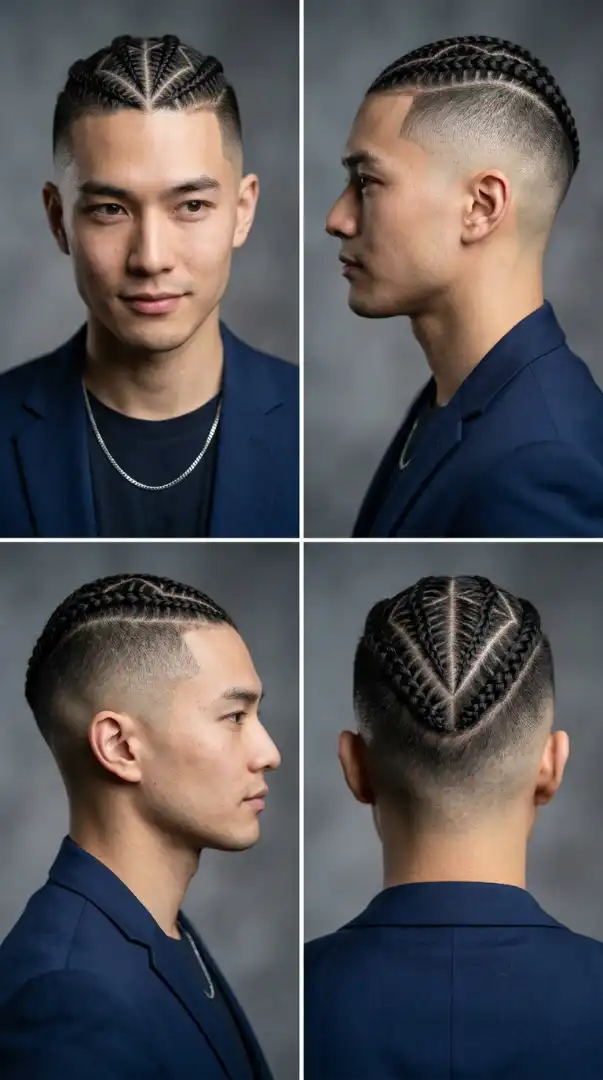
13 Stitch Braid Men’s High Fade Styles That Redefine Sharp Grooming
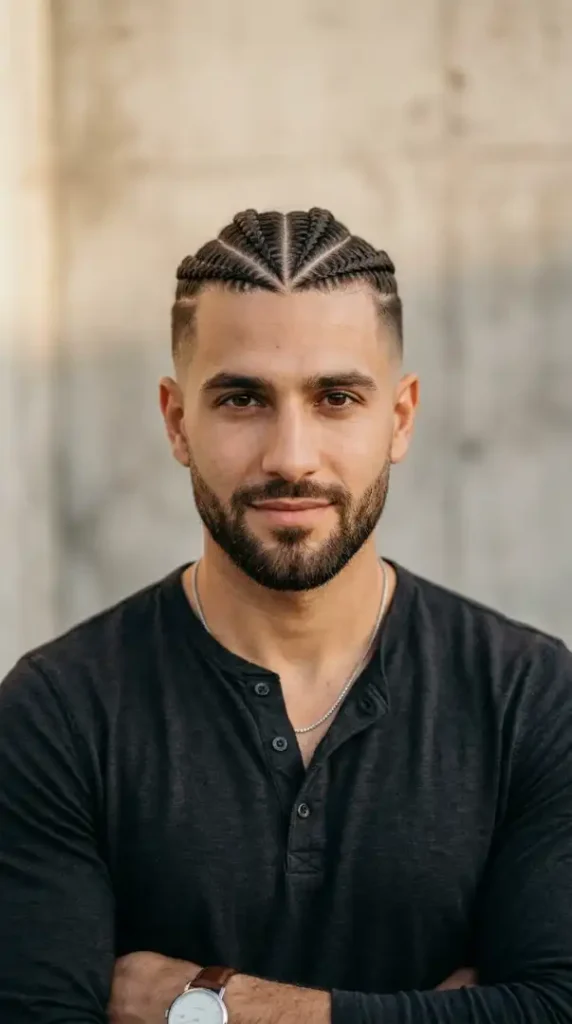
1 of 13 — The Crown Weave Fade
Face Shape Match
The Crown Weave Fade is engineered for square and oval face shapes. The curved braid rows that converge at the crown create a rounded visual anchor point directly above the forehead, which softens the strong angular jawline that defines a square face without hiding it entirely. The skin-taper sides strip away bulk at the temples, so the eye travels straight up through the woven crown rather than out across the jawline — this optically narrows a square face just enough to balance sharp bone structure with a softer silhouette on top.
Oval faces benefit because the style adds textural height without disrupting already-balanced proportions, while round faces should approach with caution: the rounded crown pattern can emphasize width rather than counter it, so a round-faced client is usually better served by a style with sharper, straighter part lines instead.
Grooming Kit
Clippers: Wahl Magic Clip (Model 5049-400) for the fade blend, or Andis Master (Model 01557) for heavier fade work. Trimmer/Outliner: Andis T-Outliner (Model 04710) for edge work, hairline cleanup, and lineup precision around the braid partings. Finishing Tools: Kent 81T fine-tooth comb for separating and defining individual braid rows, plus a Denman boar bristle brush for smoothing flyaways along the fade. Styling Product: A light-hold braid gel such as Eco Style Gel (Olive Oil formula) applied in a dime-sized amount at the root of each row to keep the weave crisp without stiffness. Maintenance: Honest Amish Beard Oil for conditioning facial hair so the beard-to-fade connection stays soft and well-groomed between barber visits.
Maintenance Level
Rating: Medium.
Barber visit frequency: every 10-14 days for a fade touch-up, since skin fades grow out visibly faster than the braid pattern itself. The stitch braids themselves can hold for 3-4 weeks before they need to be redone.
Daily styling time: 3-5 minutes each morning, mostly spent smoothing the fade edges and applying a light shine spray to the braids — the crown itself needs no restyling once installed.
Product routine: two steps — a light-hold gel on new growth at the hairline, and a beard oil application to keep the fade-to-beard transition looking intentional.
Growth pattern: the fade softens first around the temples at the two-week mark, while the braids themselves loosen gradually and start showing frizz at the roots by week three, signaling it’s time for a redo.
Monthly cost estimate: roughly 60-90 dollars combining two fade touch-ups and one full braid redo, depending on region and barber pricing.
Difficulty rating: Intermediate for home upkeep — the fade blending is barber-territory, but daily maintenance is beginner-friendly.
Barber Talk
Say this to your barber:
“I want a Crown Weave Fade with a high skin fade starting right at the temple line. Keep the stitch braids running in curved rows that converge toward the crown — don’t cut into the existing braid pattern, just clean up the perimeter. Blend the fade from skin at the hairline up to a guard #2 blending zone at the parietal ridge. Taper my beard into the fade at the jawline, keeping the beard length around 5mm. Finish with a crisp lineup at the temples and a clean edge around the ears.”
If this crown-focused weave feels like a bigger commitment than you’re ready for, the next style trades the sculpted top for a razor-sharp geometric pattern that takes styling almost completely out of your morning routine.
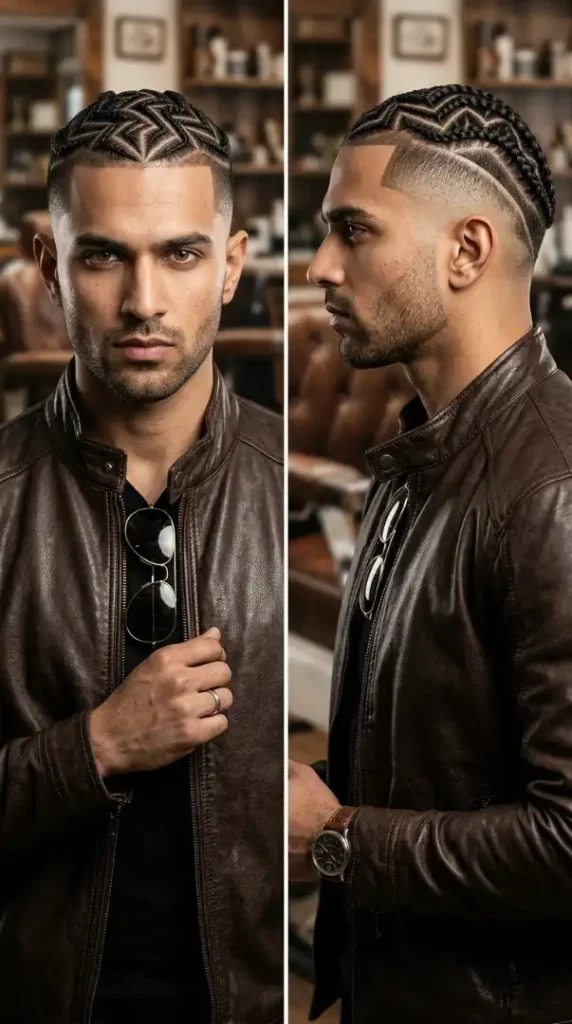
2 of 13 — The Geometric Edge King
Face Shape Match
The Geometric Edge King is purpose-built for oval and diamond face shapes because the sharp diagonal zigzag partings introduce strong angular lines that echo and enhance naturally balanced or angular bone structure without overwhelming it. On an oval face, the geometric pattern adds visual interest at the crown while the skin-bald sides keep the silhouette clean, preserving the face’s natural symmetry.
Round faces can also wear this well if the zigzag lines are angled steeply rather than horizontally, since steep diagonals create an illusion of length. Faces with a heavier jawline — square or heart-shaped — should be cautious here: the hard geometric lines can compete with an already-strong jaw, creating visual clutter instead of contrast, so a softer curved-line style is usually the better recommendation for those shapes.
Grooming Kit
Clippers: Andis Master (Model 01557) for the skin-bald fade sections, paired with a Wahl Magic Clip (Model 5049-400) for blending transitions. Trimmer/Outliner: Andis T-Outliner (Model 04710) is essential here — the geometric zigzag lines are cut freehand with this tool and require a steady, experienced barber. Finishing Tools: A rat-tail comb for sectioning the diagonal parts precisely, plus a Denman boar bristle brush to smooth the fade transition. Styling Product: American Crew Fiber (matte finish, high hold) applied in a pea-sized amount only if the top length needs light texturizing; the geometric sides need no product. Maintenance: Viking Revolution Beard Oil to keep the light stubble looking sharp and intentional against the crisp fade lines.
Maintenance Level
Rating: High.
Barber visit frequency: every 7-10 days. The geometric lines and skin-bald fade grow out fast and lose definition quickly since precision is the entire point of this cut.
Daily styling time: 5-7 minutes, mostly spent on beard grooming since the geometric top requires almost no product once freshly cut.
Product routine: one step — light matte product only if there’s length on top to texturize; the sides need nothing.
Growth pattern: the geometric lines start blurring within 5-6 days as new growth softens the sharp edges, and by day 10 the pattern looks noticeably less crisp.
Monthly cost estimate: roughly 100-140 dollars given the frequent touch-up schedule this style demands.
Difficulty rating: Advanced — this is not a home-maintenance cut; the geometric linework should always be left to a skilled barber.
Barber Talk
Say this to your barber:
“I want a Geometric Edge King with a skin-bald fade starting above the ear. Cut sharp diagonal zigzag partings freehand across the crown using the outliner, spaced evenly, connecting cleanly into the bald fade with no visible transition line. Keep any length on top under an inch for texture only. Taper my stubble close to the jawline using a guard #1. Finish with a razor-sharp perimeter lineup and clean ear outline on both sides.”
If keeping up with this level of precision every week sounds like a lot, the next style delivers a similarly bold look with a maintenance schedule that stretches out to nearly three weeks between visits.
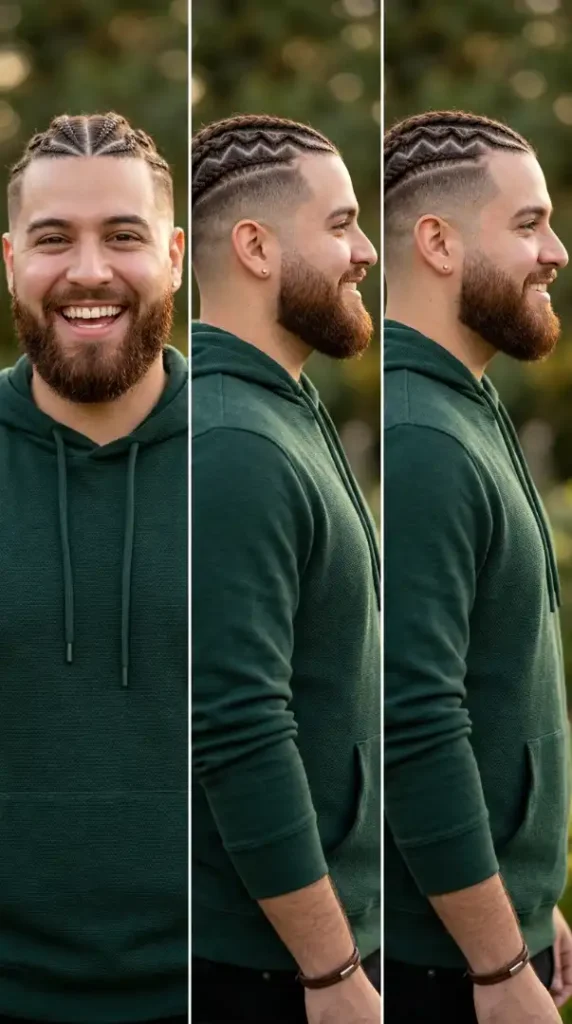
3 of 13 — The Zigzag Sovereign
Face Shape Match
The Zigzag Sovereign is best matched to round and triangle face shapes. The alternating diagonal zigzag rows break up horizontal width visually, which is exactly what a round face needs — the eye follows the zigzag pattern in a way that reads as length and structure rather than roundness. Combined with the mid skin fade at the sides, the style removes bulk precisely where a round face carries the most visual weight, around the ears and jaw.
Square and diamond faces can also carry this cut well since the zigzag pattern doesn’t compete with strong bone structure the way a fully geometric or overly rounded style might. Oblong faces should be cautious, though — the vertical energy of the zigzag rows can add unwanted length to an already long face, so a flatter, wider braid pattern is usually a better direction for that shape.
Grooming Kit
Clippers: Wahl Magic Clip (Model 5049-400) for the mid fade blend on both sides. Trimmer/Outliner: Andis T-Outliner (Model 04710) for cleaning the zigzag partings and sharpening the hairline. Finishing Tools: Kent 81T fine-tooth comb for separating the diagonal rows, Denman boar bristle brush for the beard. Styling Product: Layrite Original Pomade (medium hold), dime-sized amount, applied to smooth flyaways along the braid rows without weighing them down. Maintenance: Honest Amish Beard Oil applied daily to keep the full beard soft and shaped at the fade connection point.
Maintenance Level
Rating: Medium.
Barber visit frequency: every 2 weeks for a fade touch-up; the zigzag braids themselves can last 3-4 weeks before re-installation is needed.
Daily styling time: 5 minutes, mostly beard grooming and a light pomade pass over the braid rows.
Product routine: two steps — pomade on the braids, oil on the beard.
Growth pattern: the fade starts softening around day 12-14, while the zigzag rows loosen gradually at the roots by week three.
Monthly cost estimate: roughly 70-100 dollars for two fade touch-ups plus periodic braid maintenance.
Difficulty rating: Intermediate for home upkeep between barber visits.
Barber Talk
Say this to your barber:
“I want a Zigzag Sovereign with a mid skin fade starting at the top of the ear. Keep the zigzag stitch braid rows running in alternating diagonal patterns across the top — clean up the perimeter without disturbing the existing rows. Blend the fade from skin at the starting point up to a guard #2 at the parietal ridge. Taper my beard into the fade at the jawline, keeping it fuller at about 8mm. Finish with a crisp lineup and clean edge work around both ears.”
If this playful, textured pattern isn’t quite your speed, the next style trades the diagonal energy for a bold diamond-shaped design that makes an even stronger statement.
4 of 13 — The Diamond Cornrow Fade
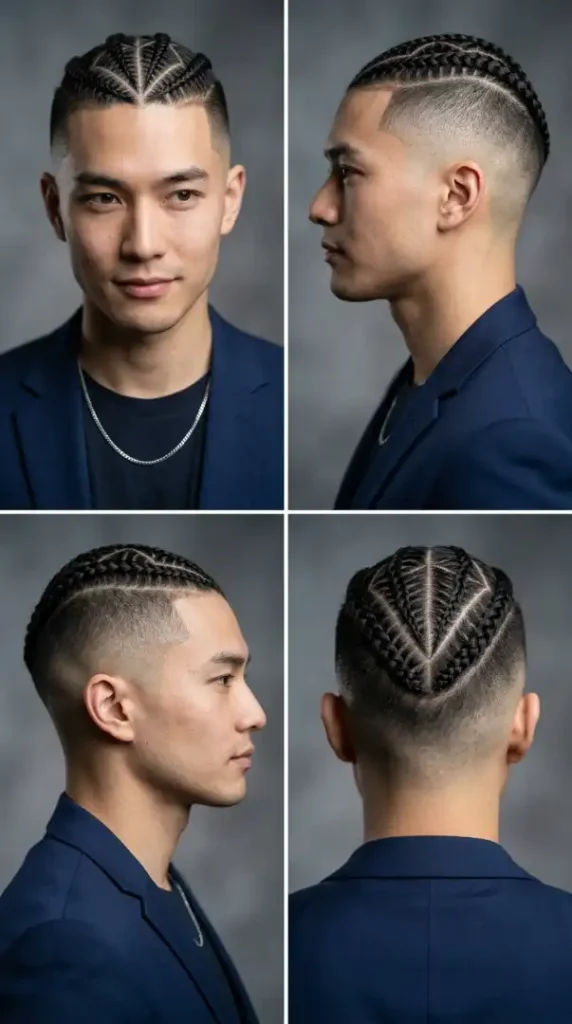
Face Shape Match
The Diamond Cornrow Fade is a natural fit for diamond and oval face shapes because the centered diamond braid geometry visually echoes and celebrates diamond bone structure rather than competing with it. The high skin fade on the sides removes width at the cheekbones — already the widest point on a diamond face — while the diamond pattern at the crown draws the eye upward and centers it, balancing a narrow chin and forehead.
Oval faces wear this equally well since the geometric focal point adds intentional structure without disrupting natural symmetry. Round and heart-shaped faces should be more careful: the sharp diamond point can visually shorten a round face further, and heart-shaped faces with a wider forehead may find the centered pattern draws too much attention upward, so a side-weighted design is typically the better recommendation there.
Grooming Kit
Clippers: Andis Master (Model 01557) for the high skin fade, Wahl Magic Clip (Model 5049-400) for blend refinement. Trimmer/Outliner: Andis T-Outliner (Model 04710), essential for the precise diamond geometry lines and nape taper. Finishing Tools: Rat-tail comb for sectioning the diamond pattern, Denman boar bristle brush for smoothing the fade. Styling Product: American Crew Fiber (matte finish, high hold), pea-sized amount, used only for touching up braid edges. Maintenance: Kent 81T fine-tooth comb kept on hand for daily part maintenance between salon visits.
Maintenance Level
Rating: Medium-High.
Barber visit frequency: every 10-12 days for the fade touch-up; the diamond cornrow pattern itself holds for roughly 3 weeks.
Daily styling time: 5 minutes, mostly checking and smoothing the fade edges since the braided top requires no restyling.
Product routine: one step — light matte product to touch up any loose edges at the diamond’s perimeter.
Growth pattern: the high fade shows regrowth fastest at the temples around day 10, while the diamond cornrow pattern loosens gradually at the crown by week three.
Monthly cost estimate: roughly 90-120 dollars for fade touch-ups plus periodic cornrow maintenance.
Difficulty rating: Intermediate for daily upkeep; the diamond geometry install itself requires an experienced barber or braider.
Barber Talk
Say this to your barber:
“I want a Diamond Cornrow Fade with a high skin fade starting at the temple line. Keep the cornrows braided into a centered diamond shape at the crown — clean the perimeter without disturbing the pattern. Blend the fade from skin up to a guard #2 at the parietal ridge. I’m clean-shaven, so keep the jawline crisp and freshly edged. For the back, taper the nape square with a sharp neck hairline. Finish with a precise lineup at the temples and hairline.”
If this centered geometric statement is bolder than what you’re after, the next style takes a more subtle route with a clean architectural line pattern that reads sophisticated rather than dramatic.
5 of 13 — The Arrow Line Executive

Face Shape Match
The Arrow Line Executive is designed specifically for oblong and rectangular face shapes. The forward-pointing arrow braids draw the eye horizontally toward the front hairline rather than emphasizing vertical length, which is exactly the correction an oblong face needs — the style visually shortens the face by interrupting the long vertical lines that oblong faces already have. The low skin fade keeps the sides tight without adding extra height, avoiding the common mistake of pairing a long face with an equally tall haircut.
Square and heart-shaped faces can also wear this well, since the horizontal arrow direction complements strong jaw structure instead of fighting it. Round faces should avoid this style, though — the low fade combined with a forward-pointing pattern can make a round face look wider rather than more defined, so a higher fade with vertical emphasis is the better direction there.
Grooming Kit
Clippers: Wahl Magic Clip (Model 5049-400) for the low fade blend. Trimmer/Outliner: Andis T-Outliner (Model 04710) for the precise arrow-point lineup at the front hairline. Finishing Tools: Kent 81T fine-tooth comb for defining the arrow braid rows, Denman boar bristle brush for the beard lineup. Styling Product: Layrite Original Pomade (medium hold), dime-sized amount, for smoothing the braid surface. Maintenance: Viking Revolution Beard Oil applied daily for the sharply lined beard.
Maintenance Level
Rating: Medium.
Barber visit frequency: every 2-3 weeks for fade touch-ups; the arrow braid pattern holds for 3-4 weeks.
Daily styling time: 4-6 minutes, primarily beard lineup maintenance and a light pomade smoothing pass.
Product routine: two steps — pomade on the braids, beard oil on the facial hair.
Growth pattern: the low fade holds its shape longer than higher fades since there’s less contrast to maintain, staying sharp for close to 3 weeks before it needs a refresh.
Monthly cost estimate: roughly 60-90 dollars given the lower-fade cut’s more forgiving growth cycle.
Difficulty rating: Beginner-to-Intermediate for home upkeep.
Barber Talk
Say this to your barber:
“I want an Arrow Line Executive with a low skin fade starting just above the ear. Keep the stitch braids arranged in an arrow pattern pointing forward toward the hairline, converging into a clean V at the front. Blend the fade from skin up to a guard #3 at the parietal ridge for a subtler transition. Line up my beard sharply along the jaw and cheek line, keeping the length short at 3-4mm. Finish with a precise front hairline point and clean edge work.”
If this low-key, professional silhouette feels underwhelming for your taste, the next style dials up the volume with a bold twist pattern built for maximum street presence.
6 of 13 — The Twist Crown Blackout
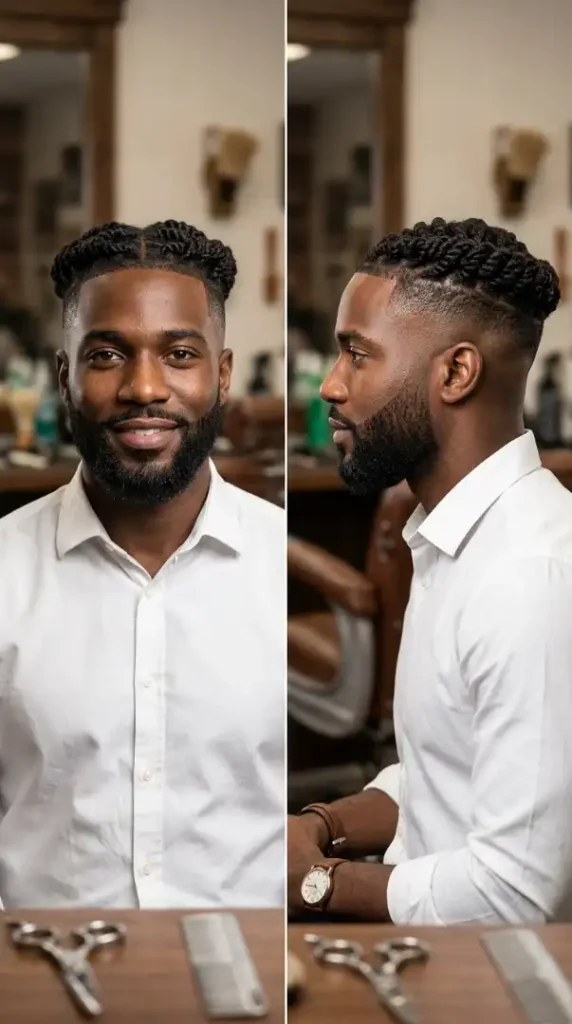
Face Shape Match
The Twist Crown Blackout works exceptionally well on heart and round face shapes. The rounded twist crown adds volume and visual weight at the top of the head, which balances a heart-shaped face’s typically wider forehead and narrower chin by drawing proportion downward through the fuller beard. The sharp skin fade at the sides keeps the silhouette clean so the twists don’t add unwanted width at the temples.
Oval and square faces also carry this style comfortably since the twist volume adds texture without disrupting already-balanced proportions. Oblong faces should approach carefully — the height added by the twist crown can elongate an already long face further, so a flatter twist pattern with less crown height is usually the smarter call for that shape.
Grooming Kit
Clippers: Andis Master (Model 01557) for the sharp skin fade, Wahl Magic Clip (Model 5049-400) for blend detailing. Trimmer/Outliner: Andis T-Outliner (Model 04710) for the fade lineup and beard edging. Finishing Tools: Denman boar bristle brush for smoothing twist edges, wide-tooth comb for detangling before twisting. Styling Product: Eco Style Gel (Olive Oil formula), dime-sized amount, applied at the base of each twist to lock definition, plus a curl-defining cream for shine. Maintenance: Honest Amish Beard Oil for daily beard conditioning at the fade connection point.
Maintenance Level
Rating: Medium.
Barber visit frequency: every 2 weeks for the fade touch-up; the twists themselves can be re-twisted or maintained for up to 4 weeks before needing a fresh set.
Daily styling time: 5-7 minutes, mostly a light gel refresh on any loose twist ends plus beard grooming.
Product routine: two steps — gel refresh on twists, oil on the beard.
Growth pattern: new growth appears first at the twist roots around day 10-12, creating a slightly fuzzy look before the fade itself needs attention closer to week two.
Monthly cost estimate: roughly 70-100 dollars for fade touch-ups and periodic twist maintenance.
Difficulty rating: Intermediate — twist upkeep between visits is manageable at home with the right products.
Barber Talk
Say this to your barber:
“I want a Twist Crown Blackout with a sharp skin fade starting above the ear. Keep the two-strand twists gathered into a rounded crown shape at the top — clean the perimeter without unraveling the existing twists. Blend the fade from skin up to a guard #2 at the parietal ridge. Taper my beard into the fade at the jawline, keeping it full at around 10mm. Finish with a crisp lineup and clean edge work around the ears and neckline.”
If this rounded, voluminous crown isn’t quite the direction you’re after, the next style channels the same street-ready energy into a sharper chevron pattern instead.
7 of 13 — The Chevron Street King
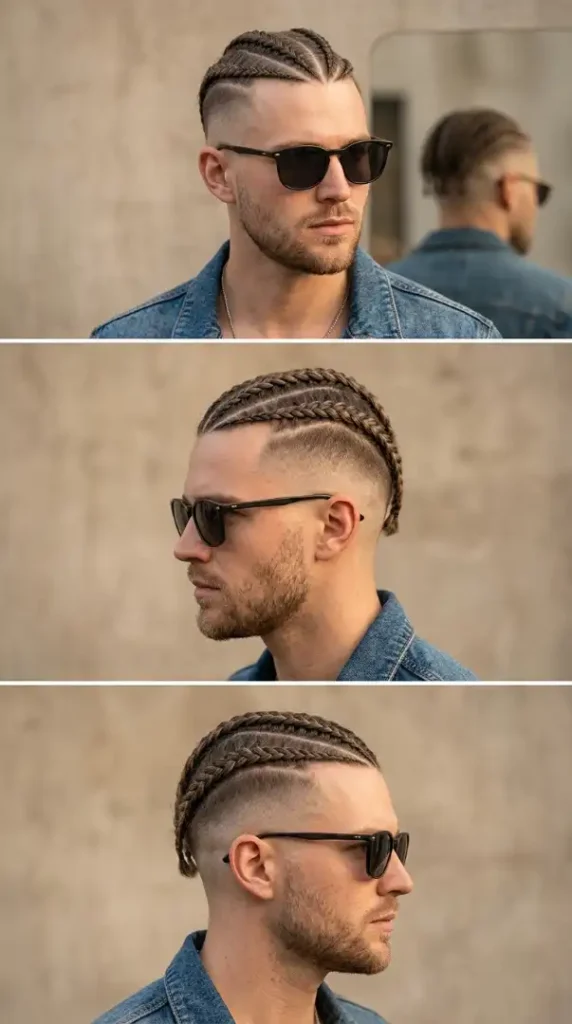
Face Shape Match
The Chevron Street King is best suited to square and diamond face shapes. The inward-angling chevron lines create a converging visual point at the crown that draws attention upward and centers the face, softening the hard angles of a square jaw by introducing a gentler focal shape at the top. The high skin fade removes width at the temples so the chevron pattern reads as the star of the look rather than fighting with jaw width.
Oval faces also handle this well thanks to the added textural interest without disrupting balance. Round faces should be cautious — the inward-converging lines can visually compress a round face even more, making it appear wider, so a style with outward or vertical lines is generally the better recommendation there.
Grooming Kit
Clippers: Andis Master (Model 01557) for the high skin fade, Wahl Magic Clip (Model 5049-400) for refinement. Trimmer/Outliner: Andis T-Outliner (Model 04710) for the precise chevron angle lines and hairline. Finishing Tools: Rat-tail comb for sectioning the chevron rows, Denman boar bristle brush for the beard. Styling Product: Layrite Original Pomade (medium hold), dime-sized amount, for braid surface smoothing. Maintenance: Viking Revolution Beard Oil applied daily for the stubble.
Maintenance Level
Rating: Medium-High.
Barber visit frequency: every 10-14 days for the fade touch-up; the chevron braid rows hold for about 3 weeks.
Daily styling time: 4-6 minutes, mostly beard grooming and a quick check on the braid edges.
Product routine: two steps — light pomade on braids, oil on stubble.
Growth pattern: the high fade shows regrowth around day 10-12 at the temples; the chevron rows loosen gradually by week three.
Monthly cost estimate: roughly 85-115 dollars for fade touch-ups plus periodic braid maintenance.
Difficulty rating: Intermediate for home upkeep.
Barber Talk
Say this to your barber:
“I want a Chevron Street King with a high skin fade starting at the temple line. Keep the stitch braids arranged in a chevron pattern angling inward toward a central point at the crown — clean up the perimeter without disturbing the pattern. Blend the fade from skin up to a guard #2 at the parietal ridge. Keep my stubble tight at a guard #1, taper it cleanly into the fade at the jawline. Finish with a sharp lineup at the temples and hairline.”
If this street-sharp geometric look feels like too bold a statement for your setting, the next style takes a more playful, high-energy route with a lightning-bolt pattern designed for maximum standout appeal.
8 of 13 — The Lightning Bolt Prodigy
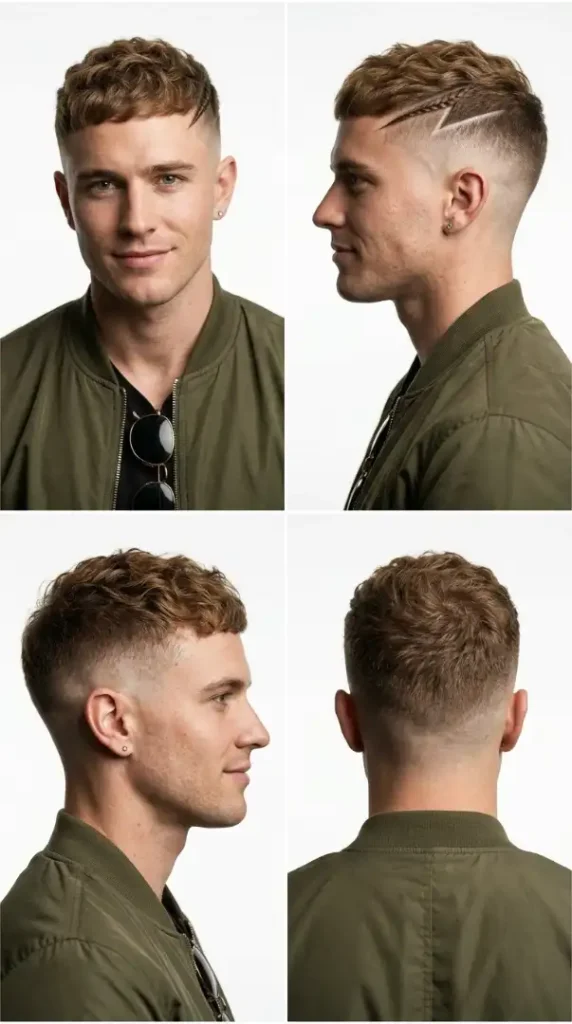
Face Shape Match
The Lightning Bolt Prodigy suits oval and round face shapes particularly well. The single diagonal bolt line creates a bold asymmetrical focal point that adds visual interest without needing width or height, making it a safe, flattering choice across most proportions. On a round face, the sharp diagonal angle introduces the straight lines a round face typically lacks, creating the illusion of more defined structure.
Oval faces benefit from the low-commitment, single-line design that adds detail without altering natural balance. Heart and diamond faces should be more selective — the singular bold line can pull focus toward one side unevenly on faces that already have strong asymmetrical features like a narrow chin, so a more symmetrical, centered pattern is often a safer recommendation there.
Grooming Kit
Clippers: Andis Master (Model 01557) for the skin-bald fade. Trimmer/Outliner: Andis T-Outliner (Model 04710), essential for the single sharp bolt line — precision is everything with this minimalist design. Finishing Tools: Denman boar bristle brush for smoothing the short crop, fine-tooth comb for line touch-ups. Styling Product: American Crew Fiber (matte finish, high hold), pea-sized amount, for light texture on the crop. Maintenance: No beard maintenance needed given the clean-shaven look; a light facial moisturizer is recommended to keep skin healthy against frequent razor use.
Maintenance Level
Rating: High.
Barber visit frequency: every 7-10 days. The single bolt line and skin-bald fade both require frequent precision touch-ups to stay sharp.
Daily styling time: 3-4 minutes, minimal since the crop length is short and low-maintenance.
Product routine: one step — light matte product for texture only.
Growth pattern: the bolt line starts blurring within 6-7 days as new growth fills in around the shaved line.
Monthly cost estimate: roughly 100-130 dollars given the frequent upkeep schedule.
Difficulty rating: Advanced — the single-line design leaves no room for error and should always be maintained by a skilled barber.
Barber Talk
Say this to your barber:
“I want a Lightning Bolt Prodigy with a skin-bald fade starting above the ear. Cut a single sharp diagonal bolt line freehand through the crop using the outliner, connecting cleanly into the bald fade with no visible break in the line. Keep the top length short at a guard #1 for a clean crop texture. I’m clean-shaven, so keep the jaw and cheek line freshly edged. For the back, taper the nape rounded with a clean neck hairline. Finish with a sharp perimeter lineup.”
If this minimalist, high-impact single line is more boldness than you’re after day to day, the next style softens the intensity with a curved, architectural pattern built for long-term wearability.
9 of 13 — The Tribal Line Architect
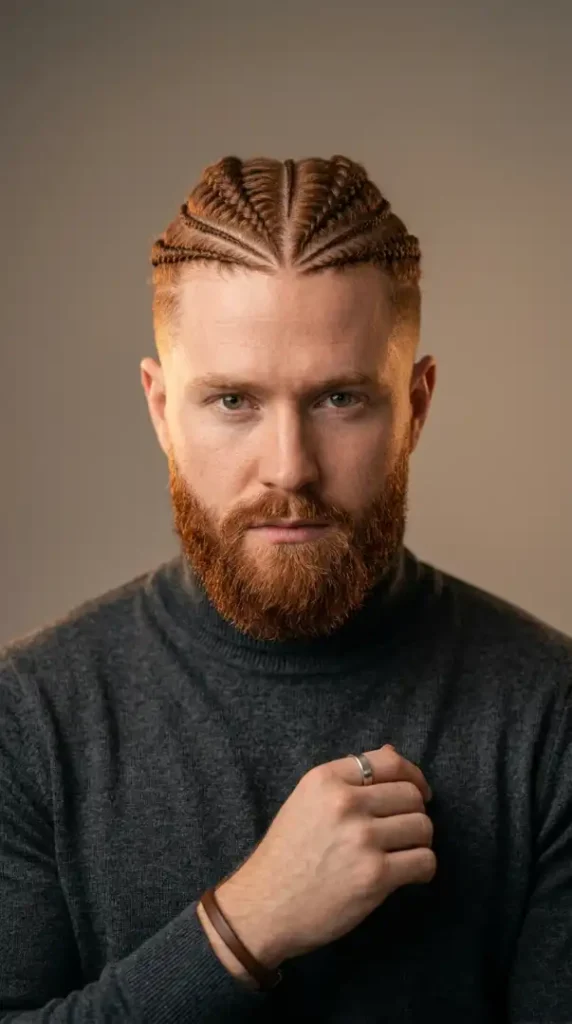
Face Shape Match
The Tribal Line Architect is tailored for round and oval face shapes. The radiating curved lines emanating from a central crown point create a starburst effect that adds structured dimension to a round face, breaking up its natural softness with defined linework while the mid skin fade trims width at the sides. The radial symmetry also gives the illusion of more angular structure without requiring an aggressively geometric pattern.
Oval faces wear this comfortably too, since the radial pattern adds texture without disrupting balance. Square and diamond faces should think twice — the soft radiating curves can compete with an already-strong angular jawline, muddying rather than complementing the face’s natural structure, so a straighter-lined style is usually the better match there.
Grooming Kit
Clippers: Wahl Magic Clip (Model 5049-400) for the mid fade blend. Trimmer/Outliner: Andis T-Outliner (Model 04710) for the radiating curved-line precision work. Finishing Tools: Rat-tail comb for sectioning the radial pattern, Denman boar bristle brush for the beard. Styling Product: Layrite Original Pomade (medium hold), dime-sized amount, for braid surface control. Maintenance: Honest Amish Beard Oil applied daily for the full beard.
Maintenance Level
Rating: Medium.
Barber visit frequency: every 2 weeks for the fade touch-up; the radial braid pattern holds for 3-4 weeks.
Daily styling time: 5 minutes, mostly beard grooming and light braid smoothing.
Product routine: two steps — pomade on braids, oil on beard.
Growth pattern: the fade softens starting around day 12-14; the radial pattern loosens gradually at the center point by week three.
Monthly cost estimate: roughly 70-100 dollars for fade touch-ups and periodic braid maintenance.
Difficulty rating: Intermediate for home upkeep.
Barber Talk
Say this to your barber:
“I want a Tribal Line Architect with a mid skin fade starting at the top of the ear. Keep the stitch braids arranged in a symmetrical radial pattern from a central crown point — clean up the perimeter without disturbing the radiating lines. Blend the fade from skin up to a guard #2 at the parietal ridge. Taper my beard into the fade at the jawline, keeping it full at around 8-10mm. Finish with a crisp lineup and clean edge work around both ears.”
If this architectural symmetry is more structure than you want to maintain, the next style curves things down into a softer, more wearable crown line that ages gracefully day to day.
10 of 13 — The Curved Crown Sculptor
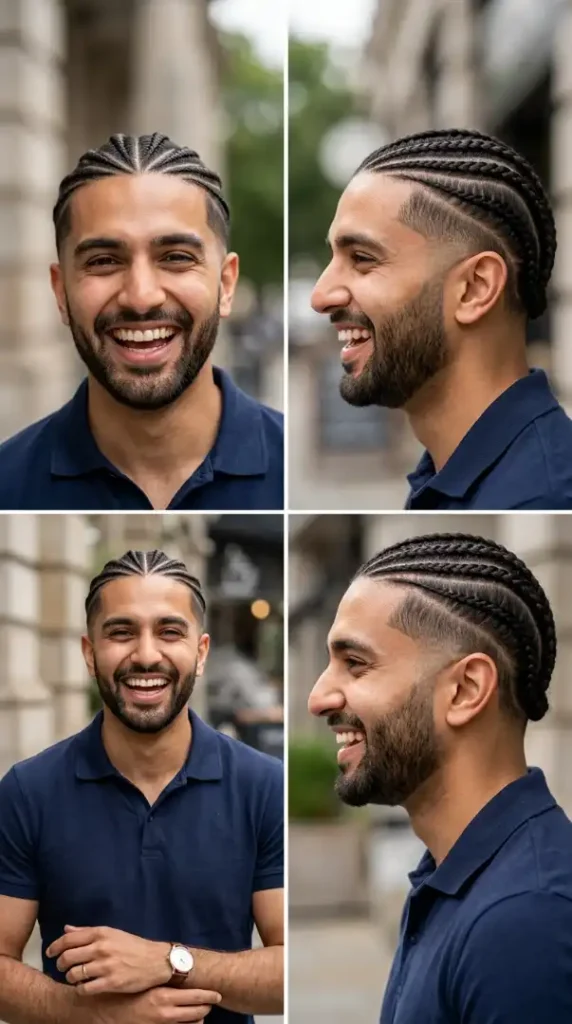
Face Shape Match
The Curved Crown Sculptor flatters oval and heart face shapes best. The gentle backward-sweeping curves soften the hairline and create a smooth, elongating line that suits an oval face’s already-balanced proportions without adding unnecessary drama. On a heart-shaped face, the soft curves ease the visual transition from a wider forehead down to a narrower chin, making the low skin fade feel like a natural extension rather than an abrupt cutoff.
Square faces can wear this too, since the rounded lines offer a nice contrast to angular jaw structure. Round faces should be more selective — too much curve on an already round face can emphasize softness rather than counter it, so pairing this style with a slightly higher fade is recommended if a round-faced client wants to try it.
Grooming Kit
Clippers: Wahl Magic Clip (Model 5049-400) for the low fade blend. Trimmer/Outliner: Andis T-Outliner (Model 04710) for the curved-line precision and hairline cleanup. Finishing Tools: Kent 81T fine-tooth comb for defining the curved rows, Denman boar bristle brush for the beard. Styling Product: American Crew Fiber (matte finish, high hold), pea-sized amount, for a light finish on the braid surface. Maintenance: Viking Revolution Beard Oil applied daily for the short beard.
Maintenance Level
Rating: Low-Medium.
Barber visit frequency: every 2-3 weeks for the fade touch-up; the curved braid rows hold for up to 4 weeks given the low fade’s more forgiving growth.
Daily styling time: 3-5 minutes, minimal since the curved rows and low fade both hold shape well.
Product routine: one step — light matte product on the braid surface if needed.
Growth pattern: the low fade holds its definition well past two weeks; the curved rows loosen gradually and evenly, staying presentable through most of the growth cycle.
Monthly cost estimate: roughly 55-85 dollars given the lower-maintenance fade schedule.
Difficulty rating: Beginner-friendly for home upkeep.
Barber Talk
Say this to your barber:
“I want a Curved Crown Sculptor with a low skin fade starting just above the ear. Keep the stitch braids arranged in smooth curved rows sweeping back from the hairline — clean up the perimeter without disturbing the curve pattern. Blend the fade from skin up to a guard #3 at the parietal ridge for a subtle transition. Keep my beard short and sharply shaped along the jawline at 4-5mm. Finish with a clean, soft lineup that follows the natural curve of my hairline.”
If this smooth, low-maintenance curve works for your everyday routine, the next style takes the total opposite approach with a shaved-close look built for absolute simplicity.
11 of 13 — The Box Braid Baldy
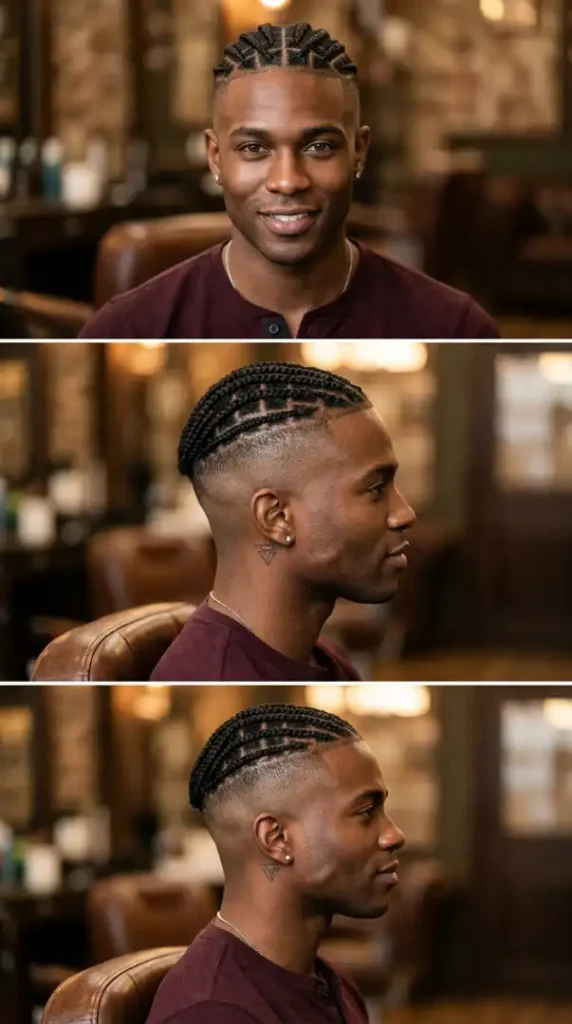
Face Shape Match
The Box Braid Baldy is an excellent match for diamond and oval face shapes. The uniform grid pattern of small box braids creates clean, symmetrical structure at the crown that mirrors the natural symmetry of a diamond face, while the skin-bald sides eliminate width at the cheekbones — the widest point on this face shape — to bring the whole silhouette into balance.
Oval faces wear this equally well since the grid pattern is neutral enough not to distort natural proportions. Round and heart-shaped faces should approach carefully — the flat, wide grid on top can add unwanted width when there’s little length happening elsewhere in the cut, so pairing this pattern with slightly more height at the crown is advisable for those shapes.
Grooming Kit
Clippers: Andis Master (Model 01557) for the skin-bald fade. Trimmer/Outliner: Andis T-Outliner (Model 04710) for perimeter cleanup and hairline precision. Finishing Tools: Rat-tail comb for maintaining the grid part lines, edge control brush for smoothing. Styling Product: Eco Style Gel (Olive Oil formula), dime-sized amount, applied to each braid base for hold and shine. Maintenance: No beard maintenance needed; a light facial moisturizer is recommended for the clean-shaven look.
Maintenance Level
Rating: Medium.
Barber visit frequency: every 10-14 days for the bald fade touch-up; the box braids themselves hold for 4-6 weeks before needing a redo.
Daily styling time: 3-5 minutes, mostly a light gel refresh along the part lines.
Product routine: one step — gel touch-up on the grid parts.
Growth pattern: the bald fade shows regrowth fastest around day 10; the box braids stay neat much longer, loosening gradually by week five or six.
Monthly cost estimate: roughly 80-110 dollars combining frequent fade touch-ups with a less frequent full braid redo.
Difficulty rating: Intermediate — the fade needs a barber, but braid upkeep between visits is manageable at home.
Barber Talk
Say this to your barber:
“I want a Box Braid Baldy with a skin-bald fade starting above the ear. Keep the box braids in a uniform grid pattern across the top — clean up the perimeter without disturbing the existing braids. Blend the fade from skin up to a guard #1 at the parietal ridge for maximum contrast. I’m clean-shaven, so keep the jawline freshly edged. Finish with a sharp, precise lineup around the entire perimeter and clean ear outline.”
If this clean grid pattern feels like the perfect low-fuss statement, the next style takes texture in a completely different direction with a fine fishbone-inspired braid detail.
12 of 13 — The Fishbone Fade Master
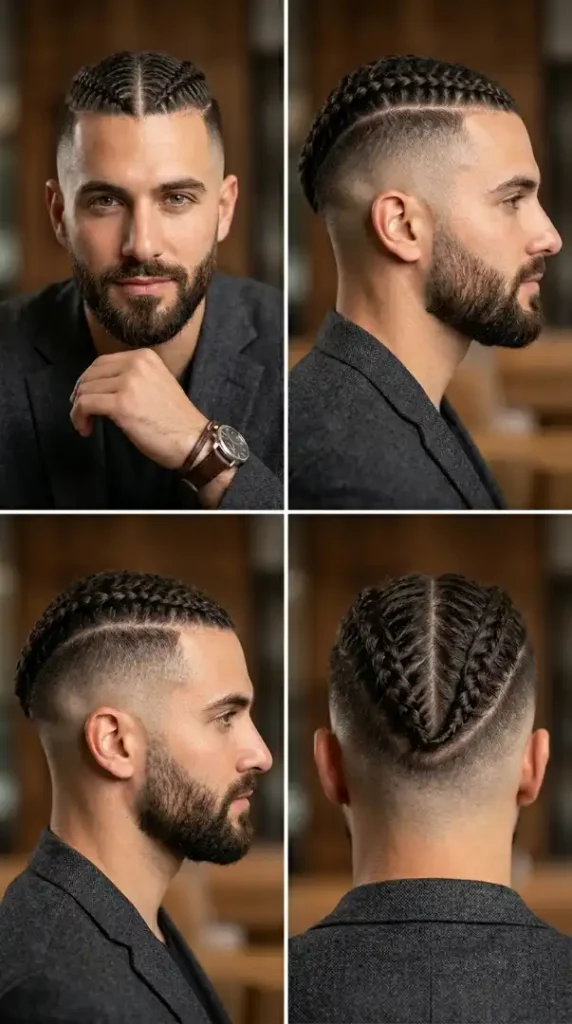
Face Shape Match
The Fishbone Fade Master is best suited to square and oval face shapes. The fine herringbone weave adds intricate texture at the crown without adding bulk, which lets the high skin fade do the heavy lifting of narrowing a square jawline while the delicate braid detail keeps the top from looking too harsh or overly structured. It’s a style that softens a strong jaw through texture rather than shape.
Oval faces wear this beautifully as an all-purpose refined option. Round faces should proceed with some caution — the tight, dense weave pattern can visually widen the crown area if not paired with enough height, so requesting extra volume at the top is a smart adjustment for a round-faced client considering this style.
Grooming Kit
Clippers: Andis Master (Model 01557) for the high skin fade. Trimmer/Outliner: Andis T-Outliner (Model 04710), essential for the fine fishbone weave precision and nape taper. Finishing Tools: Kent 81T fine-tooth comb for the delicate herringbone sectioning, Denman boar bristle brush for the beard. Styling Product: Layrite Original Pomade (medium hold), dime-sized amount, for controlling the fine weave texture. Maintenance: Honest Amish Beard Oil applied daily for the full, lined beard.
Maintenance Level
Rating: Medium-High.
Barber visit frequency: every 10-12 days for the fade touch-up; the fine fishbone weave holds for about 3 weeks given its intricate, tight construction.
Daily styling time: 5-6 minutes, mostly beard grooming plus a light pomade pass over the weave.
Product routine: two steps — pomade on the weave, oil on the beard.
Growth pattern: the high fade regrows fastest at the temples around day 10-12; the fine weave loosens gradually and evenly across the crown by week three.
Monthly cost estimate: roughly 85-115 dollars for fade touch-ups plus periodic weave maintenance.
Difficulty rating: Intermediate — the weave itself requires a skilled hand to install, though daily upkeep is manageable.
Barber Talk
Say this to your barber:
“I want a Fishbone Fade Master with a high skin fade starting at the temple line. Keep the stitch braids woven in a fine fishbone herringbone pattern across the top — clean up the perimeter without disturbing the weave. Blend the fade from skin up to a guard #2 at the parietal ridge. Taper my beard into the fade at the jawline, keeping it full at 8mm. For the back, taper the nape with a soft rounded shape and clean neck hairline. Finish with a precise lineup at the temples and hairline.”
If this refined, detailed weave is exactly your speed, the final style in this collection brings everything together with the most versatile, all-occasion crown design yet.
13 of 13 — The Royal Weave Finale
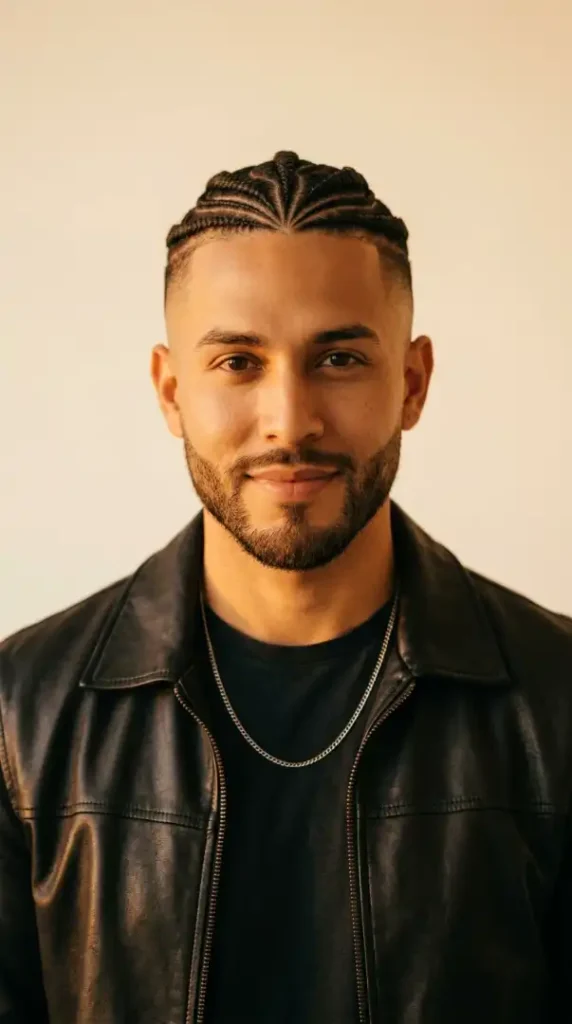
Face Shape Match
The Royal Weave Finale is the most versatile style in this collection, flattering oval, square, and heart face shapes alike. The rounded crown weave converging at a refined center point adds gentle height and structure that suits oval proportions perfectly, while the high skin fade sharpens the jawline area on square faces without adding harsh geometric lines. On a heart-shaped face, the soft convergence point balances a wider forehead nicely.
Round faces can wear this too as long as the fade is kept high enough to counteract added width at the crown. Only very oblong faces should be cautious, since the added crown height can stretch an already long face further — a flatter, lower-profile weave is the better substitute in that case.
Grooming Kit
Clippers: Wahl Magic Clip (Model 5049-400) for the high fade blend. Trimmer/Outliner: Andis T-Outliner (Model 04710) for the precise crown convergence point and hairline detail. Finishing Tools: Kent 81T fine-tooth comb for the curved weave rows, Denman boar bristle brush for the beard lineup. Styling Product: Layrite Original Pomade (medium hold), dime-sized amount, applied to smooth the weave surface. Maintenance: Viking Revolution Beard Oil applied daily for the short, lined beard.
Maintenance Level
Rating: Medium.
Barber visit frequency: every 2 weeks for the fade touch-up; the curved crown weave holds for 3-4 weeks.
Daily styling time: 5 minutes, mostly beard grooming and a light pomade pass over the weave.
Product routine: two steps — pomade on the weave, oil on the beard.
Growth pattern: the high fade softens around day 12-14; the crown weave loosens gradually at the convergence point by week three.
Monthly cost estimate: roughly 70-100 dollars for fade touch-ups plus periodic weave maintenance.
Difficulty rating: Intermediate for home upkeep between visits.
Barber Talk
Say this to your barber:
“I want a Royal Weave Finale with a high skin fade starting at the temple line. Keep the stitch braids curved back into a rounded crown weave converging at a center point — clean up the perimeter without disturbing the pattern. Blend the fade from skin up to a guard #2 at the parietal ridge. Line up my beard sharply along the jaw, keeping it short at 3-4mm. Finish with a crisp lineup at the temples and hairline for a polished, complete look.”
This wraps the full collection — from bold geometric statements to refined, low-maintenance crowns, there’s a stitch braid fade here for every face shape, lifestyle, and grooming commitment level.