10 Braided Hairstyles for Men: Unique Looks
1 of 10 — The Nordic Warrior Braid Crown
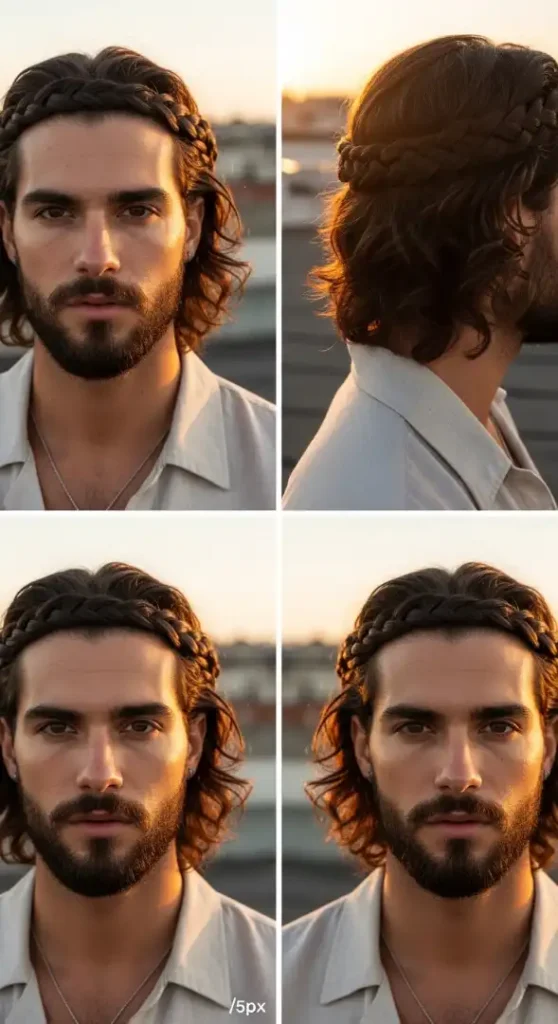
Which Face Shapes Work Best
The Nordic Warrior Braid Crown is exceptionally flattering for oval and diamond face shapes. The circular braid pattern creates horizontal visual interest across the crown, which balances the natural vertical length of oval faces without adding unwanted width. For diamond-shaped faces, this style works brilliantly because the braid crown adds structure at the temples and forehead, counterbalancing the wider cheekbone area that defines this face shape. The loose textured waves falling at the sides provide softness that prevents the angular jaw from appearing too sharp. Men with round faces should approach this style cautiously — the horizontal braid line can emphasize width rather than create the illusion of length. However, if you have a round face and love this look, ask your stylist to position the braid crown slightly higher on the head and keep the side sections tighter to elongate your overall appearance.
Your Complete Grooming Arsenal
To maintain the Nordic Warrior Braid Crown at home, you’ll need professional-grade tools. Start with the Wahl Professional 5-Star Magic Clip for precise edge work and maintaining your beard shape. The Andis T-Outliner is non-negotiable for crisp hairline definition and temple detailing every 3-4 days between salon visits. For the braiding process itself, invest in a Kent 12T comb for sectioning — its fine teeth create clean parts without snagging. Product-wise, Layrite Original Pomade provides the grip needed for tight braid work without leaving a greasy residue. American Crew Fiber works perfectly for texturizing the loose wave sections, giving them that effortless windswept look. Apply a nickel-sized amount of Suavecito Matte Clay to dry hair before braiding to add hold that lasts 12+ hours. For beard maintenance, use Honest Amish Beard Oil twice daily to prevent the boxed beard from looking dry or patchy. Finally, grab a boar bristle brush — the Mason Pearson Popular Mixture is worth the investment for smoothing the wave sections and distributing natural oils.
Maintenance Reality Check
This is a high-maintenance style, plain and simple. Expect to dedicate 15-20 minutes every morning to recreate the braid crown unless you’re skilled enough to sleep in it (which requires a silk pillowcase and strategic positioning). You’ll need salon visits every 3-4 weeks to maintain the precise edge work and keep the overall shape fresh. The daily routine involves: sectioning the hair with your Kent comb (2 minutes), applying Layrite Pomade to damp hair (1 minute), executing the circular braid pattern (8-12 minutes depending on skill level), securing with small clear elastics, and finishing the wave sections with American Crew Fiber (3 minutes). The beard requires trimming every 5-7 days to maintain the boxed shape. Total weekly time investment: approximately 2.5 hours for hair plus 20 minutes for beard maintenance. This style is not ideal if you travel frequently without your full product kit or if you have early morning commitments that don’t allow for lengthy styling sessions.
Barber Chair Script — Exactly What to Say
Walk into your barbershop with confidence and say this: “I want to grow out my top to at least 8 inches for a Viking braid crown. Keep the sides at a 1.5 guard with a low skin fade starting one finger-width above the ear. Blend the fade seamlessly into the longer top — no hard line. I need the hairline cleaned up with sharp corners at the temples but keep it natural, no geometric edges. For the beard, I want a short boxed beard at about half an inch length all around, sharp line at the cheekbones, and a defined neck line two fingers above the Adam’s apple. Make sure the beard connects smoothly to the fade on the sides — no gap. Can you show me how to section the top for the circular braid pattern? I’ll style it myself at home but want to make sure the length and layers work for that.” This script ensures your barber understands both the immediate cut and your long-term styling goal.
Want to see how this Nordic style compares to modern French braids with a street edge? The next style brings urban sophistication to classic braiding techniques.
Common Questions About This Style
Q: How long does my hair need to be for a braid crown like this?
A: You need a minimum of 6-8 inches on top to execute a proper circular braid crown with enough braid length to create a full circle around your head. If your hair is currently 3-4 inches, expect to grow it out for 4-6 months before attempting this style. The sides can be any length since they’ll typically be faded or kept shorter to emphasize the crown. During the growing-out phase, ask your barber to add subtle layers to the top section — this prevents the awkward in-between stage where hair just sits there looking shapeless.
Q: Can I sleep with the braid crown in or do I need to redo it daily?
A: Technically you can sleep in it if you use a silk or satin pillowcase and secure the braid with small, snag-free elastics, but expect to refresh it every 2-3 days maximum. The braid will loosen overnight, and you’ll notice flyaways and less definition by day two. Most men who wear this style prefer to rebraid fresh each morning for the crispest look. If you’re in a rush, you can lightly mist with water, apply a small amount of pomade to smooth flyaways, and re-secure any loose sections rather than completely undoing and rebraiding.
Q: What’s the difference between a braid crown and a man bun with braids?
A: A braid crown circles completely around your head like a halo, with the braid lying flat against your scalp in a continuous loop. A man bun with braids typically features one or more individual braids that either feed into a top knot or hang separately down the back. The braid crown is more structured and formal-looking, while braids leading to a man bun have a more relaxed, bohemian vibe. Face shape also matters — braid crowns suit oval and diamond faces better, while man buns work well on square and oblong faces because they add height.
2 of 10 — The Corporate Edge Box Braids
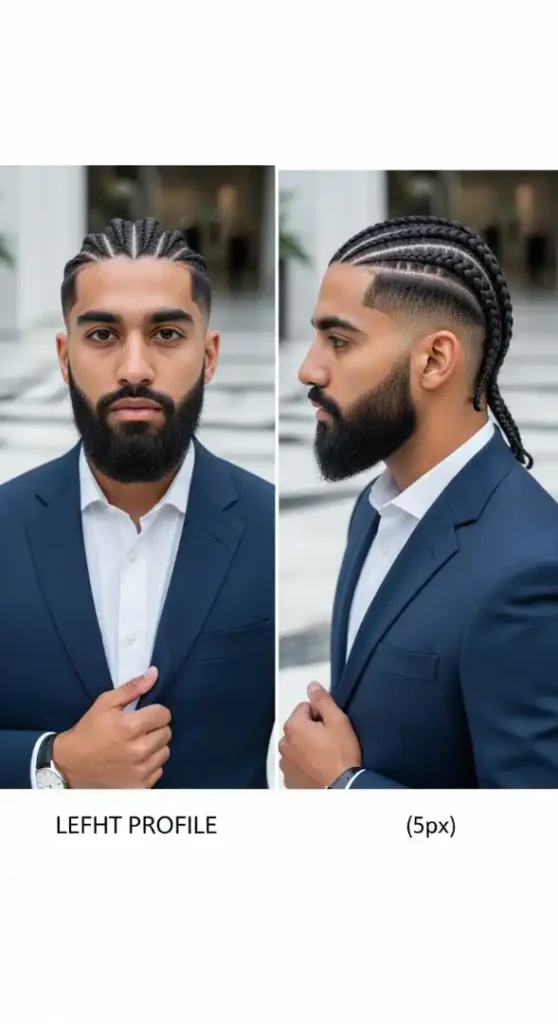
Which Face Shapes Work Best
The Corporate Edge Box Braids are a versatile powerhouse that flatters square and oblong face shapes exceptionally well. For square faces, the vertical lines created by the individual box braids draw the eye downward, softening the strong angular jawline that defines this face shape. The chin-length cut adds just enough width at the bottom to balance proportions without making the face appear boxy. Oblong faces benefit tremendously because the horizontal sectioning pattern at the scalp breaks up the vertical length, creating visual interest across the forehead and crown area. The clean lineup at the temples adds structure without extending the face further. Men with heart-shaped faces will find this style particularly flattering because the fuller bottom sections (where braids end at chin length) balance the wider forehead typical of heart shapes. Round faces should request slightly longer braids that extend past the chin to create a lengthening effect rather than emphasizing width.
Your Complete Grooming Arsenal
Professional-grade tools are essential for maintaining the Corporate Edge Box Braids between salon visits. The Andis Master Cordless Clipper is your foundation tool for keeping the temple fade crisp every 4-5 days. Pair it with the BaByliss Pro FX Outliner for ultra-precise lineup work at the hairline — this combination ensures your forehead definition stays sharp enough for boardroom presentations. For scalp maintenance, invest in the Denman D3 Original Styler 7-Row brush to keep the sections between braids clean and prevent product buildup. Product-wise, you’ll need SheaMoisture Men Maracuja Oil & Shea Butter Moisturizer applied to the scalp twice weekly to prevent dryness and flaking — box braids can cause scalp tension if not properly moisturized. Use Cantu Men’s Collection Leave-In Conditioner on the braids themselves every 3-4 days to maintain sheen and prevent frizz. For edge control, Murray’s Edge Wax is unmatched — apply a tiny amount along the hairline to keep baby hairs slicked down in professional settings. Keep a spray bottle of rose water and glycerin mix (70/30 ratio) at your desk for midday refreshing without adding weight.
Maintenance Reality Check
The Corporate Edge Box Braids fall into the medium-high maintenance category, requiring consistent attention but less daily time than loose hairstyles. Initial installation takes 3-4 hours at a professional braiding salon and lasts 4-6 weeks before requiring a complete redo. Daily maintenance is minimal — approximately 5 minutes each morning to spray with your rose water mixture, smooth edges with Murray’s Edge Wax, and tie a silk durag for 3-5 minutes while you brush your teeth to set the pattern. The temple fade requires professional touch-ups every 10-14 days to maintain that corporate polish. Scalp care is where you’ll invest most time: 15 minutes twice weekly for thorough moisturizing, gently working SheaMoisture oil between the braids with your fingertips. At night, wrapping with a silk durag or sleeping on a satin pillowcase is non-negotiable to prevent frizz and maintain braid integrity. Total weekly time investment: approximately 1 hour for at-home care plus 30 minutes every two weeks at the barbershop. The style is ideal for busy professionals who want a distinctive look without daily styling stress, but it’s not suited for men with very sensitive scalps or those who frequently switch hairstyles.
Barber Chair Script — Exactly What to Say
Arrive at your braiding appointment prepared with this script: “I want medium-sized box braids, approximately 1 centimeter square sections, starting from a clean center part going straight back. Braid down to chin length — I need to maintain a professional appearance, so nothing longer. Before we start braiding, I need a low skin fade on the sides starting half an inch above the ear, blending into the braided section with no visible line. Use a 0.5 guard for the fade, going down to skin at the very bottom. The hairline needs sharp geometric corners at the temples but keep the overall shape natural to my head. Make sure all sections are uniform in size — I want that clean, geometric look, not a freehand bohemian vibe. Use black extension hair to match my natural color exactly, and keep the tension firm but not tight — I can’t have scalp pain during work hours. At the nape, taper the braids so they don’t hang heavy on my collar when I’m wearing a suit.” This ensures both your braider and barber (you may need both professionals) understand the polished aesthetic you’re targeting.
This corporate-friendly approach proves braids aren’t just for casual settings — next, we’ll explore how French braids create an edgy street look.
Common Questions About This Style
Q: How long does my hair need to be for box braids like this?
A: Your natural hair should be at least 2-3 inches long for box braids to grip properly, though 4-5 inches is ideal for the cleanest installation. If your hair is currently shorter, you can still get box braids using extension hair from the root, but the stylist will need to use a crochet or latch-hook method which may not last as long. Natural hair that’s 6+ inches allows for the most secure braiding since there’s more length for the stylist to work with before adding extensions. Keep in mind that the chin-length you see in the final look comes from extension hair, not necessarily your natural length.
Q: Will box braids damage my hairline or cause hair loss?
A: When installed correctly with proper tension, box braids should not cause permanent hairline damage or hair loss. The key is finding a skilled braider who understands that tight does not equal better — excessive tension causes traction alopecia, particularly at the hairline and temples. During installation, you should feel a firm grip but never sharp pain or a pulling sensation at the roots. If you experience headaches in the first 24 hours, the braids are too tight — return immediately for adjustment. To protect your hairline, request that the braider leaves the first row of braids slightly looser than the rest, and never keep box braids in longer than 8 weeks. Regular scalp moisturizing and giving your hair at least 2-3 weeks of rest between braid installations prevents damage.
Q: Can I work out and wash my hair with box braids?
A: Absolutely — box braids are actually ideal for active lifestyles and frequent workouts. After exercising, simply spray your scalp with a diluted tea tree oil and water mixture (10 drops per 8 ounces) to refresh and prevent odor without full washing. For proper washing, do it weekly or every 10 days maximum: dilute your shampoo with water in a spray bottle, apply directly to the scalp (not the braids), massage gently with fingertips, and rinse thoroughly. Follow with a light leave-in conditioner on the braids themselves. Never rub or scrub vigorously — use a patting motion. Let air dry completely before tying with a durag, as damp braids can develop mildew. Some men prefer to wash every two weeks to prevent buildup while maintaining scalp health.
3 of 10 — The Street King Cornrow Fade
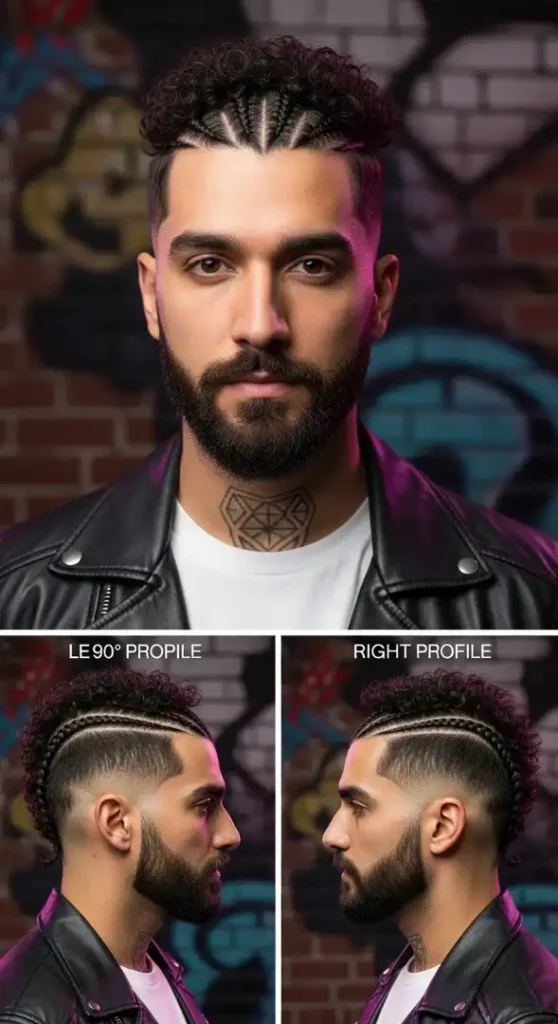
Which Face Shapes Work Best
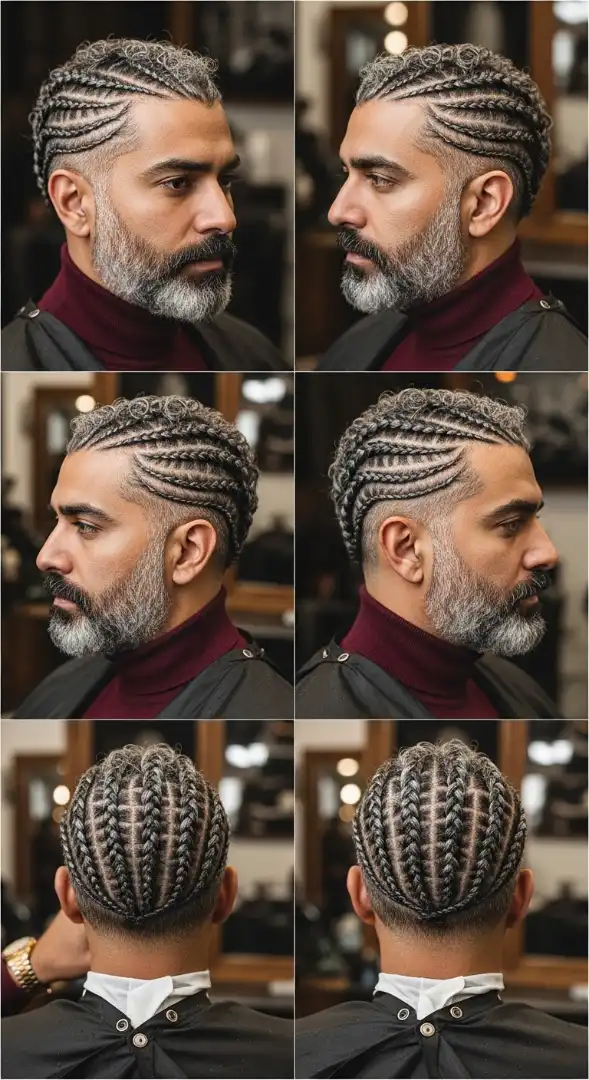
The Street King Cornrow Fade is engineered for round and oval face shapes, though it adapts remarkably well across all face types with minor adjustments. For round faces, this style is transformative — the vertical lines created by straight-back cornrows draw the eye upward, creating the optical illusion of length that round faces naturally lack. The high skin fade removes bulk from the sides, further elongating the face and emphasizing cheekbone structure. Oval faces, already balanced, benefit from the clean geometric precision of this style; the cornrows add texture and visual interest without disrupting natural proportions. Men with square faces should request that the barber keep the fade slightly lower (mid rather than high) to avoid over-emphasizing the angular jawline — the goal is to soften, not amplify, those strong corners. Diamond face shapes pair beautifully with this style because the cornrow pattern adds structure at the forehead while the high fade balances the wider cheekbone area. Heart-shaped faces should consider adding 1-2 additional cornrows to create more coverage at the forehead, counterbalancing the wider upper face.
Your Complete Grooming Arsenal
Maintaining the Street King Cornrow Fade demands a curated arsenal of professional tools and products. The Andis Master Adjustable Blade Clipper is your workhorse for fade maintenance between shop visits — its precision is unmatched for keeping that high fade sharp every 5-7 days at home. Pair it with the Wahl Detailer Li for ultra-close lineup work at the hairline and around the beard perimeter. For cornrow care, you’ll need Jamaican Black Castor Oil applied to the scalp every other day — it prevents dryness, promotes healthy hair growth, and adds subtle sheen to the braids without greasiness. Carol’s Daughter Black Vanilla Edge Control keeps your hairline immaculate throughout the day; apply after morning moisturizing for hold that lasts 12+ hours through workouts and weather. For beard maintenance, grab the Bevel Beard Balm for daily conditioning and the Zeus Boar Bristle Beard Brush for training the beard to grow downward in alignment with your fade. Keep a Kent 2T comb for precision parting before cornrow refreshing. Between full re-braids, use Cantu Shea Butter Extra Hold Edge Stay Gel to tame any frizz along the cornrow edges. Finally, invest in multiple silk durags in neutral colors — rotating them prevents buildup while maintaining your pattern overnight.
Maintenance Reality Check
This style sits firmly in the medium-maintenance category, requiring less daily effort than loose styles but more consistent upkeep than longer protective braids. Professional cornrow installation takes 1.5-2 hours and lasts 2-3 weeks before requiring a complete redo — coily hair textures may get 3-4 weeks if well-maintained. The high fade is the high-maintenance element: you’ll need barbershop visits every 7-10 days to keep it crisp, or learn to fade yourself at home with clippers (budget 20-30 minutes for self-fading every week). Daily maintenance is straightforward: 5 minutes each morning to apply edge control along the hairline and cornrow edges, 2 minutes to apply Jamaican Black Castor Oil to the scalp using fingertips or a small applicator bottle, then tie your durag for 5-10 minutes while you handle other morning routine tasks. Nighttime: 2 minutes to apply light oil to scalp, tie durag before bed. Weekly deep moisturizing session: 15 minutes to thoroughly oil the scalp and massage in small circular motions between each cornrow. Total weekly time investment: approximately 1.5 hours at home plus 30-45 minutes at the barbershop. This style works brilliantly for men who want a bold, distinct look without elaborate daily styling, but it’s not ideal for those who can’t commit to weekly barber appointments or have very sensitive scalps.
Barber Chair Script — Exactly What to Say
Walk in with confidence and deliver this precise script: “I want four straight-back cornrows starting from my hairline going all the way to my crown. Keep the cornrow sections even — about an inch to an inch and a quarter wide each. I need a high skin fade on the sides starting at the temple level, going down to completely bald at the bottom. Blend the fade into the cornrowed area with no visible shelf or line — it should be seamless. Give me a sharp edge-up with defined corners at the temples, but keep the overall hairline shape natural to my head, not geometric or pushed forward. For the beard, I want it faded into the skin fade on the sides — no separation between the face fade and beard fade. The beard should taper down as it moves toward the fade line, not just cut straight across. At the chin and goatee area, leave about half an inch length, and blend it all together. Can you show me the back so I can see where the cornrows end and how they’re sealed?” This script covers all technical aspects while showing you understand the style’s architecture.
Next, you’ll see how adding color to cornrows creates an entirely different energy — wait until you see the Amber Fade Twist.
Common Questions About This Style
Q: How often do I need to get the cornrows redone?
A: Straight-back cornrows typically last 2-3 weeks before they start looking fuzzy and need professional redoing. Signs it’s time for a refresh include: visible new growth pushing the cornrows away from your scalp, frizz accumulating along the braid edges that edge control can’t tame anymore, cornrows feeling loose when you touch them, or the back/crown area showing significant loosening while the front still looks decent. Men with faster-growing hair may need redos every 2 weeks, while those with slower growth can stretch to 4 weeks maximum. Never keep cornrows longer than 4 weeks — doing so increases breakage risk and makes the removal process more difficult and painful.
Q: Will a high fade with cornrows work in a professional office environment?
A: This depends entirely on your industry and company culture, but increasingly, the answer is yes. Tech companies, creative agencies, modern finance firms, and most industries outside of ultra-traditional law or corporate banking embrace this style as professional when executed with precision and maintained impeccably. The key factors that keep it professional: clean, even cornrow sections (no freehand wavy patterns), a sharp high fade with no overgrown areas, immaculate edge work at the hairline, and well-groomed facial hair if you have a beard. If you’re unsure about your workplace, start with a lower fade (mid-fade instead of high) and gauge reaction before going higher. The style reads as intentional and put-together, not casual or messy.
Q: What’s the difference between cornrows and box braids in terms of styling and maintenance?
A: Cornrows are braided flat against the scalp in continuous rows, creating a sleek, low-profile look that lies tight to your head — think of them as “flat tracks.” Box braids are individual braids that hang freely from the scalp, sectioned into small squares or boxes, creating a fuller, three-dimensional look. Maintenance-wise, cornrows require more frequent redoing (2-3 weeks vs. 4-8 weeks for box braids) but need less daily upkeep since they’re secured to the scalp. Cornrows show your scalp between the braids; box braids create fuller coverage. For professional settings and athletic activities, cornrows often work better because they stay in place and won’t move around. Box braids offer more styling versatility since you can put them in ponytails, buns, or let them hang loose.
4 of 10 — The Maverick Geometric Braid Pattern
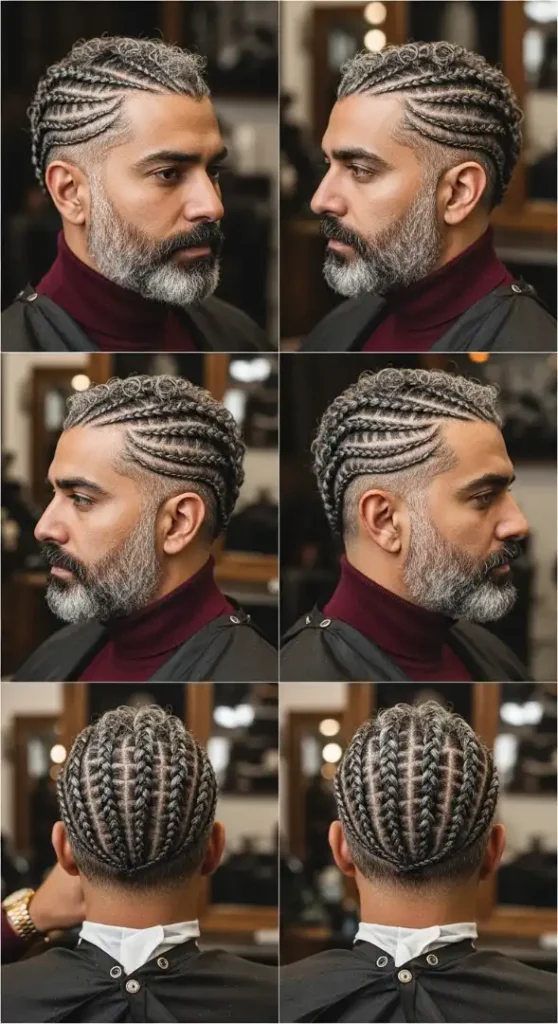
Which Face Shapes Work Best
The Maverick Geometric Braid Pattern is remarkably adaptable but shines brightest on diamond and square face shapes. For diamond faces, the angular braid pattern mirrors the natural bone structure, creating visual harmony — the zig-zag geometric lines echo the wider cheekbones while the mid fade balances the narrower forehead and chin. The artistic pattern draws attention upward to the crown, de-emphasizing the widest part of the face. Square-faced men benefit because the diagonal and curved elements in the braid pattern soften the strong, straight lines of the jaw and forehead; it’s a brilliant counterbalance that adds organic flow to angular features. Oval faces, as always, can pull this off beautifully since they’re naturally balanced. Round faces should approach cautiously — request that your braider emphasizes vertical elements in the pattern rather than horizontal or curved lines, and keep the fade on the lower side (low to mid) to create length. Heart-shaped faces work well with this style when the geometric pattern is denser at the forehead, filling in the wider upper face with interesting texture.
Your Complete Grooming Arsenal
The artistic complexity of this style demands top-tier tools and products. Start with the Wahl Professional 5-Star Cordless Senior for fade maintenance at home every 5 days — its powerful motor handles coily texture without snagging. The Andis Slimline Pro Li T-Blade Trimmer is essential for keeping pattern edges crisp and for maintaining the sharp lineup between professional visits. For braid and scalp care, Sunny Isle Jamaican Black Castor Oil is the gold standard — apply to scalp daily using the included dropper applicator, working it gently between the geometric sections. Pattern Grooming Heavy Hold Gel keeps the braid edges locked down without flaking; a dime-sized amount smoothed along each braid after morning moisturizing holds for 14+ hours. For the salt and pepper beard, use Cremo Beard & Scruff Cream for conditioning plus the Beardbrand Utility Balm for light hold and shaping. Keep a wide-tooth comb for gentle detangling before re-braiding sessions. Between full pattern redos, use Eco Styler Gel Black Castor & Flaxseed Oil to refresh individual braids that start loosening early — apply to that section, smooth with fingers, tie with a durag for 10 minutes. For overnight maintenance, King J All Natural Satin Durag in black preserves the pattern without leaving lint in the braids.
Maintenance Reality Check
This is unquestionably a high-maintenance style due to the intricate geometric pattern. Professional installation by a skilled braider takes 2.5-3.5 hours — you’re paying for artistry, not just technique. The pattern lasts 2.5-3 weeks maximum before needing a complete redo; complex designs loosen faster than simple straight-backs because there’s more tension variation across the scalp. The mid fade requires professional touch-ups every 7 days to maintain clean lines that complement the artistic top. Daily routine: 8-10 minutes each morning for comprehensive care — apply Jamaican Black Castor Oil to every visible scalp section (4 minutes), smooth Pattern Grooming Gel along all braid edges (3 minutes), tie durag for 5 minutes while finishing your routine, then apply beard cream and style (2 minutes). Nighttime: oil application again (3 minutes), durag on before bed. Weekly deep treatment: 25 minutes to oil massage the entire scalp, getting between every braid section, followed by a hot towel wrap for 5 minutes to enhance absorption. Total weekly time: approximately 2 hours at-home care plus 30-40 minutes at the barber for fade maintenance. This style is ideal for men who view grooming as an art form and have the schedule flexibility to support it, but it’s not practical for those with unpredictable work hours or frequent travel.
Barber Chair Script — Exactly What to Say
Prepare your braider and barber with this detailed script: “I want a geometric zig-zag cornrow pattern across the top — think diamond shapes created by diagonal braids that alternate direction. I need at least 8-10 individual cornrows working together to create the full geometric design. Make sure the pattern is symmetrical from front to back and side to side — I want it to look intentional, not random. Section size should be consistent throughout, about three-quarters of an inch wide for each braid. Start the pattern at my hairline and continue back to the crown where the braids can converge. For the sides, I need a mid skin fade starting one inch above the ear, blending seamlessly into the braided sections on top — no visible line where the fade meets the braids. Sharp edge-up with a natural curve to my hairline, not too geometric or boxy. The beard needs to fade into the skin fade on the sides — same technique as the hair, creating one continuous blend from beard to fade to bald skin. At the nape, keep it tapered and clean, and show me how the pattern closes at the back of my head.” Bring a reference photo of a geometric pattern you like — it gives your braider a visual starting point.
See how adding length transforms geometric braids into a completely different aesthetic in the next warrior-inspired look.
Common Questions About This Style
Q: How much does a geometric braid pattern like this typically cost?
A: Expect to pay $60-120 for geometric cornrow patterns depending on your location and the braider’s experience level. Major cities (NYC, LA, Atlanta, Chicago, Miami) command the higher end of that range, while smaller markets may be $50-80. The complexity matters — a geometric pattern with 8-10 interwoven braids creating shapes costs more than 4-5 straight-back cornrows. Master braiders who specialize in artistic patterns may charge $100-150 for truly intricate designs. The mid fade adds another $25-45 if done by a barber separate from the braider. Budget for this initial investment plus weekly fade touch-ups ($15-25) and a complete redo every 3 weeks. Monthly total: $180-300 for full maintenance.
Q: Can I design my own geometric pattern or do I need to choose from standard options?
A: Most professional braiders welcome custom pattern requests, especially if you bring clear reference images showing the geometric design you want. The braider will assess whether your chosen pattern is achievable given your hair texture, density, and head shape — some patterns only work on specific hair types or require a certain length. If you have a completely original idea, sketch it out or create a simple diagram showing how you envision the braids connecting. However, trust your braider’s expertise — they may suggest modifications to make the pattern more wearable and longer-lasting. Patterns with too many small sections or overly complex angles tend to frizz quickly and may not survive 2+ weeks.
Q: Will geometric patterns damage my hair more than simple straight-back cornrows?
A: When done correctly, geometric patterns don’t inherently cause more damage than straight-back cornrows — the risk factor is identical tension, not pattern complexity. However, geometric designs have more areas where braids change direction, and inexperienced braiders may apply inconsistent tension at these pivot points, which can cause breakage. The key is finding a braider who maintains even, moderate tension throughout the entire pattern. Signs of too-tight braiding: scalp pain lasting more than 24 hours, visible white bumps at the hairline, feeling like your scalp is being pulled even when not touching the braids. If you experience these, return for adjustment immediately. With proper technique and regular moisturizing, geometric patterns are perfectly safe for your hair.
5 of 10 — The Amber Fade Twist Braids
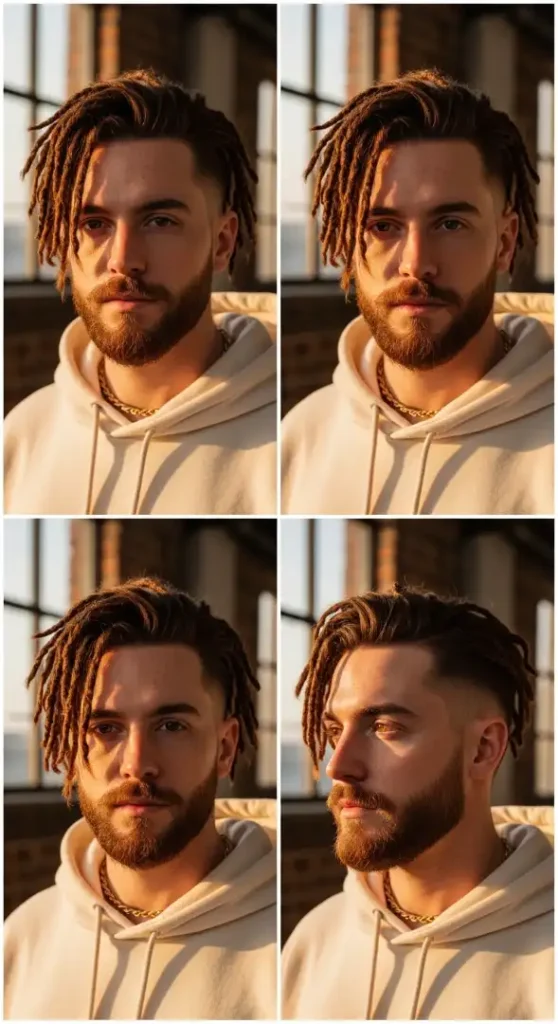
Which Face Shapes Work Best
The Amber Fade Twist Braids deliver exceptional results for oval and oblong face shapes, though men with round faces will find this particularly transformative. For oval faces, the forward-flowing twist pattern adds visual movement without disrupting natural balance — it’s a style that enhances rather than corrects. Oblong faces benefit from the horizontal visual interest created by the twists lying across the crown; this breaks up the vertical length and draws attention to the texture rather than face length. Round faces experience the most dramatic improvement: the high bald fade aggressively removes width from the sides, creating the illusion of length and structure. The forward-flowing twists add height at the crown, further elongating the face shape. The geometric temple corners provide sharp angles that round faces naturally lack. Men with square faces should request a slightly lower fade (high instead of bald high) to maintain some softness, as the ultra-clean sides combined with a strong jawline can read as overly harsh. Heart-shaped faces work beautifully because the fuller twist coverage at the crown balances the wider forehead typical of this shape.
Your Complete Grooming Arsenal
Maintaining colored twist braids requires specialized products beyond standard grooming. The Andis Master Cordless Clipper remains essential for weekly fade maintenance at home. Pair with the Wahl 5-Star Detailer for precision edge work every 3-4 days to keep that geometric temple sharp. For twist care, Carol’s Daughter Mimosa Hair Honey Shine Pomade is specifically formulated for textured styles — apply a pea-sized amount to each twist in the morning to enhance definition and sheen. Shea Moisture Coconut & Hibiscus Curl & Shine Conditioner used weekly prevents the colored sections from becoming dry and brittle; colored hair loses moisture faster than natural hair. For color maintenance, invest in Overtone Ginger Coloring Conditioner — use it every 5-7 days to refresh the amber tones without permanent dye damage. The dpHUE Cool Brunette Shampoo (used sparingly, once every 10 days) prevents the auburn base from developing brassy tones. Beard maintenance requires Honest Amish Beard Balm for daily conditioning and the Kent 81T beard comb for shaping. Keep a satin-lined cap or durag specifically for twist preservation overnight — silk works but satin with lycra provides better grip.
Maintenance Reality Check
This style registers as high-maintenance due to the color element combined with the intricate twisting. Professional two-strand twist installation takes 1.5-2 hours, and initial color application adds another 45-60 minutes if you’re starting from natural auburn (longer if your base color is darker and requires lifting). The twists themselves last 3-4 weeks, but the high bald fade requires attention every 5-7 days — either professional touch-ups or confident self-fading at home. Color refresh with Overtone happens every 5-7 days and takes 10 minutes: apply to damp twists, let sit for 3 minutes, rinse. Daily routine: 7 minutes total — apply Mimosa Hair Honey to each twist individually (4 minutes), smooth edges with a light pomade (1 minute), oil your beard and brush (2 minutes), tie your satin cap for 5 minutes while you finish getting ready. Weekly deep conditioning: 20 minutes including application time and 15-minute processing under a shower cap. Monthly color touch-up at the roots: 90 minutes at a professional colorist to maintain the ombre effect as new growth appears. Total weekly time: approximately 1.5 hours at home plus 30 minutes every other week at the barber, plus monthly colorist visits. This style demands commitment but delivers a truly unique aesthetic that’s impossible to replicate with natural color alone.
Barber Chair Script — Exactly What to Say
Deliver this comprehensive script to coordinate between your colorist and barber: “I want eight two-strand twists, medium thickness, installed from my crown flowing forward toward my forehead. Each twist should be about one inch in diameter when completed. Before twisting, I need the top section colored — start with my natural auburn as the base, then apply amber tones from mid-length to the ends creating an ombre effect. I want rich, warm amber — not orange, not gold, but true deep amber like honey. For the sides, I need a high bald fade starting at the temple level, going completely bald at the bottom. The fade should blend seamlessly into the twisted top section with no visible line. Give me an ultra-sharp edge-up with geometric corners at the temples — I want that crisp barbershop precision. The beard stays short, about a quarter-inch length, sculpted and shaped but natural-looking, faded into the skin fade on the sides. At the nape, taper it clean and tight. Can you recommend a touch-up schedule for both the fade and the color?” This ensures both your colorist and barber understand the integrated vision.
The next style strips back the color and focuses on pure length — you’ll see how simple straight-back twists create an entirely different vibe.
Common Questions About This Style
Q: Will coloring my hair damage the twist braids or make them fall apart faster?
A: When color is applied before twisting, the damage risk is minimal because the hair shaft is altered first, then braided in its colored state. However, coloring does make hair more porous and prone to dryness, which means twist braids in colored hair may loosen slightly faster — expect 3 weeks instead of 4 for peak freshness. The solution is religious moisturizing: oil the scalp daily and use color-safe leave-in conditioner every 3-4 days. Never color already-installed twists — always color first, let it process, rinse thoroughly, deep condition, then twist the next day. If you must refresh color while twists are in, use a semi-permanent color depositing conditioner like Overtone rather than permanent dye.
Q: How often do I need to refresh the amber color to keep it vibrant?
A: With quality semi-permanent color like Overtone, refresh every 5-7 days to maintain vibrancy. Permanent color (which your initial application likely is) fades gradually with each wash, so limit shampooing to once every 10-14 days maximum. Use dry shampoo or co-wash (conditioner washing) between true shampoo sessions to extend color life. The amber will naturally fade to a lighter golden tone after 4-5 weeks, at which point you’ll need a professional re-application. Sunlight is your enemy — UV exposure causes rapid color fade in auburn and amber tones, so wear a hat when spending extended time outdoors, especially in summer months.
Q: Can I achieve this style if my natural hair color is black or dark brown instead of auburn?
A: Absolutely, but the process is more involved. Dark hair requires bleaching or lifting before amber color can show — your colorist will use a lightener to bring your base to a level 6 or 7 (medium brown), then apply the amber tone. This adds 30-60 minutes to your appointment and costs $50-100 more depending on your hair density and current color. The maintenance is identical once color is achieved. Be aware that lifting dark hair causes more damage than depositing color on light hair, so your deep conditioning routine becomes even more critical. Some men with very dark hair opt for a subtle approach: amber highlights just on the front twists rather than full color, which requires less lifting and creates dimension without the full commitment.
6 of 10 — The Executive French Braid Taper
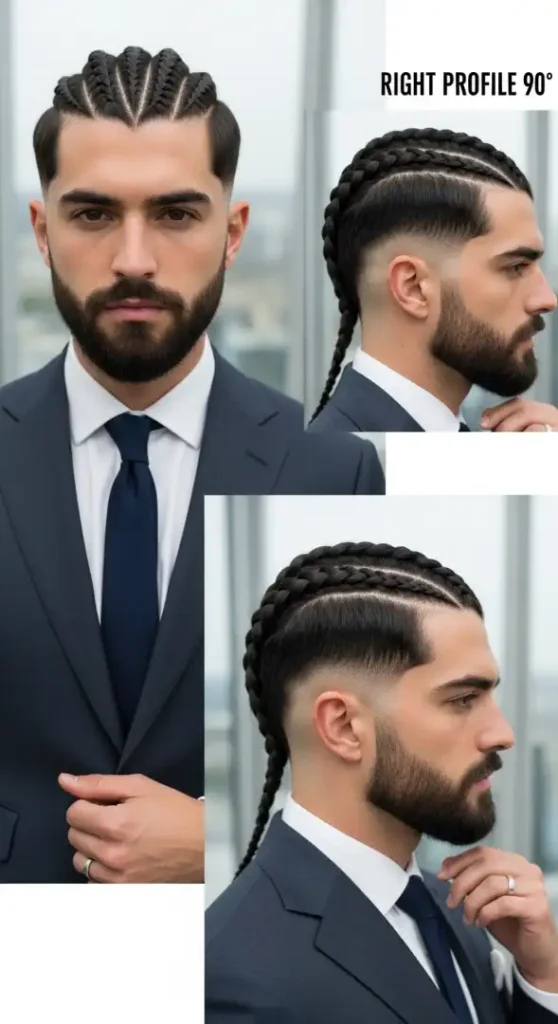
Which Face Shapes Work Best
The Executive French Braid Taper is strategically designed for oblong and oval face shapes, though it adapts remarkably well to most facial structures with minor adjustments. For oblong faces, this style is near-perfect — the single center braid creates vertical interest without adding height that would further elongate the face. The low taper fade keeps some width at the sides, preventing the face from appearing too narrow. The slicked sides add a sleek, polished finish that draws the eye to the center braid rather than emphasizing face length. Oval faces benefit from the clean symmetry this style provides; it’s inherently balanced and professional. Men with square faces should embrace this style enthusiastically — the smooth, flowing French braid softens the angular jawline and strong forehead, creating organic curves that counterbalance geometric facial features. Diamond faces work well because the center braid draws attention to the middle of the head, de-emphasizing wider cheekbones. Round faces need to approach with modification: request that the barber keeps the taper slightly higher (low-mid instead of strict low) to remove more width from the sides, creating a lengthening effect.
Your Complete Grooming Arsenal
Corporate-level grooming demands precision tools and professional-grade products. The Wahl Professional 5-Star Legend Clipper is your primary tool for maintaining the low taper at home every 7-10 days — its adjustable fade lever provides the control needed for gradual blending. The Andis Slimline Pro Li Trimmer handles detail work around the braid and maintains your clean lineup. For French braid construction, you’ll need a Kent 2T fine-tooth comb for precise sectioning and a Denman D4 brush for smoothing hair before braiding. Product-wise, start with Baxter of California Clay Pomade for the slicked sides — it provides strong hold with a natural finish appropriate for corporate settings. American Crew Grooming Cream applied to damp hair before braiding gives the structure and grip needed for a tight, all-day French braid. For braid hold, Got2B Glued Blasting Freeze Spray used sparingly at the base and end of the braid ensures it survives meetings, commutes, and weather. Keep a small vial of Kiehl’s Grooming Solutions Nourishing Beard Grooming Oil even though you’re clean-shaven — apply to the scalp along the braid line to prevent dryness from daily braiding. Finally, invest in a professional-quality mirror setup that shows your back view — you’ll need it to perfect the French braid technique.
Maintenance Reality Check
This style sits in the medium maintenance category with a corporate polish requirement. The French braid itself requires daily recreation — it’s not a protective style you can sleep in and maintain. Budget 10-15 minutes each morning: section hair down the center with your Kent comb (1 minute), apply American Crew Grooming Cream to damp hair (1 minute), execute the French braid from crown to nape (7-10 minutes depending on skill level — beginners may need 15 minutes initially), secure with a small clear elastic, apply Baxter Clay Pomade to the sides and slick back (2 minutes), light spray of Got2B Glued at braid base (30 seconds). The low taper requires professional maintenance every 10-14 days to keep it sharp enough for executive environments. At night, completely unbraid, brush through, apply light oil to scalp, sleep with hair loose. Weekly deep treatment: 15 minutes for scalp massage with Kiehl’s oil focusing on the center part line where the braid sits. Total weekly time: approximately 1.5 hours for daily styling plus 30 minutes every two weeks at the barbershop. This style is ideal for executives and professionals who want a distinctive look that reads as polished rather than rebellious, but it’s not practical for men who can’t dedicate 15 minutes to morning hair styling or who need truly low-maintenance cuts.
Barber Chair Script — Exactly What to Say
Approach your barber with this executive-focused script: “I need a low taper fade on the sides and back — start the taper about an inch above the ear and blend gradually down to skin at the very bottom near the nape. I don’t want a harsh line or shelf where the taper begins. The top should be long enough to French braid from crown to nape — I need at least 6-7 inches of length on top, possibly 8 inches at the crown for a substantial braid. Keep all one length on top, no layers — a French braid needs consistent length to work properly. Give me a sharp, clean lineup with natural hairline corners, professional enough for a corporate environment. I’ll be slicking the sides back toward the braid every morning, so I need the taper to blend seamlessly — no awkward short spots that won’t slick. The back needs to be tapered clean but not too tight — I need enough length at the nape for the braid to end properly, not just disappear into skin. Can you show me the proper sectioning technique for a center French braid so I can replicate it at home?” This ensures your barber understands both the aesthetic and functional requirements.
Next, you’ll see how taking French braids off-center creates an asymmetric edge — perfect for creative professionals who want corporate polish with artistic flair.
Common Questions About This Style
Q: How long does my hair need to be to create a proper French braid?
A: You need a minimum of 5-6 inches on top to create a French braid that runs from crown to nape with visible structure. Less than 5 inches results in a braid that’s too short to be distinctive or that requires such tight tension it causes scalp discomfort. The ideal length is 7-9 inches, which gives you enough hair to create a substantial braid with clear definition. If your hair is currently 3 inches, expect to grow it for 3-4 months before attempting this style. During the growth phase, ask your barber to maintain the taper fade on the sides while leaving the top completely untouched.
Q: Is a French braid professional enough for conservative corporate environments like law or finance?
A: This depends on your specific firm culture and client-facing role, but increasingly, the answer is yes for many conservative environments. The key factors that keep it professional: impeccable execution (tight, even braid with no flyaways), maintaining a sharp taper fade, keeping the sides slicked and neat, and pairing it with traditional business attire. A messy or loose French braid reads as casual; a precise, structured braid reads as intentional grooming. Some ultra-conservative firms may still view any braided style as too fashion-forward — if you’re uncertain, start with the style on casual Fridays or during less client-intensive periods to gauge reaction. Alternatively, wear the French braid for commutes and weekends, but slick all hair straight back into a low ponytail for important meetings or presentations.
Q: What’s the difference between a French braid and a Dutch braid, and which is more professional?
A: A French braid is created by weaving hair under at each section — the braid sits flush against your scalp and appears to be “sinking into” your head. A Dutch braid is created by weaving hair over at each section — the braid sits on top of your scalp, creating a raised, three-dimensional effect like an inverted French braid. For professional environments, French braids generally read as more understated and polished because they lay flat. Dutch braids are more visible and dramatic, making them better suited for creative industries, fashion-forward workplaces, or weekend styling. Both require the same hair length and maintenance routine.
7 of 10 — The Bohemian Side Braid Flow
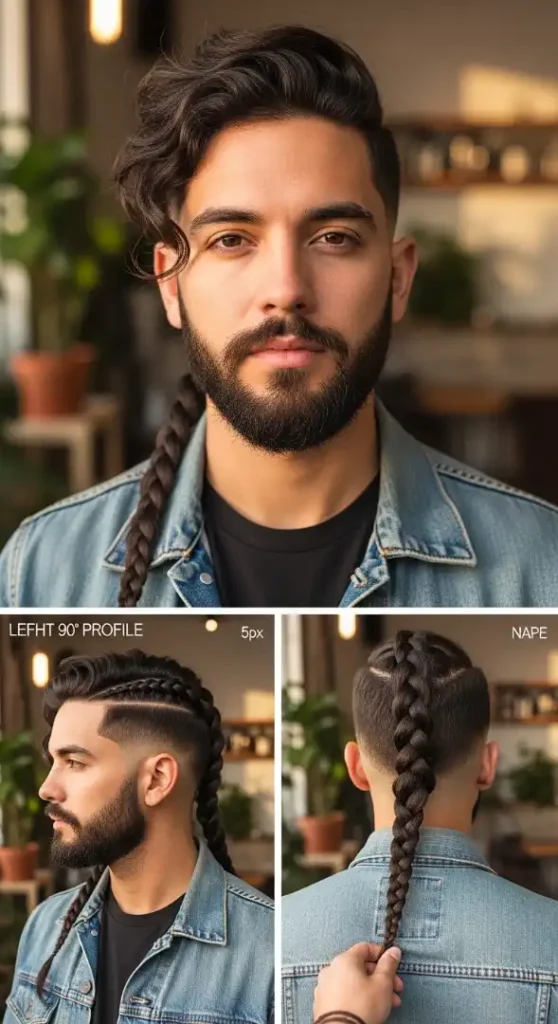
Which Face Shapes Work Best
The Bohemian Side Braid Flow demonstrates remarkable versatility across face shapes, particularly excelling with heart and oval structures. For heart-shaped faces, this style is transformative — the asymmetric design with the braid falling over one shoulder draws attention diagonally across the face, balancing the wider forehead that defines this face shape. The subtle undercut on the opposite side removes bulk, preventing the style from adding width where heart shapes don’t need it. Oval faces, as expected, handle this style effortlessly; the asymmetry adds artistic interest without disrupting natural balance. Men with diamond face shapes benefit significantly because the cascading braid and flowing wavy top create softness around the wider cheekbone area, while the undercut provides clean structure. Square faces should embrace this style — the organic, flowing elements counterbalance angular features beautifully, and the asymmetric part line breaks up the straight lines of forehead and jaw. Round faces can make this work by requesting a slightly higher undercut fade and ensuring the wavy top section has significant height and texture to create vertical visual interest.
Your Complete Grooming Arsenal
Achieving the bohemian aesthetic requires tools that enhance natural texture rather than fight it. Start with the Andis Master Adjustable Blade Clipper for maintaining the undercut fade every 10-14 days at home. The BaByliss Pro Nano Titanium Spring Curling Iron (1.25-inch barrel) enhances your natural wave pattern on the wavy top section before braiding — use it on low heat for 2-3 minutes to add definition. For the braid itself, a wide-tooth Kent comb prevents disrupting your natural wave pattern while sectioning. Product-wise, Ouai Wave Spray applied to damp hair creates effortless texture without crunch — spray liberally before air-drying or diffusing. Bumble and Bumble Thickening Dryspun Texture Spray adds volume to the wavy top section; apply at roots and scrunch. For the braid, a light application of Moroccanoil Treatment smooths flyaways without making hair look greasy or over-polished — bohemian styles should look intentional but not perfect. The medium-length beard requires Honest Amish Beard Balm for daily conditioning and Cremo Beard & Scruff Softener for maintaining natural texture without appearing unkempt. Keep Kristin Ess Working Texture Loose Hold Hair Spray for finishing — light mist over completed braid maintains structure while allowing movement.
Maintenance Reality Check
The Bohemian Side Braid Flow sits comfortably in the medium maintenance range with a relaxed approach. The single side braid requires daily recreation but is faster than complex geometric patterns — budget 8-12 minutes each morning. Here’s the routine: spray Ouai Wave Spray on damp hair (1 minute), air dry or use a diffuser attachment for 5-7 minutes to enhance natural wave, apply Bumble and Bumble Texture Spray at roots and scrunch (1 minute), section off the left side from temple downward with your wide-tooth comb (1 minute), apply tiny amount of Moroccanoil to the section (30 seconds), execute a loose three-strand braid down the left side to shoulder length (4-6 minutes), secure with a clear elastic or small leather cord, apply light texture spray to the wavy top (30 seconds). The undercut fade on the right side requires professional touch-ups every 14-21 days since it’s subtle and doesn’t need the precision of corporate fades. Beard maintenance: 3 minutes daily for balm application and brushing. At night, unbraid completely, brush through gently, apply light serum to ends. Weekly treatment: 15-minute deep conditioning mask on the braided section to prevent breakage from daily braiding. Total weekly time: approximately 1 hour for daily styling plus 25 minutes every two weeks at the barbershop. This style is perfect for creative professionals, artists, and men in casual work environments who want a distinctive look that doesn’t require rigid precision or corporate polish.
Barber Chair Script — Exactly What to Say
Walk into your appointment with this bohemian-focused script: “I want an asymmetric look — long on the left side for braiding, subtle undercut on the right. The left side should be at least 8-10 inches long from my temple down, all one length with no layers, so I can create a substantial three-strand braid that falls to my shoulder. The top section needs to be 5-6 inches with some light layering to enhance my natural wave — I don’t want it flat or all one length, I want movement and texture. On the right side, give me a subtle undercut — not a harsh disconnect, but a gradual fade that removes bulk without looking overly structured. Start the undercut about two inches above the ear and blend it smoothly. I want the part line to be slightly off-center to the left, natural not geometric. The back should blend between the long left side and the shorter right side — think gradual transition, not a hard line. For the beard, trim it to about one inch length overall but keep the texture natural — I don’t want it looking too sculpted or manicured. This is a bohemian vibe, so intentional but relaxed.” This communicates the artistic aesthetic without losing structural guidance.
See how adding beads or accessories transforms a simple side braid into a statement piece in the next tribal-inspired look.
Common Questions About This Style
Q: Will a side braid work if my hair is naturally straight instead of wavy?
A: Absolutely — straight hair actually creates very clean, defined braids with crisp edges. However, the “bohemian flow” aesthetic relies partly on natural texture and movement, which straight hair lacks. If you have straight hair and want this style, add texture artificially: use a sea salt spray like Bumble and Bumble Surf Spray on damp hair, scrunch while air-drying, or run a 1.25-inch curling iron through random sections before braiding to create loose waves. Alternatively, embrace the straight hair and go for a sleek, polished side braid instead of the textured bohemian version — it’s a different aesthetic but equally striking.
Q: How do I prevent the braid from damaging my hair when I’m doing it daily?
A: Daily braiding can cause breakage if done incorrectly, but proper technique prevents damage. First, never braid hair when it’s completely dry — spray with water or leave-in conditioner first to add slip and reduce friction. Second, keep tension moderate — the braid should feel firm but not tight. You should be able to slip a finger under the braid at the base without difficulty. Third, vary your braid position slightly every few days — don’t start at the exact same temple point each time, move it half an inch forward or back to distribute tension. Fourth, use seamless hair elastics (like Scünci No Damage elastics) rather than traditional rubber bands. Finally, unbraid completely every night — never sleep in it, as this compounds tension over time.
Q: What length should my hair be on the short side for the asymmetric undercut?
A: The undercut on the short side should fade from about 2-3 inches at the top of the undercut zone down to 0.5-1 inch at the ear, creating a subtle graduated effect rather than a harsh disconnect. This length maintains the asymmetric visual but doesn’t create such a dramatic contrast that the style looks accidental or unfinished. If you go shorter (down to skin or a 1-guard), the asymmetry becomes very bold and reads more punk than bohemian. If the short side is longer than 3 inches, you lose the asymmetric effect entirely and it just looks like you forgot to braid one side.
8 of 10 — The Warrior Viking Braids
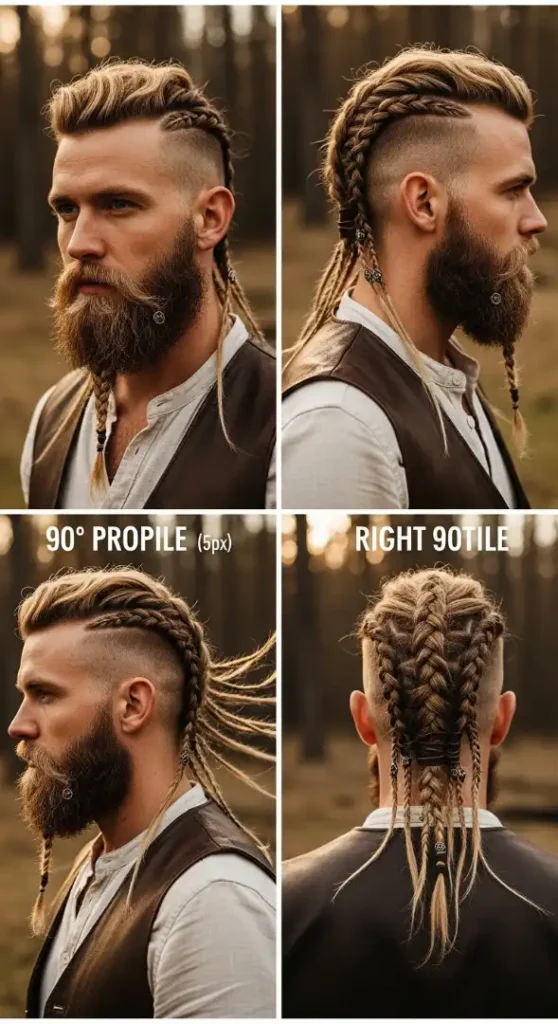
Which Face Shapes Work Best
The Warrior Viking Braids are strategically designed for square and oblong face shapes, though they create a powerful presence across all facial structures. For square faces, this style is exceptional — the multiple thin braids create vertical lines that soften the strong horizontal lines of the jaw and forehead. The braided beard adds length to the lower face, balancing the width of a square jaw while maintaining masculine strength. Oblong faces benefit from the visual complexity; the multiple braid elements create horizontal interest across different levels of the head, breaking up vertical length. The braids flowing over shoulders add width that oblong faces often lack. Oval faces handle this style with ease, as the balanced proportions accommodate the dramatic Viking aesthetic without visual discord. Diamond faces should embrace this look — the fuller braided sections at the crown and the braided beard create balance at top and bottom, de-emphasizing the wider mid-face cheekbones. Round faces need strategic adaptation: keep the top section slightly higher with more volume, use a higher nape undercut to remove bulk from the sides, and keep the beard braids long and vertical to create lengthening lines.
Your Complete Grooming Arsenal
Viking braids demand specialized tools and traditional products for authentic results. The Wahl Professional Peanut Clipper is perfect for maintaining the nape undercut due to its compact size and precision. For braid installation, you’ll need both a wide-tooth wood comb (avoid plastic — wood reduces static and breakage) and a fine-tooth rat-tail comb for precision sectioning. Accessories are part of the look: order Viking beard beads in bronze or silver (available from Norse Spirit or Grimfrost) in 6mm and 8mm sizes to fit different braid thicknesses. Leather cord in brown or black for wrapping 2-3 select braids. Product-wise, Grave Before Shave Bay Rum Beard Oil keeps both head braids and beard braids moisturized — apply daily without fail. Viking Revolution Beard Balm provides the hold needed for beard braids to maintain structure all day. For hair, Uppercut Deluxe Matt Clay applied sparingly to the sections between braids adds texture and grip. Honest Amish Heavy Duty Beard Balm is non-negotiable for the braided beard — it’s firm enough to hold braid structure without being stiff or crunchy. Keep a small spray bottle of distilled water mixed with argan oil (90/10 ratio) for refreshing braids midday. You’ll also need multiple small clear elastics specifically designed for braiding (Goody Ouchless elastics work well).
Maintenance Reality Check
This is unequivocally a high-maintenance style requiring significant daily and weekly time investment. Professional installation of 8-10 Viking braids plus beard braiding takes 2-3 hours initially. The hair braids last 5-7 days if well-maintained before needing complete redoing; beard braids need daily redoing since beard hair is coarser and loosens faster. Daily morning routine: 15-20 minutes total — check all hair braids and re-tighten any that loosened overnight (5-7 minutes), apply Grave Before Shave oil to scalp between braids and to the entire beard (2 minutes), completely unbraid the beard (2 minutes), brush and oil the beard (2 minutes), re-braid the beard into two sections (5-7 minutes depending on length and skill), secure beard braids with elastics and add beads if desired (2 minutes). The nape undercut requires professional or at-home maintenance every 10-14 days for cleanliness. Weekly deep maintenance: 30-40 minutes to oil-massage the scalp thoroughly between all braids, check for any breakage or irritation, adjust accessories, and deep-condition the beard with a 10-minute mask treatment. Total weekly time: approximately 2.5 hours for daily maintenance plus 20-30 minutes every two weeks for the nape cut. This style is ideal for men deeply connected to Viking heritage or who work in creative/alternative fields where bold historical aesthetics are embraced, but it’s impractical for corporate environments or those without 20+ minutes daily for grooming.
Barber Chair Script — Exactly What to Say
This style requires both a skilled braider and a barber, so coordinate accordingly: “I want a full Viking braid setup — multiple thin braids throughout my hair, at least 8 to 10 individual braids total, varying slightly in thickness for a natural hand-braided look, not uniform box braids. Some braids should flow forward over my shoulders, others should hang straight down my back. I need the braids tight enough to last a week but not so tight they cause scalp pain — medium tension. Leave the hair at my temples and around my ears slightly longer before the braids start, creating a natural transition. For the back, I want an undercut at the nape only — fade from about 2 inches of length down to skin at the very bottom of my neck, tapered clean. The top of my head should remain long, no cutting, all length preserved for braiding. I’ll be adding beard beads and leather cord wraps to 2-3 of the braids — can you leave those slightly looser than the rest so I can thread accessories through? For the beard, I want it braided into two sections, one on each side flowing down from my chin. The beard needs to be at least 4-5 inches long for proper braiding — if it’s shorter, let’s grow it out first. Show me how to maintain and re-braid the beard daily since that won’t last as long as the hair braids.” This comprehensive script ensures both artisan and barber understand the complete Viking vision.
Next, discover how modern barbershop techniques adapt ancient braiding into contemporary fades — the fusion creates something entirely new.
Common Questions About This Style
Q: How long does my hair and beard need to be for authentic Viking braids?
A: For the hair on your head, you need a minimum of 6-8 inches throughout to create substantial Viking braids that have visual impact. Braids in 4-5 inch hair look thin and wispy rather than warrior-like. Ideally, 10-12 inches gives you the length to create braids that flow over shoulders dramatically. For the beard, you need at least 4 inches of length to braid into two sections — anything shorter won’t hold braid structure well. If you’re currently at 2-3 inches for beard, grow for another 2-3 months before attempting beard braids. During the growing phase, keep the nape undercut maintained but leave all other hair completely untouched to maximize length.
Q: Are the metal beads and leather wraps necessary or just decorative?
A: They’re primarily decorative and serve to enhance the Viking aesthetic, but they do provide a practical function: beads add weight to the ends of braids, helping them hang straighter and preventing them from curling or kinking. Leather wraps around braids protect those sections from environmental damage and friction. If you’re in a workplace that would view beads as too costume-like, skip them and the braids still work — but in social settings or alternative work environments, the accessories complete the warrior aesthetic and signal intentional historical styling rather than just “guy with braids.” Quality matters: cheap plastic beads look costume-like, while bronze or silver metal beads look authentic.
Q: Can I maintain Viking braids while working out or doing physical activity?
A: Yes, but you’ll need to take precautions. During intense cardio or weightlifting, tie the longer braids back into a low ponytail or bundle them together to prevent them from swinging into your face or getting caught on equipment. After workouts, expect to refresh 1-2 braids that loosened from movement — keep a small elastic and comb in your gym bag. For contact sports, this style isn’t practical since braids can be grabbed or pulled. Swimming is acceptable if you braid wet hair (never dry) and use a swim cap, but chlorine will dry out both hair and beard braids significantly — deep condition after every pool session. For outdoor activities like hiking or camping, Viking braids are actually ideal since they keep hair controlled and protected.
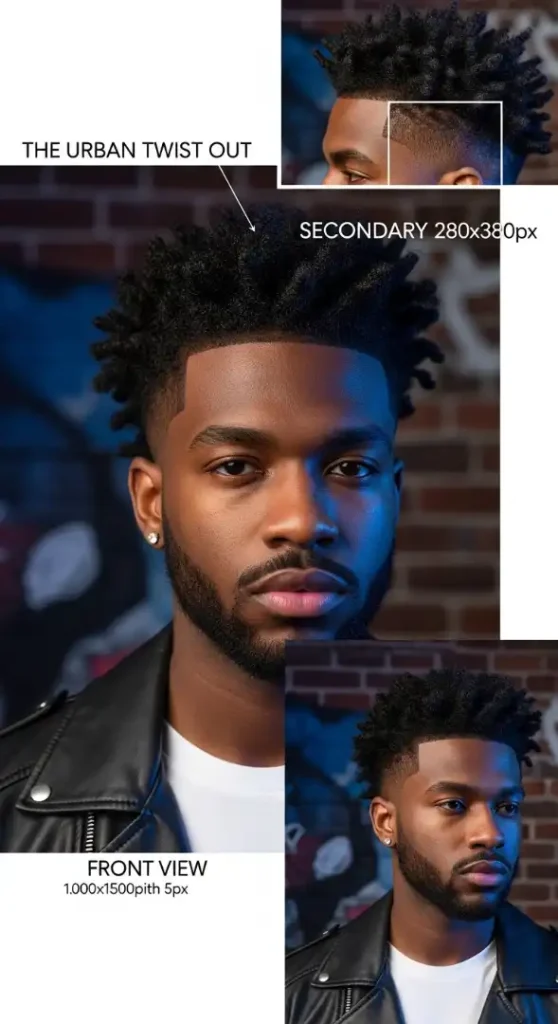
9 of 10 — The Urban Twist Out
Which Face Shapes Work Best
The Urban Twist Out is a universally flattering style that works across all face shapes with proper volume adjustment, though it particularly excels with round and heart-shaped faces. For round faces, this style is revolutionary — the significant height and volume achieved through picking out the twist-out creates vertical visual interest that elongates the face dramatically. The high skin fade removes bulk from the sides, further emphasizing length over width. The geometric corners of the sharp lineup add angular definition that round faces naturally lack. Heart-shaped faces benefit tremendously because the fuller, voluminous top section balances the wider forehead, creating better overall proportion. The clean-shaven jawline option works particularly well for heart shapes since it doesn’t add bulk to the already narrower lower face. Oval faces, always adaptable, wear this style with natural ease. Square faces should embrace the twist-out but may want to soften the lineup corners slightly and request a mid-high fade instead of a strict high fade to avoid over-emphasizing angular features. Diamond faces work beautifully with this style when the twist-out volume is picked outward slightly at the sides as well as upward, creating width at the temple level to balance wider cheekbones.
Your Complete Grooming Arsenal
Twist-out success depends entirely on product selection and technique precision. The Andis Master Cordless Clipper handles the high skin fade maintenance at home every 4-5 days. The Wahl Detailer Li provides the ultra-sharp lineup precision needed for geometric temple corners. For twist-out creation, you absolutely need the Shea Moisture Curl Enhancing Smoothie — apply to damp, freshly washed hair before twisting, approximately a quarter-sized amount per section. Cantu Shea Butter Coconut Curling Cream layered over the smoothie provides additional hold and definition. You’ll need a Denman D3 Brush to detangle and smooth each section before twisting. A wide-tooth Afro pick with a metal handle (not plastic — metal distributes more evenly) is essential for picking out the twist-out to achieve maximum volume. For nightly maintenance, Jamaican Mango & Lime Island Oil keeps the twist-out moisturized and prevents it from drying out between washes. The SheaMoisture Men Maracuja Oil & Shea Butter Beard Balm works on the scalp as well for moisture retention. Keep a satin bonnet or durag for sleep protection — the SILKE London Hair Wrap is luxury-tier but worth it for twist-out longevity. Finally, grab the Mielle Organics Mongongo Oil Thermal & Heat Protectant Spray even though you’re not using heat — it adds shine and seals moisture without weighing down the texture.
Maintenance Reality Check
The Urban Twist Out sits in the medium-high maintenance category depending on whether you’re creating twists fresh or maintaining an existing twist-out. Initial twist installation on freshly washed hair takes 45-60 minutes: section hair into approximately 20-30 two-strand twists (thickness depends on your hair density), apply products to each section, twist from root to tip, allow to air dry 6-8 hours or overnight. Once dry, unraveling takes 10-15 minutes, picking out for volume adds another 5 minutes. The twist-out lasts 5-7 days with proper nighttime maintenance before requiring a full wash and re-twist. The high skin fade requires attention every 4-5 days either professionally or at home. Daily maintenance is minimal once the twist-out is established: 5 minutes each morning to lightly oil the scalp with Jamaican Mango & Lime Island Oil, gently pick out any sections that compressed overnight, smooth edges if needed. Nighttime: 3 minutes to apply light oil throughout, cover with satin bonnet. Weekly wash and re-twist session: 90 minutes total including wash time, conditioning, product application, and full re-twisting. Total weekly time: approximately 45 minutes for daily upkeep plus 90 minutes for weekly wash/re-twist, plus 20 minutes every 5 days for fade maintenance. This style is ideal for men with coily hair textures who want a bold, textured look that doesn’t require daily wet styling but still maintains structure, though it’s not suitable for those who can’t commit to weekly wash-and-twist sessions or nighttime bonnet wear.
Barber Chair Script — Exactly What to Say
Arrive prepared with this detailed script: “I want a high skin fade starting at the temple level, going completely bald at the very bottom. Blend the fade seamlessly — no lines or shelves. The top should remain completely untouched in terms of length — I need all of it for my twist-out. Give me an ultra-sharp lineup with geometric corners at the temples — I want that crisp, fresh-from-the-barbershop precision. Clean up my neck and behind my ears but don’t touch the top length at all. I’m going to be doing two-strand twists on top and picking them out for volume, so I need maximum length preserved. Can you recommend a maintenance schedule for keeping this fade sharp between visits? Also, for my at-home touch-ups, what guard number should I use for the mid-point of my fade?” This focuses the barber on the precision fade work while protecting your top length. The twist-out itself you’ll handle at home, but some barbershops offer twist services — if yours does, add: “Can you also install about 25-30 medium-thickness two-strand twists on top using Shea Moisture Curl Enhancing Smoothie? I’ll pick them out myself once they’re dry.”
The final style brings everything together — combining twist techniques with fade artistry in an unprecedented fusion.
Common Questions About This Style
Q: How long does my hair need to be for a twist-out with significant volume?
A: You need a minimum of 3-4 inches of hair on top to create a twist-out with visible definition and decent volume when picked out. Less than 3 inches results in very tight coils that don’t have enough length to create the characteristic twist-out pattern. For the dramatic, picked-out volume shown in most inspiration photos, 5-7 inches is ideal. This length allows the twists to hang slightly when first unraveled, then achieve 3-4 inches of height when picked. If your hair is currently 2 inches, expect to grow for 2-3 months (coily hair grows approximately 0.5 inches per month) before attempting this style. During growth, maintain the high fade but leave the top completely alone.
Q: How do I prevent my twist-out from getting frizzy after the first day?
A: Frizz prevention is all about nighttime maintenance and product layering. First, never go to bed with an uncovered twist-out — always wear a satin bonnet or durag to reduce friction against your pillow. Second, apply a light oil (not cream or pomade) before covering at night — oil seals the hair cuticle and prevents moisture loss overnight. Third, avoid touching your hair throughout the day — every time you run your hands through a twist-out, you disrupt the coil pattern and create frizz. Fourth, use a quality holding product during installation; Cantu Curling Cream provides better hold than lighter products. If you’re experiencing frizz by day 2-3 despite these measures, your initial product application may be too light — use more Curl Enhancing Smoothie during the twisting phase.
Q: Can I work out with a twist-out or will sweat ruin it?
A: You can work out with a twist-out, but moisture management is critical. For cardio that produces moderate sweat, wear a moisture-wicking headband or sweatband to catch moisture before it saturates your hair — this preserves the twist-out for 5-7 days. For intense workouts with heavy sweating, tie a breathable athletic durag or head wrap during exercise, then remove and pick out the hair again afterward to restore volume. Swimming is the one activity that will completely ruin a twist-out — chlorine and full saturation destroy the coil pattern and require starting over with a fresh wash and re-twist. If you swim regularly, plan your twist-out schedule around swim days, doing your wash-and-twist the day after swimming rather than before.
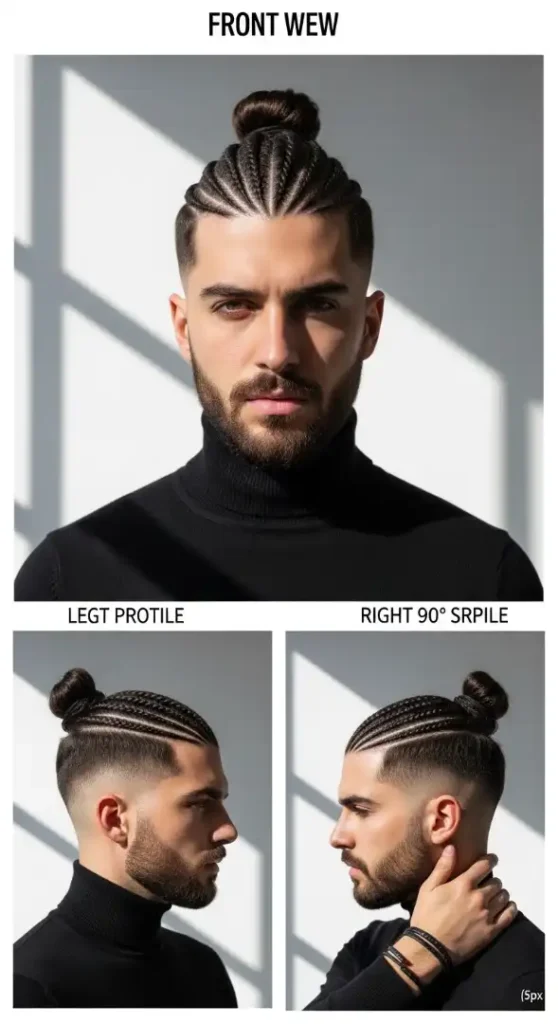
10 of 10 — The Fusion: Faded Man Bun with Underbraids
Which Face Shapes Work Best
The Fusion: Faded Man Bun with Underbraids is engineered specifically for oval and oblong face shapes, though square faces also excel with this hybrid style. For oval faces, this is the ultimate balanced look — the height created by the top knot adds vertical interest without disrupting natural proportions, while the side cornrows add horizontal detail that keeps the style from appearing too simple. The mid-high fade frames the face perfectly. Oblong faces benefit from the visual complexity; the horizontal cornrow lines running into the vertical bun create a pleasing counterbalance that breaks up length. The fuller top section prevents the face from appearing too narrow. Square-faced men should absolutely consider this style — the rounded shape of the bun and the flowing lines of the cornrows soften angular features dramatically. The mid-high fade removes bulk without being so aggressive it emphasizes the jaw width. Diamond faces work well when the bun is positioned slightly higher (closer to the crown than the back of head) to add structure at the upper face. Round faces need modifications: request a higher bun placement for maximum height, keep the fade higher (high instead of mid-high), and ensure the cornrows run strictly horizontal rather than angling upward. Heart-shaped faces should keep the bun lower and fuller to add visual weight to the narrower lower face.
Your Complete Grooming Arsenal
This fusion style demands precision tools for both fade and braid maintenance. The Wahl Professional 5-Star Cordless Magic Clip is your primary tool for mid-high fade maintenance every 5-7 days at home — its taper lever provides the control needed for graduated blending. The Andis T-Outliner delivers the ultra-sharp lineup precision this style requires. For the man bun, you’ll need high-quality hair ties — Goody Ouchless Hair Elastics in clear or black prevent breakage and don’t leave creases in straight hair. For cornrow maintenance, keep a fine-tooth rat-tail comb for precision parting and re-braiding touch-ups every 7-10 days. Product selection is critical: American Crew Firm Hold Styling Gel smooths the hair before gathering into the bun and provides all-day hold. Layrite Original Pomade applied to the cornrow sections before braiding adds grip that keeps braids tight for 10-14 days. Baxter of California Hard Cream Pomade works on both the slicked sides and for adding texture to the bun itself if you want a slightly messy aesthetic rather than ultra-smooth. For the tapered beard, Honest Amish Beard Balm provides conditioning and light shaping. Keep Suavecito Matte Pomade for finishing — smooth any flyaways on the sides or around the bun perimeter.
Maintenance Reality Check
The Fusion style registers as high-maintenance due to the combination of elements requiring separate attention. The man bun itself requires daily recreation unless you perfect sleeping with it intact (difficult with straight hair). The cornrows last 10-14 days before needing professional redoing or confident self-braiding. The mid-high fade requires attention every 5-7 days. Here’s the daily routine: 15-18 minutes total — lightly dampen hair with water or leave-in spray (1 minute), brush through the loose top section (1 minute), apply American Crew Firm Hold Gel to the top section (1 minute), carefully gather hair from the front hairline backward toward the crown avoiding disrupting the cornrows (3-4 minutes), secure into a top knot with elastic and arrange for desired tightness and height (2-3 minutes), smooth the sides between the cornrows and fade with Baxter pomade (2 minutes), apply light pomade to the cornrows themselves to tame any frizz (2 minutes), check lineup sharpness and touch up if needed with trimmer (2-3 minutes), apply beard balm and shape (2 minutes). Weekly cornrow maintenance: 15-20 minutes to check for loosening, apply fresh Layrite Pomade to the braided sections, re-braid any that are failing. Total weekly time: approximately 2 hours for daily styling plus 30-40 minutes every week for fade touch-ups and cornrow inspection, plus full cornrow redo every 10-14 days (60-90 minutes at a braider or 45 minutes self-done if skilled). This style is perfect for fashion-forward men in creative industries who want a distinctive hybrid look that combines multiple trending elements, but it’s impractical for early morning schedules or those who prefer wash-and-go simplicity.
Barber Chair Script — Exactly What to Say
This fusion style requires coordination between barber and braider, so arrive with this comprehensive script: “I want a hybrid style combining a man bun, side cornrows, and a fade. Here’s the breakdown: The top section from my hairline back to the crown needs to remain long — at least 8-10 inches for a substantial bun. On each side, starting at my temple, I want three thin cornrows running horizontally backward. These cornrows should start about an inch above where my fade begins and run all the way back to where my bun will sit at the crown — essentially they’ll feed into the bun. Make the cornrows tight and precise, about half an inch apart from each other. Below the cornrows, I need a mid-high skin fade — start the fade at the top of my ear, blend upward to about an inch below where the bottom cornrow starts. The fade should go to complete skin at the very bottom. Give me an ultra-sharp lineup with crisp corners at the temples. The beard should be tapered to match the fade aesthetic — keep about half an inch length overall with clean lines at the cheek and neck. At the back of my head, the fade blends into the area where the bun will sit. Can you show me how to position the bun so it doesn’t disrupt the cornrows, and how to re-braid these cornrows myself when they start loosening in 10 days?” This ensures both technical precision and teaches you the maintenance fundamentals.
Common Questions About This Style
Q: How do I position the man bun so it doesn’t mess up the cornrows?
A: The key is gathering your hair above and slightly forward of where the cornrows end at the crown. Think of it as creating a “safe zone” where the bun sits independently without pulling on the braided sections. When gathering your hair into the bun, use your fingers to carefully comb the loose top section backward while completely avoiding touching the cornrows — they should remain undisturbed. Secure the bun tight enough to hold all day but not so tight that it pulls the skin at your crown and puts tension on the cornrow endpoints. If you notice the cornrows loosening at the back after a few days of bun-wearing, you’re likely positioning the bun too far back or gathering too aggressively. Move the bun position slightly higher or more forward.
Q: Will the cornrows damage my hairline if I’m also pulling hair into a bun daily?
A: When done correctly with proper tension management, the combination shouldn’t cause damage. However, you’re right to be cautious — this style does involve two different tension sources on your scalp. To prevent damage: First, ensure the cornrows are installed with moderate tension, not tight tension. Second, vary your bun position slightly every few days — don’t pull from the exact same spot daily. Third, give your hair regular breaks — once every 7-10 days, skip the bun entirely and either wear the hair loose (with cornrows still in) or slick it straight back into a low ponytail instead. Fourth, never gather wet hair into a bun — wet hair is more prone to breakage when pulled. If you notice tenderness, thinning at the hairline, or persistent tension headaches, loosen both the cornrows and the bun immediately.
Q: Can I achieve this style if my hair is curly or wavy instead of straight?
A: Absolutely, though the aesthetic will differ. Curly and wavy hair creates a fuller, more textured bun with more volume, while straight hair creates a sleeker, more compact knot. For the cornrows, curly/wavy hair actually braids more easily than straight hair due to better grip between strands, and the braids tend to last longer (12-16 days vs. 10-14 for straight hair). The fade component works identically regardless of hair texture. If you have very tight coils rather than loose waves, you might need to slightly adapt the technique — use a denman brush or wide-tooth comb to smooth each section before braiding the cornrows, and apply more product (curl cream or braiding gel) for definition. The man bun on coily hair requires a different securing method — you may need two elastics or hair pins to keep the bun stable.