20 Korean Hairstyles for Men: Two Block, Comma Hair & K-Pop Cuts for Winter
Korean hairstyles for men are running men’s grooming right now — searches for Korean comma hair are up 400% in a year, the two block is the most-booked cut in Seoul salons, and every K-drama lead is a walking reference photo. Winter is the season these cuts were made for: Korean styles keep length and softness on top, which means they grow out gracefully under beanies, sit perfectly above coat collars and scarves, and never look flat the way short fades can in cold, dry air.
This guide covers the 20 korean hairstyles for men worth asking for this winter — the classic two block, comma hair, see-through fringes, Korean perms, curtain styles and soft mullets. Every look comes with the face shapes it flatters, the kit it needs, an honest maintenance rating and a word-for-word barber script you can read out in the chair. New to the K-style world? Start with the two block in Style 1 and the low-maintenance options in our short winter haircuts guide. Want the edgier side of Seoul style? The Korean cuts inside our wolf cut collection take the same softness and add shag.
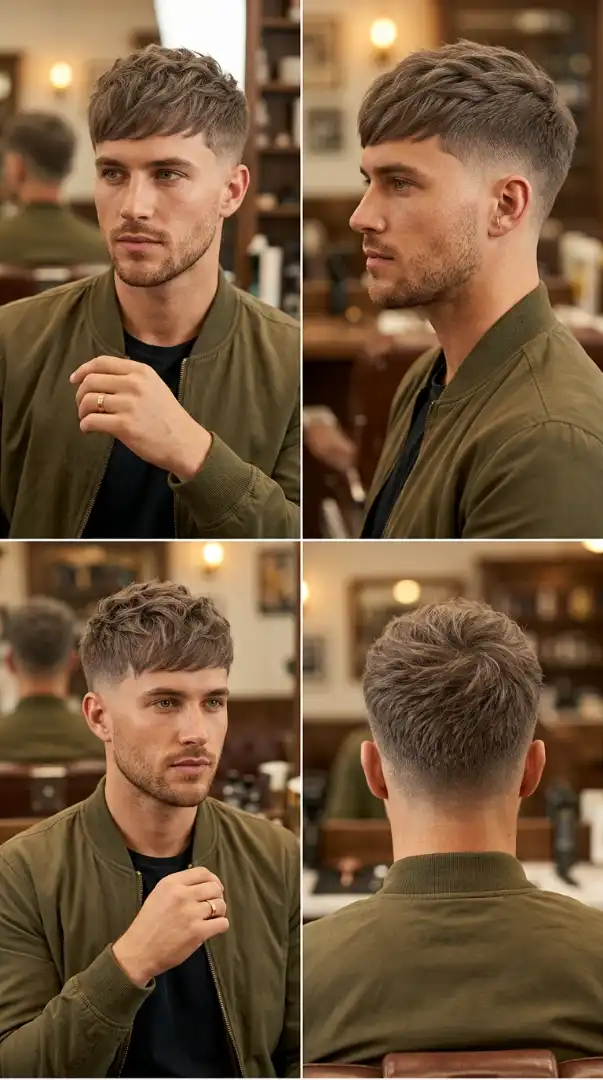
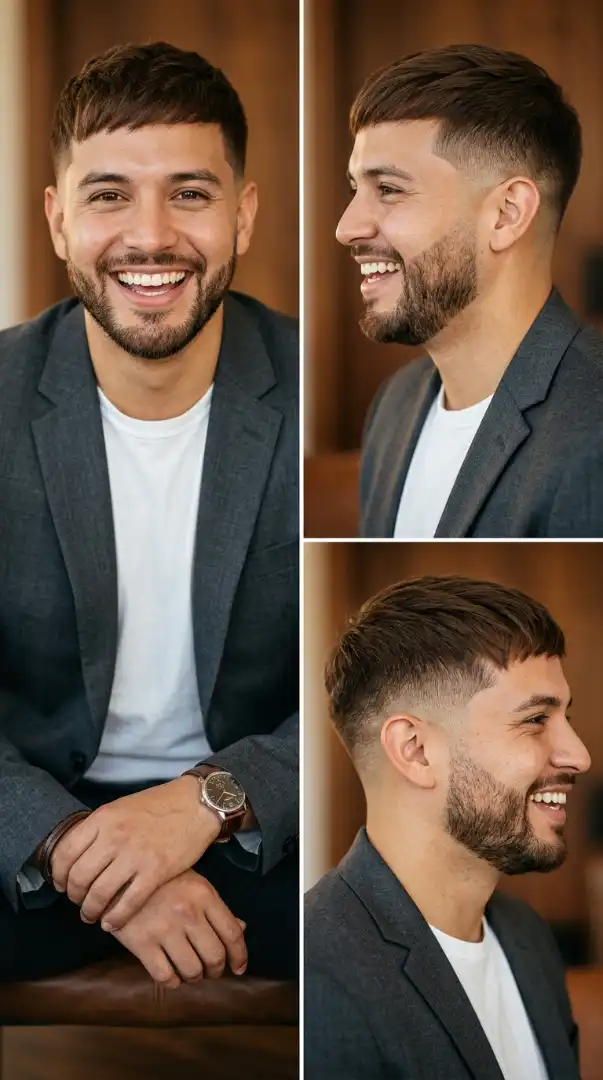
A quick note on the Korean difference before we start: Korean barbers cut with scissors far more than clippers, work in two distinct length “blocks”, and finish with almost no visible product — the hair should look like it simply grows that way. Ask for that softness by name and you are already halfway to the look.
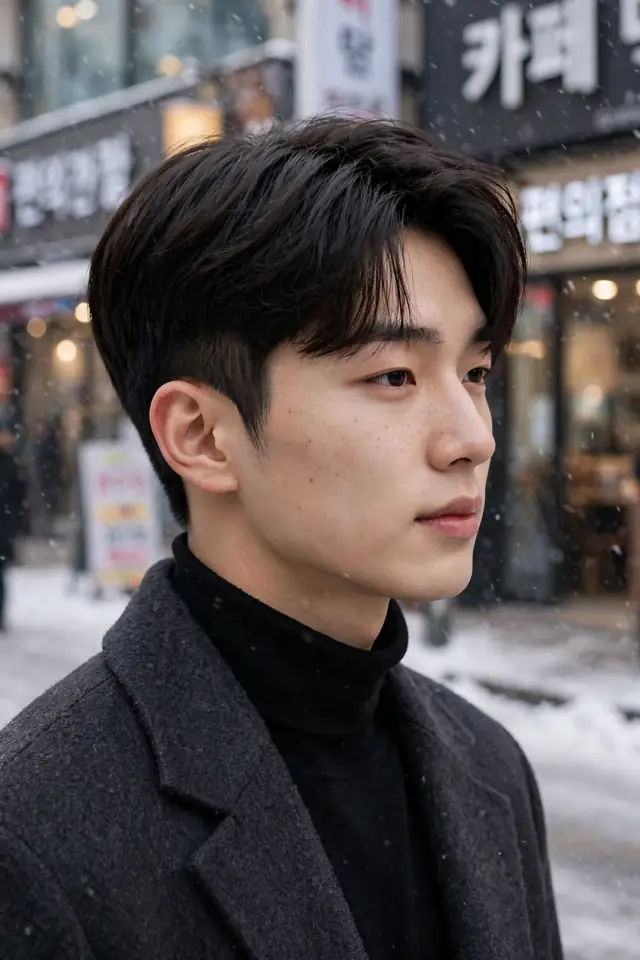
1 of 20 — The Classic Two Block
What makes this the definitive of all korean hairstyles for men?
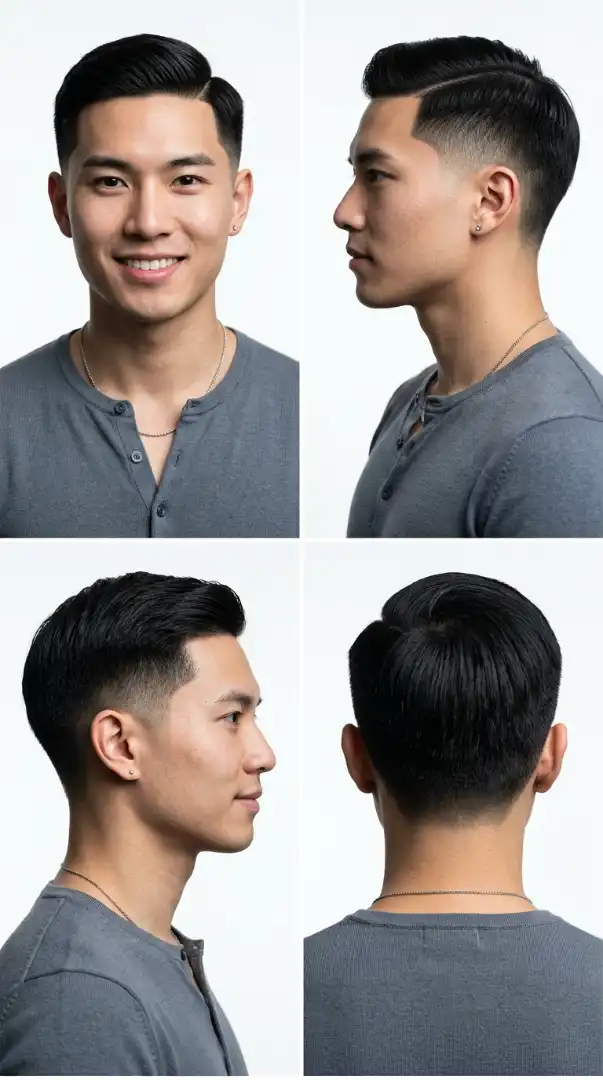
It is the blueprint every other look on this list is built from. The two block divides the head into exactly two lengths: a short, neat lower block around the sides and back, and a longer upper block that falls over it with a visible, deliberate step — no gradual fading between them. Why does the contrast work so well? Because the long top adds the height and softness Korean styling is famous for, while the tight sides keep the silhouette clean enough for any winter outfit, from a long wool coat to a puffer. If you ask for one Korean cut in your life, this is it.
Face Shape: The tall top balances round and oval faces beautifully, and the clean sides stop wide faces looking wider. Square faces should keep the top softer and less structured.
Grooming Kit: A matte wax or light styling cream, a hairdryer for the forward sweep, and a fine comb. Heavy gel ruins the two block — the finish must stay touchable.
Maintenance: Medium. The step between blocks stays sharp for about four weeks; book trims every 4–5 weeks and wash with a gentle shampoo to keep the top soft.
Barber Script: “A two block cut, please. Keep the top long and full, cut the sides and back short in one clean step — not a gradual fade — and leave natural texture through the top.”
Q: Is a two block the same as an undercut? A: They are cousins, not twins. An undercut disconnects with a hard contrast all around, while a two block keeps the step softer and scissor-finished, with the top falling naturally over the sides.
Q: Does the two block work on wavy hair? A: Yes, and waves honestly improve it — the upper block gains free texture. Just ask for the top a touch longer so the wave pattern has room to sit without springing up.
Save this one first — every Korean look you’ve ever screenshotted probably started right here.
2 of 20 — Comma Hair
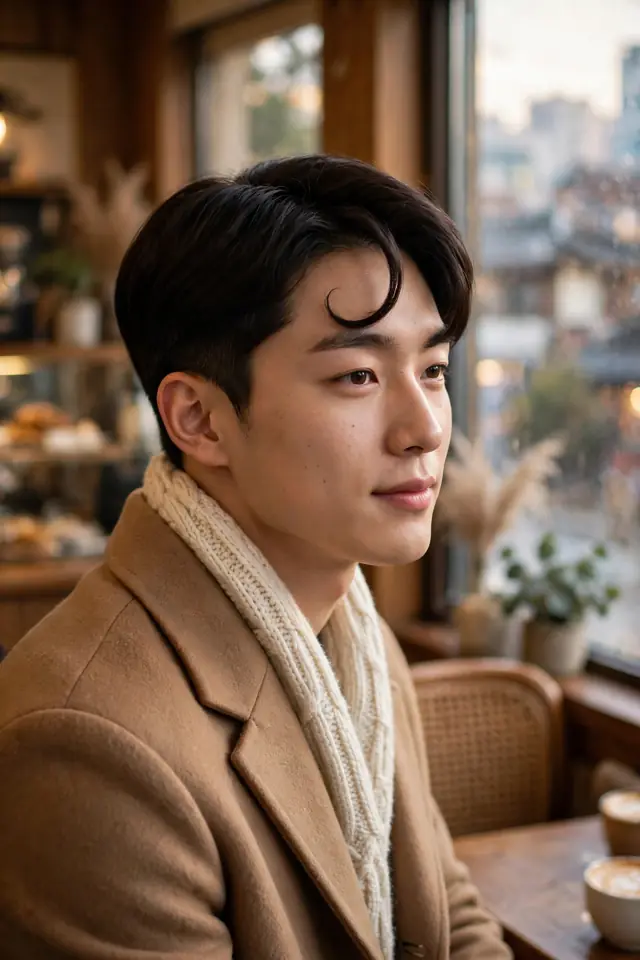
Why is comma hair men are searching for up 400% this year?
Because it is the single most recognisable K-drama hairstyle on earth right now. One front section is dried and shaped so it curls inward across the forehead like a comma, while the rest of the hair sweeps back or to the side. That one curved section does remarkable work: it frames the eyes, shortens a tall forehead and adds a deliberate, styled softness that reads romantic in person and magnetic on camera. It sits on a two block base, so the sides stay winter-neat while the front does all the talking.
Face Shape: Oval and square faces wear it best — the curve softens strong foreheads and brows. Long faces should keep the comma shallow so it does not add visual length.
Grooming Kit: A small round brush, a hairdryer, light-hold wax and optionally a mini flat iron for a stubborn curve. The shape is made with heat, then held with almost nothing.
Maintenance: Medium-high. The comma needs two minutes of heat styling most mornings, and the front section wants reshaping every 4–5 weeks.
Barber Script: “Comma hair on a two block base. Keep the front long enough to curve across my forehead like a comma, the rest swept back, and keep the sides in the short block.”
Q: How do I shape the comma at home? A: Blow-dry the front section forward, then curl it inward and across with a round brush, following the curve with the dryer. Set it with a pea-sized amount of light wax.
Q: Will comma hair suit a receding hairline? A: A shallow comma can actually help by sweeping coverage across one side of the forehead. Keep the curve soft and the part offset rather than centred for the most natural result.
One curved section of hair — that is the entire difference between a good cut and a K-drama lead.
3 of 20 — Two Block with Textured Fringe
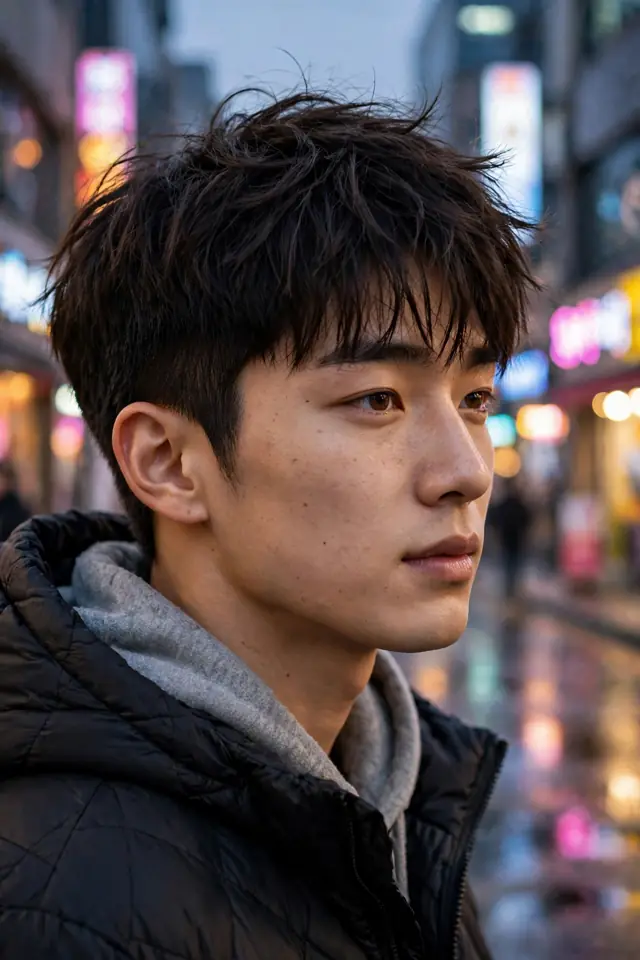
What does a two block haircut gain from a choppy fringe?
Ease. The classic two block top, but the front is point-cut into uneven, textured pieces that fall forward across the forehead instead of sweeping smoothly. The texture fakes thickness on fine hair, hides an uneven hairline and removes all the styling pressure of the polished versions — this is the two block for men who want the Seoul silhouette in a wash-and-go form. In winter it also survives beanie hair better than any smooth style: pull the hat off, shake it out, and the mess still looks intentional.
Face Shape: Round and square faces benefit most, since the choppy front breaks up width and adds angles. Oval faces can wear it at any fringe length.
Grooming Kit: Texture powder or a dry matte paste, and your fingers — that is genuinely the whole kit. A dryer on low speeds up thicker hair in the morning.
Maintenance: Low-medium. The fringe grows forward rather than out of shape, so 5–6 weeks between trims is realistic, with a quick front tidy if it reaches your eyes.
Barber Script: “A two block haircut with a textured fringe. Point-cut the front into choppy pieces falling forward, keep the top textured and the sides in the short block.”
Q: Is a textured fringe good for thin hair? A: It is one of the best options — point-cutting creates overlapping layers that read as density, and the forward fall covers more forehead, so the hair looks fuller everywhere.
Q: How messy is too messy with this fringe? A: When the pieces clump into three or four big chunks, it has gone too far. Work a little texture powder through with dry fingers to separate it back into fine pieces.
The two block’s relaxed younger brother — same bones, zero styling stress.
4 of 20 — Korean Curtain Hair
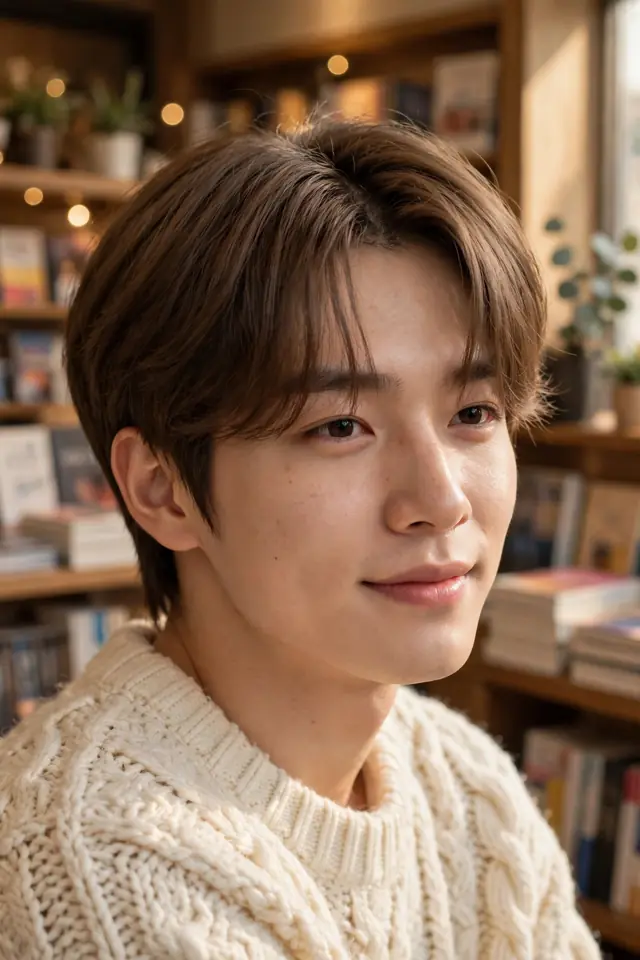
Why does curtain hair men Korean stylists cut look softer than Western versions?
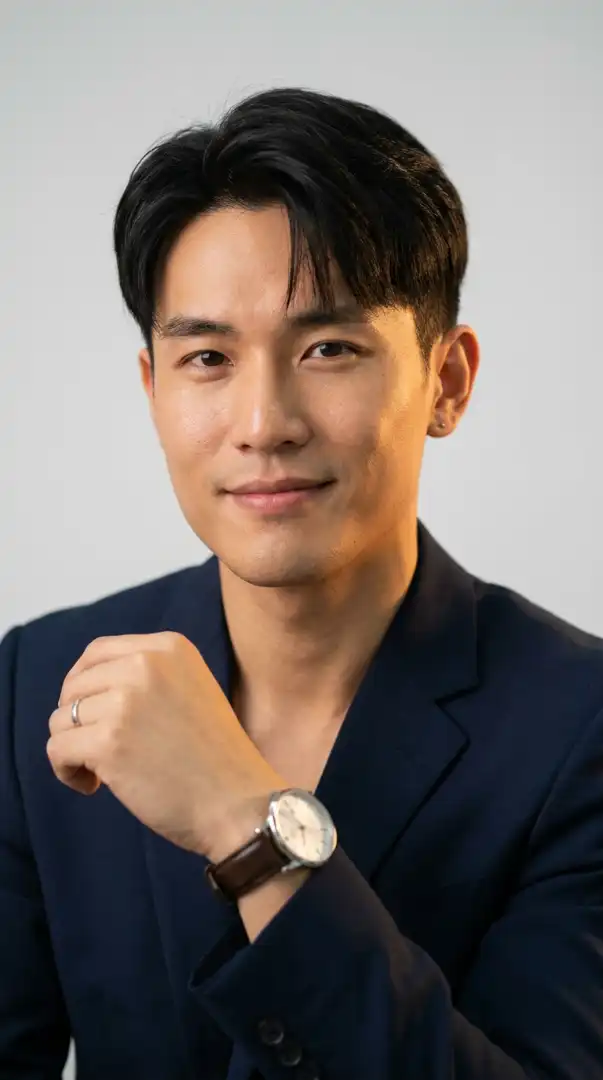
Two details: length and finish. The Korean curtain keeps the fringe long — skimming the eyebrows or below — parts it in the centre and lets it fall in two soft panels, but the ends are scissor-feathered instead of blunt, so the panels melt into the sides rather than hanging like drapes. Worn by every second K-drama romantic lead, it frames the face symmetrically, elongates round faces and pairs perfectly with winter knitwear and long coats. It also grows out gracefully, which matters in the months you least want extra salon trips.
Face Shape: Round and oval faces gain flattering length from the centre part. Heart-shaped faces suit the way the panels soften a narrower jaw, and narrow foreheads should skip it.
Grooming Kit: A light leave-in conditioner, a hairdryer and a vent brush to encourage the part, plus a drop of hair oil for the ends in dry winter air.
Maintenance: Medium. The part needs a quick daily reset with heat, and the feathered ends want a tidy every 5–6 weeks before they start to split.
Barber Script: “Korean curtain hair — a natural centre part with long fringe panels falling to both sides below my eyebrows, feathered ends, and a two block underneath to keep the sides neat.”
Q: How do I train my hair to part in the middle? A: Blow-dry it in the part straight after washing, while it is still damp, for two to three weeks. Hair learns the direction it dries in — after that the part mostly falls on its own.
Q: Does curtain hair work with a beard? A: A short, tidy beard can ground the softness nicely, but heavy beards fight the curtain’s clean frame. If you wear one, keep the cheek lines sharp and the length controlled.
Two soft panels, one natural part — the most romantic haircut on this list.
5 of 20 — See-Through Fringe
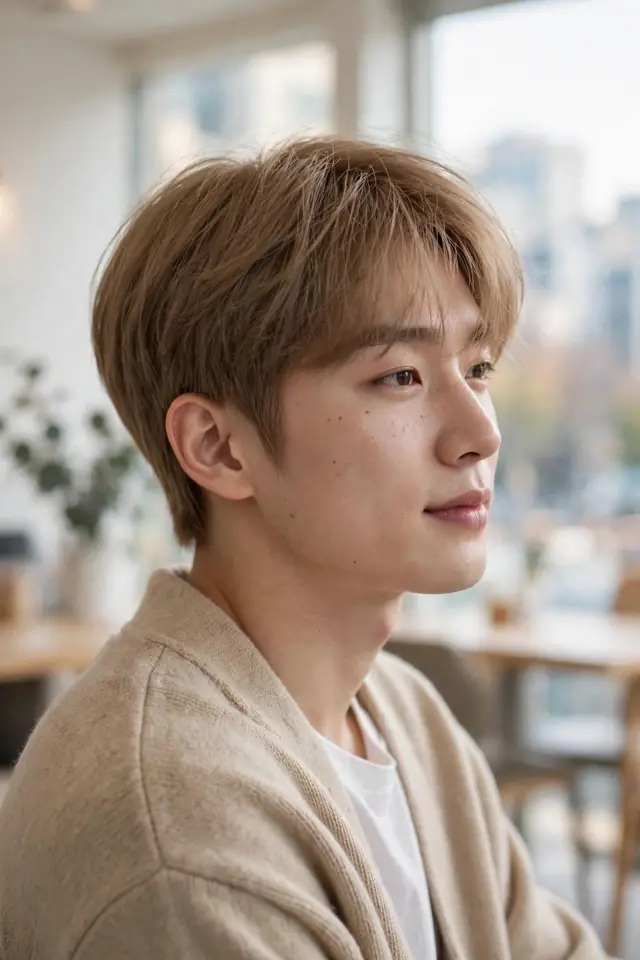
What makes a korean fringe hairstyle ‘see-through’?
Density — or the deliberate lack of it. The stylist thins the front section until you can literally see the forehead between fine, wispy strands: a fringe that suggests itself rather than covering anything. It is the lightest, youngest-looking front in Korean styling, brilliant for smaller foreheads and anyone who finds a full fringe heavy or sweaty. On a two block base it keeps the whole cut airy, and because there is barely any hair in front, it never mats down under a winter hat.
Face Shape: Oval, heart and smaller square faces suit the lightness. Very round faces should pair it with extra height on top so the look does not go too soft.
Grooming Kit: Almost nothing — a fine comb and a rice-grain amount of matte product only if your fringe separates too much. This style is designed to need nothing.
Maintenance: Low-medium. It grows out invisibly, but the wispy front loses its shape fastest, so a five-minute fringe trim every 3–4 weeks keeps it perfect.
Barber Script: “A see-through fringe on a two block base — thin the front right out so the strands stay wispy with skin showing between them, and keep the top light and airy.”
Q: Is a see-through fringe a good first Korean style? A: It is the lowest-risk one on this list. It changes your look gently, grows out without an awkward stage, and pairs with almost any base cut you already have.
Q: Can men with thick hair get a see-through fringe? A: Yes — thinning shears exist for exactly this. Ask the stylist to reduce the front section’s bulk in layers so the wispy effect lasts as it grows, not just on day one.
Barely-there bangs, maximum effect — the fringe for men who swore they’d never wear one.
6 of 20 — Korean Wave Perm
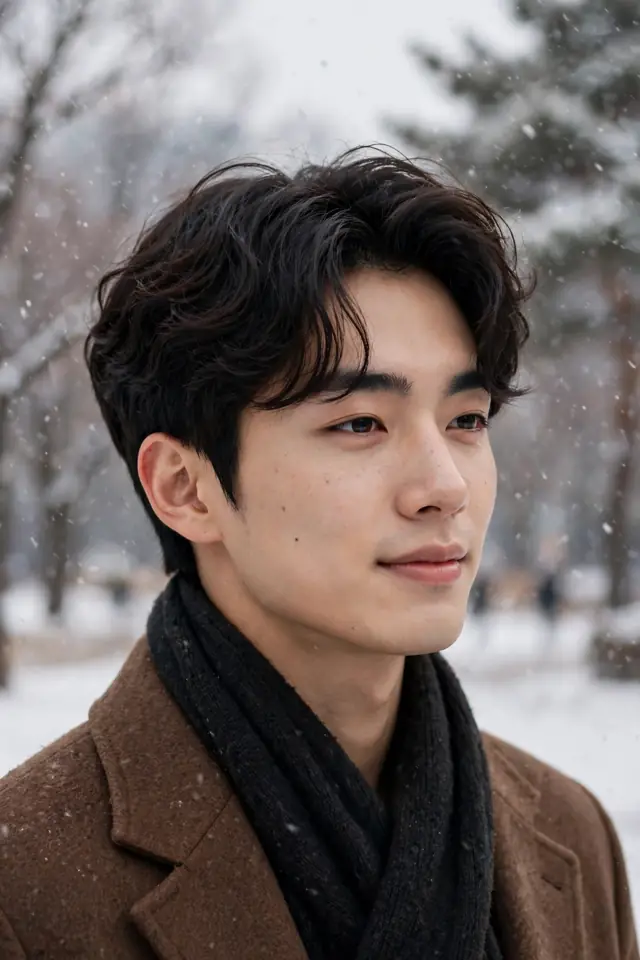
How does a korean perm men get different from a Western perm?
Restraint. A Korean wave perm aims for loose, broad movement — the soft S-waves you see on actors — not the tight coils a Western perm often produces. It is the standard Seoul fix for straight, flat hair that refuses to hold any style: one salon visit gives three to four months of built-in texture, volume at the roots and a top that falls into place with a shake. Winter’s dry air, which flattens natural hair, barely touches a perm — the shape is chemically set, not styled in.
Face Shape: Almost all of them. Waves soften square jaws, add width for long faces and give round faces the height they need. Your stylist adjusts wave size to your proportions.
Grooming Kit: A curl cream or light mousse, a diffuser attachment if you blow-dry, and a sulfate-free shampoo to protect the perm. Put the matte wax away — perms want moisture.
Maintenance: The perm itself lasts 3–4 months; the underlying cut needs a tidy every 5–6 weeks. Daily styling drops to about two minutes — scrunch cream into damp hair and go.
Barber Script: “A Korean wave perm — loose, broad waves with natural movement, not tight curls. Keep the two block base underneath and add root volume on top.”
Q: Will a perm damage my hair? A: Any chemical service stresses hair somewhat, but modern Korean perm solutions are gentler than old formulas. Deep-condition weekly and the waves will stay soft instead of frizzy.
Q: Can I perm hair that is already coloured? A: Tell your stylist first — bleached or heavily dyed hair needs a strand test, and some salons will perm and colour in separate visits a few weeks apart for safety.
Straight hair’s cheat code: wake up with the waves, skip the styling entirely.
7 of 20 — Textured Korean Crop
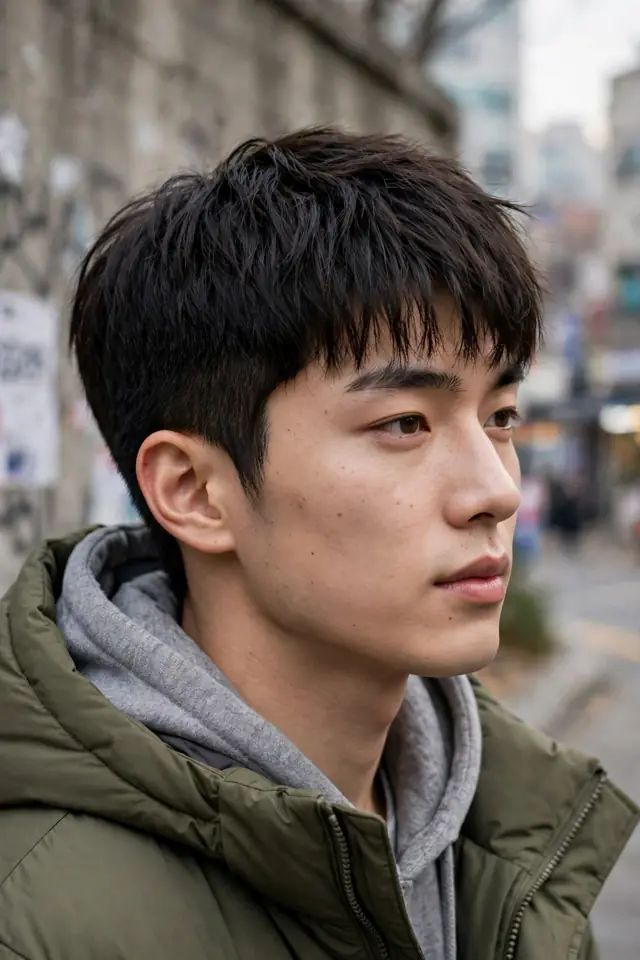
Why is the korean textured crop the easiest K-style to live with?
It keeps the Korean softness but at a length any man can manage. The top is cut short and point-cut into fine, choppy texture, worn forward with a short textured fringe, while the sides use the two block step or a gentle scissor taper. It flatters thick hair by removing bulk in the right places, and it is the one style here that looks identical in a December wind and in a studio photo — there is simply not enough hair to misbehave. Five minutes is a generous styling estimate.
Face Shape: Round faces gain angles from the choppy top; square faces get their jaw softened by the fringe. Long faces should keep the top flatter and the fringe fuller.
Grooming Kit: Matte paste or texture powder and a dryer if your hair is thick. That is the complete list — this crop is built for men who own almost no products.
Maintenance: Low. Every 4–5 weeks keeps the texture crisp, and the grow-out is so forgiving that six weeks still looks deliberate.
Barber Script: “A textured Korean crop — short point-cut texture on top worn forward, a short choppy fringe, and neat two block or scissor-tapered sides.”
Q: Is the Korean crop different from a French crop? A: Closely related, but the Korean version is softer: scissor-finished sides instead of a skin fade, and finer, lighter texture on top rather than a heavy blunt fringe.
Q: Does it suit a man over 30? A: Very well — it reads tidy and modern rather than boyish, especially with the scissor-tapered sides. Keep the fringe slightly longer for a more mature finish.
All the Seoul polish, cropped down to the lowest effort on this list.
8 of 20 — Idol Bleached Two Block
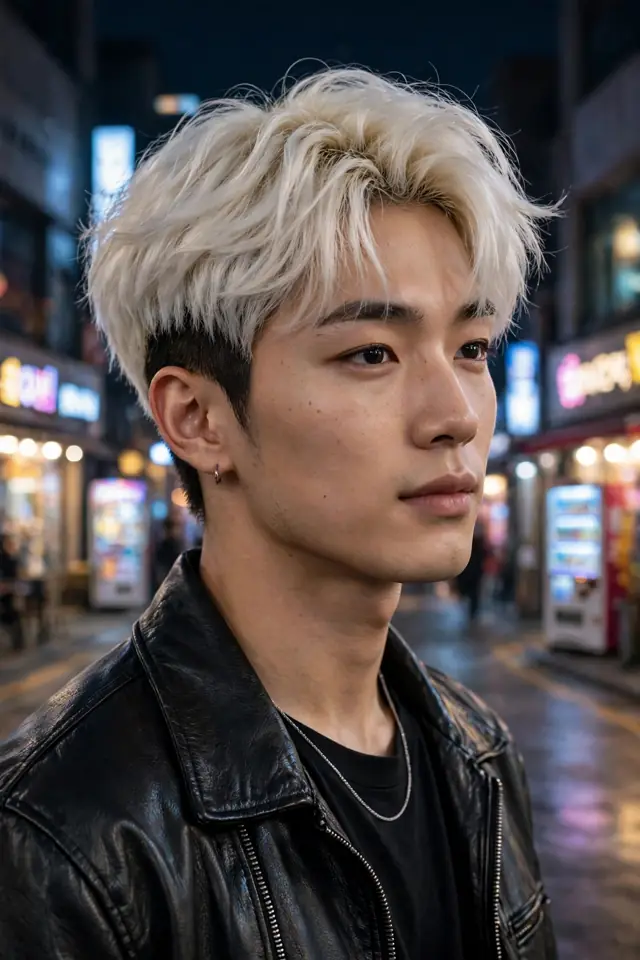
What makes kpop hairstyles men copy from idols look so stage-ready?
Colour doing the heavy lifting. Take the classic two block and lift it to platinum or silver-white, and the same cut becomes a spotlight: every strand of the long top reads individually, the dark roots shadow the step between blocks as it grows, and pale hair against winter’s dark coats is the highest-contrast look in Korean fashion. This is the hairstyle of album covers and music-show stages — and the one that demands the most commitment on this entire list, so read the maintenance before you bleach.
Face Shape: Cooler skin tones carry platinum best, and the pale top slims round faces by drawing the eye upward. Warm complexions should ask for a slightly icy beige instead of pure white.
Grooming Kit: Purple shampoo once a week, a deep-conditioning mask, hair oil for the ends, and a gentle matte cream. Bleached hair is thirsty hair — moisture is the whole routine.
Maintenance: High, honestly. Roots need lifting every 4–6 weeks, toning between visits, and the cut itself every month. Budget both time and money before you start.
Barber Script: “A two block cut with a full platinum bleach. Keep the top long and textured, tone it icy with no yellow, and I understand I’ll be back for root maintenance.”
Q: Will bleaching wreck my hair? A: It weakens it — that is the honest trade for the colour. With bond-building treatments, weekly masks and minimal heat, most men keep bleached hair looking healthy through the season.
Q: Can I go platinum in one session? A: On virgin dark hair, expect two sessions for a clean, even result without breakage. Rushing to white in one sitting is how hair snaps — trust the slower route.
The album-cover look: maximum attention, maximum upkeep — choose it with eyes open.
9 of 20 — Middle Part Flow
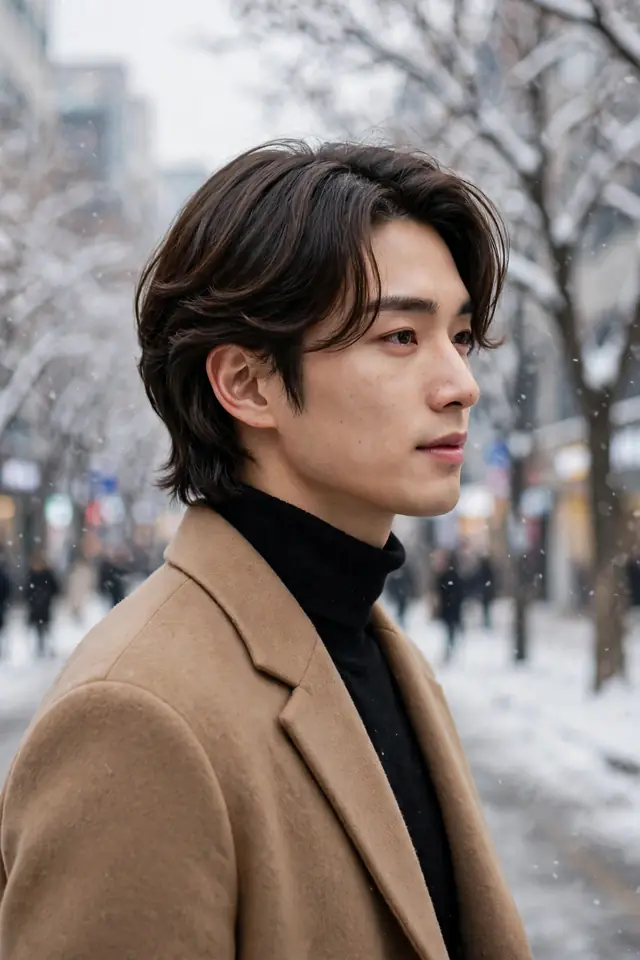
How is a korean middle part different from curtain hair?
Length and movement. The middle part flow takes the centre part and lets the hair grow to medium length, so the panels sweep back and tuck behind the ears in a soft, moving flow rather than hanging as a fringe. It is the grown-up evolution of the curtain — the style actors graduate to — and winter loves it, because the length keeps its shape under a coat collar and the swept-back panels never stick to a scarf. If your hair has any natural wave, this is the cut that finally uses it.
Face Shape: Oval and heart faces are ideal; the sweep-back elongates round faces too. Very long faces should keep the length at the shorter end of medium.
Grooming Kit: A light styling cream, a wide vent brush and a dryer for the initial sweep. A drop of oil on the ends keeps the flow glossy in heated indoor air.
Maintenance: Medium. The shape needs a trim every 6 weeks, and daily styling is a two-minute blow-dry sweep — or nothing at all once the part is trained.
Barber Script: “A Korean middle part flow — medium length, natural centre part, panels sweeping back behind my ears, feathered layers through the ends and tidy scissor sides.”
Q: How long does my hair need to be for the flow? A: Aim for the top to reach roughly the tip of your nose when pulled forward. Below that, the panels start sweeping back and tucking instead of falling in your eyes.
Q: What if my hair is poker straight? A: A light wave perm through the mid-lengths (Style 6) gives straight hair the bend this style needs. Many Seoul salons sell the two as one service — ask about it.
The curtain, all grown up — let it move and it will do the styling for you.
10 of 20 — The Dandy Cut
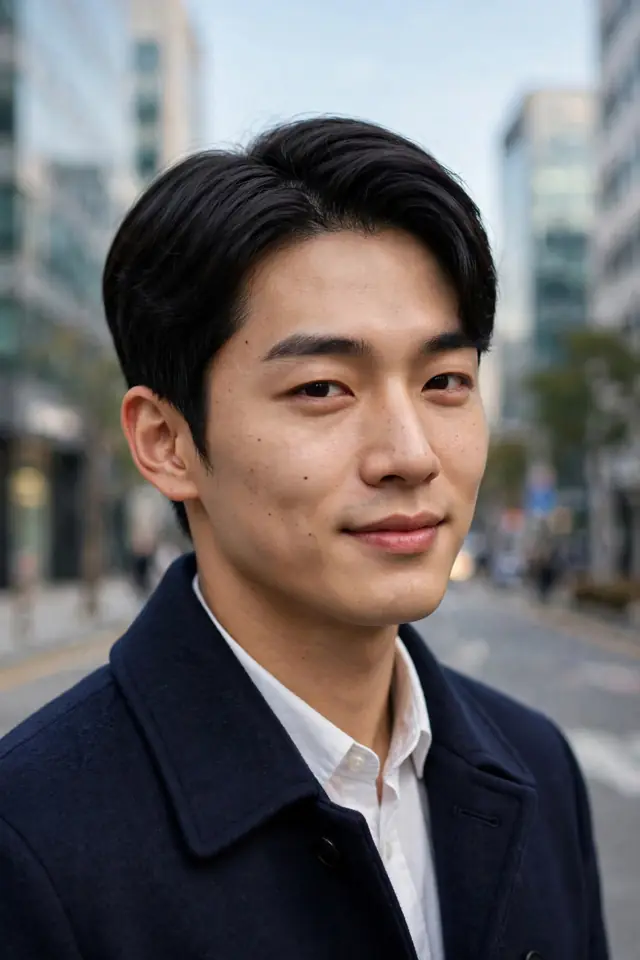
What defines a korean haircut men call the dandy?
Neatness with a soft edge. The dandy cut is Korea’s polished everyman style: a tidy side or 7:3 part, the top kept medium-short and smoothed down with gentle volume, the sides scissor-neat in a low two block, and every edge cleaned without a single harsh line. It is the haircut of news anchors, leading men in family dramas and every groom in Seoul — presentable in any room, at any age, in any weather. For winter office wear with a coat and scarf, nothing on this list is safer.
Face Shape: Universal by design — the adjustable part and volume let a good barber balance round, square, long and oval faces. It is the default recommendation for a reason.
Grooming Kit: A light pomade or grooming cream for the smooth finish, a fine comb for the part, and a dryer for root lift. Small amounts — the dandy never looks wet or hard.
Maintenance: Low-medium. The neatness is the point, so trims every 4 weeks keep the edges honest, but daily styling is under three minutes.
Barber Script: “A dandy cut — a soft 7:3 part, medium-short top with gentle natural volume, neat scissor sides in a low two block, and no hard lines anywhere.”
Q: Is the dandy cut too plain for a young guy? A: Plain is its camouflage — it reads clean and confident rather than styled. If you want more character, ask for a slightly longer top and wear it with the textured fringe on weekends.
Q: Does the dandy suit thinning hair? A: It is one of the better options: the side part and smooth lay create coverage, and the soft finish never clumps hair into revealing sections the way gel can.
Korea’s most trusted haircut — the one that never fails a room.
11 of 20 — Soft Comma Hair
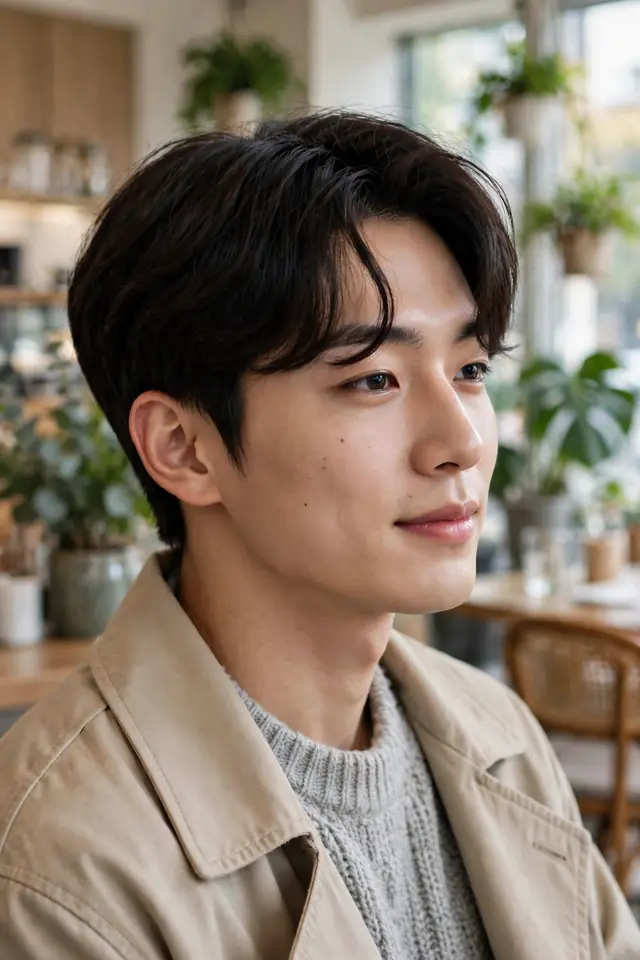
How does comma hair men wear differ in its softer form?
The curve relaxes. Instead of one sculpted comma bent firmly across the forehead, the soft comma lets the front fall in a looser, wispy sweep — the comma shape is suggested rather than engineered. It is the version for men who found the classic comma too deliberate: you get the same forehead-framing romance with a finish that looks like it happened by itself. Seoul stylists reach for it on second visits, once a client has lived with the classic and wants the grown-up edit.
Face Shape: Oval and heart faces suit the softness best; the looser sweep also forgives wider foreheads that the sharp comma can exaggerate. Long faces keep it swept higher.
Grooming Kit: A dryer and your fingers, plus the lightest touch of styling cream. The soft comma is a heat-and-go style — product should be invisible.
Maintenance: Medium. Two minutes of drying most mornings and a trim every 5 weeks; far more forgiving of a missed styling day than the classic comma.
Barber Script: “A soft comma — a loose, natural curve through the front rather than a sharp sculpted comma, on a two block base with soft scissor texture on top.”
Q: Can I switch from classic comma to soft comma without a new cut? A: Usually yes — the shape is mostly styling. Ask your barber to soften the front section’s ends at your next trim and dry it looser, and the softer version appears.
Q: Which comma suits thick, stubborn hair? A: The classic, honestly — its firmer shape holds against strong growth patterns. The soft comma works best on hair that already falls where it is told.
The comma with its tie loosened — same charm, half the effort.
12 of 20 — Two Block Undercut
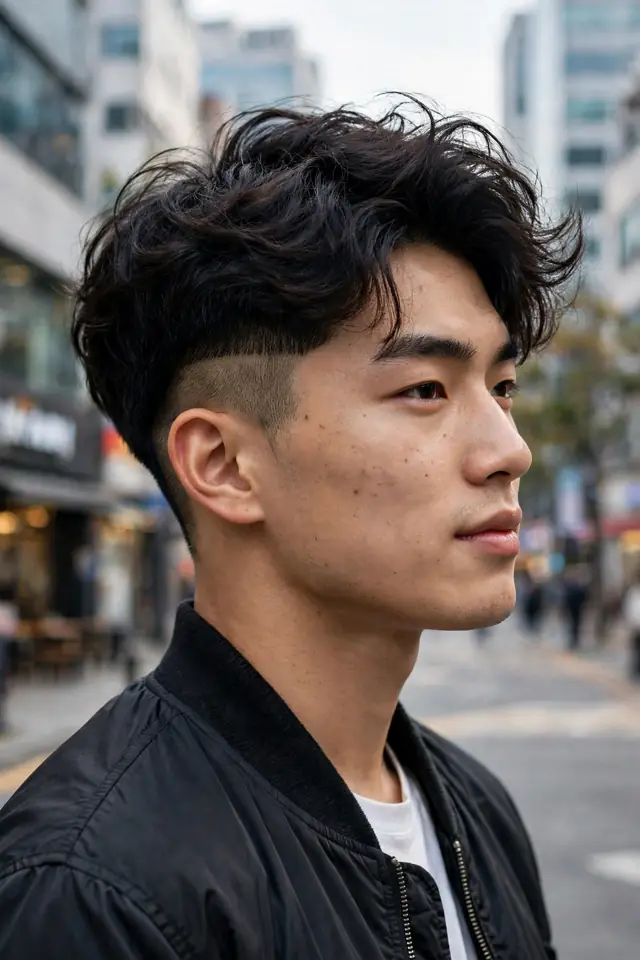
When does a two block haircut borrow the undercut’s edge?
When a man wants the Korean top with a harder contrast underneath. The upper block stays long and soft, but the lower block is clippered shorter and disconnected — closer to undercut territory than the classic scissor step. It is the sharpest silhouette in the two block family: the long top moves and sweeps like Seoul style should, while the tight sides keep it aggressive enough for men who find the classic version too gentle. In winter the contrast reads even stronger against dark coats.
Face Shape: Oval and square faces handle the drama; the long top adds height that benefits round faces too. Narrow faces should keep the sides a grade longer to avoid looking pinched.
Grooming Kit: Matte wax for the top’s sweep, a dryer, and clippers at home only if you are confident tidying the lower block between visits — most men should leave it to the barber.
Maintenance: Medium-high. Disconnected sides show growth fast, so expect barber visits every 3–4 weeks to keep the contrast deliberate rather than accidental.
Barber Script: “A two block with an undercut — keep the top long and soft, clipper the sides and back short and disconnected, with a clean step where the blocks meet.”
Q: How is this different from a normal undercut? A: The top stays longer and scissor-textured in true Korean fashion, and the transition is a structured step rather than a fully shaved separation — softer from the front, sharper from the side.
Q: Does it work with a beard? A: Yes — a short boxed beard mirrors the clean lower block nicely. Keep the beard’s top line below where the haircut’s step sits so the two contrasts don’t compete.
Seoul on top, street edge underneath — the two block with its gloves off.
13 of 20 — C-Curl Perm
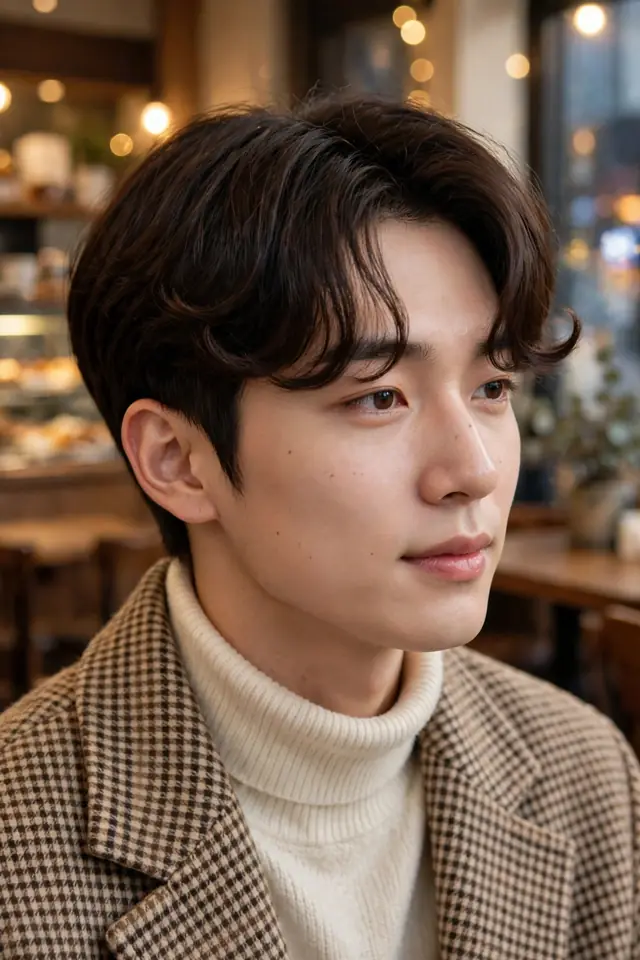
What does a korean perm men choose when they want softness, not waves?
The C-curl perm curls only the ends of the hair inward, toward the face, tracing the letter C. There is no wave through the lengths — just the tips rolling gently under, which rounds off a straight, blocky haircut and makes the whole style look younger and softer. It is a favourite first perm in Seoul because it reads as ‘great haircut’ rather than ‘obvious perm’, and it pairs with the two block and comma shapes especially well. On winter hats it behaves too: the curl lives at the ends, not the roots.
Face Shape: Square and angular faces gain the most — the inward roll softens jawlines and straight hairlines. Round faces should add root volume so the softness does not go round as well.
Grooming Kit: A light curl cream scrunched into the ends, a sulfate-free shampoo, and fingers instead of a comb. Brushes pull the C straight out within the hour.
Maintenance: The perm lasts 3–5 months; the cut under it needs tidying every 5–6 weeks. Daily effort is one minute of cream through damp ends.
Barber Script: “A C-curl perm — curl just the ends of the top inward toward my face like the letter C, keep the lengths straight, on a neat two block base.”
Q: How long does my hair need to be for a C-curl? A: The top should reach at least past your eyebrows when pulled straight — the ends need enough length to complete the inward roll without springing into a hook.
Q: Will a C-curl suit very thick hair? A: Yes, and it is often recommended for it: the inward curl organises thick ends that otherwise stick out, giving a heavy haircut a finished, rounded outline.
Just the ends rolling under — the quietest perm in Seoul, and maybe the cleverest.
14 of 20 — Leaf Hair
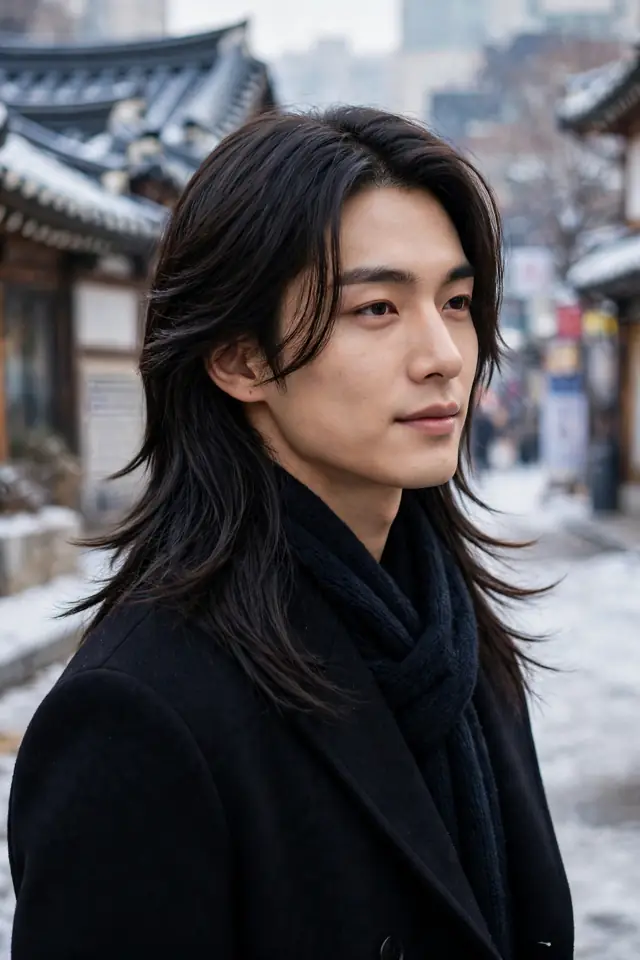
What is a korean middle part with leaf-shaped layers?
Leaf hair (called ‘leaf cut’ in Seoul salons) is the middle part grown long and layered so the front sections fall like two long leaves framing the face — pointed, feathered tips reaching the jaw. It is the most elegant long style in Korean men’s styling, worn by actors in period and modern dramas alike, and it moves beautifully: every turn of the head swings the layers. Winter suits it because the length sits over coat collars and scarves like it was designed for them.
Face Shape: Long and oval faces are the natural home of leaf hair — the jaw-length layers add width where long faces need it. Round faces should keep the front layers above the cheekbones.
Grooming Kit: Leave-in conditioner, a light hair oil for the pointed ends, a wide brush and a dryer. The layers must stay moisturised or the leaf tips turn to straw in heated rooms.
Maintenance: Medium-high. It is a growing style, so trims are only every 8 weeks, but the ends need daily care and the shape asks for a patient two-minute dry.
Barber Script: “Leaf hair — a centre part with long feathered layers framing my face down to the jaw like two leaves, pointed ends, and the back kept long and layered.”
Q: How long does it take to grow into leaf hair? A: From a curtain cut, roughly three to four months of growing the front sections to jaw level. Regular end-trims during the grow-out keep it looking like a style, not an accident.
Q: Can leaf hair be tied back? A: At full length, yes — a low, loose tie keeps the face-framing layers free at the front. It is one of the few long Korean styles that looks as deliberate tied as it does loose.
Two long leaves framing the face — the drama actor’s signature, grown not styled.
15 of 20 — Korean Wolf Cut
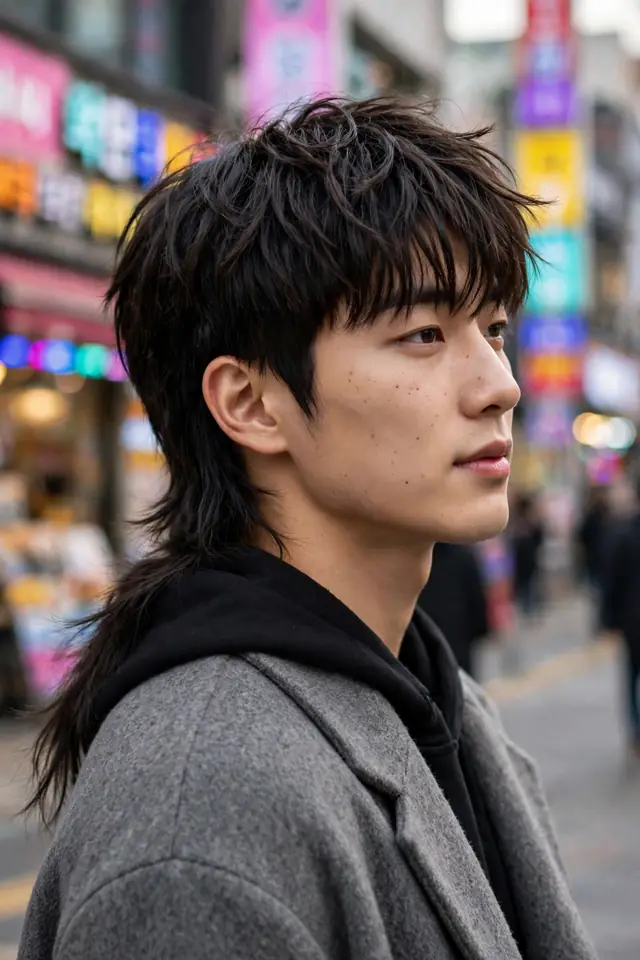
How does the korean wolf cut soften the Western shag?
By keeping the wolf’s shape — heavy layered top, choppy fringe, length at the back — but cutting it with Korean restraint: the layers are finer, the mullet tail is slimmer and feathered, and the whole thing is scissor-softened so it reads tousled rather than wild. It has become a genuine Seoul street staple on the same young crowd that made our wolf cut guide essential reading, and winter multiplies its appeal — shaggy layers were born for oversized coats and high collars.
Face Shape: Oval and long faces wear the full shag best; the back length adds width that helps narrow faces. Round faces should ask for a slimmer tail and more height on top.
Grooming Kit: Sea-salt spray or a light texture cream, a dryer for the fringe, and your hands. Wolf cuts are scrunched and shaken, never combed into place.
Maintenance: Medium. The shape holds 6–8 weeks because the mess is built in, but the fringe and tail want a tidy before they start swallowing your eyes and collar.
Barber Script: “A Korean wolf cut — fine choppy layers on top, a textured fringe, and a slim feathered length at the back, all scissor-softened, nothing too wild.”
Q: Is the Korean wolf cut office-safe? A: In its softer Seoul form, mostly yes — the slimmer tail and cleaner fringe pass in all but the strictest workplaces. Show your barber the softest reference photos you can find.
Q: Does it suit straight hair or does it need waves? A: Straight hair works with enough layering; natural waves make it effortless. Very straight, heavy hair may want a light wave perm (Style 6) to unlock the shaggy movement.
The wolf, Seoul-trained: same bite, better manners.
16 of 20 — Slicked-Back Two Block
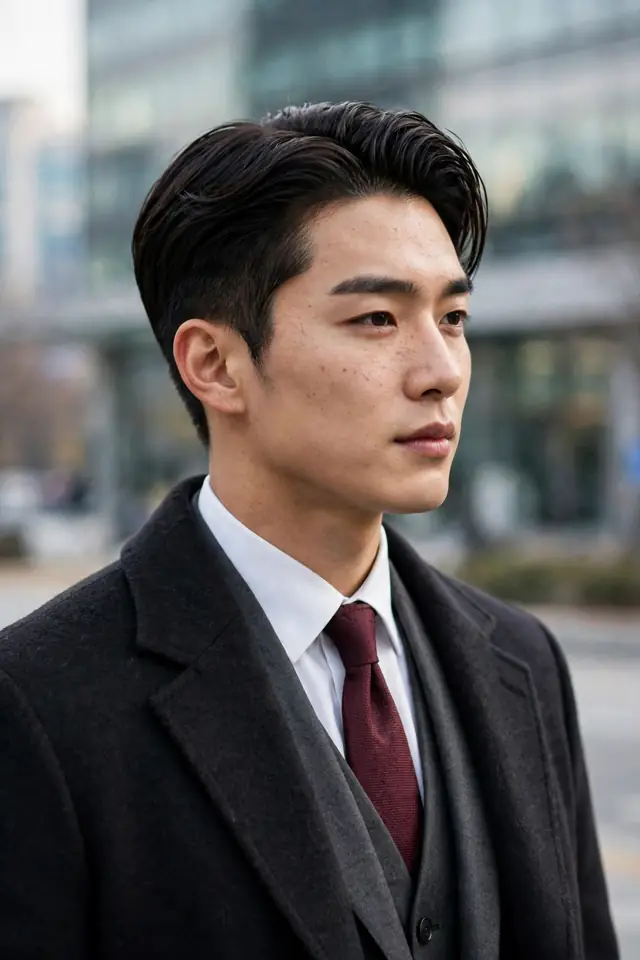
Can a korean haircut men wear look this formal and stay Korean?
Yes — the slicked-back two block is Seoul’s answer to the boardroom. The top keeps its two block length but is dried back off the face in a smooth sweep with soft volume (never the wet, hard slick of Western versions), while the short lower block keeps everything military-neat at the edges. It is the style Korean executives and grooms choose when the fringe-based looks feel too young, and it photographs impeccably at winter weddings and events.
Face Shape: Oval and square faces carry the exposed forehead best. Long faces should sweep the top slightly to one side instead of straight back to avoid adding height.
Grooming Kit: A grooming cream with light hold, a dryer, and a wide-tooth comb for the sweep. Shine should stay satin, not glossy — this is a matte, modern slick.
Maintenance: Medium. Three minutes of drying back each morning, and trims every 4 weeks to protect the clean lower block.
Barber Script: “A slicked-back two block — keep the top long enough to sweep fully back with soft volume, short neat lower block, and a natural matte finish, no wet look.”
Q: My hair falls forward naturally — can it be trained back? A: Yes, with two to three weeks of blow-drying it back while damp. A light perm (the down-perm technique salons use on stubborn fronts) can lock the direction in if training fails.
Q: Does slicked-back suit a receding hairline? A: Sweeping everything back exposes the hairline fully, so early recession usually looks better with a fringe style. A side-swept version (the dandy, Style 10) is the safer formal option.
The fringe takes the day off — Seoul formality, swept clean back.
17 of 20 — Korean Soft Mullet
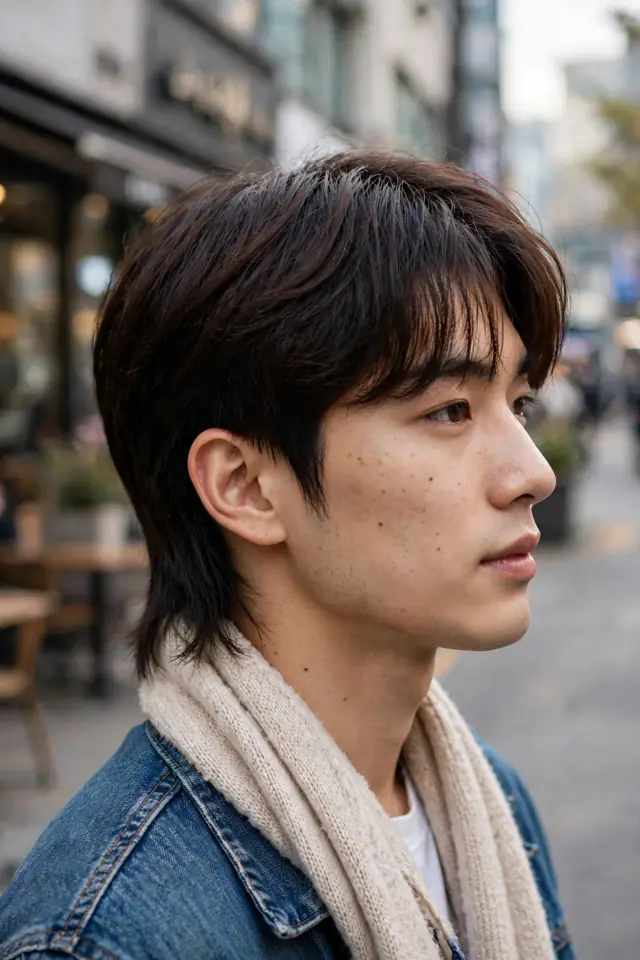
What turns kpop hairstyles men wear into a mullet you could take home?
Proportion. The Korean soft mullet keeps the back length modest — a slim, layered tail that just covers the collar — and blends it into a standard two block front and sides, so from the front it reads as a normal neat Korean cut and only the profile reveals the party. Idols wear it precisely because it photographs tame from the front and interesting from the side. Under a winter coat the tail sits over the collar instead of tangling inside it.
Face Shape: Angular and long faces suit the added back width; oval faces wear it effortlessly. Round faces should keep the tail slimmest and the top tallest.
Grooming Kit: A light texture cream for the tail’s separation, a dryer, and a brush for smoothing the front. The tail wants touching up most days to keep it slim, not puffy.
Maintenance: Medium. The front follows two block timing (4–5 weeks), and the tail needs its shape checked at the same visit before it widens.
Barber Script: “A Korean soft mullet — a normal two block from the front, with a slim layered tail at the back just covering my collar, feathered and neat, not wide.”
Q: How long should the tail be? A: Just enough to cover the collar’s edge — roughly 5–8 cm past the hairline at the nape. Longer than that and it stops being the soft Korean version and becomes a full mullet.
Q: Will the soft mullet suit curly hair? A: Natural curls make the tail fuller, so ask for it cut slimmer to compensate. The front two block stays the same — see the curl-specific options in our curly guide if your hair is very tight.
Business in the front, Seoul in the back — the mullet with its volume turned down.
18 of 20 — Fringe-Up Two Block
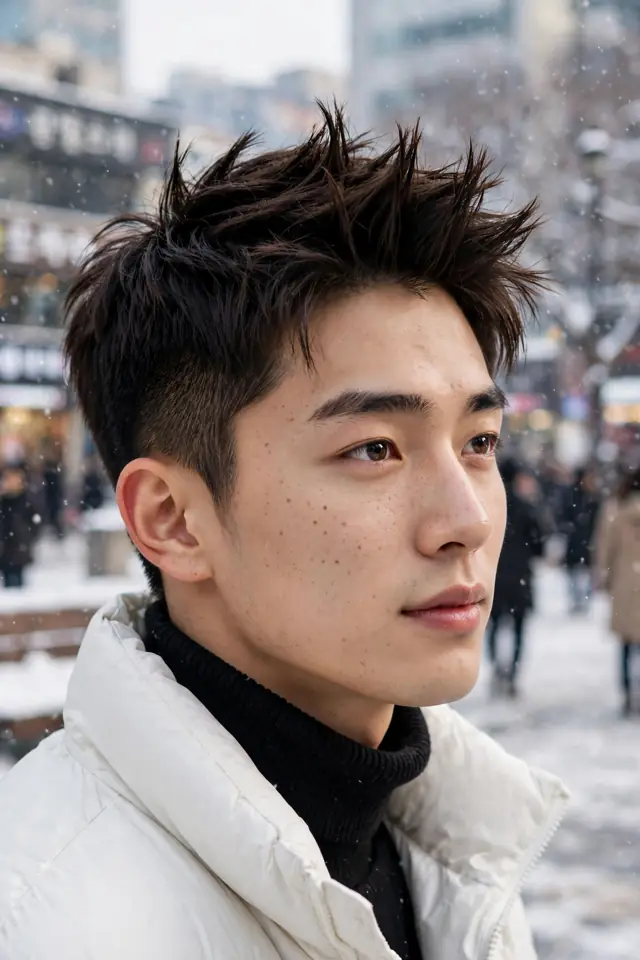
What does a korean fringe hairstyle look like pushed up instead of down?
It becomes the freshest short look in the two block family. The fringe section is cut textured, then dried up and slightly back so it stands in soft separated spikes off the forehead — think of it as the regent-inspired style Seoul stylists call ‘fringe up’. It opens the face completely, shows off brows and eyes, and adds vertical height that flatters round faces. On windy winter days it is also the most hat-proof front here, since there is nothing hanging down to flatten.
Face Shape: Round and heart faces gain the most from the exposed forehead and height. Long faces should keep the lift low and the spikes softer.
Grooming Kit: A dryer, a small amount of strong-but-matte wax, and texture powder at the roots for fine hair. The lift is built with heat first, product second.
Maintenance: Medium. Two to three minutes of styling daily and trims every 4 weeks; the fringe length is critical, so do not stretch appointments.
Barber Script: “A fringe-up two block — textured fringe I can dry up and back in soft spikes, short neat lower block, and enough length on top to stand without looking stiff.”
Q: Will fringe-up work on a high hairline? A: The upright fringe actually draws the eye to the hair itself rather than the hairline’s edge, and the texture adds apparent density — many men find it more flattering than a flat fringe.
Q: How do I stop the spikes collapsing by midday? A: Dry the fringe fully upward while the hair is damp — half-dried roots are the usual cause of collapse. Finish with wax on the ends only, never the roots.
The fringe, standing to attention — the brightest, most open face on this list.
19 of 20 — Long Layered Korean Hair
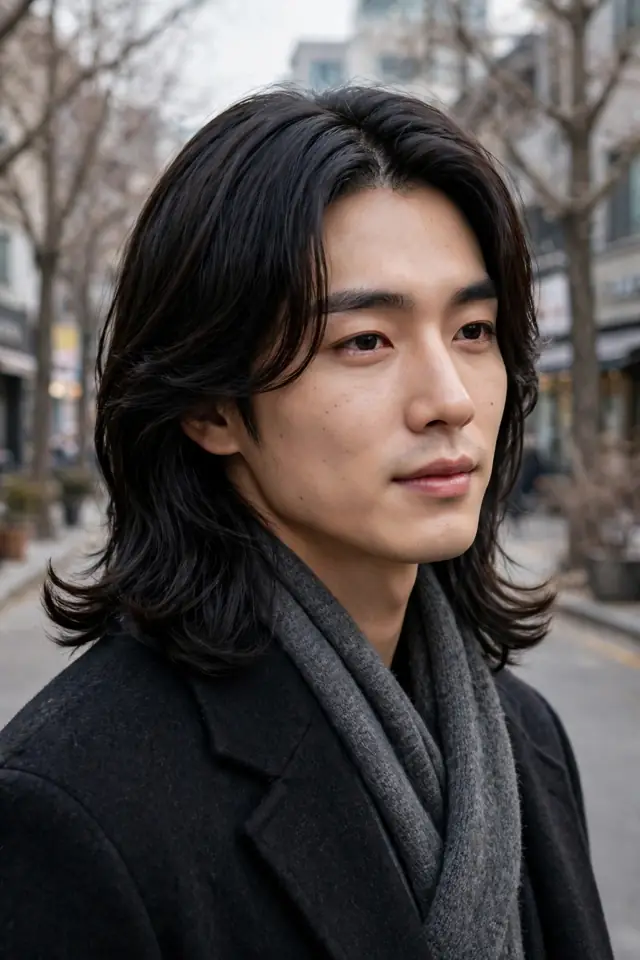
Why does curtain hair men Korean actors grow out become this?
Because this is the curtain’s final form: hair grown to the shoulders, layered throughout so it falls in soft sheets with a natural centre or off-centre part. It is the romantic-lead look at full length — glossy, moving, and unmistakably deliberate. Korean salons maintain it with feathered layers and (often) a whisper of C-curl at the ends so the sheets roll rather than hang. It demands the most patience on this list and rewards it with the most striking silhouette in winter coats.
Face Shape: Oval and long faces carry the length best; the layers add width for narrow faces. Round faces should keep the part off-centre and the front layers starting below the chin.
Grooming Kit: A proper conditioner, leave-in treatment, hair oil, a wide brush and a dryer with a diffuser for the ends. Long Korean hair is a moisture routine with a haircut attached.
Maintenance: High on care, low on cuts: trims every 8–10 weeks to refresh the layers, but daily conditioning and gentle drying are non-negotiable.
Barber Script: “Long layered Korean hair — keep the length to my shoulders, feather layers through the ends, a natural soft part, and a slight inward curl at the tips.”
Q: How long does it take to grow this from a two block? A: Realistically 8–12 months, with shaping trims every two months so the grow-out passes through curtain and leaf stages (Styles 4 and 14) that look good on the way.
Q: Is long hair high-risk for looking unkempt? A: Only if the ends split — layered, conditioned long hair reads as a style; neglected long hair reads as an accident. The difference is the 8-week trim and the oil, nothing more.
The full commitment: a year of growing for the most cinematic hair in Seoul.
20 of 20 — The Finale: The K-Drama Lead
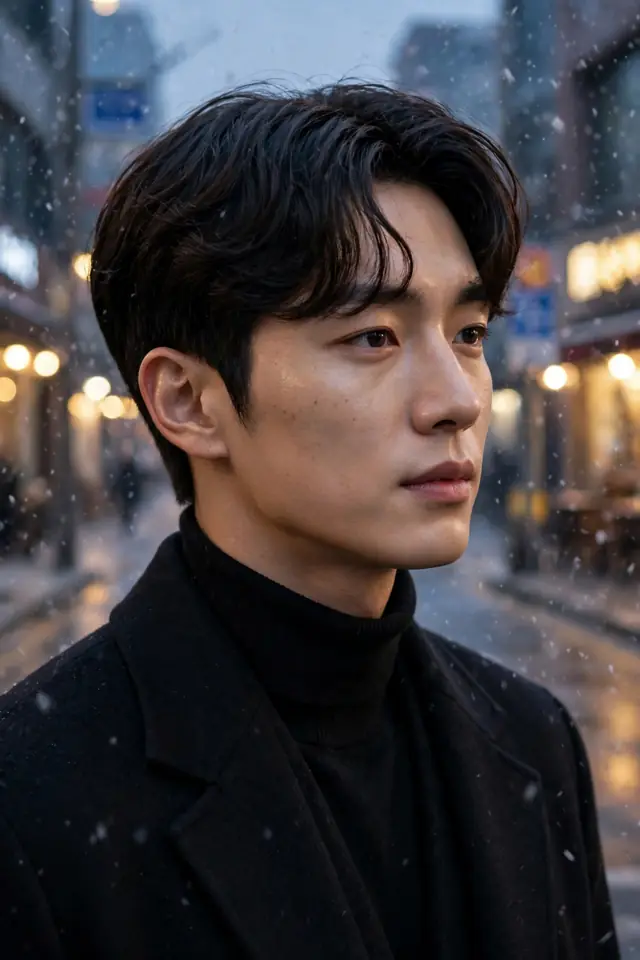
Which of these korean hairstyles for men would the leading man choose?
The one that combines all of them: a two block base carrying a long, softly waved top — part comma, part curtain, with a gentle perm holding the movement and the front falling in that signature curved sweep across one side of the forehead. It is not a single salon menu item; it is the composite look stylists build for drama posters, tuned to the actor’s face over several scenes. Ask for the elements, not the name: two block, soft wave perm, comma-curtain front — and you will walk out with the poster look.
Face Shape: Adaptable by design — your stylist shifts the balance (more comma for tall foreheads, more curtain for round faces) which is exactly why every lead’s version looks slightly different.
Grooming Kit: Curl cream, a diffuser, a small round brush for the front sweep and light wax for the comma curve. This is the fullest kit on the list — the poster look is a routine, not an accident.
Maintenance: High. The perm lasts 3–4 months, the cut wants attention every 4 weeks, and the front sweep is a daily two-to-three-minute ritual. Leads have stylists; you will have a dryer and discipline.
Barber Script: “The full K-drama look: a two block base, a soft wave perm through the top, and the front styled between a comma and a curtain — a curved sweep across one side of my forehead.”
Q: Can one barber visit really create this look? A: The cut and perm can be done in one long appointment; the exact poster finish is styling. Ask the stylist to dry and shape the front once slowly so you can copy the routine at home.
Q: Is this look too much for everyday life? A: Styled at full volume, it is a statement; worn looser with a softer sweep, it passes as simply excellent hair. The elements scale down gracefully — that is the point of building it from parts.
Every style on this list, composed into one — save the best screenshots and take them all to your barber.
The Bottom Line
Korean hairstyles for men win winter because they are built on length, softness and scissor work rather than clipper fades — they grow out gracefully, survive hats, and sit perfectly with coats and scarves. Start with the classic two block if you are new to K-style, chase comma hair if you want the trend everyone’s searching for, and consider a soft wave or C-curl perm if your straight hair refuses to hold any shape at all. Bring the barber script, insist on the soft natural finish, and your winter hair will look like it stepped off a drama set. For more Seoul-flavoured edge, revisit the Korean cuts in our curly hairstyles collection and the medium-length looks in our winter hairstyles guide.