
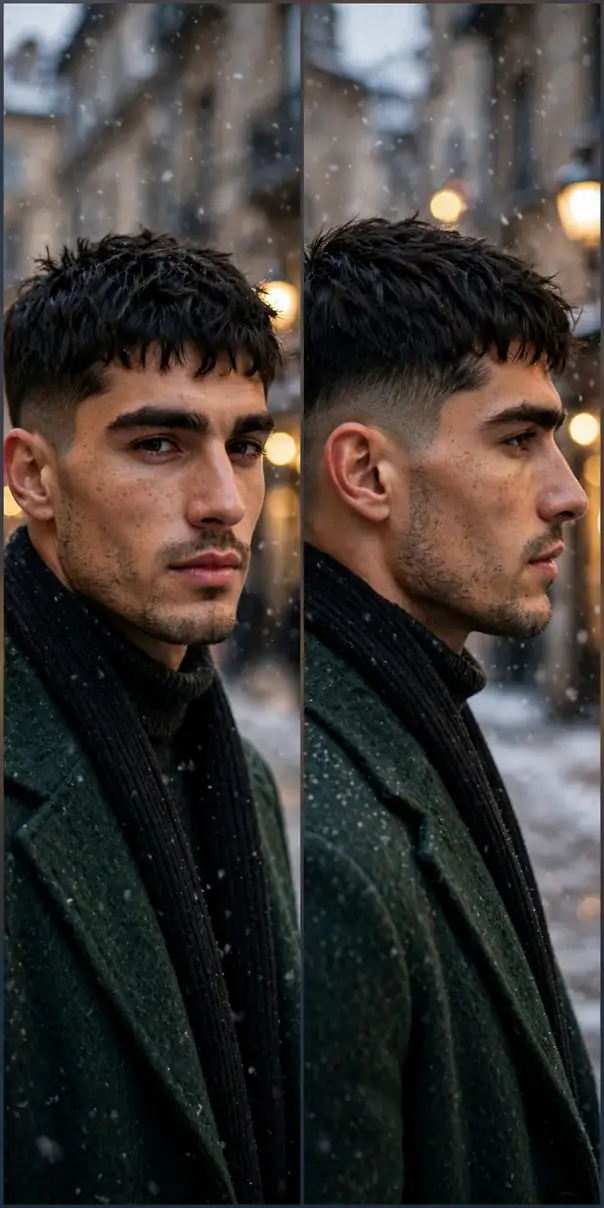
20 Short Mens Hairstyles for Winter: Textured Crops & Taper Fades
Short hair owns winter. It survives beanies, dries fast after snow and never fights your coat collar — and this season the sharpest short haircuts for men are built on texture: choppy crops, forward fringes and clean taper fades. Below are 20 barber-approved looks, each with the face shapes it flatters, the kit it needs and the exact words to say in the chair.
Growing your hair out instead? Our guide to medium-length mens hairstyles for winter covers the longer flows and quiffs. If you are cutting it down for the cold months, start here.
1 of 20 — The Classic Textured Crop
Why is the textured crop the most asked-for mens haircut this winter?
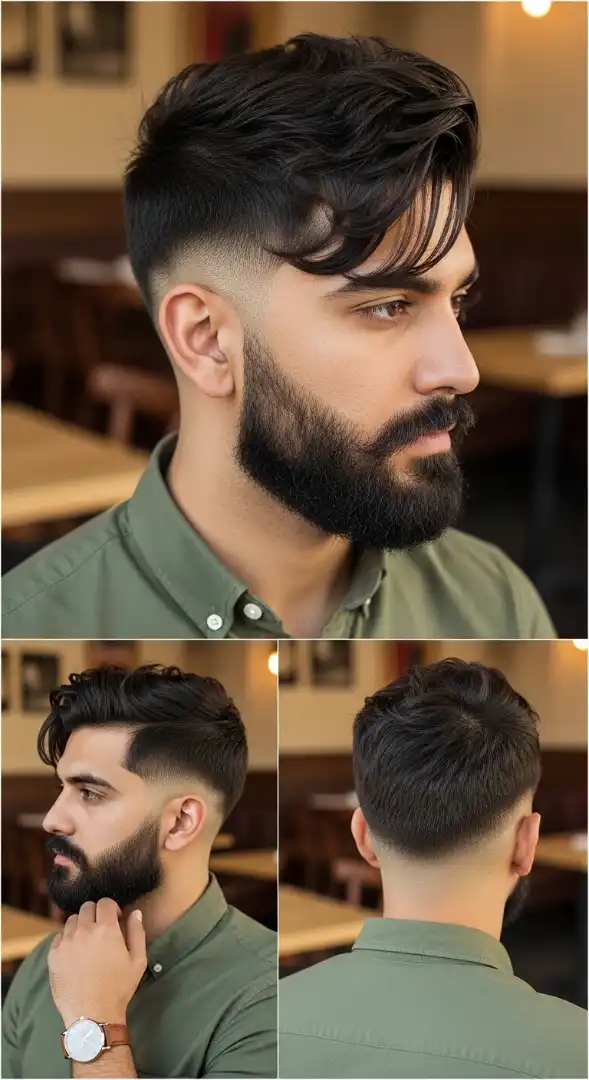
Because the textured crop does everything at once: choppy point-cut layers kill bulk, the forward fall hides a softening hairline, and it styles in under two minutes. Think of it as the french crop’s bigger brother — same family, more movement, finished with a clean taper fade.
Face Shape: Oval and square faces wear it best, because the forward texture softens a heavy brow without hiding the jaw. Round faces should ask for a higher fade to add height, and long faces should keep the fringe fuller.
Grooming Kit: Matte clay (pea-sized amount), wide-tooth comb, sea salt spray for day-two texture.
Maintenance: LOW — trim every 3–4 weeks, 2 minutes daily styling, roughly $25–$35 per month.
Say This to Your Barber: “Textured crop on top, about an inch and a half, point-cut for choppy texture and pushed forward. Mid taper fade on the sides, and keep the fringe natural, not a straight line.”
Q: What is the difference between a textured crop and a french crop?
A: The french crop has a blunt, straight-cut fringe, while the textured crop is point-cut into choppy, uneven layers. The crop looks softer and more lived-in; the french crop reads sharper and more graphic.
Q: Does a textured crop work on thick hair?
A: Yes — thick hair is ideal for it. Point-cutting removes weight so the top lies flat instead of puffing up, and the taper fade keeps the sides tight against winter hats and collars.
Prefer a sharper, straighter fringe? The next look flies in from Paris.
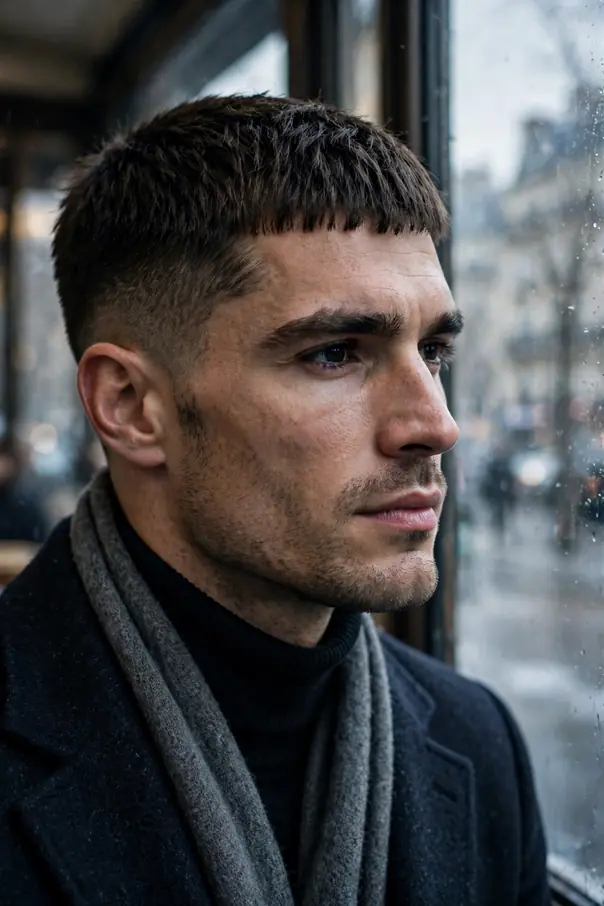
2 of 20 — The Parisian French Crop
Is the french crop still in style for winter?
Very much — the french crop is the sharpest short cut in Europe right now, built on a blunt straight fringe and a micro-textured top. It borrows the textured crop’s easy styling but swaps the choppy edge for a clean graphic line over a low taper fade.
Face Shape: Square and oblong faces gain most, because the straight fringe shortens a long forehead and balances strong features. Round faces should pair it with a slightly higher fade to keep some vertical length.
Grooming Kit: Matte paste (pea-sized amount), fine comb for the fringe line, lightweight hair powder for flat hair.
Maintenance: LOW — trim every 3 weeks, 2 minutes daily styling, roughly $25–$35 per month.
Say This to Your Barber: “French crop, short on top with a blunt fringe cut straight across. Texture the top lightly, low taper fade on the sides, and keep the hairline natural at the temples.”
Q: Can a french crop hide a receding hairline?
A: Yes, it is one of the best cuts for it. The forward blunt fringe covers the corners of the hairline, and the short sides stop the eye comparing thin and thick areas.
Q: How short is a french crop on top?
A: Usually 1 to 2 inches — long enough to show texture and a clear fringe, short enough to stay flat under a beanie. Ask your barber to keep the fringe just above the brows.
Love the crop but want the fade quieter? The next look drops it low.
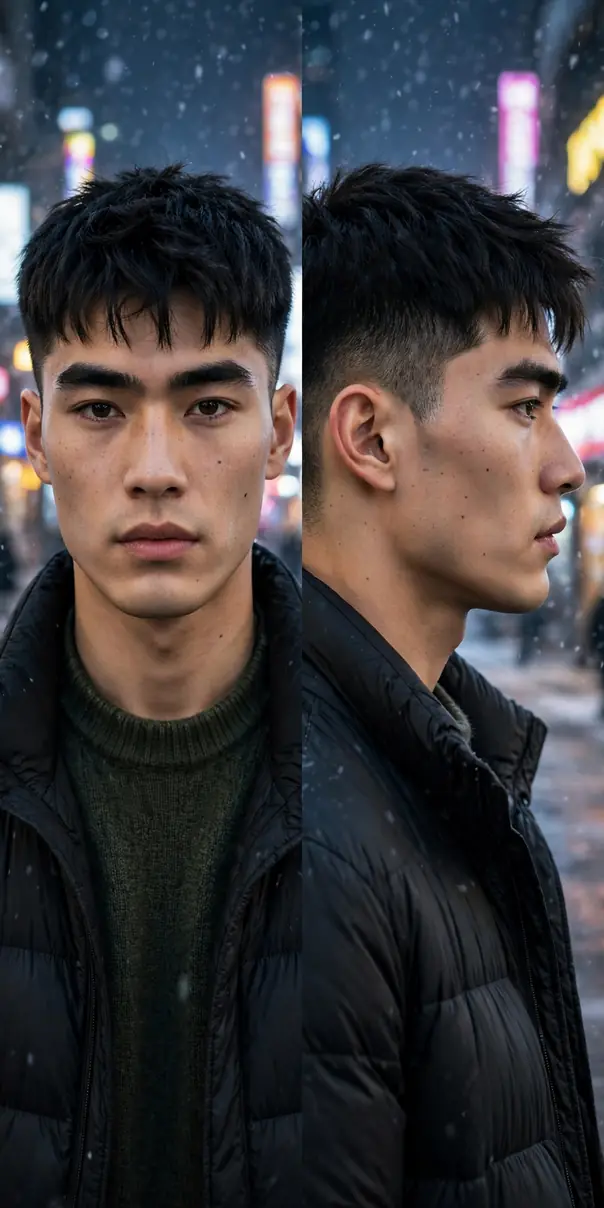
3 of 20 — The Low Taper Textured Crop
What makes a low taper fade the safest winter upgrade?
A low taper fade cleans up only the edges — around the ears and neckline — so the cut keeps its weight and grows out gracefully for weeks. Paired with a textured crop top, it is the mens haircut that looks barbered without ever looking severe.
Face Shape: Almost every face suits it. Round faces get gentle structure from the clean edges, square jaws stay masculine because the sides keep some length, and it never fights glasses or a beard.
Grooming Kit: Matte clay (pea-sized amount), boar bristle brush, leave-in conditioner for dry winter air.
Maintenance: LOW — edge clean-up every 3–4 weeks, 2 minutes daily styling, roughly $20–$30 per month.
Say This to Your Barber: “Textured crop on top, forward fringe. Low taper fade only — start at a #1 around the ears and neckline and blend it softly. No skin fade, keep the sides natural.”
Q: How is a low taper fade different from a low fade?
A: A low fade takes the sides down to skin low on the head, while a low taper fade only tapers the very edges. The taper keeps more hair, grows out softer and suits conservative workplaces.
Q: Does a low taper fade suit curly hair?
A: Yes. Keeping length on the sides gives curls room to sit naturally instead of springing out, and the clean edges stop the shape looking overgrown between barber visits in winter.
Want more contrast instead? The next look raises the fade to the middle.
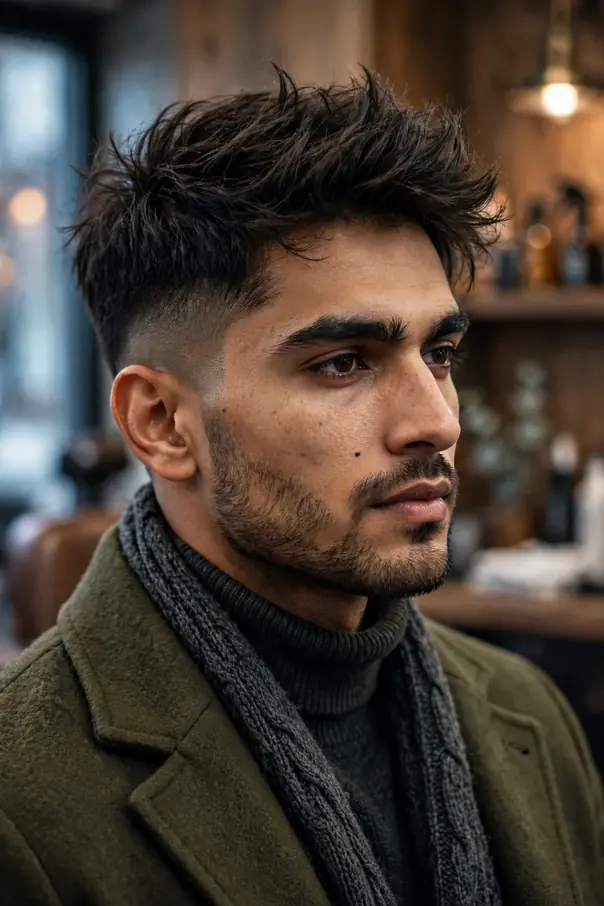
4 of 20 — The Mid Fade Textured Top
Who should choose a mid fade haircut with a textured top?
Choose this fade haircut if you want maximum contrast without going full skin-tight: the mid fade takes the sides clean at the temple line, while 2 inches of messy textured crop on top keep it modern. It is the mens haircut most barbers cut daily this season.
Face Shape: Round and oval faces benefit most, because the faded sides slim the cheeks while the textured top adds height. Very long faces should keep the top under 2 inches to avoid stretching the profile.
Grooming Kit: Matte paste (pea-sized amount), texture powder for fine hair, vent brush and dryer for lift.
Maintenance: MEDIUM — fade refresh every 2–3 weeks, 3 minutes daily styling, roughly $30–$45 per month.
Say This to Your Barber: “Mid skin fade on the sides, blended at the temple. Leave two inches on top, point-cut it heavily for texture, and style it messy forward with a natural fringe.”
Q: How fast does a mid fade grow out?
A: The crisp line lasts about 10–14 days before it softens. Most men refresh the fade every 2–3 weeks and let the top run a week or two longer between full cuts.
Q: Is a textured top better with matte or shiny products?
A: Matte, almost always. Matte clay or paste shows off the choppy layers and keeps winter hat-hair looking intentional, while shine products can make short textured hair look greasy and flat.
Not a fringe fan? The next look pushes all the texture forward.
5 of 20 — The Messy Fringe Forward

How do you wear a messy fringe without looking untidy?
The messy fringe works when the chaos is only on top: choppy layers fall forward over the forehead while the sides stay scissor-tapered and clean. It sits between a french crop and longer short haircuts for men who want softness around the face.
Face Shape: Heart and square faces love it, because the forward fringe softens a wide forehead and strong brow. Men with very round faces should keep the sides shorter so the fringe does not widen the face.
Grooming Kit: Sea salt spray (3–4 spritzes), matte cream (pea-sized amount), fingers only — no brush needed.
Maintenance: LOW — trim every 4 weeks, 3 minutes daily styling, roughly $25–$35 per month.
Say This to Your Barber: “Messy fringe, choppy and forward over the forehead, about two inches on top. Scissor-taper the sides, keep them soft, and point-cut the fringe so it falls in pieces, not a block.”
Q: Does a messy fringe suit straight hair?
A: Yes — straight hair shows the choppy point-cutting best. A little sea salt spray stops it lying too flat, and wavy hair gets the same look with almost no product at all.
Q: Can a messy fringe work with a beard?
A: It pairs well with short boxed beards, because the clean beard line balances the soft fringe. Keep the cheek lines sharp so the overall look stays deliberate rather than overgrown.
Ready for the shortest fringe in the game? The Caesar is next.
6 of 20 — The Sharp Caesar Cut
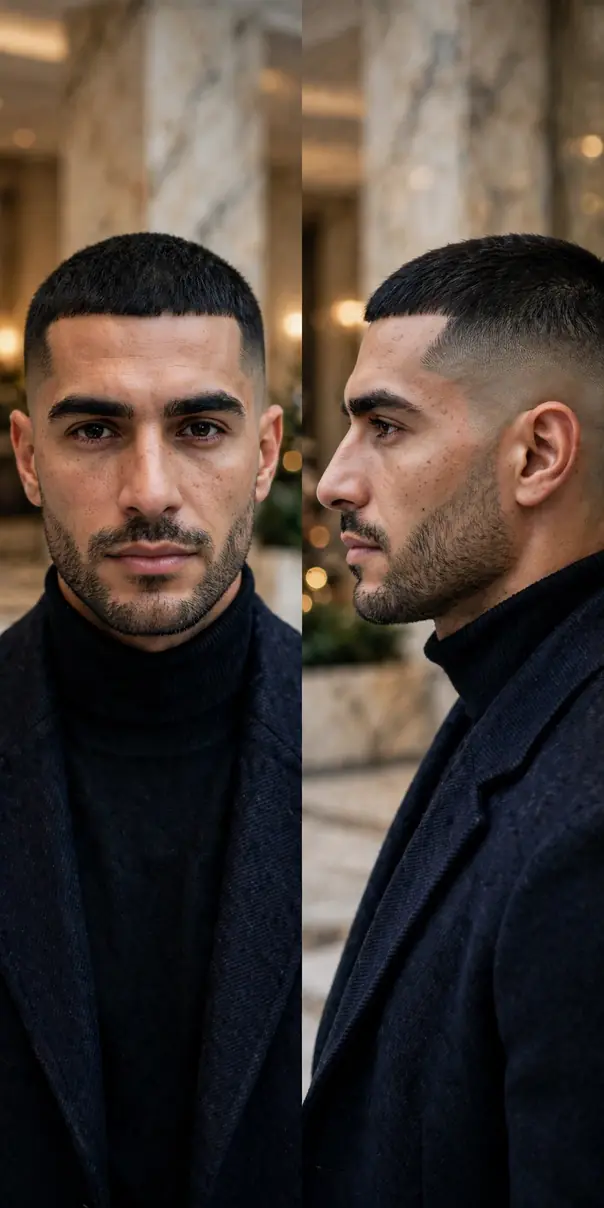
Why is the caesar the smartest mens haircut for busy mornings?
Because a caesar asks for nothing: a uniform short top, a tiny straight fringe and zero styling beyond a towel dry. It is the original low-effort mens haircut — sharper than a buzz cut thanks to that fringe line, tidier than a crew cut in the grow-out.
Face Shape: Strong jawlines and oval faces carry it best, since the short fringe frames the face without adding width. Men with very round faces should add a touch more length on top for balance.
Grooming Kit: Matte paste (fingertip amount, optional), soft brush, moisturising scalp oil for winter dryness.
Maintenance: LOW — trim every 3 weeks, 1 minute daily styling, roughly $20–$30 per month.
Say This to Your Barber: “Caesar cut, about half an inch to an inch on top, same length all over. Short straight fringe at the front, low fade on the sides, and a clean natural hairline.”
Q: Is a caesar cut good for thinning hair?
A: Yes — the uniform short length stops light and dark patches contrasting, and the forward fringe covers a receding hairline better than styles brushed back. Keep it under an inch for the fullest look.
Q: What is the difference between a caesar and a buzz cut?
A: A buzz cut is one clipper length everywhere with no fringe. The caesar keeps a short horizontal fringe at the front and slightly more texture on top, which reads as a styled haircut, not a clipper job.
Shorter still? The next look goes full clipper with a skin fade.
7 of 20 — The Buzz Cut with Skin Fade

How short should a buzz cut with a skin fade be?
The sweet spot is a #2 or #3 on top blended into a high skin fade — short enough to read bold, long enough to keep your head warm and your head shape flattering. This buzz cut is the ultimate reset: a strong fade haircut finish with zero daily styling.
Face Shape: Defined, angular faces suit it best, because there is no hair left to soften features. Round faces should keep a #3 on top for a little more presence; the high fade adds the height.
Grooming Kit: Clippers for home touch-ups (optional), scalp moisturiser, SPF for bright winter days at altitude.
Maintenance: LOW — barber refresh every 2–3 weeks, 0 minutes daily styling, roughly $20–$30 per month.
Say This to Your Barber: “Buzz cut, guard #2 on top. High skin fade on the sides blended smoothly into the top, sharp clean hairline, and tidy up the edges around the ears.”
Q: Does a buzz cut suit every head shape?
A: Mostly, yes. The skin fade hides bumps and uneven growth better than a uniform buzz, and keeping one guard longer on top adds structure. Your barber can adjust the fade height to your head shape.
Q: How do you stop a buzz cut looking dull in winter?
A: Keep the hairline razor-clean and the beard shaped — the contrast is what makes it look sharp. A drop of scalp oil stops dry winter skin from dulling the finish.
Want short but classic instead of clipper-bold? The crew cut is next.
8 of 20 — The Tapered Crew Cut
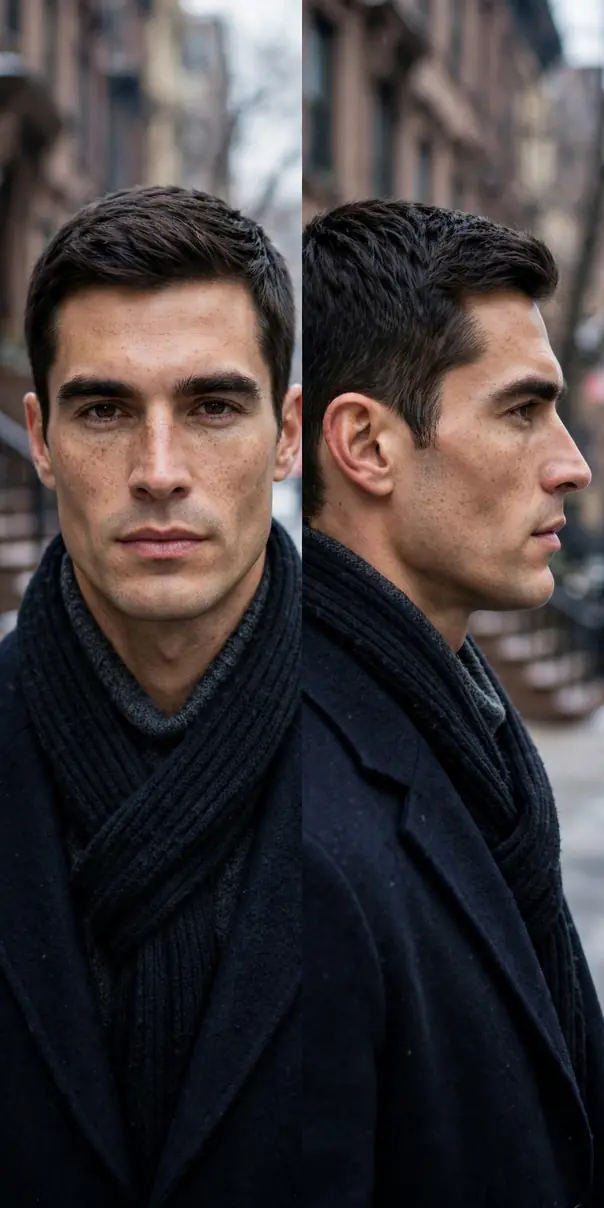
Why does the crew cut never go out of style?
The crew cut is the mens haircut that works everywhere — office, gym, wedding — because the proportions never date: a short neat top, a gentle taper fade at the edges and nothing to style. Among short haircuts for men, it is the safest pair of hands in barbering.
Face Shape: Universal. Oval faces wear the classic version, square faces suit a slightly longer front, and the taper keeps round faces looking structured without the severity of a skin fade.
Grooming Kit: Light matte cream (pea-sized amount), fine comb, small bristle brush.
Maintenance: LOW — trim every 3–4 weeks, 1 minute daily styling, roughly $20–$30 per month.
Say This to Your Barber: “Crew cut, about an inch on top, a touch longer at the front. Classic scissor taper on the sides — no skin fade — and a natural neckline.”
Q: What is the difference between a crew cut and a buzz cut?
A: A crew cut leaves graduated length on top — longer at the front, shorter at the crown — and is finished with scissors. A buzz cut is one uniform clipper length all over.
Q: Can a crew cut work for older men?
A: It is one of the best choices. The short neat top handles greying and thinning evenly, the taper keeps it smart, and it needs almost no product or daily styling time.
Need boardroom polish? The next look parts it clean to the side.
9 of 20 — The Executive Side Part Fade
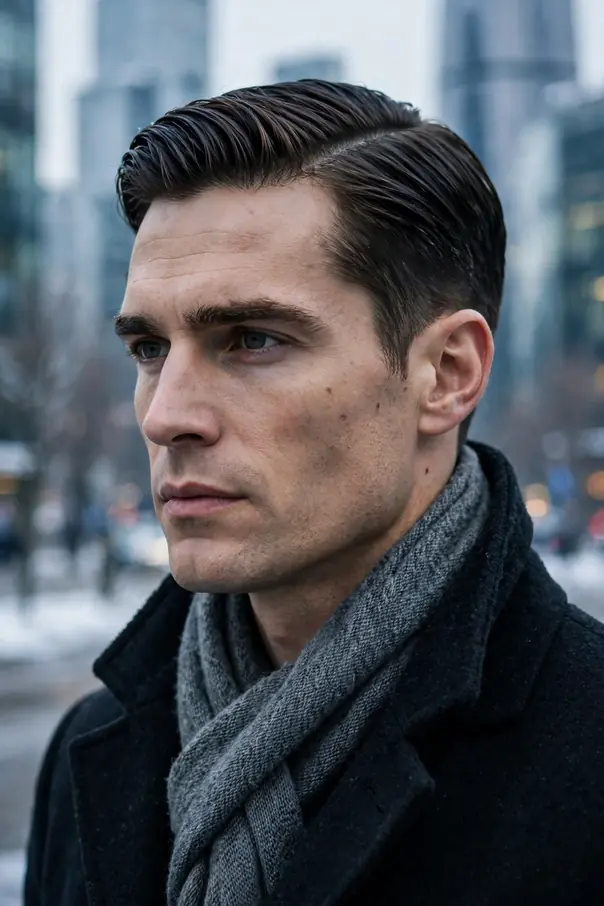
What is the most professional of all short haircuts for men?
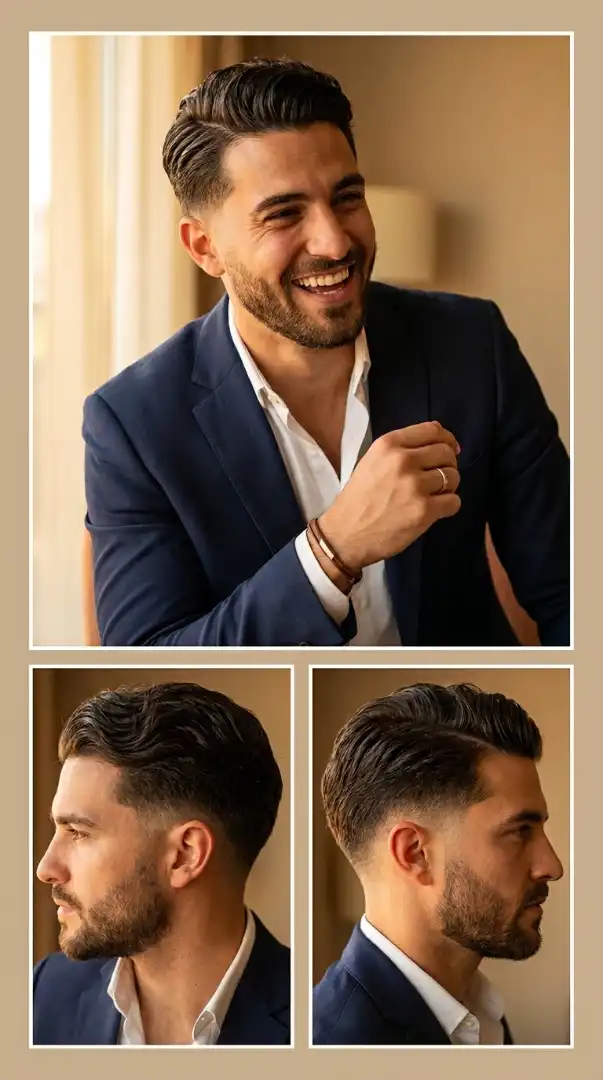
The executive side part. A clean parting, a polished comb-over top and a tidy mid fade make it the sharpest of short haircuts for men in formal settings — and unlike longer mens haircut styles, it looks identical under a winter coat collar every single day.
Face Shape: Oval and rectangular faces suit the side part best, since the diagonal line breaks up length elegantly. Square faces should keep the fade a touch lower so the silhouette stays balanced.
Grooming Kit: Fine-tooth comb, medium-shine pomade (pea-sized amount), dryer for setting the part in the morning.
Maintenance: MEDIUM — trim every 3 weeks, 4 minutes daily styling, roughly $30–$40 per month.
Say This to Your Barber: “Side part with a hard natural parting on my left. Two inches on top combed over, mid fade on the sides, and keep the part line clean but not shaved wide.”
Q: Does a side part work on wavy hair?
A: Yes — waves give the comb-over natural body. Comb it while damp with a little pomade and let it set; the wave pattern actually helps the part hold all day.
Q: How do you find your natural side part?
A: Comb all your hair straight back when wet and push it forward gently — it will fall to one side at the crown. That split is your natural part, and fighting it never works.
Business done — the next look lifts the front for the weekend.
10 of 20 — The Short Quiff Taper
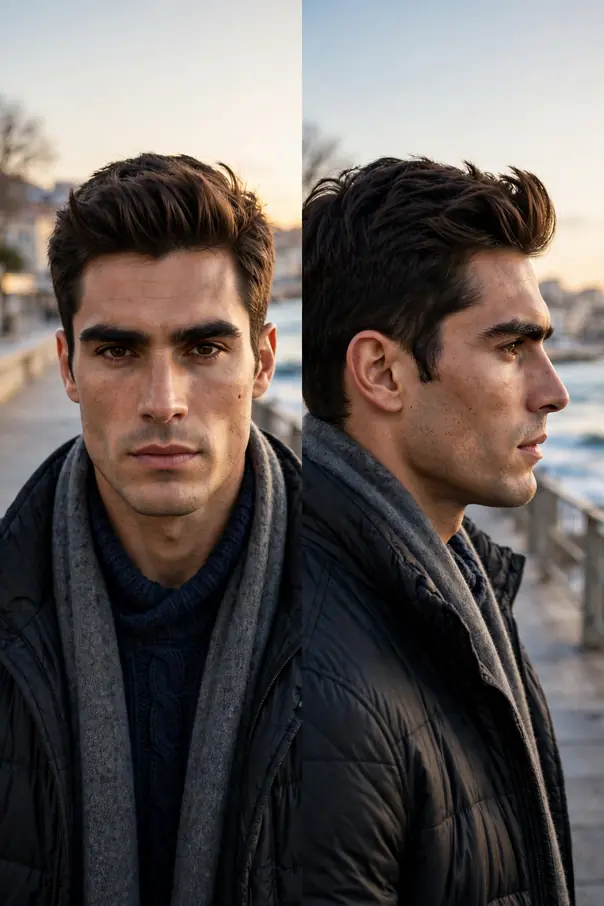
Can a taper fade quiff stay short and still have volume?
Yes — the short quiff proves it. Two and a half inches at the front brush up into real lift while the scissor taper fade keeps the sides soft and grown-man neat. It borrows the textured crop’s easy top and gives it height instead of a fringe.
Face Shape: Round and oval faces gain the most, because the front lift lengthens the face. Oblong faces should keep the quiff flatter and wider, and diamond faces suit the soft taper perfectly.
Grooming Kit: Volumising mousse or dryer with vent brush, matte paste (pea-sized amount) to lock the lift.
Maintenance: MEDIUM — trim every 3 weeks, 4 minutes daily styling, roughly $30–$40 per month.
Say This to Your Barber: “Short quiff — two and a half inches at the front tapering shorter to the crown. Scissor taper on the sides, keep them soft, no skin fade. I’ll brush the front up and back.”
Q: How do you stop a short quiff falling flat by noon?
A: Blow-dry the front up and back while damp — heat sets the direction. Finish with matte paste only on the tips; product at the roots weighs short hair down and kills the lift.
Q: Does a short quiff suit fine hair?
A: It is one of the better volume styles for fine hair, because the short length stops it separating. A light mousse before drying adds the grip that fine hair needs to hold the shape.
Got curls? The next look crops them clean instead of fighting them.
11 of 20 — The Curly Crop Fade
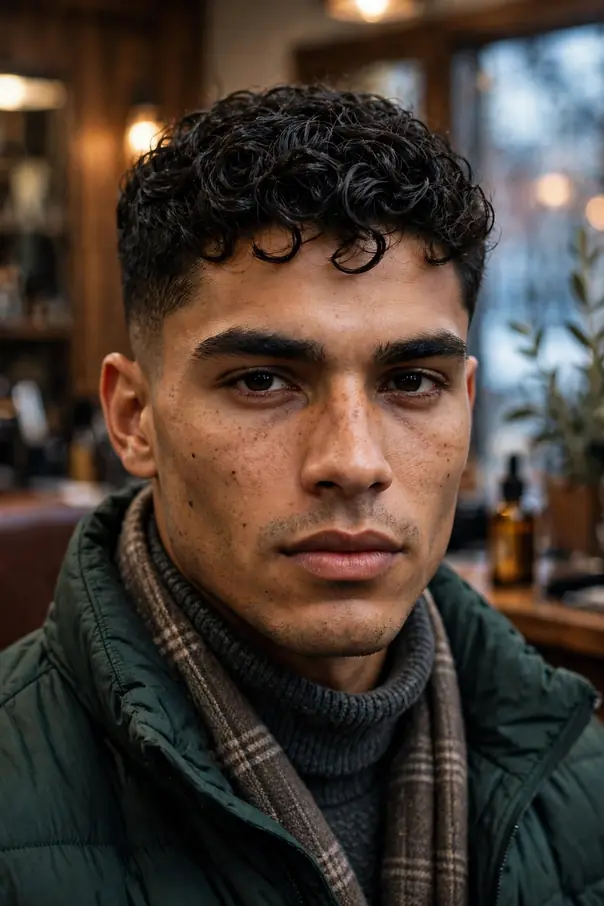
What is the best textured crop for curly hair?
The curly crop fade: keep the curls short and defined on top, close to the head with a soft forward edge, and let a mid skin fade do the tidying. This textured crop works with your curl pattern instead of against it — no straightening, no fighting the frizz that winter heating causes.
Face Shape: Square and oval faces suit the close curls best. Round faces should keep the fade higher for structure, and men with heart-shaped faces can leave the front curls a touch longer for balance.
Grooming Kit: Curl cream (pea-sized amount), leave-in conditioner, wide-tooth comb or fingers only.
Maintenance: MEDIUM — fade refresh every 2–3 weeks, 3 minutes daily styling, roughly $30–$40 per month.
Say This to Your Barber: “Curly crop — keep the curls about an inch on top, shaped close with a soft forward fringe line. Mid skin fade on the sides, and don’t thin the top out, I want the curl pattern intact.”
Q: How do you stop short curls going frizzy in winter?
A: Moisture is the whole answer. Scrunch a pea of curl cream into damp hair and never brush it dry — dry brushing separates curls into frizz, especially with indoor heating running.
Q: Should curly crops be cut wet or dry?
A: Dry, ideally. Curls shrink as they dry, so a dry cut shows the true length and shape. If your barber cuts curls wet, ask them to leave extra length to be safe.
Straight hair and feeling bold? The next look builds a soft ridge.
12 of 20 — The Short Faux Hawk Fade
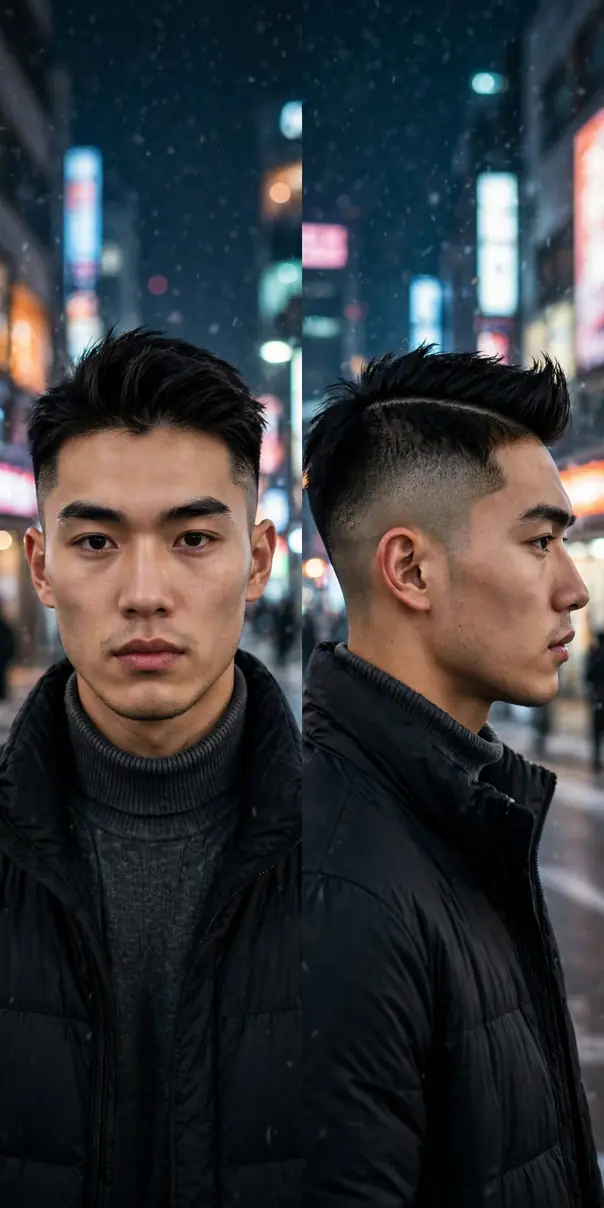
Is a faux hawk fade haircut still wearable in 2026?
The modern version absolutely is. This fade haircut keeps a soft 2-inch ridge down the centre — more textured crop than punk mohawk — while high faded sides keep it clean enough for real life. It is the boldest mens haircut on this list that still works on a Monday.
Face Shape: Oval and heart faces suit the centre ridge best. Round faces gain height from it, and square faces should keep the ridge wider and softer so the silhouette does not turn harsh.
Grooming Kit: Strong matte paste (pea-sized amount), dryer for setting the ridge, texture spray for separation.
Maintenance: MEDIUM — fade refresh every 2–3 weeks, 4 minutes daily styling, roughly $35–$45 per month.
Say This to Your Barber: “Short faux hawk — leave a two-inch centre strip on top styled up into a soft ridge. High fade on the sides blended into the strip, and keep the ridge wearable, not spiky.”
Q: What is the difference between a faux hawk and a mohawk?
A: A mohawk shaves the sides completely and leaves one dramatic strip. A faux hawk fades the sides instead and keeps the centre only slightly longer, so it reads as a bold crop, not a costume.
Q: Can a faux hawk work with a receding hairline?
A: A short, wide ridge can actually help, because the eye reads the centre fullness. Keep the front corners blended rather than squared off, and avoid pushing the ridge too narrow or too tall.
Bold enough — the next look is the cleanest cut in the Ivy League.
13 of 20 — The Clean Ivy League

What makes the ivy league the timeless mens haircut?
The ivy league is a crew cut that went to university: a neat short top with just enough length to sweep to the side and lift at the front. It has been the default smart mens haircut for decades because it flatters everyone and sits perfectly under winter knitwear and collars.
Face Shape: Genuinely universal. The soft side sweep balances square jaws, the tidy taper structures round faces, and the small front lift keeps long faces in proportion.
Grooming Kit: Light styling cream (pea-sized amount), side-part comb, soft brush.
Maintenance: LOW — trim every 3–4 weeks, 2 minutes daily styling, roughly $25–$35 per month.
Say This to Your Barber: “Ivy league — an inch and a half on top, long enough to sweep to the side with a small lift at the front. Classic taper on the sides, neat around the ears.”
Q: What is the difference between an ivy league and a crew cut?
A: Length and styling. An ivy league keeps the top long enough to comb sideways with a visible sweep, while a crew cut is shorter and sits forward with no real part or sweep.
Q: Does the ivy league suit thinning hair?
A: Yes, at the shorter end. The sideways sweep covers a softening crown better than styles brushed back, and the neat taper stops the thinner top standing out against thick sides.
Prefer it combed back instead of across? The slick-back taper is next.
14 of 20 — The Short Slick-Back Taper
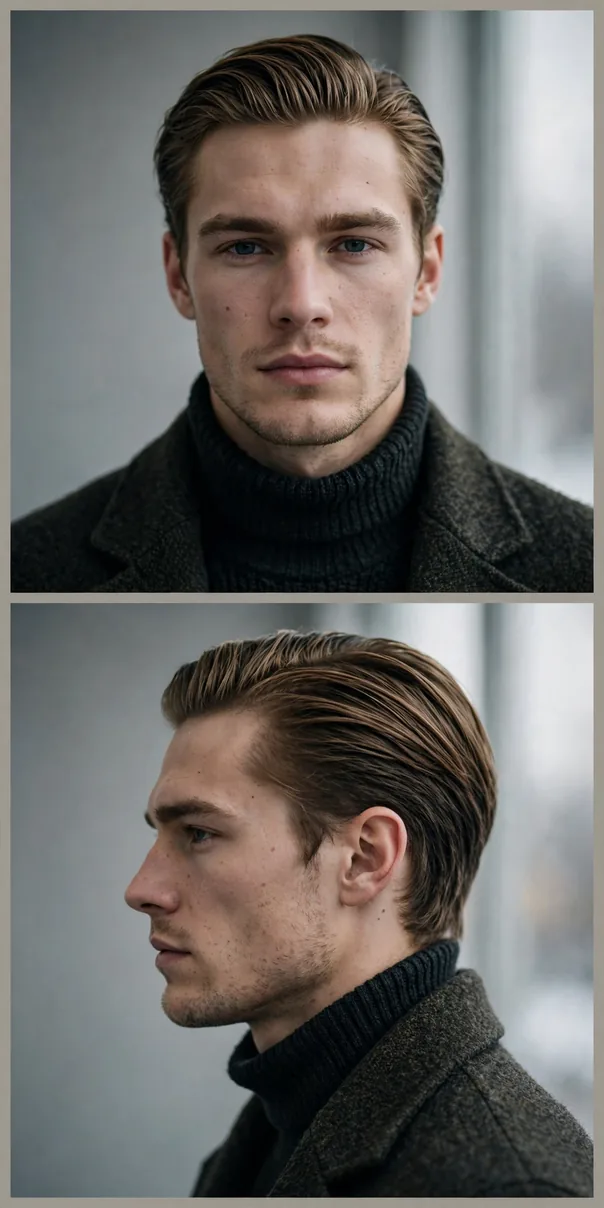
Can a slick back work as a short taper fade style?
Yes — at 2.5 inches the top combs straight back into a clean, low-shine sweep, and the soft taper fade keeps the edges grown-up instead of severe. This taper fade is the old-money finish at short length: polished, quiet and perfect with a winter overcoat.
Face Shape: Oval and square faces suit the swept-back line best. Round faces should add a little height at the front as it combs back, and long faces can keep the top slightly shorter.
Grooming Kit: Low-shine pomade (pea-sized amount), fine comb, dryer to set the direction back.
Maintenance: MEDIUM — trim every 3 weeks, 3 minutes daily styling, roughly $30–$40 per month.
Say This to Your Barber: “Short slick-back — two and a half inches on top combed straight back. Soft scissor taper fade on the sides, nothing to skin, and keep the back neat at the neckline.”
Q: How do you stop a short slick back sliding forward?
A: Comb it back while damp and blow-dry it in that direction — heat-locked roots hold all day. A pea of pomade on the surface only; product underneath makes short hair separate and flop.
Q: Does a slick back work on wavy hair?
A: Wavy hair gives the best natural slick backs, because the wave lies in one direction like a fingerprint. Straight hair needs the dryer trick above; very curly hair suits the curly crop better.
Business at the front, party at the back — the mini mullet is next.
15 of 20 — The Mini Mullet Taper
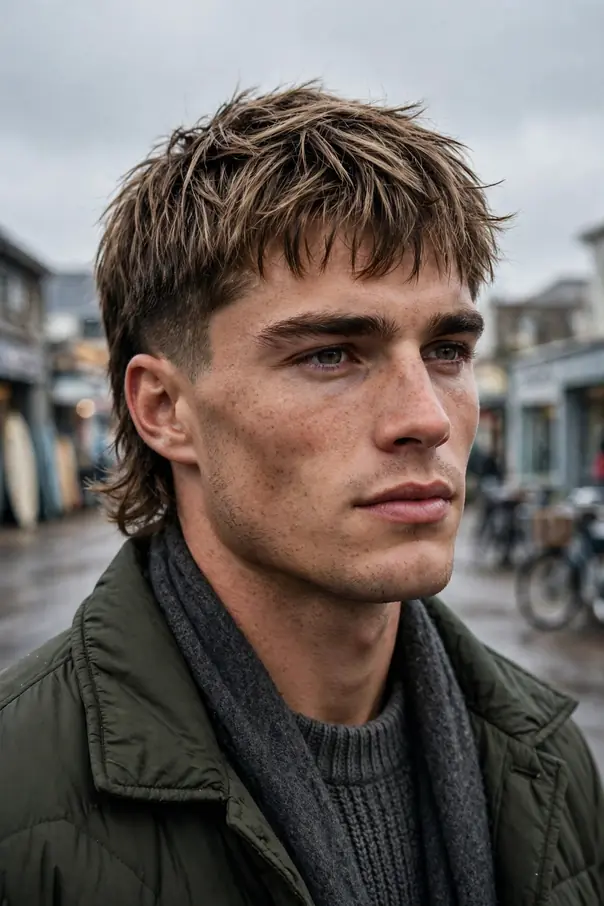
Why is the mini mullet the rebel pick of short haircuts for men?
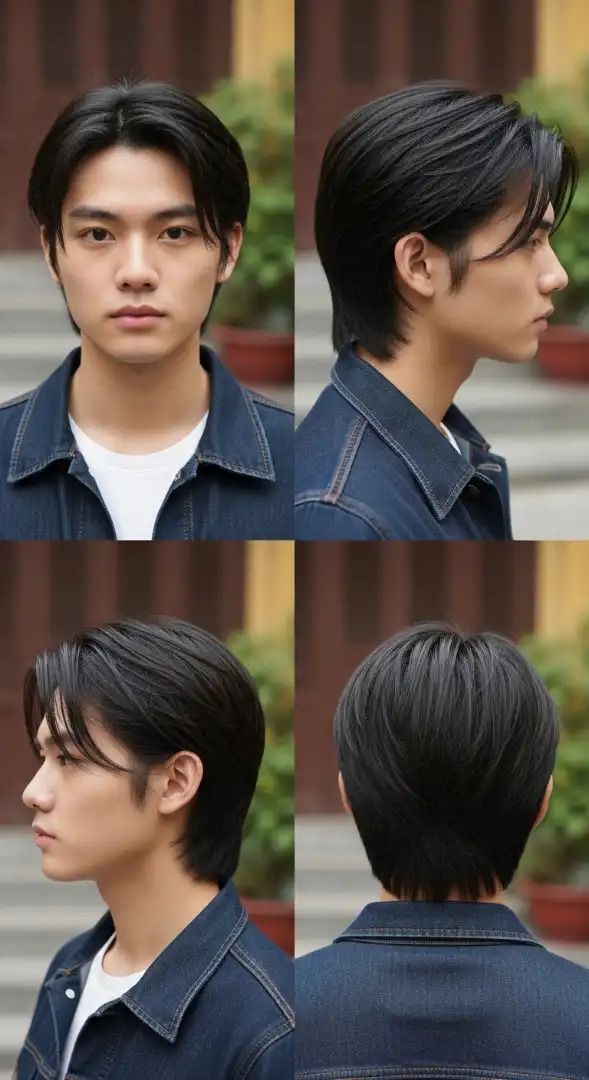
Because it keeps the fun part — a textured tail at the back — and removes everything that made the original mullet a joke. Short top, tapered ears, 2 inches of texture at the nape: among short haircuts for men it is the one with a wink, and it loves a messy fringe up front.
Face Shape: Oval and heart faces wear it best, since the tail softens a strong chin line. Round faces should keep the top textured and the ears tight so the back length does not widen the silhouette.
Grooming Kit: Sea salt spray (3–4 spritzes), matte paste (pea-sized amount), no comb — fingers keep the tail piecey.
Maintenance: MEDIUM — sides every 3 weeks, tail trim every 5–6 weeks, 3 minutes daily, roughly $30–$40 per month.
Say This to Your Barber: “Mini mullet — short textured top and fringe, taper the sides tight around the ears, but leave two inches of layered length at the back. Point-cut the tail so it sits piecey, not heavy.”
Q: Is a mini mullet office-appropriate?
A: The short version usually is, because from the front it reads as a normal crop with tapered ears. The tail is subtle at 2 inches; tuck it under a collar and most people never notice.
Q: How fast does a mini mullet grow into a full mullet?
A: The back gains roughly half an inch a month, so the tail reads as a true mullet by month three if you skip trims. A quick nape tidy every 5–6 weeks holds the mini length.
More layers, more attitude — the wolf cut goes shorter next.
16 of 20 — The Short Wolf Cut
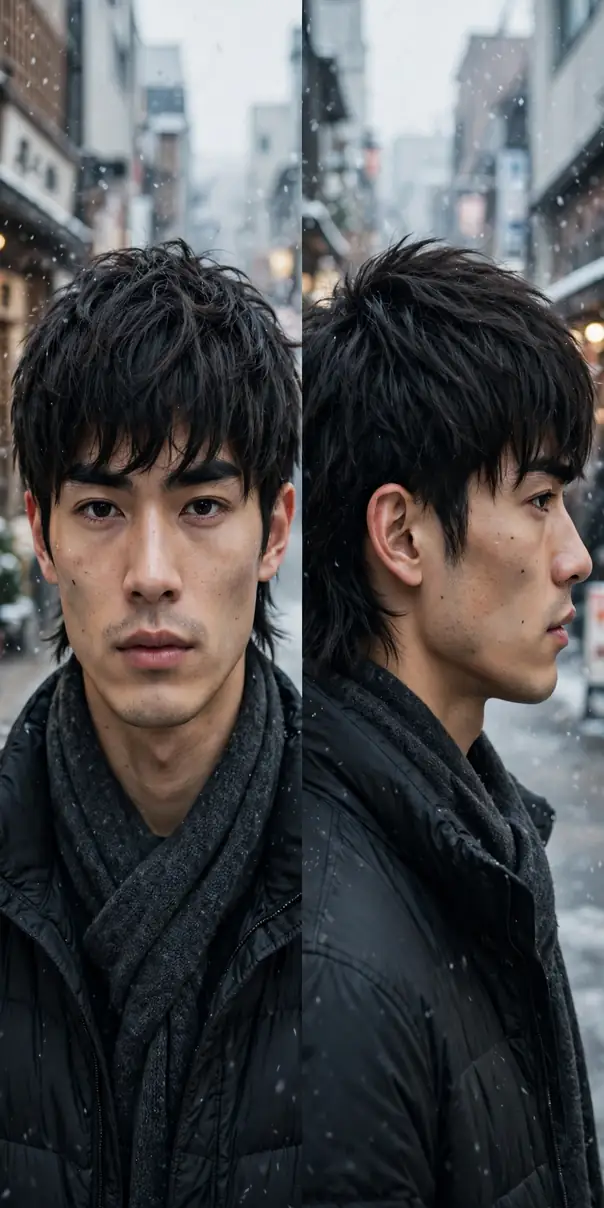
What is a short wolf cut and who does it suit?
The wolf cut is the mullet’s wilder cousin — heavy choppy layers, a shaggy messy fringe and a layered tail, all cut with a razor-soft edge. Short, it keeps the attitude and loses the upkeep: the layers do the styling, somewhere between a textured crop and a french crop gone feral.
Face Shape: Heart and oval faces suit the volume at the crown best. Square faces should keep the sides a little fuller to balance the jaw, and round faces need the tail kept short and piecey.
Grooming Kit: Sea salt spray (4 spritzes), matte paste (pea-sized amount) for separating the layers.
Maintenance: MEDIUM — reshaping every 4–5 weeks, 3 minutes daily styling, roughly $30–$40 per month.
Say This to Your Barber: “Short wolf cut — heavy choppy layers on top, shaggy fringe forward, tapered around the ears, and a layered wolf tail at the back. Razor the ends so it sits messy and light, not blunt.”
Q: What is the difference between a wolf cut and a mullet?
A: A mullet is mainly about back length with shorter sides. A wolf cut adds heavy layering everywhere — crown, fringe and tail — so the whole shape looks shaggy and wild, not just long at the back.
Q: Does a wolf cut work on straight hair?
A: Yes, with enough point-cutting and razor work to fake the separation wavy hair gets free. Sea salt spray is essential on straight hair; without it the layers can lie too flat and neat.
From wild to military — the next look is uniform, clean and zero-fuss.
17 of 20 — The Butch Cut Low Taper

Why choose a butch cut with a low taper fade finish?
Because it is the most honest haircut on this list: one uniform clipper length, sharpened by a low taper fade at the edges only. Longer than a buzz cut, shorter than a crew cut, the butch is the athlete’s default — nothing to style, nothing to hide behind, everything clean.
Face Shape: Angular and oval faces suit the uniform length best, because the cut shows every line of your features. The low taper keeps rounder faces looking structured rather than severe.
Grooming Kit: Home clippers for edge touch-ups (optional), scalp moisturiser, soft brush.
Maintenance: LOW — trim every 2–3 weeks, 0 minutes daily styling, roughly $20–$30 per month.
Say This to Your Barber: “Butch cut, guard #3 all over, uniform length. Low taper fade at the sideburns and neckline only — keep the sides full length, no skin fade, and clean up the hairline.”
Q: What is the difference between a butch cut and a buzz cut?
A: Guard length and intent. A butch sits at #3–#4 — short but clearly a haircut with a shaped finish — while a buzz cut usually runs #1–#2 and reads as a deliberate clipper statement.
Q: Can you cut a butch cut at home?
A: It is the easiest barber cut to copy at home: one guard all over, then taper the edges with the lever half-open. Book a barber for the first one so the shape and hairline are set right.
One step shorter still — the induction buzz is next.
18 of 20 — The Induction Buzz
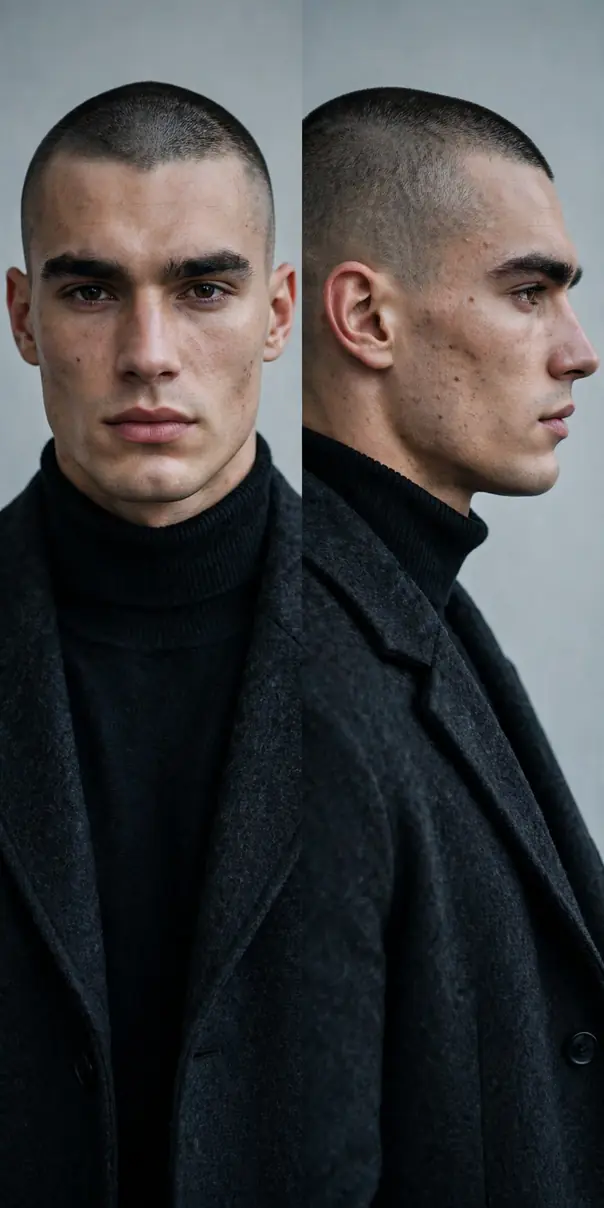
Is the induction buzz cut too extreme for winter?
It is the boldest buzz cut there is — the military’s first-day cut at a near-uniform #0 to #1 — yet winter is exactly when men try it: hats exist, the grow-out is a great short haircuts for men journey, and no mens haircut makes a jawline work harder.
Face Shape: Strong, symmetrical faces carry it best; there is nowhere for features to hide. Men with rounder faces often prefer the #2 buzz with a fade earlier on this list for a softer landing.
Grooming Kit: Scalp oil or moisturiser (daily in winter), SPF for sunny cold days, a warm beanie — you will feel the cold now.
Maintenance: LOW — re-clip every 2 weeks, 0 minutes daily styling, roughly $15–$25 per month.
Say This to Your Barber: “Induction buzz — guard #1 all over, uniform, no fade. Keep my natural hairline, clean the edges, and tidy the neckline. I want the true military-short finish.”
Q: How long does an induction buzz take to grow out?
A: Hair grows about half an inch a month, so it reaches a #3 butch length in roughly 4–6 weeks and a short crop in about 3 months. The awkward middle fortnight is the price of the reset.
Q: Does an induction buzz suit a beard?
A: Extremely well — the contrast between bare scalp and a full, shaped beard is the classic pairing. Keep the beard lines crisp and the cheeks clean so the combination looks deliberate.
Short with a little more shape on top? The high taper crew is next.
19 of 20 — The High Taper Crew
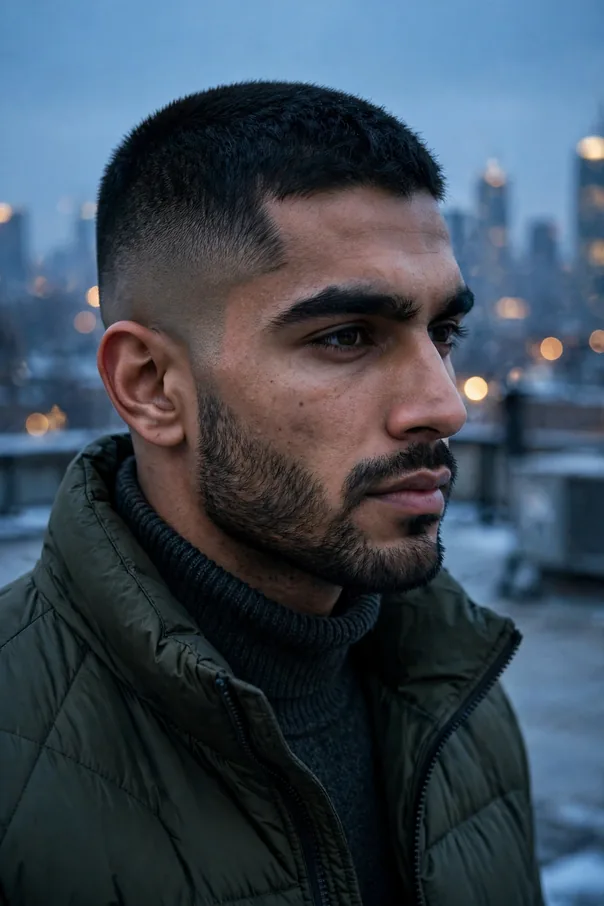
What does a high taper do to a classic crew cut?
It sharpens it. Raising the taper fade high on the sides gives the crew cut an athletic, modern edge while the short top keeps the classic shape your grandfather would recognise. It is the fade haircut finish for men who find a mid fade too soft and a skin fade too much.
Face Shape: Round faces gain the most, because the high taper slims the silhouette and the short top keeps proportions tight. Long faces should keep the taper a fraction lower to avoid adding height.
Grooming Kit: Matte cream (pea-sized amount), fine comb, bristle brush.
Maintenance: LOW — trim every 3 weeks, 1 minute daily styling, roughly $25–$35 per month.
Say This to Your Barber: “Crew cut, about three quarters of an inch on top. High taper fade — take the taper up high above the temple, blend it clean, and keep a natural neckline.”
Q: High taper or high fade — what is the difference?
A: A high fade drops to skin high on the head. A high taper follows the same high line but keeps a short layer of hair instead of skin, so it reads softer and grows out more gracefully.
Q: Does the high taper crew suit thick hair?
A: Perfectly. Thick hair holds the short crew shape without puffing, and the high taper removes the side bulk that makes thick hair look wide under winter hats.
One look left — the finale is the crop, perfected.
20 of 20 — The Finale Crop
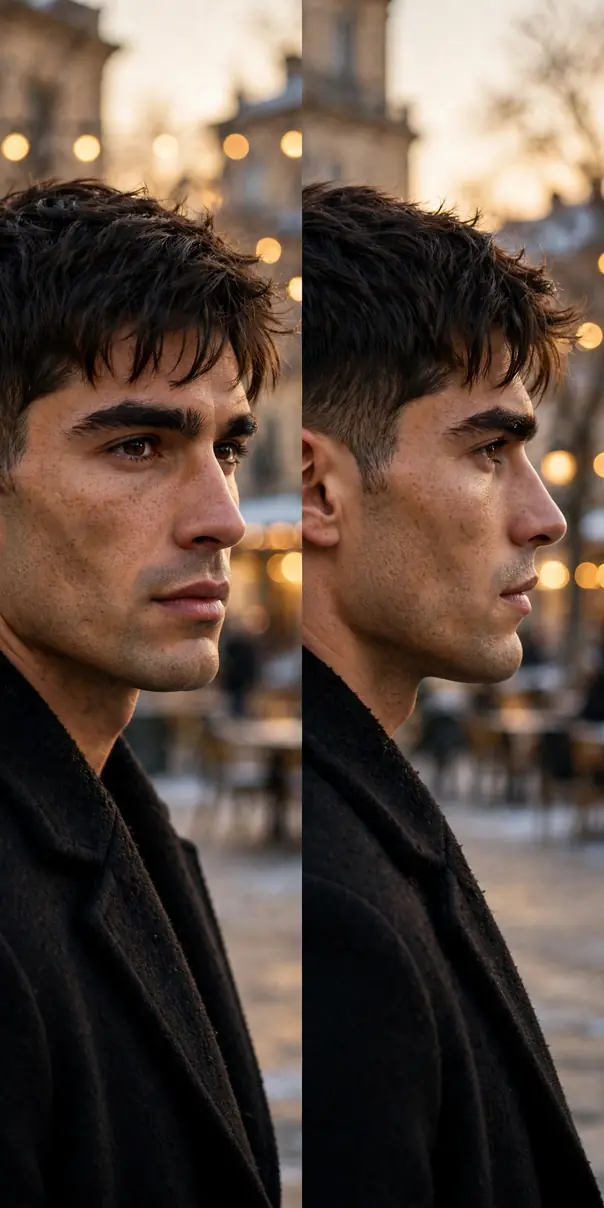
Which french crop should you save for your barber?
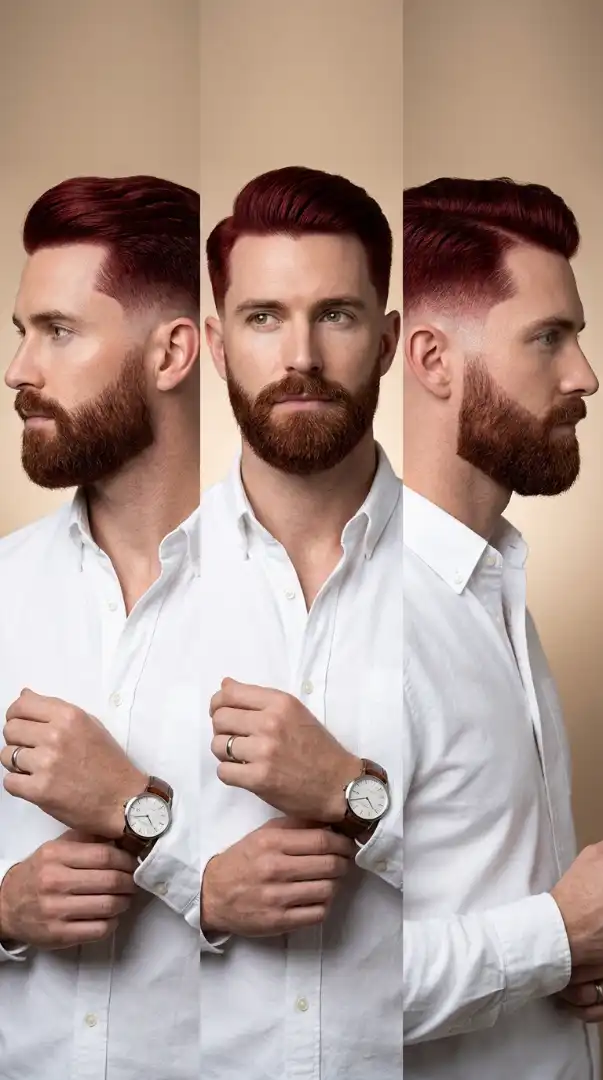
This one. The Finale Crop takes everything that made the french crop a phenomenon — the forward fringe, the choppy layers, the clean fade — and balances them perfectly: 2 inches of textured top, a soft fringe and a flawless mid taper fade. It is the textured crop’s final form.
Face Shape: Built to flatter the widest range: the fringe balances long foreheads, the mid fade structures round faces, and the layered top keeps square jaws looking strong but not heavy.
Grooming Kit: Matte clay (pea-sized amount), sea salt spray for texture days, fine comb for the fringe line.
Maintenance: LOW — trim every 3 weeks, 2 minutes daily styling, roughly $25–$35 per month.
Say This to Your Barber: “French crop, two inches on top, heavily point-cut for choppy texture with a soft forward fringe. Mid taper fade on the sides, blended clean, and keep the fringe piecey — not a straight block.”
Q: Why do barbers recommend the french crop so often?
A: Because it solves the three commonest problems at once: it hides a softening hairline, removes bulk from thick hair, and styles itself in two minutes. Few cuts flatter as many men with as little effort.
Q: How do you keep a crop looking fresh between cuts?
A: Refresh the fringe line with your barber at the two-week mark if it grows fast, and keep product light — heavy clay builds up and makes the choppy layers clump instead of separating.
That is the full twenty. Save the one that matches your face, show your barber the script, and let winter do its worst.
How to Choose Your Short Winter Cut
Still torn between two looks? Use the barber’s shortcut. Thick, straight hair takes any textured crop or french crop on this list. Curls belong in the curly crop fade. A softening hairline wants a forward fringe — crop, caesar or messy fringe. And if your mornings allow zero styling minutes, the buzz cut, butch and induction buzz will never let you down. Whatever you choose, the script under each style is word-for-word what your barber needs to hear.


One Comment