
20 Winter Haircuts for Men: Textured Crops, Fringes & Soft Fades
This winter, barbers agree on one thing: the sharpest men’s hair is short, textured and worn forward. Harsh skin fades are giving ground to softer blends, the fringe has moved to the front of the forehead where it belongs, and the textured crop — named first by barbers everywhere this season — has become the defining winter haircut for men who want maximum style for minimum morning effort.
This guide collects the 20 winter haircuts for men worth booking now: textured crops in every flavour, forward fringes from blunt to micro, soft fades, a gentler mullet, flowy curtains and the beanie-proof cuts that survive hat season without a fight. Every look comes with the face shapes it suits, the kit it needs, an honest maintenance rating and a word-for-word barber script. Prefer your length on top? Our medium-length winter hairstyles go longer, and the truly short options live in our short winter haircuts collection.
The winter rules are simple: texture beats shine (matte products, always), softness beats severity, and whatever you choose must forgive a beanie. Pick your cut below — then wear it like the cold can’t touch you.
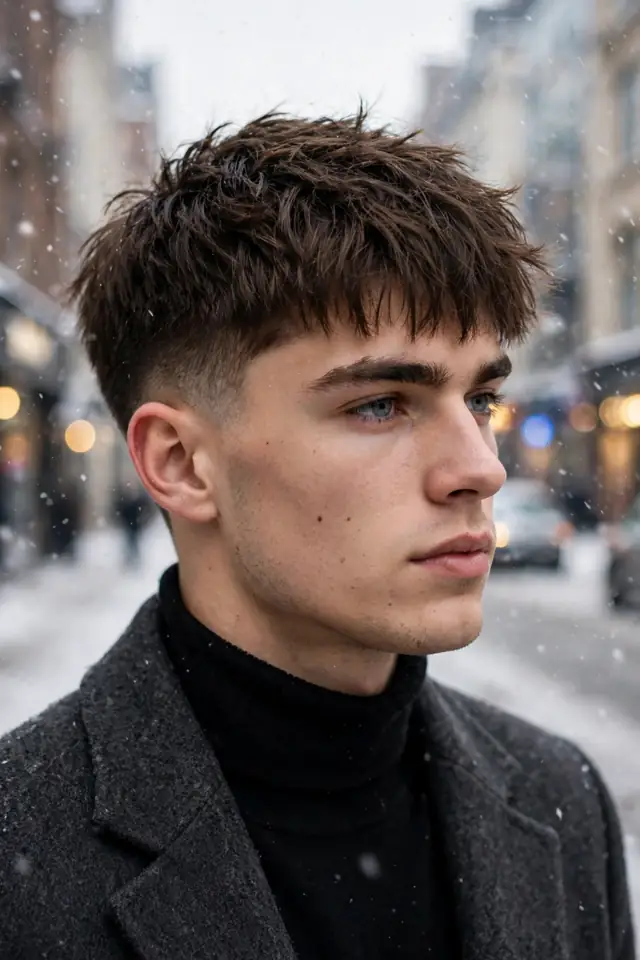
1 of 20 — The Textured Crop
What makes this the first of all winter haircuts for men this season?
Ask any barber which cut they are booking most and this is the answer. The top is point-cut into short, choppy layers full of separation, worn forward into a short textured fringe, while the sides carry a low or mid fade — soft, not skinned. It is the complete winter package: two minutes of matte clay in the morning, a silhouette that survives a beanie, and texture that looks better slightly lived-in than perfect. If you book one cut from this list blind, book this one.
Face Shape: Nearly universal — the forward fringe shortens long faces, the texture adds width to narrow ones, and round faces should ask for a slightly higher fade.
Grooming Kit: Matte clay or paste, and that is genuinely it. A fingertip amount through dry hair, pushed forward. Sea salt spray is the optional volume booster.
Maintenance: Low. Two minutes daily; the fade wants a tidy every 3–4 weeks, and the point-cut top forgives growth better than any blunt cut.
Barber Script: “A textured crop — short choppy point-cut layers on top, a short textured fringe worn forward, and a low-to-mid fade on the sides, kept soft.”
Q: Does the textured crop work on straight hair?
A: It is made for it — point-cutting creates the separation straight hair lacks naturally, and clay does the rest. Wavy hair gets the same cut with even less effort.
Q: How short is the fringe on a crop?
A: Short — sitting above the eyebrows, usually an inch or less of length at the front. Long enough to show texture, short enough to never need styling decisions.
The barber’s number one for a reason — texture, forward, done.
2 of 20 — French Crop with a Skin Fade
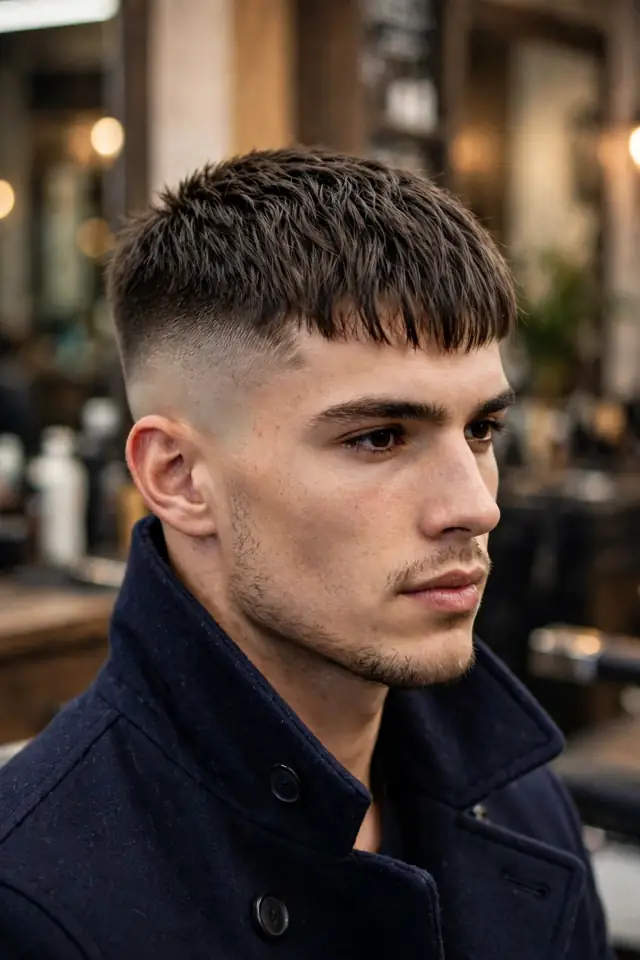
How is a french crop men wear different from a regular crop?
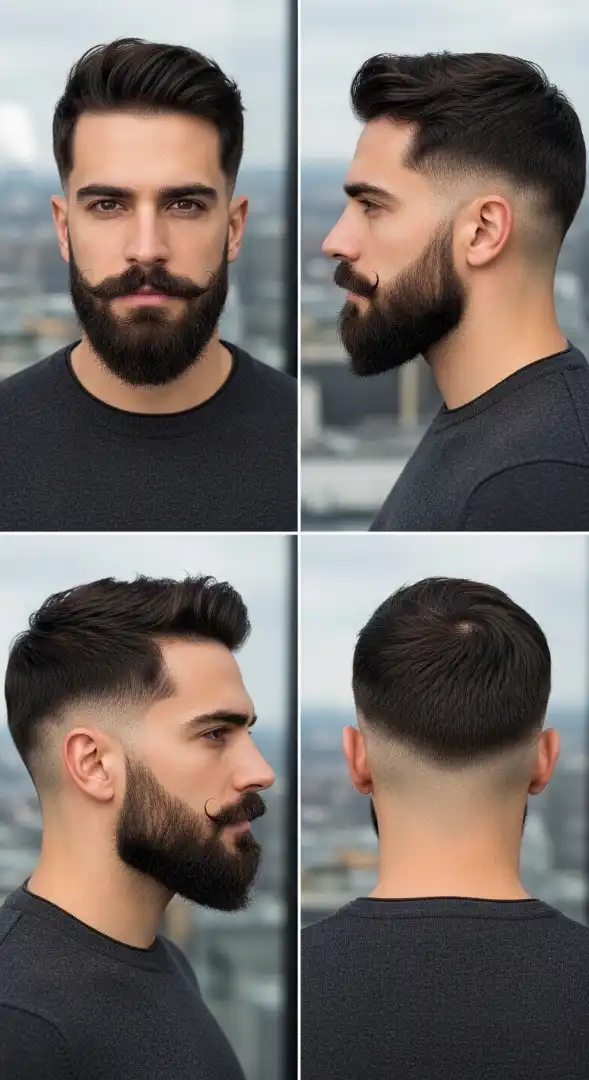
Precision and contrast. The French crop keeps the top a touch longer and more defined than the standard crop, with a distinctly cut fringe line — blunt or lightly textured — and pairs it with a high skin fade for a sharper, more deliberate finish. It is the crop’s tailored cousin: the same forward-worn shape, but with every edge considered. In winter it photographs beautifully against heavy coats and scarves, because the hard fade line keeps the silhouette graphic even when everything else you wear is soft.
Face Shape: Oval and square faces wear the sharp version best; round faces gain structure from the high fade. Long faces should soften the fringe rather than blunt it.
Grooming Kit: Matte paste for the top’s definition, a small comb for the fringe line. The fade is your barber’s department entirely.
Maintenance: Medium. The skin fade shows growth fast — a refresh every 2 weeks keeps the contrast this style lives on.
Barber Script: “A French crop — textured top worn forward, a clean-cut fringe line, and a high skin fade on the sides and back, blended tight.”
Q: French crop or Caesar cut — what’s the difference?
A: Cousins with different fringes: the Caesar’s fringe is shorter and more uniform (Style 7), while the French crop keeps more length and texture up top.
Q: Will a skin fade look too harsh in winter?
A: It is a deliberate contrast — if your wardrobe is soft and layered, the sharp fade balances it. If you prefer gentle, Style 5’s soft fade is your version.
The crop in a tailored suit — same shape, sharper manners.
3 of 20 — Forward Fringe with a Mid Fade
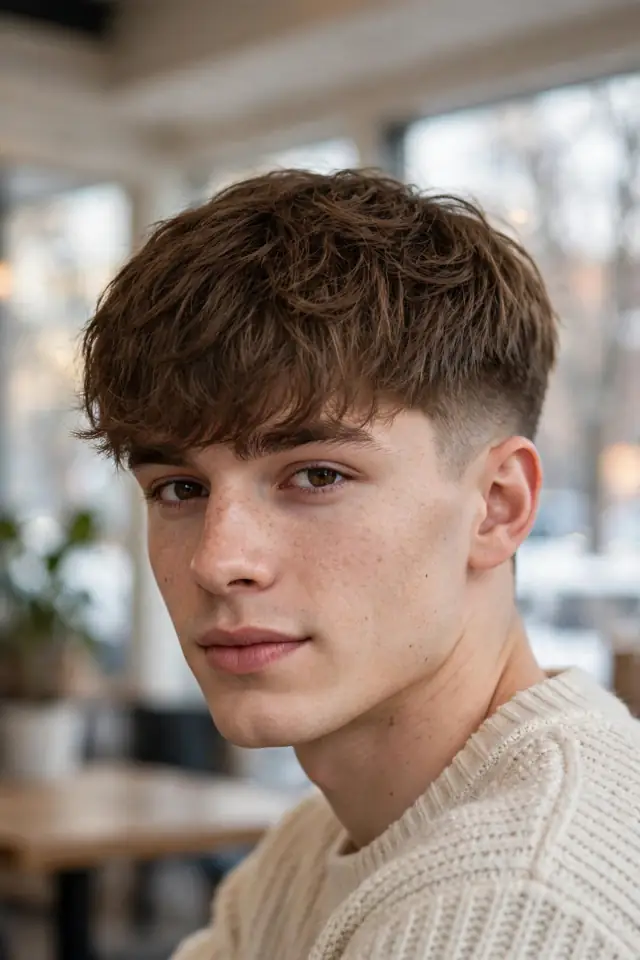
Why has the fringe haircut men ask for moved to the front?
Because forward is flattering. Hair is left long enough on top to fall onto the forehead in a full, textured fringe — not a token flap but a real curtain of hair across the brow — while a mid fade keeps the sides disciplined. The effect is youthful, a little romantic, and excellent at its secret job: covering a high forehead or an uneven hairline better than any other short style. Winter layers and high collars frame it perfectly, and it is the most saved fringe look on inspiration boards right now.
Face Shape: Long and oval faces benefit most — the fringe visually shortens the face. Square faces should ask for a choppier, uneven fringe line.
Grooming Kit: A light styling cream or matte paste, a blow dryer for setting the fall direction, and fingers — this fringe is arranged, never combed flat.
Maintenance: Medium. The fringe needs 3–4 minutes each morning and a trim every 3–4 weeks before it starts eating your eyebrows.
Barber Script: “A forward fringe with a mid fade — leave the top long enough to fall fully onto my forehead, texture through the fringe, mid fade on the sides.”
Q: How do I stop my fringe splitting in the middle?
A: Blow-dry it forward and slightly across while damp, then set with a pea of matte paste. The split is a growth-pattern habit — drying direction retrains it.
Q: Does a forward fringe suit a receding hairline?
A: It is one of the best camouflages there is — the fringe starts behind the recession points and falls over them. Your barber will map the fringe to your hairline honestly.
The fringe does the talking — forehead, covered; compliments, incoming.
4 of 20 — Micro Fringe Crop
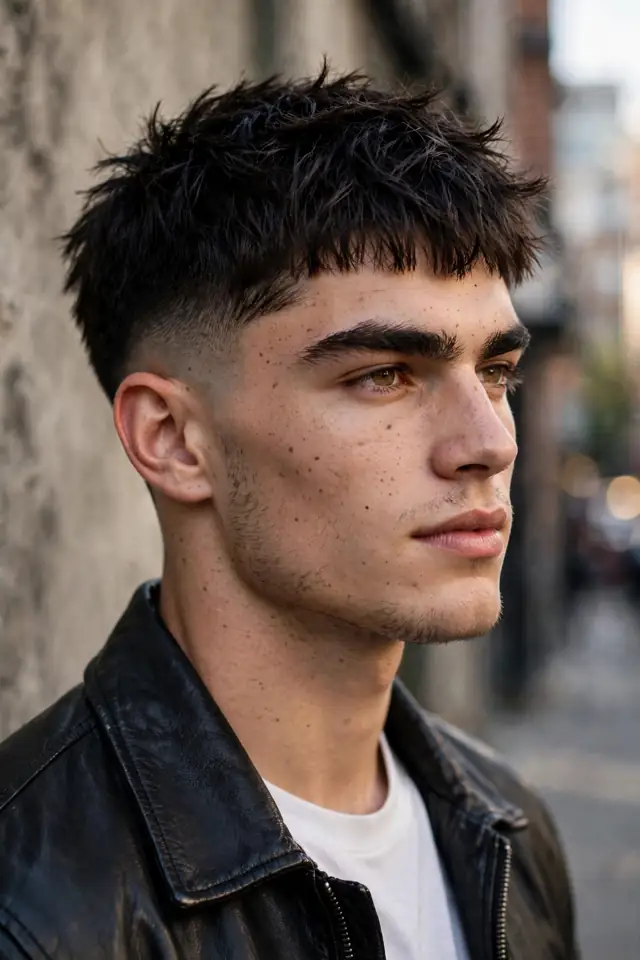
What is the textured fringe haircut everyone’s calling the micro fringe?
The runway’s favourite detail this season: a crop whose fringe is cut very short — a centimetre or two of choppy, piecey edge sitting high on the forehead. It sounds severe, but on the right head it reads as pure attitude: architectural, fashion-forward, and impossible to ignore. The rest of the cut stays a familiar textured crop with soft sides, so the micro fringe is the single bold decision. Winter is the kindest time to try it — if you hate it, a beanie covers the evidence while it grows.
Face Shape: Oval faces carry it best; it exposes the forehead fully, so confidence matters more than shape. Avoid if your forehead is very high.
Grooming Kit: Almost nothing — a whisper of matte paste to separate the piecey edge. This cut’s styling budget is the lowest on the list.
Maintenance: Low-medium. The fringe line needs a tidy every 3 weeks to stay micro; left alone it simply becomes Style 1.
Barber Script: “A textured crop with a micro fringe — fringe cut very short and piecey, high on the forehead, textured top, soft low fade on the sides.”
Q: Is the micro fringe a risky haircut?
A: It is a statement, not a risk — the grow-out path is just a normal crop in three weeks. The only real requirement is liking your forehead.
Q: Who should avoid the micro fringe?
A: Men with very high foreheads or strong widow’s peaks usually prefer Style 3’s fuller fringe, which covers more and forgives more.
Two centimetres of fringe, a whole personality — the runway detail, made wearable.
5 of 20 — Soft Fade with a Tousled Top
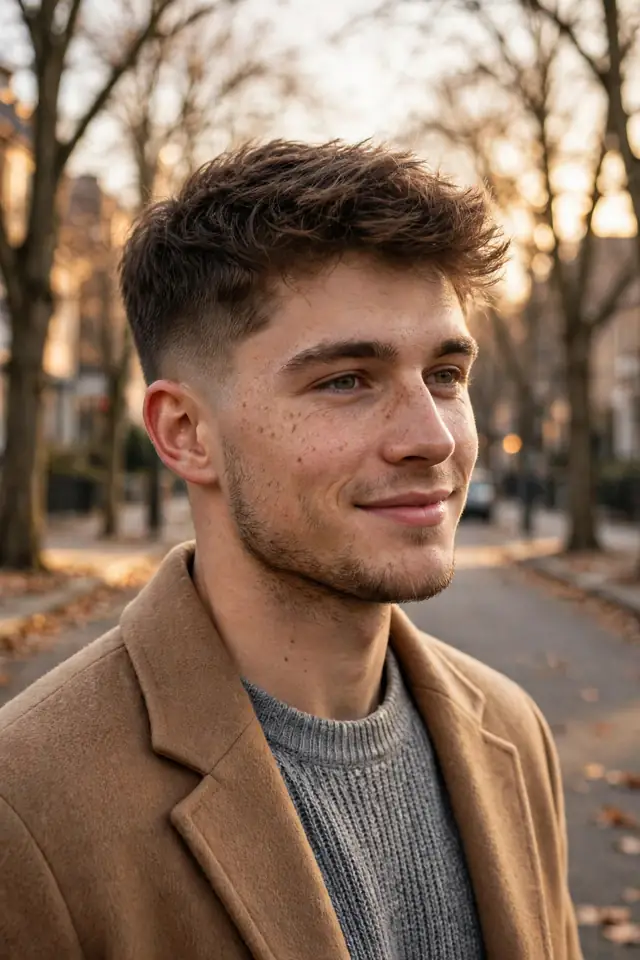
Why is the soft fade haircut replacing the skin fade everywhere?
Because gentle is the new sharp. A soft fade keeps a whisper of hair on the sides and blends gradually — no hard line, no scalp showing — while the top is left tousled and natural with scissor-cut texture. It reads expensive rather than severe, grows out gracefully instead of expiring in ten days, and in winter it keeps a little warmth around the ears as a genuine bonus. This is the fade for men who found skin fades ageing or harsh, and it suits the season’s softer tailoring perfectly.
Face Shape: Universal — the gradual blend flatters every head shape, and the tousled top can be pushed higher (round faces) or flatter (long faces) as needed.
Grooming Kit: A light cream or soft paste with a natural finish — nothing matte-cement. The look is touchable hair, not armour.
Maintenance: Low. The soft blend forgives 4–5 weeks between visits, and the top needs only a minute of finger-styling.
Barber Script: “A soft fade with a tousled top — gradual blend, keep some hair on the sides, no skin line, scissor texture on top left natural.”
Q: Soft fade or taper — are they the same?
A: Close relatives: the taper fades only the sideburns and neckline, while the soft fade blends the whole side gradually. The soft fade looks fuller around the ears.
Q: Does a soft fade work in a formal office?
A: It is arguably the most office-appropriate fade there is — clean and groomed without a single harsh line. Pair it with the side part in Style 15 for full formal.
No hard lines anywhere — the fade grew up and softened.
6 of 20 — Blunt Fringe
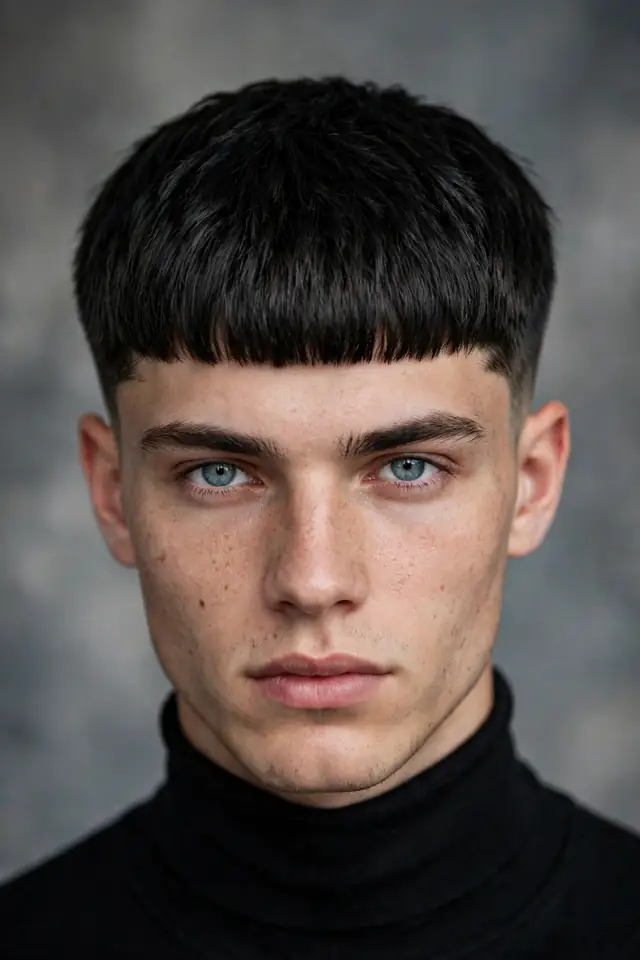
What makes a blunt fringe haircut men wear look so graphic?
The line. Instead of being texturised into softness, the fringe is cut straight and even across the forehead — a deliberate horizontal edge that turns the haircut into geometry. Worn with a textured crop or slightly longer top and faded sides, it is the most editorial fringe on this list, with roots in mod and indie style that resurface every few winters. It demands a steady hairline and rewards it: no other short style frames the eyes this strongly.
Face Shape: Oval and heart faces suit the straight line; round faces should keep the sides higher-faded to balance the horizontal. Long faces are shortened beautifully by it.
Grooming Kit: A fine comb for the line, a light paste to keep the fringe lying as one piece, and a mirror-check habit — this fringe shows every stray hair.
Maintenance: Medium-high. The blunt line blurs fast; a fringe trim every 2–3 weeks keeps the geometry honest.
Barber Script: “A blunt fringe — fringe cut straight and even across my forehead, textured crop on top, mid fade on the sides, fringe line left crisp.”
Q: Can a blunt fringe work with wavy hair?
A: Honestly, it fights you — waves break the straight line within hours. Wavy hair should take Style 9’s wavy fringe, which works with the texture instead.
Q: Is the blunt fringe high maintenance for dating and photos?
A: For photos it is unbeatable — the line reads graphic from every angle. The cost is those fringe trims; between them, a comb and 30 seconds keep it true.
A fringe drawn with a ruler — mod geometry for the winter streets.
7 of 20 — The Caesar Crop
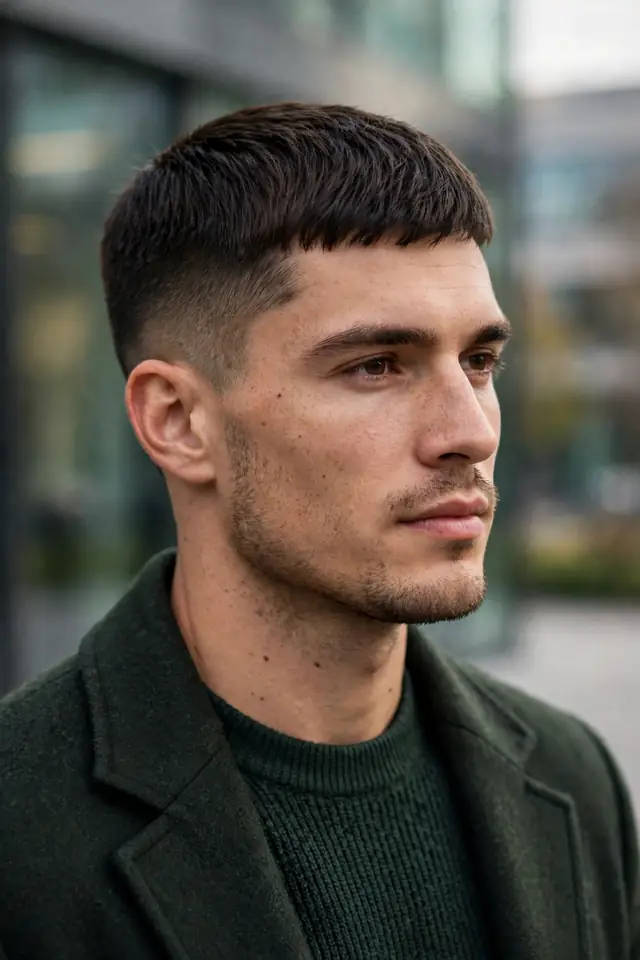
Why does the crop haircut men have worn for centuries never die?
Because it is perfect at its job. Short, even length all over the top — an inch or so — with a short, straight, horizontally-cut fringe and clean tapered or faded sides: the Caesar is the crop in its purest form, unchanged since it was carved in marble. It hides thinning better than any short cut, takes ninety seconds to style, and suits the winter uniform of coats and collars like it was designed alongside them. When in doubt, men have chosen this for two thousand years.
Face Shape: Square and oval faces are the Caesar’s home ground. It also minimises a large forehead and balances a strong jaw beautifully.
Grooming Kit: One matte product, used sparingly, pushed forward. The Caesar’s kit list has not changed in centuries either.
Maintenance: Low. A tidy every 3–4 weeks; the even length grows out uniformly, so it never looks desperate between cuts.
Barber Script: “A classic Caesar — short even length on top, about an inch, a short straight fringe cut horizontally, tapered sides, everything neat.”
Q: Is the Caesar good for thinning hair?
A: One of the best short options — the even forward direction creates uniform coverage with no contrast between thick and thin areas for the eye to catch.
Q: Caesar or French crop?
A: The Caesar is shorter, straighter and more uniform; the French crop (Style 2) keeps more texture and a longer fringe. Same family, different tailoring.
Two thousand years undefeated — the crop in its purest form.
8 of 20 — Messy Matte Layers
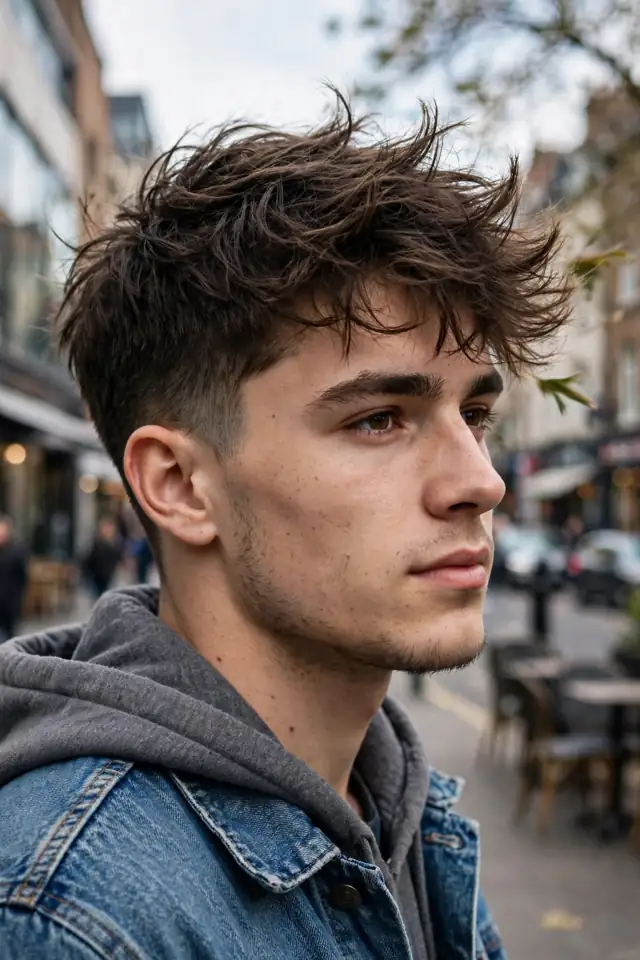
What does a textured crop men style look like with the polish removed?
This — the lived-in version. Layers are cut choppy and uneven through the top, finished entirely matte, and styled by pushing the hair in several directions rather than one tidy forward fall. It is the dishevelled look the runways keep reviving: deliberate imperfection that reads as confidence, and the most forgiving cut in this guide for winter life, because hat hair, wind and a long day all just add to it instead of ruining it.
Face Shape: Oval and long faces take the width and mess well; round faces should keep the sides tighter-faded so the top’s chaos has a frame.
Grooming Kit: Matte clay is the whole recipe — the chalkier the finish, the better. A sea salt spray underneath adds the grit that makes it read windswept.
Maintenance: Low. The mess is the style, so upkeep is a 3–4 week shape tidy and sixty seconds of clay whenever you feel like it.
Barber Script: “Messy matte layers — choppy uneven layers through the top, nothing uniform, low-to-mid fade on the sides, keep it rough and natural.”
Q: How messy is too messy?
A: The line is the sides: as long as the fade and neckline stay clean, the top can be as undone as you like. Chaos up top, discipline at the edges.
Q: Does this suit fine hair?
A: Very well — choppy layers and matte clay are the oldest fine-hair thickeners in the book. The separation creates the illusion of density.
Imperfection, engineered — the cut that hat hair improves.
9 of 20 — Wavy Fringe

How does a textured fringe haircut work when your hair has waves?
It lets the wave do the styling. The top is left at fringe length with layers that follow the hair’s natural S-bend, so the fringe falls in soft, separated waves across the forehead — romantic, a little surfer, completely unbothered. The sides stay tapered or softly faded so the wave owns the picture. In winter this is the lowest-effort good-looking cut for wavy men: cold air adds texture, and the style asks for cream, not heat or force.
Face Shape: Oval and square faces suit the softness; the falling fringe shortens long faces. Round faces should ask for a higher taper so the waves don’t widen the silhouette.
Grooming Kit: A curl or waving cream and a light sea salt spray — moisture and separation. Avoid heavy waxes, which straighten and weight the wave out.
Maintenance: Low-medium. Two minutes of cream on damp hair; a shape tidy every 4 weeks as the layers grow.
Barber Script: “A wavy fringe — leave the top long enough for my waves to fall onto my forehead, layer it with the wave pattern, soft taper on the sides.”
Q: My waves frizz in winter — does this cut help?
A: Yes — length plus layers gives frizz somewhere to belong, and cream-based styling fights the dry air that causes it. Frizz hates moisture; feed it.
Q: Can I straighten this fringe for formal days?
A: You can blow-dry it flatter with a brush for an evening, but daily heat fights the cut’s whole point. Choose Style 3 if you want a straight fall permanently.
The wave is the style — stop fighting it and frame it.
10 of 20 — Low Taper with a Soft Fringe

What happens when a soft fade haircut meets its gentlest fringe?
The most conservative cut in this guide — in the best way. Only the sideburns and neckline are tapered, the sides keep their length and lie flat, and the top falls into a soft, light fringe with airy texture. Nothing about it shouts, which is exactly its power: it suits school, office, family photos and first impressions equally, and it is the easiest winter cut to grow into a longer style later, since nothing has been faded away.
Face Shape: Universal and forgiving — the soft fringe softens square jaws, and the kept sides add width that balances long faces.
Grooming Kit: A light cream or leave-in for the fringe’s softness. Heavy matte products would ruin the gentleness that is the entire point.
Maintenance: Low. Taper tidies every 4–5 weeks; the style reads tidy the whole way through its growth.
Barber Script: “A low taper with a soft fringe — taper only the sideburns and neckline, keep the sides’ length, soft light fringe on top with airy texture.”
Q: Is this too plain if I want compliments?
A: It gets the quiet compliments — “you look fresh” rather than “nice haircut”. For men who want grooming noticed rather than the cut, that is the better compliment.
Q: Can this grow into curtains later?
A: Perfectly — nothing is faded, so the top and sides simply keep growing into Style 13’s flow with no awkward in-between stage to survive.
Tapered edges, feather fringe — the gentleman of the crop family.
11 of 20 — Short Curly Fringe
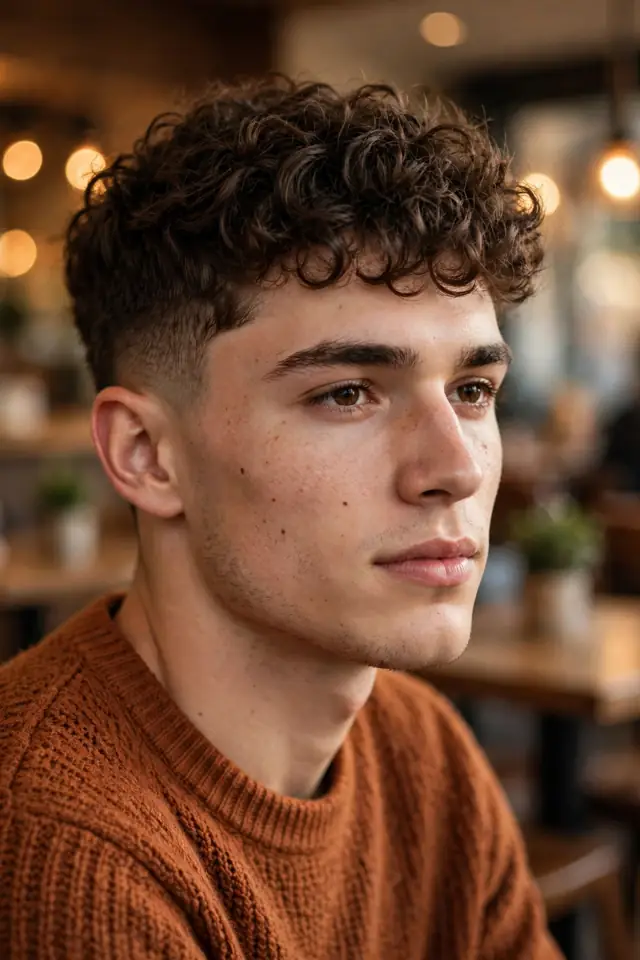
How does a fringe haircut men with curls wear stay short and sharp?
By letting the curls be the fringe. Instead of growing into the full shapes of our curly guide, this version keeps the curls cropped close on top, springing forward into a short curly fringe that sits on the forehead with natural bounce, over a taper or soft fade. It is the neatest way to wear curls in winter — no length to crush under a hat, no morning routine beyond a scrunch of cream — and the curl pattern gives the fringe more character per centimetre than any straight cut here.
Face Shape: Oval and square faces suit the bounce; round faces should keep the fade higher so the curls’ width doesn’t widen the face further.
Grooming Kit: A curl cream and your fingers. Short curls need moisture against winter dryness more than they need styling — cream on damp hair, scrunch, done.
Maintenance: Low. Two minutes daily, a shape tidy every 3–4 weeks before the fringe starts dropping into the eyes.
Barber Script: “A short curly fringe — curls cropped close on top falling forward into a short fringe, taper fade on the sides, keep the curl pattern natural.”
Q: How short can curly fringe go before it looks odd?
A: Keep at least enough length for one full curl to form — usually 2–3 inches on top. Shorter than that, curls read as texture rather than fringe.
Q: Does hat season ruin short curls?
A: Less than any long style — short curls spring back with a water spritz and a scrunch. Crush is a length problem, and this cut has no length to crush.
Curls, cropped and forward — the bounce without the bulk.
12 of 20 — The Soft Mullet
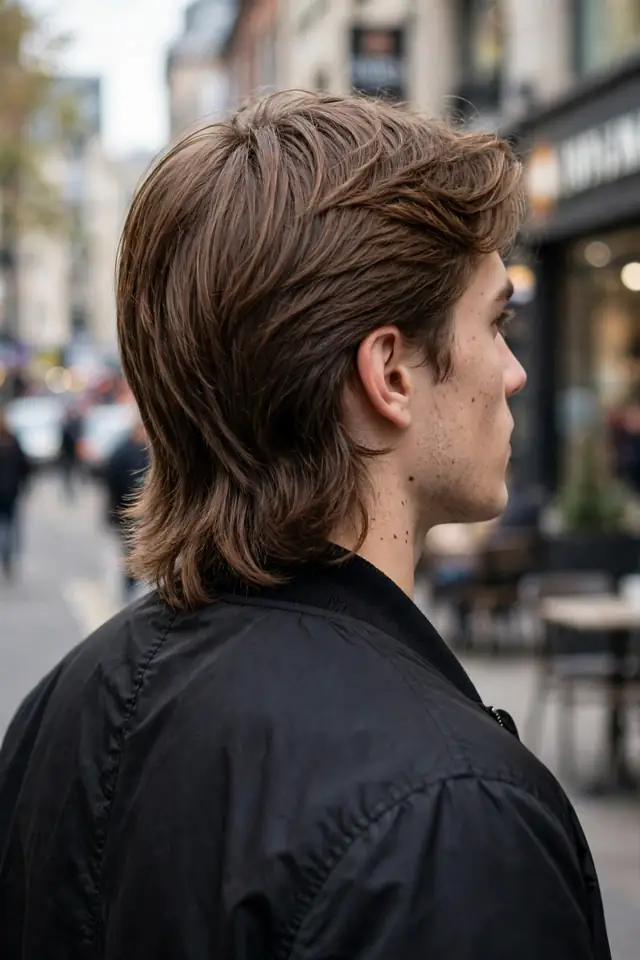
Why are mens winter hairstyles bringing the mullet back softer?
Because the new mullet learned manners. Instead of shaved sides and a hard disconnect, the soft mullet uses gentle tapers or scissor-cut sides, textured layers, and a back that flows rather than hangs — business enough at the front, party enough at the back, and warm around the neck exactly when winter wants it. It works on straight, wavy and curly hair alike, and it is the most personality-forward cut in this guide that still passes in most workplaces.
Face Shape: Oval and long faces carry the back length best; round faces should keep the sides tighter so the silhouette stays vertical.
Grooming Kit: Sea salt spray for the back’s movement and a light cream for the front’s texture. The soft mullet dies under heavy product — keep it touchable.
Maintenance: Medium. The shape needs a tidy every 4–5 weeks; daily styling is a scrunch and a push, nothing more.
Barber Script: “A soft mullet — gentle taper on the sides (no harsh skin fade), textured layers on top, and a soft flowing back that keeps its length.”
Q: Soft mullet or wolf cut — what’s the difference?
A: The wolf cut (in our wolf cut guide) is shaggier and more disconnected with heavier layers; the soft mullet is gentler, cleaner at the sides and more tapered.
Q: Is the soft mullet office-safe?
A: In most modern workplaces, yes — keep the back at collar length and the sides tidy, and it reads as a textured medium cut rather than a statement.
The mullet, house-trained — flow at the back, manners at the front.
13 of 20 — Flowy Curtains
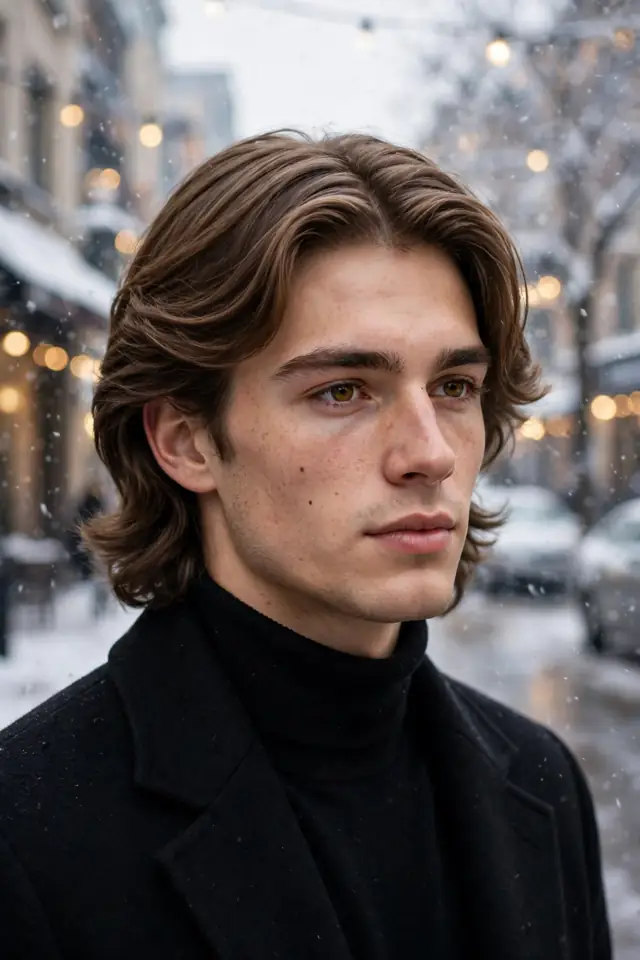
Why do mens winter hairstyles keep returning to curtains?
Because winter is curtains weather. The middle part with hair flowing to both sides — long enough to tuck behind the ears or fall to the jaw — is at its best with the season’s wardrobe: turtlenecks, scarves and coats frame the flow like they were designed for it. It asks for length on top (four inches minimum) and patience, and pays back a look that has cycled from boy-band to runway to barbershop classic without ever fully leaving. The cold months, when hats hide grow-out stages, are the smartest time to commit.
Face Shape: Oval faces are the classic curtains canvas; the centre part adds symmetry that flatters heart faces. Very round faces should keep the sides tucked to avoid width.
Grooming Kit: A light cream or leave-in for flow without stiffness, a wide comb for the part, and a blow dryer if your hair needs persuading to split centrally.
Maintenance: Medium. The length needs a tidy every 5–6 weeks; daily, the part and a push to each side is the whole routine.
Barber Script: “Flowy curtains — a clean middle part, length kept on top to flow to both sides and tuck behind my ears, light layers, natural tapered edges.”
Q: How long does hair need to be for curtains?
A: Roughly 4–5 inches on top to part and fall properly. Winter is grow-out season — start now under beanies and arrive by the coldest months.
Q: Can curtains work with a receding hairline?
A: A centre part is honest about the hairline — men with recession usually prefer Style 3’s forward fringe, which covers instead of frames.
The middle part in its natural season — flow framed by wool.
14 of 20 — Old-Money Slick Back
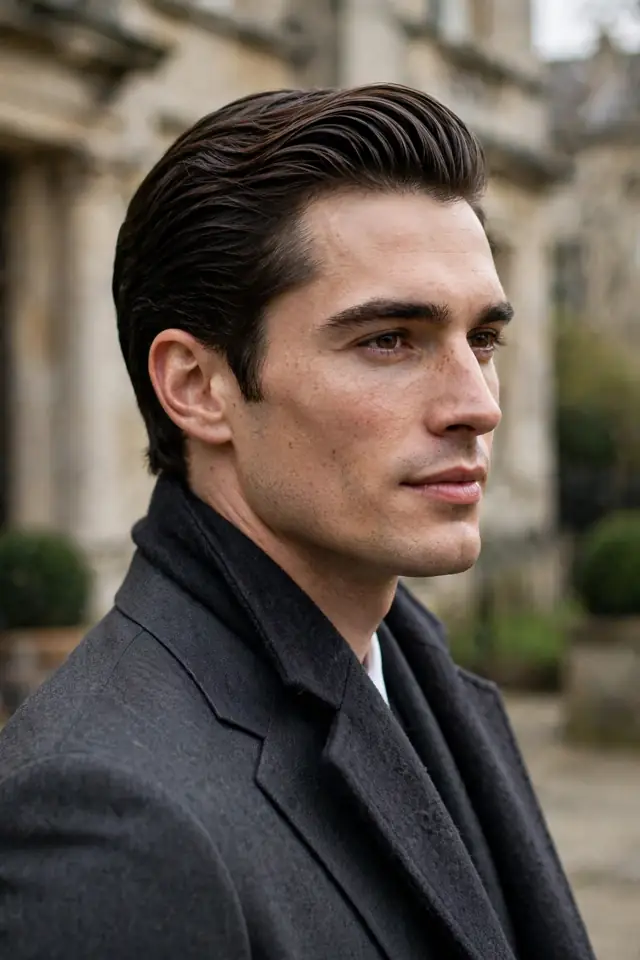
What makes mens winter hairstyles call this one ‘old money’?
Restraint. Hair is kept longer on top, combed straight back with a natural, low-shine finish — no gel armour, no height, nothing that looks like it tried. The sides are scissor-cut or softly tapered so the whole head reads as one groomed surface. It is the quiet-luxury haircut: expensive-looking precisely because nothing about it shouts, and it pairs with winter’s heavy fabrics and structured coats like a private bank pairs with a marble hall.
Face Shape: Oval and square faces carry the exposed forehead best; long faces should keep a slight side sweep rather than a strict straight-back.
Grooming Kit: A light pomade or grooming cream with a natural finish, a good comb, and the discipline to use less than you think.
Maintenance: Medium. The length needs barber polish every 4–5 weeks, and the daily comb-back takes two honest minutes.
Barber Script: “An old-money slick back — length kept on top, combed straight back with a natural low-shine finish, scissor-cut sides, nothing harsh or gelled.”
Q: Slick back or side part — which reads more formal?
A: The slick back reads richer and more evening; the side part (Style 15) reads more classic-office. Both are formal — choose by wardrobe, not rules.
Q: My hair falls forward naturally — can I train it back?
A: Yes — blow-dry it back while damp for two weeks and the growth pattern starts cooperating. A light cream applied before drying does most of the training.
Wealth whispers — and so does this haircut.
15 of 20 — Side Part with Volume

Which winter haircuts for men never embarrass you in a family photo?
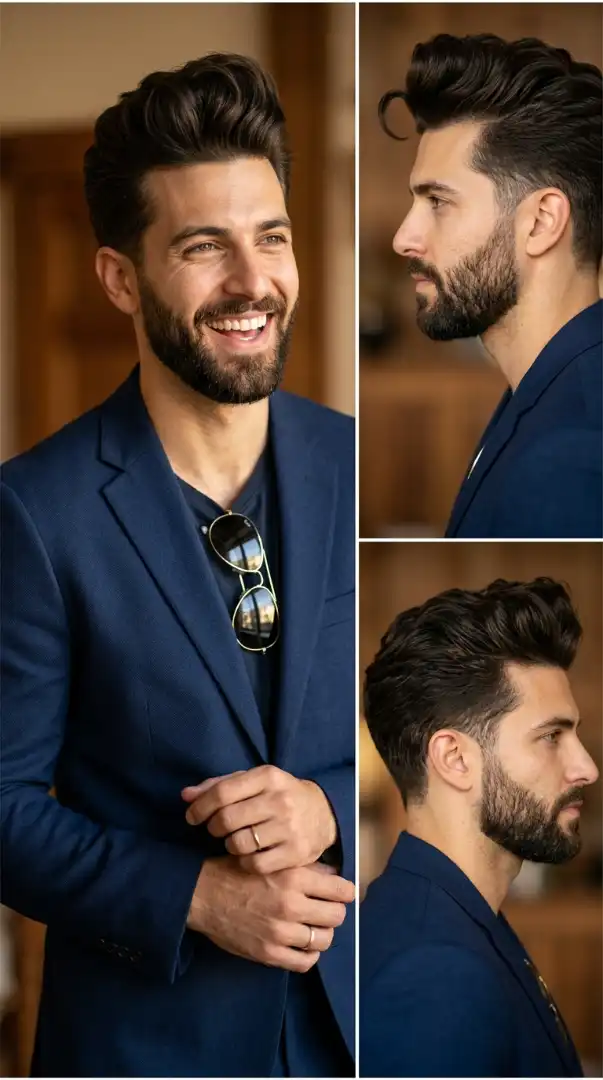
This classic. Three to four inches on top swept into a defined side part with lifted volume, sides tapered clean — the haircut that has survived every trend cycle since your grandfather’s barber because it suits every age, every dress code and every winter occasion from office party to holiday dinner. This season’s version keeps the top softer and more voluminous, less lacquered than the vintage original, so it reads modern rather than costume.
Face Shape: Universal — the part can be placed to balance asymmetry, and the volume helps round and long faces in opposite directions. A barber’s safest recommendation.
Grooming Kit: A medium-hold cream, a comb for the part line, and a blow dryer with a round brush if you want the full lifted finish.
Maintenance: Low-medium. A tidy every 4 weeks; the part takes two minutes with the dryer, or thirty seconds with cream alone.
Barber Script: “A side part with volume — keep 3–4 inches on top, a defined part on my natural side, tapered sides, and lift through the front.”
Q: Hard part or natural part?
A: The natural part (combed, not shaved in) is this season’s version — softer and more modern. A shaved hard part reads sharper but dates faster.
Q: Does the side part work with a beard?
A: Excellently — it is the classic pairing. Keep the beard’s lines as considered as the part and the combination reads intentional from every angle.
The family-photo guarantee — volume up, part down, never wrong.
16 of 20 — Beanie-Proof Buzz Crop
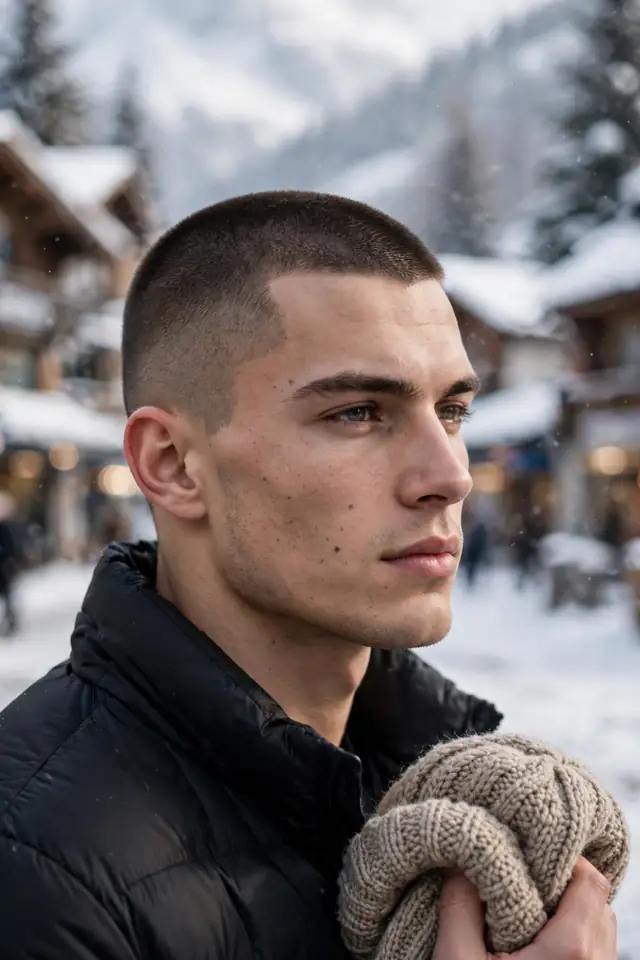
Which beanie friendly haircuts survive hat season with zero damage?
The one with nothing to damage. A buzz crop — even short length all over, a touch of texture left on top if your barber is kind, edges lined up — goes under a beanie, comes out of a beanie, and looks identical both times. It is the winter pragmatist’s masterpiece: no styling, no products, no hat hair physics to fight, and a silhouette that makes strong features do all the talking. Winter is its natural season, because the one downside — a cold head — is solved by the very hat it ignores.
Face Shape: Strong, symmetrical faces shine; the cut hides nothing, so it rewards good bone structure. Oval faces wear it most easily.
Grooming Kit: A moisturiser for the scalp — winter dryness shows on short hair first. That, and a beanie, is the entire kit.
Maintenance: Lowest on the list for effort; highest for frequency — a clipper tidy every 2–3 weeks, which many men simply do at home.
Barber Script: “A buzz crop — even short length all over, a little texture left on top, edges and neckline lined up sharp, beard shaped to match.”
Q: What guard number should I ask for?
A: A #3–#4 on top reads as a deliberate crop rather than a shave; #2 and below is full buzz territory. Bring a photo — guard numbers vary by head shape.
Q: Is winter too cold for a buzz cut?
A: Your head will notice the cold — that is what the beanie is for. Indoors and in photos, the cut looks its sharpest in winter light and layers.
Nothing to crush, nothing to style — hat season’s undefeated champion.
17 of 20 — Grown-Out Fringe
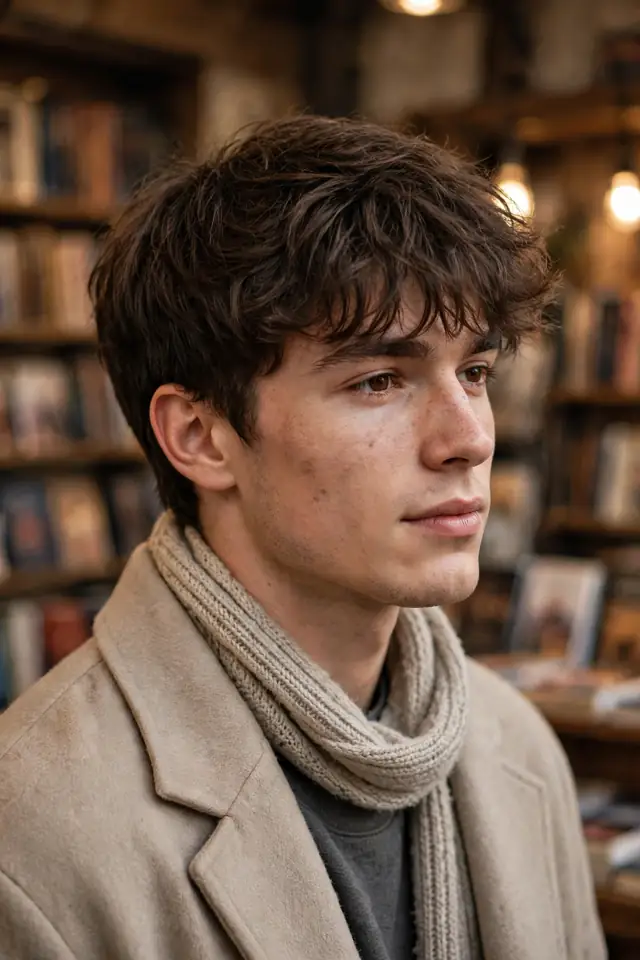
What is a textured fringe haircut supposed to look like at month three?
Like this — on purpose. The grown-out fringe takes Style 3’s forward fall and lets it live longer: the fringe reaches the eyebrows and beyond, the top carries weeks of soft growth, and the whole cut reads relaxed, artistic and slightly undone. Barbers cut it deliberately now — shaped growth, not neglected growth — with the sides kept tapered so the length up top looks chosen. Winter is when men grow hair out anyway; this is how to make the grow-out itself the hairstyle.
Face Shape: Long faces gain from the fringe’s coverage; oval faces wear the full artistic version. Round faces keep the taper higher for structure.
Grooming Kit: A light cream to keep the longer fringe lying in one direction, and patience — this style is 20% product, 80% letting it be.
Maintenance: Low. A fringe tidy every 5–6 weeks keeps it deliberate; daily effort is a push forward and out the door.
Barber Script: “A grown-out fringe — leave the top long and lived-in, fringe reaching my eyebrows, texture throughout, but keep the sides tapered clean.”
Q: Grown-out or just lazy — where is the line?
A: The sides and neckline. Tidy those and any top length reads as a style; let them fuzz and the same hair reads as neglect. The barber visits are the difference.
Q: Can I grow this into curtains by spring?
A: It is the perfect on-ramp — keep growing the top, start training a middle part in the last month, and you arrive at Style 13 without a bad phase.
Growth with intent — the fringe, lived-in and unbothered.
18 of 20 — Dishevelled Quiff
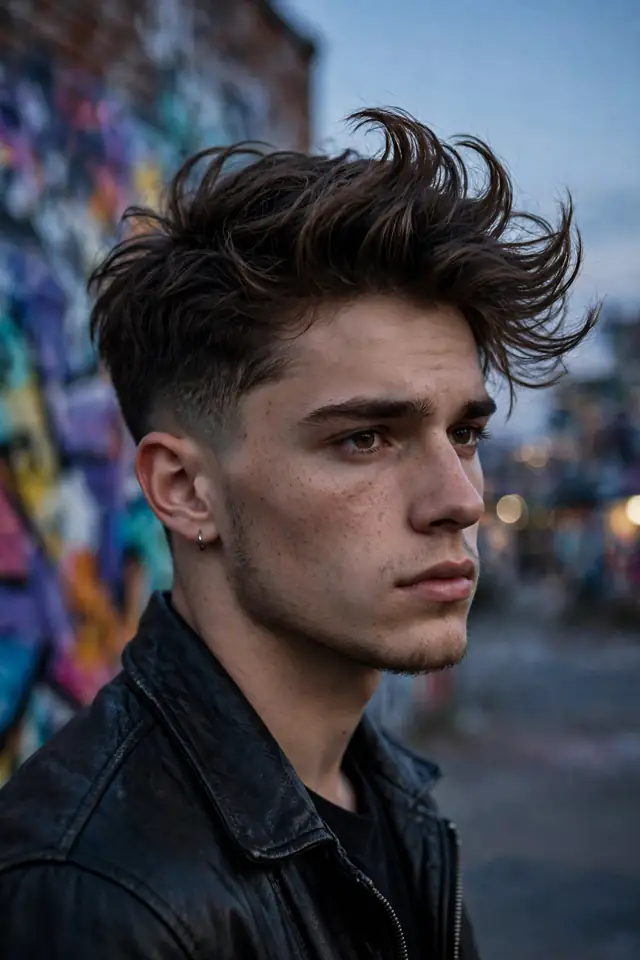
How does a textured crop men know become a quiff without the polish?
By roughing it up. The quiff’s lifted front stays, but instead of being combed into a smooth wave it is textured, separated and finished matte — height with chaos in it. Short faded sides keep the shape barbershop-clean, so the result is the dishevelled look the fashion houses keep sending down winter runways: deliberate imperfection on a disciplined frame. It is the most expressive short style here, and it photographs with more attitude than any tidy cut.
Face Shape: Round faces gain the most — the height lengthens them. Long faces should keep the lift modest and push it slightly sideways instead of straight up.
Grooming Kit: Matte clay for the separation, applied to dry hair and pulled upward in pieces. A blow dryer on the front section builds the height before the clay locks it.
Maintenance: Medium. Three minutes on styling days; the fade wants its usual 3-week tidy, and the front length needs shaping monthly.
Barber Script: “A dishevelled quiff — textured length on top lifted at the front with a messy matte finish, short fade on the sides, nothing combed or smooth.”
Q: Quiff or crop — how do I choose?
A: The quiff shows your forehead and adds height; the crop covers the forehead and reads calmer. Face length decides: round and short faces take the quiff, long faces take the crop.
Q: Will this survive a winter hat?
A: Better than a polished quiff — the matte mess can be re-ruffled with fingers in five seconds after the hat comes off. It is designed disorder; hats just contribute.
Height, roughed up — the quiff after a night out, bottled.
19 of 20 — Shaggy Mid-Length Layers
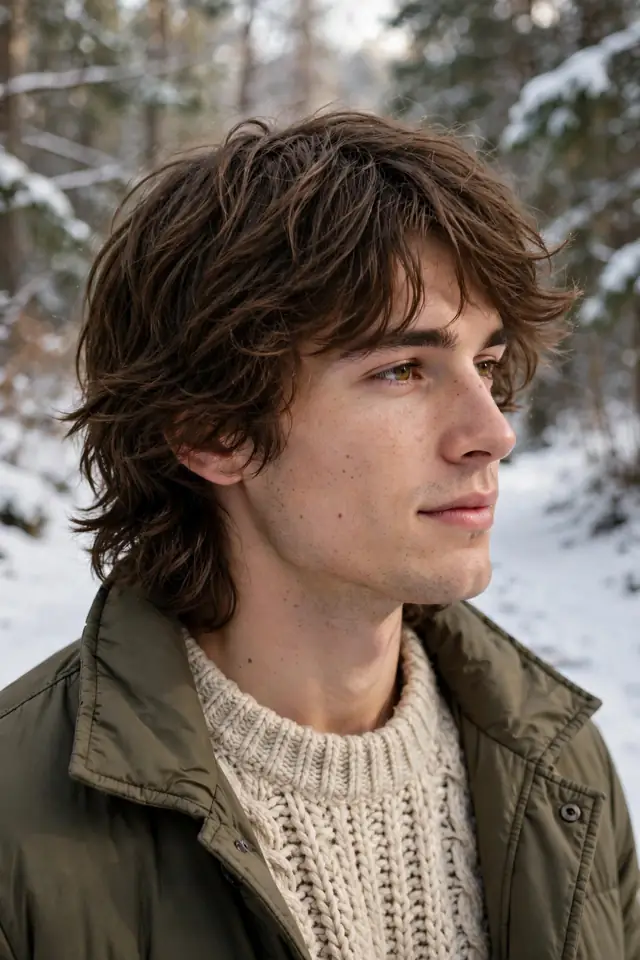
Which beanie friendly haircuts actually use the beanie as a styling tool?
This one. Choppy layers fall past the ears and touch the collar, and the beanie does two jobs: it keeps the length warm and flat at the roots while the ends stay free — then it comes off and the layers fall with exactly the lived-in movement stylists fake with product. It is the longest look in this guide, the warmest around the neck and ears, and the one that most improves with winter’s indoor-outdoor life. Think less haircut, more habitat.
Face Shape: Oval and heart faces suit the length; square faces soften beautifully. Round faces should keep layers longer at the front to draw the eye down.
Grooming Kit: A moisturising styling cream — mid-length winter hair dries at the ends first — and a wide comb. Heat tools are banned; this texture is air-dried by design.
Maintenance: Medium-low. A layer tidy every 6–8 weeks; daily, it is genuinely wash, cream, beanie, go.
Barber Script: “Shaggy mid-length layers — choppy layers falling past my ears and touching the collar, natural and lived-in, light tidy at the ends only.”
Q: Does this length tangle under scarves?
A: Some — cream on the ends and a satin-lined beanie reduce it a lot. A quick finger-comb when the scarf comes off is the whole fix.
Q: Can I tuck it all under a beanie for work?
A: Mostly — tuck the sides behind your ears first, then the beanie. What escapes at the collar reads as intentional with this cut’s shape.
The longest look here, and the beanie is on its styling team.
20 of 20 — The Finale: The Winter Crop King
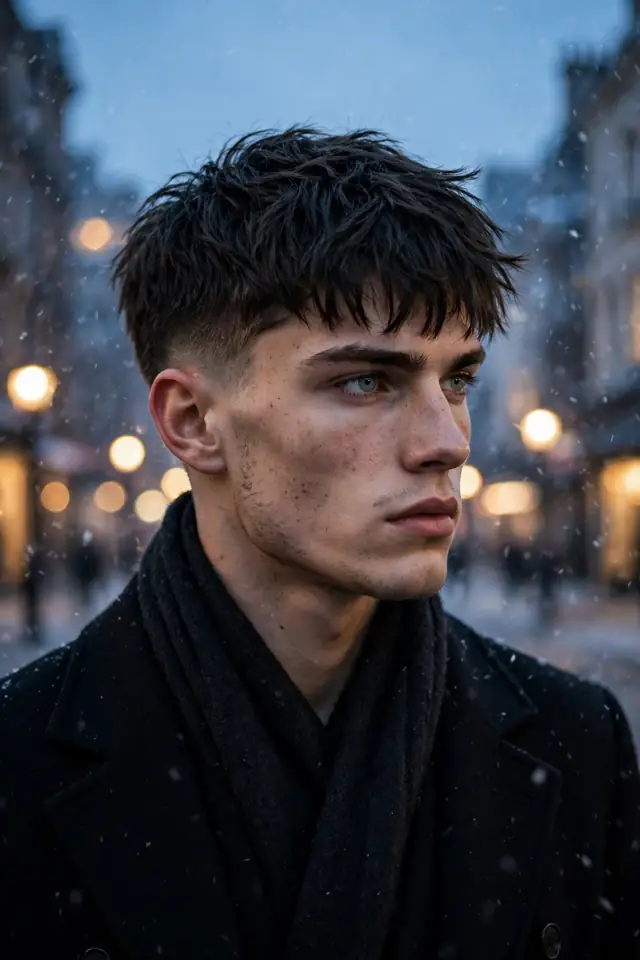
Which of these winter haircuts for men takes the crown?
The one that combines the season’s three biggest stories in a single cut: a textured crop’s choppy forward top, a fringe with real presence — textured, brow-skimming, unmistakably the point — and a soft fade that keeps everything gentle at the edges. It is Style 1 perfected and personalised: more fringe than the standard crop, softer sides than the French crop, more attitude than both. Photographed against winter coats and cold light, it is the look this whole guide has been building toward — book it exactly like this.
Face Shape: Oval and square faces wear the full version; long faces gain from the fringe, round faces from a fractionally higher soft fade. Your barber tunes the balance.
Grooming Kit: Matte clay for the top’s separation and a light cream for the fringe’s direction — the two-product kit that runs this entire guide in miniature.
Maintenance: Medium. Three minutes daily to push the fringe home; a tidy every 3 weeks keeps the crop’s architecture honest through the season.
Barber Script: “The winter crop: choppy textured top worn forward, a full textured fringe skimming my brows, and a soft fade on the sides — crop structure, fringe presence, gentle edges.”
Q: How is this different from Style 1’s textured crop?
A: The fringe is longer and more deliberate here, and the fade is softer — it is the crop tuned toward the fringe, where Style 1 is tuned toward all-round ease.
Q: One cut for the whole winter — is this really it?
A: If your hair is straight to wavy and your mornings are short, yes. It grows out into Style 17 gracefully, works under every hat, and never dates in a photo.
Crop structure, fringe presence, soft edges — the season in one cut. Save it for your barber.
The Bottom Line
This winter’s formula is settled: texture on top, softness at the sides, and a fringe that faces forward. Start with the textured crop if you want the barber’s number one, the soft fade if harsh lines aged you, and the grown-out fringe or shaggy layers if you are using the cold months to grow. Whatever you choose, keep it matte, keep it moisturised against the dry air, and let the beanie be a tool rather than an enemy. For longer options see our medium-length winter hairstyles, and for texture in its fullest form, our curly hairstyles for men.

One Comment