10 Stylish Hairstyles For Asian Men In 2026
1 of 10 — The Tokyo Drift Textured Crop
FACE SHAPE MATCH
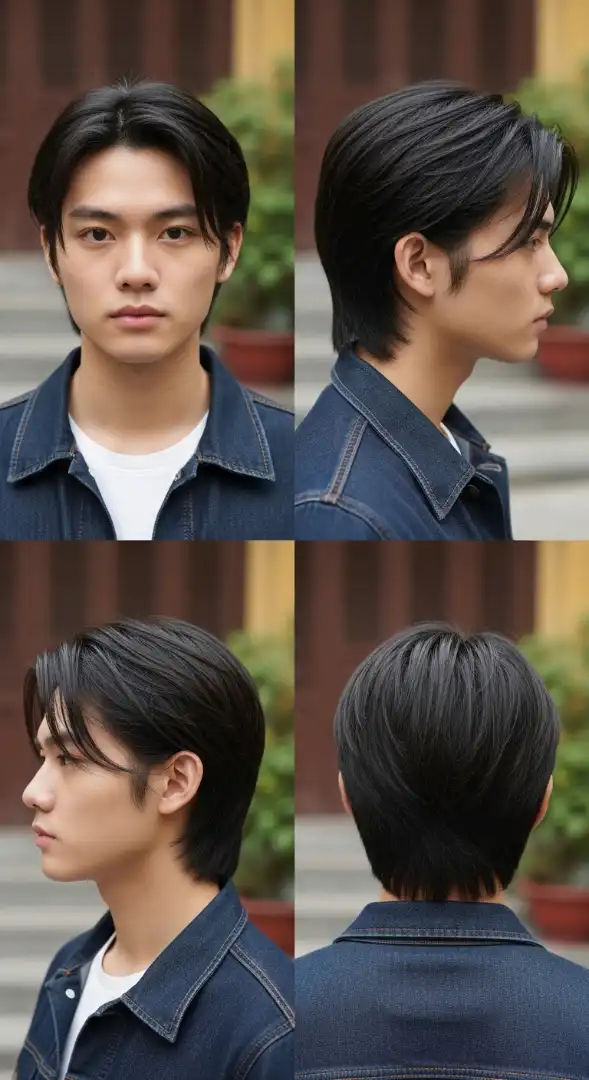
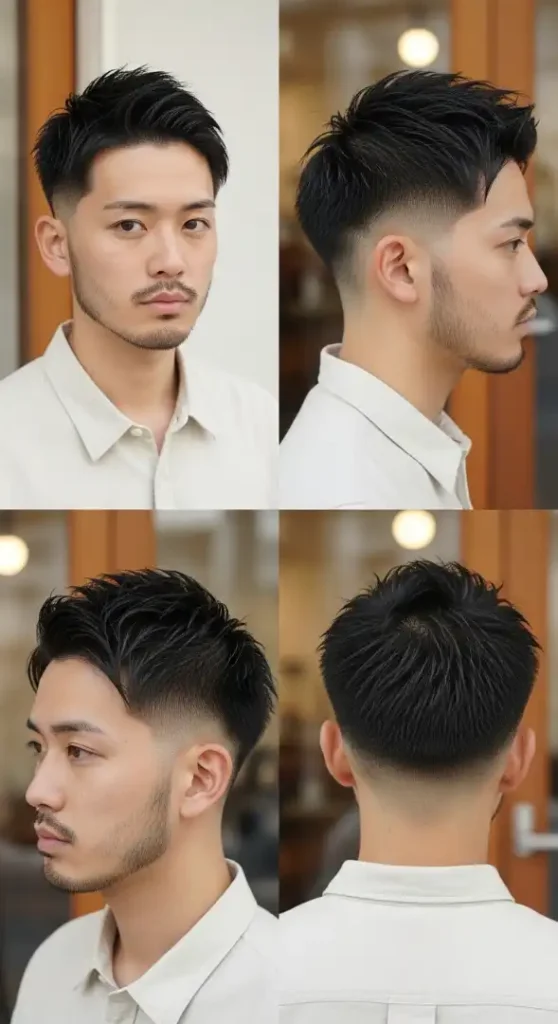
The Tokyo Drift Textured Crop is best suited to oval and oblong face shapes, and performs exceptionally well on East Asian men whose hair naturally grows straight and dense — the exact texture that makes choppy crop techniques truly sing. For oval faces, the balanced proportions of this cut maintain harmony without exaggerating any dimension. The textured top adds visual interest without adding significant height, keeping the oval’s natural symmetry intact. For oblong faces, the forward-swept fringe shortens the perceived vertical length of the face by drawing the eye horizontally across the forehead. The low fade avoids adding width at the sides, which would widen the silhouette in an unflattering way. This cut is less ideal for very square face shapes — the horizontal fringe can emphasize an already-wide jawline.
GROOMING KIT
- Clippers: Wahl Senior Cordless for the fade body work; Wahl Detailer for the neckline architecture
- Trimmer/Outliner: Andis T-Outliner for nape shape-up and hairline edge
- Scissor: 6-inch Japanese steel texturizing shears (e.g. Mizutani Acro) for point-cutting the top
- Comb: Kent SPC20 wide-tooth for sectioning; fine-tooth tail comb for fringe placement
- Product: Uppercut Deluxe Matt Clay (pea-sized amount worked into damp hair, blown dry for lift, then re-activated with fingertips for separation); Bumble and Bumble Surf Spray as a pre-styler for texture grip
MAINTENANCE LEVEL: MEDIUM
- Barber visit frequency: Every 3–4 weeks to maintain the fade’s crispness. The textured top can stretch to 5 weeks before losing shape.
- Daily styling time: 6–8 minutes. Blow-dry upward on the crown for 3 minutes, work product through, separate with fingers.
- Routine: Towel dry → Surf Spray throughout → rough blow-dry upward → Matt Clay through the top → fingertip separation → done. No second-day re-styling needed if you sleep on a silk pillowcase.
THE EXACT SCRIPT
“I want a textured crop with a low skin fade. On the sides and back, start with a 0.5 guard tight to the skin at the bottom, blend into a 1 guard mid-section, then fade into the top with a 2 guard — keep the fade line low, sitting about 1 finger above the ear. On top, leave 2.5 to 3 inches and point-cut with texturizing shears to break up the weight line — I don’t want a blunt edge, I want choppy separation. Leave the fringe long enough to sweep forward to my left eyebrow. Nape should be a soft arch — no hard corners. Clean the hairline with a straight razor. No product, I’ll style it at home.”
If you love the effortless movement of this crop, Style #2 takes Asian texture in a completely opposite direction — more structured, more powerful, and built for the man who means business.
FAQs
Q: What is a textured crop haircut and how is it different from a regular crop? A: A textured crop is a short-to-medium cut where the top is point-cut or razor-cut to remove weight and create deliberate separation between strands, unlike a regular crop which has a blunt, even edge. The textured version has more movement, dimension, and a less “helmeted” appearance — ideal for Asian hair, which is naturally dense and benefits from weight removal.
Q: How do I style a textured crop at home with Asian hair? A: Start with damp — not wet — hair. Rough-dry it pointing upward with a medium-heat dryer for 2–3 minutes to build root lift. Then work a matte clay (try Uppercut Deluxe or Layrite Matte) through the crown with your fingertips, not a comb, separating strands as you go. Finish by pushing the fringe forward. Total time: 7 minutes.
Q: How often should I get a textured crop touched up? A: Every 3 to 4 weeks for the fade — this is the part that grows out fastest and becomes noticeably untidy first. The top can last 5 weeks before it loses the intended shape. If you push past 5 weeks, the fringe will start overhanging your brow, which changes the entire look.
Q: Is the textured crop good for thick, straight Asian hair? A: Yes — it’s one of the best cuts for thick, straight Asian hair. The point-cutting technique removes bulk from the top without reducing overall length, and straight hair holds the separated, textured look better than curly hair. The challenge with Asian hair is over-heaviness; this cut directly solves that problem.
2 of 10 — The Seoul Executive Taper
FACE SHAPE MATCH
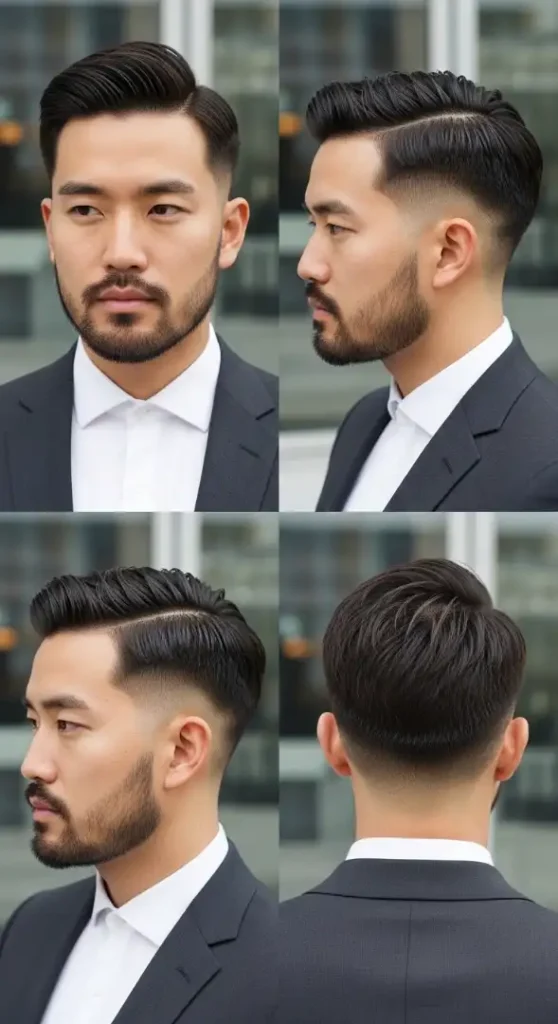
The Seoul Executive Taper is the single most powerful cut for a square face shape on an Asian man. Here’s the anatomical logic: a square face has strong, equal-width jaw and forehead measurements with angular corners. The classic hard side part and slicked top create strong vertical movement that draws the eye upward, elongating the perceived face length. Meanwhile, the mid taper — intentionally not a skin fade — preserves just enough width at the temple to avoid making the jaw look disproportionately wide by comparison. The squared nape reinforces the jaw’s angularity, making it look intentional rather than heavy. This cut also works beautifully on diamond face shapes, where the taper softens the wide cheekbones without reducing the jawline’s presence.
GROOMING KIT
- Clippers: Andis Master Cordless for taper precision — the lever adjustment is essential for the seamless 0.5-to-3 blend
- Trimmer/Outliner: BaByliss Pro FX Skeleton Trimmer for the beard edge and part-line razor definition
- Comb: Kent 20T fine-tooth comb for the slick-back application; tail comb for the hard part
- Brush: Denman D4 for distributing pomade evenly through the top
- Product: Layrite Original Pomade (medium hold, medium shine) — 2 dime-sized scoops, worked through damp hair before blow-drying, then reset with dry application of the same product to lock the part. Avoid water-based gels — they flake on dark Asian hair.
MAINTENANCE LEVEL: HIGH
- Barber visit frequency: Every 2.5 to 3 weeks. The squared nape and mid taper grow out extremely visibly on dark hair against light skin — 3 weeks is the absolute outer limit.
- Daily styling time: 8–12 minutes. Wash, towel dry, apply pomade to damp hair, blow-dry with a round brush (3 minutes), reset part with tail comb, re-apply pomade for shine and hold.
- Honest assessment: This is not a style for men who travel frequently without a hairdryer and pomade. One morning of air-drying will break the silhouette entirely.
BARBER TALK: THE EXACT SCRIPT
“I want a classic side-part taper — no skin fade, just a mid taper. On the sides and back, use a 1 guard at the bottom, blend up through a 2 and 3 guard, feathering the top with a 4 — keep the taper sitting tight to the skull. I want a hard part on the left side, one inch in from the temple — use a straight razor or trimmer to cut the part line clean. Leave the top 3 inches and comb it to the right. Square the nape — two clean corners, no arch. Neckline with a straight razor. Blend the sideburn into my short beard at the 1 guard level so everything connects. Finish with your blow-dryer to set the part direction.”
Style #3 takes the side-part DNA of this cut and electrifies it — same Asian hair type, completely different energy. If you’ve ever wanted to look like you just walked off a K-drama set, don’t skip it.
FAQs
Q: What is a mid taper and how is it different from a skin fade? A: A mid taper blends from shorter hair at the bottom to full-length hair at the top, with the lowest point sitting at mid-ear level using a 0.5 or 1 guard — never reaching the skin. A skin fade goes all the way to bare skin at the base. The taper is more conservative and corporate-appropriate; the skin fade is more streetwear and barbershop-culture oriented. For formal workplaces, the taper is the correct choice.
Q: Is the slick-back side part good for thick Asian hair? A: Yes — thick, straight Asian hair is the ideal texture for a slick-back side part. The density holds the pomade in place without collapsing, and the natural straightness means the comb-over lies flat without frizz. The key is using a medium-hold oil-based pomade like Layrite rather than a gel, which can stiffen and flake on dense dark hair.
Q: How do I maintain a hard side part between barber visits? A: Use a fine-tooth tail comb to re-establish the part every morning before applying product. If the part grows out or blurs, dampen the hair with a spray bottle first — dry hair resists part formation. A light touch of Layrite or Brylcreem along the part line, set with a blow-dryer on low, will keep it defined for the full day.
Q: Which face shapes should avoid the hard side part? A: Oblong and rectangular face shapes should approach this cut cautiously. The hard part and height on top can exaggerate an already-long face. If you have an oblong face, ask your barber to reduce the height on top and add more volume at the sides instead — a modified version without the hard part works much better.
3 of 10 — The Monsoon Quiff
FACE SHAPE MATCH
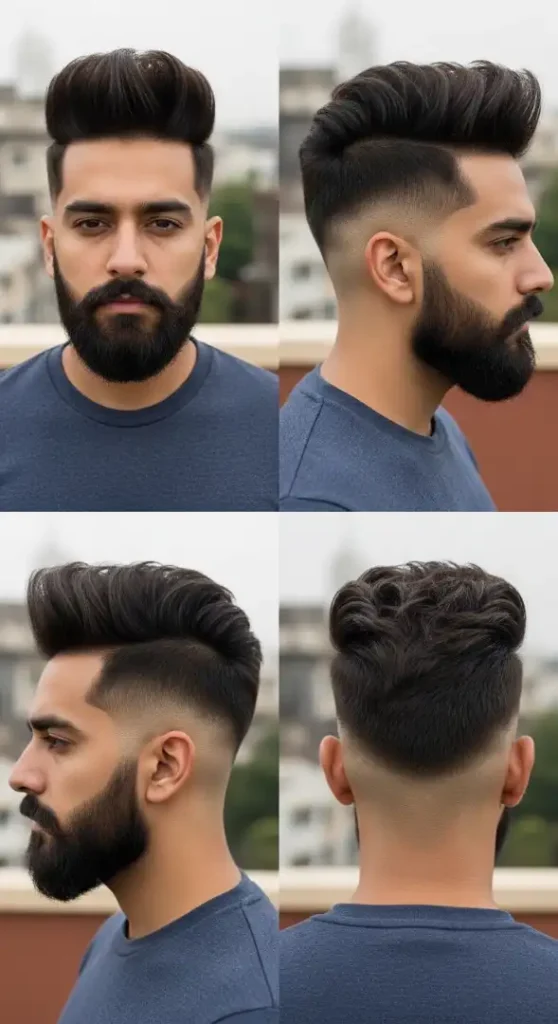
The Monsoon Quiff was designed with one primary face shape in mind: round. A round face has roughly equal width and height measurements with no strong angles — the softness of a round face works against most men because it can read as “young” or undefined rather than structured and masculine. The quiff solves this with pure geometry. The vertical height of the quiff adds 2–3 inches of perceived face length from the front view, elongating the silhouette dramatically. The tight skin fade removes all horizontal width from the sides — a critical move because adding width to a round face would make it appear rounder. The full beard below adds further vertical length and introduces sharp angles at the cheek and jaw. This combination — height up, width removed, jaw defined — creates the illusion of an oval or heart-shaped face. This style is equally powerful on heart-shaped faces where the quiff’s volume balances a wide forehead against a narrow chin. It is not recommended for oblong or rectangular face shapes, where the added height would exaggerate facial length to an unflattering degree.
GROOMING KIT

- Clippers: Wahl Magic Clip Cordless for the skin fade body — the stagger-tooth blade handles the coarse South Asian hair texture without snagging
- Trimmer/Outliner: Andis Slimline Pro Li for the hard beard line at the cheek and mustache definition
- Blow Dryer: Dyson Supersonic with the smoothing concentrator nozzle — essential for training coarse straight hair upward during the quiff styling process
- Comb: Metal pintail comb for root-lift sectioning; Denman D3 for the quiff sweep-back
- Products: American Crew Fiber (high hold, low shine) for the quiff structure — 2 pea-sized amounts; Kevin Murphy Easy Rider (curl definer repurposed as a pre-styler) to add moisture and grip to dry Asian hair before blow-drying. Beard oil: Beardbrand Tree Ranger for the full beard.
MAINTENANCE LEVEL: HIGH
- Barber visit frequency: Every 2–3 weeks. The skin fade is the short fuse here — at week 3, the clean graduation blurs noticeably on dark hair.
- Daily styling time: 10–12 minutes. This style demands a blow-dryer. No blow-dryer = no quiff. Pre-styler applied to damp hair → rough-dry upward → switch to concentrator nozzle → blow upward and back → apply American Crew Fiber → set with cool air.
- Note: This style has high reward but demands daily commitment. Not recommended if your morning routine is under 10 minutes.
BARBER TALK: THE EXACT SCRIPT
“I want a quiff with a low skin fade. Start at the skin — 0.5 guard at the base — and blend up through a 1, then a 2, and feather into the length on top around the 3 guard. Keep the fade low: sitting no higher than 1.5 fingers above the ear. On top, leave me 3.5 to 4 inches from root — I need length to blow a quiff upward. No hard part — leave a natural fall line. Scissor-cut the top to remove bulk without reducing length. Round the nape — no squared corners. Clean the hairline and neck with a straight razor. For the beard, line it straight across the cheek at the natural beard line — I don’t want it too high. Keep the mustache full, trim only the bulk.”
🔗 Internal Linking Hook: The Monsoon Quiff gives height. Style #4 gives structure — it’s the ultimate Asian men’s cut for anyone who wants volume without the commitment of daily blow-drying.
FAQs
Q: Can Asian men with straight hair pull off a quiff? A: Absolutely — straight, dense Asian hair is actually one of the best textures for a quiff because it holds the upward shape without collapsing. The key is using a blow-dryer with a concentrator nozzle to train the hair upward while it’s damp, then locking it with a high-hold matte product like American Crew Fiber. Naturally straight hair will hold a quiff longer than wavy or curly hair.
Q: How do I make a quiff stay up all day? A: The two-step method works best: first blow-dry the quiff upward while applying light product to damp hair — this sets the shape at the root. Let it cool fully, then apply a second, smaller amount of high-hold product with your fingers to the surface. The root-set from blow-drying is what makes the quiff last; product alone won’t hold straight hair upward past hour two.
Q: Which beard style goes with a quiff on Asian men? A: A short full beard or heavy stubble (3–5mm) works best with a quiff on Asian men. It adds jaw definition that balances the height on top, creating visual equilibrium. A clean-shaven look works too if your jawline is naturally strong, but avoid a long beard — it creates two competing focal points and makes the head look crowded.
Q: What is the difference between a quiff and a pompadour? A: A quiff sweeps upward and slightly backward with a natural fall and visible texture throughout. A pompadour is swept backward only, sits flatter against the skull at the sides, and traditionally uses a higher-shine finish. The quiff is more modern and casual; the pompadour is more retro and formal. Both add height to round faces, but the quiff is lower-maintenance for Asian hair textures.
4 of 10 — The Hanoi Curtain Flow
FACE SHAPE MATCH
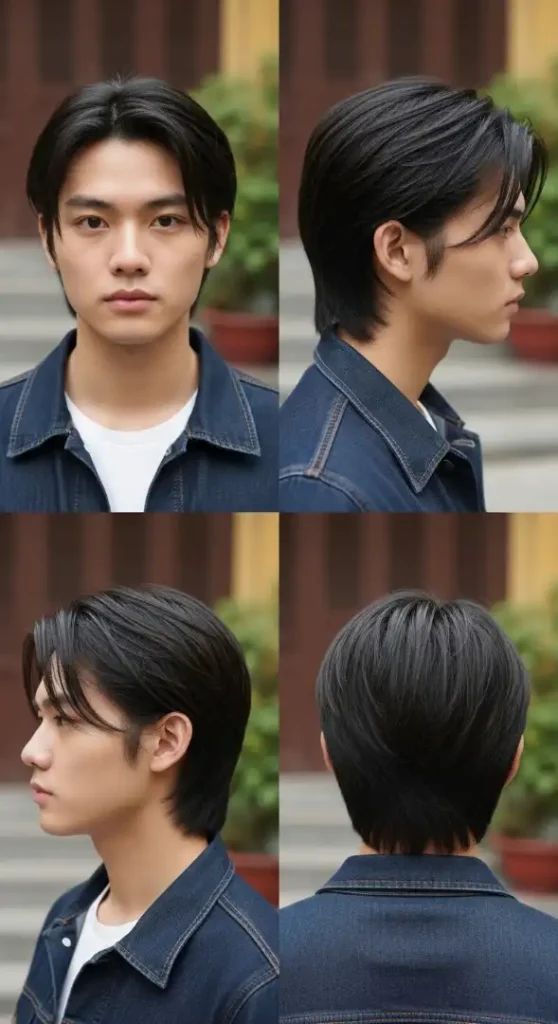
The Hanoi Curtain Flow is a masterclass in softening a heart-shaped face. A heart face features a wide forehead and cheekbones paired with a narrow, pointed chin — a combination that can look angular and unbalanced without the right framing. The center-parted curtain fringe addresses this directly: the two falling panels draw vertical lines down both sides of the forehead, visually narrowing the widest part of the face. The chin-length — or near-chin-length — fall of the curtains also draws attention downward toward the narrower chin area, creating a sense of balanced proportion. This cut is equally excellent for oval and round faces — for oval faces it maintains natural harmony, and for round faces the downward-falling curtains create a slimming vertical line. It is the wrong call for oblong faces, where adding length to the sides of the face with long curtains will exaggerate the already-long proportion.
GROOMING KIT
- Scissors: 5.5-inch Japanese steel blunt-cut scissors for perimeter trim; point-cut scissors for the interior to reduce any bulk without losing length
- Fine-tooth comb: Kent 20T for center-part placement and daily detangling
- Brush: Mason Pearson Pocket Bristle & Nylon brush (BN4) — the gold standard for distributing natural oils through silky straight Asian hair and creating the liquid sheen that makes this style iconic
- Product: Minimal is the mandate. Bumble and Bumble Hairdresser’s Invisible Oil (2 drops worked through the lengths on damp hair) for anti-frizz shine without weight. For hold on humid days: Living Proof Perfect Hair Day (PhD) 5-in-1 styling spray — a light mist before air-drying
- Barber visit frequency: Every 6–8 weeks for a perimeter trim only — no fade to maintain means the growth cycle is forgiving.
- Daily styling time: 2–4 minutes. Towel-dry, 2 drops of hair oil, center-part with comb, air-dry or light blow-dry. This is one of the easiest styles on this entire list to maintain daily.
- Honest note: The tradeoff for low maintenance is lower longevity. By week 8–10, the curtains will lose their intended proportion as they grow past the jaw.
“I want a curtains hairstyle — center part, natural fall. Don’t touch the length too much, just clean up the perimeter: trim the back nape to a soft rounded taper, no hard lines, no fade. Just a natural scissor taper. On the sides, trim enough to remove split ends and maintain the shape — the left side should fall to my jaw, the right slightly shorter, to my cheekbone. No layers through the interior — I want the hair to hang naturally with weight. No product in, just clean and dry, and I’ll style it at home.”
: If the low-maintenance elegance of this style speaks to you, Style #5 takes the curtain concept and adds a sharp modern twist that bridges 1990s nostalgia with 2026 precision.
FAQs
Q: What are curtains hair and why are they trending in 2026? A: Curtains hair is a center-parted style where the hair falls on both sides of the face in two sections — like opening curtains on a window. They’re trending in 2026 because K-drama and J-pop culture have pushed the aesthetic globally, and the style works exceptionally well with the silky straight hair texture common among Asian men. It’s effortless, romantic, and genuinely low-maintenance.
Q: How long does hair need to be for curtains hairstyle? A: You need at least 4–5 inches of length on top to achieve a true curtains look. The fringe should reach at least to the mid-cheek level to frame the face properly. If your hair is shorter than 3 inches, you’re in the growing-out phase — use a light hair oil and let it grow for 8–12 weeks before attempting the style.
Q: How do I part curtains hair in the center if my hair naturally parts to one side? A: Train the part by dampening your hair every morning and running a fine-tooth comb along the center from forehead to crown. Use a lightweight product like Bumble and Bumble Invisible Oil to weight the hair into the new direction. It takes 1–2 weeks of consistent daily training before the hair stops resisting the center part.
Q: Does the curtains hairstyle work for Asian men with thick hair? A: Yes, but bulk management is critical. Thick Asian hair can make curtains look heavy and helmet-like rather than flowing. Ask your barber to point-cut the interior to remove weight without reducing length. This preserves the curtain silhouette while allowing individual strands to move and catch the light naturally.
5 of 10 — The Dragon’s Crest Pompadour
FACE SHAPE MATCH
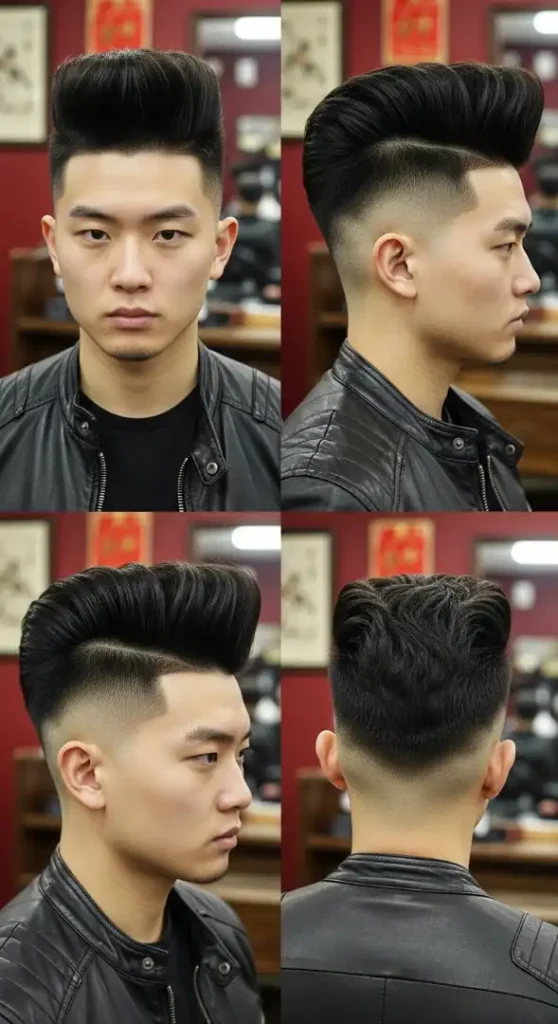
The Dragon’s Crest Pompadour is the statement piece of Asian men’s hairstyling — and it’s perfectly calibrated for oval and diamond face shapes. On an oval face, the pompadour’s dramatic height creates a bold, theatrical presence without disrupting the face’s natural balance, because the oval’s proportional symmetry absorbs the height without distortion. For a diamond face — wide cheekbones, narrower forehead and jaw — the high skin fade removes visual width at the cheek level while the pompadour adds forehead-level width through volume, creating the illusion of a more uniform width across the face. This is a powerful optical correction tool dressed as a fashion statement. What this cut cannot help: round faces (the height is beneficial, but the high fade removes too much width and can make the face look very tall and narrow) and square faces where the combination of height plus angular jaw can read as overly severe.
GROOMING KIT
- Clippers: Andis Master Cordless — the precision lever is critical for the clean high skin fade, especially around the temple corners
- Outliner: BaByliss Pro FX Skeleton Outliner for the squared nape and hairline edge
- Blow Dryer: Dyson Supersonic with smoothing nozzle — non-negotiable for building pompadour height on Asian hair
- Round Brush: Denman D3 for directional backward blow-drying
- Products: Suavecito Pomade Original Hold (2 scoops, applied to damp hair, blow-dried back with the round brush, then re-applied to the surface for gloss and hold). For the stubble: Murdock London Beard Balm to add softness and definition without shine.
MAINTENANCE LEVEL: HIGH
- Barber visit frequency: Every 2 weeks — the high skin fade blurs after 10–14 days on Asian hair. This is the fastest-growing-out style in this guide.
- Daily styling time: 12–15 minutes. Wash, apply Suavecito to damp hair, round-brush blow-dry completely backward (5–7 minutes), cool the shape, re-apply a surface layer of pomade.
- Honest note: If you skip the blow-dry, you have no pompadour — you have a messy cowlick. This style requires daily tool use, no exceptions.
BARBER TALK: THE EXACT SCRIPT
“I want a modern pompadour with a high skin fade. Start at 0 — bare skin — at the base of the sides and back. Blend through a 0.5, then a 1 guard, graduating up to a 2 on the upper side. Keep the fade high — the line should sit 2.5 fingers above the ear. Square the nape: two hard corners, straight razor for the neck hairline. On top, leave 4 inches minimum — I need length to blow the pompadour backward and upward. No part, just a natural front-to-back sweep. Scissor-trim only the top — don’t reduce the length, just remove any weight that’s fighting the backward direction. Hard edge-up on the front hairline — I want it sharp.”
The Dragon’s Crest is maximum drama — Style #6 takes the opposite approach, proving that the most confident look on an Asian man in 2026 sometimes says everything by doing almost nothing.
FAQs
Q: How do you get a pompadour to stay up on thick Asian hair? A: The secret is root-setting with heat, not just product. Apply Suavecito or a medium-hold pomade to damp hair, then blow-dry using a round brush directed completely backward and upward — the heat bends the hair shaft into the pompadour position. Once cool, apply a second layer of pomade to the surface. The blow-dry sets the shape from the root; the product maintains it. Product alone on unstyled Asian hair will not hold the height.
Q: What is the difference between a modern pompadour and a classic pompadour? A: A classic pompadour (1950s) features hair swept back with high-shine oil-based products, a very formal silhouette, and typically no fade — the sides are cut with scissors only. A modern pompadour (2026) pairs the backward volume with a skin fade on the sides, uses matte or semi-matte products, and allows for more natural texture in the crest. The modern version is appropriate for both casual and formal settings; the classic is strictly formal.
Q: Is a pompadour appropriate for the workplace? A: Yes, with the right product finish. A matte or satin-finish pomade (rather than high-gloss) makes the pompadour read as a sophisticated grooming choice rather than a theatrical statement. In most corporate environments, the structured backward sweep reads as polished and intentional. In conservative industries like finance or law, keep the height moderate — 2.5 inches rather than 3.5 — and opt for a mid taper instead of a skin fade.
Q: How often does a pompadour with a skin fade need to be touched up? A: Every 2 weeks is the minimum to maintain a high skin fade. The fade line blurs noticeably after 12–14 days on dark Asian hair against lighter skin. If budget or schedule prevents 2-week visits, consider dropping to a mid or low fade — it lasts closer to 3–4 weeks before noticeable grow-out.
6 of 10 — The Shadow Slick Back
FACE SHAPE MATCH
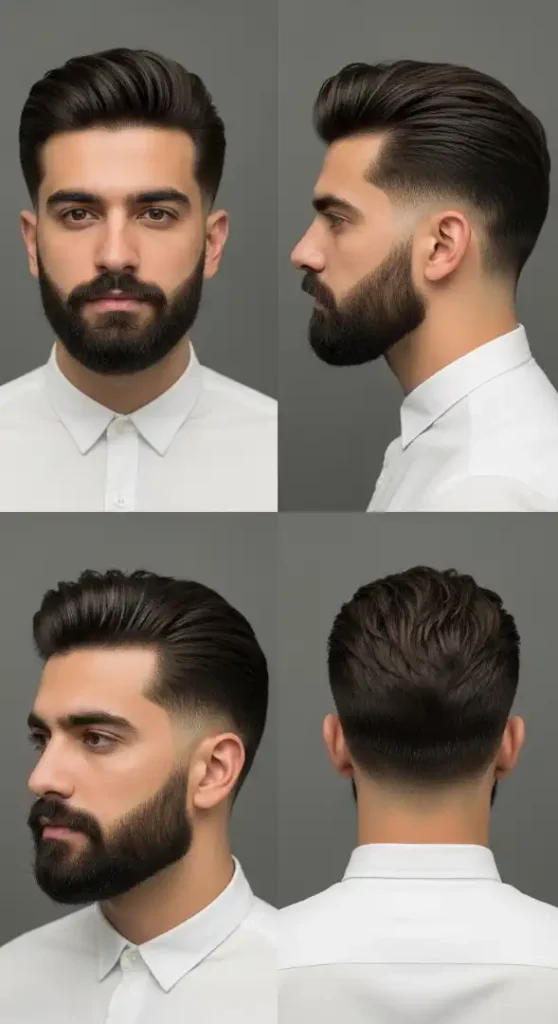
The Shadow Slick Back performs a specific and elegant function on a diamond face shape — it removes all visual noise from the top of the head, allowing the face’s natural architecture to speak. A diamond face has wide cheekbones as its widest point, with a narrower forehead above and a narrower jaw below. By slicking all hair directly backward with no fringe, part, or volume breaks, the cut reveals the full forehead width, creating an optical widening of the forehead that brings it closer in proportion to the wide cheekbones. The result: a more balanced, less top-heavy appearance. The full beard below adds width at the jaw level, completing the triangle-to-rectangle visual correction. This cut also works remarkably well on oval faces — the clean backward sweep emphasizes natural facial bone structure without distortion. It is a challenging choice for round faces, where the absence of height on top allows the face’s roundness to become the dominant visual impression.
GROOMING KIT
- Clippers: Wahl Senior for the minimal neckline taper — only the perimeter needs touching
- Trimmer: Philips Norelco OneBlade Pro for the beard’s daily maintenance (cheek line, neckline, mustache trim)
- Brush: Denman D3 for backward directional brushing of the slick-back; boar bristle brush (Mason Pearson Popular BN1) for distributing product through the length
- Product: Uppercut Deluxe Pomade (strong hold, high shine) — 2–3 pumps worked from root to tip through damp hair, then blow-dried backward with the Denman brush. For a matte slick-back: Layrite Superhold Pomade. For the beard: Kiehl’s Nourishing Beard Grooming Oil (3–4 drops daily).
MAINTENANCE LEVEL: MEDIUM
- Barber visit frequency: Every 5–6 weeks — the minimal taper and natural fall perimeter means the grow-out is graceful rather than stark. Length-based styles are kinder on visit frequency.
- Daily styling time: 8 minutes. Wet hair, apply pomade, brush back with Denman, quick directional blow-dry (3 minutes), brush again cold. Beard oil application: 1 minute.
- Note: The glossy finish of this style requires clean, moisturized hair. If your hair is dry or produces excessive oil, the slick will either look dull or greasy respectively. Adjust shampoo frequency accordingly — every other day, not daily.
BARBER TALK: THE EXACT SCRIPT
“I want a slick-back — no part, no fade, just a clean natural taper at the neckline perimeter. On the sides and back, just clean up the outline — I want the sides to stay long enough to be slicked back against the skull. No clipper work above the neckline perimeter. On top, take out any split ends but maintain the length at 4–5 inches. I want the natural taper at the nape — rounded and soft, not squared, not skin-faded. For the beard, clean up the cheek line and neckline with a straight razor — keep the cheek line at my natural beard growth line. Leave the mustache full and trim just the bulk with scissors.”
The Shadow Slick Back is all refinement — Style #7 throws the rulebook out entirely and delivers the most fashion-forward Asian men’s cut on this list, straight from the streets of Bangkok and Jakarta.
FAQs
Q: How do I slick back thick Asian hair without it looking stiff or helmet-like? A: The key is product application to damp — not wet — hair. Wet hair will cause any pomade to distribute unevenly and create stiffness as it dries. Towel dry to about 70% dry, work the pomade through evenly from root to tip with a brush, then blow-dry in the backward direction using medium heat. The result is a natural slick with movement rather than a lacquered helmet. Use a medium-hold pomade rather than a maximum-hold gel.
Q: What is the difference between a slick-back and an undercut slick-back? A: A classic slick-back retains hair on the sides, slicking them backward as well. An undercut slick-back has the sides shaved or clipped very short (0–1 guard), with only the top left long and slicked back — creating a sharp disconnection. The Shadow Slick Back is a natural-taper version — no undercut, no fade — making it more versatile and lower-maintenance than the undercut variant.
Q: Does a slick-back hairstyle work for interviews and professional settings? A: Yes — a polished slick-back reads as highly professional and intentional. It’s one of the few hairstyles that works equally well in a boardroom and at a formal event. The choice of product determines the formality level: high-shine pomade reads as classic and formal; matte pomade reads as modern and editorial but still professional.
Q: How do you maintain a slick-back between washes? A: Apply a small amount of water using a spray bottle to dampen the hair, then re-brush backward with your Denman brush. This re-activates the water-soluble pomade and resets the shape without a full wash. On non-wash days, add a very small top-up of fresh pomade to the surface only — never to the roots, which will build up product and cause scalp irritation over time.
7 of 10 — The Street Ronin Undercut
FACE SHAPE MATCH
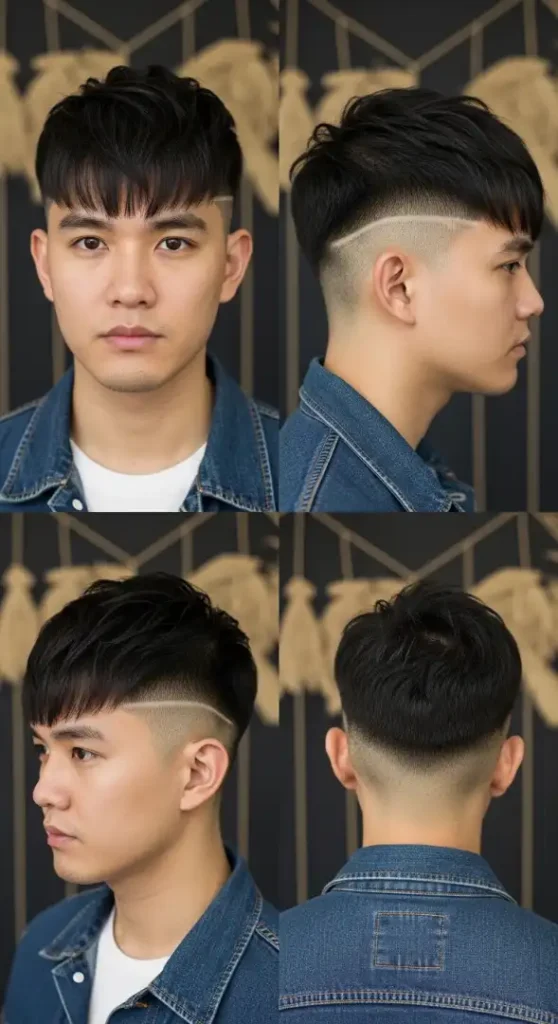
The Street Ronin Undercut is a bold structural choice that works best on oval and heart face shapes, and can be adapted for square faces with the right fringe direction. For oval faces, the disconnected undercut’s contrast between bare sides and full top creates a dramatic silhouette without distorting the face’s natural balance — the fringe can sweep in any direction without penalty. For heart faces, the heavy forward-falling fringe reduces the forehead’s visual width by covering part of it, which directly addresses the heart face’s primary proportion challenge. On square faces, sweeping the fringe asymmetrically — heavily to one side — breaks the jaw’s hard symmetry and adds dynamic movement. Where this cut fails: round faces. The horizontal disconnection line at mid-skull creates an unfortunate equator across the head, visually slicing the face in half rather than elongating it. If you have a round face, the quiff (Style #3) delivers similar drama with much more flattering geometry.
GROOMING KIT
- Clippers: Wahl Finale for the 0-guard close shave on the sides — this tool gets closest to bare skin without irritation on Southeast Asian scalp
- Outliner: Andis T-Outliner for the razor-sharp disconnection line — the straight blade is critical for the clean horizontal cut
- Scissors: 6-inch professional scissors for trimming the top’s length and removing bulk from the heavy fringe
- Comb: Wide-tooth comb for detangling the dense top; fine-tooth for fringe direction
- Product: Kevin Murphy Night Rider (matte, extreme hold, no shine) — ideal for the heavy fringe fall on straight Asian hair. 1 pea-sized amount through damp fringe, finger-styled forward. The matte finish is essential — any shine product on a disconnected undercut reads as trying too hard.
MAINTENANCE LEVEL: MEDIUM-HIGH
- Barber visit frequency: Every 3 weeks — the 0-guard sides grow back to a 1-guard equivalent within 10–14 days, which softens the dramatic disconnection. At 3 weeks, the sides are noticeably hairy and the cut begins to look unintentional.
- Daily styling time: 5–7 minutes. No blow-dryer required — the heavy fringe falls naturally. Apply Kevin Murphy Night Rider through damp fringe, push forward, let air-dry. The sides need no daily attention.
- Honest note: This is not an office-appropriate look in conservative corporate environments. It is perfect for creative industries, music, fashion, hospitality, and entrepreneurship.
BARBER TALK: THE EXACT SCRIPT
“I want a disconnected undercut. On the sides and back, I want a 0 guard — as close to bare skin as possible, no blend, no fade, just a hard clip off. The disconnection line should be sharp — sitting 2 fingers above the ear, going horizontal around the back. Use your outliner to cut the disconnection line clean — no graduation. On top, I want to keep 4 to 5 inches. Leave the fringe long enough to fall forward past my eyebrows. Just trim any split ends and remove weight if it’s too heavy. No part — just let the fringe fall forward naturally. Square the nape below the disconnection line with a straight razor.”
The Street Ronin Undercut is raw and intentional — Style #8 channels the same disciplined energy into an entirely different direction that’s sharper, cleaner, and made for the man who needs to look powerful in a boardroom at noon and a gallery opening at eight.
FAQs
Q: What is a disconnected undercut and how do I ask for it at the barber? A: A disconnected undercut has the sides and back clipped to near-bare skin, with a hard horizontal line — the disconnection — separating the short sides from the full-length top. There is no blending or graduation between the two sections. To ask for it: say “0 guard on the sides with a hard disconnection line 2 fingers above the ear — no blend, no fade, just a clean cut-off.”
Q: Does an undercut work for Asian men with thick hair? A: Yes — in fact, thick Asian hair is the ideal texture for a disconnected undercut. The heavy, dense top creates maximum contrast with the bare sides, which is precisely the aesthetic the cut is designed for. Thinning the top slightly with texturizing shears helps prevent a “block” appearance in the fringe.
Q: How do I grow out a disconnected undercut without it looking awkward? A: The hardest stage is 4–6 weeks after the last cut, when the sides grow to 0.5–1 inch but the top hasn’t gained enough length to cover them. The smoothest grow-out strategy: switch to a 1-guard taper on the sides (adding a soft fade) and keep booking trims on the top to maintain proportion. After 3–4 months, you’ll have enough length to transition into a curtains or slick-back style.
Q: Is a disconnected undercut professional or too edgy for work? A: It depends on your industry. Creative fields (design, marketing, film, music, hospitality) actively welcome this aesthetic. Traditional corporate environments (finance, law, accounting) will likely view it as too edgy. If you need to straddle both worlds, keep the fringe swept neatly to one side rather than falling forward — this dresses the undercut down significantly.
8 of 10 — The Obsidian Mid-Part Taper
FACE SHAPE MATCH
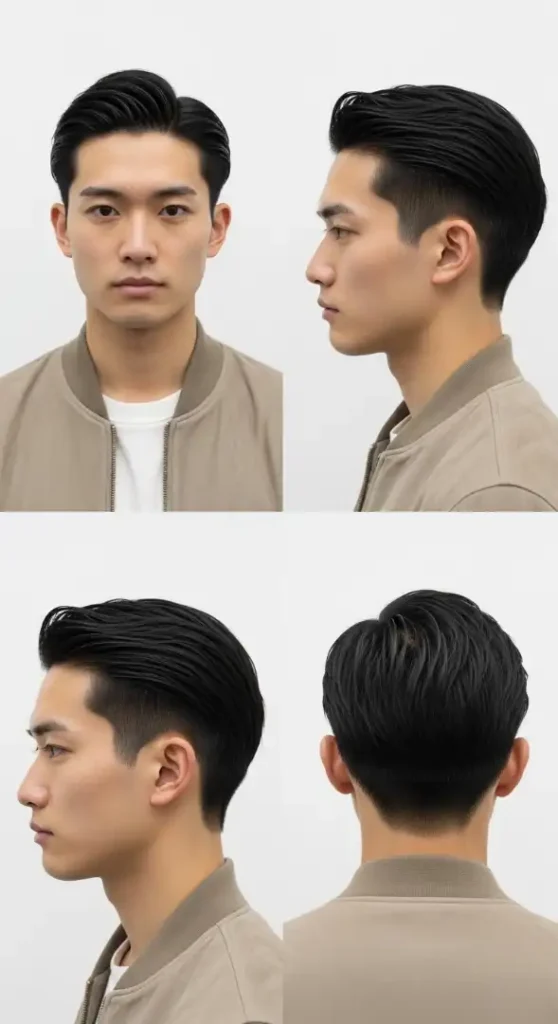
The Obsidian Mid-Part Taper is specifically engineered for oblong and rectangular face shapes — the most underserved face shapes in men’s hairstyling guides. An oblong face is longer than it is wide, with roughly equal forehead, cheek, and jaw widths. Most haircut guides suggest adding volume to the sides to “widen” the face, but this advice is often wrong for Asian hair, which adds bulk rather than controlled width. The mid-part taper solves the problem more precisely: the outward sweep of the two sections adds width at the temples and cheekbone level without the bulk of a full volume top. The horizontal visual line of the parted sections draws the eye left and right across the face rather than up and down, effectively shortening the perceived face length. The low taper keeps the sides clean without further lengthening the head shape. This cut is less effective on round faces, where the horizontal visual element exaggerates width in the wrong direction.
GROOMING KIT
- Clippers: Wahl Senior Cordless for the low taper — the taper blending attachment is ideal for the smooth graduation
- Scissors: Japanese Joewell or Hikari 5.5-inch for the micro-trimming of the outward flick and split-end cleanup
- Fine-tooth comb: Kent R7T for precise center-part placement and daily styling
- Brush: Kent SPC20 for smoothing the sections outward and distributing product
- Product: Gatsby Moving Rubber (Wild Shake type) — a uniquely Japanese product that delivers medium hold with a natural finish that sets silky Asian hair without stiffness. Alternatively: Bumble and Bumble Thickening Dryspun Texture Spray for volume and grip before the center part is set. Finish with a fine mist of Got2b Freeze Spray along the part line to lock it for the full day.
MAINTENANCE LEVEL: MEDIUM
- Barber visit frequency: Every 4–5 weeks. The low taper is forgiving on grow-out — it reads as a natural taper even at 5 weeks. The center part is self-maintained daily.
- Daily styling time: 5–7 minutes. Towel dry, apply Gatsby to damp hair, comb center part precisely, brush sections outward, quick cool blast with dryer to set. No round brush needed.
- Maintenance tip: The center part must be reset every morning. Use a fine-tooth comb and a drop of hair water spray each morning before applying product to maintain the precision that defines this look.
BARBER TALK: THE EXACT SCRIPT
“I want a center-part style with a clean low taper. On the sides, use a 1 guard at the base and blend up through a 2 and 3 to the full length — the taper should sit low, at the ear level only, not high on the temple. Don’t go to bare skin — I want a natural hair look, not a fade. On top, leave 3 to 3.5 inches and trim only split ends and any weight that’s pushing down the center part. I want the sections to fall slightly outward on both sides, not backward or forward. Round the nape with a soft arch. Clean the hairline with the outliner but keep it natural — no super-hard edge-up, just a clean natural line.”
The Obsidian Mid-Part Taper brings symmetry and precision to center stage — Style #9 takes the center part and throws deliberate asymmetry at it, creating the most editorial haircut on this entire list.
FAQs
Q: What face shape suits a center part haircut for men? A: A center part works best on oblong, rectangular, and oval face shapes. For oblong and rectangular faces, the horizontal visual created by the outward-sweeping sections shortens the perceived face length. For oval faces, it maintains natural balance. It is least flattering on round faces, where the horizontal element can widen the face further, and on heart-shaped faces, where it emphasizes an already-wide forehead.
Q: How do I keep a center part straight all day on thick Asian hair? A: Set the part on damp hair using a fine-tooth comb — the part must be established before any product is applied, not after. Apply a small amount of light-hold product, then use a fine-mist spray of Got2b Freeze Spray along the part line only to lock it in place. A silk pillowcase at night helps preserve the part direction and reduces the amount of re-styling needed in the morning.
Q: Is the center part trend appropriate for older Asian men? A: Yes — the mid-part taper specifically is. The clean taper, precise parting, and neat proportions make it age-appropriate for men in their 30s and 40s. It reads as intentional and groomed rather than youthful or trend-chasing. The key for older men: use a semi-matte product rather than high-shine pomade, and keep the length moderate (2.5–3 inches, not 4+).
Q: What products are best for a center part on silky Asian hair? A: Silky Asian hair is resistant to styling because of its smooth cuticle structure. Gatsby Moving Rubber (Japan) or American Crew Fiber are the top choices — both provide grip on a smooth hair surface. Avoid water-based gels, which create a wet, stiff look on silky hair. A texturizing spray used before product application dramatically improves hold and definition.
9 of 10 — The Jade Fade Burst
FACE SHAPE MATCH
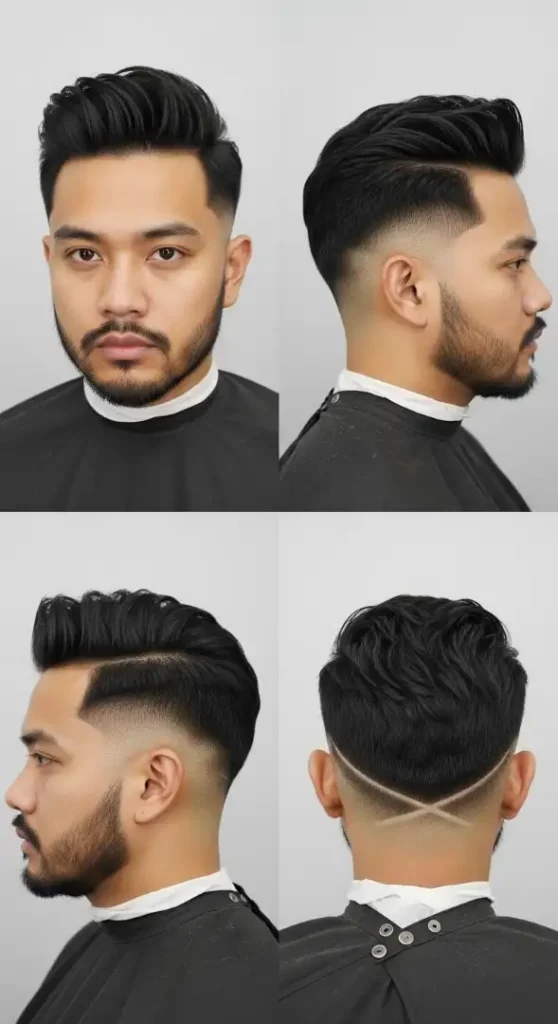
The Jade Fade Burst is one of the most visually dynamic fade techniques available, and it performs its best work on round and heart-shaped face shapes among Asian men. The burst fade’s semicircular arc emanates from behind the ear — this curved shape is fundamentally different from the straight graduation of a standard fade. On a round face, the burst arc draws the eye to the side of the head at ear level and upward, creating the illusion of height and reducing the face’s apparent roundness. The free-form brush-up on top adds further vertical energy without the formal commitment of a quiff. For heart-shaped faces, the burst fade removes width at the widest cheekbone level while the broad top maintains visual balance. The boxed beard adds jaw definition below, completing the proportional correction. Where this style struggles: square and oblong faces. On square faces, the burst’s arc can draw attention to the jaw’s width. On oblong faces, the vertical energy of the brush-up adds to an already-long proportion.
GROOMING KIT
- Clippers: Wahl Magic Clip for the burst fade body — the magic clip’s zero-overlap blade handles wavy Southeast Asian hair texture without line marks
- Detailer: Andis Slimline Pro Li for the burst arc’s precise outer perimeter line — the curved burst shape requires a fine-tooth outliner rather than a clipper
- Brush: Denman D4 for the free-form brush-up styling; Diane Firm Boar Bristle Brush for the beard shaping
- Product: Layrite Natural Matte Cream — provides the relaxed, natural hold the free-form brush-up needs. 1 dime-sized amount distributed through damp hair, air-dried or lightly blow-dried upward. For the beard: Cremo Beard Balm (Original scent) — defines the boxed shape while moisturizing the beard texture.
MAINTENANCE LEVEL: MEDIUM
- Barber visit frequency: Every 3 weeks. The burst fade’s geometric arc is extremely visible when growing out — at week 4, the arc loses its clean definition and the circular shape blurs. Budget barber visits: focus on the burst arc even if the top trim is postponed.
- Daily styling time: 5–7 minutes. Apply Layrite Natural Matte through damp hair, use fingers or a Denman brush to push the top upward and forward, air-dry for 10 minutes. The natural wave does most of the work.
- Tip: The burst fade looks best immediately post-barber and at days 1–14. Plan barber visits before important events.
BARBER TALK: THE EXACT SCRIPT
“I want a burst fade — starting at 0 guard bare skin right at the ear, fading outward in a semicircular arc behind the ear. The arc should sit behind the ear and curve upward — skin at the bottom, then 0.5, 1, and 2 guards as it fans out upward. The nape should stay lower in the center — create a slight V-shape between the two burst arcs at the nape. On top, leave 3 to 4 inches and brush-cut — remove some weight from the interior but keep the length. I don’t want a specific shape on top, just a free-form brush-up. For the beard, line the cheek straight with the outliner and fade the neckbeard into the skin above the Adam’s apple.”
The Jade Fade Burst is organized, intentional chaos — Style #10, the final look in this guide, strips everything back to deliver the most quietly confident haircut in the entire collection.
FAQs
Q: What is a burst fade and how is it different from a regular skin fade? A: A burst fade is a semicircular fade that radiates outward from behind the ear in an arc shape — like a sunrise. A regular skin fade is a straight vertical graduation from bare skin upward on the sides. The burst fade is more complex technically and creates a more sculptural, artistic result. It is most common in streetwear and barbershop culture and is associated with a fashion-forward, expressive aesthetic.
Q: Does a burst fade work on Southeast Asian wavy hair? A: Yes — wavy Asian hair actually enhances the burst fade’s impact because the natural texture on top creates visible dimension that contrasts beautifully with the smooth, bare skin of the burst arc. Straight hair also works, but the top may need product to add the texture and volume that wavy hair provides naturally.
Q: How long does it take to get a burst fade at the barber? A: A skilled barber requires 45–60 minutes to execute a clean burst fade, particularly on dark Asian hair where the fade line is very visible against the scalp. Do not rush this service or book it when the shop is busy — the burst arc’s precision requires focused attention. Budget an hour and tip appropriately.
Q: Can I combine a burst fade with a beard? A: Yes — a boxed beard or short full beard pairs naturally with a burst fade. The burst arc creates a clean architectural transition from the fade into the beard at the sideburn level. Ask your barber to blend the sideburn into the beard at the 1-guard level for a seamless connection between the fade and the beard.
10 of 10 — The Kyoto Clean Line
FACE SHAPE MATCH
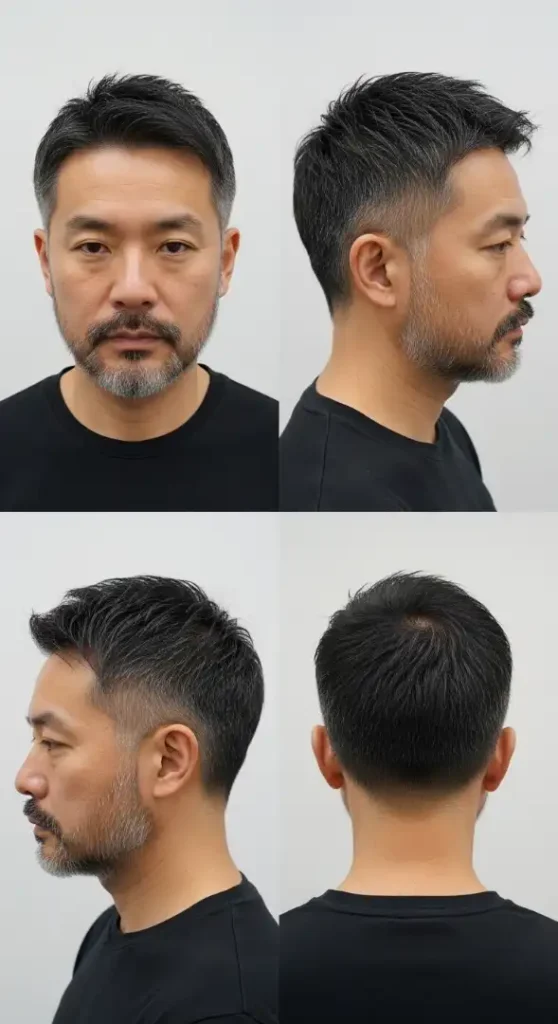
The Kyoto Clean Line is the most universally flattering cut in this entire guide — which is precisely why it was saved for last. The short, uniform, low-taper silhouette works across oval, square, diamond, and heart face shapes without modification. For oval faces, it maintains perfect proportion. For square faces, the short uniform length reduces the head’s visual bulk, allowing the jaw’s natural strength to read as defined rather than heavy. For diamond faces, the minimal taper preserves the cheekbones’ natural width advantage. For heart faces, the short top reduces the forehead’s visual dominance and creates a balanced overall silhouette. The only adaptation needed: for round faces, add a very small amount of volume at the crown — 0.5 inches taller — to elongate the face shape slightly. Salt-and-pepper hair deserves particular mention here: this is one of the few cuts that actively celebrates rather than conceals mature hair texture. The warm cinematic grading renders the grey threads as silver highlights, making the natural aging process a visual asset rather than a concern.
GROOMING KIT
- Clippers: Wahl Senior Cordless with the standard blade — for consistent length across the entire top
- Scissor: 6-inch Joewell or Yasaka for scissor-over-comb cleanup and weight reduction in the crown
- Trimmer: Andis Slimline Pro Li for the hairline edge, beard cheek line, and neckline definition
- Comb: Kent SPC20 for scissor-over-comb work at the barber; fine-tooth at home for daily direction-setting
- Product: Minimal by design — Murdock London Matte Paste (small amount, 1 pea-sized) if definition is desired, or nothing at all. The cut is designed to look intentional with zero product. For the beard: Jack Black Beard Oil (fragrance-free option) — 3–4 drops daily, worked into beard with fingers then combed with a beard comb (Kent BC3).
MAINTENANCE LEVEL: LOW-MEDIUM
- Barber visit frequency: Every 4–5 weeks. The uniform short length grows out evenly — there is no fade to blur or structural element to lose. The low taper is the only area that requires attention.
- Daily styling time: 1–3 minutes. Towel-dry, optional minimal product, done. This is the lowest-maintenance cut on this list that still looks intentional and precise.
- Ideal for: Frequent travellers, men who prefer simplicity, executives who don’t have time for morning routines, and men over 35 who want a cut that projects confidence without demanding maintenance.
BARBER TALK: THE EXACT SCRIPT
“I want a clean, uniform short cut — scissor over comb on the top and sides, keeping it at 1.5 to 2 inches throughout. I want a low taper at the perimeter only — 1 guard at the base, blending into the full top length over about 1.5 inches. No skin fade, no undercut, no disconnection. Keep the natural direction the hair grows — don’t fight the growth pattern. Round the nape with a soft arch and straight-razor finish the neckline. Clean the hairline naturally — no sharp edge-up, just define the natural hairline. For the beard, clean the cheek line with the outliner, trim the beard to 5mm uniform with a comb guide, and straight-razor the neckline above the Adam’s apple.”
: And there it is — all 10 styles completed. If you made it to Style #10, you now have the most comprehensive Asian men’s hairstyle reference for 2026 on Pinterest. Bookmark this article, save every pin, and come back when you’re ready to try Style #1 — the Tokyo Drift Textured Crop is waiting.
FAQs
Q: What is the best short haircut for Asian men over 40? A: The Kyoto Clean Line — a uniform short cut with a low taper — is the definitive choice for Asian men over 35–40. It requires minimal product, grows out gracefully, works with salt-and-pepper hair instead of fighting it, and projects understated authority. Ask your barber for a scissor-over-comb cut at 1.5–2 inches with a low perimeter taper and a rounded nape.
Q: How do I style grey and black Asian hair without it looking old-fashioned? A: Embrace the salt-and-pepper contrast rather than fighting it. Use a matte or no-product finish — high-shine pomades on grey hair tend to look dated. A clean, precise cut with no flamboyant elements (no hard parts, no quiffs) is the most modern approach to salt-and-pepper hair. The cut must be perfectly executed because the grey color draws attention to the shape with unforgiving clarity.
Q: Should Asian men dye their grey hair or embrace it? A: Both are valid — but for men over 35 with naturally distributed salt-and-pepper, embracing the grey with a precise, clean cut is increasingly the more stylish choice. Uniform dye jobs on Asian hair can look artificial due to the stark contrast between black and skin tone. If you choose to color, a toner or semi-permanent color that blends (rather than eliminates) the grey typically reads as more natural and intentional.
Q: What is a scissor-over-comb haircut and why is it better than clipper-only for short hair? A: Scissor-over-comb is a technique where the barber holds a comb against the scalp and cuts the hair that protrudes above the comb’s teeth with scissors — creating a precise, tapered result. Unlike clipper-only cuts, which cut every hair to the exact same length, scissor-over-comb allows the barber to create subtle variation in length that creates natural movement and avoids a “machine-cut” uniformity. It is the technique of choice for premium short haircuts on Asian hair, where density is high and individual blade selection can look stark.