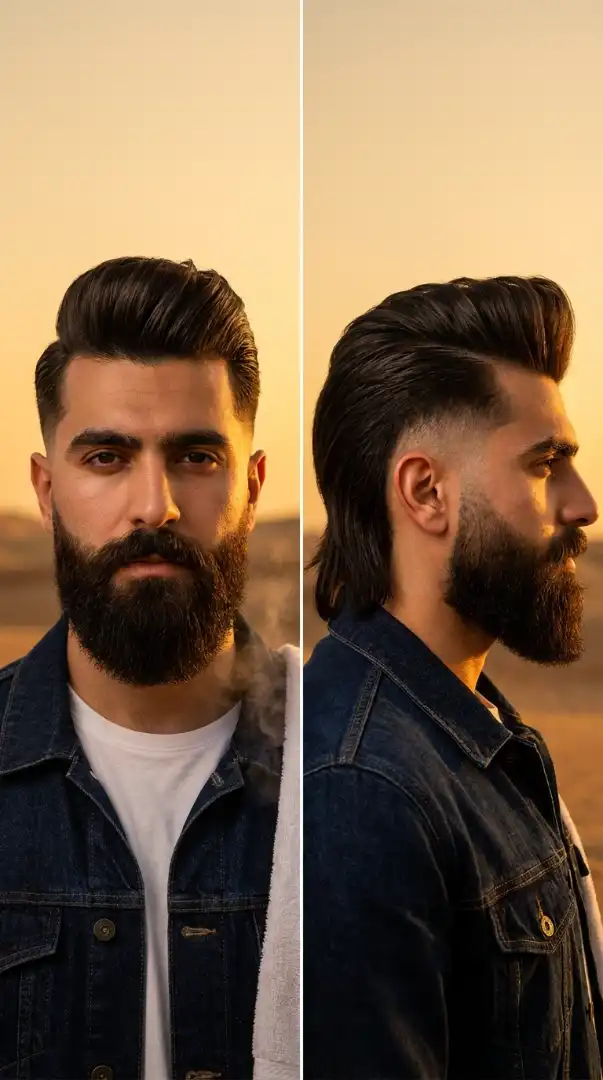
10 Trendy Mullet Variations To Inspire Your Look
STYLE 1 OF 10 — THE RIVER REBEL MULLET
FACE SHAPE MATCH:
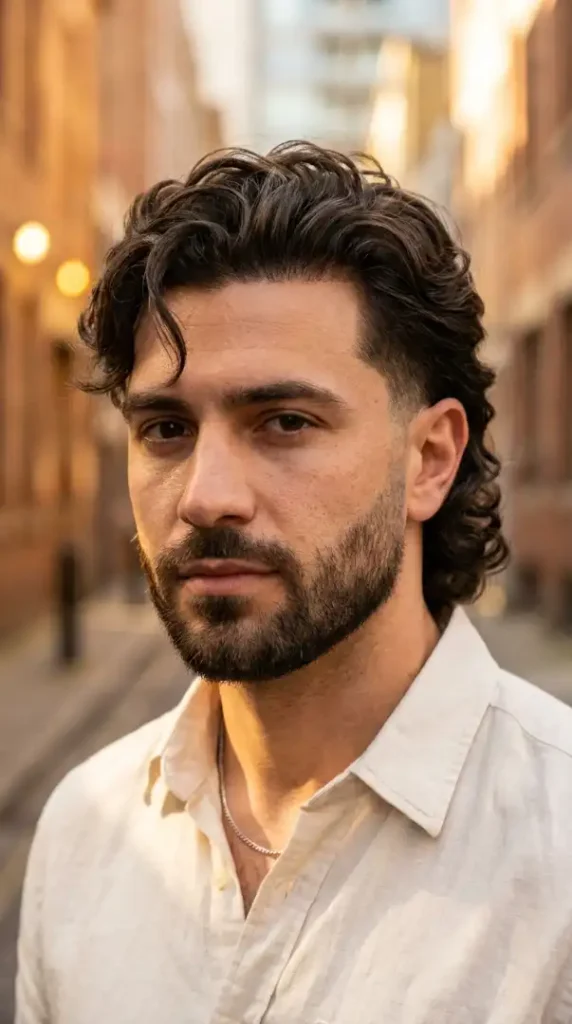
The River Rebel Mullet is a natural fit for men with Square and Oval face shapes. For square faces, the flowing wavy volume on top softens the angular jawline and creates upward visual momentum, drawing the eye away from the wide jaw and toward the lush crown. The length at the back adds vertical proportion that visually elongates the face from forehead to nape. For oval faces, this style works because the balanced proportions of an oval allow virtually any mullet variation to land perfectly — the wavy texture adds personality without disrupting the face’s natural harmony. Men with Round faces should be cautious: the width of wavy, voluminous sides can appear to widen the face further unless paired with a tighter fade on the sides to compensate. This cut is NOT recommended for men with very short, round face shapes who prefer minimal styling, as the wavy flowing length demands daily product work and intentional shaping to maintain its structured-yet-relaxed silhouette. Men with Diamond face shapes can pull this off beautifully by allowing the wavy fringe to soften the wider cheekbone zone.
GROOMING KIT:
Clippers: Wahl Magic Clip Cordless for the side fade work; Andis Master Adjustable Blade for precision outline definition.
Trimmer/Outliner: Andis T-Outliner for the beard fade-to-haircut connection line and neckline shaping.
Finishing: Kent Handmade Comb (model 20T) for detangling wavy length; Denman D3 Original Styler Brush for wave definition.
Products: Suavecito Pomade Firme Hold for controlling the wavy crown with grip; American Crew Grooming Cream for nape length definition without crunch; Malin + Goetz Peppermint Shampoo for scalp health on dense wavy hair; Beardbrand Tree Ranger Beard Oil (3 drops daily) for the full beard.
MAINTENANCE LEVEL: MEDIUM
Salon Visit Frequency: Every 4–5 weeks to maintain the shape, taper integrity, and neckline cleanliness.
Daily Styling Time: 8–12 minutes.
Daily Product Routine: Start with a coin-sized amount of American Crew Grooming Cream on towel-dried hair, distribute through the length from crown to nape, blow-dry with a diffuser on medium heat for 3 minutes to enhance wave structure, then apply a small pea-sized amount of Suavecito Pomade Firme to the crown for hold. Finish by using the Kent comb to direct the fringe. Apply 3 drops of beard oil into the beard and shape with a boar bristle brush.
BARBER TALK (EXACT SCRIPT):
“I want a wavy mullet — keep the top and length natural, about 3.5 to 4 inches on top with the wave intact, no aggressive thinning. On the sides, I want a medium fade starting at a 1.5 guard at the skin fade line, blending up to a 3 at mid-temple, then into the natural top length. Leave the back long — about 1.5 to 2 inches past the collar — and keep the natural wave at the nape. Don’t cut the back into a straight line; let it follow the natural curl pattern. For the beard, clean up the cheek line and keep a tight low fade connecting the sideburn to the beard. Neckline sharp but natural, not boxed. Finish with a little beard oil before I leave.”
If the River Rebel gives you that effortless wavy energy, wait until you see Style 2 — a clean, high-contrast mullet built for the man who wants precision and edge in equal measure.
FAQs
Q: How do I maintain a wavy mullet at home between barber visits?
A: Maintain a wavy mullet at home by using a light grooming cream on damp hair daily, diffusing with a blow dryer on low-medium heat to preserve the wave pattern, and using a wide-tooth comb to detangle the length without disrupting the curl. Avoid brushing dry — it creates frizz. A weekly deep-conditioning mask keeps the wavy length healthy and prevents breakage at the nape.
Q: Which face shapes suit the wavy mullet best?
A: Wavy mullets suit Square and Oval face shapes best. For Square faces, the soft wave volume on top reduces the angularity of a strong jaw by drawing the eye upward. Oval faces suit virtually all mullet variations because their balanced proportions work with any length and texture combination. Men with Round faces should pair a wavy mullet with a tighter side fade to avoid adding width.
Q: What is the difference between a wavy mullet and a shag mullet?
A: A wavy mullet keeps defined shape and structure — the sides are faded or tapered, the top has intentional volume, and the back length is clean. A shag mullet is more disheveled by design, with curtain bangs, choppy layers throughout, and often no fade — it has an intentionally unkempt 70s rock feel. A wavy mullet looks polished; a shag mullet looks deliberately undone.
Q: How often should I get my wavy mullet trimmed?
A: Get your wavy mullet trimmed every 4 to 5 weeks. The fade line grows out and loses sharpness after 3 weeks, and the nape length starts to lose its shape after 5. If you want to maintain the precision of the blend and the clean neckline, a 4-week schedule is ideal. The top length can go 6 weeks without a trim if you’re growing it out intentionally.
STYLE 2 OF 10 — THE NEO-TOKYO PRECISION MULLET
FACE SHAPE MATCH:
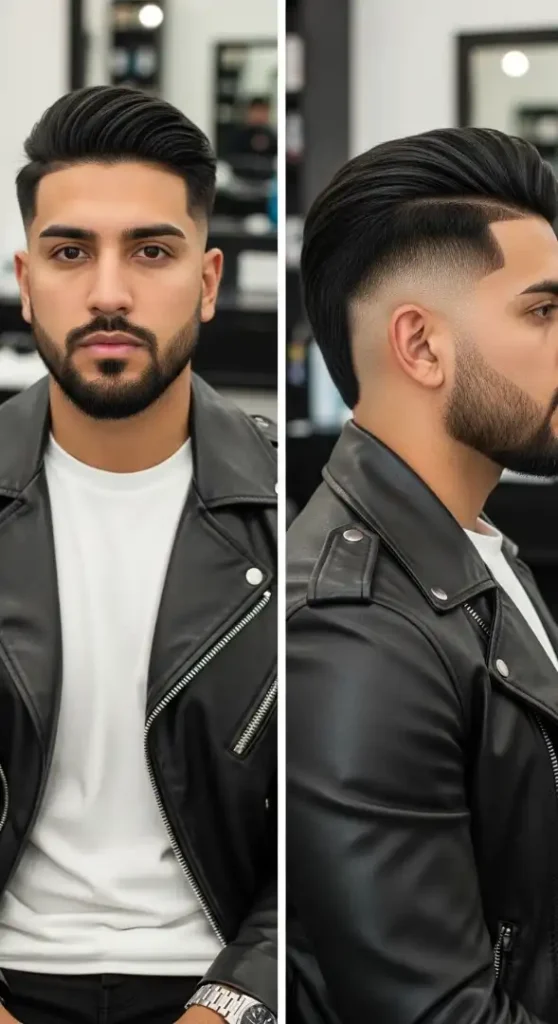
The Neo-Tokyo Precision Mullet is engineered for men with Oval and Oblong face shapes. The slicked-back, flat top plane creates a clean horizontal visual line at the crown, which is ideal for Oblong faces because it adds apparent width rather than height — preventing the face from reading as overly elongated. For Oval faces, the geometric precision of the skin fade and blunt-cut nape length works like a sculptural frame, emphasizing the jaw without adding undesired bulk at the temples. Men with Diamond face shapes will find this cut highlights their strong cheekbone structure beautifully — the tight skin fade removes any visual weight below the cheekbones, making them the focal point. This cut is NOT ideal for men with Round faces who want to appear slimmer, as the flat low crown profile doesn’t add enough vertical height to counteract round facial proportions. It is also high-commitment in terms of daily maintenance — men who travel frequently or prefer air-dry styles should factor in the glossy, structured finish this look demands.
GROOMING KIT:
Clippers: Andis Master Adjustable Blade for the skin fade precision; Wahl Senior Cordless for bulk removal on the top.
Trimmer/Outliner: BaByliss Pro FX787 for crisp beard outline and jaw definition.
Finishing: Wide-tooth Kent comb (model 81T) for distributing product through straight length; boar bristle brush for smoothing the crown.
Products: Layrite Super Hold Pomade (hazelnut-sized amount) for the slicked-back top — gives glossy hold without stiffness; American Crew Defining Paste for the nape length texture; Beardbrand Gold Line Beard Oil for the low fade beard; Oribe Signature Shampoo for maintaining the jet-black shine.
MAINTENANCE LEVEL: HIGH
Salon Visit Frequency: Every 2–3 weeks strictly. Skin fades lose their precision after 10–14 days on fast-growing hair.
Daily Styling Time: 10–15 minutes.
Daily Product Routine: Blow-dry the top section on medium heat while directing with a flat brush to flatten and smooth. Apply a pea-sized amount of Layrite Super Hold Pomade to the palms, warm it between hands, then press into the top from roots to crown and comb backward in one fluid motion. Use the Kent comb for edge definition. Apply 2 drops of beard oil to the low beard. The blunt nape cut requires no daily product — just ensure it stays flat against the neck.
BARBER TALK (EXACT SCRIPT):
“I want a precision skin fade mullet — tight skin fade on the sides, starting completely bald at the temples and base, blending up through a 0.5 and a 1 up to the natural hair line. I don’t want a high fade — keep it low, just above the ear line. On top, I want the length kept at 3 to 3.5 inches, all swept back with no fringe, no texture cut — leave it clean and blunt. The back gets a mullet tail — straight blunt cut at about 1.5 inches past the collar, no layering, no tapering. Just one clean horizontal line across the nape. The beard stays low — tight skin fade on the cheeks connecting into the sideburn. Keep the jaw outline sharp. I want to leave here looking clean, not messy.”
The Neo-Tokyo is all control and precision — but Style 3 brings something rawer, a coily texture mullet that redefines what the cut can look like on natural African-American hair.
FAQs
Q: How do I ask my barber for a skin fade mullet?
A: Ask your barber for a “low skin fade mullet” — specify bald at the base, blending through a 0.5 and 1 guard up to the natural hairline, with the top kept at 3 to 3.5 inches swept back. For the nape length, say “blunt-cut mullet tail, about 1.5 inches past the collar.” Bring a reference photo to eliminate any ambiguity about the fade height and back length.
Q: What products make straight hair look shiny in a mullet style?
A: Layrite Super Hold Pomade is the top choice for a glossy, slicked-back mullet on straight hair. Apply a hazelnut-sized amount to towel-dried hair, distribute it evenly with your fingers, then comb backward with a fine-tooth comb for maximum shine. For extra gloss and humidity resistance, follow with a light mist of Oribe Superfine Hair Spray from 12 inches away.
Q: How is a precision skin fade different from a regular taper?
A: A skin fade goes to zero — completely bald at the base — and transitions through very close guard sizes (0.5, 1, 1.5) within a narrow band, creating a sharp gradient. A regular taper uses longer guard lengths throughout and has a softer, more gradual blend that never reaches the skin. Skin fades look sharper and more dramatic; tapers are lower maintenance and grow out more naturally.
Q: How often does a skin fade mullet need a barber touch-up?
A: Every 2 to 3 weeks. The skin fade is the first feature to lose its crispness — visible stubble appears at the base within 10 to 14 days on average. If you can tolerate a slightly grown-out look, 3 weeks is the maximum before the fade starts looking overgrown rather than intentional. The mullet length can go 5 to 6 weeks without a trim.
STYLE 3 OF 10 — THE CROWN AUTHORITY MULLET
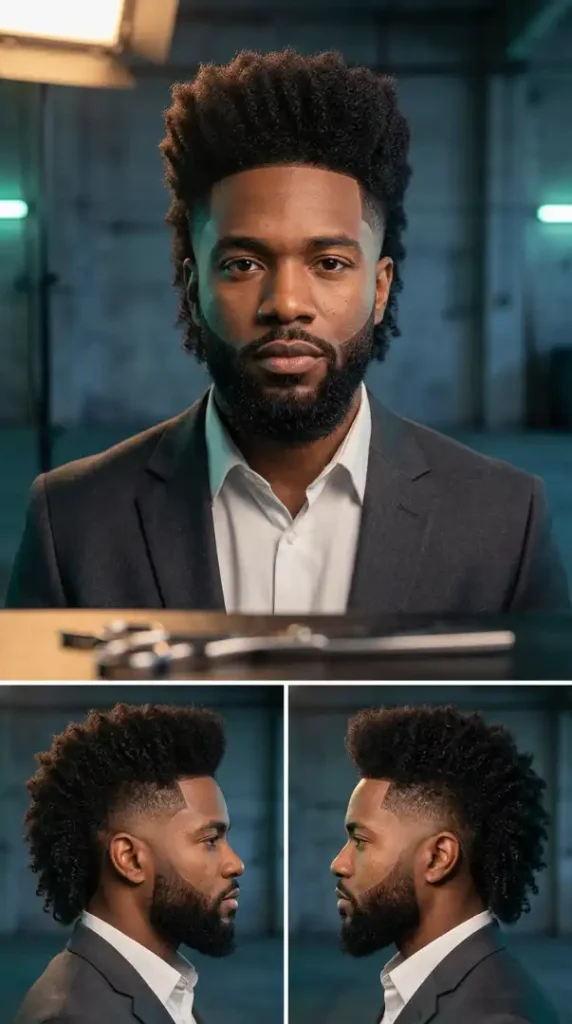
FACE SHAPE MATCH:
The Crown Authority Mullet is specifically designed for men with Round and Diamond face shapes who have natural coily or Type 4 hair texture. For Round faces, the high-volume coily crown is essential — it adds dramatic vertical height, elongating the face’s profile and counteracting the horizontal width of a round jaw structure. The mid-skin fade removes all width from the sides, reinforcing the vertical illusion. For Diamond faces, the coily top volume balances the wider cheekbone by adding crown presence, while the tight fade keeps the lower face proportional. Men with Oblong or already-long face shapes should approach with caution: a very high coily crown on an already long face can create an exaggerated, top-heavy appearance. In that case, a shorter, shaped crown rather than maximum height is recommended. This style is celebrated specifically because it honors the natural coily hair pattern — rather than straightening or reforming the texture, it works WITH the coil structure, making it one of the most authentically expressive mullet variations available.
GROOMING KIT:
Clippers: Wahl Magic Clip Cordless with Ceramic blade attachment for coily hair precision fading.
Trimmer/Outliner: Andis T-Outliner for beard edge definition and facial hairline shaping.
Finishing: Denman D3 Styler Brush for coil definition and clumping on the crown; wide-tooth shower comb for detangling on wash days.
Products: Cantu Shea Butter Moisturizing Curl Activator Cream (dime-sized amount) for crown coil definition and shine; Mielle Rosemary Mint Strengthening Hair Oil for scalp health; Cremo Original Shave Cream for beard edge line-up; Scotch Porter Beard Balm (1 pump) for the box beard shape; SheaMoisture 100% Extra Virgin Coconut Oil as a daily moisture sealant for the mullet length.
MAINTENANCE LEVEL: MEDIUM
Salon Visit Frequency: Every 3–4 weeks. Mid-skin fades on coily hair can show visible regrowth faster due to denser hair texture, so 3-week visits are recommended for maximum crispness.
Daily Styling Time: 5–8 minutes on non-wash days; 15–20 minutes on wash days.
Daily Product Routine: On non-wash days, apply Cantu Curl Activator to slightly dampened fingertips and scrunch into the crown coils to refresh definition. Apply 1 pump of Scotch Porter Beard Balm to the box beard and shape with a boar bristle brush. On wash days, use SheaMoisture Manuka Honey Shampoo, follow with deep conditioner for 10 minutes, then apply Mielle Hair Oil to the length before diffuse drying.
BARBER TALK (EXACT SCRIPT):
“I want a coily natural mullet with a mid-skin fade. Start bald at the base — right at the temple and just above the ear — blend through a 0.5 to a 1 to a 1.5, keeping the fade line at mid-temple height. Above the fade, leave all my natural coil texture intact — I don’t want it shaped down, I want the crown to stand. Keep the top at least 2 to 2.5 inches of coil height. Shape the outline of the crown so it’s clean but not a geometric afro — organic crown shape. For the back, let the coily length hang naturally — about 1.5 to 2 inches past the collar — just dust the very ends to remove split ends, don’t cut the length. For the beard, keep my box beard — clean up the cheek lines with a straight line, sharp jaw outline, and fade the neck. No designs, just clean and precise.”
The Crown Authority commands respect with its natural coily power — but if you want to take the mullet in a more rebellious, auburn-toned direction, Style 4 is about to earn a permanent spot in your barber’s reference folder.
FAQs
Q: Can Black men wear mullets with natural coily hair?
A: Absolutely — coily and Type 4 natural hair creates some of the most visually striking mullet variations available. A natural coily mullet works by using the hair’s natural texture as the primary visual element: the crown coils create impressive height and volume, the sides get a tight skin or mid-fade for contrast, and the back length hangs in natural coily elongation. Many barbers specializing in Black hair texture are now specifically trained in mullet shaping for coily hair.
Q: How do I keep my coily mullet defined and moisturized daily?
A: Keep your coily mullet defined by using a curl activator cream on slightly damp fingertips and scrunching into the crown daily — Cantu Shea Butter Moisturizing Curl Activator is a reliable option. Seal moisture with a small amount of coconut or argan oil on the nape length. Avoid brushing coily mullets dry; always work product in on damp or misted hair to avoid frizz and breakage.
Q: What is the difference between a coily mullet and an afro mullet?
A: A coily mullet is shaped and intentional — the sides are faded tight, the crown has defined height, and the back has a distinct mullet tail of elongated natural hair. An afro mullet (sometimes called a “mullet fro”) typically has no side fade, allowing the sides to blend organically into a full afro shape while the back length is significantly longer than the sides. The coily mullet is more structured; the afro mullet is fuller and more voluminous on all sides.
Q: How often should a coily mullet be touched up at the barber?
A: Every 3 to 4 weeks is recommended. Coily hair grows denser and faster in appearance at the fade zone, so the mid-skin fade can look overgrown within 2.5 weeks on dense hair types. The crown shape and nape length need a check-up every 4 weeks to maintain the silhouette. If budget allows, a 3-week cycle keeps the fade sharp and the beard edges pristine consistently.
STYLE 4 OF 10 — THE BARRIO BLADE MULLET
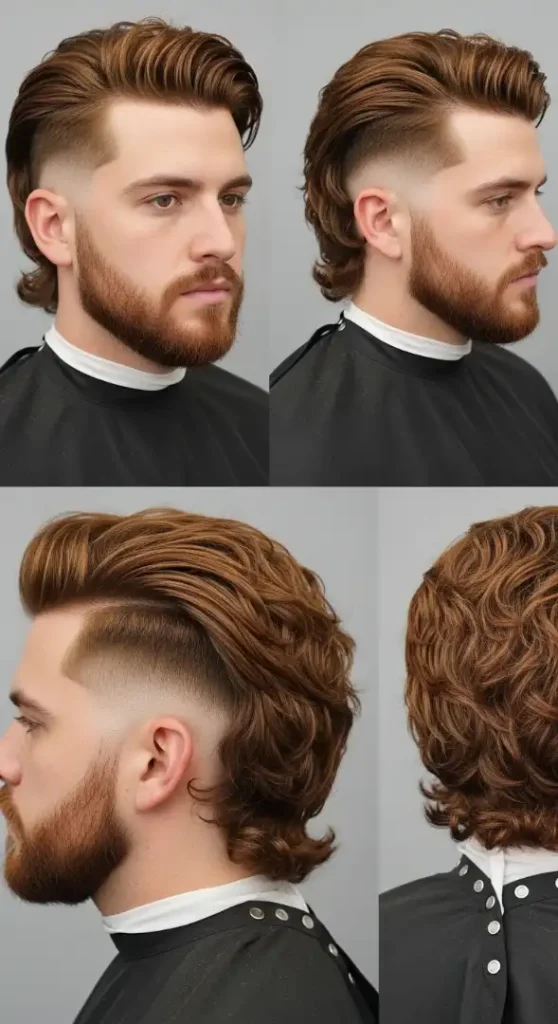
FACE SHAPE MATCH:
The Barrio Blade Mullet, with its defining hard part and high bald fade, is a precision tool for men with Diamond and Square face shapes. For Diamond faces, the hard part adds structural geometry that emphasizes the face’s natural angular symmetry, while the high fade removes temple width and draws attention upward toward the strong brow. For Square faces, the hard side part creates asymmetry that softens the rigid, symmetrical heaviness of a square jaw — the soft fringe falling toward one eye creates movement that balances the strong jaw. Men with Oval faces will find this an easy win — virtually any hard part variation works on an oval canvas. This style is NOT ideal for men with Heart face shapes where the forehead is already wide, as the high fade combined with volume pushed to one side can exaggerate forehead width. For Heart-faced men, a lower fade and center-balanced top volume would serve better. The auburn hair coloring is a significant visual advantage — the warm tone pops with high contrast against a tight bald fade, making the style dramatically visible even in low-resolution thumbnail images.
GROOMING KIT:
Clippers: Andis Master MLC Cordless for bald fade precision and high-contrast fade line work.
Trimmer/Outliner: Andis Slimline Pro Li for the hard part razor-line and chin strap precision.
Finishing: Mason Pearson Boar Bristle Brush for distributing product and smoothing the wavy volume; Ace Comb wide-tooth for detangling auburn length.
Products: Suavecito Pomade Original Hold for the side-swept wavy top — medium hold with natural finish; Uppercut Deluxe Featherweight Foam for volume lift at the crown; American Crew Beard Foam for the chin strap beard maintenance; Redken Brews Mint Shampoo for scalp stimulation and auburn shine enhancement.
MAINTENANCE LEVEL: HIGH
Salon Visit Frequency: Every 2–3 weeks. High bald fades require the most frequent maintenance of any fade type — visible regrowth appears within 7–10 days on fast-growing hair.
Daily Styling Time: 12–15 minutes.
Daily Product Routine: Blow-dry top section while using a round brush to push volume in the fringe direction. Apply two finger-widths of Suavecito Pomade to the hands, emulsify, then press into the crown from the hard part outward. Use a fine-tooth comb to define the hard part sharply. For the mullet tail, apply a small amount of Uppercut Featherweight Foam to the wavy length and scrunch upward. Beard: apply American Crew Beard Foam and shape with a Denman brush.
BARBER TALK (EXACT SCRIPT):
“I want a hard part mullet with a high bald fade. Bald at the base — zero skin on the sides right up to a high fade line at the upper temple. Blend from bald through 0.5 to 1, then a clean graduation up to the natural top. I want a hard part — razor-shaved part, left side, defined and straight. Volume on top gets pushed to the right with a wavy, textured finish — keep the length at about 3 to 3.5 inches on the top. For the back, mullet tail, keep about 2 inches past the collar, wavy natural finish. Don’t straighten or taper the length — just dust the ends. For the beard: chin strap line, clean and defined. Shave the cheeks clean above the chin strap. Keep the mustache full and connected. Neckline: sharp, low arc.”
The Barrio Blade hits hard with its razor-sharp energy — but Style 5 takes the mullet in a completely different direction, built for the East Asian aesthetic and the man who wants sleek, minimalist cool over street-level drama.
FAQs
Q: How do I maintain the hard part of a mullet at home?
A: Maintain a hard part at home using a fine-tooth tail comb and a small amount of pomade applied directly along the part line — the comb handle tip can re-define the part by pressing it into the scalp and combing outward with the product. To re-shave the hard part at home, use an outliner trimmer on zero setting along a straight guideline. This takes 3 minutes and keeps the part sharp between barber visits.
Q: What does a “high bald fade” mean and how is it different from a regular fade?
A: A high bald fade means the skin-bare portion of the fade goes up to the upper temple, just below the crown area — making the fade line sit high on the head. A regular mid fade starts at ear level, and a low fade starts at the lower temple. “Bald” means the fade reaches true skin (zero clipper guard) at the base. High bald fades create maximum contrast and a very dramatic, sculptural head silhouette.
Q: Can I dye my mullet auburn and maintain the color at home?
A: Yes — auburn is one of the easiest fashion colors to maintain at home on naturally dark-brown hair. Use a semi-permanent auburn tone like Garnier Nutrisse Auburn Intensity over a light lift base, or opt for a professional balayage for a more natural gradient. At home, use a color-safe shampoo (Redken Color Extend) and cold water rinses to slow fading. Touch up the color every 6 to 8 weeks.
Q: Does a hard part mullet work for professional work environments?
A: A hard part mullet can work in creative, media, fashion, and tech-forward professional environments where individuality in personal presentation is accepted. In conservative corporate settings — law, finance, banking — the hard part fade mullet may be perceived as too casual. If you’re in a formal work environment, consider a lower, softer fade with the same top volume but a tidier nape length that doesn’t extend past the collar.
STYLE 5 OF 10 — THE SLEEK DYNASTY MULLET
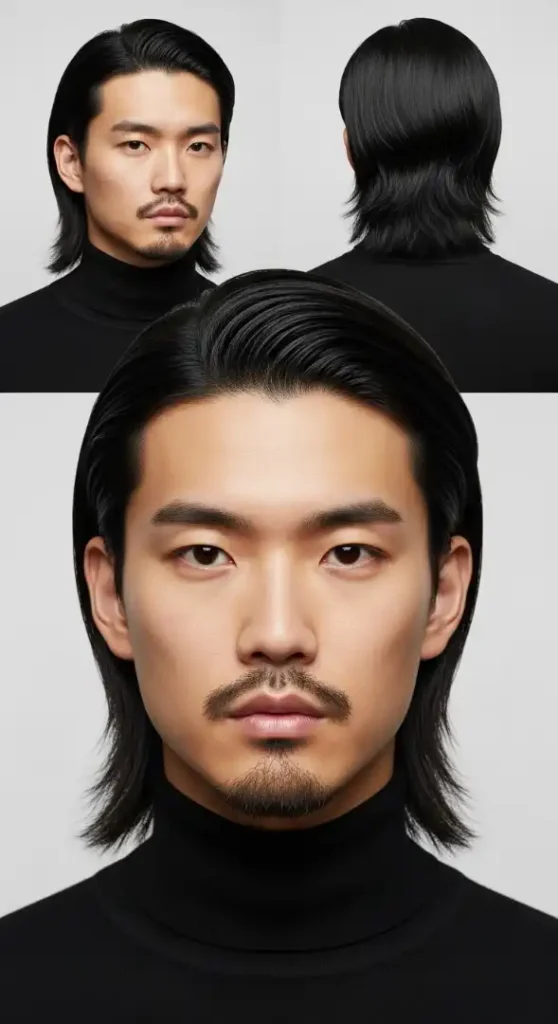
FACE SHAPE MATCH:
The Sleek Dynasty Mullet is the most universally flattering mullet variation in this collection, and its elegant restraint makes it work across almost every face shape. However, it is particularly exceptional for men with Oblong and Oval face shapes. For Oblong faces, the curtain fringe is the key element — it creates a horizontal visual line across the forehead that reduces the perceived length of the face, breaking up the vertical stretch effectively. The low skin fade preserves width at the temples, further minimizing the elongated appearance. For Oval faces, every aspect of this cut lands perfectly — the smooth swept volume, the curtain fringe, and the sleek nape length all work in harmony with the balanced oval proportions. For Square faces, the soft curtain fringe dramatically reduces the angularity of the brow, while the smooth sides eliminate the heaviness that a higher fade might add. This is also one of the few mullet styles appropriate for semi-formal and professional settings — the sleek top and minimal beard make it boardroom-adjacent despite the mullet length at the back. Men with very Round faces should ensure the fringe doesn’t cover the forehead fully, as a full fringe on a round face removes vertical height from the equation.
GROOMING KIT:
Clippers: Wahl Bravura Lithium for the soft low fade maintenance.
Trimmer/Outliner: BaByliss Pro FX787 for the 2mm all-over stubble definition and neck outline.
Finishing: Mason Pearson Pocket Bristle/Nylon Brush for distributing pomade through fine straight hair; rat-tail comb for defining the soft side part.
Products: Layrite Natural Matte Cream for a non-greasy, natural-shine hold on ultra-fine straight hair (less product needed — fingertip amount only); Kiehl’s Nourishing Hair Oil (2 drops on towel-dried hair before blow-drying) for a mirror-like gloss finish; Every Man Jack Thickening 2-in-1 Shampoo + Conditioner for fine hair volume; OSEA Men’s Stubble Serum for the defined stubble beard.
MAINTENANCE LEVEL: LOW-MEDIUM
Salon Visit Frequency: Every 5–6 weeks. The low soft fade grows out gracefully — it doesn’t look overgrown as quickly as a high bald fade. The curtain fringe needs trimming every 4 weeks to maintain the above-brow length.
Daily Styling Time: 5–8 minutes.
Daily Product Routine: Apply 2 drops of Kiehl’s Hair Oil to towel-dried hair and distribute from mid-length to ends. Blow-dry top section with a flat paddle brush on medium heat, directing the hair in the part direction to set the shape. Apply a fingertip-sized amount of Layrite Natural Matte Cream to the crown and smooth in the direction of the sweep. Use a rat-tail comb to define the soft part. Style takes 6 minutes total.
BARBER TALK (EXACT SCRIPT):
“I want a sleek mullet with a soft low fade and a curtain fringe. On the sides, I want a low skin fade — keep it very subtle and clean, starting at a 0.5 at the base and blending up to a 1 and a 1.5 at mid-temple. Don’t go above the ear level with the fade — keep it low and refined. On top, I want a curtain fringe — center-parted, reaching just above my eyebrows. The top is all swept smooth, no texture, no layers — length is about 3 inches, clean and flat. For the back, straight mullet length — I want it about 1 to 1.5 inches past the collar, all one length, no layers, no taper. Just a clean weight line across the back. For my beard: 2mm all-over stubble, natural cheek line, defined neck. No design lines — clean and natural looking.”
The Sleek Dynasty proves the mullet can live between worlds — but Style 6 abandons restraint entirely, delivering a desert-warm mullet built for the Middle Eastern man with a jaw that demands attention.
FAQs
Q: Can I wear a mullet in a professional office job?
A: Yes — the key is choosing a refined variation like a sleek, low-fade mullet with a curtain fringe rather than a dramatic high-fade or heavily textured version. Keep the nape length to 1 to 1.5 inches past the collar, maintain clean grooming, and pair it with formal attire. Many creative industries — tech, design, media, advertising — openly accept modern mullet styles. Conservative fields like law and finance may require the length to remain above the collar.
Q: What is a curtain fringe and how is it different from a regular fringe?
A: A curtain fringe is center-parted, with hair flowing outward from the middle to both sides of the face — framing the face like curtains do a window. A regular fringe falls straight across the forehead in one direction. Curtain fringes add symmetry and a vintage 90s-meets-modern feel, and they work particularly well for softening strong brow lines or reducing the visual length of Oblong face shapes.
Q: How do I style fine straight hair in a mullet without it going flat?
A: Fine straight hair in a mullet needs root lift before product application. Blow-dry with a round brush while directing upward from the roots at the crown, then apply a light matte cream or pomade — not heavy oil-based products that weigh fine hair down. Layrite Natural Matte Cream is ideal because it provides hold without adding weight or greasiness. Avoid over-applying — fingertip-sized amounts only.
Q: What is the best mullet for an East Asian man?
A: The curtain fringe mullet or the sleek swept-back mullet works beautifully for East Asian hair texture because straight, fine-to-medium hair holds smooth, glossy shapes exceptionally well. The natural shine of straight Asian hair makes sleek mullets look premium without heavy product. A low skin fade with minimal contrast keeps the overall look refined and versatile for both casual and semi-professional settings.
STYLE 6 OF 10 — THE DESERT STORM MULLET
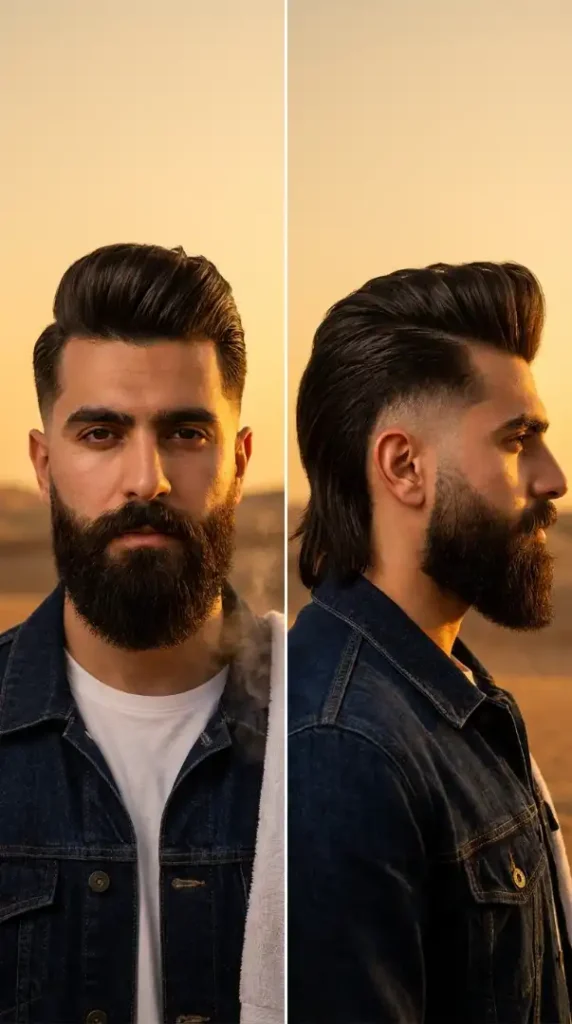
FACE SHAPE MATCH:
The Desert Storm Mullet is purpose-built for men with Heart and Diamond face shapes who also wear a full, dense beard. For Heart-shaped faces — wider at the forehead, narrower at the chin — the full beard is the great equalizer: it adds apparent width and mass to the lower face, counteracting the narrow chin and creating a balanced rectangular or oval silhouette. The pompadour-lifted top on a Heart face is a calculated move — rather than adding more forehead width (which you’d want to avoid), the lift goes vertical, adding height without width. For Diamond faces, the lifted crown adds height above the widest cheekbone zone, drawing the eye upward and making the proportionally narrower forehead appear more substantial. For Square faces, the full beard combined with the pompadour volume can create an overpowering effect — use this cut with a trimmed-down beard (under 1 inch) on Square faces to keep proportions balanced. This cut is NOT recommended for men who are prohibited from wearing beards in their work environment, as the beard is an integral design element — without it, the mullet-pompadour combination loses its architectural cohesion.
GROOMING KIT:
Clippers: Andis Excel 5-Speed Detachable Blade Clipper for the thick-density mid-fade work.
Trimmer/Outliner: Andis T-Outliner GTX for the full beard edge definition and neckline shaping.
Finishing: Kent Handmade Comb 20T for top styling; Torino Pro Pick Comb for crown volume lift.
Products: Suavecito Firme Hold Pomade for the pompadour front lift — two finger-widths applied to the root zone; Beardbrand Utility Balm for the full thick beard (1 pump — worked in from roots to tips in circular motion); Moroccan Oil Treatment (2 drops) on the mullet length to add gloss and manage frizz in the thick dark brown hair; Redken Brews Fortify Shampoo for dense hair weekly cleanse.
MAINTENANCE LEVEL: HIGH
Salon Visit Frequency: Every 3 weeks for the fade; beard shaping at 2-week intervals.
Daily Styling Time: 15–18 minutes.
Daily Product Routine: Start with Moroccan Oil on towel-dried mullet length and blow-dry straight from crown to nape on medium heat. Then blow-dry the top section forward (opposite of final direction) to create volume at the root, then blow back into position for pompadour lift. Apply Suavecito Firme Pomade to the front-crown zone and comb backward + upward to set the lift. For the beard: apply 1 pump of Beardbrand Utility Balm, massage in circular motion, shape with a boar bristle beard brush to direction.
BARBER TALK (EXACT SCRIPT):
“I want a pompadour mullet with a mid-skin fade. Mid fade on the sides — skin at the base just above the ear, blending through a 0.5, 1, and 1.5 up to mid-temple height. Above the fade, keep all the length and volume. On top, I want a left side part — not a hard shaved part, just a natural part. The front gets a pompadour lift — leave at least 3.5 to 4 inches on the top so I have enough length to create the lift. The back is mullet — 1.5 to 2 inches past the collar, straight blunt cut across the weight line. No taper on the back. For the beard: clean up the cheek line, keep the beard length at about 2 inches, taper the chin area. Mustache stays full, connected. Neckline arced clean.”
The Desert Storm commands the room with warm amber power — but Style 7 shifts to a silver-toned, mature masculinity that makes the mullet look like it was always meant for grown men.
FAQs
Q: How do I style thick dark hair in a mullet pompadour without it looking stiff?
A: Use a medium-to-firm pomade like Suavecito Firme, but emulsify it fully between your palms before applying — this prevents clumping on thick hair. Apply to towel-dried hair, not completely dry, so the product distributes through the density evenly. Blow-dry simultaneously while combing backward for a natural pompadour movement rather than a rigid helmet shape. Avoid over-applying — less product is more on thick hair.
Q: Does a full beard work with a mullet hairstyle?
A: Absolutely — a full beard is one of the most powerful complements to a mullet haircut. The beard adds structural weight to the lower face, which balances the top volume of the mullet and creates a complete top-to-bottom composition. A mullet with a full beard reads as intentional and masculine rather than casual or retro. Ensure the beard is well-groomed with defined edges to maintain the overall editorial quality of the look.
Q: What face shape is best for a pompadour mullet?
A: Heart and Diamond face shapes benefit most from a pompadour mullet. Heart faces gain lower-face width from the beard and upper-face height from the pompadour lift. Diamond faces use the pompadour height to balance wide cheekbones. Oval faces are universally flattering and work with any variation. Square faces should keep the pompadour lift moderate and the beard trimmed shorter to avoid a top-heavy appearance.
Q: How do I keep thick mullet hair from getting frizzy in humid weather?
A: Apply a humidity-blocking serum or anti-frizz oil to towel-dried hair before blow-drying — Moroccan Oil Treatment or Oribe Grandiose Hair Plumping Mousse both work well on thick hair. Blow-dry fully rather than air-drying, as thick hair that air-dries tends to develop frizz at the mid-shaft. Finish with a light mist of Kenra Platinum Silkening Mist to seal the cuticle.
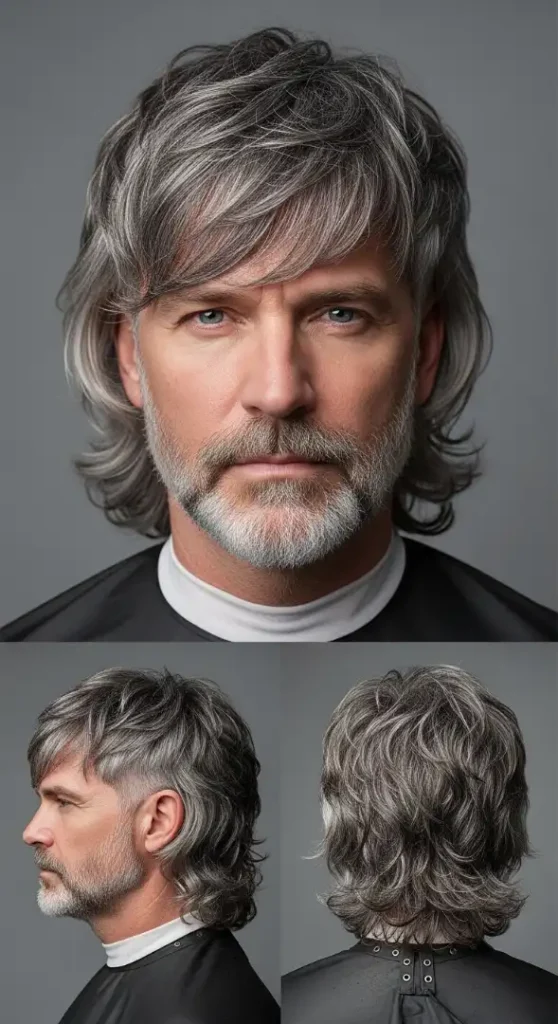
STYLE 7 OF 10 — THE SILVER WOLF SHAG MULLET
FACE SHAPE MATCH:
The Silver Wolf Shag Mullet is the definitive mullet variation for mature men and for men embracing the natural salt-and-pepper transition. In terms of face shape, it performs beautifully on Square and Heart faces. For Square faces, the choppy, multi-layered shag completely disrupts the symmetrical angularity of the jaw — the organic, unpredictable movement of the shag layers adds visual chaos that softens strong bone structure, making the face appear more relaxed and less rigidly structured. The curtain fringe further softens the brow line. For Heart faces, the added volume of the shag at the sides fills in the narrow lower face visually, balancing the wider forehead. Critically, this style works BECAUSE of salt-and-pepper hair — the natural high-contrast within the hair itself (dark base, silver highlights) creates texture and visual interest that a single-toned shag simply cannot match. Younger men with uniform hair color will not achieve the same effect. This is NOT a suitable choice for men who want a polished, corporate-appropriate look — the shag mullet projects an intentionally unstructured persona best suited for creative fields, the arts, and casual-forward lifestyles.
GROOMING KIT:
Clippers: Wahl Professional 5-Star Cordless Senior for scissor-over-comb side taper work (no hard clipper grades needed).
Trimmer/Outliner: Panasonic ER-GB80 for the natural stubble beard at 4mm.
Finishing: Tangle Teezer Wide Tooth Detangler for the wavy shag length; boar bristle brush for daily light smoothing.
Products: American Crew Grooming Cream (small coin-sized amount) for the shag layers — defines movement without stiffness; Paul Mitchell Tea Tree Special Shampoo for scalp health and silver hair vibrancy; Kiehl’s Midnight Recovery Scalp Treatment for mature scalp hydration; Proraso Silver for Men Beard Balm (1 pump) for the salt-and-pepper stubble nourishment.
MAINTENANCE LEVEL: LOW
Salon Visit Frequency: Every 6–8 weeks. The scissor taper and shag grow out naturally and gracefully — there is no hard fade line to deteriorate. The shag actually looks better with slight growth, as added length enhances the layered movement.
Daily Styling Time: 3–5 minutes.
Daily Product Routine: Apply American Crew Grooming Cream to slightly damp hair — scrunch in with the fingers from roots to tips, letting the natural wave pattern form. Do not comb or brush after product application — air-dry or diffuse on low heat for 5 minutes. The shag requires zero precision styling — the point is intentional dishevelment. Apply Proraso Beard Balm to the stubble daily with fingertips. Total time: 4 minutes.
BARBER TALK (EXACT SCRIPT):
“I want a shag mullet — no fade, no hard grades. I want it cut with scissors only, or scissors over comb. On the sides, taper it with scissors from short at the base — about half an inch — blending up into the shag layers above. The top and back are all layered — I want choppy layers throughout, removing bulk but keeping length. The curtain fringe stays, just clean up the ends — don’t lift the fringe above my eyebrow line. For the back, I want the mullet to sit about 2 to 2.5 inches past the collar with the layers intact, no thinning on the length. Soft natural taper at the nape — no hard neckline, a natural feathered edge. For my stubble beard: just clean up the neck and keep the cheek line natural. No design lines — keep the beard looking effortlessly grown.”
The Silver Wolf Shag proves that some things genuinely get better with age — but Style 8 swings back to a sharp coastal energy with a mullet cut built for golden-hour confidence.
FAQs
Q: What is a shag mullet and how is it different from a regular mullet?
A: A shag mullet combines the choppy, layered texture of a shag haircut with the length-at-the-back defining feature of a mullet. Unlike a regular mullet — which has a clear, structured contrast between short sides (often faded) and a long back — a shag mullet has layers throughout, no hard fade, and a deliberately disheveled, organic texture on all sides. It has a 70s rock-influenced feel and works best with natural wave or texture.
Q: How do I embrace grey and salt-and-pepper hair in a modern mullet style?
A: Salt-and-pepper hair is one of the best textures for a shag mullet because the natural contrast between dark and silver creates built-in visual depth. Embrace it by avoiding any toning or darkening treatments — let the silver grow naturally. Use a purple-toned shampoo weekly to keep silver streaks bright and eliminate any yellow tones. The natural high-contrast pattern makes the shag layers look richer and more dimensional than a solid color ever could.
Q: Does a shag mullet work for men over 40?
A: Absolutely — the shag mullet is arguably one of the best haircuts for men over 40. It works naturally with the gradual texture change that comes with aging hair, it doesn’t require a high-maintenance fade or daily precision styling, and it projects a confidently mature, creative persona. Paired with a natural stubble beard, it reads as intentional and stylish rather than dated. Men over 40 with salt-and-pepper hair in particular will find this their most complimented haircut.
Q: How do I stop a shag mullet from looking messy rather than intentional?
A: The difference between intentional shag and genuinely messy hair comes down to two things: a professional cut and a daily light grooming cream. Have the shag cut professionally with deliberate layers — the barber sets the shape. At home, scrunch American Crew Grooming Cream or a similar light styler into damp hair and air-dry. The layers will fall into their designed positions naturally. The moment you brush dry or blow-dry without diffusing, the organic structure breaks and it reads as unkempt.
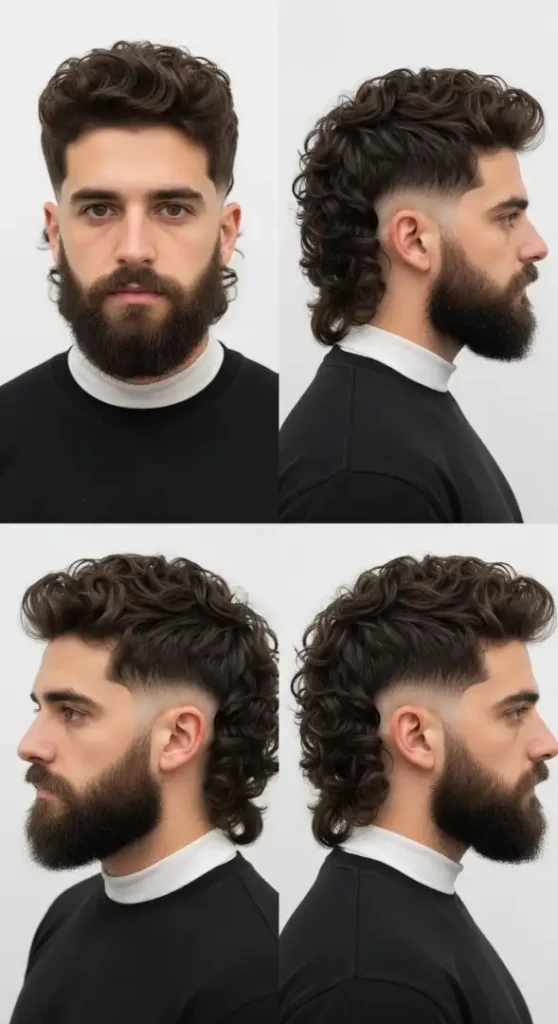
STYLE 8 OF 10 — THE COASTAL ROGUE MULLET
FACE SHAPE MATCH:
The Coastal Rogue Mullet, built on a foundation of natural curly texture and mid-fade structure, is most flattering for men with Oval and Round face shapes. For Oval faces, the curly top volume sits naturally high without needing structural support — the natural curl spring creates upward momentum that enhances the already-balanced proportions of an oval face, adding personality without distorting anything. For Round faces, the curly crown volume adds critical vertical height, elongating the face upward while the mid-fade removes width from the sides — this one-two combination is the most effective facial slimming strategy available in the mullet category. The full curly beard functions as a chin-extender on Round faces, creating the illusion of a longer, more defined jaw. For Diamond faces, the combination of curly top volume and full beard creates a top-and-bottom framing that balances the prominent cheekbone width perfectly. Men with Oblong faces should use this style with caution — the curly crown height could further elongate an already-long face unless the top length is kept to a maximum of 3 inches without additional blow-dry volume lift. Note: this style demands a genuine curl pattern — men with straight hair cannot authentically recreate this look without chemical texture services.
GROOMING KIT:
Clippers: Wahl Magic Clip Cordless for the curly mid-fade precision work.
Trimmer/Outliner: Andis GTX-EXO Cordless for beard edge definition on a full curly beard.
Finishing: Denman D4 Large Styler Brush for curl definition and clumping on the mid-fade mullet; Tangle Teezer Wide Tooth Shower Detangler for nape length on wet hair.
Products: DevaCurl SuperCream Coconut Curl Styler for defining the curly top — quarter-sized amount on soaking-wet hair, scrunched in from roots; Cantu Shea Butter Leave-In Conditioning Repair Cream for the curly nape length; Cremo Beard and Scruff Cream for the full natural beard; Moroccanoil Frizz Control (1 pump) before diffuse drying for frizz management in humidity.
MAINTENANCE LEVEL: MEDIUM
Salon Visit Frequency: Every 4 weeks. Mid-fades on curly hair show growth faster at the base due to the visual contrast between the textured top and the fade zone.
Daily Styling Time: 8–12 minutes on wash days; 3–5 minutes on non-wash days.
Wash Day Routine: Cleanse with DevaCurl No-Poo cleanser, deep condition for 5 minutes, rinse with cold water. On dripping-wet hair, apply DevaCurl SuperCream and scrunch. Diffuse on low heat for 8 minutes. Apply beard cream to wet beard and shape.
Non-Wash Day: Mist the curly top with a water spray bottle, apply a small amount of leave-in conditioner to revive curl definition, scrunch. Apply beard balm. 3 minutes total.
BARBER TALK (EXACT SCRIPT):
“I want a curly mullet with a mid-fade. Mid-fade on the sides — start with a 1 guard at the base, blend through a 1.5 to a 2, and transition into the natural hair at mid-temple height. Not a skin fade — I want to see some hair at the base, just very short. Leave the curly texture completely intact above the fade — no thinning shears on the curls, no razor work on the top. Keep the top at 3 to 4 inches of curl spring height. For the back, mullet tail — let the curls hang naturally about 2 inches past the collar. Just clean up the perimeter of the curl clusters at the nape, don’t cut into the curl length. Nape: soft low-arc natural hairline, no hard boxing. For the beard: clean up the cheek line at a natural angle, keep the beard about 1.5 inches, and leave the natural curl in it — just use a trimmer to even out the length and define the neck. No design lines.”
The Coastal Rogue has that salt-air magic that makes every day feel like summer — and Style 9 matches that energy with a neon-lit night version of the mullet that’s built for after dark.
FAQs
Q: How do I style a curly mullet without frizz?
A: Style a curly mullet on soaking-wet hair — not damp, not dry, but completely wet. Apply a curl cream or DevaCurl SuperCream by scrunching upward from the nape to the crown, never raking or brushing. Diffuse on low heat keeping the dryer underneath the hair clusters rather than pressing down on them. Once dry, do not touch the curls with your hands — break the cast gently by scrunching upward once. Frizz is almost always caused by styling on damp rather than wet hair or disrupting curls while drying.
Q: What is the best curl product for a curly fade mullet?
A: DevaCurl SuperCream Coconut Curl Styler is the top recommendation for a curly fade mullet — it defines curl clusters, adds weightless hold, and controls frizz without making hair feel stiff or crunchy. Apply on soaking-wet hair, scrunch in, and diffuse. For high-density thick curls, layer it over a leave-in conditioner base like Cantu Shea Butter Repair Cream for maximum moisture and definition.
Q: Can I get a mullet with curly hair if my curls are loose and wavy, not tight?
A: Yes — loose wavy curls actually create one of the most visually appealing mullet silhouettes because the waves add natural volume and movement without the density control challenges of tight coils. A mid-fade with wavy curly texture at the top and a flowing wavy nape length is an extremely popular Pinterest and barbershop request. Use a lighter styler than a heavy curl cream — American Crew Grooming Cream or USTRAA Hair Cream for wavy hair works better than thick curl butter on loose wave patterns.
Q: How do I keep the back of my curly mullet healthy and long?
A: Retain curly mullet length by deep conditioning every 7 to 10 days, using a microfiber towel or a cotton T-shirt to dry (standard towels cause breakage on curly hair), applying a leave-in conditioner as a base layer every wash day, and sealing with a lightweight natural oil like argan or jojoba on the ends. Sleep on a satin pillowcase to prevent friction breakage at the nape length overnight.
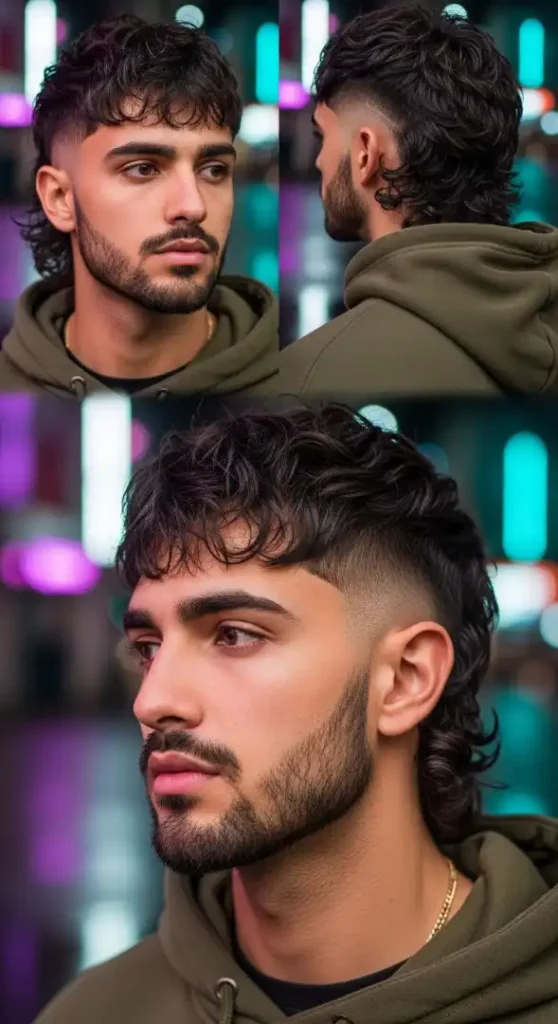
STYLE 9 OF 10 — THE NEON PHANTOM MULLET
FACE SHAPE MATCH:
The Neon Phantom Mullet, defined by its dramatic high skin fade, choppy textured top, and minimal stubble beard, is most powerfully suited to Diamond and Oval face shapes. For Diamond faces — the most sculpted of all face shapes, characterized by a narrow forehead, wide cheekbones, and narrowing chin — the high skin fade is the optimal choice because it eliminates visual width at the temple and cheekbone zone, allowing the natural cheekbone prominence to function as the focal architectural feature of the face. The choppy textured top at modest height adds crown presence without adding excessive width. For Oval faces, the minimal stubble beard keeps the balanced proportions intact while the high fade adds a sharpness and modernity that transforms the face from pleasant to striking. The 1mm shadow beard is a deliberate choice here — it defines the jaw without adding beard volume that might obscure the sharp lines of the fade-to-face transition. Men with Round faces should exercise caution: a very high skin fade on a round face without sufficient crown height can paradoxically make the face look wider at the cheekbones. Add at least 0.5 to 1 inch of additional top volume to compensate. This style is NOT recommended for men with Oblong faces, as the high fade plus choppy top adds both height and width simultaneously, potentially exaggerating the face length.
GROOMING KIT:
Clippers: Andis Master MLC Cordless for high skin fade precision — essential for clean bald base and tight graduation.
Trimmer/Outliner: BaByliss Pro FX726 for the 1mm shadow beard definition and cheekbone hairline clean-up.
Finishing: Denman D14 Vent Brush for blow-drying texture into the choppy layers; fine-tooth rat-tail comb for directing the curtain fringe.
Products: TIGI Bed Head for Men Pure Texture Molding Paste for the choppy textured top — adds definition to individual layer ends for that editorial disheveled finish; American Crew Fiber for a slightly stronger-hold version; Every Man Jack 2-in-1 Shampoo + Conditioner for Daily use; Kiehl’s Facial Fuel Moisturizer for visible skin quality at the high-fade zone.
MAINTENANCE LEVEL: HIGH
Salon Visit Frequency: Every 2 weeks for the high skin fade; 3 weeks maximum before it looks visibly overgrown.
Daily Styling Time: 8–10 minutes.
Daily Product Routine: Blow-dry the choppy top upward and forward on medium heat using a vent brush, creating volume and enhancing the layer separation. Apply a pea-sized amount of TIGI Bed Head Molding Paste to fingertips, rub until fully dissolved in the palms, then press into the top using random finger movements to enhance the choppy end texture. For the curtain fringe, use a rat-tail comb to direct both sides outward from center. Apply 1 drop of beard oil to the 1mm shadow to avoid dry, flaky skin underneath. Trim shadow beard to 1mm every 5 days.
BARBER TALK (EXACT SCRIPT):
“I want a high skin fade textured mullet. The fade: bald at the base — fully skin, zero guard, from just above the ear all the way down to the temple and sideburn zone. Blend through a 0.5 at a high fade line, meeting the natural hair at upper temple level — make the fade line sit high, near where the head starts to curve inward at the top. On top, I want choppy texture — point cut throughout the top to create layer separation and movement. Keep the length at 3 inches on the crown. Curtain fringe — center broken, reaches to just above the eyebrows. For the back, mullet length — about 1.5 to 2 inches past the collar, choppy ends, not blunt cut. The ends should look textured, not one weight line. Shadow beard: 1mm all over, natural cheek line, defined neck arc.”
INTERNAL LINKING HOOK:
The Neon Phantom owns the night — but Style 10 closes this collection with the most ambitious mullet of all, a power-executive variation built for the man who wants to look like a CEO and a creative director at the same time.
FAQs
Q: What is the difference between a high fade and a mid fade in a mullet haircut?
A: In a mullet, a high fade starts its graduation at the upper temple — just below where the head curves toward the crown — creating maximum contrast between the faded sides and the top. A mid-fade starts at ear level and graduates up to mid-temple. High fades look more dramatic, modern, and street-styled; mid-fades are more classic and conservative. High fades require more frequent barber visits (every 2 weeks) to maintain their sharpness.
Q: How do I add texture to straight hair for a choppy mullet look?
A: Add texture to straight hair by point-cutting throughout the top — have your barber use texturizing shears at the ends of each layer rather than cutting straight across. At home, use a molding paste like TIGI Bed Head Pure Texture applied to almost-dry hair with fingertip pressure and random movements — avoid combing after product application. You can also sea-salt spray damp hair before blow-drying to create wave-like texture on otherwise straight hair.
Q: What hairstyle products are best for a textured mullet top?
A: For a textured mullet top, TIGI Bed Head for Men Pure Texture Molding Paste is the top recommendation — it provides medium-to-firm hold with a matte finish and excellent piece-y definition between the choppy layers. American Crew Fiber is a stronger alternative for thicker hair or more humid climates. Avoid pomades with high shine for textured mullets — gloss products make textured cuts look wet rather than deliberately disheveled.
Q: How long does a high skin fade take to grow out noticeably?
A: A high skin fade begins to show visible stubble growth at the bald base within 5 to 7 days on average for fast-growing hair. By 10 to 14 days, the fade line starts to blur and lose its precision. By 3 weeks, the contrast between the faded side and the top is significantly reduced and the cut starts to look overgrown. For maintaining a sharp high skin fade, booking every 2 weeks is the professional recommendation.
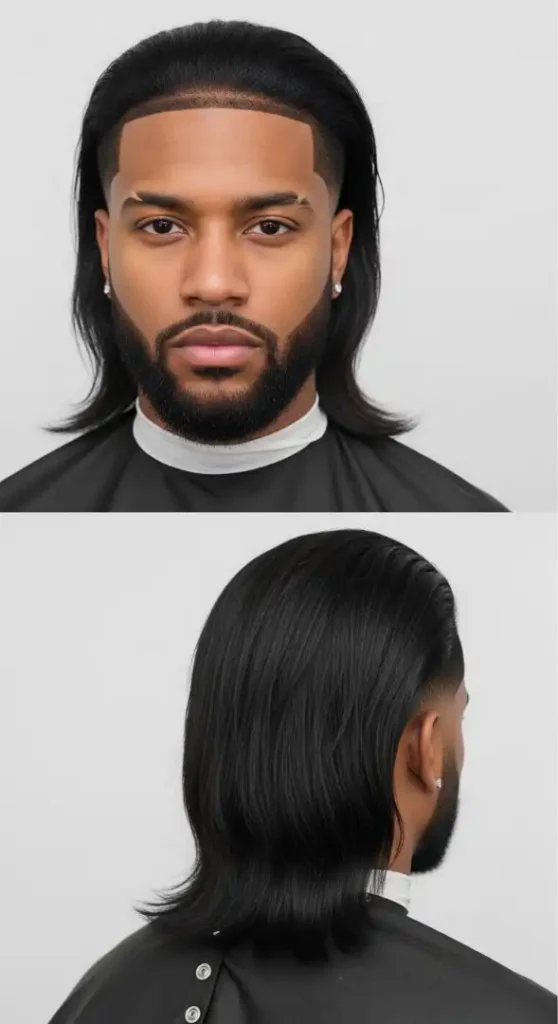
STYLE 10 OF 10 — THE OBSIDIAN EXECUTIVE MULLET
FACE SHAPE MATCH:
The Obsidian Executive Mullet is the most formally versatile mullet variation in this entire collection, and it performs at its absolute best on Oval and Oblong face shapes. For Oval faces, the absence of fringe and the clean backward sweep creates an unobstructed view of the full face, allowing the naturally balanced proportions to command the room without competition from hairstyle elements. Every line is a statement of confidence. For Oblong faces, the very controlled, low-fade mullet avoids adding height (no volume, no fringe lift) and instead keeps the silhouette horizontal and balanced — the blunt back weight line is particularly flattering, as it creates a clean horizontal termination at the nape that visually widens the perception of the lower head. For Square faces, the smooth swept-back top and clean low fade work together to reduce the heaviness of a strong jaw rather than amplifying it, unlike high fades or textured tops that can create a top-heavy square silhouette. This cut is a genuine grey-area mullet — it can pass in conservative professional environments when the nape length stays at 1 to 1.5 inches past the collar and the sides are kept clean. Men who require absolute corporate compliance should discuss this with their employer before committing — but in most modern workplaces, this falls within acceptable grooming parameters.
GROOMING KIT:
Clippers: Wahl Professional 5-Star Sterling 4 Cordless for the immaculate low skin fade work on jet-black hair.
Trimmer/Outliner: Andis T-Outliner for the architectural beard line definition and cheek geometry.
Finishing: Premium boar bristle brush for distributing pomade; fine-tooth Kent 20T comb for the backward sweep alignment.
Products: Layrite Super Hold Pomade for the swept-back top — delivers high gloss and firm hold essential for the executive finish; American Crew Precision Blend (10 minute conditioning treatment once per week) for maintaining jet-black color richness and hair density; Beardbrand Utility Balm for the precise short beard; Kiehl’s Facial Fuel Moisturizer for the highly visible skin areas at the clean low fade zone.
MAINTENANCE LEVEL: MEDIUM-HIGH
Salon Visit Frequency: Every 3 weeks. The low skin fade grows out gradually but the nape weight line loses sharpness after 3 weeks, compromising the executive finish quality.
Daily Styling Time: 8–12 minutes.
Daily Product Routine: Blow-dry the swept-back top with a flat brush on medium-high heat, directing hair uniformly backward and ensuring zero flyaways — this cut allows no visible disorder at the front hairline. Apply Layrite Super Hold Pomade — hazelnut-sized amount, fully emulsified — and press into the crown zone, sweeping backward with the fine-tooth comb in one clean stroke. Apply a second very light pass of pomade to the nape length if it shows any wave. Beard: apply Beardbrand Utility Balm, shape with a fine-tooth comb to maintain the geometric lines.
BARBER TALK (EXACT SCRIPT):
“I want an executive mullet — clean, refined, no drama. Low skin fade on the sides: skin at the very base along the temple and above the ear, blending through a 0.5 to a 1 — keep the fade low, below the ear line. The transition to the natural hair should be invisible, not dramatic. No high fade line. On top, everything swept back: 3 inches of length on the crown, no fringe, no part, just clean swept backward. The front hairline should be sharp and natural — no boxed outline at the front, just the natural hairline cleaned up. For the back: mullet weight line at 1 to 1.5 inches past the collar — a clean, precise horizontal cut across the back nape, perfectly level. The cut should look polished from behind — the blunt weight line is the signature detail of this style. Nape fade: bald at the hairline base, blending upward clean. Beard: geometric cheek line, 5mm all over, defined neck arc, no strays.”
The Obsidian Executive closes this collection at the pinnacle of mullet evolution — if you want to explore how fades pair with beard styles to build a complete look, our next guide on The Best Fade-and-Beard Combinations For Every Face Shape will change how you think about the barber chair.
FAQs
Q: Can a mullet be considered professional or office-appropriate?
A: Yes — when the nape length stays between 1 and 1.5 inches past the collar, the sides are kept with a low, refined fade, and the top is clean and swept back, a mullet can pass as professional in most modern workplaces. Industries such as tech, media, design, advertising, and fashion regularly accept modern mullet variations. Conservative industries (law, finance, banking, government) may require the length above the collar — in those cases, a mullet taper that ends at the collar is the diplomatic choice.
Q: What is a “weight line” in a mullet haircut and why does it matter?
A: A weight line is the horizontal cut line at the back of a mullet where the length terminates — it is the visual edge that defines the silhouette. A blunt weight line is a clean, single straight cut across the nape length, creating a sharp, precise edge. A textured or razor weight line has uneven, choppy ends. In an executive mullet, a blunt weight line is essential — it signals precision and intentionality, distinguishing a deliberate modern mullet from an overgrown haircut.
Q: What products give jet-black hair maximum shine in a swept-back mullet?
A: Layrite Super Hold Pomade delivers the highest natural shine on jet-black hair without creating a wet or oily finish. Apply a hazelnut-sized amount fully emulsified between the palms, then press through the top zone and comb backward with a fine-tooth comb. For additional gloss on the nape length, apply 1 drop of Kiehl’s Nourishing Hair Oil before blow-drying. Avoid matte products entirely for executive swept-back styles — shine signals health, density, and control.
Q: How is a modern executive mullet different from the classic 80s mullet?
A: The classic 80s mullet had a high contrast between a very short, often feathered or permed top and an exaggeratedly long back — it was big, bold, and intentionally theatrical. A modern executive mullet is all restraint: the length difference between the top and the nape is subtle (1 to 1.5 inches past the collar), the sides are refined with a clean low fade rather than the 80s’ tapered but still-long sides, and the top is worn smooth and intentional. The modern version says “I know exactly what I’m doing.” The 80s version said “it’s party time.”