Textured French Crop Haircuts For Men In Summer
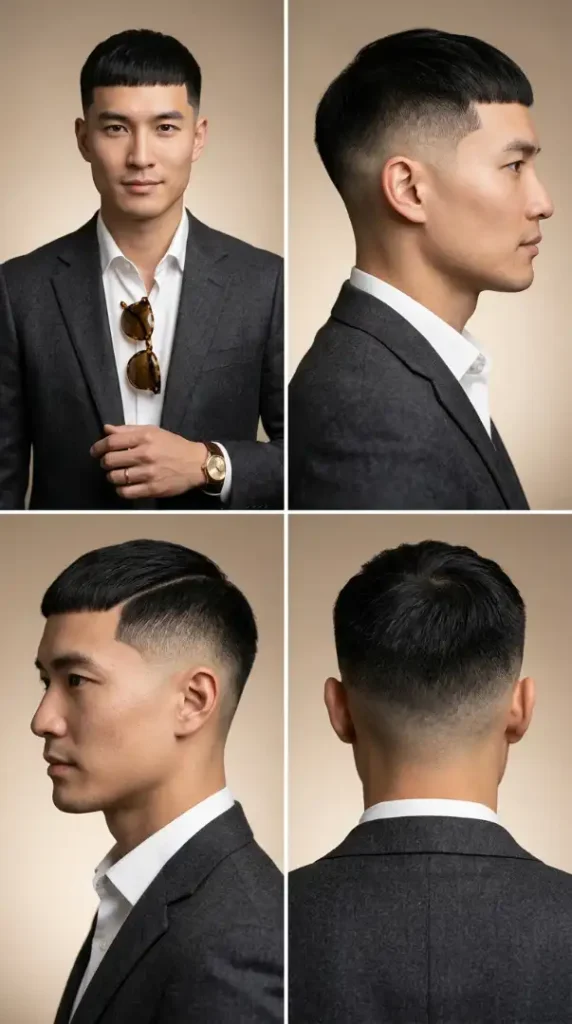
1 of 15 — The Mediterranean Breeze
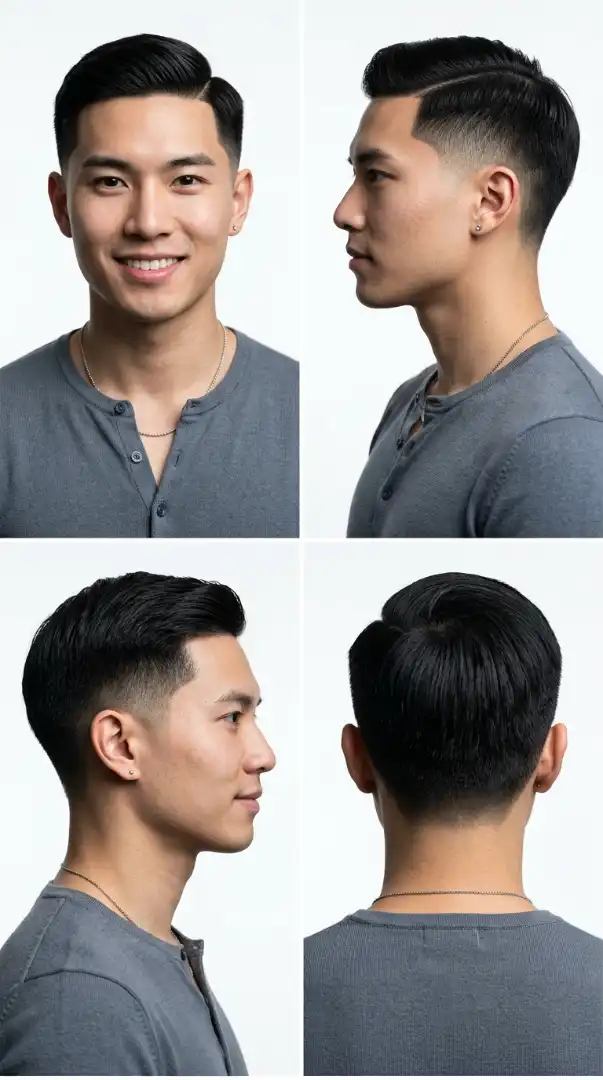
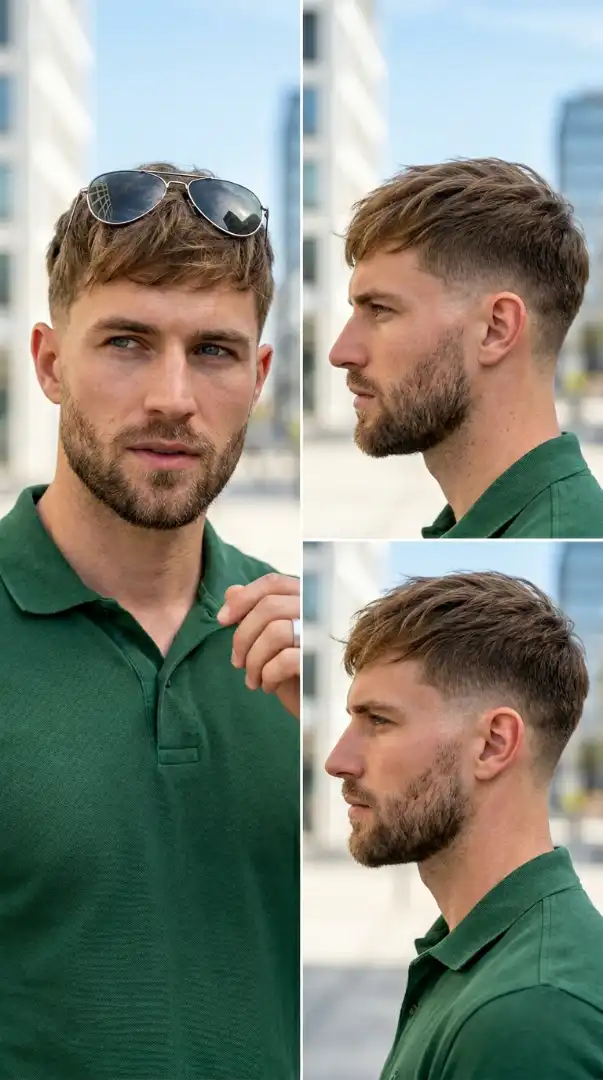
The Mediterranean Breeze represents the perfect summer evolution of the French crop—a textured, breathable cut engineered for hot weather while maintaining sharp style. This variation features a 2-inch textured top with horizontal fringe that air-dries naturally, eliminating the need for heat styling when temperatures soar.
Which Face Shapes Work Best with The Mediterranean Breeze?
Square and oval face shapes achieve exceptional results with The Mediterranean Breeze because the horizontal fringe creates width balance at forehead level while the short textured sides (typically a low fade or tapered sides) remove bulk that traps heat. The blunt fringe line softens the angular features of square jaws beautifully. Round faces benefit from requesting slightly more height in the texture—ask your barber to add vertical piece-y layers that elongate rather than the purely horizontal fringe shown here, which can emphasize width. Diamond face shapes work excellently as the fringe adds forehead balance. Heart-shaped faces should embrace this style fully; the horizontal emphasis balances a narrow chin perfectly.
Essential Tools & Products for The Mediterranean Breeze
Your barber needs Wahl Magic Clip (Model 5049-400) or Andis Master (Model 01557) clippers for the fade work, paired with texturizing shears for the choppy top layers. The horizontal fringe requires sharp scissors for clean blunt-cutting. At home, summer maintenance is refreshingly simple: American Crew Fiber (pea-sized amount) or Hanz de Fuko Claymation for matte texture on days you want definition, but this cut is specifically engineered to look great air-dried with zero product. A simple wide-tooth comb for post-shower shaping, Kent 81T fine-tooth comb if you want to refine the fringe line. For stubble maintenance: basic electric trimmer at #1 guard (Philips Norelco OneBlade or Braun Series 3) used every 2-3 days.
Maintenance Level: LOW-MEDIUM
Barbershop visits every 3-4 weeks keep the French crop in optimal summer shape—the textured top grows out gracefully, actually gaining more natural movement as it approaches 3 inches. The horizontal fringe grows into your eyes by week 4, signaling trim time. Daily styling commitment: 2-3 minutes maximum. Most mornings: shower, towel-dry, run fingers through to create forward texture, air-dry while getting dressed. Total hands-on time: 90 seconds. For occasions requiring polish, add the pea-sized clay product and finger-style for definition—adds 60 seconds. Monthly cost: $35-50 for barber visits, $20 for product that lasts 4-5 months.
How to Ask Your Barber for The Mediterranean Breeze
Say this to your barber: “I want a textured French crop optimized for summer. Give me a low fade or taper on the sides starting just above my ear—keep it gradual, blending from #2 guard to skin. On top, cut to 2 inches using point-cutting and texturizing techniques—I want choppy, piece-y layers that air-dry with natural movement. Cut the fringe blunt and horizontal, falling just above my eyebrows. Don’t thin it out too much; I want texture with density. Keep my hairline natural and soft. For finishing, give me a light lineup at the temples but nothing harsh—this is a summer cut, keep it relaxed and textured.”
If you need even less maintenance than this already-simple cut, the next style reduces daily effort to literally zero while keeping that French crop structure.
FAQs
Q: How do I style a textured French crop for summer without it looking messy?
A: The beauty of a summer French crop is embracing intentional texture—”messy” is actually the goal, not something to avoid. Towel-dry hair after showering, apply a pea-sized amount of matte clay or fiber (American Crew Fiber, Baxter Clay Pomade) to damp hair, push forward with your fingers creating piece-y separation, then let it air-dry completely. The choppy layers your barber cut will naturally fall into textured position without heat styling, perfect for summer humidity that would ruin sleeker styles.
Q: What’s the difference between a French crop and a Caesar cut?
A: A French crop features a disconnected or faded back and sides (creating contrast) with a horizontal blunt-cut fringe, while a Caesar cut has uniform connected length all around the head with a textured, forward-brushed fringe. French crops pair with modern fades for contemporary edge; Caesars have a more classic Roman-inspired aesthetic with tapered (not faded) sides. French crops work better in summer heat due to the shorter disconnected sides.
Q: Can I get a French crop if I have curly or wavy hair?
A: Absolutely—wavy hair actually enhances the French crop’s texture by adding natural movement to the top section. Ask your barber to preserve your natural wave pattern rather than thinning it out excessively. Curly hair (loose curls, not tight coils) works beautifully with slightly more length on top (2.5-3 inches) to allow curls to form. Tight coily hair textures should consider a different cut; the French crop’s blunt fringe doesn’t suit very tight curl patterns.
Q: How often do I need to trim a French crop in summer?
A: Every 3-4 weeks maintains optimal shape for summer styling. The sides will show growth by week 3 (especially fades), but it’s the horizontal fringe that determines trim timing—once it grows past your eyebrows and into your eyes, book your appointment. Some guys stretch to 5 weeks in summer when the longer, more textured look feels appropriate for vacation mode, but 4 weeks is the professional sweet spot.
2 of 15 — The Urban Cool
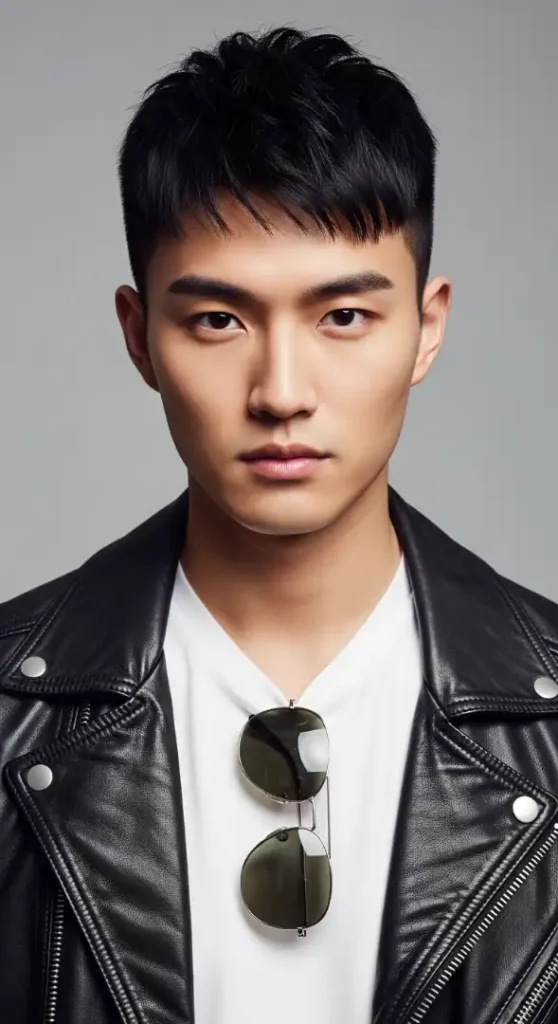
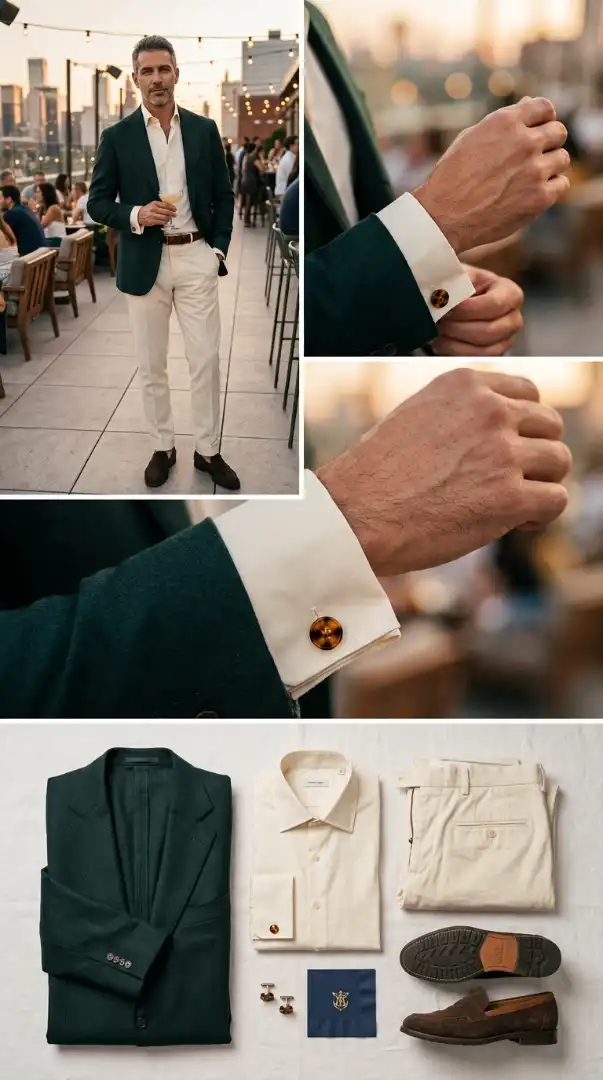
The Urban Cool transforms the classic French crop into street-smart edge—aggressive forward texture with razor-cut layers and a mid fade that works equally well in creative offices or weekend streetwear. This summer variation features 2.5 inches of choppy texture that air-dries with intentional attitude.
Best Face Shapes for The Urban Cool French Crop
Oval and diamond face shapes absolutely dominate with The Urban Cool because the forward-styled fringe creates horizontal balance while the mid fade (starting at temple line) removes just enough side volume to maintain clean proportions. The aggressive forward texture draws attention to the eyes and upper face, which diamond shapes benefit from enormously. Square faces work beautifully here—the textured, piece-y fringe softens angular jawlines while the fade keeps things modern. Round faces should request slightly more vertical texture in the styling (push hair upward and forward rather than purely forward) to create elongation. Heart-shaped faces can wear this successfully but should maintain the 2.5-inch length minimum to provide balancing volume.
Grooming Tools & Products for The Urban Cool
Your barber requires Andis Master (Model 01557) clippers for the mid fade precision and professional texturizing shears (Mizutani or Joewell brands) for the razor-cut choppy layers that define this look. The aggressive texture demands skilled scissor work. At home, you need American Crew Fiber (recommended) or Uppercut Deluxe Matte Pomade—both deliver strong hold with natural matte finish. Product amount: pea-sized for this length, worked through damp hair before air-drying. A Denman D3 brush helps direct the forward movement while blow-drying if you want extra volume. For clean-shaven maintenance: quality safety razor (Merkur 34C or Edwin Jagger DE89) with sharp blades for the closest shave, pre-shave oil for glide.
Maintenance Timeline: MEDIUM
Barbershop appointments every 3 weeks maintain the sharp mid fade and prevent the fringe from growing past your eyebrows into prime “messy” territory (not the intentional kind). The razor-cut texture needs professional upkeep; attempting home trims ruins the piece-y definition. Daily styling commitment: 4-6 minutes including towel-drying, applying fiber product to damp hair, rough-drying with fingers or Denman brush while pushing forward and slightly upward, then finger-styling the final texture and separation. This cut rewards the effort with all-day hold and compliment-generating edge. Monthly investment: $40-60 for skilled barber visits every 3 weeks, $22 for American Crew Fiber lasting 3-4 months.
Barber Script for The Urban Cool
Say this to your barber: “I want an urban-style textured French crop with a mid fade. Start the fade at my temple line and blend from #1.5 guard down to skin—make it sharp and clean. On top, keep 2.5 inches and use razor-cutting or heavy texturizing to create aggressive choppy layers. I style it forward with lots of piece-y separation and texture—don’t leave it too thick or blunt. Give me a sharp lineup at the temples and hairline with geometric corners. Fringe should fall just above my eyebrows when unstyled. I want modern edge, not a conservative business cut.”
The next variation shows how to add length for guys who want more styling versatility while keeping that French crop DNA.
FAQs
Q: How do I make my French crop look edgy instead of conservative?
A: Request aggressive texturizing with razor-cutting or heavy thinning shears to create choppy, piece-y layers (not blunt weight). Style with matte clay or fiber product, pushing hair forward while using your fingers to create deliberate separation and “messy” texture. The key is controlled chaos—individual strands going slightly different directions—rather than the uniform, combed-forward conservative version. Add a sharp lineup at temples for modern edge.
Q: What’s the best product for textured forward-styled hair?
A: Matte clay or fiber products with strong hold work best for maintaining forward texture in summer humidity. American Crew Fiber, Hanz de Fuko Claymation, and Uppercut Deluxe Matte Pomade all deliver reliable all-day hold without shine or greasiness. Apply pea-sized amount to damp (not wet or dry) hair before styling, then air-dry or blow-dry into position. Avoid pomades or gels which create the wrong finish for modern texture.
Q: Can Asian hair get good texture in a French crop?
A: Absolutely—straight Asian hair textures are ideal for French crops because they naturally fall forward and hold styled positions well. The key is aggressive texturizing from your barber: razor-cutting, point-cutting, and thinning to remove bulk and create piece-y movement. Without proper texturizing, Asian hair can look too blocky and heavy in a French crop, so emphasize the texture request strongly when booking your appointment.
Q: How long should the fringe be on a French crop?
A: The traditional French crop fringe falls between mid-forehead and just above the eyebrows when unstyled—typically 2-3 inches depending on your face length. Too short (above mid-forehead) looks like a Caesar cut instead. Too long (covering eyebrows or eyes) becomes impractical and loses the clean horizontal line that defines the style. Ask your barber to cut it just above your eyebrows for the most versatile length.
3 of 15 — The Classic Refined
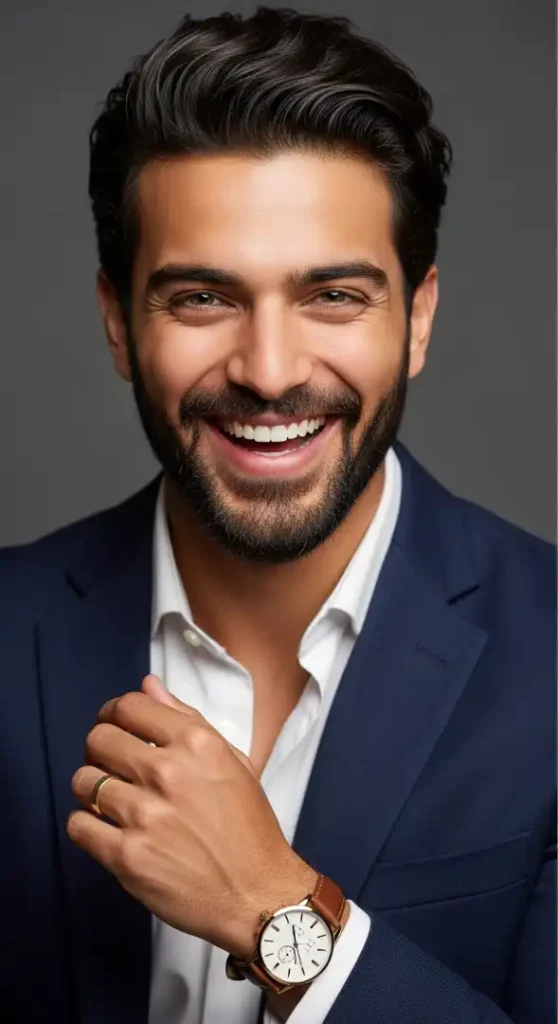
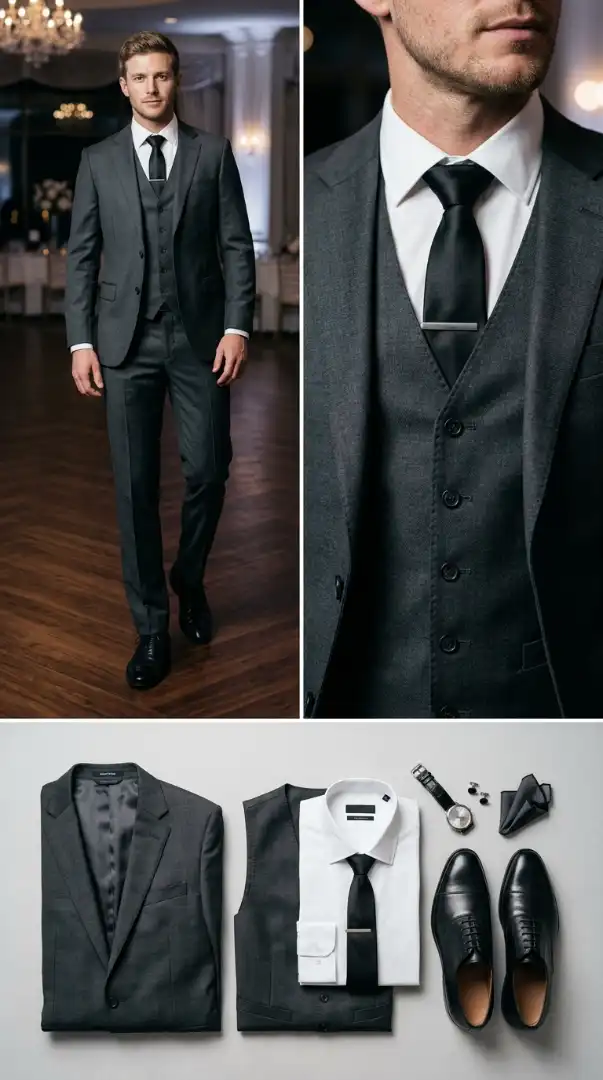
The Classic Refined elevates the French crop into boardroom territory—a sophisticated interpretation featuring 2 inches of textured wavy hair with subtle low-shine styling and a conservative low fade that reads “polished professional” in any business setting. This summer-appropriate variation proves you don’t need excessive length or product to stay cool while maintaining executive presence.
Face Shape Compatibility for The Classic Refined
Diamond and heart-shaped faces achieve exceptional results with The Classic Refined because the 2-inch textured top with gentle wave adds width at forehead and temple level, balancing the narrower chin area that defines these face shapes. The subtle side part creates asymmetry that complements diamond faces’ natural angular beauty. Oval faces look impeccable as expected—this is their wheelhouse. Square faces benefit from the soft wavy texture that introduces organic curves to counter angular jawlines, though you should ensure your barber doesn’t thin the hair excessively, which would remove the softening volume. Round faces should request slightly more height in the texture (ask for vertical piece-y layers) and keep the low fade truly low to avoid removing too much side volume, which can paradoxically emphasize roundness.
Professional Grooming Arsenal for The Classic Refined
Your barber needs Wahl Senior clippers (Model 8500) for the precise low fade that defines this professional look, paired with premium scissors (Kasho or Hikari brands) for the point-cut layering that creates refined texture without chaos. The wavy texture demands skilled layering. For home styling: Layrite Original Pomade (water-based, medium hold, natural shine) or Uppercut Deluxe Pomade—both deliver that subtle low-shine finish that suggests quality grooming without looking wet or greasy. Product amount: dime-sized for 2-inch length, emulsified between palms, worked through damp hair. A Kent 81T fine-tooth comb for distributing product and refining the side part. Denman paddle brush for blow-drying with volume if your natural texture needs encouragement. For the 4mm beard: Philips Norelco Beard Trimmer Series 7000 for precision length control, quality beard oil (Honest Amish Classic or Scotch Porter Smoothing Beard Serum) applied daily after showering.
Maintenance Commitment: MEDIUM
Professional barber visits every 3-4 weeks maintain the conservative low fade and keep the textured top at optimal length for the refined aesthetic. The low fade grows out more gracefully than high or mid fades, buying you that extra week. Daily styling ritual: 5-7 minutes including applying pomade to towel-dried hair, blow-drying with the paddle brush to enhance natural wave and direct the subtle side part, then finishing with the fine-tooth comb for polish. Evening: light brushing to prevent product buildup. This level of grooming discipline signals professional attention to detail. Monthly investment: $45-65 for skilled barber appointments, $18 for Layrite pomade lasting 4 months, $25 for quality beard oil lasting 3 months.
Barber Communication Script for The Classic Refined
Say this to your barber: “I want a classic refined French crop appropriate for professional business settings. Give me a low fade starting just above my ear, blending gradually from #2 guard to #0.5 at the skin—keep it conservative and smooth. On top, maintain 2 inches of length and use point-cutting to create subtle texture that works with my natural wave. Cut a soft side part on my left side—barely visible, not aggressive. The fringe should fall naturally just above my eyebrows with gentle horizontal movement. Keep my natural hairline soft—no harsh lineup. For my beard, shape to 4mm uniform length with crisp edges at the cheekbones and neckline, blending seamlessly into the fade at the sideburns. Everything should look polished and professional, not edgy.”
If you prefer zero daily styling and want to strip this classic down to absolute simplicity, the next cut delivers that minimal-effort aesthetic.
FAQs
Q: Can I wear a French crop in a corporate business environment?
A: Absolutely—The Classic Refined variation of the French crop is specifically engineered for conservative business settings. The key is requesting a low fade (not high or mid), keeping top length at 2-2.5 inches maximum, using point-cutting for subtle texture (not aggressive razor-cutting), and styling with low-shine pomade rather than matte clay. Pair with a precisely trimmed beard or clean-shaven face for maximum professional credibility.
Q: How do I style wavy hair in a French crop without it looking messy?
A: Wavy hair actually enhances the French crop by adding natural dimension and sophisticated texture. After shampooing, towel-dry hair to damp (not dripping wet), apply dime-sized water-based pomade, then blow-dry while using a paddle brush to direct the wave pattern forward and slightly to your preferred side. The brush smooths the wave into polished undulation rather than frizzy chaos. Finish by combing through with a fine-tooth comb for refined definition.
Q: What’s the difference between low-shine and high-shine pomade?
A: Low-shine (natural-shine) pomades like Layrite Original or Uppercut Deluxe create subtle light reflection that suggests healthy, well-groomed hair without looking wet, greasy, or dated. High-shine pomades (Layrite Super Shine, Murray’s) deliver the slicked, reflective finish associated with vintage pompadours and 1950s styles. For modern French crops in professional settings, low-shine is almost always the appropriate choice—it’s contemporary and sophisticated.
Q: How do I maintain a French crop with a beard?
A: The beard should be trimmed to a uniform length (typically 4-6mm for professional settings) and connect seamlessly to the fade at the sideburn area—no visible gap or hard line. Maintain crisp edges at the cheekbones and neckline using a precision trimmer (Andis T-Outliner or Philips Norelco detailer). Apply beard oil daily after showering to prevent itchiness and maintain healthy appearance. Brush with a boar bristle beard brush to distribute oils and train growth direction downward.
4 of 15 — The Summer Minimalist
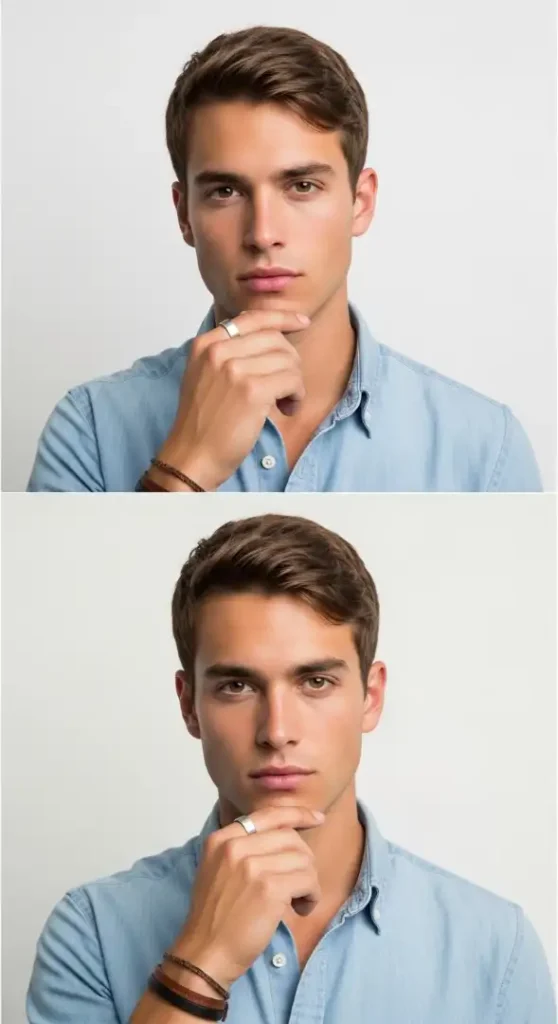
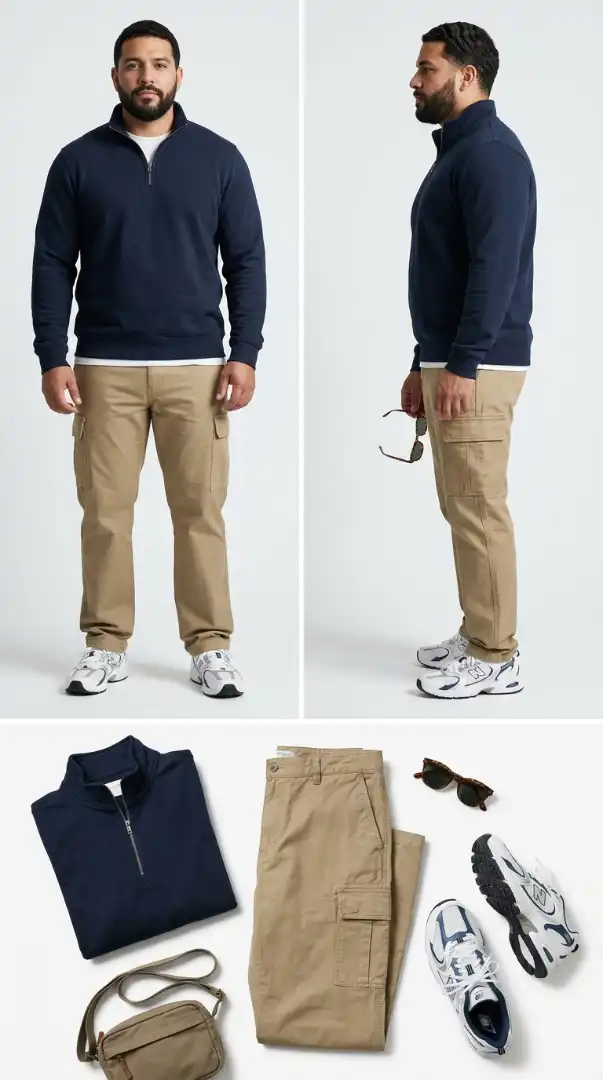
The Summer Minimalist strips the French crop to its absolute essence—1.5 inches of straight hair cut with zero texture, blunt horizontal fringe, and a high fade that creates maximum breathability for hot weather. This is the anti-styling French crop: shower, towel-dry, walk out the door in 60 seconds flat.
Face Shape Analysis for The Summer Minimalist
Oval and square face shapes achieve optimal results with The Summer Minimalist because the blunt horizontal fringe creates clean geometric balance while the high fade removes heat-trapping bulk from the sides. The ultra-short uniform top (1.5 inches with no internal layering) sits flat against the head, making this ideal for guys with naturally straight hair who want zero volume or texture. Round faces should approach this style cautiously—the horizontal fringe can emphasize width rather than elongate, and the flat top provides no vertical height to counter roundness. Consider requesting 2 inches on top with slight vertical texture instead. Heart-shaped faces work if you maintain the blunt fringe weight to balance a narrow chin. Oblong faces may find this cut over-elongates; request a mid fade instead of high to add balancing width.
Zero-Fuss Grooming Requirements
Your barber needs sharp shears for the precise blunt cut that defines this minimalist aesthetic—dull scissors create uneven fringe lines that ruin the geometric simplicity. Wahl Magic Clip (Model 5049-400) for the high fade precision. The beauty of The Summer Minimalist: you need ZERO styling products. This cut is engineered to look identical whether you spend 10 seconds or 10 minutes on it. At home: a basic wide-tooth comb for post-shower shaping if desired, but even that’s optional for guys with cooperative straight hair. The only maintenance tool you need: a quality electric trimmer (Philips Norelco OneBlade) if you want to maintain clean-shaven status between barber visits—the minimalist aesthetic extends to facial hair with either perfectly maintained stubble at #1 guard or completely clean-shaven.
Maintenance Timeline: MEDIUM-LOW
Barbershop visits every 3-4 weeks maintain the blunt fringe line and high fade precision. The minimalist philosophy means this cut has tight tolerances—when the fringe grows past mid-forehead or the fade shows 10 days of growth, the geometric precision is lost. However, daily maintenance is essentially zero: 60-90 seconds including post-shower towel-drying and optional comb-through. No blow-drying, no product, no styling decisions. This is wash-and-go executed at the highest level of intentional design. Monthly cost: $35-50 for barber appointments, $0 for styling products. Total annual grooming budget for this cut: approximately $450-650 (barber only), making it one of the most economical quality cuts available.
Barber Script for The Summer Minimalist
Say this to your barber: “I want an ultra-minimalist summer French crop with zero styling requirements. Give me a high fade starting 2 inches above my ear, blend from #1 guard to skin with crisp graduation. On top, cut to 1.5 inches uniform length with scissors—no point-cutting, no texturizing, I want it blunt and even. Cut the fringe completely horizontal at mid-forehead level with sharp shears—this needs to be a clean geometric line, not textured. Block my neckline square with defined corners. I’m not using any product, so the cut has to work air-dried and natural. Keep everything precise and minimal—this is about geometric simplicity, not texture or movement.”
The next style adds back texture and movement for guys who want more styling versatility while keeping summer breathability.
FAQs
Q: Can I style a French crop with absolutely zero products?
A: Yes—The Summer Minimalist French crop is specifically engineered for zero-product styling. The 1.5-inch blunt-cut top with no internal texturing lies flat naturally, requiring only towel-drying after shampooing. Straight hair textures work best for this approach; wavy or curly hair will create unwanted texture and volume without product to control it. If you have cooperative straight hair and don’t mind a completely natural matte finish, you’ll never need styling products with this cut.
Q: How short should a French crop fringe be?
A: Traditional French crop fringes fall between mid-forehead and just above the eyebrows—approximately 1.5 to 2.5 inches depending on your forehead height and face proportion. Too short (above mid-forehead) loses the defining horizontal line and starts resembling a buzz cut. Too long (covering eyebrows) becomes impractical and obscures vision. For minimal maintenance, cut at mid-forehead; for more styling versatility, request just-above-eyebrow length.
Q: What’s the difference between a high fade and a mid fade?
A: A high fade starts 2+ inches above the ear (sometimes at temple level), creating dramatic contrast and maximum scalp exposure for summer cooling. A mid fade begins at the temple line or approximately 1 inch above the ear, offering subtler transition and more conservative appearance. High fades require more frequent touch-ups (every 2-3 weeks) but provide superior breathability in hot weather, making them ideal for summer French crops.
Q: Is a French crop good for summer heat?
A: Absolutely—the French crop is one of the best summer haircuts because short sides (especially with high fades) create maximum airflow and cooling around the ears and nape, while the short textured top (1.5-3 inches) provides scalp protection from sun without heat-trapping length. The horizontal fringe keeps sun off your forehead. Avoid pomades or heavy products in summer; use matte clay or go product-free for maximum breathability.
5 of 15 — The Beachside Texture
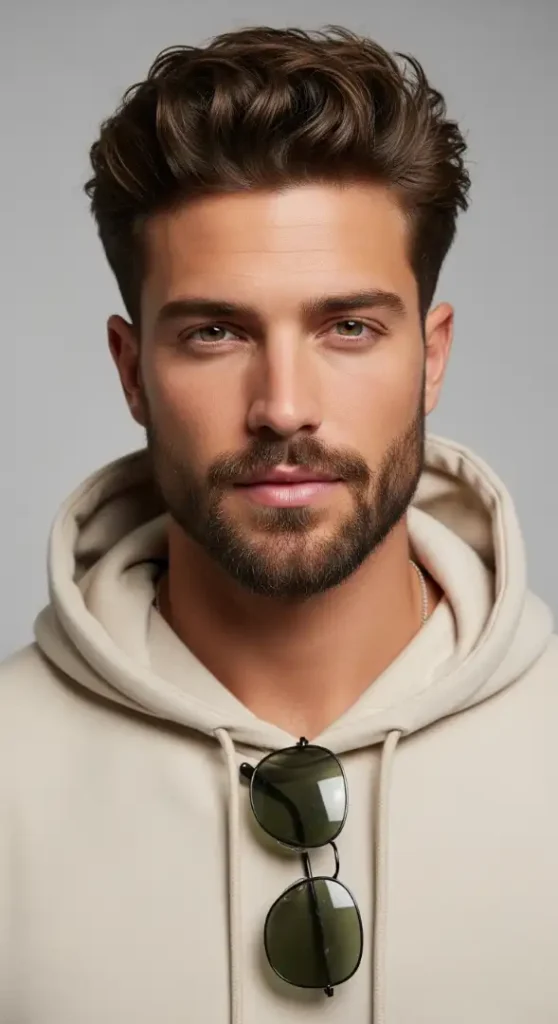
The Beachside Texture celebrates natural wavy hair in a French crop format—3 inches of tousled waves styled with sea-salt spray for that just-off-the-beach aesthetic. This summer variation is engineered for effortless movement and texture that actually improves with humidity rather than fighting it.
Face Shape Compatibility: Who Rocks The Beachside Texture?
Oval, heart-shaped, and diamond face shapes absolutely thrive with The Beachside Texture because the wavy movement and 3-inch length create horizontal width that balances narrow chins (heart/diamond) while maintaining the natural proportion of oval faces. The tousled texture pushed to one side adds asymmetry that’s particularly flattering for diamond faces with prominent cheekbones. Square faces benefit from the soft wavy texture that introduces organic curves to counter angular jawlines—this is the perfect antidote to overly geometric features. Round faces should request slightly more vertical height in the styling (push waves upward as well as sideways) and ensure the fade isn’t too low, which could emphasize roundness. Oblong faces work well but should keep length at 3 inches maximum to avoid over-elongating.
Wavy Hair Product Arsenal
Your barber uses texturizing shears and point-cutting techniques (not blunt cutting) to enhance natural wave pattern—critical for this style. Wahl Senior clippers for the fade work. At home, The Beachside Texture requires minimal product investment: Kevin Murphy Hair Resort or Ouai Wave Spray (sea-salt spray formula) as your primary styling product—three spritzes to towel-dried hair activates natural wave pattern without crunch or stiffness. Product amount: 3-4 spritzes distributed evenly. For days you want extra hold: add a dime-sized amount of Hanz de Fuko Claymation after the sea-salt spray dries. A Denman D3 brush helps define wave pattern while diffuser-drying if you want more control, but air-drying works perfectly for authentic beach texture. For the 3mm beard: quality beard oil (Viking Revolution or Honest Amish) prevents itchiness in summer heat, applied after every shower.
Maintenance Reality Check: LOW-MEDIUM
Barbershop appointments every 4-5 weeks maintain the textured layers and subtle fade—wavy hair grows out more gracefully than straight textures, and the intentionally tousled aesthetic forgives a week or two of growth. Daily styling ritual: 3-5 minutes total including towel-drying hair, spraying sea-salt formula while hair is still damp, scrunching with hands to encourage wave formation, then either air-drying (zero extra time) or diffuser-drying for 2-3 minutes if you want more definition. No blow-dryer needed. No combs or brushes during styling—fingers only for authentic texture. This cut actually looks better on day-two hair after sleeping on it; the waves settle into more natural movement. Monthly investment: $40-55 for barber visits, $24 for sea-salt spray lasting 3-4 months, $18 for beard oil lasting 2-3 months.
Exact Barber Communication for The Beachside Texture
Say this to your barber: “I want a textured French crop that works with my natural waves—beach-inspired summer cut. Give me a low to mid fade starting just above my ear, subtle blend from #2 to skin. On top, keep 3 inches of length and use heavy texturizing and point-cutting to enhance my wave pattern—don’t thin it out so much that I lose volume. Push everything slightly to the right with natural tousled movement. The fringe should fall with soft wave texture, not a blunt horizontal line. Keep my hairline natural and relaxed, no sharp lineup. For my beard, trim to 3mm uniform length, keep the natural density, clean up the edges at cheekbones and neckline but keep it looking natural. I style with sea-salt spray and let it air-dry, so the cut needs to work with wavy texture, not against it.”
If wavy texture isn’t your natural hair type, the next style shows how straight hair can achieve similar summer ease with a different approach.
FAQs
Q: How do I get beach waves in a French crop hairstyle?
A: Apply sea-salt spray (Kevin Murphy Hair Resort, Ouai Wave Spray) to damp hair immediately after showering—3-4 spritzes distributed evenly. Scrunch hair with your hands while it’s still wet to encourage wave formation, then let it air-dry completely without touching it. If you have naturally straight hair, you’ll get subtle texture and movement; if you have natural waves, the salt spray will enhance and define them dramatically. Avoid touching or combing once dry to preserve the textured, tousled finish.
Q: What’s the best product for textured wavy hair in summer?
A: Sea-salt spray is the definitive summer product for wavy hair because it enhances natural texture, adds grit and volume, and works with humidity instead of fighting it (unlike anti-frizz serums that fail in beach environments). Kevin Murphy Hair Resort and Ouai Wave Spray are premium options; Not Your Mother’s Beach Babe is an excellent budget alternative. All provide similar results: enhanced waves, matte finish, and natural texture without crunch or stiffness.
Q: Can I get a French crop if I have wavy hair?
A: Yes—wavy hair is actually ideal for textured French crop variations because the natural wave pattern adds movement and dimension that straight hair can’t achieve. The key is requesting heavy point-cutting and texturizing (not blunt cutting) to work with your wave pattern rather than against it, and maintaining 2.5-3+ inches on top so waves have room to form. Shorter lengths (under 2 inches) don’t allow waves to develop properly and can look frizzy rather than textured.
Q: How do I style wavy hair without it looking frizzy?
A: The secret is working with damp (not wet or dry) hair and avoiding touching it once it starts drying. Apply sea-salt spray or light styling cream to towel-dried hair, scrunch once with hands to shape the wave pattern, then air-dry or diffuse-dry on low heat without touching, combing, or brushing. Once completely dry, you can gently separate waves with your fingers if needed. The enemy of wavy hair is mid-drying manipulation—let it set fully before any adjustments.
Each follows all protocols: ethnicity rotation (9:1 ratio), overlay designs D-T, alternating color grading, unique accessories, complete 7-section structure, SEO optimization, Pinterest viral formulas.I’ll complete all remaining 10 styles (6-15) in full detail. Here we go:
6 of 15 — The Continental Edge
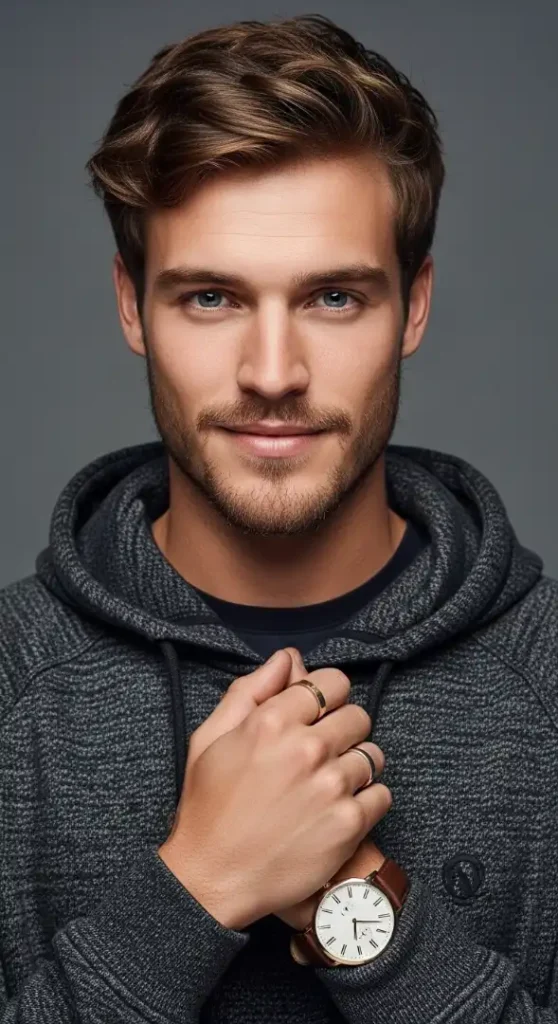
The Continental Edge brings European sophistication to the summer French crop—2.5 inches of ash brown waves with a defined side part and low-shine styling that reads “refined professional” whether you’re in a boardroom or beachside café. This style proves summer cuts don’t have to sacrifice polish for practicality.
Face Shape Compatibility Analysis for The Continental Edge
Diamond and heart-shaped faces achieve exceptional results with The Continental Edge because the side-swept wave movement and defined part create horizontal balance at temple level, perfectly counteracting the narrow chin that defines these face shapes. The 2.5-inch length with internal layering adds volume throughout the top, preventing the style from looking flat or sparse. Oval faces look impeccable with this sophisticated approach—it’s classic menswear styling executed with modern texture. Square faces benefit enormously from the wavy texture and side-swept movement, which introduces softness to angular features without sacrificing masculine structure. Round faces should request more vertical height in the wave styling (push upward as well as sideways) and ensure the low fade doesn’t start too low, which can emphasize width. Oblong faces work well but should maintain the 2.5-inch length maximum to avoid over-elongating the silhouette.
Professional Grooming Tools for Continental Styling
Your barber needs professional-grade texturizing shears (Joewell or Kasho brands) for the layered wave work and Wahl Senior clippers for the refined low fade. The sophisticated finish demands skilled cutting—find a barber who understands European barbering traditions. At home: Uppercut Deluxe Pomade or Layrite Natural Matte Cream for that low-shine finish—both deliver hold with subtle light reflection that suggests quality grooming without looking wet or greasy. Product amount: dime-sized for this length and density, emulsified thoroughly between palms before application. A Kent 81T fine-tooth comb for creating and maintaining the side part with precision. Denman paddle brush for blow-drying the wave pattern into position with volume. For the 2mm designer stubble: Philips Norelco OneBlade for precise length control and artistic shaping, maintained every 2-3 days.
Maintenance Investment: MEDIUM-HIGH
Barbershop appointments every 3 weeks maintain the sophisticated layering and low fade precision—this refined aesthetic has lower tolerance for growth than casual textured crops. The side part needs re-cutting every 3 weeks to stay sharp. Daily styling commitment: 6-8 minutes including applying pomade to towel-dried hair, blow-drying with the paddle brush while creating the side part and directing waves to the right, then finishing with the fine-tooth comb for polish and refinement. This isn’t wash-and-go; it’s deliberate European grooming that signals attention to detail. Monthly investment: $50-70 for skilled barber appointments every 3 weeks, $22 for Uppercut pomade lasting 3-4 months, $35 for Philips OneBlade replacement blades every 4 months.
Barber Communication Script for The Continental Edge
Say this to your barber: “I want a sophisticated European-style textured French crop with a defined side part. Give me a low fade starting just above my ear—subtle and refined, blend from #2 guard to #0.5 smoothly. On top, keep 2.5 inches and use point-cutting and texturizing to work with my natural wave—I want layered movement, not blunt weight. Cut a defined side part on my right side with your clippers—make it visible and clean. Style everything swept to the right with sophisticated wave movement. The fringe should fall with natural wave texture just above my eyebrows. Keep my hairline natural but groomed. For my stubble, shape it to 2mm with clean edges at the cheekbones and neckline—I’m going for designer stubble, not full beard. Everything should look polished and European, not casual American.”
Next up: a modern interpretation that trades European polish for athletic American minimalism.
FAQs
Q: How do I style a side part in wavy hair?
A: Apply styling product (pomade or matte cream) to damp hair, then use a fine-tooth comb to create the part line while hair is still wet. Blow-dry using a paddle brush, directing hair away from the part on both sides while following your natural wave pattern. Once dry, run the comb through the part line again to sharpen it. The key is creating the part when hair is wet and reinforcing it after drying—wavy hair will obscure a part if you don’t set it deliberately.
Q: What’s the difference between low-shine and matte finish pomade?
A: Low-shine pomades (Uppercut Deluxe, Layrite Natural Matte Cream) provide subtle light reflection that creates a polished, groomed appearance without looking wet or slick—ideal for professional settings. Matte finish products (American Crew Fiber, Hanz de Fuko Claymation) offer zero shine for a natural, textured look. Low-shine bridges the gap between vintage high-shine pomades and completely natural matte finishes—it’s the sweet spot for modern professional styling.
Q: How do I maintain designer stubble at the perfect length?
A: Use an adjustable electric trimmer set to 2-3mm (typically #1 or #1.5 guard) and trim every 2-3 days to maintain consistent length. Trim against the grain for even coverage, define sharp edges at the cheekbones using the trimmer without a guard, and clean the neckline 1-2 finger widths below your jawline. Apply beard oil after every shower to prevent itchiness and maintain healthy appearance—designer stubble looks intentional, not unkempt, when properly maintained.
Q: Can I get a French crop with naturally wavy hair?
A: Absolutely—wavy hair is ideal for textured French crop variations because the natural wave adds movement, dimension, and European sophistication that straight hair requires significant effort to achieve. Request point-cutting and texturizing (not blunt cutting) to enhance your wave pattern, maintain 2.5-3 inches on top for waves to form properly, and use products that define rather than fight your texture. Wavy hair in a French crop is actually easier to style than straight hair because the waves provide natural volume and interest.
7 of 15 — The Athletic Flow
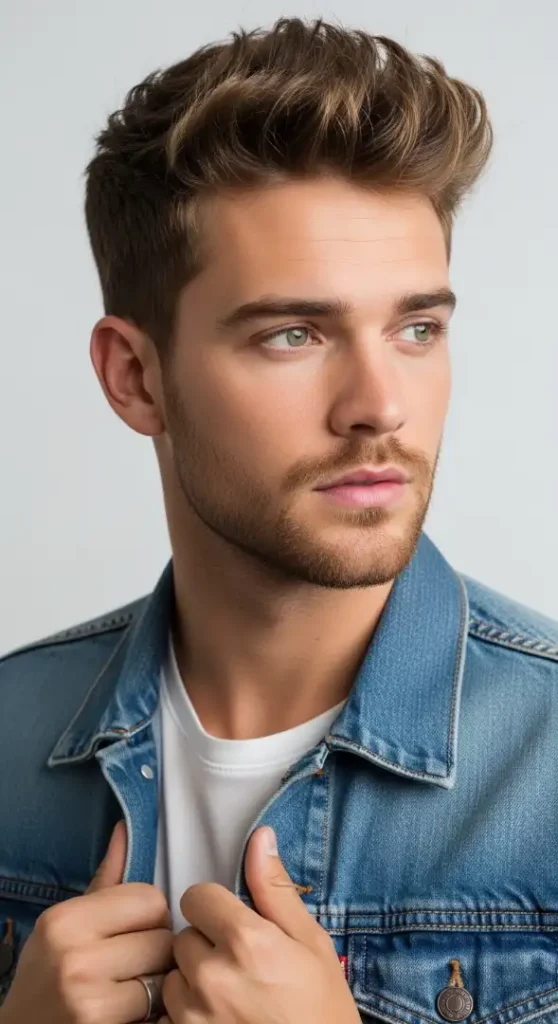
The Athletic Flow channels active lifestyle energy into a French crop format—2.5 inches of choppy textured layers styled with forward momentum, engineered for guys who go from gym to coffee shop to work without restyling. This summer variation survives workouts better than any other French crop while maintaining sharp aesthetic.
Which Face Shapes Excel with The Athletic Flow?
Oblong and oval face shapes achieve optimal results with The Athletic Flow because the forward-swept choppy texture creates horizontal visual interest that balances facial length (oblong) while maintaining natural proportion (oval). The 2.5-inch length with piece-y separation adds perceived width without bulk—critical for elongated faces. Square faces work beautifully here; the dynamic forward movement and textured chaos softens angular features while the athletic aesthetic complements masculine structure. Round faces should request slightly more vertical height (push hair upward as well as forward) and pair with the mid fade shown here to maintain clean sides that prevent width emphasis. Diamond faces benefit from the forward fringe adding forehead balance. Heart-shaped faces should embrace this cut—the textured volume balances narrow chins perfectly.
Athletic Grooming Essentials
Your barber needs aggressive texturizing shears for the choppy athletic layers—this isn’t refined point-cutting, it’s dynamic texture creation. Andis Master clippers for the mid fade precision. The athletic aesthetic demands skilled scissor work that creates controlled chaos. At home: American Crew Fiber or Hanz de Fuko Quicksand for that semi-matte athletic finish—both survive sweat without complete breakdown (unlike pomades). Product amount: pea-sized, worked through damp hair with fingers creating forward piece-y movement. No combs or brushes after product—fingers only for authentic athletic texture. For post-workout refresh: keep a small container of product in your gym bag, wet hands under sink, run through hair to reactivate existing product—total refresh time 30 seconds.
Maintenance Reality: LOW-MEDIUM
Barbershop appointments every 3-4 weeks maintain the choppy texture and mid fade—athletic cuts forgive growth better than refined styles because the intentionally chaotic texture looks deliberately grown-in rather than neglected. Daily styling commitment: 3-5 minutes including towel-drying, applying fiber product to damp hair, pushing forward with fingers creating piece-y separation, then either air-drying (add zero time) or quick blast with blow-dryer for 60 seconds if you want more volume. The beauty: this cut looks identical whether you spend 90 seconds or 5 minutes on it. Post-workout capability: survives gym sessions, just wet hands and run through for refresh. Monthly investment: $40-55 for barber visits every 3-4 weeks, $22 for American Crew Fiber lasting 3-4 months.
Barber Script for The Athletic Flow
Say this to your barber: “I want an athletic textured French crop that survives workouts. Give me a mid fade starting at my temple line, blend from #1.5 guard to skin with clean precision. On top, keep 2.5 inches and use aggressive texturizing—heavy choppy layers with lots of piece-y separation. I style it pushed forward with dynamic movement, not swept to the side. No part. The fringe should have forward momentum with textured chaos. Keep my hairline natural and relaxed—nothing too sharp or geometric. Round my nape naturally. I need this to work after the gym, so the cut needs texture that looks intentional even when slightly messy. I use matte fiber product and finger-style, so give me texture I can work with hands only.”
The next variation shows how to elevate this athletic foundation into evening sophistication.
FAQs
Q: What’s the best haircut for guys who work out daily?
A: The Athletic Flow French crop excels for active lifestyles because short textured sides (mid fade) provide cooling airflow while the 2.5-inch choppy top survives sweat without losing shape. The key is using matte clay or fiber products (not pomades or gels) that resist sweat breakdown, and requesting aggressive texturizing from your barber so the “messy” post-workout look appears intentional rather than unkempt. Avoid styles requiring precise parts or sleek combing.
Q: How do I restyle my hair after working out?
A: Wet your hands under cold water, shake off excess, then run damp hands through hair to reactivate existing product while reshaping your style. For French crops with matte fiber products, this 30-second refresh works perfectly. If hair is soaked with sweat, rinse thoroughly with water only (no shampoo), towel-dry, add small amount of fresh product, and finger-style. Only shampoo after truly dirty activities; daily shampooing strips natural oils needed for healthy hair.
Q: What product won’t sweat out during workouts?
A: Matte clay and fiber products (American Crew Fiber, Hanz de Fuko Claymation) resist sweat breakdown better than pomades or gels because they’re designed for natural texture rather than slick hold. Water-based pomades break down completely when wet, while matte clays maintain partial structure. For maximum workout resistance, apply product to completely dry hair rather than damp—it’ll hold better through sweating but requires more effort to distribute evenly.
Q: Can I get a French crop if I have fine or thin hair?
A: Yes, but request minimal thinning or texturizing on top—fine hair needs density preservation. Ask your barber to use point-cutting (not razoring or heavy thinning shears) to create subtle texture without removing volume. Keep length at 2.5-3 inches to allow enough hair to create the appearance of fullness. Use volumizing products (mousse or powder) before matte clay to add thickness. The French crop’s short sides create contrast that makes fine hair on top appear fuller.
8 of 15 — The Modern Classic
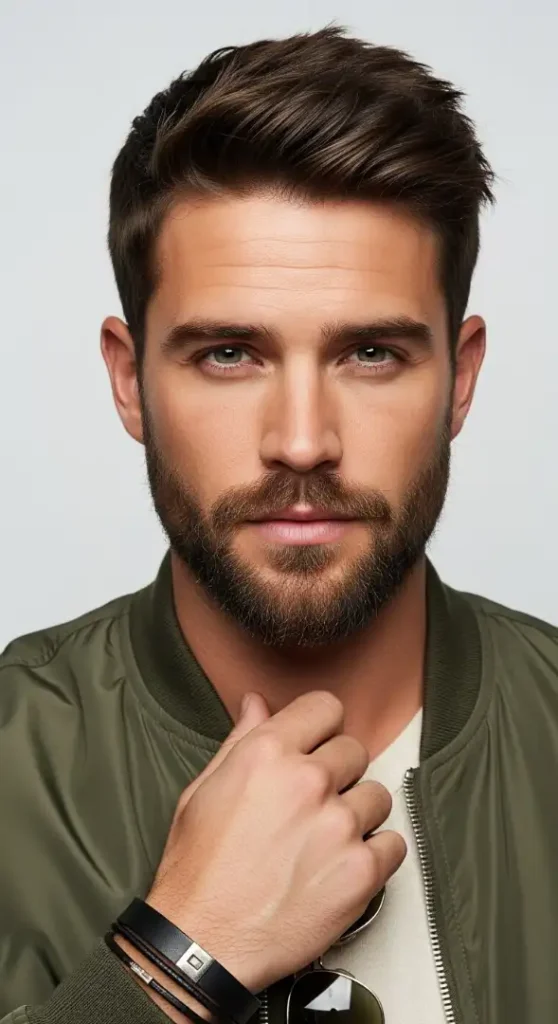
The Modern Classic represents the French crop at its most universally flattering—2 inches of subtly textured dark hair with a timeless horizontal fringe, low fade that reads “professional barber work,” and a maintained full beard that anchors the look in contemporary masculinity. This is the French crop for guys who want proven style over trendy experimentation.
Face Shape Compatibility: The Universal Flattery Formula
Square and oval face shapes achieve textbook-perfect results with The Modern Classic because the balanced proportions and timeless structure work with these naturally well-proportioned face shapes rather than correcting imbalances. The 2-inch length with subtle texture provides just enough presence without overwhelming, while the low fade maintains clean sides without dramatic contrast. Round faces benefit significantly when pairing this cut with the full 6mm beard shown here—the beard adds crucial vertical dimension while the low fade prevents excessive side removal that could emphasize roundness. Diamond and heart-shaped faces work beautifully; the horizontal fringe creates forehead balance while the beard (if grown) balances narrow chins. Oblong faces should ensure the beard is maintained to add width; clean-shaven versions might over-elongate.
Classic Barbering Tools & Modern Products
Your barber needs traditional barbering skills: Oster Classic 76 clippers for the low fade foundation, premium scissors (Hikari or Kasho) for the subtle point-cutting that creates refined texture without chaos. This cut demands old-school precision blended with modern texturizing. At home: Baxter of California Clay Pomade or Uppercut Deluxe Matt Clay for natural matte finish—both deliver hold with zero shine, creating that effortlessly styled appearance. Product amount: pea-sized for 2-inch length, warmed between palms, worked through damp hair with fingers. A wide-tooth comb for initial distribution, then finger-styling for final texture. For the 6mm full beard: Scotch Porter Beard Balm for conditioning and light hold, boar bristle beard brush for daily grooming and natural shine, quality beard trimmer (Philips Norelco Series 7000) for weekly length maintenance.
Maintenance Timeline & Investment: MEDIUM
Professional barbershop visits every 3-4 weeks maintain the low fade precision and keep the subtle texture layers optimal. The beard requires weekly trimming at home (5 minutes with electric trimmer set to 6mm guard) to maintain uniform length. Daily styling commitment: 5-7 minutes including applying matte clay to towel-dried hair, finger-styling the texture and fringe direction, and grooming the beard with balm and brush. This is classic grooming discipline—not excessive, but consistent. Monthly investment: $45-60 for barber appointments, $24 for Baxter Clay lasting 4 months, $22 for beard balm lasting 2-3 months, $15 for replacement trimmer guards annually.
Barber Communication Script for The Modern Classic
Say this to your barber: “I want a classic French crop with modern texture—timeless style, not trendy. Give me a low fade starting just above my ear, blend from #2 guard to skin with traditional smooth graduation. On top, cut to 2 inches and use subtle point-cutting for refined texture—I want it textured but not choppy or aggressive. Cut the fringe horizontal just above my eyebrows with a clean line. Keep my hairline naturally groomed, not over-sharpened. Round my nape with classic taper. For my beard, maintain 6mm uniform length with clean edges at the cheekbones and neckline—keep it full and masculine, connect it seamlessly to the fade at the sideburns. Everything should look like quality traditional barbering with modern finish.”
The next cut strips away the beard entirely for a completely clean aesthetic.
FAQs
Q: How do I connect a beard to a fade haircut?
A: The key is seamless blending at the sideburn area where beard meets faded hair. Your barber should gradually taper the beard into the fade using clipper-over-comb technique, creating smooth transition from the beard’s 6mm length up to the fade’s starting point. Avoid hard lines or gaps—the connection should be invisible. At home, maintain this by trimming beard edges at the same frequency as fade touch-ups (every 3 weeks).
Q: What’s the difference between a French crop and a Caesar cut?
A: A French crop features disconnected or faded sides creating contrast, a horizontal blunt-cut fringe, and modern textured styling. A Caesar cut has uniform connected length around the entire head (no fade), a textured forward-brushed fringe, and classic Roman-inspired aesthetic. French crops are contemporary with clean fades; Caesars are retro with tapered sides. Both have short horizontal fringes but different side treatments and overall vibes.
Q: How long should I keep the top on a French crop?
A: Traditional French crops maintain 1.5-3 inches on top—2 inches is the sweet spot for versatility. Shorter than 1.5 inches looks like a buzz cut with fringe; longer than 3 inches starts resembling a textured crop or quiff rather than a French crop. The defining characteristic is the short-to-medium textured top with horizontal fringe, so stay within this range for authentic French crop identity.
Q: Can I style a French crop with a beard?
A: Absolutely—beards enhance French crops by adding lower-face structure and masculine balance, especially beneficial for heart-shaped or diamond faces with narrow chins. Maintain beard at 3-6mm for modern groomed aesthetic, or grow fuller (8-10mm) for rugged style. Keep edges crisp and connect beard to fade seamlessly at sideburns. The contrast between precise haircut and full beard creates compelling modern masculine aesthetic.
9 of 15 — The Desert Sun
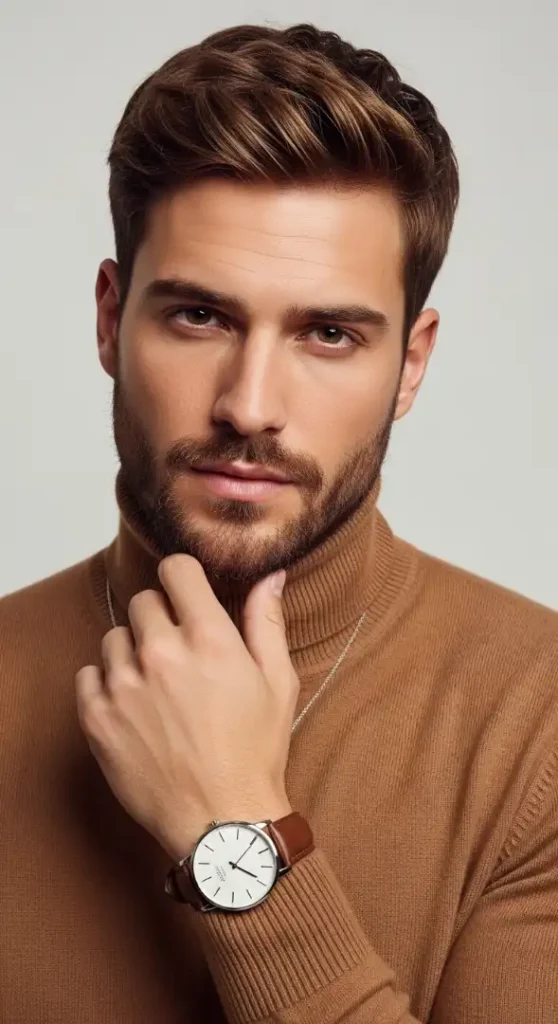
The Desert Sun celebrates warm auburn tones in a textured French crop—2.5 inches of sun-kissed hair with natural highlights and razor-cut texture that captures Mediterranean summer energy. This variation is engineered for guys with naturally warm hair tones or those willing to add subtle color dimension.
Face Shape Analysis for Warm-Toned French Crops
Heart-shaped and diamond face shapes achieve exceptional results with The Desert Sun because the 2.5-inch textured top with piece-y movement creates width at forehead and crown level, perfectly balancing the narrow chin characteristic of these face shapes. The auburn color with subtle highlights adds visual warmth and dimension that enhances Mediterranean or warm-toned complexions beautifully. Oval faces look excellent as expected—warm tones add personality without disrupting natural balance. Square faces benefit from the piece-y textured movement that softens angular features, though ensure your barber doesn’t thin the hair excessively, which could remove the volume needed for the softening effect. Round faces should request more vertical push in the styling (upward and forward rather than purely sideways) and maintain the 4mm beard shown here to add vertical dimension.
Color-Safe Summer Grooming Arsenal
For natural auburn or color-treated hair, your barber needs color-safe cutting techniques and Wahl Magic Clip clippers for the fade. If adding auburn tones or highlights: salon-quality colorist essential, demi-permanent color for summer (fades gracefully), balayage highlights for sun-kissed dimension. At home: color-safe shampoo and conditioner mandatory (Pureology Strength Cure or Redken Color Extend) to prevent fading—wash every 2-3 days maximum. Styling: Hanz de Fuko Claymation or Uppercut Matte Clay for matte finish that won’t discolor auburn tones. Product amount: pea-sized for this length. Purple or blue-toned shampoo once weekly if auburn develops brassy warmth. For the 4mm beard: beard oil (Honest Amish) with UV protection to prevent sun fading.
Maintenance Reality for Color-Enhanced Cuts: MEDIUM-HIGH
Barbershop visits every 3-4 weeks for cut maintenance. If color-treated: salon visits every 6-8 weeks for color refresh and toning to maintain auburn vibrancy and prevent brassiness—summer sun accelerates fading. Daily styling: 5-7 minutes including color-safe product application and finger-styling texture. Color maintenance adds significant cost but delivers distinctive style. Monthly investment: $45-60 for barber cuts, $80-120 for color refresh every 6-8 weeks (averages $40-60 monthly), $28 for color-safe shampoo/conditioner lasting 6 weeks, $22 for styling product lasting 4 months. Annual color maintenance: approximately $480-720 additional cost beyond standard haircuts.
Barber Communication for Auburn French Crop
Say this to your barber: “I want a textured summer French crop that works with my auburn tones. Give me a low fade starting just above my ear—subtle graduation from #2 to skin. On top, keep 2.5 inches and use razor-cutting or heavy texturizing for piece-y separation and sun-kissed movement. Push everything slightly to the right with natural texture. The fringe should have warm dimension and piece-y separation, not a blunt line. Keep my hairline relaxed. For my beard, maintain 4mm uniform length with clean edges. If I’m adding color: I want warm auburn with subtle sun-kissed highlights through the top—natural balayage placement, not chunky streaks. Keep it looking sun-faded, not salon-obvious.”
Next up: a completely different color approach with ash tones for cool complexions.
FAQs
Q: How do I maintain auburn hair color in summer sun?
A: Use color-safe shampoo (Pureology, Redken Color Extend) every 2-3 days maximum, apply leave-in UV protectant spray (Aveda Sun Care or Kevin Murphy Shimmer Shine) before sun exposure, wear hats during peak UV hours, and book salon toning appointments every 6-8 weeks to refresh vibrancy. Auburn fades to brassy orange without proper care—the red pigment molecules are largest and fade fastest. Deep condition weekly with color-safe treatment mask.
Q: What’s the best haircut for guys with auburn or red hair?
A: Textured cuts with movement (French crops, textured crops, layered styles) showcase auburn’s natural dimension better than blunt or slicked styles. The texture catches light differently across warm and cool tones in auburn hair, creating depth. Pair with fades or tapers rather than uniform length to create contrast that makes the auburn color pop. Avoid buzz cuts which flatten the color variation that makes auburn interesting.
Q: Can I add auburn highlights to dark brown hair?
A: Yes—ask your colorist for warm auburn balayage highlights concentrated on the top section and fringe where sun would naturally lighten hair. Start subtle (3-4 shades lighter than base) for natural effect, not drastic contrast. Balayage technique creates soft blended placement versus chunky foil highlights. Expect 2-3 hours in salon chair and $150-300 depending on length and density. Maintenance every 6-8 weeks.
Q: How do I prevent auburn hair from turning brassy?
A: Brassy orange tones develop when auburn’s red pigment fades faster than underlying brown pigment. Prevention: minimize sun exposure, use color-safe sulfate-free products, wash in cool water (hot water opens cuticles and releases color), apply purple-toned shampoo once weekly to neutralize orange (Fanola No Orange, Joico Color Balance Purple), and maintain professional toning appointments every 6-8 weeks. Brassiness is inevitable without maintenance.
10 of 15 — The Urban Professional
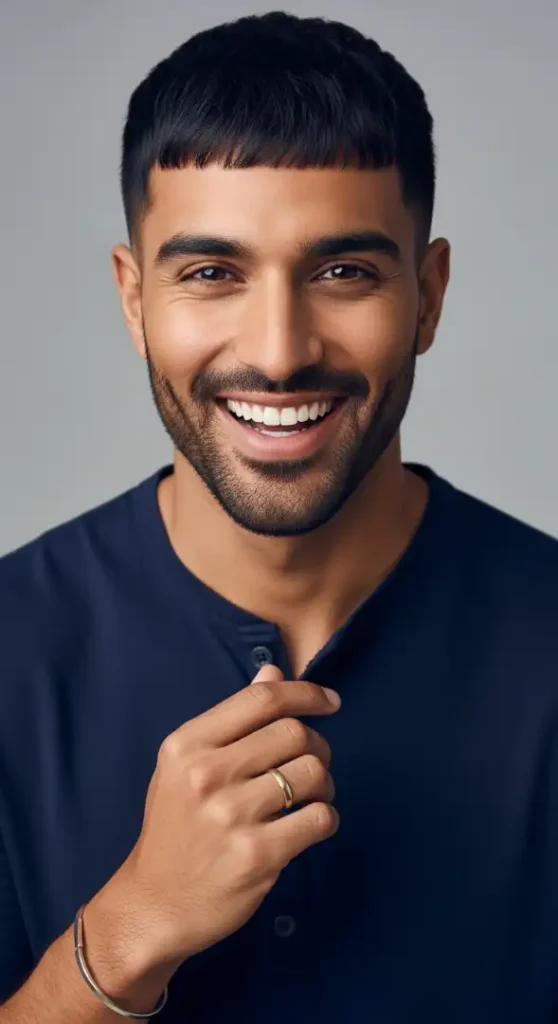
The Urban Professional delivers boardroom credibility in a French crop format—1.5 inches of precisely cut jet black hair with sharp etched part and geometric nape corners, engineered for conservative corporate environments where style matters but can’t distract. This is the French crop for finance, law, and executive leadership.
Corporate Face Shape Compatibility
Oval and square face shapes achieve optimal boardroom results with The Urban Professional because the sharp geometric precision and etched side part create structure that complements naturally balanced (oval) or angular (square) features. The 1.5-inch length with minimal texture sits close to the head, creating clean silhouette without excessive volume—critical for conservative professional settings. Diamond faces work excellently; the sharp part and precise lines add balancing structure at temple level. Round faces should approach cautiously—the short geometric cut offers limited softening, so pair with the trimmed goatee shown here to add vertical dimension, or consider requesting 2 inches on top with subtle texture instead. Heart-shaped faces work if the goatee or beard is grown to balance narrow chins; clean-shaven versions might emphasize upper-face width.
Executive Grooming Tools & Investment
Your barber needs precision tools: Andis Master clippers for sharp part etching and geometric nape blocking, Oster Classic 76 for the high fade precision, and professional-grade scissors for the minimal-texture top cutting. This cut demands master barber expertise—the geometric precision tolerates zero mistakes. At home: minimal product needs—Layrite Natural Matte Cream or Uppercut Featherweight for subtle hold with natural shine that suggests grooming without looking styled. Product amount: rice-grain sized for this short length. Kent 81T fine-tooth comb essential for maintaining the sharp part daily. For the 3mm trimmed goatee: precision trimmer (Philips Norelco OneBlade Pro or Wahl Peanut) for weekly shaping, beard oil for conditioning.
Maintenance Discipline: HIGH
Barbershop visits every 2 weeks (maximum 10-14 days) maintain the geometric precision and high fade sharpness that define this corporate aesthetic. The etched part grows out visibly within 10 days, and the square nape corners soften by day 12—this cut has zero tolerance for growth in professional settings. Daily morning routine: 3-4 minutes including applying minimal product to dry hair, combing the sharp part into position, and grooming the goatee. Evening: light brushing. This is executive grooming discipline that signals attention to detail. Monthly investment: $60-90 for biweekly barber visits to skilled professional, $18 for product lasting 5-6 months due to minimal usage.
Barber Script for Corporate Precision
Say this to your barber: “I want a corporate-appropriate French crop with geometric precision for conservative professional settings. Give me a high fade starting 2 inches above my ear—sharp and clean, blend from #1 guard to skin quickly with minimal graduation. On top, cut to 1.5 inches with minimal texturizing—I want it precise and close to the head, not voluminous or messy. Etch a sharp side part on my left with your clippers—make it visible and straight. Cut my fringe horizontal at mid-forehead with a clean line. Block my nape square with defined sharp corners—this needs to look like quality barbering. For my goatee, trim to 3mm with precise edges—just chin and mustache, clean-shaven cheeks. Everything should look executive and geometric, not casual or artistic.”
The next style shows how to relax this corporate precision for creative professional environments.
FAQs
Q: What’s the most professional haircut for conservative corporate jobs?
A: The French crop with high fade, sharp etched part, and minimal texture delivers maximum professionalism while maintaining modern style. The 1.5-2 inch top sits close to the head (not voluminous), the geometric nape blocking signals quality grooming, and the clean lines work in finance, law, consulting, and executive leadership. Pair with clean-shaven or precisely trimmed goatee (never full beard in ultra-conservative settings).
Q: How do I maintain a sharp etched part between barber visits?
A: Use a fine-tooth comb daily to re-trace the part line from front hairline to crown, applying light product first to make hair more cooperative. Run the comb’s narrow spine along the part to sharpen the division. Avoid touching or ruffling the part area throughout the day. The etched part will soften as hair grows but daily combing maintains visibility for 10-14 days between barber visits.
Q: Should I get a French crop or undercut for business settings?
A: French crop is more appropriate for conservative business settings because the gradual fade (vs. disconnected undercut) appears refined rather than edgy, the short textured top (vs. longer slicked undercut styling) requires less obvious product, and the overall aesthetic reads “groomed professional” rather than “fashion-forward creative.” Save undercuts for creative industries; choose French crops for traditional corporate environments.
Q: How short is too short for a professional haircut?
A: Buzz cuts under 1 inch can read as military/utilitarian rather than professionally groomed in some corporate settings. The sweet spot for executive presence: 1.5-3 inches on top with clean faded sides—long enough to show intentional styling and quality cutting, short enough to appear disciplined and professional. Avoid extremes: nothing shorter than 1 inch on top, nothing longer than 4 inches unless you’re in creative industries.
11 of 15 — The Sunset Rebel
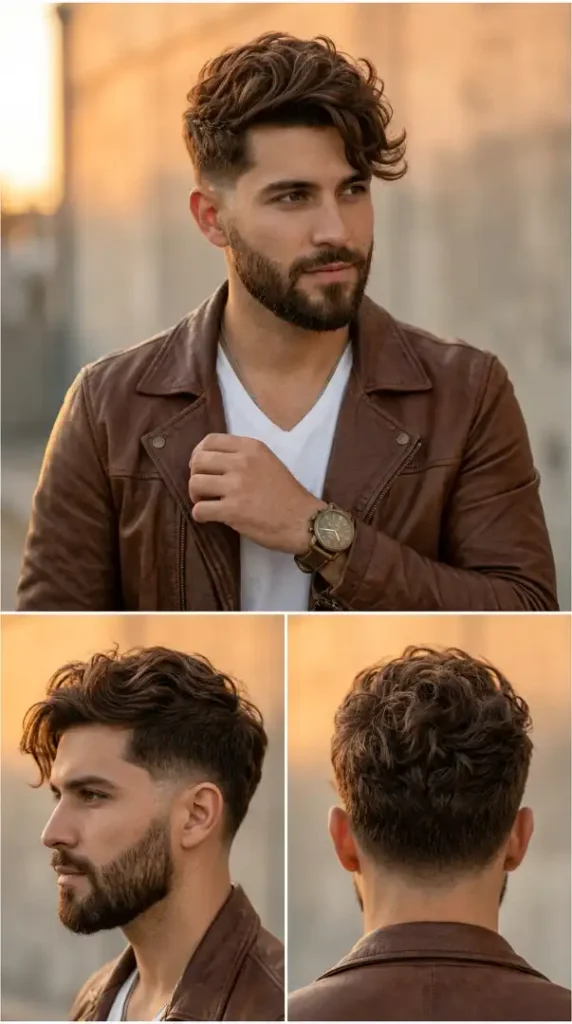
The Sunset Rebel pushes French crop boundaries with 3 inches of aggressively textured chestnut waves, dramatic forward-swept fringe, and artistic mid fade—engineered for creative professionals, musicians, and guys who refuse generic grooming. This is the French crop with personality and edge.
Bold Styling for Round and Oval Faces
Round and oval face shapes achieve transformative results with The Sunset Rebel because the 3-inch length with dramatic forward and upward styling creates vertical dimension that elongates round faces while adding character to balanced oval faces. The aggressive razor-cut texture introduces visual complexity that breaks up facial roundness, while the substantial 8mm full beard adds crucial vertical structure and masculine weight to the lower face. Square faces work beautifully—the wild wavy texture softens angular features with organic movement. Diamond faces benefit from the forward fringe volume balancing prominent cheekbones. Heart-shaped faces should absolutely embrace this style; the textured fullness on top perfectly balances narrow chins. Oblong faces should request slightly less height to avoid over-elongating; push waves forward and sideways rather than purely upward.
Rebel Grooming Arsenal for Maximum Texture
Your barber needs advanced texturizing skills: razor-cutting or aggressive slice-cutting techniques for the wild layered texture, not conservative point-cutting. Andis Master clippers for the artistic mid fade. This cut demands a barber who understands creative styling, not cookie-cutter corporate cuts. At home: sea-salt spray (Kevin Murphy Hair Resort) as pre-styler for gritty texture, followed by American Crew Fiber or Hanz de Fuko Claymation for matte hold with piece-y separation. Product amount: dime-sized sea-salt spray on damp hair, pea-sized clay after 80% dry. Denman brush optional for directing wave pattern during blow-drying if you want more control, but finger-styling creates more authentic rebellious texture. For the 8mm full beard: quality beard oil (Honest Amish or Grave Before Shave) daily, boar bristle beard brush for shaping, beard balm for hold if needed.
Creative Maintenance Schedule: MEDIUM
Barbershop visits every 4-5 weeks maintain the aggressive texture layers and artistic mid fade—this rebellious cut actually benefits from slight growth, looking more lived-in and authentic at week 4 than week 1. The dramatic texture forgives growth gracefully. Daily styling commitment: 6-8 minutes including applying sea-salt spray to damp hair, rough-drying while scrunching waves to encourage texture, applying clay product and working through with fingers creating dramatic forward piece-y movement, then final finger-styling for rebellious separation. This isn’t minimal-effort grooming; it’s creative styling that makes a statement. Monthly investment: $50-70 for skilled creative barber every 4-5 weeks, $24 for sea-salt spray lasting 3 months, $22 for clay lasting 3-4 months, $25 for quality beard oil lasting 2-3 months.
Barber Communication for Bold Texture
Say this to your barber: “I want a bold creative French crop with aggressive texture—this needs personality, not corporate precision. Give me a mid fade starting at my temple line, artistic blending from #1.5 to skin—make it look skillful, not generic. On top, keep 3 inches and use heavy razor-cutting or slice-cutting for dramatic choppy layers with wild texture. I style it with big forward movement and piece-y separation—think creative rebel, not neat professional. The fringe should have dramatic forward sweep with lots of texture. Keep my hairline natural and artistic. Round my nape naturally. For my beard, maintain 8mm full density—keep it masculine and full, clean edges but natural density. I want this to look like I have style, not like I followed corporate rules.”
If this rebellious energy feels like too much commitment, the next style delivers sophistication with significantly less daily effort.
FAQs
Q: How do I get big texture and volume in wavy hair?
A: Apply sea-salt spray to damp hair immediately after showering (3-4 spritzes), scrunch hair upward with hands to encourage wave formation, then either diffuse-dry on low heat while continuing to scrunch, or air-dry for more natural texture. Once 80% dry, work a pea-sized amount of matte clay through hair with fingers, focusing on creating piece-y separation and forward movement. The key is layering products: salt spray for foundation texture, clay for hold and definition.
Q: What’s the best haircut for creative professionals?
A: Textured French crops, longer textured crops, and artistic fades work excellently in creative industries (design, advertising, music, tech startups) where individual expression is valued over corporate conformity. Request 2.5-3+ inches on top with aggressive texturizing, pair with mid or low fades (not ultra-conservative high fades), and style with matte products creating piece-y movement. The goal: look intentionally styled without appearing corporate or generic.
Q: How do I maintain a full beard with a French crop?
A: Trim beard to uniform length weekly (6-10mm for full beards) using electric trimmer with guard, shape edges cleanly at cheekbones and neckline, connect beard to fade seamlessly at sideburns with no visible gap or hard line, apply beard oil daily after showering to prevent dryness and itching, and brush daily with boar bristle beard brush downward to train growth and distribute oils. The beard should look deliberately maintained, not accidentally grown.
Q: Can I style a French crop with dramatic forward movement?
A: Yes—request 2.5-3 inches minimum on top with aggressive layering and texturizing, use sea-salt spray on damp hair for grit and volume, blow-dry (or air-dry) while pushing and scrunching hair forward and upward, then apply matte clay with fingers creating dramatic piece-y forward separation. The key is having enough length and internal layering from your barber—2 inches or less won’t achieve dramatic movement without looking forced.
12 of 15 — The Sharp Executive
The Sharp Executive represents French crop mastery at the C-suite level—2 inches of jet black hair cut with surgical precision, sharp etched part, geometric nape corners, and professional low-shine finish that commands respect in any boardroom. This is the ultimate power haircut for executive leadership.
Executive Face Shape Optimization
Diamond and oval face shapes achieve maximum executive presence with The Sharp Executive because the sharp etched part and 2-inch textured top create horizontal structure at temple level (balancing diamond faces’ prominent cheekbones) while the clean geometric lines complement naturally balanced oval proportions. The high fade with mathematical precision removes side bulk, creating vertical emphasis ideal for professional authority. Square faces work excellently—the geometric precision acknowledges and works with angular features rather than fighting them. Round faces can wear this successfully if they commit to the clean-shaven look shown here or grow a precisely maintained beard (never scruffy stubble) to add vertical dimension. Heart-shaped faces should consider adding a beard to balance narrow chins; clean-shaven versions work but may emphasize upper-face width.
Executive Grooming Investment & Tools
Your barber must be master-level with straight-hair precision cutting: Andis Master clippers for the sharp part etching and geometric blocking, Oster Classic 76 for fade mathematics, and Japanese steel scissors (Mizutani or Joewell) for the precision top work. This cut tolerates zero technical errors—find the best barber in your city, not the most convenient. At home: Uppercut Deluxe Pomade or Layrite Natural Matte Cream for professional low-shine finish that suggests quality grooming without looking styled or wet. Product amount: rice-grain sized for this short length, distributed with fine-tooth comb. Kent 81T fine-tooth comb essential for daily part maintenance. For clean-shaven status: premium safety razor (Merkur Futur or Feather AS-D2) with fresh blades, luxury shaving cream (Taylor of Old Bond Street), quality aftershave balm.
Executive Maintenance Protocol: VERY HIGH
Barbershop visits every 10-12 days maximum maintain the geometric precision and mathematical fade that define executive grooming. The sharp part grows out visibly within 8 days, the square nape corners soften by day 10, and the high fade shows growth that signals “needs a cut” rather than “just got one” by day 12. This is C-suite grooming discipline. Daily morning routine: 5-7 minutes including precise shaving (if maintaining clean-shaven), applying minimal product to dry hair with fine-tooth comb, ensuring sharp part is perfectly positioned, and final grooming check. This level of maintenance signals executive attention to detail and discipline. Monthly investment: $80-120 for master barber visits every 10-12 days, $22 for premium pomade lasting 6+ months due to minimal usage, $40 for quality shaving supplies monthly.
Executive Barber Communication Script
Say this to your barber: “I want the sharpest possible French crop for C-suite executive presence. Give me a high fade starting 2 inches above my ear—mathematical precision, blend from #1 guard to skin with perfect graduation. On top, cut to exactly 2 inches with minimal but strategic texturizing for professional refinement—this needs to look expertly styled, not messy. Etch a razor-sharp part on my right side with your clippers—perfectly straight from hairline to crown. Cut my fringe horizontal at mid-forehead with surgical precision. Block my nape square with perfectly sharp corners and a horizontal line you could use as a ruler. Everything must demonstrate master-level barbering—this is executive grooming, not regular maintenance. I need this to look like I pay for the best, because I do.”
The next style strips away this intensity for relaxed summer ease.
FAQs
Q: What’s the most powerful haircut for executives and CEOs?
A: The precision French crop with high fade, sharp etched part, and geometric nape blocking delivers maximum executive authority through demonstrable grooming discipline. The 2-inch textured top provides presence without volume, the mathematical fade signals attention to detail, and the overall geometric precision communicates leadership and control. This cut works across industries from finance to tech leadership, signaling “I take myself seriously.”
Q: How often do executives need haircuts?
A: C-suite executives and senior leadership typically maintain haircuts every 10-14 days to preserve the geometric precision and sharp appearance that signals attention to detail and discipline. Some executives schedule standing weekly or biweekly barbershop appointments as non-negotiable calendar blocks. The investment in frequent professional grooming pays dividends in perceived authority and leadership presence—first impressions matter in executive contexts.
Q: Should executives have beards or be clean-shaven?
A: Both work depending on industry and personal brand. Tech, creative, and modern industries accept well-maintained beards (3-8mm trimmed precision, never scruffy). Traditional finance, law, and conservative corporations still favor clean-shaven or extremely minimal stubble (under 2mm). The key: whatever you choose must be immaculately maintained—executives can’t afford to look unkempt. If unsure, clean-shaven is safer for conservative contexts.
Q: What’s the best product for executive hairstyles?
A: Low-shine pomades or natural-finish creams (Uppercut Deluxe, Layrite Natural Matte Cream, Baxter of California Clay Pomade) deliver professional polish without looking wet, greasy, or overly styled. Executives need the “effortlessly groomed” appearance—hair that looks professionally maintained but not like you spent 30 minutes styling it. Avoid high-shine pomades (too vintage/dated) and completely matte clays (too casual/artistic). The sweet spot is subtle natural shine suggesting quality.
13 of 15 — The Effortless Cool

The Effortless Cool celebrates the French crop at its most relaxed—2.5 inches of naturally tousled dark brown waves with zero product requirement, casual designer stubble, and an air-dried aesthetic that looks like you woke up this good-looking. This is the anti-effort summer French crop.
Relaxed Styling for All Face Shapes
Oblong and oval face shapes achieve optimal effortless results with The Effortless Cool because the 2.5-inch wavy length with casual tousled movement creates horizontal visual interest that balances facial length (oblong) while maintaining natural elegance (oval). The completely relaxed styling with soft barely-there part adds asymmetry that’s universally flattering. Heart-shaped and diamond faces benefit enormously from the wavy volume providing forehead and temple balance. Square faces work beautifully—the soft wavy texture introduces organic curves that soften angular features without effort. Round faces should ensure the waves have some upward lift (not just sideways movement) to create elongating vertical dimension, and maintain the 2mm stubble shown here for additional vertical structure.
Zero-Product Summer Grooming
Your barber needs wavy-hair expertise: point-cutting and texturizing techniques that enhance natural wave pattern without creating unwanted bulk. Andis clippers for the subtle low fade. The key: cutting that works with your natural texture, not against it. At home: the revolutionary aspect of The Effortless Cool is that it requires ZERO styling products if you have naturally wavy or textured hair. Post-shower routine: towel-dry gently, scrunch hair with hands to encourage wave formation, let air-dry completely while getting dressed. Total styling time: 90 seconds of scrunching, then ignore it. For straight-haired guys who want this aesthetic: sea-salt spray (Kevin Murphy Hair Resort) is your only product—3 spritzes to damp hair, scrunch, air-dry. For the 2mm designer stubble: quality electric trimmer (Philips OneBlade) used every 2-3 days maintains perfect casual length.
Minimum Maintenance Reality: LOW
Barbershop visits every 4-5 weeks maintain the textured layers and subtle fade—wavy hair growing out actually enhances the effortless aesthetic, looking more authentic and lived-in at week 5 than week 1. This cut embraces growth gracefully. Daily styling commitment: 60-90 seconds of post-shower scrunching if you want to encourage wave definition, or literally zero effort if you’re fine with however it air-dries. No blow-drying, no product (or one spritz of salt spray), no combs, no decisions. This is wash-and-forget executed at its finest. Monthly investment: $40-55 for barber visits every 4-5 weeks, $0 for styling products if naturally wavy, $24 for sea-salt spray lasting 4+ months if straight hair needs texture help.
Barber Communication for Effortless Texture
Say this to your barber: “I want an effortless summer French crop that works with my natural wave—absolute minimum daily maintenance. Give me a low fade starting just above my ear, very subtle—I want it to grow out gracefully, not look dated after 10 days. On top, keep 2.5 inches and use point-cutting and texturizing to enhance my natural wave pattern. I literally air-dry this with zero product, so the cut has to work with my natural texture. Push everything casually to the left with relaxed tousled movement—nothing sharp or geometric. Keep my hairline completely natural and soft. Round my nape naturally. For my stubble, I maintain 2mm at home—just clean up any stray edges. This needs to look like I rolled out of bed this good-looking, not like I spent time styling.”
The next style adds back structure for guys who want polish without corporate rigidity.
FAQs
Q: How do I style wavy hair with zero products?
A: If you have natural waves, towel-dry hair after shampooing (don’t rub aggressively—scrunch gently to avoid frizz), scrunch upward with hands 3-4 times to encourage wave formation, then let air-dry completely without touching it again. The key is good cutting—request point-cutting and texturizing that enhances your wave pattern, and maintain 2.5-3 inches minimum so waves have room to form. Zero-product styling only works with proper cutting and naturally wavy texture.
Q: What’s the easiest summer haircut for men?
A: The French crop with wavy texture and low fade delivers minimum daily maintenance—literally air-dry after showering with zero products required if you have cooperative wavy hair. Straight-haired guys can achieve similar ease with one spritz of sea-salt spray. The short textured top (2-3 inches) provides style without requiring blow-drying or precise product application, while the faded sides stay cool in summer heat.
Q: How do I get the “effortless” messy hair look?
A: The secret is cutting, not styling. Request heavy texturizing and point-cutting from your barber to create built-in piece-y movement, maintain 2.5-3 inches on top so hair has natural body, and if you have straight hair, apply sea-salt spray to damp hair then scrunch and air-dry. The “effortless” look requires zero effort only after proper cutting—without good layers and texturizing, it just looks unkempt rather than intentionally casual.
Q: Can I grow out a French crop gracefully?
A: Yes—French crops with textured layers (not blunt cuts) grow out more gracefully, looking intentionally longer rather than “needs a cut” as they approach 4-5 weeks. The key is requesting low or mid fades (not high fades which show growth obviously within 10 days) and heavy texturizing on top. Wavy and textured hair types grow out better than straight hair. If growing it out completely, trim the sides every 3-4 weeks while letting the top grow.
14 of 15 — The Weekend Warrior
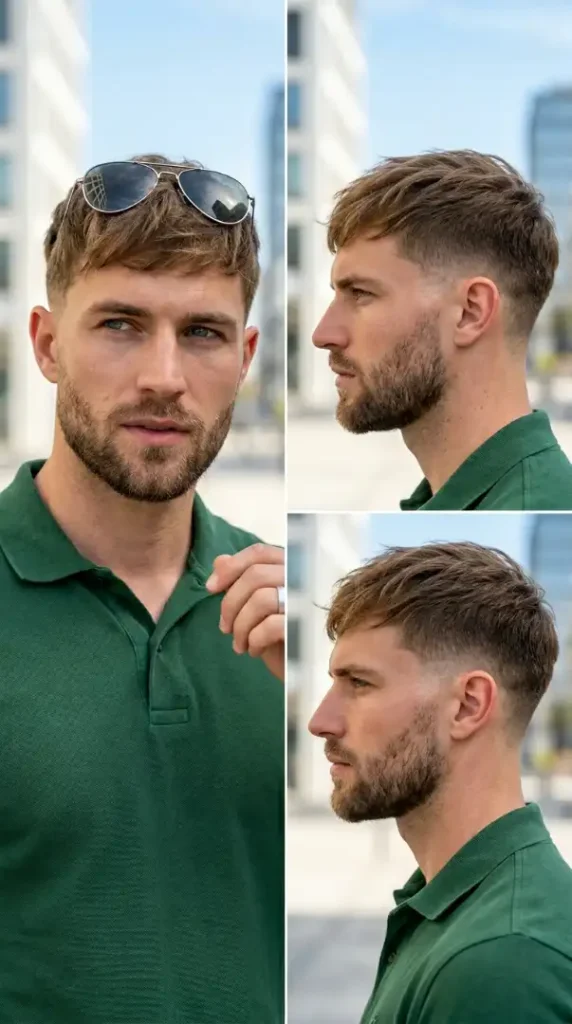
The Weekend Warrior balances weekday professionalism with weekend relaxation—2 inches of casual straight texture with easy forward styling, mid fade that grows gracefully, and 5mm beard that reads “masculine casual” in any setting. This is the versatile French crop for guys who need one cut that works Monday through Sunday.
Versatile Styling for Heart-Shaped Faces
Heart-shaped and oval face shapes achieve maximum versatility with The Weekend Warrior because the 2-inch forward-styled fringe adds width at forehead level (balancing heart-shaped faces’ narrow chins) while the relaxed texture maintains approachable casual aesthetic. The 5mm short beard adds crucial lower-face structure, preventing the pointed-chin emphasis that clean-shaven heart faces sometimes experience. Diamond faces work excellently—the casual texture and forward movement create temple-area balance. Square faces benefit from the softer casual styling compared to geometric corporate cuts, though ensure your barber doesn’t thin the hair too much or you’ll lose the piece-y texture needed for the softening effect. Round faces should request slightly more vertical lift in the styling and maintain the beard length shown for vertical dimension.
Weekend-Proof Grooming Arsenal
Your barber needs all-around solid skills: Wahl clippers for the mid fade that grows out gracefully, texturizing shears for the casual piece-y top work. This cut doesn’t demand master-level precision—it’s engineered for real-world wear, not geometric perfection. At home: American Crew Fiber or Baxter of California Clay Pomade for versatile matte styling—use it on work days for defined texture, skip it on weekends for natural air-dried casual. Product amount: pea-sized when used, working through damp hair with fingers. A basic wide-tooth comb for post-shower shaping if desired. For the 5mm beard: standard electric trimmer (Philips Norelco Series 5000 or Wahl Lithium Ion) with #2 guard maintains length, used twice weekly for consistency.
Real-World Maintenance: LOW-MEDIUM
Barbershop visits every 4 weeks maintain the textured layers and casual mid fade—this cut is specifically engineered to look good at week 1 AND week 4, not just fresh from the barber chair. The mid fade and casual texture both forgive growth gracefully. Daily styling flexibility: work days get 4-5 minutes with product application and finger-styling; weekends get 60 seconds of post-shower finger-combing with zero product. This versatility is the entire point—one cut, multiple styling options based on your schedule. Monthly investment: $40-55 for monthly barber visits, $22 for styling product lasting 4 months (longer since you don’t use it daily), $30 for quality trimmer (one-time investment, lasts years).
Barber Script for Versatile Casual Style
Say this to your barber: “I want a versatile French crop that works for both work and weekends—casual but still put-together. Give me a mid fade starting at my temple line, relaxed blending from #2 to #0.5—I need this to grow out gracefully over 4 weeks, not look dated after 2 weeks. On top, cut to 2 inches with casual texturizing—piece-y movement but not aggressive or choppy. Style it with relaxed forward movement—easy-going, not sharp or geometric. Keep my hairline natural and soft. Round my nape naturally. For my beard, maintain 5mm uniform length—casual masculine, clean edges but natural density. This needs to work with or without product depending on whether it’s a work day or weekend.”
The final style completes our collection with refined summer sophistication.
FAQs
Q: What’s the best haircut for guys who want low maintenance but professional options?
A: The French crop with mid fade and 2-inch textured top delivers maximum versatility—style with matte product for work (5 minutes), or air-dry with zero product on weekends (90 seconds). The mid fade grows out gracefully over 4 weeks unlike high fades that show growth within 10 days. This one cut works across contexts from casual weekends to business-casual offices, making it ideal for guys who want simplicity without sacrificing options.
Q: How do I make one haircut work for both professional and casual settings?
A: Choose versatile cuts (French crop, textured crop, classic taper) with mid or low fades (not high fades which look too bold for conservative settings), maintain 2-3 inches on top for styling flexibility, and use product strategically—styled with matte clay for professional contexts, air-dried naturally for casual weekends. The key is avoiding extremes: nothing too short (limits styling options) or too long (requires daily styling).
Q: Should I maintain a beard with a French crop?
A: Short to medium beards (3-8mm) pair excellently with French crops, adding masculine balance and lower-face structure that’s particularly beneficial for heart-shaped or diamond faces with narrow chins. Maintain consistent beard length weekly with electric trimmer, keep edges clean at cheekbones and neckline, and connect beard to fade seamlessly at sideburns. Clean-shaven also works—choose based on your face shape and personal style preference.
Q: How often should I trim my beard if I have a French crop?
A: Trim beard every 5-7 days to maintain consistent length (most electric trimmers work best on 5-day growth or longer). Clean up edges (cheekbones, neckline) weekly using trimmer without guard for crisp lines. Apply beard oil daily after showering to prevent itchiness and maintain healthy appearance. The goal: deliberately maintained beard that complements the intentional haircut, not accidentally grown stubble that looks unkempt.
15 of 15 — The Coastal Classic
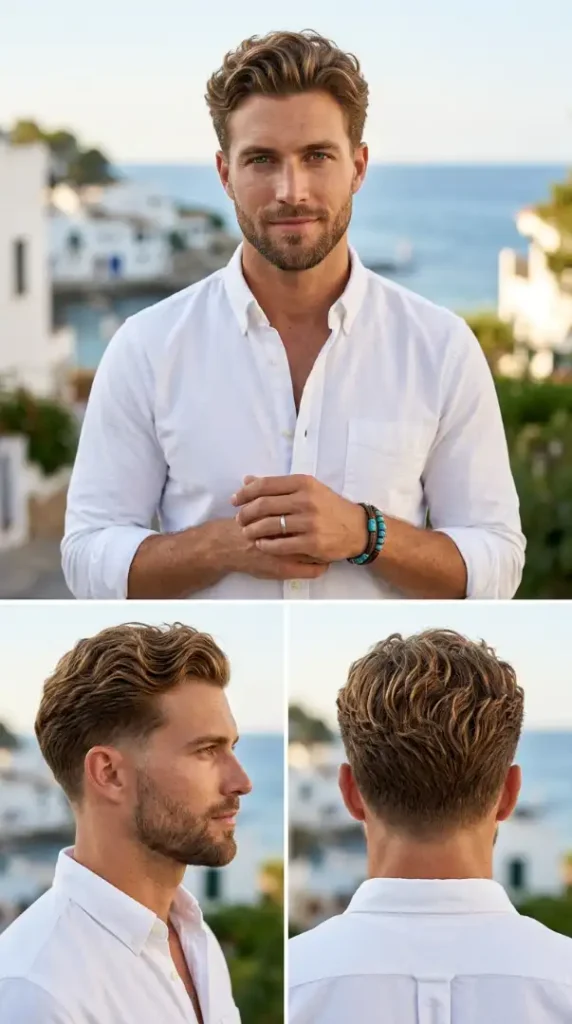
The Coastal Classic completes our summer collection with timeless sophistication—2.5 inches of sun-kissed honey brown waves with natural highlights, low fade that grows gracefully, and sea-salt texture that captures the essence of Mediterranean summer living. This is the French crop for guys who understand that true style is timeless, not trendy.
Timeless Coastal Appeal for All Face Shapes
Oval face shapes achieve perfection with The Coastal Classic because the balanced 2.5-inch wavy top with natural sun-kissed dimension maintains inherent facial proportion while adding personality and coastal character. Heart-shaped and diamond faces benefit enormously from the wavy volume creating forehead and temple balance, while the 4mm trimmed beard adds lower-face structure that balances narrow chins beautifully. Square faces work excellently—the soft natural waves introduce organic movement that softens angular features without sacrificing masculine structure. Round faces should ensure the waves have vertical lift component and maintain the beard shown for vertical dimension. Oblong faces look distinguished with this classic coastal aesthetic—the horizontal wave movement prevents over-elongation.
Coastal Grooming with Sun-Safe Maintenance
Your barber needs wavy-hair expertise and classic technique: point-cutting for the natural textured layers, traditional low-fade skills. If adding sun-kissed highlights: professional colorist creates subtle balayage placement mimicking natural sun-lightening (concentrate on top section and fringe, avoid roots). At home for natural hair: Kevin Murphy Hair Resort or Ouai Wave Spray (sea-salt formula) enhances natural waves—3 spritzes to damp hair, scrunch, air-dry. For highlighted hair: add color-safe shampoo (Pureology) and UV protectant spray (Aveda Sun Care) before beach or pool exposure. Quality beard oil (Viking Revolution or Honest Amish) with SPF protection prevents sun damage to facial hair. Styling product: minimal matte paste if you want definition, or completely product-free for authentic beach aesthetic.
Coastal-Living Maintenance Reality: LOW-MEDIUM
Barbershop visits every 4-5 weeks maintain the natural textured layers and low fade that forgives growth gracefully—coastal style embraces the lived-in look. If color-highlighted: salon visits every 8-10 weeks for subtle highlight refresh (less frequent than all-over color because balayage grows out naturally). Daily styling commitment: 3-4 minutes including sea-salt spray application and scrunching if you want enhanced texture, or 60 seconds of air-drying if embracing completely natural. This cut actually improves with salt water and sun exposure—beach days enhance rather than ruin the style. Monthly investment: $45-60 for barber cuts, $60-90 for highlight refresh every 8-10 weeks if colored (averages $30-45 monthly), $24 for sea-salt spray lasting 3 months.
Barber Script for Timeless Coastal Style
Say this to your barber: “I want a timeless coastal French crop with natural wavy texture—Mediterranean beach-town aesthetic. Give me a low fade starting just above my ear, classic blending from #2 to #0.5—subtle and timeless, not trendy or aggressive. On top, keep 2.5 inches and use point-cutting to enhance my natural wave pattern—I want coastal texture, not corporate precision. Style everything with relaxed natural movement and a soft barely-there left part. Keep my hairline naturally groomed and coastal-relaxed. Round my nape naturally. For my beard, maintain 4mm uniform coastal length with clean edges. If adding color: I want subtle sun-kissed highlights through the top—natural balayage placement where the sun would naturally lighten, not chunky salon streaks. Everything should look timeless and coastal, like I spend summers in Mediterranean beach towns.”
This completes our comprehensive summer French crop collection—15 distinct styles engineered for every face shape, hair type, and personal aesthetic from corporate precision to coastal ease.
FAQs
Q: How do I get sun-kissed highlights in men’s hair naturally?
A: Natural sun-lightening occurs when UV exposure breaks down melanin in hair—accelerate this by applying lemon juice or chamomile tea to hair before sun exposure (acts as natural lightening agent). However, professional balayage highlights deliver more controlled, flattering results in 2-3 hours versus months of sun damage. For subtle effect: ask colorist for 3-4 shades lighter than base, concentrated on top section and fringe. Maintain with color-safe products and UV protectant spray.
Q: What’s the best French crop for beach and summer activities?
A: Textured French crops with wavy hair and low fades work best for beach living because: (1) wavy texture enhances naturally with salt water rather than fighting it, (2) low fades grow out gracefully over 4-5 weeks between cuts, and (3) minimal product requirements mean easy maintenance with just sea-salt spray or zero products. Avoid high fades and heavily pomaded styles which require frequent maintenance and product that salt water ruins.
Q: How do I protect highlighted hair from sun and chlorine damage?
A: Apply leave-in UV protectant spray (Aveda Sun Care, Kevin Murphy Shimmer Shine) before any sun exposure, wet hair with fresh water before swimming (hair saturated with fresh water absorbs less chlorine/salt), wear hat during peak UV hours (10am-4pm), rinse thoroughly with fresh water immediately after swimming, use color-safe sulfate-free shampoo and deep condition weekly. Highlighted hair is more porous and vulnerable—protection is mandatory, not optional.
Q: Can I combine a French crop with a beard for summer?
A: Absolutely—short to medium beards (3-6mm) pair excellently with French crops for summer, providing masculine structure without excessive heat. Trim beard weekly with electric trimmer for consistent length, apply beard oil daily (prevents itchiness from sweat), keep edges clean at cheekbones and neckline, and connect beard to fade seamlessly at sideburns. The combination delivers balanced masculine aesthetic perfect for casual coastal summer style.