12 Goatee Styles To Elevate Your Look — MENXSTYLE
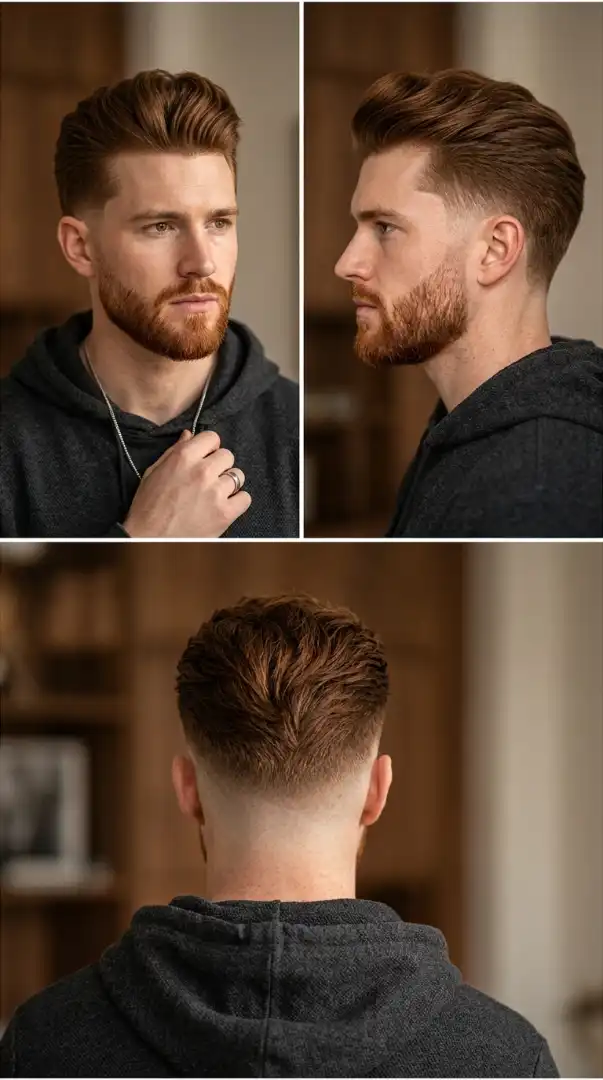
1 of 12 — The Classic Power Goatee
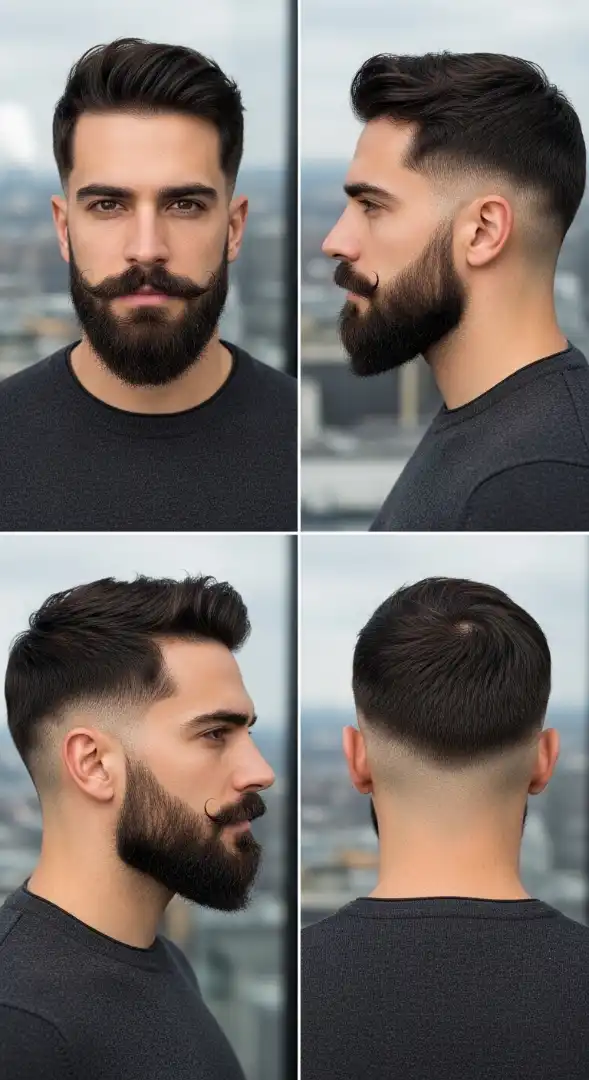
SHAPE MATCH: The Classic Power Goatee is arguably the most universally versatile beard style ever developed, but it delivers its most dramatic results on Square and Oval face shapes. On a Square face, the rounded base of the goatee softens the hard angular jawline, pulling the eye toward the center of the face and creating a more balanced, proportionate appearance. The vertical emphasis of the chin beard also adds perceived length to faces that are wider than they are long. On an Oval face, this style simply enhances what’s already balanced — adding definition and character without disrupting the face’s natural symmetry. It is less ideal for Round faces, where the circular shape of a full goatee can accidentally echo the face’s roundness; those men should opt for a slightly elongated, pointed variation instead.
GROOMING KIT:
- Trimmer/Outliner: Andis T-Outliner (the industry gold standard for goatee edge definition) or BaByliss Pro FX Outliner for ultra-sharp lines
- Body Trimmer: Wahl Stainless Steel Lithium Ion+ set to a #1 or #1.5 guard for maintaining goatee density
- Straight Razor / Foil Shaver: Panasonic Arc5 or a traditional Feather straight razor with a fresh blade for the cheek shave boundary
- Beard Comb: Kent Handmade Beard Comb (fine-tooth end for precise alignment)
- Beard Oil: Jack Black Beard Oil or Beardbrand Tree Ranger (2-3 drops daily, worked in from the roots to tips)
- Beard Balm: Honest Amish Beard Balm for shape hold without stiffness
MAINTENANCE LEVEL: MEDIUM
- Barber/salon visit: Every 3-4 weeks for professional edge cleanup and neckline shaping
- Daily home maintenance: 8-10 minutes — shave the cheek boundary every 2-3 days, apply beard oil daily, comb into shape
- Weekly deep routine: Beard wash with a dedicated beard shampoo (not regular shampoo — it strips oils), followed by balm application
BARBER TALK (Exact Script): “I want a Classic Goatee kept clean. Keep the mustache natural but trimmed — no longer than the lip edge. Use a T-outliner to define a hard edge from the corner of my mouth, curving down to frame my chin. The chin beard should be about an inch and a half, trimmed flat across the bottom with just a very subtle point — not sharp, just shaped. Use a #1.5 guard on the body of the goatee for uniform density. Clean-shave everything outside the goatee boundary with a straight razor — I want that cheek line surgical. Square the neckline right at the Adam’s apple level and clean up the back with a low skin fade at a 0 guard, blending up to a 1.5 by mid-back-head.”
The Classic Power Goatee is the foundation — but Style #2 takes the same chin framework and transforms it into something that looks like it walked straight off a Milan runway.
FAQs
Q: How do I keep my Classic Goatee looking sharp between barber visits? A: Use an Andis T-Outliner or BaByliss trimmer to redefine the cheek shave boundary every 2-3 days. Apply 2-3 drops of beard oil daily after washing your face. A Kent fine-tooth comb will keep hairs aligned and prevent a scraggly look. Total daily routine: under 10 minutes.
Q: Which face shape does the Classic Goatee suit best? A: Square and Oval face shapes benefit most. The Classic Goatee softens a Square face’s hard angles by centering attention on the chin, while it adds character and definition to an already balanced Oval face. Round faces should opt for a slightly elongated, pointed goatee variation to add facial length.
Q: What is the difference between a Classic Goatee and a Circle Beard? A: A Classic Goatee connects only the mustache to the chin beard, leaving the cheeks completely clean-shaven. A Circle Beard includes a thin connecting line of hair running along the sides of the mouth, creating a more rounded, enclosed shape. The Classic Goatee looks sharper and more angular; the Circle Beard looks rounder and softer.
Q: How often should I get my Classic Goatee professionally shaped? A: Every 3-4 weeks is ideal. The barber resets the cheek shave boundary, re-defines the chin shape, and maintains the neckline — tasks that are difficult to do with precision at home without professional tools and mirror angles.
2 of 12 — The Van Dyke Architect
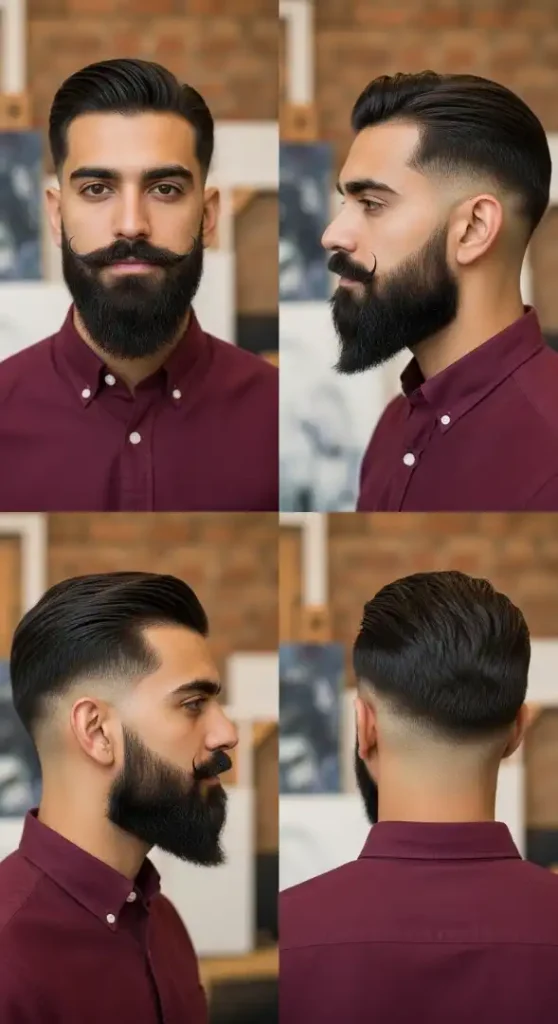
FACE SHAPE MATCH: The Van Dyke is a high-drama beard style that performs best on Diamond and Oval face shapes. The Diamond face — characterized by a narrow forehead, wide cheekbones, and a narrow chin — benefits immensely from the Van Dyke’s pointed chin beard, which visually widens the chin area and creates balance against the wide cheekbones. The elongated chin beard draws the eye downward, adding perceived length and structure. On an Oval face, the Van Dyke adds a distinct artistic character without disrupting the face’s natural balance. It is strongly discouraged for Round faces, as the isolated mustache and pointed chin beard create a floating, unanchored aesthetic that accentuates facial width. Oblong faces should also avoid very long Van Dyke points, as additional length can make the face appear even narrower.
GROOMING KIT:
- Mustache Wax: Captain Fawcett’s Moustache Wax or Fisticuffs Strong Hold Moustache Wax for curl definition and tip control
- Trimmer: Wahl Stainless Steel Lithium Ion+ with a #0.5 guard for maintaining chin beard body density uniformly
- Precision Outliner: BaByliss Pro FX Outliner or Andis Slimline Pro Li for the critical philtrum gap definition and cheek shave lines
- Straight Razor: Merkur 34C safety razor with Feather blades for the cheek and gap shave (precision is everything here)
- Beard Oil: Beardbrand Utility Oil — 3 drops morning and evening on the chin beard to maintain sheen and softness
- Fine Comb: Hercules Sägemann 655 for precision mustache alignment before waxing
MAINTENANCE LEVEL: HIGH
- Barber visit frequency: Every 2-3 weeks — the Van Dyke’s separation gap requires professional redefinition regularly to maintain its architectural precision
- Daily styling time: 12-15 minutes — mustache wax application and curling (5 min), shaving the gap and cheeks (5 min), beard oil on chin beard (2 min)
- This is not a travel-friendly style — the mustache wax and precise separation gap make it extremely difficult to maintain without a well-equipped grooming station
BARBER TALK (Exact Script): “I want a Van Dyke. Keep the mustache completely separated from the chin beard — there should be a clean-shaved gap right below the corners of my mouth. The mustache should be trimmed to just sit on the lip line, and I want a very slight outward curve at the tips — not a full handlebar, just a suggestion of a curl. The chin beard should be roughly 2 inches, brought to a defined geometric point at the bottom — not wispy, a clean point. Use a 0.5 guard on the chin beard body for density. Clean-shave everything else — cheeks, the separation gap — with a straight razor. Make the cheek shave lines clean and defined. Square the neckline at the Adam’s apple.”
The Van Dyke is an artist’s beard — but Style #3 proves that an artistic spirit can still run a boardroom with the right goatee silhouette.
FAQs
Q: How is a Van Dyke beard different from a regular goatee? A: The key difference is separation. A Van Dyke keeps the mustache and chin beard as two completely distinct, disconnected elements — there is a clean-shaved gap between them. A regular goatee connects the mustache directly to the chin beard along the sides of the mouth, creating one unified shape. The Van Dyke looks more dramatic and artistic; the standard goatee looks more traditional.
Q: How do I keep the Van Dyke’s separation gap clean at home? A: Use a precision outliner (BaByliss Pro FX or Andis T-Outliner) and a handheld mirror plus a wall mirror for the dual-angle view. Shave the philtrum-to-chin gap every 2-3 days with a safety razor. The gap typically needs professional barber redefinition every 2-3 weeks as overgrowth can blur the line.
Q: What face shape is best for the Van Dyke beard? A: Diamond and Oval face shapes get the most benefit. The Van Dyke’s pointed chin beard adds width and definition to a Diamond face’s narrow chin. Round and very wide faces should avoid this style as the isolated mustache and pointed beard can look disconnected and disproportionate.
Q: What mustache wax should I use for a Van Dyke? A: Captain Fawcett’s Moustache Wax or Fisticuffs Strong Hold are both excellent. Apply a small amount (size of a grain of rice per side) to clean, dry mustache hairs and use a fine comb or fingertips to curl the tips outward and upward. A blow dryer on low heat sets the wax faster and holds longer.
3 of 12 — The Anchor & Edge
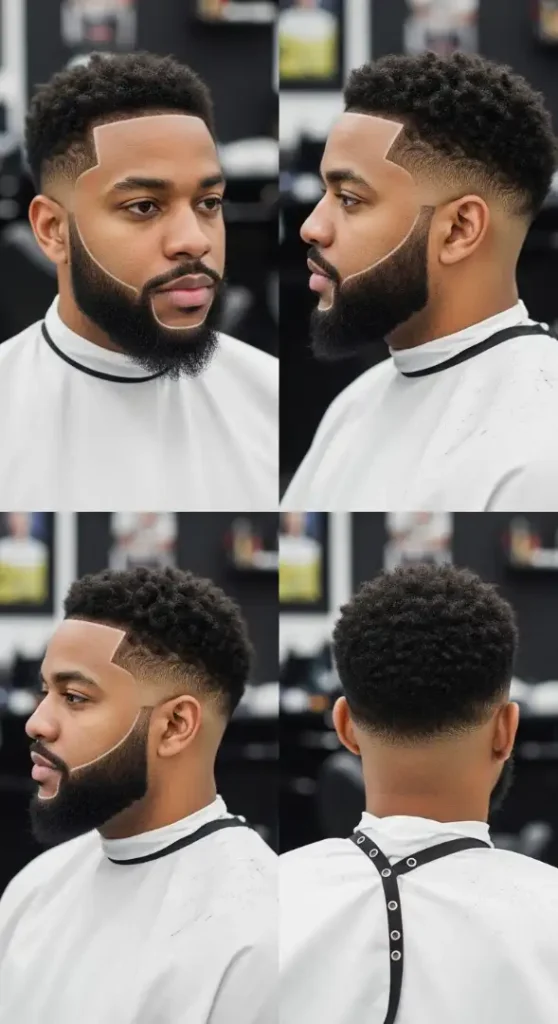
FACE SHAPE MATCH: The Anchor Beard is a precision instrument for Round and Oblong face shapes. For a Round face, the anchor’s inverted triangular chin patch creates an illusion of a longer, more angular chin — drawing the eye downward and elongating the face’s perceived shape. The defined outer edges of the anchor also create the impression of a stronger, more defined jawline on faces that naturally lack angularity. On an Oblong face (longer than it is wide), the anchor’s widened triangular base adds perceived width at the chin, helping to balance the face’s vertical proportion. The chin strap option adds further horizontal emphasis. Square faces can also wear this effectively — it softens the jaw angles while keeping the overall look sharp. It is not recommended for Diamond faces with already pointed chins, as it over-emphasizes that pointed quality.
GROOMING KIT:
- Clippers: Wahl Magic Clip Cordless — essential for the close-crop fade top (0.5 guard at skin level, blending up with a 1 and 1.5)
- Beard Trimmer: Andis Slimline Pro Li set to #0.5 or #1 guard for the anchor beard body
- Precision Outliner: Andis T-Outliner or BaByliss Pro FX787ii — critical for defining the anchor’s triangular outer edges with sub-millimeter accuracy
- Straight Razor + Shave Butter: Gillette Fusion ProGlide with King C. Gillette Shave Gel for the cheek shave area
- Edge-Up Tool: Wahl Detailer T-Wide for the hairline crisp edge
- Beard Oil: SheaMoisture Men Maracuja Oil & Shea Butter Beard Oil — 2-3 drops daily for coily hair texture moisture
- Beard Balm: Gold Label Beard Balm for coily/kinky beard textures
MAINTENANCE LEVEL: HIGH
- Barber visit frequency: Every 1.5-2 weeks — this style loses definition rapidly; the edge-up, anchor definition, and skin fade all degrade fast
- Daily home maintenance: 10-12 minutes — outline touch-up with T-outliner every 3 days, daily beard oil, and edge-up touch with a home detailer
- This is a barbershop-dependent style — the geometric anchor shape is extremely difficult to maintain with home tools alone without professional eye measurement
BARBER TALK (Exact Script): “I want an Anchor beard. Give me a thin lip stripe mustache — just the natural hairs directly above the lip, about 3mm thick, and trim it so it doesn’t extend past the corner of my mouth. Connect that straight down through the philtrum to a chin patch — the chin patch should splay outward in a triangular anchor shape, following my jawline curve. I want the outer edges of the anchor defined with a T-outliner — clean, hard lines. The whole beard at a #1 guard — keep it close. Add a chin strap that follows the jaw bone from each side of the anchor to below the ear. Clean-shave everything above the chin strap and outside the anchor. For the top, I want a high skin fade — 0 guard bald at the temples, blend up with a 1 to about two fingers above the ear, then let the natural coily texture take over on top. Hard line edge-up on the hairline.”
The Anchor is all precision and architecture — but Style #4 strips things back and shows what happens when you let natural beard texture do the heavy lifting.
FAQs
Q: What exactly is an anchor beard and how do I describe it to my barber? A: An anchor beard combines a thin mustache, a vertical chin strip, and a widened triangular chin patch that curves to follow the jawline — resembling a ship’s anchor from the front. Tell your barber: “thin lip stripe mustache, connected down to a triangular chin patch with hard defined outer edges, and optional chin strap along the jaw — all at a #1 guard length.”
Q: How do I maintain an anchor beard’s sharp edges at home? A: Use an Andis T-Outliner or BaByliss Pro FX787ii trimmer. Redefine the outer triangular edges of the chin patch every 3-4 days using the corner of the trimmer blade as a precision tool. Use a straight razor or safety razor for the cheek shave zone. Daily beard oil (2 drops) on the beard itself prevents dryness and keeps the texture healthy.
Q: How often should I get an anchor beard touched up at the barber? A: Every 10-14 days is ideal for maintaining the high skin fade and the defined anchor shape. The geometric edges and skin fade both lose definition within 2 weeks — this is a high-maintenance style that depends on regular professional visits.
Q: Does the anchor beard work for coily/kinky beard textures? A: Yes, and often better than straight textures because coily hair holds defined edges extremely well once shaped. Use a dedicated beard oil formulated for kinky/coily textures (SheaMoisture or Shea Moisture Men’s range) daily to prevent dryness and brittleness at the edges.
4 of 12 — The Circle Beard Executive
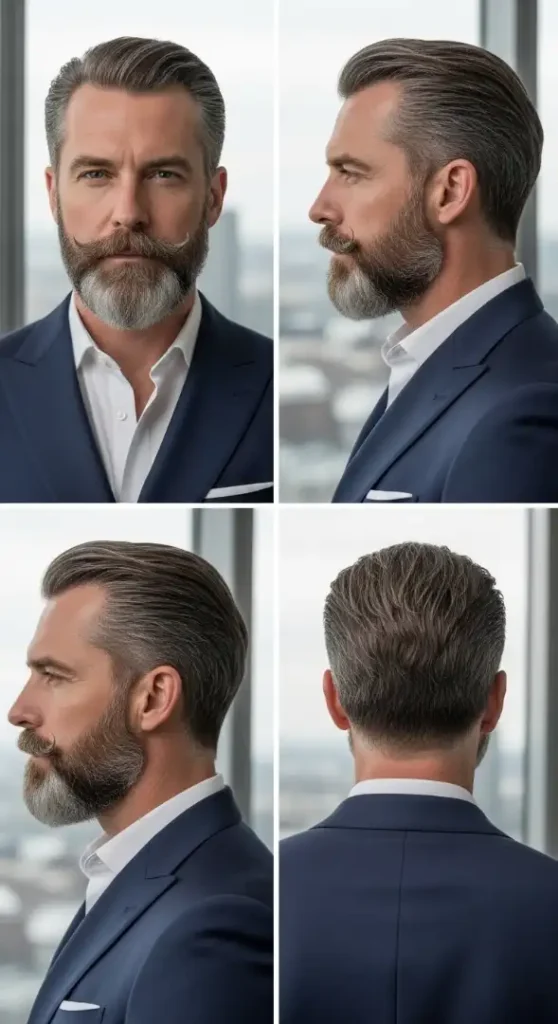
FACE SHAPE MATCH: The Circle Beard is the single most office-appropriate goatee variant in existence, and it works across a wider range of face shapes than almost any other beard style. It is most flattering on Round and Oblong face shapes. On a Round face, the circle beard’s oval outline creates a visual center of focus around the mouth, drawing attention away from the face’s overall width and toward a defined central feature. On an Oblong (long) face, the horizontal width of the oval circle beard adds a sense of balance and breaks the face’s vertical monotony. Oval faces wear it with ease — the style simply adds groomed professionalism. Heart-shaped faces also benefit, as the chin beard adds visual mass to a narrow chin. Square faces wear it well but may prefer the goatee version without connectors for more angularity.
GROOMING KIT:
- Trimmer: Wahl Stainless Steel Lithium Ion+ with #2 guide comb for body maintenance
- Precision Outliner: Andis T-Outliner for defining the connector line along the corners of the mouth — this is the technical challenge of the circle beard
- Cheek Razor: Gillette SkinGuard for sensitive skin in the high cheek shave zones
- Beard Shampoo: Bulldog Original Beard Shampoo & Conditioner (use 2-3x per week — not daily)
- Beard Oil: Every Man Jack Sandalwood Beard Oil — 3 drops morning on the dry beard
- Beard Brush: Smooth Viking Beard Brush (firm boar bristle) to train the circle beard hairs into position
MAINTENANCE LEVEL: MEDIUM
- Barber visit: Every 3-4 weeks for body trim and connector line re-definition
- Daily time: 7-9 minutes — shave the outer boundary every 3 days, apply beard oil, brush into shape
- Travel-friendly: Yes — a good trimmer handles most of the maintenance. The connector lines are the only tricky home maintenance element
BARBER TALK (Exact Script): “I want a Circle Beard — the mustache and chin beard connected. Trim the whole beard to a #2 guard for an even, uniform length throughout. Use a T-outliner to create the connector line at the corner of the mouth — it should connect the mustache to the chin beard in a line that follows the natural curve of the mouth corner, no wider than about 5mm. The chin beard should be rounded at the bottom, not pointed — I want an oval, not a diamond. Keep the mustache trimmed to just below the lip edge — no overhang onto the lip. Clean-shave the cheeks and everything below the chin beard right to the jawline. Low taper on the hair, rounded neckline.”
The Circle Beard Executive is the style you wear to close deals — but Style #5 proves you can keep all that authority and still turn heads on a Saturday night.
FAQs
Q: Is a circle beard professional enough for a corporate environment? A: Absolutely. The Circle Beard is widely considered the most workplace-appropriate goatee variation. When kept to a #2 guard length (about 6mm), cleanly outlined with defined edges, and paired with a conservative haircut, it reads as groomed and intentional — not casual. Fortune 500 executives, lawyers, and senior managers wear this style regularly.
Q: How is a circle beard different from a classic goatee? A: The classic goatee has no side connectors — the mustache and chin beard are separated at the sides of the mouth. The circle beard adds thin side connectors at the mouth corners, linking the mustache and chin beard into one continuous oval or rounded shape. The circle beard looks rounder and softer; the classic goatee looks sharper and more disconnected.
Q: How do I define the connector lines of a circle beard at home? A: Use the corner of an Andis T-Outliner or BaByliss precision trimmer. Place the trimmer blade perpendicular to the skin at the corner of your mouth and use a slow, single downward stroke to define each connector. Work slowly — removing too much creates a visible gap. Practice with the trimmer’s body guard on first.
5 of 12 — The Balbo Signature
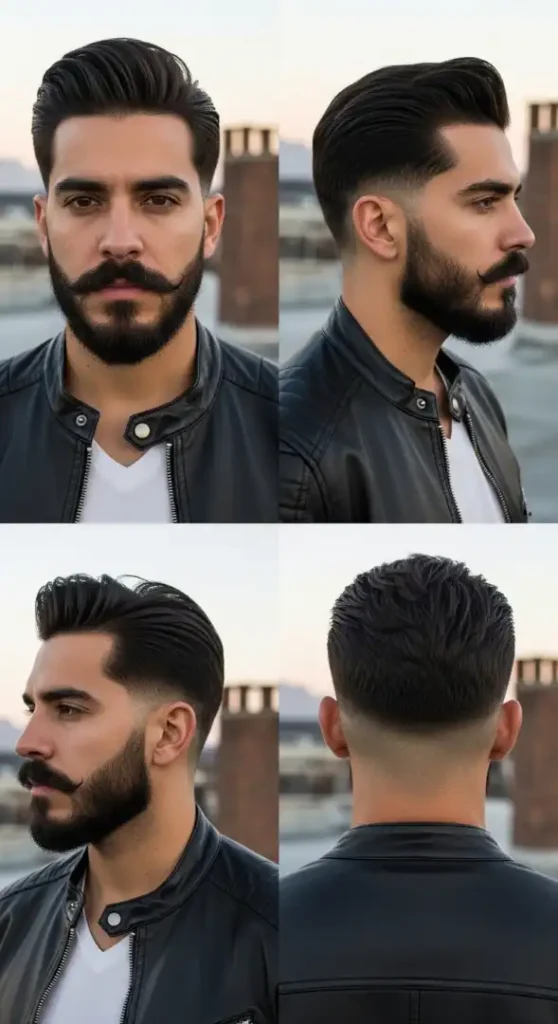
FACE SHAPE MATCH: The Balbo beard is one of the most uniquely suited styles for Heart and Oval face shapes. On a Heart face — characterized by a wide forehead and narrow chin — the Balbo’s chin beard adds visual weight and width exactly where the face needs it most, making the chin appear fuller and more balanced against the broader upper face. The disconnected mustache also adds horizontal emphasis in the mid-face, further distributing visual balance. On an Oval face, the Balbo adds individuality and character. Diamond faces also benefit significantly. This style is not recommended for Round faces, where three separate floating facial hair elements can look visually cluttered and draw attention to the face’s roundness rather than minimizing it.
GROOMING KIT:
- Trimmer: Andis Slimline Pro Li with #0.5 and #1 guide combs for the three Balbo elements
- Precision Outliner: Andis T-Outliner for the critical boundary lines separating the mustache, soul patch, and chin beard
- Razor: Gillette Fusion5 ProGlide for the wide cheek and neck shave areas
- Shave Cream: Proraso White Shave Cream (sensitive formula) for shaving the zones between Balbo elements without irritation
- Beard Oil: Cremo Beard Oil (Original) — 2 drops on the chin beard patch daily
- Mustache Comb: Handmade Italics Mustache & Beard Comb for daily alignment of all three separate elements
MAINTENANCE LEVEL: HIGH
- Barber visit: Every 2-3 weeks — the three separate elements and their precise boundaries require professional redefinition
- Daily time: 10-12 minutes — shaving the zones between elements (around the soul patch especially) requires precision daily
- Travel challenge: Moderate — the soul patch shave boundary is the hardest element to maintain without your regular setup
BARBER TALK (Exact Script): “I want a Balbo. Three separate elements — keep them completely disconnected. First, a mustache: trim to 6mm, natural shape following the lip line, ending just at the corner of the mouth — no connectors going down. Second, a small diamond-shaped soul patch just below my lower lip — about 4mm long, 8mm wide at the widest. Third, a chin beard: wider than the soul patch, rounded at the bottom, approximately 1 inch long — trim with a #1 guard. There should be a cleanly shaved gap between the soul patch and the chin beard, and between the mustache and everything below. Clean-shave the cheeks and everything outside these three zones with a straight razor. Give me a skin fade at the back, medium height — 0.5 guard at the nape, blending to a 2 by the crown.”
The Balbo Signature carries the kind of casual confidence that only comes with precision — and Style #6 takes that same energy and channels it into something you can wear to a black-tie event without blinking.
FAQs
Q: What is a Balbo beard and how is it different from a Van Dyke? A: A Balbo has three completely separate elements: a standalone mustache, a soul patch, and a chin beard — none of them connected to each other. A Van Dyke connects the mustache to the chin beard via side connectors but keeps the cheeks clean. The Balbo reads as more modern and eclectic; the Van Dyke reads as more classic and dramatic. Both are “disconnected mustache” styles but with different chin beard arrangements.
Q: How do I maintain the gap between the soul patch and chin beard? A: This is the Balbo’s trickiest maintenance point. Use a precision outliner (Andis T-Outliner or BaByliss FX) turned on its side to shave the small gap between the soul patch and chin beard. This gap should be approximately 5-8mm wide. Shave it every 2-3 days. A handheld mirror in front and a wall mirror behind helps with angle accuracy.
Q: Is the Balbo beard suitable for men with thick, dense beards? A: It actually works best with dense beards — the three distinct patches have presence and visual weight. Men with thin or patchy beards may struggle to fill out all three elements simultaneously, particularly the soul patch, which requires good density in the philtrum area specifically.
6 of 12 — The Disconnected Shadow Goatee
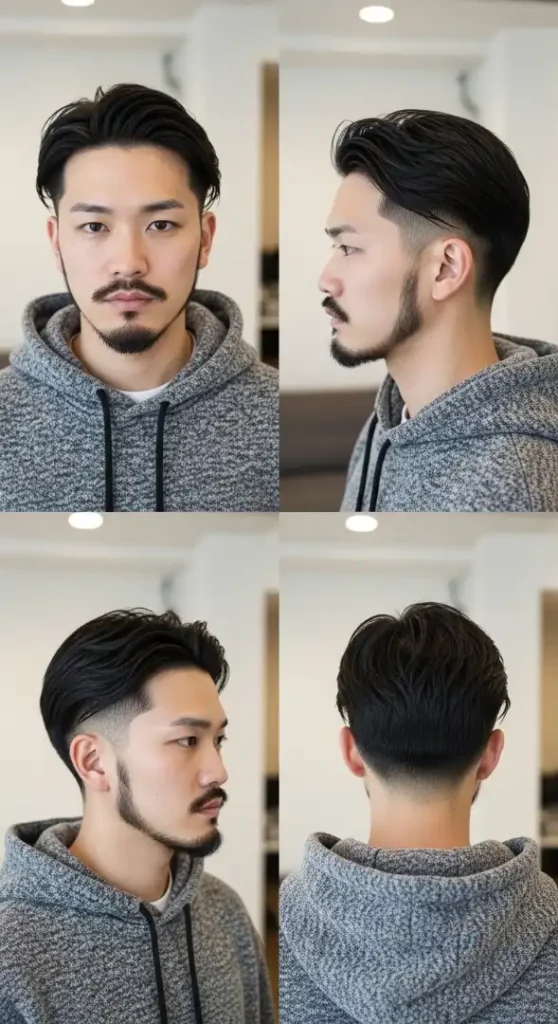
FACE SHAPE MATCH: The Disconnected Shadow Goatee is particularly powerful for men with Heart and Oval face shapes, and it is arguably the best goatee option for East Asian men whose beard growth is often concentrated in the mustache and chin area (making a full goatee or van dyke difficult due to patchy connector zones). By embracing the disconnected, shadow-length format, this style works with natural sparse growth patterns rather than against them. On a Heart face, the chin shadow adds visual weight at the narrowest part of the face. On an Oval face, it adds dimension and maturity. This style is also ideal for men with office dress codes who want to maintain a controlled, groomed appearance while wearing some facial hair — the 2-3mm shadow length reads as “intentional stubble” rather than “forgot to shave.”
GROOMING KIT:
- Stubble Trimmer: Braun Series 9 Pro or Philips Series 9000 Prestige — both have 0.4mm precision settings perfect for maintaining shadow goatee length
- Precision Outliner: BaByliss Pro FX Outliner (used with no guard) for defining the goatee’s boundary lines at skin level
- Foil Shaver: Panasonic Arc5 for the cheek and upper lip shave zones — gives the cleanest result on smooth cheek skin
- Exfoliation: Jack Black Face Buff Energizing Scrub (used 3x per week in the clean-shaved cheek zones to prevent ingrown stubble)
- Moisturizer: Kiehl’s Facial Fuel SPF 20 Moisturizer applied to the clean-shaved cheek zones daily
- Beard Oil (light): Dove Men+Care Hydrating Clean Comfort Beard Oil — just 1-2 drops for the shadow-length goatee
MAINTENANCE LEVEL: LOW-MEDIUM
- Barber visit: Every 4-5 weeks for a cleanup — this style can mostly be home-maintained
- Daily time: 5-7 minutes — trimmer pass over the chin patch every 2-3 days to keep it at exactly 2-3mm, cheek shave every 2 days
- Best travel-friendly option in this entire article — just needs a compact travel trimmer
BARBER TALK (Exact Script): “I want a Shadow Goatee — stubble length, disconnected. Use a 2.5mm guard on the goatee areas — mustache and chin beard only. Keep them completely separate — I don’t want a connector at the mouth corners. The chin beard should be a natural oval shape, slightly wider than the mouth. Use the T-outliner with no guard to define the cheek shave line — clean hard boundary. Shave the cheeks completely clean with a foil shaver or straight razor. For the hair: two-block cut — leave the top long and textured, undercut the sides and back to a 0.5 guard at the ear level with a hard horizontal line. Square the back. Hard edge-up on the front hairline.”
The Shadow Goatee proves that restraint is its own kind of statement — and Style #7 takes that quiet confidence and dials it all the way up to maximum authority.
FAQs
Q: What is a shadow goatee and who is it best for? A: A shadow goatee is a short-stubble version of a traditional goatee, maintained at 2-3mm in length rather than grown out. It’s ideal for men with sparse or patchy connector zones, men who want a low-commitment groomed look, and those in professional environments where full beards aren’t ideal. It’s especially popular among East Asian and South Asian men whose natural beard growth is concentrated in the mustache and chin areas.
Q: How do I keep a shadow goatee at the perfect stubble length? A: Use a Braun Series 9 Pro or Philips Series 9000 Prestige set to 2.5mm — trim the goatee zone every 2-3 days to maintain the consistent shadow length. The clean-shaved cheek zones need attention every 1-2 days. Total maintenance per day: under 7 minutes.
Q: Is the disconnected shadow goatee suitable for the office? A: Yes — at 2-3mm length with cleanly defined edges, this style reads as deliberate and groomed. It’s one of the most corporate-friendly goatee variations because the short length doesn’t read as casual, and the disconnected format keeps the overall look clean and minimal.
7 of 12 — The Extended Chin Commander
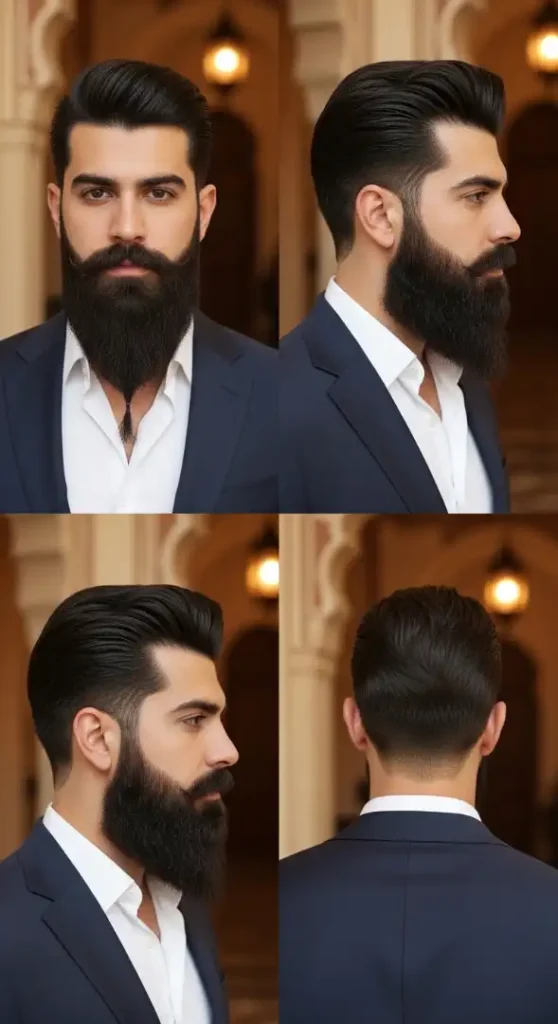
FACE SHAPE MATCH: The Extended Chin Commander — a long goatee with 3 or more inches of chin beard — is a high-impact style suited exclusively for Oblong and Square face shapes. On a Square face, the extended chin beard draws the eye dramatically downward, elongating the face’s perceived proportions and softening the broad, angular jaw by redirecting visual attention vertically. On an Oblong face, surprisingly, a long goatee can work well if the beard is wider at the base — but a very narrow, elongated beard will make an already long face appear even longer, so the width of the chin beard must be managed carefully. This style is absolutely not recommended for Round faces, where a long goatee will create a bizarre vertical emphasis on a horizontally-wide face. Heart faces should also avoid it — the narrow chin cannot visually support a heavy extended beard without looking disproportionate.
GROOMING KIT:
- Scissors: Equinox International Professional Barber Scissors (6-inch) — extended goatees must be trimmed with scissors, never clippers alone, for organic texture and tapered ends
- Wide-tooth Beard Comb: Viking Revolution Beard Comb for detangling and aligning the extended beard before trimming
- Trimmer: Wahl 5-Star Cordless Magic Clip with a #2 guard for maintaining the mustache and upper chin beard body
- Beard Wash: Honest Amish Beard Wash — use 3-4x per week; a 3.5-inch beard collects debris and requires dedicated cleansing
- Beard Oil: Beardbrand Gold Beard Oil — 5-7 drops worked from root to tip morning and evening (longer beard = more oil needed)
- Beard Balm: Honest Amish Classic Beard Balm (heavy formula) for shaping and controlling the extended length throughout the day
MAINTENANCE LEVEL: MEDIUM-HIGH
- Barber visit: Every 4-5 weeks for trimming the extended length and professional edge cleanup
- Daily routine: 15-20 minutes — beard wash (3x weekly), oil application (daily, morning and evening), combing and balm application for shape control
- Honest caveat: This style is not ideal for men who eat on-the-go frequently or who live in high-humidity climates — the extended length requires daily product maintenance to avoid looking unkempt
BARBER TALK (Exact Script): “I want an extended goatee — the chin beard should be about 3.5 inches long, trimmed with scissors into a natural, soft taper at the bottom. Don’t force a sharp point — I want a natural, organic taper. Use a #2 guard on the mustache and the upper inch of the chin beard for density consistency. Free-hand scissors for the lower portion of the chin beard, following the natural growth direction. Define the cheek shave boundary with a T-outliner — hard line from the corner of my mustache straight down to the goatee boundary. Clean-shave the cheeks completely. Slick back the hair — 0.5 guard undercut on sides and back, hard horizontal line 2 inches above the ear.”
The Extended Chin Commander is a statement that takes commitment — Style #8 is for the man who wants that same commanding presence but in half the maintenance time.
FAQs
Q: How long does it take to grow an extended chin goatee to 3-4 inches? A: The average beard grows approximately 0.5 inches per month. A 3.5-inch extended goatee typically requires 6-8 months of growth, depending on genetics. During the growing phase (especially between 1-3 inches), use a boar bristle brush and beard oil daily — this trains the hairs downward and reduces the awkward side-spreading stage significantly.
Q: How do I keep an extended goatee from looking unkempt? A: Two things matter most: daily combing and twice-daily beard oil. After washing your face in the morning, apply 5-7 drops of beard oil (Beardbrand Gold or Honest Amish) from roots to tips, then comb the beard downward with a wide-tooth comb. Apply a small amount of beard balm for hold. A 5-minute combing and oiling routine keeps even a 4-inch goatee looking intentional and polished.
Q: Can I use scissors instead of a trimmer to shape my extended goatee at home? A: Yes — for extended lengths (3+ inches), scissors actually give better results than clippers because they preserve the natural texture and allow precise point-shaping at the tip. Use sharp barber scissors (6-inch minimum). Comb the beard straight down, then trim horizontal cuts at the desired length. For the taper at the tip, use the scissors’ point in small, angled diagonal cuts.
8 of 12 — The Stubble Royale Goatee
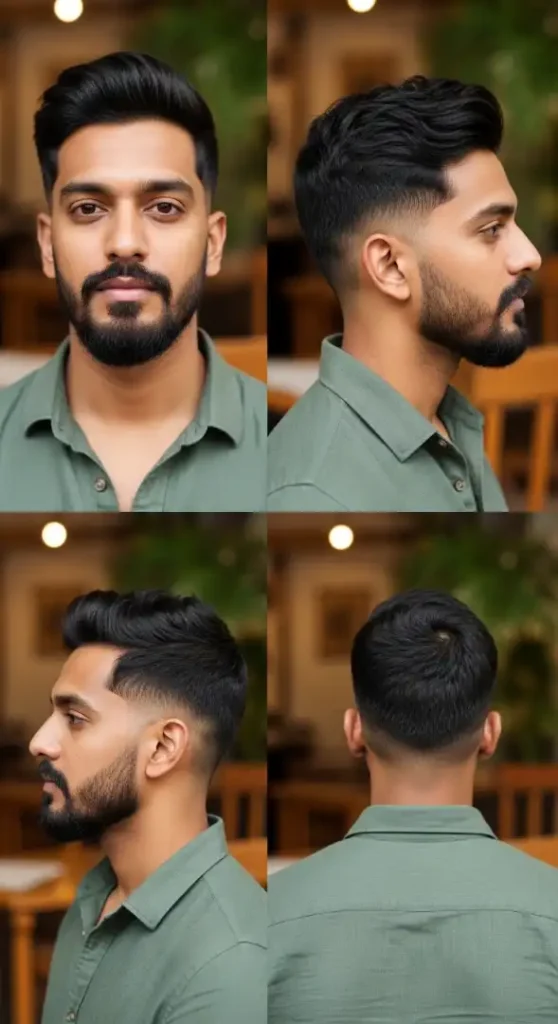
FACE SHAPE MATCH: The Stubble Royale Goatee — distinguished by its natural cheek fade boundary rather than a hard razor shave line — is the most universally flattering goatee option in this entire guide. The natural boundary softens the otherwise clinical sharpness of traditional goatee shaping, making it complement virtually every face shape without the risk of over-emphasizing or under-compensating any facial feature. It is particularly effective for men with Oval, Heart, and Round face shapes who find that a hard-edged classic goatee looks too severe or too constructed. For Oval faces, the natural boundary integrates the goatee into the face organically. For Round faces, the goatee’s center-face density still elongates the appearance without the hard outer lines creating an artificial frame.
GROOMING KIT:
- Trimmer with multiple guards: Philips Norelco Multigroom 9000 — three guard sizes (2mm, 3mm, 5mm) are used to create the natural cheek fade gradient
- No outliner required — this style deliberately avoids hard lines; the graduated guard technique replaces the outliner
- Cheek cleanup (minimal): Gillette SkinGuard for spot-shaving any stray hairs on the upper cheek that fall outside the natural fade zone
- Beard Wash: Bulldog Original Beard Shampoo (2-3x per week)
- Beard Oil: Scotch Porter Beard Serum — 3 drops daily at 5mm length
- SPF Moisturizer: Neutrogena Men Age Defying SPF 15 applied to the cheek areas between the goatee fade and the hairline
MAINTENANCE LEVEL: LOW
- Barber visit: Every 5-6 weeks (or entirely home-managed by many men)
- Daily time: 5-6 minutes — trimmer pass over the goatee every 3-4 days, keeping it at 5mm; natural fade recreated with 3mm then 2mm guards at the cheek boundary
- Best option for busy men — no outliner, no hard edges, no precision shave required
BARBER TALK (Exact Script): “I want a connected goatee — mustache connected to chin beard — but I don’t want a hard cheek shave line. I want a natural fade at the cheek boundary: trim the goatee body at a 5mm guard, then fade the cheek boundary by using a 3mm guard one finger-width outside the main goatee, then a 2mm guard another finger-width out, then let it fade to skin. No T-outliner on the cheek boundary. For the neckline, use a 0.5 guard to just clean it up — no hard shave line there either. Keep the overall look natural and organic. For the hair, textured crop: scissor over comb on top, 1.5 guard on sides, rounded natural neckline.”
The Stubble Royale is about effortless naturalness — Style #9 takes that same energy and adds just enough edge to make it electric.
FAQs
Q: How do I create a natural-looking goatee fade without using a razor? A: Use three trimmer guard sizes. Set your main goatee body at 5mm. Then use a 3mm guard in a one-finger-width band around the goatee’s outer edge. Then use a 2mm guard in another thin band beyond that. Let the rest of the cheek go to skin naturally. The result is a gradual density fade that looks like natural beard growth rather than a hard shave line.
Q: What is the difference between a stubble goatee and a full-length goatee? A: The primary difference is length and commitment. A stubble goatee is maintained at 3-7mm using a trimmer, takes minutes to maintain, and grows out in 2-3 days if missed. A full goatee is typically 1-3 inches, requires dedicated beard oil, balm, combing routines, and grows for months to develop. The stubble goatee is lower commitment but still communicates grooming intentionality.
Q: Can I maintain a stubble goatee entirely at home without barber visits? A: Yes — this is one of the very few goatee styles that is genuinely manageable at home without professional help. The natural fade cheek boundary eliminates the need for outliner precision. A Philips Multigroom 9000 or Braun Series 9 is all you need. Visit a barber once every 5-6 weeks just for a haircut and light cleanup.
9 of 12 — The Full Chin Rebel
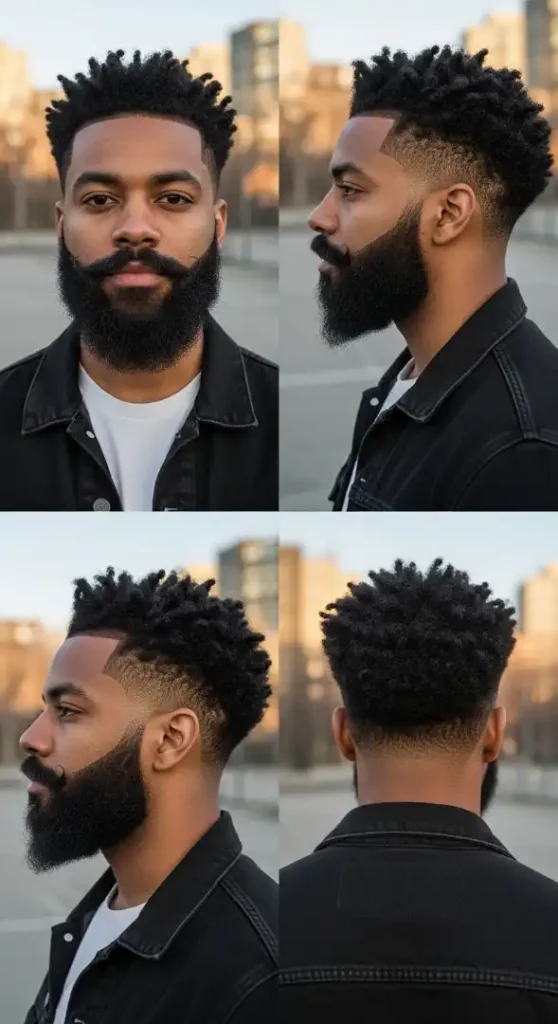
FACE SHAPE MATCH: The Full Chin Rebel — a wide, square-bottomed full goatee — is an exceptional choice for Diamond and Square face shapes. On a Diamond face (wide cheekbones, narrow forehead and chin), the wide, square-trimmed chin beard adds substantial visual mass to the chin, balancing the prominent cheekbones and creating a more proportionate bottom third of the face. On a Square face, the goatee draws the eye to the chin’s center while softening the corner angles of the jaw — the width of the goatee works with, not against, the face’s natural width. For men with very dense, coily beard textures, this style is also structurally superior because coily hair holds a square-trimmed shape with incredible precision and presence. Oval faces can wear it beautifully. Round faces should opt for a narrower version with a slight taper to avoid widening the face further.
GROOMING KIT:
- Trimmer: Wahl 5-Star Senior Clipper with #2 guide comb — coily beard textures have more density than straight beards and need a powerful trimmer motor
- Flat-bottom Trim Tool: A barber’s straight T-outliner (Andis T-Outliner) used horizontally to create the clean, flat bottom edge — this is the defining feature of this style
- Cheek Razor: BIC Flex 5 Hybrid with Edge Pro Sensitive Shave Gel for the cheek shave zone
- Co-wash Beard Cleanser: Cantu Men’s 2-in-1 Beard Wash & Conditioner (3-4x per week — coily beards require more moisture retention)
- Beard Butter: SheaMoisture Men Maracuja Oil & Shea Butter Beard Butter — applied daily to coily beard for moisture and definition
- Beard Picks: Small afro-style beard pick for lifting and defining coily beard texture daily
MAINTENANCE LEVEL: MEDIUM
- Barber visit: Every 2.5-3 weeks for maintaining the flat-bottom edge and cheek shave precision
- Daily time: 10-12 minutes — beard butter application, pick-out for definition, cheek spot-shave every 3 days
- Honest note: coily beard textures grow faster in visual terms (because of density) and will show length change faster — the flat-bottom edge specifically needs more frequent home touching to stay square
BARBER TALK (Exact Script): “I want a full goatee — connected mustache and chin beard. Keep the whole beard at a #2 guard for uniform density. The chin beard should be wide — follow the natural jaw width, don’t taper it narrow. I want a flat bottom trim — use the T-outliner held horizontally to cut a clean, straight bottom edge at 2 inches below my lower lip. That square bottom line is essential. Don’t taper or point the bottom — flat and wide. Clean-shave the cheeks with a straight razor or foil shaver — hard edge. Medium fade on the hair: 1 guard at the nape, blend up through 2 and 3 to the natural coily texture on top. Rounded neckline.”
The Full Chin Rebel owns the room with its boldness — Style #10 is for the man who wants that same natural presence but in a shape that works just as powerfully in a three-piece suit.
FAQs
Q: How do I get a clean, flat bottom edge on a goatee at home? A: Hold your Andis T-Outliner or BaByliss precision trimmer with the blade facing horizontally (like drawing a straight line). Use a fine-tooth beard comb to lift the beard hairs straight down, then run the trimmer blade across the bottom edge in one clean horizontal stroke. Check from multiple mirror angles. The flat-bottom cut reads as intentional and sharp — it’s the detail that separates a shaped goatee from a grown-out one.
Q: How do I care for a coily beard texture in a goatee? A: Coily beard hair needs significantly more moisture than straight or wavy textures. Use a dedicated co-wash beard cleanser (Cantu Men’s or SheaMoisture Men’s) 3-4 times per week. Apply beard butter (not just oil) daily — the butter provides moisture and light hold for definition. Use a small beard pick daily to lift the coils and prevent matting. Avoid regular shampoo on coily beards — it strips natural oils.
Q: What face shapes should avoid a wide, square-bottom goatee? A: Round face shapes should avoid the wide square-bottom goatee, as the horizontal width of the flat bottom edge amplifies the face’s circular appearance. If you have a Round face but want a full goatee, opt for a narrower version trimmed to a slight taper at the bottom to create vertical emphasis rather than horizontal width.
10 of 12 — The Pointed Sultan Goatee
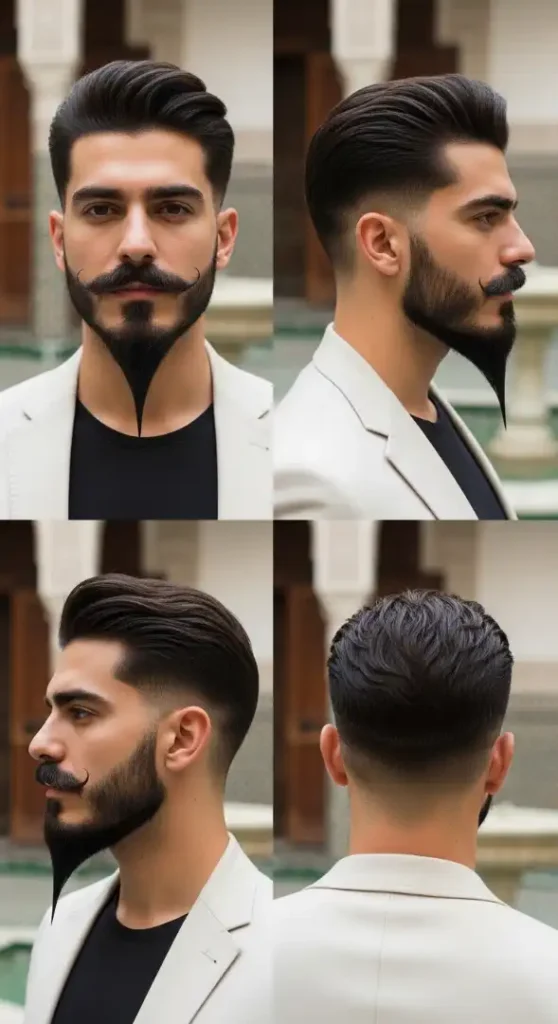
FACE SHAPE MATCH: The Pointed Sultan Goatee — a sculpted, sharp-pointed chin beard — performs magnificently on Oval and Oblong face shapes. On an Oval face, the pointed beard adds an aristocratic, distinctive character without disrupting the face’s natural balance. The point creates a commanding downward emphasis that gives the face a sophisticated authority. On an Oblong face (long and narrow), the beard must be managed carefully — keep the base width broader than the length to prevent the face appearing even narrower. Square and Diamond faces also benefit significantly: on both, the pointed chin beard softens angular jaw corners and redirects visual attention from the jaw’s width to the face’s elegant center feature. Round faces should completely avoid this style — a pointed goatee on a round face creates a jarring contrast that accentuates facial roundness rather than minimizing it.
GROOMING KIT:
- Trimmer: Andis Slimline Pro Li with #1.5 guide comb for the body of the beard
- Barber Scissors: Equinox Professional 6.5-inch Shears — the sharp point cannot be achieved with clippers alone; final tip shaping requires scissors
- Mustache Wax: Firehouse Moustache Wax (medium hold) for the subtle mustache tip curl
- Fine-tooth Comb: Hercules Sägemann comb for aligning beard hairs before scissor work
- Cheek Razor: Feather Safety Razor with Feather Hi-Stainless blades for an immaculate cheek shave — a pointed goatee demands perfect cheek cleanliness
- Beard Oil: Beardbrand Spice Route Beard Oil — 4-5 drops daily, worked from root to tip
- Beard Wax (finishing): Suavecito Beard Wax applied lightly at the tip to maintain the point’s geometric integrity throughout the day
MAINTENANCE LEVEL: HIGH
- Barber visit: Every 2-3 weeks — maintaining the geometric point requires professional scissor work; home maintenance of the tip is possible but risks losing the clean point
- Daily time: 12-15 minutes — cheek shave (every 2 days), beard oil (daily), mustache wax (daily), tip wax (daily)
- Honest caveat: This style is essentially destroyed if you sleep with it unprotected — a beard snood or wrapping at night is recommended to preserve the point’s shape
BARBER TALK (Exact Script): “I want a pointed Sultan-style goatee. Full mustache connecting to the chin beard — the mustache should sit right at the lip line with the slightest outward curl at the tips using wax. The chin beard body: use a #1.5 guard throughout, trim uniformly. The bottom 1.5 inches should then be hand-scissored into a defined geometric point — narrow it progressively using diagonal scissor cuts, finishing with a sharp, clean tip. The total beard length from lower lip to point should be 2.5 inches. Use a straight razor on the cheeks — I want that shave immaculate because the point demands it. Medium undercut on the hair — 0.5 on sides, side sweep on top.”
The Pointed Sultan Goatee carries centuries of aristocratic authority — Style #11 brings that same gravitas but strips away the formality for something completely street-level raw.
FAQs
Q: How do I maintain the sharp tip of a pointed goatee at home? A: Use a pair of sharp 6-inch barber scissors (not clippers). Comb the beard tip straight down, then use small diagonal cuts on both sides of the tip — cutting from the body of the beard inward toward the center point. Finish with a small application of Suavecito Beard Wax on the tip to hold the point in shape. Check from the front and both profiles with a mirror to ensure the point is symmetrical.
Q: What face shape is best for a pointed goatee? A: Oval and Oblong face shapes benefit most. Square and Diamond faces also wear it well as it softens angular jawlines and redirects attention to the face’s center feature. Round faces should avoid the pointed goatee — the sharp point on a round face creates an unflattering contrast that makes the face appear rounder.
Q: How is the Pointed Sultan Goatee different from the Van Dyke? A: Both feature a pointed chin beard, but the Sultan Goatee is connected — the mustache links directly to the chin beard at the mouth corners. The Van Dyke is disconnected — the mustache and chin beard are two completely separate elements. The Sultan Goatee looks more traditional and powerful; the Van Dyke looks more artistic and modern.
11 of 12 — The Corporate Chin Strap Goatee
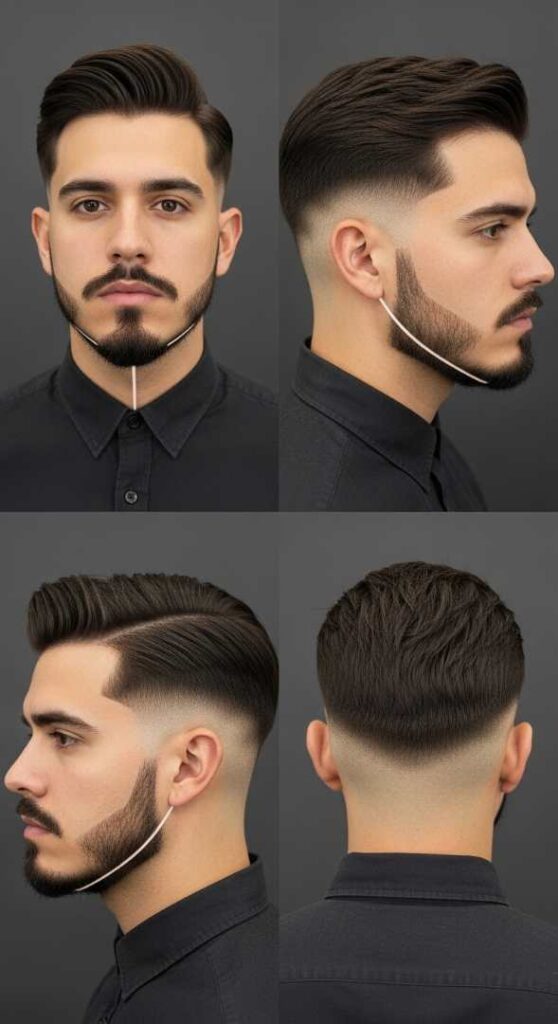
FACE SHAPE MATCH: The Corporate Chin Strap Goatee is a precision instrument designed specifically for men who want maximum jawline definition with minimum beard coverage. It is most transformative on Round and Oblong face shapes. On a Round face, the chin strap follows the jawbone contour and essentially draws the viewer’s eye directly along the jaw’s shape — creating the illusion of a sharper, more defined jawline where one may not naturally exist. The effect is similar to contouring in makeup: you are tracing the jaw’s outline in hair, making the jaw appear more sculpted than it is. On an Oblong face, the horizontal cheek-level line of the chin strap adds width perception. Diamond faces also benefit greatly. Square faces should use this style carefully — if the face already has a very prominent, angular jaw, the chin strap can over-emphasize the jaw’s width.
GROOMING KIT:
- Precision Outliner (Critical): Andis T-Outliner — this is non-negotiable for a 5mm chin strap; no other consumer tool provides the blade proximity needed for this width precision
- Parallel Guide Tool: A credit card held parallel to the jawline while using the outliner helps maintain the consistent 5mm width
- Cheek Razor: Panasonic Arc5 foil shaver for the broad cheek shave zones (large areas shave faster with foil than outliner)
- Exfoliant: Baxter of California Facial Scrub (2x weekly on cheeks) to prevent ingrown hairs in the intensively shaved cheek zones
- Aftershave Balm: Jack Black Post Shave Cooling Gel applied to all shaved zones after each shave
- Edge-Up Tool: Wahl Detailer T-Wide for the hairline edge-up and high skin fade touch-ups
MAINTENANCE LEVEL: VERY HIGH
- Barber visit: Every 7-10 days — this is the highest-maintenance goatee style in this guide; a chin strap of 5mm width loses its definition within a week
- Daily time: 15-20 minutes — the precision cheek shave, chin strap width maintenance, and edge-up all require daily or every-other-day attention
- Honest assessment: Only commit to this style if you genuinely enjoy grooming as a daily practice or have a reliable, nearby barber
BARBER TALK (Exact Script): “I want a Corporate Chin Strap Goatee. The chin strap should be exactly 5mm wide — a thin, precise line following my jawbone from below each ear all the way to the chin. At the chin, connect it to a small chin patch: about 1 inch tall, same 5mm width through the center, widening slightly to match the chin contour. Connect that upward to a thin mustache above the lip — trim the mustache to 5mm length maximum, just above the lip line. Use a T-outliner for all the boundary lines — no guard on the outliner, straight skin precision. 0.5 guard on the chin strap and mustache body for uniform texture. High skin fade: 0 guard bald at the temples, blend up through a 0.5 and 1 by 2 inches above the ear. Hard edge-up on the hairline. Square the back neckline.”
The Corporate Chin Strap demands daily dedication — Style #12 closes out this guide with a style that is equally sharp but built for the man who wants full impact with half the upkeep.
FAQs
Q: How do I keep a chin strap goatee’s lines consistently even at home? A: The most common mistake is inconsistent width. Use a credit card or thin ruler held parallel to your jawline as a width guide while you run the outliner along the jaw. The card acts as a visual reference to keep the 5mm line even from ear to chin. Practice both sides separately and check with a handheld mirror for symmetry.
Q: Is the chin strap goatee too high-maintenance for everyday life? A: For most men, yes. The chin strap requires edge definition every 3-4 days to maintain its precision width — hair growing outside the 5mm line immediately blurs the effect. If you travel frequently, work long hours, or don’t have easy access to good grooming tools, this style will look unkempt within a week. It’s best suited to men who genuinely enjoy daily grooming routines.
Q: Can a chin strap goatee help define a weak jawline? A: Yes — this is arguably its primary purpose. By precisely tracing the jawbone’s contour in a line of facial hair, the chin strap creates a visual definition of the jaw even where the jaw’s natural angles are soft. It’s the beard equivalent of jawline contouring. This effect is most dramatic on Round and Oblong faces where the jawline naturally lacks angularity.
12 of 12 — The Short Boxed Goatee
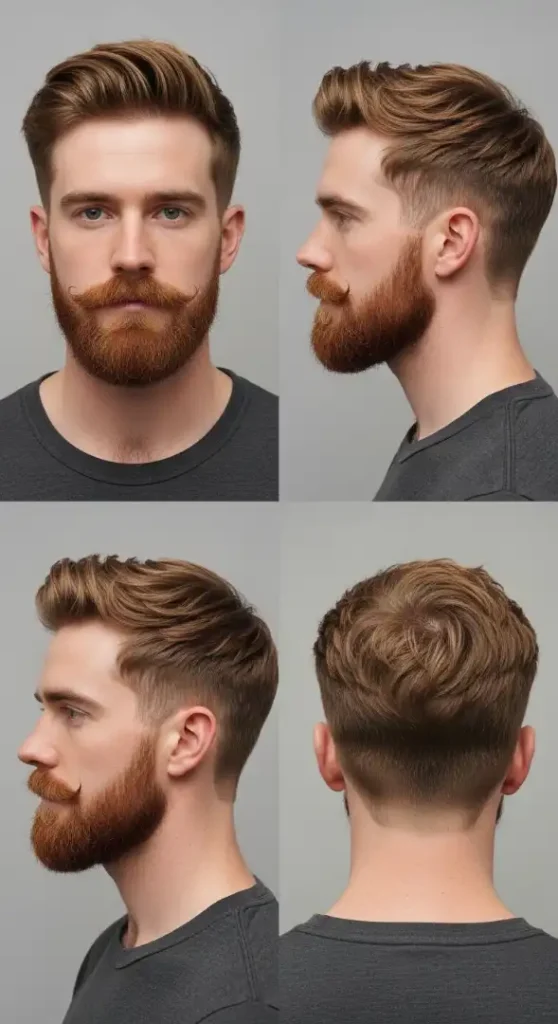
FACE SHAPE MATCH: The Short Boxed Goatee is one of the most democratic beard styles in men’s grooming — it works across the broadest range of face shapes of any style in this entire guide. Its rectangular geometry adds subtle definition to the lower face without dramatic elongation, narrowing, or widening — making it a safe, flattering option for Oval, Round, Square, and Heart faces alike. On a Round face, the box’s flat bottom creates horizontal geometry that adds the illusion of a more defined chin. On a Square face, the short length and box shape harmonize with the face’s angular features without competing. On a Heart face, the chin beard adds essential visual mass at the narrow chin. On an Oval face, it simply adds groomed character. The only face shape that gets marginal benefit is Oblong — the horizontal emphasis of the box can make an already long face appear even narrower if the chin beard is kept too narrow.
GROOMING KIT:
- Trimmer: Wahl Stainless Steel Lithium Ion+ with #2 guide comb — the workhorse for this style’s entire maintenance routine
- Outliner: Andis T-Outliner or BaByliss Pro FX for defining the straight horizontal bottom edge and the side shave lines
- Cheek Razor: Gillette Fusion5 ProGlide with Gillette Satin Care Sensitive Shave Gel
- Beard Shampoo: Every Man Jack Beard + Face Wash (2-3x per week)
- Beard Oil: Cremo Beard Oil (Tea Tree & Mint) — 2-3 drops daily
- Boar Bristle Brush: Striking Viking Beard Brush for daily brushing that trains the beard hairs into the box shape and distributes oil throughout
MAINTENANCE LEVEL: LOW-MEDIUM
- Barber visit: Every 4-5 weeks for a trim and cleanup — highly home-maintainable
- Daily time: 6-8 minutes — trimmer pass every 3-4 days at #2 guard, cheek shave every 2-3 days, beard oil daily
- This is the best entry-level goatee for men new to facial hair grooming — it’s forgiving, simple, and consistently delivers a polished result without demanding precision tools or techniques
BARBER TALK (Exact Script): “I want a Short Boxed Goatee. Connected mustache and chin beard, trimmed uniformly at a #2 guard throughout — no variation in length. I want the bottom edge trimmed straight and flat with a T-outliner — a clean, horizontal line creating a box shape at the chin, not tapered or pointed. The side cheek shave lines should be straight and vertical — creating a rectangular overall shape when you look at me face-on. The mustache should be trimmed so it doesn’t overhang the lip. Clean-shave the cheeks with a straight razor. Relaxed taper on the hair — 1.5 guard at the nape, blend naturally into the wavy texture on top. No hard fade line — keep it relaxed.”
The Short Boxed Goatee is where this guide ends — but if you’ve made it here, you’re ready to dive into our complete guide to men’s beard maintenance kits that will help you keep any of these 12 styles looking sharp every single day.
FAQs
Q: What is a Short Boxed Goatee and why is it good for beginners? A: A Short Boxed Goatee is a connected mustache and chin beard trimmed uniformly short (5-7mm) with a straight, flat horizontal bottom edge — creating a clean rectangular shape. It’s ideal for beginners because it only requires one guard size, is forgiving if you miss a day or two of maintenance, and suits almost every face shape without risk. It’s the most universally flattering goatee style in men’s grooming.
Q: How do I trim a boxed goatee’s flat bottom edge without a barber? A: Use an Andis T-Outliner held horizontally. Comb the beard hairs straight down, then position the outliner blade at your desired bottom length and draw one clean horizontal line across the chin beard. Move slowly and check both sides from a front-facing mirror. A small ruler placed across the chin horizontally helps verify the line is even before you cut.
Q: Can men with patchy beard growth pull off a Short Boxed Goatee? A: Yes — better than most other goatee styles. The short length (5-7mm) means individual patches are less visible than at longer lengths, and the box shape’s defined edges draw the eye to the overall geometric shape rather than the individual density. Keep the length at #1.5-2 guard and define the edges clearly — the structure compensates for patchiness effectively.
Q: How is a Short Boxed Goatee different from a Circle Beard? A: The primary difference is the bottom shape. A Short Boxed Goatee has a straight, flat horizontal bottom edge — creating a rectangle. A Circle Beard has a rounded, curved bottom edge — creating an oval. Both are connected goatee styles. The Box reads as more angular and modern; the Circle reads as softer and more traditional.