ICE BLONDE HAIR 13 Ways to Rock Ice Blonde Hair This Winter Season
1 of 13 — The Arctic Crown Sweep
Face Shape Match
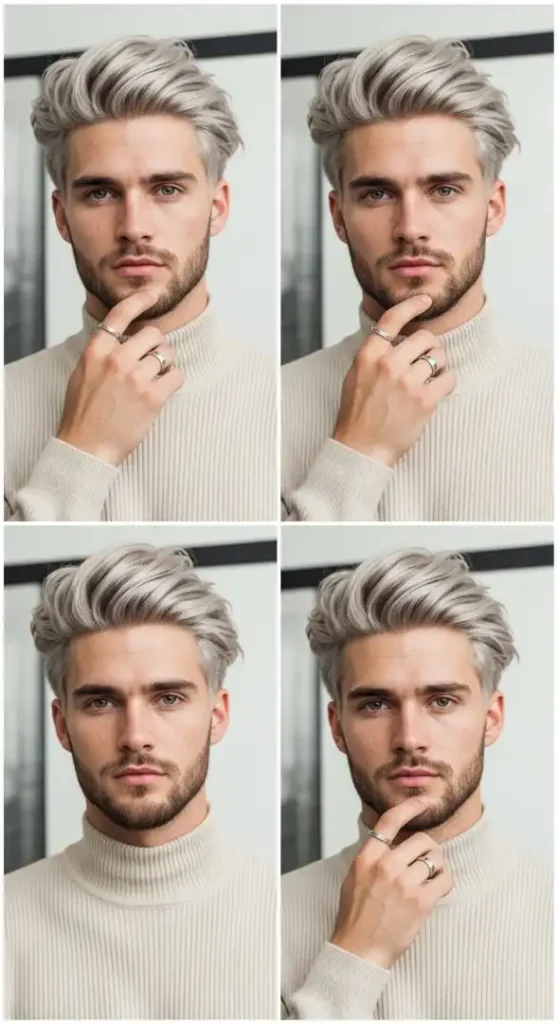
The Arctic Crown Sweep is architecturally designed for men with Oblong and Diamond face shapes. The crown volume adds lateral width at the top while the tapered temples prevent the style from elongating the face further — a critical balance for longer face geometries. The back-swept motion draws the eye horizontally across the crown, creating the illusion of a broader forehead and stronger cheekbone presence. For Diamond-faced men specifically, the soft volume at the crown fills the naturally narrow forehead zone, achieving proportion that few other styles can deliver without aggressive styling.
Grooming Kit
- Clippers: Wahl Magic Clip Cordless for initial length setting and taper blending
- Trimmer/Outliner: Andis T-Outliner for clean hairline definition and sideburn shaping
- Finishing: Kent Handmade Comb (Model 20T) for precision parting; Mason Pearson Pocket Bristle Brush for distributing product through fine blonde strands
- Styling Product: American Crew Pomade (Light Hold/High Shine) for the swept-back motion without weighing down fine hair; Oribe Grandiose Hair Plumping Mousse at the roots for crown lift
Maintenance Level
Medium. Salon visit every 4–5 weeks to maintain the taper and keep the crown length at its optimal 3–4 inch working length. Daily styling takes approximately 8–12 minutes: apply mousse to damp hair at roots, blow-dry upward and back with a round brush, finish with a small amount of pomade worked through the lengths. Color maintenance (toning/glossing) every 6–8 weeks to prevent ice blonde from going brassy in winter indoor heating environments.
Barber Talk Script
“I want a tapered side profile — not a fade, just a clean natural taper from about a 3 guard on the sides graduating up to the natural length on top. Keep the top long — minimum 3.5 inches at the crown, I need enough length to sweep it back. Clean up my hairline at the back with a neck taper, nothing too aggressive. Trim the sideburns to just below the ear lobe. Blend where the taper meets the top so there’s no harsh line. And square off my stubble at about 3mm all over — no shaping on the beard, just clean the neck line.”
Want to see how ice blonde transforms with added texture? Style 2 takes the platinum look in a completely different structural direction that your barber will love executing.
FAQs
Q: What face shape suits a swept-back ice blonde hairstyle? A: Swept-back ice blonde styles suit Oblong and Diamond face shapes best. The crown volume adds width to narrower face geometries while the tapered sides prevent the look from over-elongating. Men with Square faces can also pull it off by keeping the taper soft rather than sharp.
Q: How do I keep ice blonde hair from looking yellow indoors in winter? A: Use a purple or blue toning shampoo once every 7–10 days — Shimmer Lights by Clairol or Fanola No Yellow are top-rated options. Indoor heating and hard water both accelerate brassiness. Follow with a hydrating conditioner as toning shampoos can dry fine strands.
Q: What product gives ice blonde hair volume without weighing it down? A: Oribe Grandiose Mousse applied to damp roots before blow-drying delivers lift without stiffness or heaviness. Follow with a lightweight pomade like American Crew Light Hold through the lengths to finish. Avoid waxes and heavy clays on fine blonde hair — they flatten the crown.
Q: How often should I get a taper trim for a swept-back style? A: Every 4 to 5 weeks. Tapers grow out quickly because the graduation from short sides to longer top becomes visible as the sides gain length. Waiting beyond 5 weeks will cause the swept volume to lose its clean frame and the style will start looking shapeless rather than intentional.
2 of 13 — The Platinum Textured Quiff
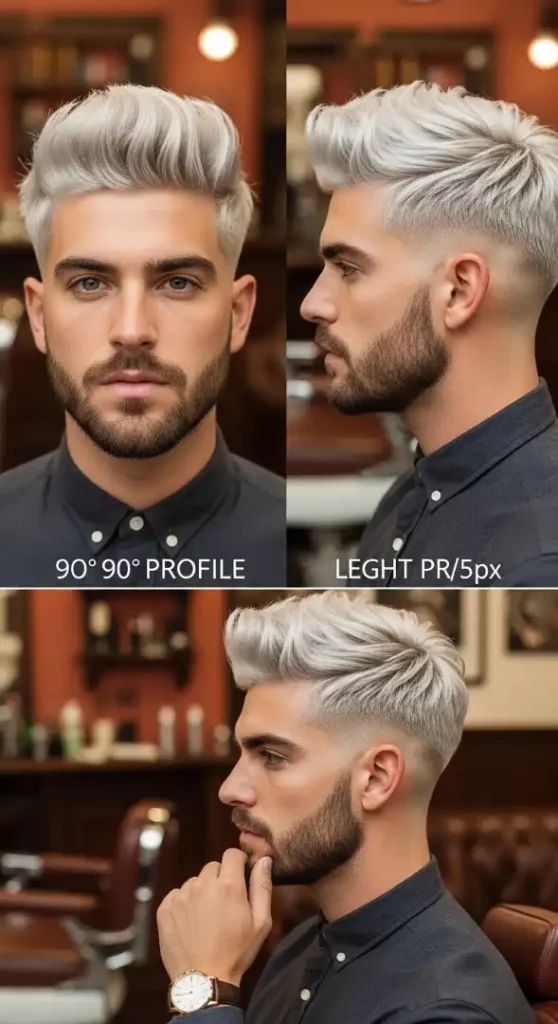
Face Shape Match
The Platinum Textured Quiff is the defining choice for men with Round and Square face shapes. The elevated front volume creates vertical height that directly counteracts the wideness of a Round face — the eye travels upward to the peak of the quiff rather than across the full width of the cheeks. For Square-faced men, the textured, separated strands at the top introduce organic irregularity that softens the angular jawline without hiding it. Oval-faced men can equally wear this style, though they can afford to push the quiff even higher for a more dramatic editorial result.
Grooming Kit
- Clippers: Andis Master Cordless for the low skin fade work at the temples and above the ear
- Trimmer/Outliner: BaByliss Pro FX787 for razor-sharp hairline definition and beard neckline cleanup
- Finishing: Denman D3 Classic Styling Brush for initial blowout direction; Kent Carbon Comb for piece-y separation at the top
- Styling Product: Suavecito Matte Clay for the textured separation and matte finish on platinum strands; Kenra Platinum Silkening Mist as a heat protectant before blow-drying to protect color-treated hair from thermal damage
Maintenance Level
Medium-High. Platinum blonde color requires salon toning every 5–6 weeks — ice blonde fades fast on Mediterranean hair due to underlying warm pigment. The fade itself needs a refresh every 3 weeks maximum or the low skin fade begins to look grown-out. Daily styling: 10–14 minutes. Apply Kenra heat protectant to damp hair, rough-dry with fingers upward, then use a round brush to direct the quiff forward and upward, finishing with clay worked through fingertips on dry hair for the textured separation effect.
Barber Talk Script
“I want a low skin fade — skin at the temple, graduating up to about a 1 guard just above the ear, then blending naturally into the full length above the parietal ridge. Keep the top long enough for a quiff — I need at least 3 to 3.5 inches at the front to push it up. Point cut the top to remove bulk without losing length, so it sits textured rather than heavy. Clean my hairline with a razor — very sharp at the temples and forehead. Beard stays as is but clean the neckline at the jaw and trim to about 4mm all over.”
If textured quiff energy is what you’re after, wait until you see Style 3 — it takes the ice blonde texture concept into a longer, more rebellious structure that hits completely differently.
FAQs
Q: Can men with naturally dark hair pull off ice blonde without damaging their hair? A: Yes, but it requires a multi-session bleaching process with professional toners — never attempt ice blonde in a single appointment on dark hair. Use Olaplex Bond Multiplier during bleaching sessions to minimise breakage. Expect 2–3 salon visits spaced 3–4 weeks apart for a safe, clean platinum result on dark Mediterranean hair.
Q: What is the difference between a textured quiff and a pompadour? A: A textured quiff sits forward and has a separated, piece-y finish with matte or low-shine products — it reads modern and casual. A pompadour sweeps back with full smooth volume and typically uses high-shine pomade for a polished, vintage feel. Quiffs are lower maintenance and work better with textured or wavy hair; pompadours suit straight hair and formal styling.
Q: How do I stop my ice blonde quiff from looking flat by midday? A: Flat quiffs on fine platinum hair are caused by moisture loss and gravity. Use a volumising mousse at the root before blow-drying, and finish with a light-hold matte clay — NOT a heavy wax. Carry a small travel-size dry shampoo (Batiste Original is ideal) to refresh root lift on the go without re-wetting the hair.
Q: How low should a low skin fade be for a quiff hairstyle? A: For a quiff, a low skin fade should begin at the temple, with zero-skin at the very base graduating to a 0.5 or 1 guard by the mid-ear line. This keeps the sides clean without removing too much visual weight — which would make the quiff look disproportionately top-heavy. The fade should be gradual and blended, not a sharp line.
3 of 13 — The Frost Taper Fringe
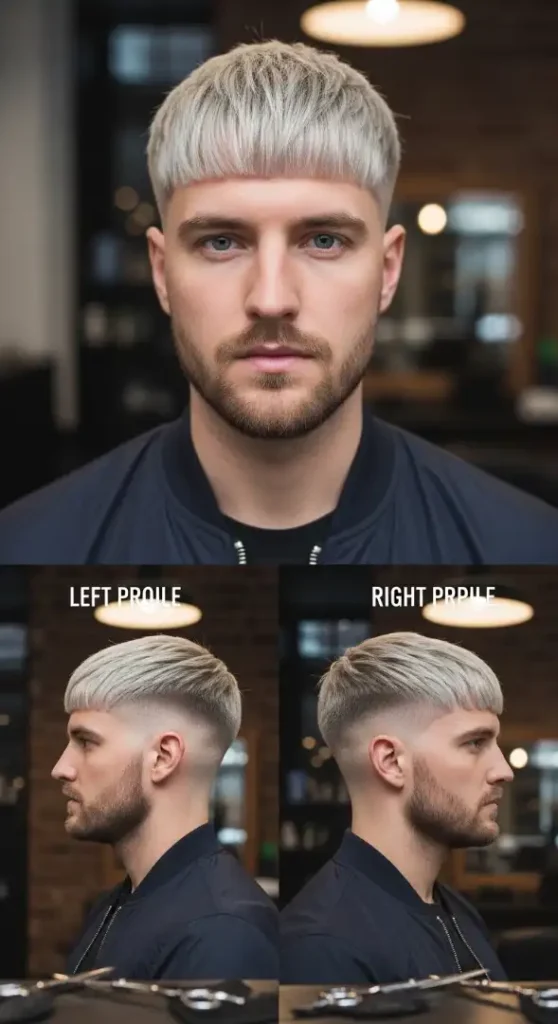
Face Shape Match
The Frost Taper Fringe is ideally matched to men with Heart and Oval face shapes. The horizontal fringe line across the forehead visually reduces the width of a broader forehead — the primary characteristic of Heart-shaped faces — creating a more proportionate balance between the upper and lower face. Oval-faced men benefit from the fringe as it adds definition and visual interest to a face shape that can otherwise appear undefined from the front. The mid-skin fade on the sides prevents the overall look from becoming too top-heavy, maintaining clean proportions through the temple and cheek.
Grooming Kit
- Clippers: Wahl Senior Cordless for the mid skin fade gradient work — its close-cutting precision is ideal for the zero-to-1.5 graduation required here
- Trimmer/Outliner: Andis Slimline Pro Li for defining the fringe’s lower edge and temple hairline
- Finishing: Tangle Teezer Wet Detangler for fringe alignment when damp; Denman D1 Small Styling Brush for directing fringe forward during blowout
- Styling Product: Kevin Murphy Un.Dressed texture cream for piece-y fringe separation; Moroccanoil Hydrating Styling Cream to protect fine ice blonde strands from winter dryness and static
Maintenance Level
Medium. The fringe length is the most maintenance-intensive element — it needs trimming every 3–4 weeks or it drops below the brow line and loses its sharp horizontal geometry. Fade refresh: 4 weeks. Daily styling: 6–9 minutes. Mist damp fringe, comb forward, and allow to air-dry in the correct direction — or use a flat paddle brush and low-heat blow-dryer to set a clean horizontal hang. Finish with a small amount of texture cream pressed through fingertips.
Barber Talk Script
“I want a mid skin fade — skin at the base of my temple, graduating up to a 1.5 guard by the top of the ear, then blending naturally into the full length. Keep the fringe at exactly eyebrow level — I want a clean horizontal cut across, not angled or textured, just straight across. Fringe length about 2 to 2.5 inches. Point-cut the top for slight texture but keep the fringe blunt at the tips. Hairline very clean at the temples with a straight razor. Keep my stubble, just tidy the neckline and cheek line — I’ll maintain the length.”
The Frost Fringe keeps things structured and refined — but Style 4 breaks all the rules with an ice blonde look built for maximum street impact.
FAQs
Q: How do I stop my ice blonde fringe from looking flat and limp? A: Fine ice blonde fringes go flat because bleached hair has a lifted cuticle that loses moisture quickly. Use a volumising spray (try Joico Volumize Hair Shake) misted onto a damp fringe before blow-drying forward with a round brush. Avoid heavy products entirely on the fringe — a single drop of texture cream worked through the tips is enough.
Q: What is the difference between a fringe and a curtain fringe for men? A: A standard blunt fringe lies flat and horizontal across the forehead as one solid piece. Curtain fringes are parted in the centre and fall to either side of the face, framing the features like curtains. Blunt fringes read sharper and more editorial; curtain fringes are softer and more relaxed. Ice blonde works exceptionally well on both.
Q: Can a fringe hairstyle work with a skin fade? A: Absolutely — the fringe-with-skin-fade combination is one of the most requested combinations in modern barbershops. A low to mid skin fade keeps the sides clean and sharp, which actually enhances the structural impact of the fringe rather than competing with it. The contrast between the longer top and cropped sides makes the fringe the clear focal point.
Q: How do I ask my barber for a mid skin fade? A: Tell your barber: ‘I want a mid skin fade — start with skin zero at the temple, graduate to a 1 or 1.5 guard mid-way up the side, and blend naturally into the top length. Keep the fade tight and clean at the sides, and make sure the blend line sits at ear height, not higher.’ This gives your barber all the technical information they need.
4 of 13 — The Glacial Undercut Pompadour
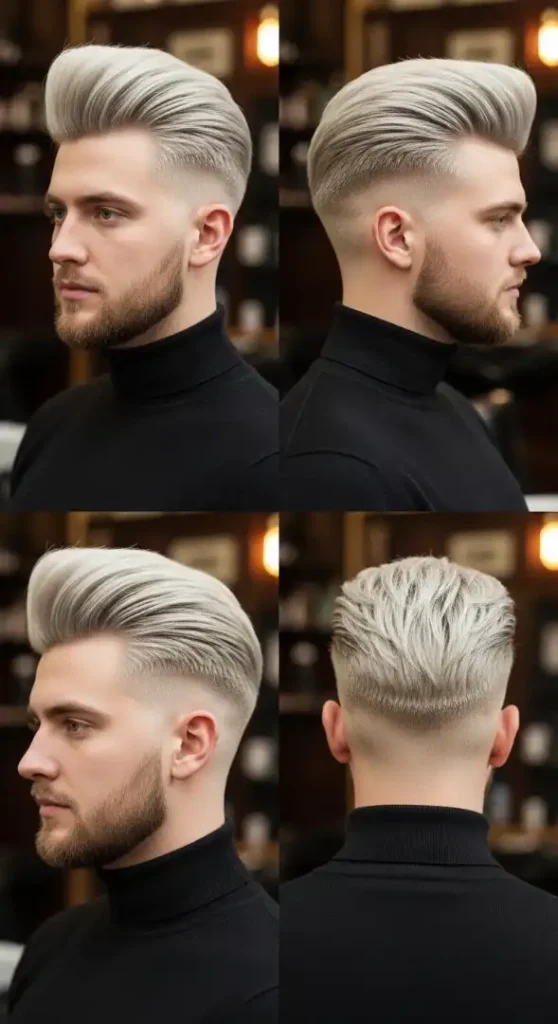
Face Shape Match
The Glacial Undercut Pompadour is purpose-built for men with Square and Oblong face shapes. The extreme height of the pompadour adds vertical drama to Square faces, drawing attention upward and away from the angular jaw — which remains present but no longer dominates the overall silhouette. For Oblong faces, the full volume at the top must be balanced by keeping the sides very tight (which the undercut does naturally), preventing the overall shape from becoming excessively tall. The hard part adds a clean geometric anchor that gives sharp-jawed men an almost architectural aesthetic.
Grooming Kit
- Clippers: Andis Master ML for the undercut’s defined boundary — the precision blade creates the clean disconnect between top and sides
- Trimmer/Outliner: Wahl Detailer with T-blade for razor-sharp hard part and hairline definition
- Finishing: Mason Pearson Large Bristle & Nylon Brush for the pompadour blowout direction; wide-tooth Kent comb for initial wet styling
- Styling Product: Layrite Super Hold Pomade for maximum hold on the tall pompadour structure; Suavecito Firme Hold Pomade as a backup for extreme weather or long-event days when slippage is not an option
Maintenance Level
High. This is a demanding look by every measure. Undercut boundary needs sharpening every 2–3 weeks — beyond that, regrowth blurs the hard disconnect that defines this style. Hard part needs razor re-etching every 1–2 weeks. Daily styling: 15–20 minutes. Apply hold pomade to dry hair section by section, directing each section backward and upward with a round brush under medium-high heat. This is not a style for men who skip product days.
Barber Talk Script
“I want a full disconnected undercut — shave the sides to skin below a horizontal line sitting at the parietal ridge. Everything above that line stays full length — I need at least 4 to 5 inches at the front to push the pompadour up. Etch a hard part on my left side — razor sharp, about 1 centimeter wide. At the back, keep the undercut boundary clean and straight across — nape shaved to skin with a clean taper. No fade — I want a hard disconnect, not a blend. Razor sharp everywhere. No beard today — just clean up the neck.”
The Glacial Undercut Pompadour is high commitment, high reward — but if you want ice blonde with less daily styling effort, Style 5 delivers serious impact with a fraction of the morning routine.
FAQs
Q: How do I maintain an undercut pompadour at home between salon visits? A: Daily upkeep requires 15–20 minutes of product application and blow-drying. Use Layrite Super Hold Pomade worked section by section from the nape forward, directing hair upward and back with a round brush. The hard part can be re-defined at home using a fine-tooth comb and a small amount of edge control gel along the parting line — do not attempt to re-shave the part yourself unless you have clippers training.
Q: Which face shape suits an undercut pompadour best? A: Square and Oblong face shapes suit undercut pompadours best. Square-faced men benefit from the upward height drawing the eye away from a wide angular jaw. Oblong-faced men should keep the pompadour height moderate — no more than 2.5 inches of height above the crown — to avoid over-elongating the face. Round-faced men should avoid this style as the tall top dramatically exaggerates circular face proportions.
Q: What is the difference between an undercut and a fade for a pompadour? A: An undercut features a hard, disconnected line where the top length meets the side — there is no blending, just a clean boundary. A faded pompadour blends the side length gradually from short to long, creating a softer transition. Undercuts read more dramatic and high-fashion; faded pompadours read more barbershop-classic and wearable for everyday settings.
Q: How often should I get an undercut trimmed? A: Every 2 to 3 weeks. The undercut’s defining visual feature — the sharp disconnect between the shaved sides and full top — disappears quickly as side regrowth blurs the boundary line. Waiting longer than 3 weeks will shift the look from ‘intentional undercut’ to ‘grown-out fade,’ which defeats the entire structural purpose of the style.
5 of 13 — The Silver Drop Taper
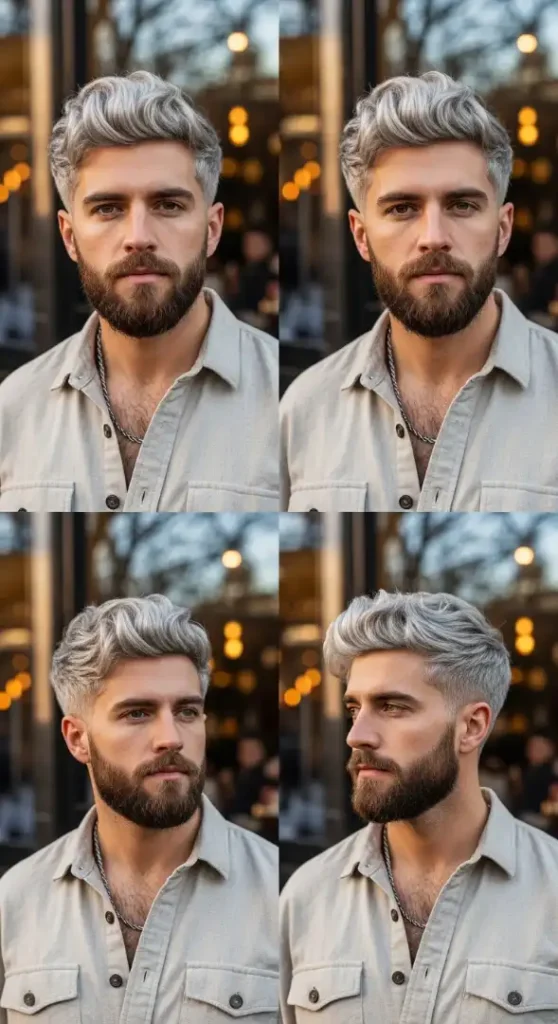
Face Shape Match
The Silver Drop Taper was designed for men with Oval and Round face shapes who want a low-effort style that still reads as intentionally styled. The natural drop of the top creates soft diagonal movement across the forehead, breaking the symmetry that makes Round faces appear flat. The low taper on the sides provides structure without harsh geometry, which would over-angular a softer facial structure. Oval-faced men have the most freedom with this style — they can wear the drop heavier to one side for a casual asymmetry, or centre it for a more balanced editorial look.
Grooming Kit
- Clippers: Wahl Magic Clip with #1 and #1.5 guards for the soft low taper graduation
- Trimmer/Outliner: Andis T-Outliner for cleaning the natural hairline without sharpening it into an unnatural arch
- Finishing: Boar bristle paddle brush (Denman B2 Natural Bristle) for distributing product evenly through the drop; wide Kent comb for initial wet direction-setting
- Styling Product: Bumble and Bumble Surf Spray misted on damp hair before air-drying to enhance natural wave texture; American Crew Light Hold Fiber on dry hair to define the drop without stiffness; Beardbrand Tree Ranger Beard Oil for beard conditioning and light sheen
Maintenance Level
Low-Medium. The Silver Drop Taper is the most accessible ice blonde style in this collection. Taper refresh every 5 weeks is sufficient — the gradual graduation grows out gracefully rather than looking neglected. Daily styling: 4–7 minutes. Mist with surf spray on damp hair, scrunch lightly, and allow to air-dry or use a diffuser on low heat. Finish with a small amount of fiber pressed through the tips of the drop. No blow-drying technique required.
Barber Talk Script
“I want a low taper — not a fade, just a natural taper. Start blending from about a 1 guard at the bottom of the side, graduating naturally into the full length above the ear. No skin, no hard line — I want it to look natural, like it grew into place. Keep the top about 2.5 inches all over, no hard part, no etch. Trim any split ends from the top and point-cut the ends for a little texture. Don’t touch the hairline — keep it natural. Beard: clean the neckline and cheek line, trim to about 6mm all over.”
If the relaxed effortless approach resonates with you, you’ll want to see Style 6 — which takes silver-toned ice blonde and pairs it with a bold structural fade for an entirely different energy level.
FAQs
Q: What is the difference between a taper and a fade for men’s hair? A: A taper gradually reduces hair length from top to bottom, ending before the skin — the shortest length is still a very short clipper length, not bare skin. A fade continues all the way to skin zero. Tapers look more natural and grow out better; fades are sharper and more defined but require more frequent upkeep. The Silver Drop Taper uses a low taper for intentionally soft, natural-looking results.
Q: How do I get my hair to drop naturally to one side without a hard part? A: Train your hair by consistently combing or brushing it in the desired drop direction while damp every day for 2–3 weeks. Use a lightweight spray or leave-in cream to set the direction while the hair dries. Natural hair growth cowlicks will often dictate which direction the drop wants to fall — work with your natural pattern rather than against it for the most effortless result.
Q: Is ice blonde hair high maintenance for men with full beards? A: The beard itself adds minimal extra maintenance — beard oil daily and a trim every 3–4 weeks. The real maintenance cost is the ice blonde colour, which needs toning every 6–8 weeks to prevent brassiness. The silver-blonde tone is actually more forgiving than full platinum — it can hold its tone slightly longer because the silver pigment masks early-stage brassiness better than pure platinum does.
Q: What products should I use to maintain natural wave texture in ice blonde hair? A: Salt spray (Bumble and Bumble Surf Spray or John Paul Mitchell Sea Salt Spray) applied to damp hair before air-drying is the best tool for enhancing natural waves without heaviness. Avoid shampoo every day — co-washing with a moisturising conditioner on off-days preserves the wave pattern. Use a deep conditioning mask weekly, as bleached hair loses moisture rapidly, which flattens natural wave texture.
6 of 13 — The Icy High Skin Disconnect
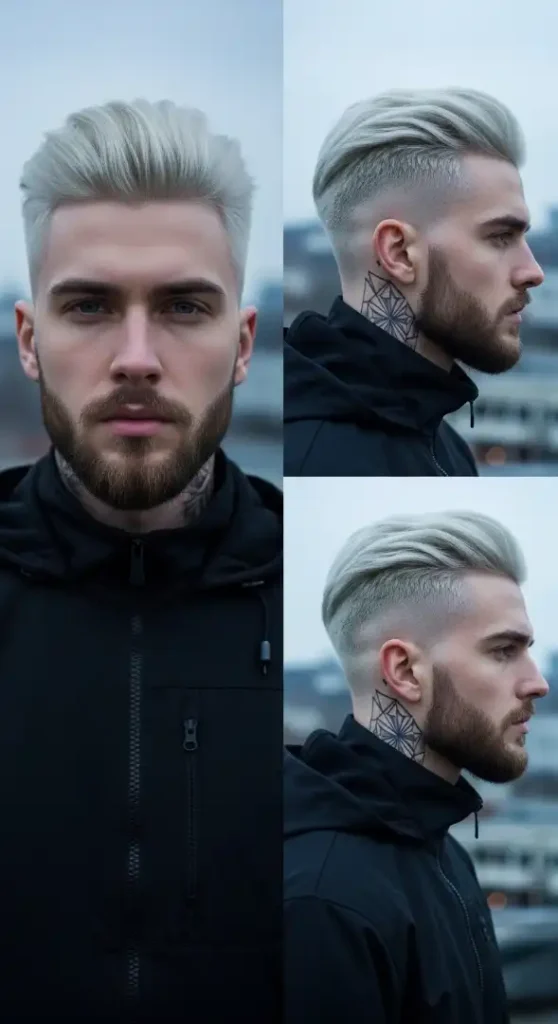
Face Shape Match
The Icy High Skin Disconnect makes the most powerful statement on men with Diamond and Square face shapes. The extreme skin fade removes all visual weight from the sides and temples, which directly counteracts the wideness of a Square jaw by focusing all visual attention on the contrast between the clean sides and the ice white top. Diamond-faced men benefit enormously from the high disconnect — the sharpness of the boundary line at the parietal ridge creates the illusion of a wider upper head, perfectly balancing the naturally narrow forehead of Diamond face shapes. This is not a forgiving style for Round faces — the high fade will only emphasize circular proportions.
Grooming Kit
- Clippers: Andis Master ML Cordless for the zero-skin foundation of the high fade — the Andis Master’s precision blade is non-negotiable for a truly clean bald base
- Trimmer/Outliner: Andis T-Outliner GTX for the geometric beard shaping — cheek line precision is critical in this style to maintain the overall hard-edge aesthetic
- Finishing: Denman D31 Military Brush for distributing product through the ice white top; Y.S. Park Carbon Comb for pushing the top back
- Styling Product: Suavecito Firme Hold Pomade (water-based, strong hold) for pushing the dense top back; Beardbrand Utility Balm for maintaining the medium beard’s geometric shape and reducing flyaways at the cheek line
Maintenance Level
High. A high skin fade on ice white hair is one of the most demanding styles in men’s grooming. The fade needs a refresh every 10–14 days maximum — the skin base grows back visibly within two weeks, and any regrowth destroys the high-contrast disconnect effect entirely. Beard geometric shaping every 10 days. Daily styling: 8–12 minutes applying firm hold pomade through the top and pushing back. This style is not suitable for men who travel frequently without access to their regular barber.
Barber Talk Script
“I want a high skin fade — bald skin at the base, right at the temple. I want the fade to rise steeply — minimal graduation, I want it to look almost like a hard disconnect by the time it reaches the parietal ridge. The top stays full and thick — push everything upward and don’t thin it out. No blend between the top and the sides — I want a disconnected look, not a soft blend. Hairline razor sharp at the temples and forehead. Beard: I want a clean geometric shape — sharp line at the cheek, sharp corner at the jaw, neckline trimmed tight at 5mm, trim the beard length to about 8mm all over.”
The high skin disconnect is maximum impact — but if you prefer ice blonde with a longer, more flowing top, Style 7 is going to be exactly what you’re looking for.
FAQs
Q: How do I ask my barber for a high skin fade with a disconnect? A: Say: ‘I want a high skin fade — start at skin zero right at my temple and rise steeply to the parietal ridge. I want a hard disconnect at the top — no blend, no taper, just a clean boundary line where the short sides stop and the full top begins. Keep the top full and don’t thin it.’ This script covers all the technical specifics your barber needs.
Q: Does ice blonde hair show up better on a high skin fade than other fade levels? A: Yes — dramatically. A high skin fade creates the maximum contrast between the pale scalp sides and the ice blonde top, making the colour appear more vivid and more intentional. Low and mid fades create softer transitions where the ice blonde blends gradually into the skin — beautiful, but far less dramatic than the stark contrast of a high skin fade.
Q: How often should I get a high skin fade touched up? A: Every 10 to 14 days is the absolute maximum for a high skin fade to stay crisp. The bald base grows back visibly faster than any other fade style because the contrast between bare skin and any hair growth is immediately obvious. If your fade appointment cadence drops to every 3 weeks, the style transitions from sharp disconnect to messy regrowth.
Q: Can men with thick hair get a disconnected high fade? A: Thick hair is actually ideal for this style — the density of the top creates a more dramatic contrast against the shaved sides. Ask your barber to point-cut through the top to remove some bulk while maintaining length. Thick ice blonde hair styled back over a high skin fade has enormous Pinterest and Instagram visual impact precisely because of how the density catches the light.
7 of 13 — The Frozen Mid-Length Flow
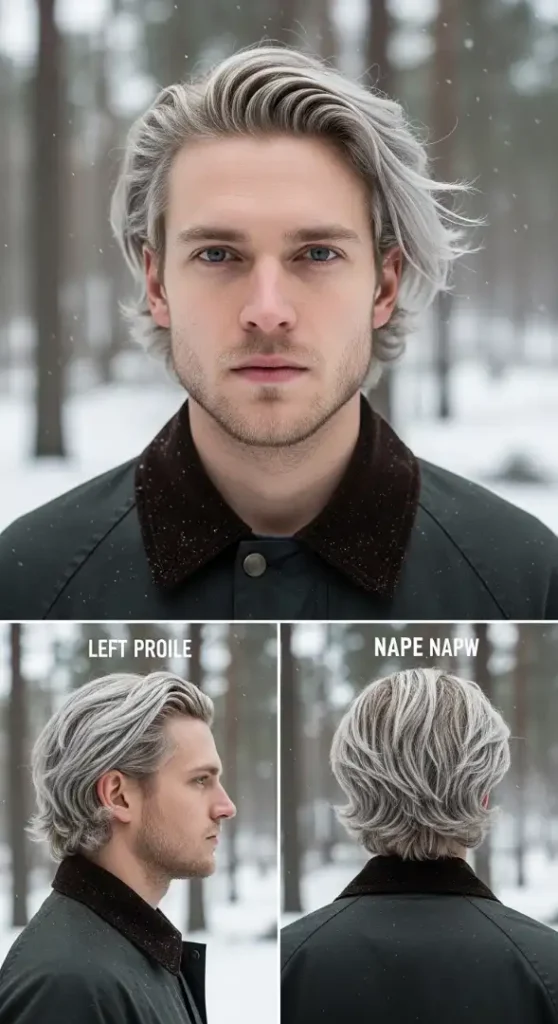
Face Shape Match
The Frozen Mid-Length Flow is most flattering on men with Oval and Oblong face shapes. The mid-length all-over volume creates a horizontal mass that visually widens the narrower proportions of Oblong faces — the waves falling to below-ear level add width exactly where these face shapes need it most. Oval-faced men can wear this style in any direction — forward, pushed back, or parted naturally — and it reads beautifully from every angle. Square-faced men can also benefit from this style as the soft wave texture and rounded movement soften the angular jaw without competing with it. Round-faced men should apply a light texturising product to push the hair back from the face rather than allowing it to fall forward, which would emphasize roundness.
Grooming Kit
- Clippers: Not applicable for this style — scissors-only cut at the salon to preserve wave integrity throughout
- Trimmer/Outliner: Wahl Detailer for light neckline tidying and stubble cleanup — keep the neck natural, not shaved
- Finishing: Diffuser attachment for blow-dryer (Dyson Supersonic compatible) for enhancing wave pattern without frizz; wide-tooth shower comb for detangling without disrupting waves
- Styling Product: Ouai Wave Spray for defining ice blonde waves without crunch; Living Proof No Frizz Weightless Styling Spray as a humidity shield for winter indoor/outdoor transitions; Beardbrand Utility Balm for light stubble conditioning
Maintenance Level
Low. The Frozen Mid-Length Flow is the most low-maintenance style in this entire collection for men who are willing to let their natural wave pattern do the work. Salon scissors trim every 6–8 weeks for split end maintenance is all that’s required structurally. Daily styling: 3–5 minutes maximum. Apply wave spray to damp hair, scrunch lightly, and either air-dry or diffuse on low heat. Avoid brushes while hair is drying — they break up the wave pattern and introduce frizz into ice blonde-treated hair.
Barber Talk Script
“I want to keep the length — mid-length all over, sitting just below my ears. Scissors only please, no clippers on the sides — I want to keep the full natural length everywhere. Just trim about half an inch all over for split ends, point-cut the ends for texture rather than blunt-cutting. Don’t remove too much from the top — I need enough length to let the wave show through. No fade, no taper — keep everything natural. Light stubble stay — just clean the neckline and trim to about 4mm.”
Mid-length flow is the style for men who let their personality lead — but Style 8 shows what happens when ice blonde goes to full length with polished structure and serious editorial presence.
FAQs
Q: How do I style mid-length wavy ice blonde hair for a natural look? A: Apply a wave-defining spray like Ouai Wave Spray to damp hair, scrunch upward from the ends, and allow to air-dry or use a diffuser on low heat. Do not touch the hair while it is drying — any manipulation breaks the wave formation. Once dry, shake out with fingertips only to separate clumps. Finish with a drop of shine serum pressed over the surface.
Q: Does ice blonde colour damage naturally wavy hair? A: Bleaching does raise the hair cuticle, which can cause wavy hair to feel dryer and appear less defined over time. Combat this with a keratin or protein treatment every 8 weeks, a deep conditioning mask weekly, and a sulphate-free shampoo. Ouai’s Medium Shampoo and Conditioner are specifically formulated for wavy hair and maintain the wave pattern without stripping ice blonde tones.
Q: What is the best haircut for men with naturally wavy blonde hair? A: A mid-length cut with point-cutting throughout is ideal for naturally wavy blonde hair. Point-cutting removes bulk without destroying the wave pattern — unlike blunt cuts, which force all the weight to the ends and can make waves appear bottom-heavy and shapeless. Ask your barber to cut dry if possible, as wavy hair behaves differently dry versus wet.
Q: How do I prevent ice blonde wavy hair from getting frizzy in winter? A: Winter indoor heating creates low humidity environments that cause the raised cuticle of bleached wavy hair to absorb moisture erratically, creating frizz. Use a smoothing leave-in cream on damp hair before drying, and apply a tiny amount of light hair oil (Moroccanoil Treatment Light) over the surface of dry hair to seal the cuticle. Anti-frizz bonnets at night and silk pillowcases also dramatically reduce winter frizz in wavy ice blonde hair.
8 of 13 — The Winter Slick Executive
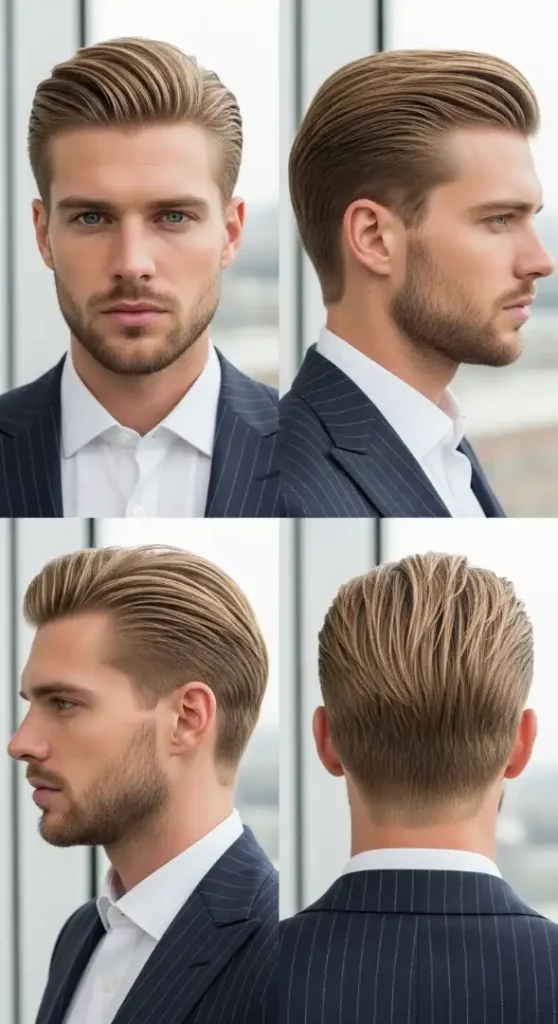
Face Shape Match
The Winter Slick Executive is the definitive choice for men with Oval and Square face shapes operating in professional environments. The slicked-back direction exposes the full face and hairline, which works exceptionally well for Oval-faced men as it allows their naturally balanced proportions to take full visual center stage. For Square-faced men, the clean low taper keeps the sides conservative and corporate while the hard part adds a decisive geometric element that complements angular jaw structure — making the style look intentional rather than merely tidy. This style is notably not recommended for men with very high or pronounced foreheads, as the full exposure of the hairline with hair combed back will accentuate rather than soften that feature.
Grooming Kit
- Clippers: Wahl Senior Cordless with #1 guard for the conservative low taper — corporate environments require the most controlled, clean graduation possible
- Trimmer/Outliner: Andis T-Outliner for the hard part precision etch and temple hairline cleanup
- Finishing: Kent Handmade Comb (Model 20T, large-tooth) for the initial wet slick-back direction; Denman D14 Classic Dressing Comb for finished refinement
- Styling Product: Uppercut Deluxe Pomade (strong hold, medium shine) for the slick-back structure; Layrite Super Shine Cream as a mixing enhancer for additional hold without stiffness; Kiehl’s Facial Fuel moisturiser for the clean-shaven skin, preventing dryness from winter indoor heating
Maintenance Level
Medium. Conservative low taper grows out gracefully — salon visit every 5–6 weeks is sufficient for professional presentation. Hard part etch every 3–4 weeks. Daily styling: 10–14 minutes. Apply pomade to dry hair section by section, combing from front to back with firm tension to build a flat, directed result. Use the fine-tooth comb to finalize the part and tighten any stray strands. Clean-shaven maintenance requires daily or every-other-day shaving with a quality razor and post-shave balm.
Barber Talk Script
“I want a conservative low taper — 1 guard blending naturally, nothing aggressive. No skin fade. Start the taper just above the ear and blend it naturally into the full length on top. Keep the top length at about 2 to 2.5 inches so I have enough to slick back comfortably. Etch a hard part on my left side — sharp and clean with the razor, about half a centimeter wide. At the back, I want a natural neckline — no etch, just clean up the neck naturally. No beard, just a clean shave — take care of the neckline and I’ll keep the face myself.”
The executive slick is the most office-ready ice blonde style we’ve covered so far — but Style 9 takes the champagne-blonde energy completely off the clock and into the street.
FAQs
Q: What is the best pomade for a slicked-back blonde hairstyle? A: Uppercut Deluxe Pomade or Layrite Original Pomade are the top choices for a slick-back on blonde hair. Both are water-based (easier to wash out) and provide enough hold to maintain the direction all day in corporate environments. Avoid oil-based pomades on ice blonde or champagne-blonde hair — they can tint the hair with yellow undertones over time and are notoriously difficult to remove fully.
Q: How do I keep a hard part looking sharp throughout the day? A: Apply a small amount of edge control or firm-hold gel precisely along the part line before styling the rest of the hair. Comb the parting firmly in both directions to set the division. The gel anchors the part against humidity and movement. A light mist of medium-hold hairspray over the part once styled will lock the definition for 8–10 hours in most environments.
Q: Is ice blonde hair appropriate for corporate or office environments? A: Ice blonde is entirely appropriate in professional environments when the cut itself is conservative and well-maintained. A champagne or light platinum blonde with a clean low taper and slick-back reads executive and polished rather than edgy. The key is maintaining a tidy hairline and avoiding very high-contrast fades or disconnected styles, which read more street than boardroom.
Q: What face shapes should avoid a slicked-back hairstyle? A: Men with very prominent foreheads, receding hairlines, or high widow’s peaks should approach the slick-back cautiously — combing all hair back fully exposes these features. Men with Round faces should also be careful, as exposing the full face without any framing can emphasize circular proportions. For these face shapes, a modified slick-back with some loose strands at the front softens the exposure while maintaining the corporate aesthetic.
9 of 13 — The Blizzard Burst Crop
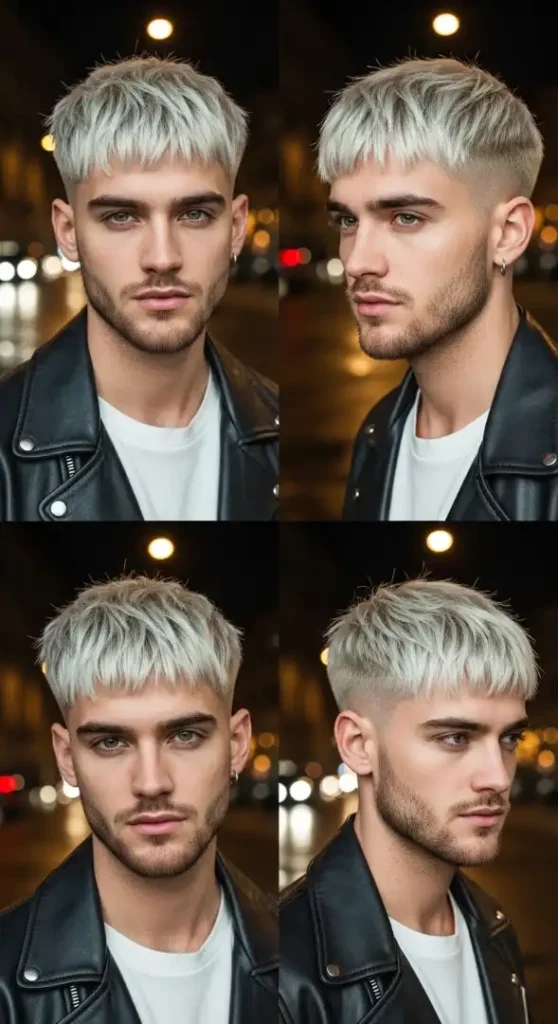
Face Shape Match
The Blizzard Burst Crop is the go-to recommendation for men with Round and Square face shapes. The heavy horizontal fringe creates a powerful visual line across the upper face that counteracts the circular proportions of Round faces — the weight of the crop sitting forward and downward grounds the top of the face and creates perceived definition. For Square-faced men, the dense horizontal top works with the angular jaw to create a deliberately geometric overall silhouette — face and hair become a unified architectural statement. The mid skin fade on the sides removes lateral width, which benefits both face shapes simultaneously.
Grooming Kit
- Clippers: Andis Master Cordless with fade lever for the mid skin fade — control over the lever graduation is critical for achieving the abrupt contrast between fade and the dense top
- Trimmer/Outliner: BaByliss Pro GoldFX for the ultra-precise fringe baseline and temple hairline cleanup — gold titanium blades perform exceptionally on dense, thick-strand ice blonde
- Finishing: Denman D14 Dressing Comb for initial wet fringe alignment; stiff natural bristle brush for pushing the crop forward into the horizontal position while blow-drying
- Styling Product: Suavecito Matte Clay (strong hold, matte finish) for holding the dense crop forward and giving the piece-y ice blonde texture — matte finish is critical here because shine would make the blunt fringe look heavy rather than textured; Dove Men+Care Fortifying Shampoo for the light designer stubble area to soften coarse growth
Maintenance Level
Medium-High. French crop fringes need trimming every 3–4 weeks — they grow below the brow line within a month and lose the sharp horizontal impact that defines this style. Fade refresh: every 3 weeks. Daily styling: 8–10 minutes. Apply matte clay to dry hair, press and work through the dense top, then push the crop forward and slightly inward, pressing the fringe down firmly with fingertips. Use a blow-dryer briefly to set the position before releasing.
Barber Talk Script
“I want a French crop — blunt horizontal fringe sitting right at my brow, or just touching it. Heavy and dense on top, don’t thin it out too much — I want the crop to look full and bold. Mid skin fade on the sides — skin at the base, graduating to about a 1.5 by the mid-ear. Top and fade should contrast — no soft blend at the top. Point-cut the surface of the crop for texture but keep the fringe blunt at the tips. Razor sharp hairline at the temples. Designer stubble: just clean the neckline and cheek line, keep it at about 3 to 4mm.”
The Blizzard Burst Crop is pure street energy — but Style 10 shows how ice blonde transforms into a completely different aesthetic when the top grows out into a flowing modern structure.
FAQs
Q: What is a French crop haircut for men? A: A French crop is a men’s haircut where the top is cut to a medium short length and styled forward with a blunt, horizontal fringe sitting at or just above the eyebrow line. The sides are typically faded or tapered. The result is a dense, forward-weighted style with a clean structural fringe that reads modern and editorial. It is one of the most requested barbershop styles currently trending.
Q: How do I keep a French crop fringe from curling or lifting? A: A lifting fringe is caused by growth at the root pushing the fringe upward. Use a matte clay pressed firmly from the root through to the tip, then press the fringe down with your palm for 10–15 seconds to set the direction. A light pass of a flat paddle brush and brief low-heat blow-dryer blast from above will also hold the fringe down. Avoid applying too much product at the tips — weight at the ends can cause the fringe to droop rather than stay horizontal.
Q: Is ice blonde hair hard to maintain on a dense French crop? A: Dense hair with a high strand count actually holds ice blonde toner better and longer than fine hair, because there is more hair mass absorbing the toner pigment per application. However, the toning process itself takes longer on thick hair and requires more product. Expect every toning session at the salon to take 30–45 minutes longer on dense thick hair. The colour result is typically more vibrant and lasts 2–3 weeks longer than on fine hair.
Q: What fade level works best with a French crop? A: A mid skin fade (skin at the base, graduating to a 1.5 guard by the ear top) is the most popular and most visually balanced pairing for a French crop. A low skin fade creates a softer look; a high skin fade creates a more aggressive contrast. The mid skin fade is the versatile middle ground that looks appropriate from barbershop to boardroom without appearing either too soft or too extreme.
10 of 13 — The Frostbite Curtain Part
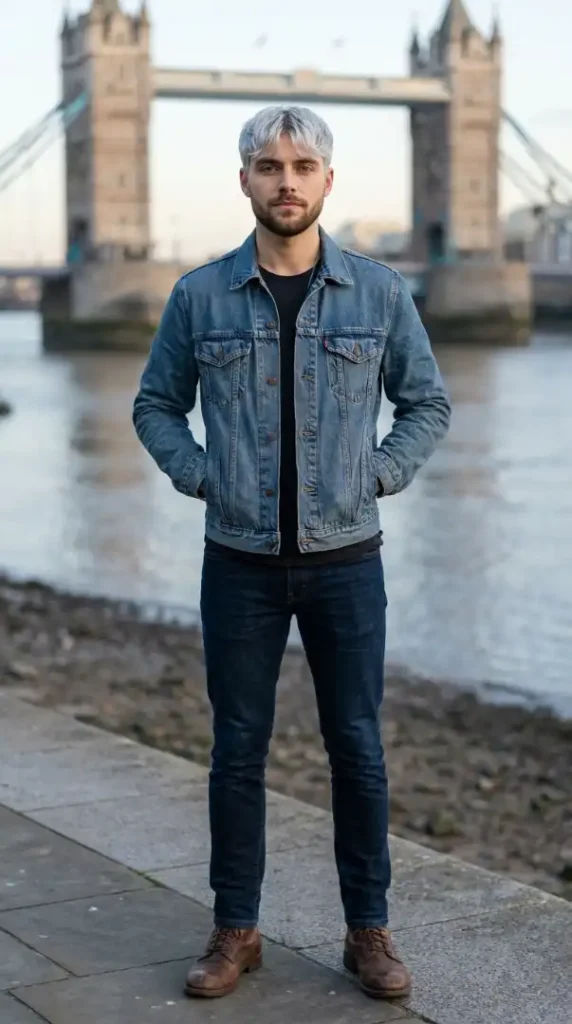
Face Shape Match
The Frostbite Curtain Part is one of the most universally flattering styles in modern men’s hair — it works across Oval, Oblong, Diamond, and Heart face shapes with genuine effectiveness. For Heart-faced men, the curtain framing adds visual width at cheek level, counteracting the natural tapering of the lower face and chin. For Oblong faces, the horizontal spread of the curtain panels adds perceived width across the cheekbone, preventing the face from reading as excessively long. Diamond-faced men benefit from the curtain’s weight at cheek level which visually widens the narrowest part of their face shape. Oval is the wild card — curtain parts on Oval faces are effortlessly proportionate from every angle.
Grooming Kit
- Clippers: Not required for curtain part styles cut with scissor-only technique — this preserves the natural wave movement essential to the curtain’s visual appeal
- Trimmer/Outliner: Wahl Detailer for natural neckline cleanup only — do not sharpen the neckline with a trimmer in this style; keep it soft and natural
- Finishing: Tangle Teezer Original for detangling damp curtain fringe without disrupting wave pattern; Kent Carbon Comb (fine/coarse dual-tooth) for setting the centre part precisely
- Styling Product: R+Co Balloon Volumizing Mousse at the roots for lift and curtain volume; Moroccanoil Hydrating Styling Cream through the mid-lengths and ends for frizz control and wave definition; a drop of Olaplex Bonding Oil No.7 on the surface for shine and colour protection on ice blonde strands
Maintenance Level
Low. Curtain part styles grow out naturally and gracefully — they can extend comfortably for 6–8 weeks between salon visits without looking unkempt, as longer curtain hair actually reads more intentional rather than less. Daily styling: 3–6 minutes. Set the centre part with a comb while hair is damp, apply mousse from roots and styling cream from mid-lengths down, then air-dry or diffuse on low. The curtain part essentially styles itself with minimal product intervention.
Barber Talk Script
“I want to keep my length — medium all over, just below my cheekbones. Scissors only — I want to keep the natural wave and length. Trim about half an inch to clean up the ends, point-cut throughout so the curtain has texture and movement rather than a heavy blunt feel. I need a clean centre part — just guide me on where the natural centre falls. No fade, no taper on the sides — keep everything the same length. The neckline: just trim naturally, don’t shave or shape it — I want a soft natural neckline. Stubble: trim to about 5mm, clean the neckline.”
The curtain part brings a relaxed, effortless cool that works in any setting — but Style 11 shifts ice blonde into a completely different mood with bold structural edges and a modern clean cut that commands attention.
FAQs
Q: How do I train my hair to hold a centre curtain part? A: Part your hair at the centre every single time you style it while damp — use a fine-tooth comb and press the part firmly in both directions. Apply a lightweight styling product from the root to hold the direction as the hair dries. After 2–3 weeks of consistent daily parting in the same place, the hair follicle pattern adjusts and the part holds naturally with minimal effort.
Q: What is the difference between a curtain fringe and a middle part? A: They are essentially the same concept described differently — ‘curtain fringe’ emphasises the framing movement of the hair falling to either side of the face like curtains, while ‘middle part’ refers simply to the parting technique. Curtain fringes typically have more length and movement; middle parts can be applied to any length. The key visual element is the hair falling forward and to both sides rather than being swept back.
Q: Does ice blonde look good on a curtain part hairstyle? A: Ice blonde is arguably the best colour choice for a curtain part because the pale, bright tone catches light as the curtain panels move and fall, creating a beautiful luminous framing effect around the face. Darker hair colours can make curtain fringes look heavy; ice blonde keeps the style looking light, airy, and editorial even at medium lengths.
Q: How do I stop my curtain fringe from going frizzy in winter humidity? A: Winter transitions from cold outdoor air to warm indoor heating spike humidity fluctuations that cause frizz in wavy ice blonde curtain fringes. Apply a smoothing leave-in cream (Moroccanoil Hydrating Styling Cream works best) to damp hair before drying. Store a small travel-size hair oil (Olaplex No.7 Bonding Oil) to press over the surface of dry hair when entering warm environments. Silk pillowcases at night also dramatically reduce frizz by eliminating friction during sleep.
11 of 13 — The Polar Wolf Shag
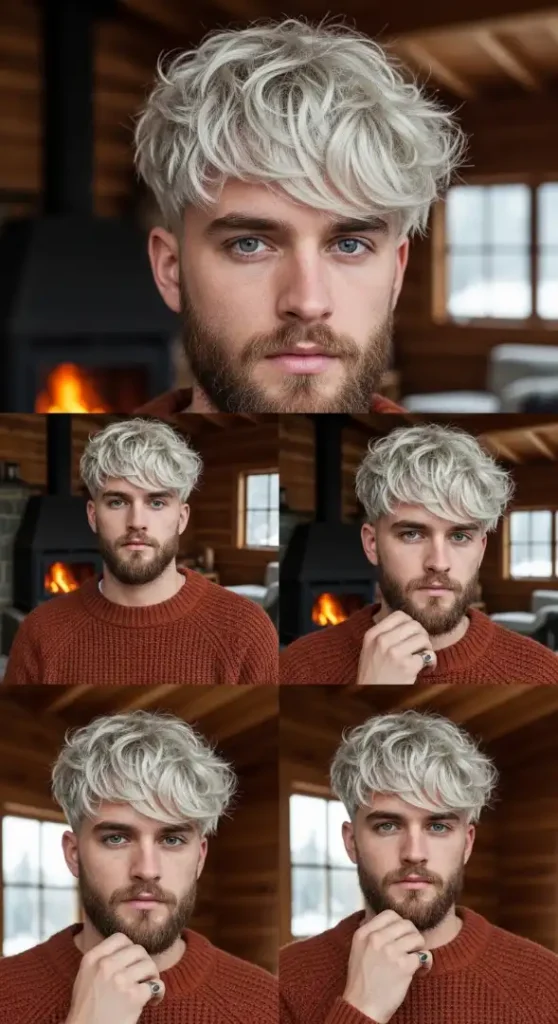
Face Shape Match
The Polar Wolf Shag is an extraordinary match for men with Oval, Heart, and Diamond face shapes. The heavy layering creates volume at the crown and movement through the sides and ends, which works against the natural narrowness of Diamond face shapes by adding perceived width and visual mass from the mid-face downward. Heart-faced men benefit from the fuller shaggy ends that add visual weight below the cheekbone, balancing a naturally wider forehead. Oval-faced men are the natural winners of this style — the layers enhance their proportional balance and add textural interest without compromising structural harmony. Square-faced men should approach the wolf shag with caution — the full volume on all sides can over-widen an already strong square jaw unless layers are strategically graduated.
Grooming Kit
- Clippers: Not required — the wolf shag is entirely scissors-cut; any clipper involvement destroys the organic layered movement
- Trimmer/Outliner: Andis Slimline Pro for natural neckline cleanup and beard outline shaping
- Finishing: Denman D4 Universal Brush for gentle distribution of styling products through layers; wide-tooth comb for initial wet detangling of the dense shag layers
- Styling Product: Ouai Hair Oil (2 drops worked through mid-lengths and ends) for shine and frizz control on ice blonde layers; Drybar Detox Dry Shampoo for root volume refreshing on day 2 and 3; Bumble and Bumble Hairdresser’s Invisible Oil Primer before blow-drying for heat protection on bleached strands; Beardbrand Beard Balm for conditioning and shaping the medium rugged beard
Maintenance Level
Low-Medium. Wolf cuts grow out beautifully — the layered structure maintains its movement even as it extends, making this one of the most growth-friendly styles in modern men’s hair. Salon visit every 7–9 weeks for layer refresh. Daily styling: 5–8 minutes. Apply hair oil and primer to damp hair, scrunch and diffuse on low heat, or simply scrunch and air-dry. The heavy texture of the shag does most of the visual work independently of product — it reads styled even with minimal intervention.
Barber Talk Script
“I want a wolf cut shag — heavy layers throughout. Keep the top and crown shorter for volume — about 2.5 to 3 inches at the crown — then let the layers get progressively longer through the sides and back, ending at about collar length. Point-cut everything — no blunt cuts anywhere in this style. I want the layers disconnected and textured, not blended smooth. Keep a curtain fringe at the front — centre parted, falling to both sides. No fade on the sides — keep the full length. Natural neckline at the back — just tidy it with scissors. Beard: trim to about 10mm all over, clean the cheek line and neckline.”
The wolf shag is pure personality — but Style 12 brings ice blonde into a completely different territory with a refined, polished structure built for men who want the colour without the drama.
FAQs
Q: What is a wolf cut and how is it different from a shag haircut? A: A wolf cut is a modern hybrid of the shag and the mullet — it features heavy layers at the crown for volume, a fringe, and longer shaggy ends at the back and sides. A traditional shag is more evenly layered throughout without the mullet-inspired back length. Wolf cuts have more defined volume contrast between crown and ends; shags have more uniform layer distribution. Both are cut with scissors only and rely on natural texture.
Q: Can men with thick hair get a wolf cut? A: Thick hair is the ideal canvas for a wolf cut — the density supports the crown volume layers and creates natural dramatic movement through the mid-lengths and ends that fine hair can only achieve with heavy product use. The key is asking your stylist to point-cut aggressively through the layers to remove bulk without removing length — this creates the light, airy, textured result the wolf cut is known for.
Q: How do I style a wolf cut with ice blonde hair for maximum texture? A: Apply Ouai Hair Oil to damp hair from mid-lengths down, then scrunch upward to activate the layered movement. Diffuse on low heat with a diffuser attachment — never rough-dry with a regular nozzle, as this will flatten the layers. Once 80% dry, flip your head upside down and shake gently to build crown volume, then finish with a light shake-out of the layers from the sides. The ice blonde tones enhance the visual texture because the pale colour catches light at every layer angle simultaneously.
Q: Is a wolf cut high maintenance for men? A: A wolf cut is one of the lowest-maintenance longer styles available for men. The heavy layering means the cut grows out gracefully and continues to look intentional for 7–9 weeks between appointments. Daily styling is 5–8 minutes with minimal product. It is however not suitable for men who prefer a clean, polished daily appearance — the organic texture and movement read deliberately casual rather than corporate-formal.
12 of 13 — The Ice Storm Buzz Contrast
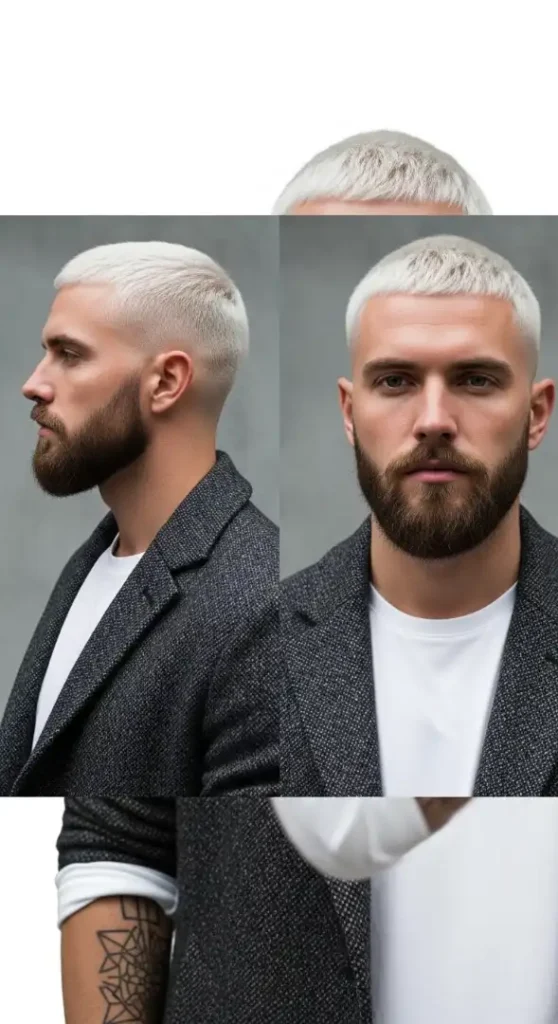
Face Shape Match
The Ice Storm Buzz Contrast works most powerfully for men with Diamond, Oval, and Square face shapes. The uniform ice white buzz cut is a bold move that removes all hair from the equation as a structural tool — which means the face shape itself becomes the primary visual anchor. This makes face shape compatibility critical. Diamond-faced men with strong cheekbones gain a dramatic sculptural quality from the buzz — the cropped head emphasises the cheekbone width as the widest facial point, and the full beard adds compensatory weight at the jaw. Square-faced men benefit from the beard providing a longer chin-forward visual emphasis that softens the jaw’s wideness. Oval-faced men simply look proportionally excellent — there is no face shape the buzz cut benefits more reliably. Round-faced men should use this style with extreme caution without an elongating beard.
Grooming Kit
- Clippers: Wahl Magic Clip Cordless with a #1.5 guard for the uniform buzz — consistency across the entire head is the entire point, so a reliable high-precision clipper is non-negotiable
- Trimmer/Outliner: Andis T-Outliner GTX for the geometric beard shaping — this style’s visual drama depends entirely on the beard’s geometric precision
- Finishing: Denman D1 Small Paddle for any surface touch-ups (minimal use on buzz); soft boar bristle face brush for clearing any clipper debris from the head after buzzing
- Styling Product: No product required on the buzz cut — the ice white speaks for itself. Beard: Beardbrand Utility Balm (medium hold) for daily beard shaping and conditioning; Cremo Original Shave Gel for maintaining the geometric cheek line at home between barber visits
Maintenance Level
Medium. The buzz cut itself requires clipping every 10–14 days to maintain the uniform ice white consistency — any regrowth with dark roots at this length is immediately visible. Colour root touch-up every 4–5 weeks to prevent visible dark regrowth on the buzzed ice white. Beard geometric shaping every 10 days. Daily styling: 2–5 minutes — beard balm through the beard, done. This is one of the lowest daily styling commitments in the collection despite its high visual impact.
Barber Talk Script
“I want a uniform buzz all over — 1.5 guard, consistent from front to back, top to sides. No fade, no taper, no gradient — just a flat even buzz everywhere. Keep my beard full — geometric shape on the cheek line, sharp corner at the jaw. Trim the beard to about 15mm all over — I want it full but controlled. Neckline clean — straight across, tight to the jaw. No fading on the beard into the neckline — a clean horizontal line is exactly what I want.”
The buzz contrast shows that ice blonde doesn’t need length to make a statement — but our final style, Style 13, brings the most refined and polished ice blonde look of the entire collection to close this article in style.
FAQs
Q: Does ice blonde colour work on a buzz cut hairstyle? A: Ice blonde on a buzz cut creates a distinctive, striking look — the uniform pale colour across the close-cropped head gives a silver-white sculptural quality that reads very editorial and intentional. The key challenge is root maintenance — at buzz cut length, dark root regrowth is visible within 2–3 weeks, so colour touch-up appointments need to be frequent. The visual payoff is significant for men willing to maintain the schedule.
Q: How do I contrast a buzz cut with a beard effectively? A: The beard-buzz contrast works through a strict geometric separation — the beard’s geometric cheek line and sharp jaw shaping must be extremely precise and clean to create the intended contrast against the uniformly cropped head. Have your barber use an outliner to define the cheek line as a clean straight line from the sideburn corner to the chin corner. The sharper and more defined the beard geometry, the more dramatic the contrast against the buzzed head.
Q: How often do I need to touch up an ice blonde buzz cut? A: Every 10 to 14 days for the buzz cut length maintenance, and every 4 to 5 weeks for colour root touch-up. At 1.5 guard length, dark root regrowth of even 2–3mm creates a visible two-tone effect that signals the ice blonde has grown out. This is the most frequent colour maintenance cadence in this entire collection — men considering this look should factor regular salon visits into their grooming budget and schedule.
Q: What beard length works best with a buzz cut? A: Medium-length beards (12–20mm) create the most dramatic contrast with a buzz cut because the length differential between the head and the beard is at its maximum. Shorter designer stubble (3–5mm) creates a subtler, more minimalist contrast — cleaner but less dramatic. Full long beards can actually overwhelm the buzz cut visually at a certain point. A medium geometric beard at 12–15mm is the universally agreed sweet spot for the buzz-beard contrast aesthetic.
13 of 13 — The Crystal Fade Ivy
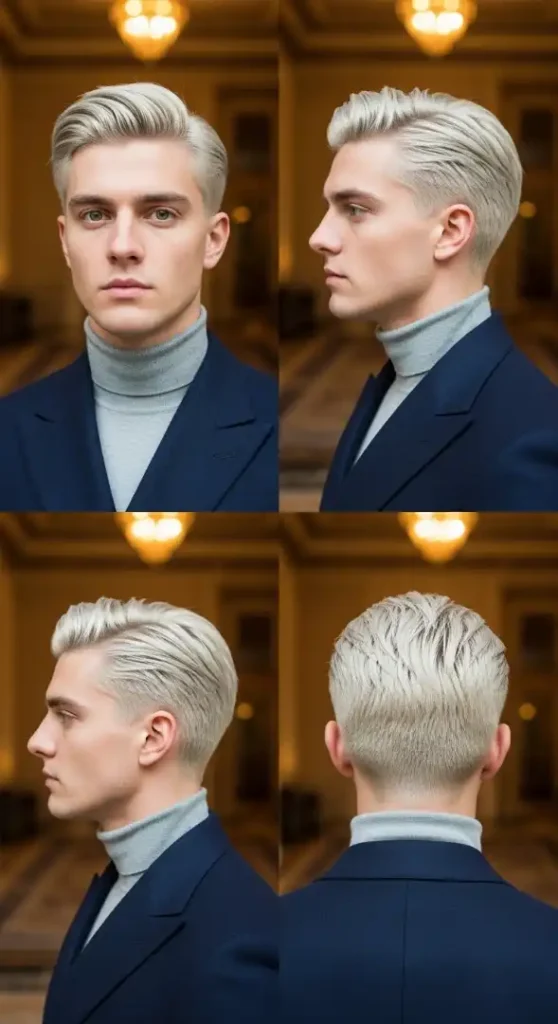
Face Shape Match
The Crystal Fade Ivy is the most universally appropriate ice blonde style in this entire collection — it suits all face shapes with appropriate styling adjustments, but performs best on Square, Oval, and Oblong face shapes. For Square-faced men, the soft combed-over direction and conservative skin fade creates polish without geometric aggression — the Ivy League’s rounded, classic form softens the jaw’s natural angularity without hiding it. Oval-faced men receive the style’s full balanced treatment — the proportionate parted volume and clean sides create a textbook result. Oblong faces benefit from the horizontal emphasis of the combed-over part which adds perceived width. This is the style to recommend when a man wants ice blonde that works in the boardroom, at a wedding, and on a date — simultaneously.
Grooming Kit
- Clippers: Andis Master Cordless with #0.5 and #1 guards for the refined skin fade graduation — the Ivy League’s conservative fade must be executed with surgical precision, not a heavy hand
- Trimmer/Outliner: Andis T-Outliner for the clean hairline etch at the temples and the precise nape shape — the rounded neck hairline in an Ivy League cut requires a trimmer, not a razor, for the most natural-looking result
- Finishing: Kent Handmade Comb K2 (medium-tooth) for the precision combed-over part; Mason Pearson Pocket Bristle Brush for smoothing the ice blonde top after product application
- Styling Product: American Crew Pomade (Strong Hold, High Shine) for the classic combed-over Ivy League — the high shine reading is contextually appropriate for the refined setting this style occupies; Layrite Natural Matte Cream as an alternative for men who want the Ivy structure in matte for a slightly less formal context; Kiehl’s Facial Fuel SPF 20 moisturiser for the clean-shaven face in winter dryness
Maintenance Level
Medium. The Ivy League’s classic proportions mean the style stays intentional and sharp for 5–6 weeks between salon visits — longer than most fade styles because the conservative graduation grows out gradually rather than suddenly. Skin fade base needs a touch-up at week 3–4. Daily styling: 7–10 minutes. Apply pomade to dry hair starting at the part, comb the dominant side over first, then smooth back any loose strands. Finish with a final pass of the comb to sharpen the part. Clean-shaven face: daily or every-other-day shaving to maintain the polished pairing.
Barber Talk Script
“I want an Ivy League — classic combed-over style with a left-side part. Skin fade on both sides — skin zero at the temple, graduating up to about a 1 guard by the parietal ridge. Blend the fade gently — I don’t want a hard line, I want a clean graduate. Keep the top long enough for a comfortable comb-over — about 2 to 2.5 inches at the longest point above the part. Hard part on the left, razor sharp. At the back, shape the neckline rounded and natural — no harsh square or etched line. Clean-shaven look: use the razor to tighten up my neck and sideburns — I’ll maintain the face shave at home.”
FAQs
Q: What is an Ivy League haircut and how is it different from a side part? A: An Ivy League haircut is a longer version of the classic crew cut with enough length on top to be combed to one side — it sits between a crew cut and a full side part. The key distinction is that an Ivy League has a defined part and enough top length for a combed-over look, while a basic side part can be applied at any length and doesn’t require the same precision fade combination. The Ivy League always pairs with a taper or fade on the sides.
Q: How do I keep ice platinum blonde from looking harsh against clean-shaved skin? A: The contrast between ice platinum blonde and clean-shaved skin can read harsh if the fade transition is too abrupt. Ask your barber for a ‘feathered’ or ‘blended’ skin fade — where the zero skin base graduates very gradually rather than jumping sharply. Additionally, use a toner with a subtle warm or violet undertone (like Wella T18 or Shimmer Lights) to keep the platinum from looking stark white against the natural skin tone, which reads softer and more harmonious.
Q: Is the Ivy League haircut appropriate for formal events with ice blonde hair? A: Absolutely — the Ivy League is the most formally appropriate structure in modern men’s haircuts. The combed-over side part, conservative skin fade, and clean hairline read as polished and intentional at any formal event. Ice platinum blonde adds a modern editorial dimension without compromising the formality of the structure itself. Pair with a strong-hold high-shine pomade for maximum formal impact.
Q: How long does it take to grow out an Ivy League to a longer style? A: Growing an Ivy League to a full side-swept longer style takes approximately 4–6 months of consistent growth, with scissors-only trim appointments every 6–8 weeks during the transition to maintain shape without sacrificing length. The most difficult phase is typically months 2–3 when the sides begin to lose their fade definition before they are long enough to sit naturally. Ask your barber for a ‘grow-out taper’ to manage this transition period cleanly.