10 Best Short Summer Haircuts for Men to Stay Cool
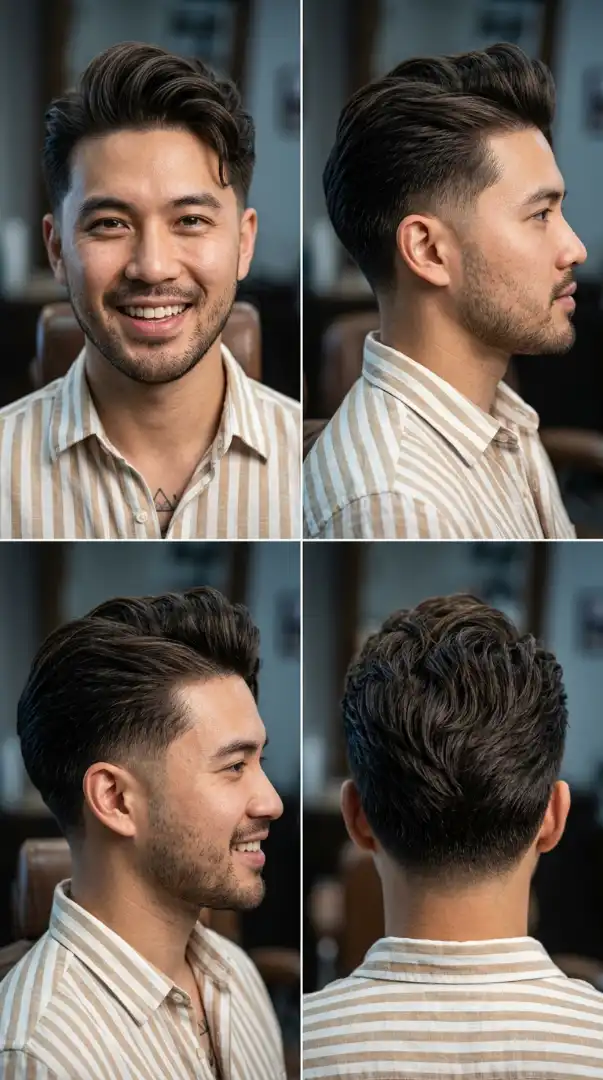
1 of 10 — The Cool Breeze Fade
Face Shape Compatibility Analysis
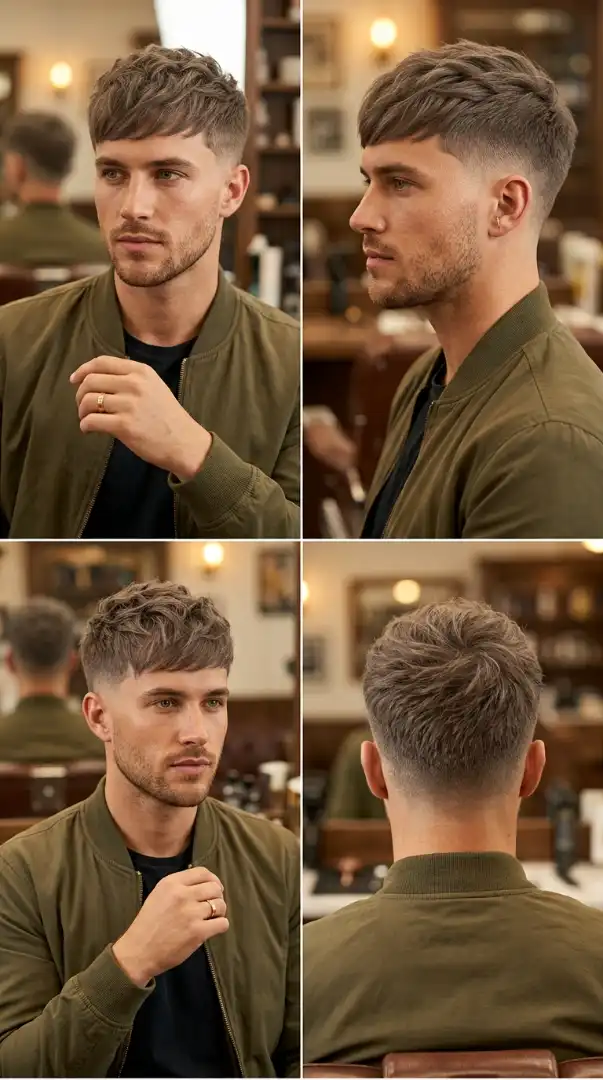
The Cool Breeze Fade works exceptionally well for square and rectangular face shapes because the textured top adds dimension without height, while the low fade on the sides creates vertical visual lines that elongate the face. Square faces particularly benefit because the angular fade contours the jaw area, creating definition that mirrors the strong features already present—the cut essentially emphasizes and enhances what’s already there. The textured fringe breaks up facial width subtly, preventing the harsh horizontal line that a blunt-cut fringe would create.
Oval face shapes can absolutely wear this cut and will appear even more balanced because the proportions naturally suit vertical emphasis. Round faces should request slightly more texture and movement on top rather than a slicked-down style, as the movement adds height perception that counters roundness. Diamond and heart-shaped faces benefit from the softness of the textured fringe, which prevents the cut from appearing too severe at the temples and jawline. Avoid this cut if you have an extremely elongated oblong face unless you specifically request slightly more volume on the sides to create width and proportion.
Essential Grooming Kit
To achieve and maintain The Cool Breeze Fade, gather these specific tools and products:
• Clippers: Wahl Magic Clip (Model 5049-400) or Andis Master (Model 01557)—both provide precision and durability for fade work • Trimmer/Outliner: Andis T-Outliner (Model 04710) for edge work, hairline cleanup, and precise lineup definition • Finishing Tools: Kent 81T fine-tooth comb for parting and fringe separation; Denman boar bristle brush for smoothing and directing texture • Styling Product: Layrite Original Pomade (medium hold, pea-sized amount for texture definition) or American Crew Fiber (matte finish, high hold, dime-sized portion for complete styling) • Maintenance: Beard oil (optional if maintaining facial hair)—Honest Amish or Viking Revolution for conditioning any stubble
For application: Use the pea-sized amount of pomade, warm it between your palms, and work through damp hair from roots to tips. Work the fringe separately, directing it forward and slightly to one side. The texture should appear lived-in, not slicked-back.
Maintenance Level: Medium
The Cool Breeze Fade requires touch-ups every 2.5-3 weeks to maintain the precision of the fade and the sharp hairline definition. The top length can extend to 4 weeks before needing a full reshape, but the fade loses its impact quickly as hair grows out, especially around the temple area where gradient precision is critical.
Daily styling requires approximately 5-7 minutes: shower, rough-dry with hands or towel, apply product, distribute through fringe with fingers, style into place. This is not a wash-and-go cut—it requires intentional daily styling but not the 15-20 minute commitment of high-maintenance textured crops.
Monthly maintenance cost estimation: $25-45 per cut depending on your barber ($30-135 quarterly), plus $10-15 for product per month ($120-180 annually). Total annual investment: $250-315.
Difficulty rating for home maintenance: Intermediate. You can stretch cuts between appointments by using an Andis T-Outliner to clean up the hairline every 10 days, but the fade requires professional clipper work.
Growth pattern: This cut grows out relatively gracefully because the textured top doesn’t look dramatically longer immediately—the textured fringe actually benefits from slightly more length for added movement. However, the fade blur becomes noticeable by week 3, making the cut appear unintentional rather than deliberate.
Barber Script: The Exact Words
Say this to your barber:
“I want The Cool Breeze Fade with a low fade starting at the temple line, not the skin. Take the sides from a Guard #1 at the nape up to a Guard #2.5 at the temple area—I want a smooth gradient, not a sharp jump. For the top, I want 1.5 to 2 inches of length, textured with point cutting for movement, not blunt. Cut the fringe separately so it falls naturally across the forehead without weight. Keep the hairline crisp—I want clean lines from the temples down to the sideburns. Don’t take the fade too high; I want the bulk of hair to stay on top. Finish with a tight lineup at the hairline and temples, and use thinning shears on the fringe to break up any density and create that lived-in texture.”
2 of 10 — The Street King Textured Crop
Face Shape Compatibility Analysis
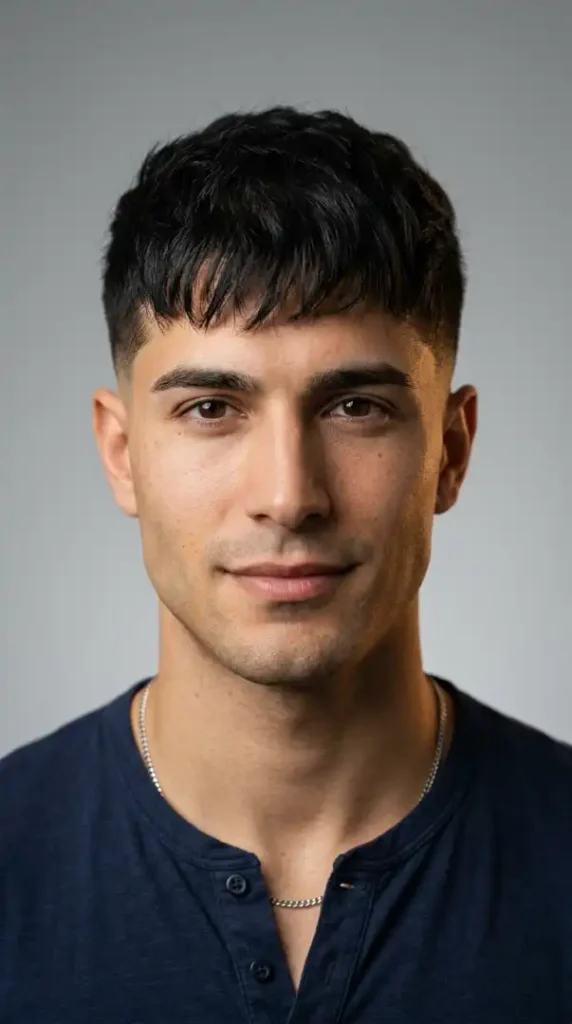
The Street King Textured Crop excels on diamond and heart-shaped faces because the substantial top volume and height create balance against naturally narrower jawlines and chins. The mid-fade adds width perception at the temple area, which is exactly what narrower faces need. Diamond faces particularly benefit because the angular fade contours complement existing cheekbones without appearing harsh.
Square faces can wear this cut, but should request slightly more taper and less extreme height—the combination of a square jaw plus extreme top volume sometimes reads as overwhelming. Focus the barber on creating texture movement rather than simple height.
Oval faces are universally compatible and will appear well-proportioned in any direction because their natural balance accommodates both height and structure. Round faces should avoid this cut unless they specifically request less volume and more directional styling (side-swept top rather than vertical height), because substantial height on a round face can intensify the roundness perception.
This cut requires an above-average commitment to daily styling and confidence in your appearance—it’s not designed for men who prefer blending into the background.
Essential Grooming Kit
Building your arsenal for The Street King Textured Crop requires investment in quality tools and products:
• Clippers: Wahl Magic Clip (Model 5049-400)—precision is critical for the mid-fade gradient • Trimmer/Outliner: Andis T-Outliner (Model 04710) for detail work and precise edge definition • Finishing Tools: Denman boar bristle brush for distributing product and directing texture; Kent 81T fine-tooth comb for detail work • Styling Product: American Crew Fiber (matte finish, dime-sized amount) for maximum hold and texture emphasis—this is the ideal product for this cut’s aesthetic • Blow-Dryer: A ceramic ionic blow dryer set to medium heat for styling efficiency (optional but recommended) • Beard Maintenance: Beard oil (Honest Amish or Beard Brand) if maintaining stubble-length facial hair
Application technique: Apply product to towel-dried (not dripping wet) hair. Work fiber through hair using fingers in upward and directional motions. Use blow dryer on medium heat if you want faster styling and more pronounced texture definition. The final look should appear textured but intentional, not messy. Product should not be visible—it’s purely for hold and texture definition.
Maintenance Level: High
The Street King Textured Crop requires professional touch-ups every 2-2.5 weeks to maintain the mid-fade precision and the textured top structure. The cut loses visual impact quickly as hair grows, with the fade blur becoming noticeable by week 2.
Daily styling demands 10-15 minutes: shower, towel dry thoroughly, apply product, blow-dry on medium heat while directing texture upward and backward, finish with finger styling for final texture placement. This is an intentional styling commitment—not a wash-and-go cut by any definition.
Monthly maintenance cost estimation: $30-50 per cut depending on barber expertise ($90-150 quarterly), plus $15-25 for quality styling products per month ($180-300 annually). Total annual investment: $270-450.
Difficulty rating for home maintenance: Intermediate to Advanced. Home clipper work is possible for the fade, but professional shapework on the top texture is recommended every 4-6 weeks for optimal results.
Growth pattern: This cut grows out less gracefully than others because the textured top quickly becomes shapeless as length increases. By week 2, the intentional texture blur becomes unintentional shaggy appearance. The fade blur makes it obvious the cut needs refreshing.
Barber Script: The Exact Words
Say this to your barber:
“I want The Street King Textured Crop with a mid-fade starting at the temple line. Take the sides from a Guard #0.5 at the nape up to a Guard #2 at the temple—I want a smooth gradient but I want the bulk of hair staying on top. For the top, I want 2.5 to 3 inches of length, and this is the critical part: I want it textured with point cutting and choppy layers to emphasize movement and dimension. Don’t blend it smooth; I want separation between the pieces so it looks intentional and textured. Keep a subtle part line on the left side (or right—your preference). Finish with a tight, crisp lineup at the hairline and temples, and taper the beard into the fade line if I’m keeping stubble. I want this to air-dry into a textured look, not require daily blow-dry styling.”
3 of 10 — The Executive Minimalist
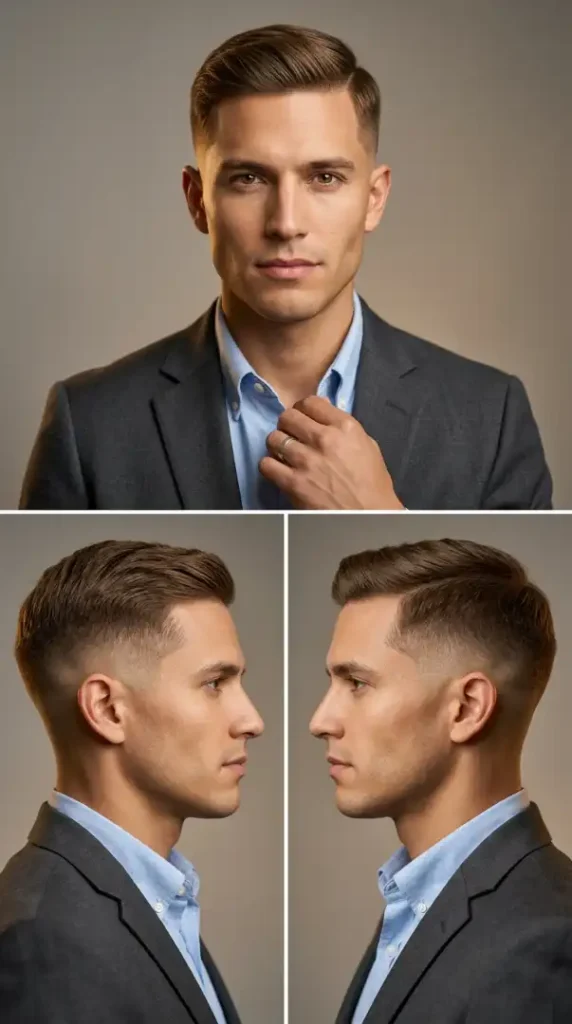
Face Shape Compatibility Analysis
The Executive Minimalist works exceptionally well for oblong and rectangular faces because the high fade creates vertical emphasis that enhances the natural length, while the minimal top prevents the addition of further visual height. The clean lines and sharp proportions work with the angular structure already present in these face shapes.
Square faces can absolutely wear this cut and will appear even more defined because the minimal top and high fade emphasize the strong jawline. The simplicity prevents overwhelming the face with too much visual complexity.
Oval faces are universally compatible—their proportions accommodate any approach equally well. Round faces should avoid this cut unless they want to intensify the rounded appearance, because the minimal height and high fade actually emphasize the width that round faces naturally possess. If a round face absolutely must wear this cut, request slightly more length on top (bring it to 1.5-2 inches) and position the fade slightly lower to add subtle height perception.
Diamond and heart-shaped faces benefit from the minimal visual weight because this cut avoids adding bulk at the temples where these face shapes are naturally narrower. The sharp lines complement the angular cheekbones.
Essential Grooming Kit
The Executive Minimalist requires minimal product investment and tool precision:
• Clippers: Wahl Magic Clip (Model 5049-400) or Andis Master (Model 01557)—precision is critical for the high fade gradient • Trimmer/Outliner: Andis T-Outliner (Model 04710) for the hairline work and edge definition • Finishing Tools: Kent 81T fine-tooth comb for checking precision; Denman boar bristle brush optional for light finishing • Styling Product: Typically not necessary—air-dry styling works for straight hair. If you want slight hold or shine, use a light pomade like Layrite Original (pea-sized amount) sparingly • Maintenance: Basic beard oil if maintaining visible shadow definition on face
Application: This cut is genuinely wash-and-go. Shower, rough-dry with towel, direct hair with your hands while wet in the direction it should dry. That’s it. Optional: light pomade if you specifically want shine or slight hold for special occasions.
Maintenance Level: Low
The Executive Minimalist requires professional touch-ups every 3-4 weeks to maintain the clean lines and sharp fade definition, but the cut still looks intentional during growth-out phases because the minimal length means slight growth is less noticeable than in longer styles.
Daily styling requires approximately 3-5 minutes maximum: quick shower, rough-dry with hands or towel while directing the hair, and you’re done. This is a genuine wash-and-go cut for straight or wavy hair that cooperates naturally. Curly hair requires slightly more effort (5-7 minutes) but still significantly less than any textured style.
Monthly maintenance cost estimation: $25-40 per cut depending on barber expertise ($75-120 quarterly), plus minimal product cost ($0-5 per month). Total annual investment: $150-210.
Difficulty rating for home maintenance: Beginner to Intermediate. The fade requires precision clipping work, but home clipper maintenance is absolutely achievable with practice. The top length is forgiving—small variations are barely noticeable.
Growth pattern: This cut grows out extremely gracefully because the minimal length means week 3-4 growth is barely perceptible. The fade blur becomes noticeable by week 4-5, but the overall silhouette remains intentional and sharp-looking for longer than high-volume cuts.
Barber Script: The Exact Words
Say this to your barber:
“I want The Executive Minimalist with a high skin fade starting above the ear. Take the sides from a Guard #0.5 at the nape all the way up to nearly bald at the temple and above the ear—I want clean, sharp contrast between the top and sides. For the top, I want 1 to 1.5 inches maximum, no more. Keep the top length uniform and blunt—no texture, no layers. I want a clean part line (your recommendation on placement). Finish with an extremely sharp, crisp lineup at the hairline—this is the detail that makes the cut, so take time on it. I want this to air-dry naturally without any product needed. No styling required.”
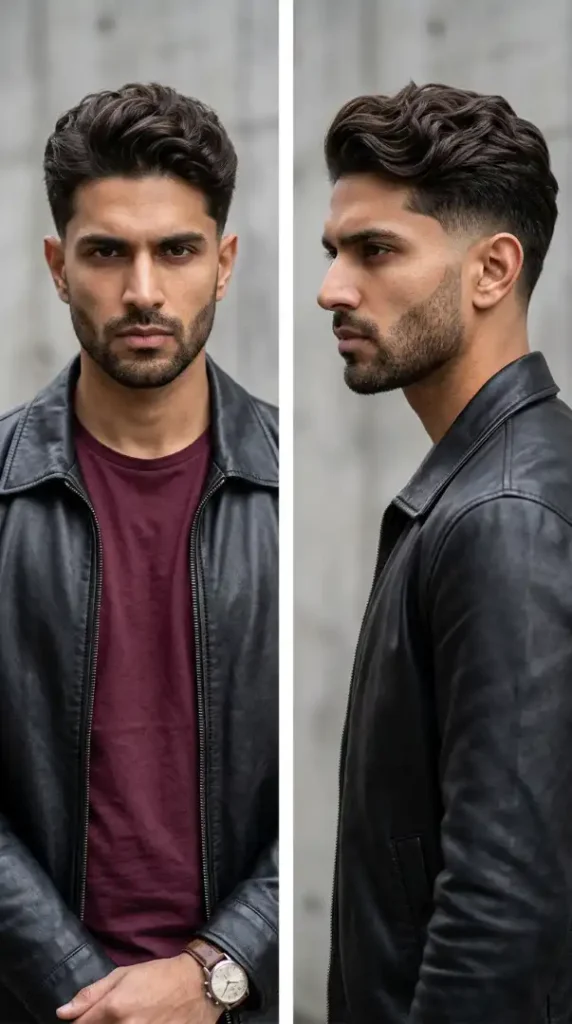
4 of 10 — The Summer Pompadour
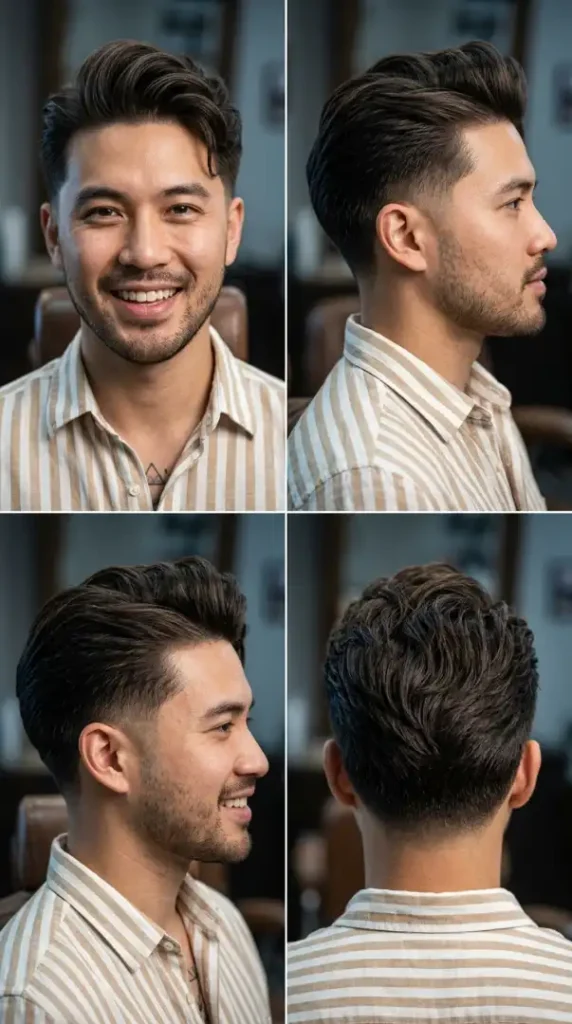
Face Shape Compatibility Analysis
The Summer Pompadour excels on round, oval, and diamond face shapes because the height and vertical emphasis created by the swept-back styling counteracts roundness and adds definition. Round faces in particular benefit dramatically—the height perception creates a visual lengthening effect that balances the natural width.
Square faces can absolutely wear this cut, though they should request slightly less extreme height to avoid appearing too angular combined with the jawline prominence. The fade should start slightly lower (at ear level rather than above) to add subtle width perception at the temple area.
Oblong and rectangular faces should avoid this cut or modify it significantly by keeping the height more modest (closer to 2 inches rather than 2.5) because the vertical emphasis can over-lengthen already-elongated faces. The low fade works, but request more volume and texture on the sides to create width perception.
Heart-shaped faces benefit from the pompadour because the height draws attention upward away from a narrower chin. Diamond faces with their natural cheekbone prominence work beautifully with the side fading.
Essential Grooming Kit
Building your pompadour arsenal requires investment in key products and tools:
• Clippers: Wahl Magic Clip (Model 5049-400) or Andis Master (Model 01557)—precision for the fade gradient • Trimmer/Outliner: Andis T-Outliner (Model 04710) for detail work and crisp edges • Finishing Tools: Denman boar bristle brush (essential for styling the pompadour top); Kent 81T fine-tooth comb for parting precision • Styling Product: Layrite Original Pomade (medium hold, dime-sized amount) for the pompadour styling or American Crew Forming Cream for a more matte finish • Blow-Dryer: Recommended for efficient styling—ceramic ionic blow dryer set to medium heat • Hair Tonic or Grooming Spray: Optional but recommended—helps with volume and grip
Application technique: Shower and towel-dry (not dripping). Apply dime-sized amount of pomade to damp hair, work through from roots to tips. Blow-dry on medium heat while directing hair back and slightly upward using your fingers or brush. Finish with brush work to refine the shape. Final result should show intentional styling with volume at crown, swept-back direction, and polished appearance. Pomade should provide hold and subtle shine, but not appear shiny or greasy.
Maintenance Level: Medium-High
The Summer Pompadour requires professional touch-ups every 2.5-3 weeks to maintain the shape, height, and fade precision. The cut loses visual impact as hair grows longer, and the fade blur becomes noticeable by week 3.
Daily styling requires 8-12 minutes: shower, towel-dry, apply product, blow-dry with directional focus on height creation, brush-work for refinement, and styling adjustments. This is more time-intensive than minimalist cuts but significantly less than extreme textured styles.
Monthly maintenance cost estimation: $30-50 per cut depending on barber expertise ($90-150 quarterly), plus $15-25 for quality styling products monthly ($180-300 annually). Total annual investment: $270-450.
Difficulty rating for home maintenance: Intermediate to Advanced. The fade requires professional clipper work, and the top shaping requires barber-level precision. Home maintenance is possible for touch-ups but professional reshaping recommended every 4-6 weeks for optimal results.
Growth pattern: The pompadour grows out less gracefully than minimalist cuts. By week 3, the intentional shape becomes less defined, and by week 4, it appears grown-out rather than deliberately styled. The fade blur happens quickly, making the overall proportions feel off.
Barber Script: The Exact Words
Say this to your barber:
“I want The Summer Pompadour with a low-to-mid fade starting at the temple line. Take the sides from Guard #1 at the nape up to Guard #2 at the temple with a smooth blend. For the top, I want 2 to 2.5 inches of length—this is the volume area. I want the top styled back and up, so cut it accordingly. Leave more length at the crown than at the front hairline to create that lifted appearance naturally. Use point cutting to create texture that helps hold the styling direction. Keep a subtle part line if you recommend it, or leave it clean. Finish with a crisp lineup at the temples and hairline. I want this to blow-dry into a pompadour shape with minimal effort once I get home.”
5 of 10 — The Cool Wave Undercut
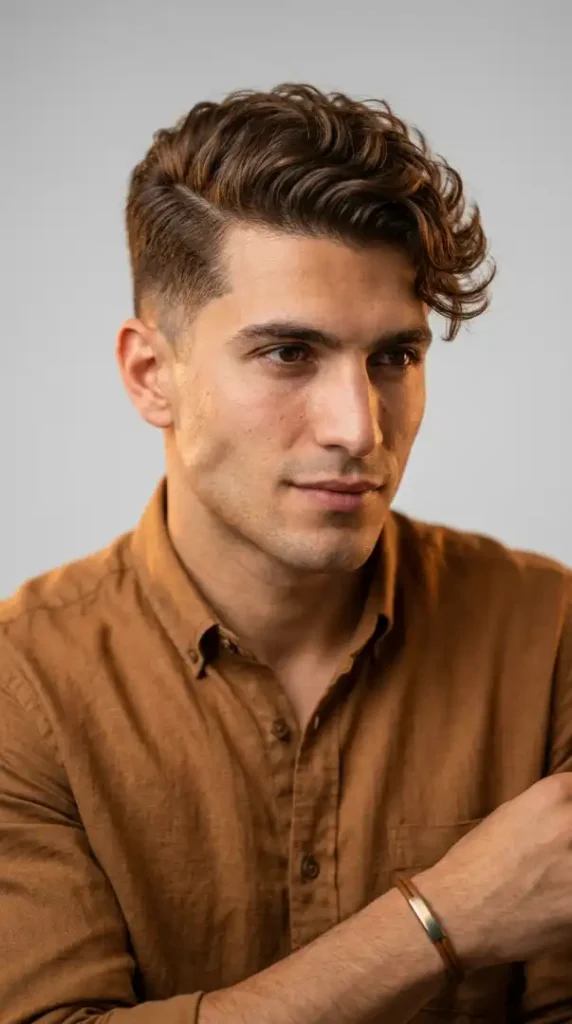
Face Shape Compatibility Analysis
The Cool Wave Undercut works exceptionally well for heart and diamond-shaped faces because the extreme side shortness emphasizes width at the cheekbones, which is exactly what narrow faces need. The textured top draws attention upward away from narrower chins. Heart-shaped faces in particular benefit because the cheekbone width perception balances against the narrower jawline.
Square faces can wear this cut but should request slightly less extreme undercut (guard #1.5 instead of #0.5) to avoid over-emphasizing already-strong jawline definition. The top styling should emphasize forward movement rather than height to balance the strong lower face.
Round faces should generally avoid this cut unless they specifically request modifications—the horizontal emphasis of the undercut separation can intensify the perceived roundness. If a round face absolutely wants this style, request the undercut line be positioned higher (at temple level rather than ear level) and request slightly more height on top to counteract the roundness.
Oval faces are universally compatible and will appear balanced in any direction. Oblong faces should avoid the height emphasis and instead request more textured movement and side-sweep styling.
Essential Grooming Kit
The Cool Wave Undercut requires specific tools and products designed for contrast maintenance:
• Clippers: Wahl Magic Clip (Model 5049-400) or Andis Master (Model 01557)—precision is critical for maintaining the undercut separation line • Trimmer/Outliner: Andis T-Outliner (Model 04710) for detail work, edge definition, and maintaining the sharp undercut line • Finishing Tools: Denman boar bristle brush for texturing the top and directing waves; Kent 81T fine-tooth comb for detail work • Styling Product: American Crew Fiber (matte finish, dime-sized amount) for defining texture without shine, or Layrite Original Pomade for more polished appearance • Hair Tonic or Sea Salt Spray: Optional but recommended—adds texture, grip, and wave definition to the top layers • Beard Maintenance: Beard oil if maintaining facial hair definition
Application technique: Shower and towel-dry. Apply product to damp hair, working through with fingers or brush to distribute evenly. Direct the wavy texture upward and slightly back. Allow air-dry or use brief blow-dry work for faster styling. The textured top should appear intentionally styled but lived-in, not artificial or product-heavy. Undercut sides should remain clean and sharp—no product visible on short sides, just clean hair with precision edges.
Maintenance Level: Medium
The Cool Wave Undercut requires professional touch-ups every 2.5-3 weeks specifically for maintaining the undercut line precision. The separation line is the defining feature—as hair grows, the undercut blurs and the style loses its impact. The top length can extend to 4 weeks, but the undercut blur makes it look unkempt by week 3.
Daily styling requires 6-8 minutes: shower, towel-dry, apply product to top sections, distribute with fingers or brush, direct texture, and allow air-dry or brief blow-dry finish. This is less time-intensive than pompadour styling but more involved than minimalist cuts.
Monthly maintenance cost estimation: $28-45 per cut depending on barber expertise ($84-135 quarterly), plus $12-20 for quality styling products monthly ($144-240 annually). Total annual investment: $228-375.
Difficulty rating for home maintenance: Intermediate. The undercut line requires precision clipper work that’s challenging for home maintenance. The top texture is forgiving, but the crisp undercut separation demands professional-level accuracy. Most men benefit from professional reshaping every 3-4 weeks.
Growth pattern: This cut has one critical weakness—the undercut blurs quickly as hair grows, losing the dramatic separation that makes it distinctive. The top grows longer gracefully (wavy texture actually benefits from more length), but the undercut separation becomes fuzzy and imprecise by week 3-4. The overall appearance shifts from intentional to grown-out rapidly.
Barber Script: The Exact Words
Say this to your barber:
“I want The Cool Wave Undercut with an extreme separation between the top and sides. Take the sides to nearly bald—Guard #0.5 or #0.75 (I want it really short and clean). Create a clear undercut line at approximately the temple level on the sides. For the top, I want 3 to 4 inches of length, kept textured and wavy. This is crucial: I don’t want the top blended into the sides—I want a distinct, dramatic line separating them. Point-cut the top to emphasize the wavy texture and separation. Keep the hairline super crisp with a precise lineup. I want the top to air-dry into texture, and I want the sides to stay clean and short-looking between cuts. Make sure that undercut line is sharp and visible—that’s the whole point of this cut.”
6 of 10 — The Low-Key Textured Fade
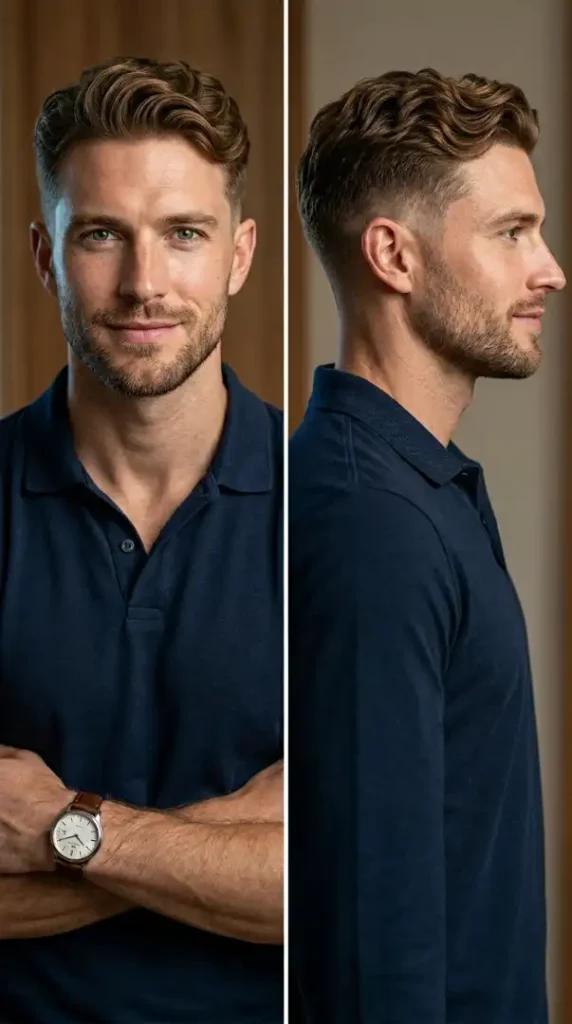
Face Shape Compatibility Analysis
The Low-Key Textured Fade works universally across face shapes because the moderate approach avoids extremes that might overemphasize particular features. Square faces particularly benefit because the subtle texture softens the angularity while the low fade respects the strong jawline without adding drama.
Oval faces are compatible in all directions—their natural balance accommodates the moderate approach equally well. Round faces should request slightly more texture movement and directional styling to create subtle height perception without creating a severe appearance.
Oblong and rectangular faces can wear this cut with the recommendation to keep slightly more volume on the sides (lower fade starting point, around guard #2.5 instead of guard #2) to add subtle width perception. Heart and diamond faces benefit from the understated approach because it doesn’t over-emphasize the cheekbone area.
Essential Grooming Kit
The Low-Key Textured Fade requires minimal but essential grooming tools and products:
• Clippers: Wahl Magic Clip (Model 5049-400) or Andis Master (Model 01557)—precision for low fade gradient • Trimmer/Outliner: Andis T-Outliner (Model 04710) for edge work and hairline definition • Finishing Tools: Kent 81T fine-tooth comb for detail work; Denman boar bristle brush for light texture direction • Styling Product: Layrite Original Pomade (pea-sized amount) for light hold and subtle shine, or skip product entirely for completely natural styling • Optional: Light hair tonic or grooming spray for texture grip
Application technique: Shower and towel-dry thoroughly. Apply product if using (pea-sized amount works through damp hair from roots to tips). Direct texture with fingers in natural direction—you’re enhancing natural wave pattern, not creating artificial styling. Allow air-dry or brief blow-dry for faster result. Final appearance should be naturally styled and polished, not product-heavy or artificial.
Maintenance Level: Low-Medium
The Low-Key Textured Fade requires professional touch-ups every 3-4 weeks to maintain the subtle texture definition and low fade precision. The cut still looks intentional during growth-out because the conservative approach means slight growth is less noticeable than in longer styles.
Daily styling requires 4-6 minutes: shower, towel-dry, optional light product application, and finger-styling for texture direction. This is minimal commitment compared to higher-maintenance styles but slightly more involved than pure wash-and-go cuts.
Monthly maintenance cost estimation: $25-40 per cut depending on barber expertise ($75-120 quarterly), plus $8-12 for light product monthly ($96-144 annually). Total annual investment: $171-264.
Difficulty rating for home maintenance: Beginner to Intermediate. The low fade is forgiving for home maintenance, and the subtle top texture is very forgiving for slight variations. Home clipper work is absolutely achievable with practice.
Growth pattern: This cut grows out more gracefully than most textured approaches. By week 4, it still appears intentionally styled rather than grown-out because the conservative length means growth is barely noticeable. The fade blur becomes visible by week 4-5, but the overall silhouette remains sharp.
Barber Script: The Exact Words
Say this to your barber:
“I want The Low-Key Textured Fade with a low fade starting at the temple line. Take the sides from Guard #1 at the nape up to Guard #2 at the temple—I want a smooth blend without drama. For the top, I want 1.5 to 2 inches maximum. I want subtle texture here—point-cut for movement and to avoid a slicked appearance, but keep it cohesive and blended, not separated or choppy. No extreme layers or disconnection. I want this to look polished and professional, not fashion-statement bold. Keep a subtle natural parting if it works with my hair. Finish with a crisp lineup at the hairline and temples. I want this to air-dry naturally with minimal to no product needed.”
7 of 10 — The Wavy Pompadour Hybrid
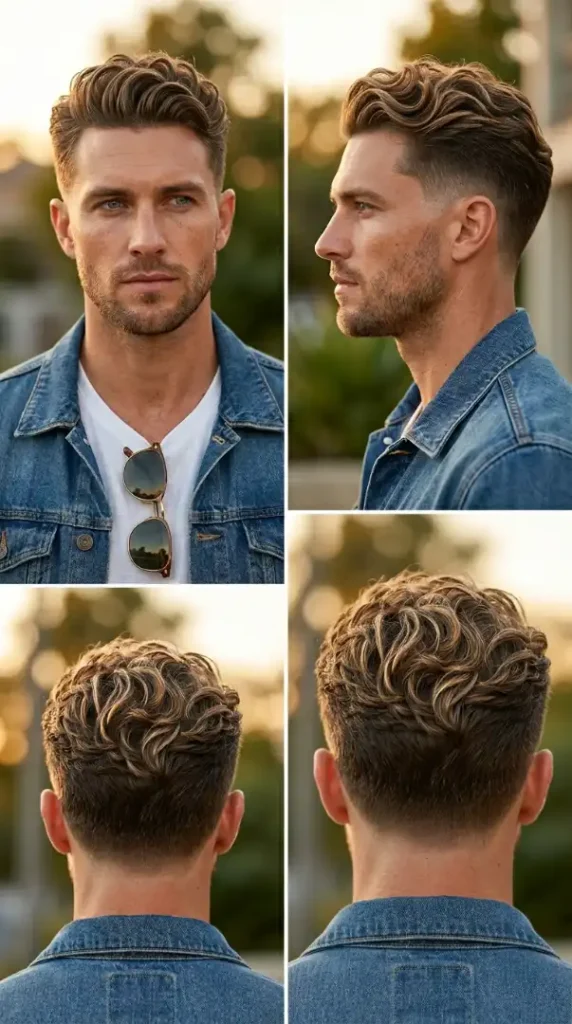
Face Shape Compatibility Analysis
The Wavy Pompadour Hybrid works excellently for oval, round, and diamond face shapes because the textured volume and height create definition without the severe appearance of slicked-back styling. Round faces particularly benefit because the natural wave pattern prevents the overly angular appearance that extreme pompadours can create.
Square faces can wear this cut, though they should request slightly softer styling (less structured height) to balance against the naturally strong jawline. The wavy texture actually works in favor here because it softens the overall appearance.
Oblong and rectangular faces should avoid this cut unless they specifically request less height and more side volume to counteract the natural vertical emphasis. The wave texture alone doesn’t solve the vertical challenge.
Heart-shaped faces benefit from the textured, less-structured approach because it prevents the cut from appearing too severe at the cheekbones and temples.
Essential Grooming Kit
The Wavy Pompadour Hybrid requires products and techniques specifically designed for textured hair:
• Clippers: Wahl Magic Clip (Model 5049-400) or Andis Master (Model 01557)—precision for fade work • Trimmer/Outliner: Andis T-Outliner (Model 04710) for edge definition and hairline work • Finishing Tools: Denman boar bristle brush (essential for styling waves) or wide-tooth comb for curl pattern; Kent 81T fine-tooth comb for detail work • Styling Product: American Crew Forming Cream (for texture and hold without shine) or SheaMoisture products specifically for textured hair — dime-sized amount • Blow-Dryer: Ceramic ionic blow dryer on medium-low heat, or air-dry styling is acceptable • Curl/Wave Enhancer: Optional but recommended—curl-enhancing spray or sea salt spray adds texture grip and definition (Cantu Wave Whip or SheaMoisture)
Application technique: Shower and towel-dry thoroughly (wavy hair needs moisture to show wave pattern). Apply product to damp hair, distributing with fingers or brush through the wave pattern. Blow-dry on medium-low heat using a diffuser attachment if available, directing air to enhance the wave pattern rather than fight it. Alternatively, air-dry with product for more natural wave appearance. The final look should show intentional styling within natural texture, not sculpted or artificially shaped.
Maintenance Level: Medium
The Wavy Pompadour Hybrid requires professional touch-ups every 2.5-3 weeks for fade maintenance and shape refinement, though wavy hair is slightly more forgiving than straight hair during growth-out phases.
Daily styling requires 6-10 minutes: shower, towel-dry, apply product, blow-dry on medium-low heat with diffuser (or air-dry, adding 10-15 minutes wait time), and finger-styling for final texture. This is less demanding than structured pompadours but more involved than minimalist cuts.
Monthly maintenance cost estimation: $28-45 per cut depending on barber expertise with wavy hair specialization ($84-135 quarterly), plus $12-18 for quality textured-hair products monthly ($144-216 annually). Total annual investment: $228-351.
Difficulty rating for home maintenance: Intermediate. The fade requires professional clipper work. The top styling is more forgiving for at-home adjustments because wavy texture is naturally more resilient to slight variations.
Growth pattern: This cut grows out moderately gracefully because wavy hair naturally accepts length without losing intentional appearance. By week 4, the cut still reads as styled rather than grown-out. The fade blur becomes visible by week 4-5, requiring touch-up maintenance.
Barber Script: The Exact Words
Say this to your barber:
“I want The Wavy Pompadour Hybrid with a low-to-mid fade starting at temple line. Take sides from Guard #1 at nape up to Guard #2 or #2.5 at temple—smooth blend. For the top, I want 3 to 3.5 inches, but here’s what makes this different: I have wavy/curly hair, so I want this textured and styled with the waves, not against them. Point-cut for texture, don’t try to force it into a slicked-back pompadour shape. Keep the volume at the crown for that lifted appearance, but let the waves move naturally. I want this to work with a diffuser blow-dry or even air-dry, not require tons of product and blow-drying time. Finish with a crisp lineup at temples and hairline. Make this work with my hair texture, not against it.”
8 of 10 — The Sharp Business Crop
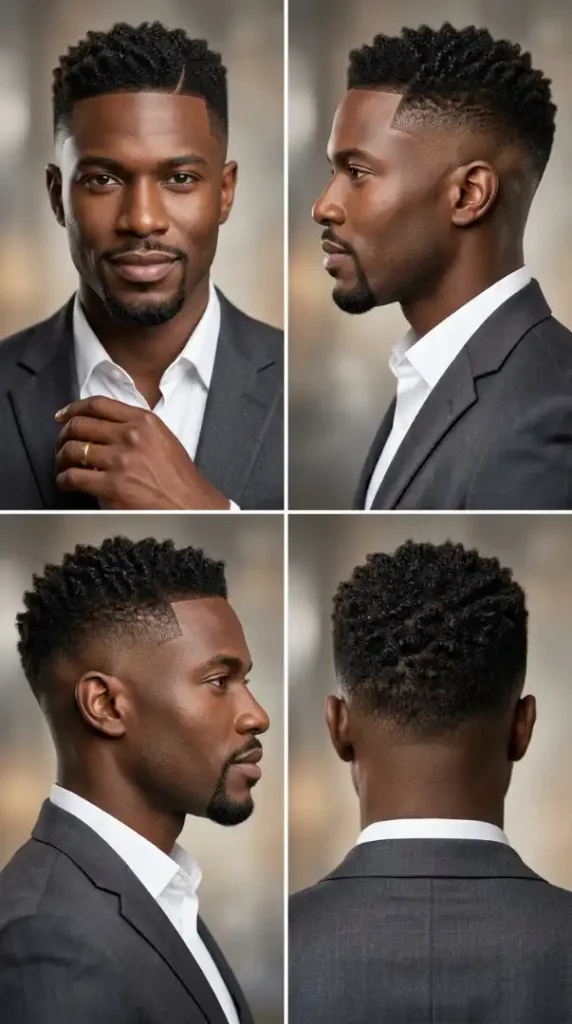
Face Shape Compatibility Analysis
The Sharp Business Crop works universally across face shapes because the minimal length means it doesn’t overemphasize any particular feature. Square faces particularly benefit because the short top and high fade emphasize the strong jawline cleanly.
Oval, round, diamond, and heart-shaped faces all work well with this cut because the conservative length prevents any proportional imbalance. Round faces won’t see the height emphasis that might intensify roundness. Diamond and heart faces won’t see any width imbalance because minimal styling maintains proportions.
Oblong and rectangular faces can wear this cut but should request a slightly lower fade starting point (at ear level rather than above) to add subtle width perception at the temple area, creating more visual balance against natural vertical emphasis.
Essential Grooming Kit
The Sharp Business Crop requires specific tools and products designed for textured and coily hair:
• Clippers: Wahl Magic Clip (Model 5049-400) or Andis Master (Model 01557)—precision for high fade gradient • Trimmer/Outliner: Andis T-Outliner (Model 04710) for detailed edge work and hairline definition • Finishing Tools: Denman boar bristle brush for texture definition; Kent 81T comb for edge detail work • Styling Product: Minimal—this cut is wash-and-go compatible. Optional light styling product (Cantu Shea Butter Leave-In Conditioning Repair Cream or SheaMoisture curl enhancer, pea-sized amount) for shine and definition if desired • Beard Care: Edge shaper for facial hair line definition (Andis Edge Shaper or similar); beard oil for facial hair conditioning (Honest Amish or Beard Brand)
Application technique: Shower and towel-dry thoroughly. Optional: apply light product (if using) in pea-sized amount, distributing through damp hair with fingers. Allow air-dry or brief hand-dry with towel. The textured top should showcase natural hair pattern with intentional edge work throughout. Facial hair edges should be crisp and defined with meticulous line work.
Maintenance Level: Low-Medium
The Sharp Business Crop requires professional touch-ups every 3-4 weeks to maintain the high fade definition and the texture work on top. The short length means growth is barely noticeable on the top, but the fade blur becomes visible by week 4.
Daily styling requires 2-5 minutes: quick shower, towel-dry with hands or towel while directing hair, and optional light product application (or skip product entirely). This is a genuine wash-and-go cut for many men. Edge work maintenance (facial hair line definition) might require touch-up between cuts if you want meticulous definition.
Monthly maintenance cost estimation: $30-50 per cut depending on barber expertise with textured hair specialization ($90-150 quarterly), plus $5-10 for optional product monthly ($60-120 annually). Total annual investment: $150-270.
Difficulty rating for home maintenance: Beginner to Intermediate. The high fade requires professional clipper work for precision. The top texture is forgiving for at-home touch-ups. Home clipper work is achievable with practice for maintenance between professional cuts.
Growth pattern: This cut grows out very gracefully. The minimal top length means week 4 growth is barely noticeable—a 1-inch cut grows to approximately 1.25 inches by week 4, which is imperceptible. The fade blur is the only notable element by week 4. The overall silhouette remains intentional and sharp for longer than longer styles.
Barber Script: The Exact Words
Say this to your barber:
“I want The Sharp Business Crop with a high skin fade starting above the ear. Take the sides to nearly bald at the top (Guard #0.5 or #0.75), creating a clear high fade line. For the top, I want 1 to 1.5 inches maximum, textured to work with my natural hair pattern. I don’t want it slicked back or forced into an unnatural shape. Respect my coils/waves/curls and use texturizing techniques to enhance the natural pattern. Point-cut for texture definition. Keep my facial hair lines sharp and clean—tight edge work at the jawline, hairline, and around the beard area. I want this to be wash-and-go comfortable without daily styling requirements. Finish with an extremely crisp lineup and edge definition throughout.”
9 of 10 — The Vintage Slicked-Back
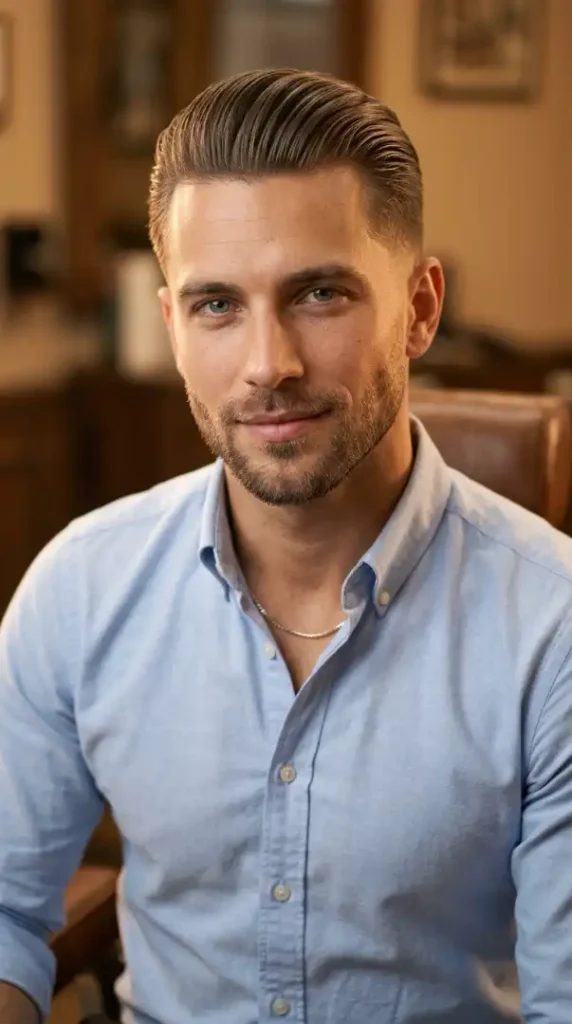
Face Shape Compatibility Analysis
The Vintage Slicked-Back works exceptionally well for oblong, rectangular, and oval face shapes because the slicked-back styling creates vertical emphasis that complements or enhances these natural proportions. The longer front hairline balances against potential vertical over-elongation.
Square faces can wear this cut with the recommendation to request slightly softer styling (not severe back-slicking) to balance against the naturally strong jawline. The clean proportions work well with square faces, but extreme styling can appear overly harsh.
Round faces should avoid this cut unless they specifically request modifications—the slicked-back styling can intensify the perceived roundness by eliminating the framing that forward-falling hair provides. If a round face wants this aesthetic, request slightly more side volume and less severe back-styling.
Diamond and heart-shaped faces benefit from the cleaned temple area (fade exposes cheekbones) and the slicked-back approach that emphasizes cheekbone structure.
Essential Grooming Kit
The Vintage Slicked-Back requires specific pomades and tools designed for polished styling:
• Clippers: Wahl Magic Clip (Model 5049-400) or Andis Master (Model 01557)—precision for low-to-mid fade • Trimmer/Outliner: Andis T-Outliner (Model 04710) for edge definition and sharp hairline work • Finishing Tools: Denman boar bristle brush for pomade distribution and styling direction; Kent 81T fine-tooth comb for precision parting (if desired) • Styling Product: Layrite Original Pomade (medium hold, dime-sized amount) for the classic slicked-back appearance with shine, or Baxter of California Clay (matte alternative if preferring less shine) • Blow-Dryer: Ceramic ionic blow dryer on medium heat recommended for efficient styling and product distribution • Optional: Hair tonic or grooming spray for lightweight hold and fragrance
Application technique: Shower and towel-dry (not dripping). Apply dime-sized amount of pomade to damp hair, work through from roots to tips. Blow-dry on medium heat while directing hair back and slightly to one side using your fingers or brush. Finish with brush work to refine the style and remove tangles. The final look should be polished and shiny (or matte, depending on product choice) with hair clearly directed back off the face. Vintage styling should appear intentional and groomed, not slicked or greasy.
Maintenance Level: Medium-High
The Vintage Slicked-Back requires professional touch-ups every 2.5-3 weeks to maintain the shape and fade precision. The styling product breaks down with heat and humidity, requiring daily reapplication.
Daily styling requires 8-12 minutes: shower, towel-dry, apply pomade, blow-dry on medium heat while directing back, and brush refinement. This is less demanding than extreme textured crops but significantly more involved than minimalist cuts. The daily commitment is the trade-off for the polished, vintage aesthetic.
Monthly maintenance cost estimation: $25-40 per cut depending on barber expertise ($75-120 quarterly), plus $12-18 for quality pomade and styling products monthly ($144-216 annually). Total annual investment: $219-336.
Difficulty rating for home maintenance: Beginner to Intermediate. The low-to-mid fade is forgiving for home maintenance. The top styling is straightforward once you understand the technique. Home clipper work is achievable with practice.
Growth pattern: This cut grows out moderately gracefully. The longer front hairline stretches longer, and by week 4, the overall proportion shifts. The fade blur becomes noticeable by week 3-4, making the cut appear less intentional. Most men prefer to cut every 3-4 weeks rather than stretching longer.
Barber Script: The Exact Words
Say this to your barber:
“I want The Vintage Slicked-Back with a low-to-mid fade starting at the temple line. Take the sides from Guard #1.5 at the nape up to Guard #2 at the temple—I want smooth blend, not dramatic. For the top, I want 2.5 to 3 inches of length, kept longer throughout and intentionally longer at the front hairline. I want this styled back and off my face with pomade for that vintage barber aesthetic. Use blunt cutting or slight layers to maintain length, not choppy texture. I want a clean, polished appearance that reads as groomed and intentional. Finish with a crisp lineup at the hairline and temples. I’ll be styling this daily with product, so make sure the length and shape support that styling approach.”
10 of 10 — The Modern Textured Disconnect
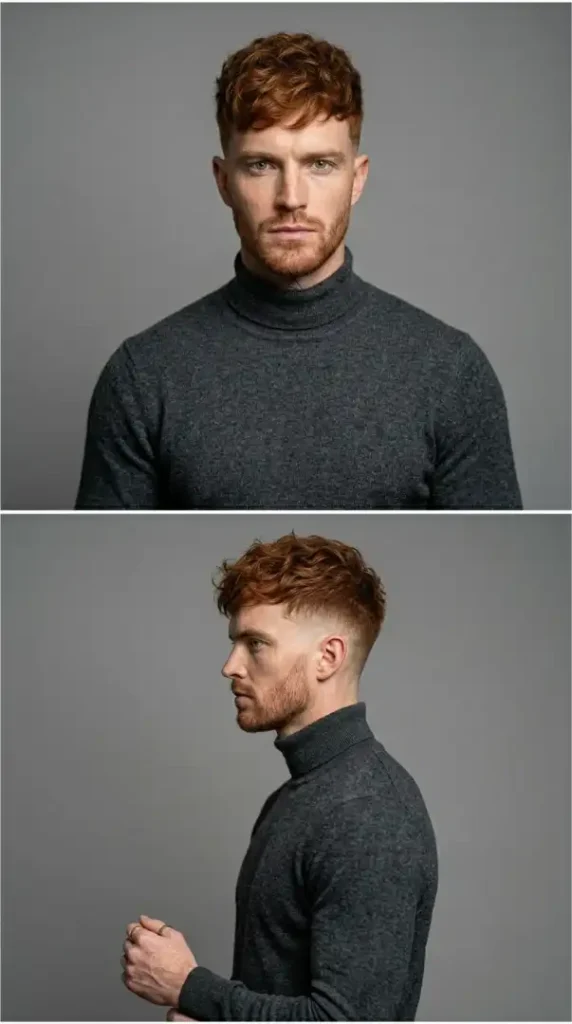
Face Shape Compatibility Analysis
The Modern Textured Disconnect works exceptionally well for diamond, heart-shaped, and round faces because the substantial top volume and height create visual lengthening that counters the natural width of round faces and the narrowness of diamond/heart faces. The disconnect sides emphasize the top-heavy silhouette, which works for narrow-chinned face shapes.
Square faces can wear this cut but should request slightly more taper and less extreme height to avoid over-emphasizing the already-prominent jawline. The volume and top length should be present (to maintain the modern aesthetic), but the extreme height can appear overwhelming on square faces.
Oval faces are universally compatible and will appear proportionally balanced with any version of this cut. Oblong and rectangular faces should avoid this cut unless they specifically request less height—the volume and vertical emphasis can over-lengthen already-elongated faces.
Essential Grooming Kit
The Modern Textured Disconnect requires tools and products designed for maximum texture definition:
• Clippers: Wahl Magic Clip (Model 5049-400) or Andis Master (Model 01557)—precision for mid-to-high fade gradient • Trimmer/Outliner: Andis T-Outliner (Model 04710) for detail work and disconnect line definition • Finishing Tools: Denman boar bristle brush for texture work and separation; Kent 81T comb for detail precision • Styling Product: American Crew Fiber (matte finish, dime-sized amount) for maximum texture definition without shine, or salt spray for lightweight hold and texture enhancement • Blow-Dryer: Optional—air-dry styling works well with this cut due to textured construction, but blow-dryer on medium heat with fingers can add definition • Optional: Sea salt spray (Bumble and bumble or similar) for added texture grip and definition
Application technique: Shower and towel-dry thoroughly. Optional: apply product (pea to dime-sized amount depending on desired definition level). Work through damp or towel-dried hair using fingers to separate and define the choppy layers. Optional blow-dry on medium heat to add shape and definition, or allow air-dry for more lived-in, natural appearance. The final look should show intentional separation and texture definition, with individual pieces visible and distinct. Final appearance can read as polished (with product) or casual (air-dry) depending on your preference and occasion.
Maintenance Level: High
The Modern Textured Disconnect requires professional touch-ups every 2-2.5 weeks to maintain the disconnect line precision, the textured top definition, and the fade gradient. The separation line is the defining feature—as hair grows, the disconnect blurs and the style loses its impact.
Daily styling requires 5-10 minutes: shower, towel-dry, optional light product application, and finger-styling for texture separation. Optional blow-dry work adds 3-5 minutes if desired. This is moderate daily commitment compared to extreme pompadour work but more involved than minimalist cuts.
Monthly maintenance cost estimation: $35-55 per cut depending on barber expertise with textured work ($105-165 quarterly), plus $10-15 for quality styling products monthly ($120-180 annually). Total annual investment: $225-345.
Difficulty rating for home maintenance: Intermediate to Advanced. The disconnect line requires professional precision clipper work. The textured top is forgiving for at-home touch-ups. Home clipper work is possible for experienced users but professional reshaping every 3-4 weeks recommended for optimal results.
Growth pattern: This cut grows out less gracefully than textured minimalist approaches. By week 2-3, the disconnect line blurs. By week 3, the cut appears fuzzy rather than sharply disconnected. The textured top can extend to week 4, but the overall visual impact diminishes as the disconnect blurs.
Barber Script: The Exact Words
Say this to your barber:
“I want The Modern Textured Disconnect with a clean, sharp separation line. Take the sides from Guard #0.75 at the nape up to Guard #2 at the temple—I want a clear disconnect line visible at approximately temple level. For the top, I want 3.5 to 4 inches of length, textured with choppy, separated layers. This is crucial: I want distinct pieces and separation visible, not blended or smooth. Point-cut for texture, use clippers or scissors to create that disconnected, layered appearance. I want this to air-dry into texture, with optional product for definition if I choose. The disconnect line needs to be razor-sharp and visible—that’s the whole point. Finish with a crisp lineup at the hairline and temples. I want this to read as intentionally styled and modern, with clear visual impact.”