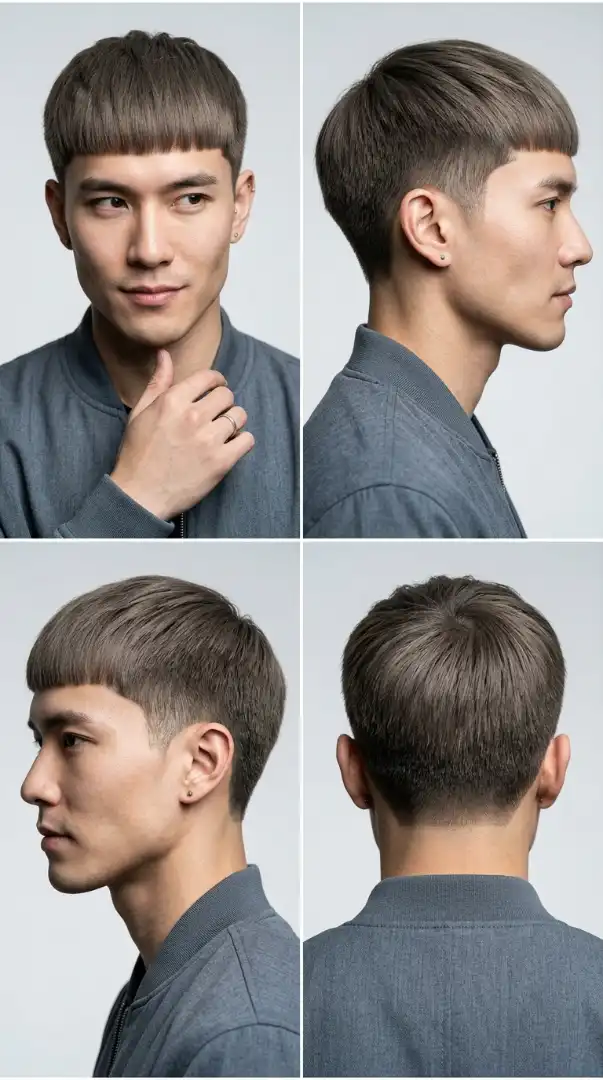
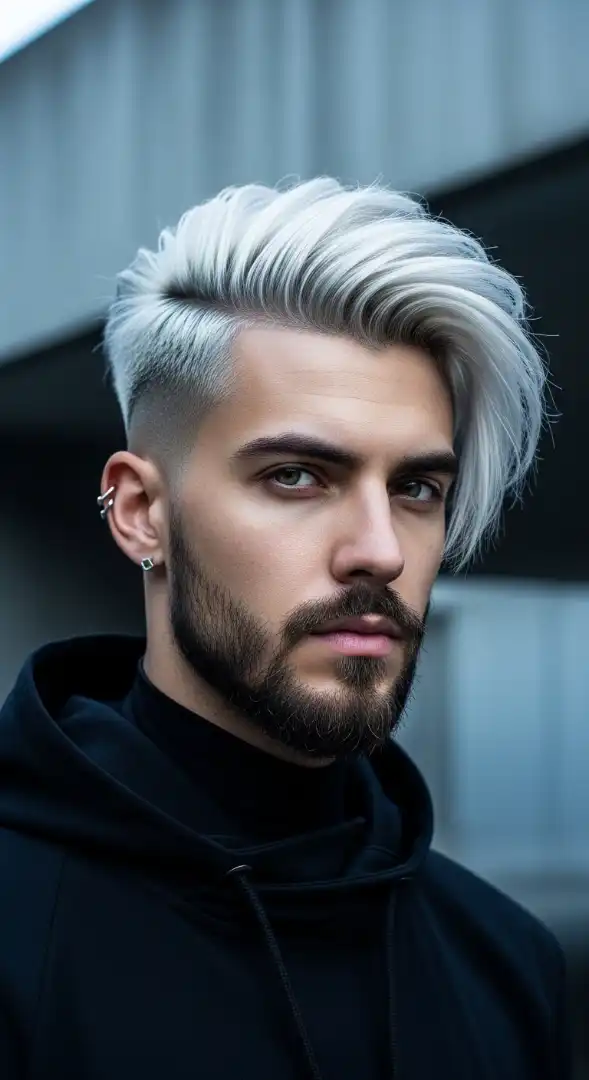
13 Mid Taper Fade Haircuts Every Men Need To Try
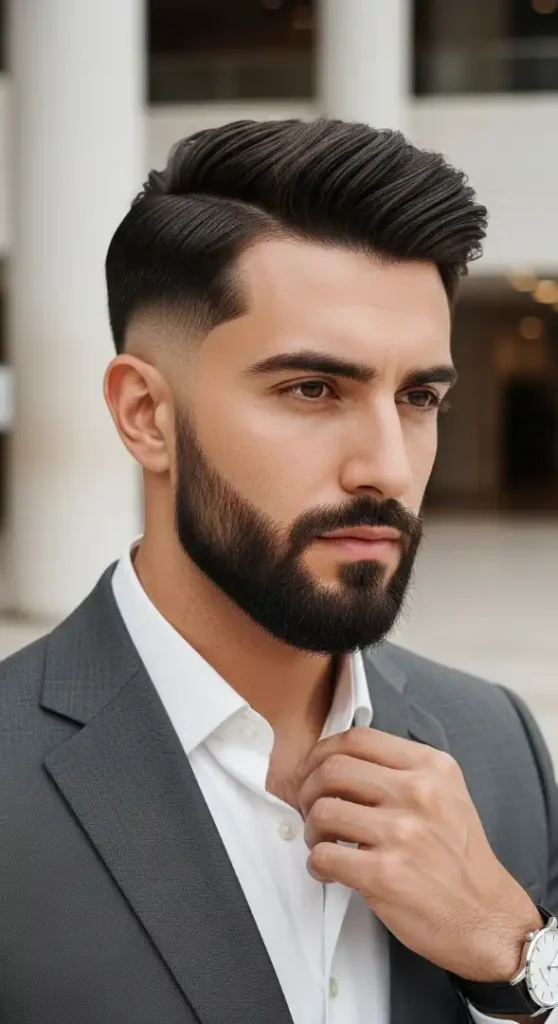
1 of 13 — The Executive Sharp Cut
Best Face Shape Match
The Executive Sharp Cut works exceptionally well for Square and Oval face shapes. The mid taper fade removes bulk from the sides while maintaining enough length to balance strong jawlines. For square faces, the graduated fade creates visual height, elongating the overall appearance and softening the angular jaw. The textured top adds dimension without overwhelming facial features. Oval faces benefit from the structural definition — the side part and swept styling enhance natural proportions without adding unnecessary width. Round face shapes can also pull this off successfully, as the vertical height from the 3-inch top combined with the tapered sides creates an illusion of length. The key anatomical advantage is how the fade line draws the eye upward from the jawline to the temple, creating an elongating effect that flatters most face structures.
Essential Grooming Kit
Clippers: Wahl Magic Clip (cordless precision for the fade work) or Andis Master (adjustable blade for perfect graduation)
Trimmer/Outliner: Andis T-Outliner (critical for sharp hairline definition and sideburn detailing) or BaByliss PRO FX787 (gold standard for line work)
Styling Tools: Mason Pearson Pocket Bristle Brush (distributes natural oils and creates texture), Kent 81T Fine Tooth Comb (for precise parting and styling)
Products: Layrite Original Pomade (medium hold for the swept look with natural shine), American Crew Fiber (for matte finish days when you want texture without gloss), Honest Amish Beard Balm (keeps beard conditioned and blended with the fade line), Jack Black Beard Oil (lightweight, prevents itching during fade maintenance)
Finishing: Andis Cool Care Plus (blade maintenance spray), Clubman Pinaud Finest Powder (absorbs excess oil between washes)
Maintenance Level
Rating: Medium-High
This cut demands commitment. You’ll need a barber touch-up every 2-3 weeks to maintain the crisp fade transition — mid tapers grow out noticeably faster than high fades because there’s more hair length on the sides. Daily styling takes 8-12 minutes: dampen hair, apply pomade to towel-dried hair, blow-dry while brushing back and to the side, finish with light fiber for texture control. The side part requires daily reestablishment. Beard trimming every 4-5 days keeps the connection clean between fade and facial hair. Budget 15 minutes every morning if you want this look sharp. If you travel frequently, pack your pomade and a compact brush — this style doesn’t cooperate with “wash and go.” The trade-off? You’ll look like you walked out of a GQ editorial every single day.
How To Ask Your Barber
“I want a mid taper fade — start the fade just above my ears with a 1.5 guard at the baseline, blend up to a 3 on the sides, and leave 3 inches on top. I want the taper gradual, not too tight, so it grows out clean for two weeks. Give me a deep side part on the left, about an inch from my natural part line. Keep the front textured with point cutting — I want to sweep it to the right with some movement, not flat. Blend my beard into the fade with the trimmer, keep the sideburns low and square. Clean up my hairline with the T-Outliner, especially around the temples and back of the neck. I’m styling this with pomade, so leave enough length for grip but keep it business-appropriate.”
This style pairs perfectly with the structured confidence of classic menswear. If you’re ready to explore how a mid taper fade adapts to curly textures, the next style will show you exactly how to work with natural coils instead of against them.
FAQ
Q: How often do I need to get a mid taper fade touched up?
A: Every 2-3 weeks for optimal sharpness. The mid taper grows out more noticeably than high fades because the transition zone sits in a high-visibility area right above your ears. By week three, the blend starts to look fuzzy rather than graduated. If you’re maintaining a beard that connects to the fade, you’ll want those touch-ups even more frequently — every 10-14 days keeps the whole look cohesive.
Q: What’s the difference between a mid taper fade and a low taper fade?
A: The starting point of the fade line. A mid taper begins approximately one inch above the top of your ears, creating a balanced transition that works for most professional settings. A low taper starts near the bottom of your ear, closer to the natural hairline, preserving more hair on the sides for a conservative look. Mid tapers offer more contrast and structure, low tapers offer subtlety and slower grow-out.
Q: Can I style a mid taper fade without heat tools?
A: Yes, but you’ll sacrifice some precision. Apply pomade to damp hair, use a boar bristle brush to direct the hair while it air-dries, and finish with a small amount of fiber for texture. The result will be more relaxed and less structured than the blow-dried version — think “casual Friday” instead of “boardroom ready.” For textured tops, this actually works better because you’re preserving natural movement rather than forcing it flat.
Q: What face shape should avoid the Executive Sharp Cut style?
A: Long or oblong face shapes should approach this carefully. The vertical height from the 3-inch top combined with the short sides can over-elongate already long faces. If you have an oblong face and love this cut, ask your barber to keep the top closer to 2-2.5 inches and add more horizontal texture rather than vertical volume — this creates width instead of length, balancing your proportions.
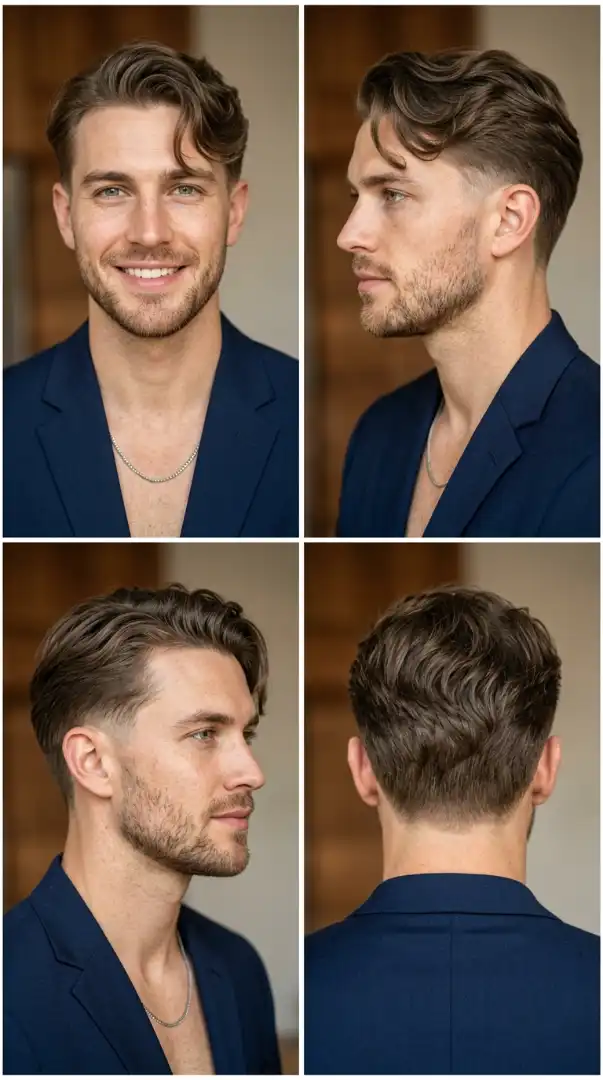
2 of 13 — The Textured Wave Master
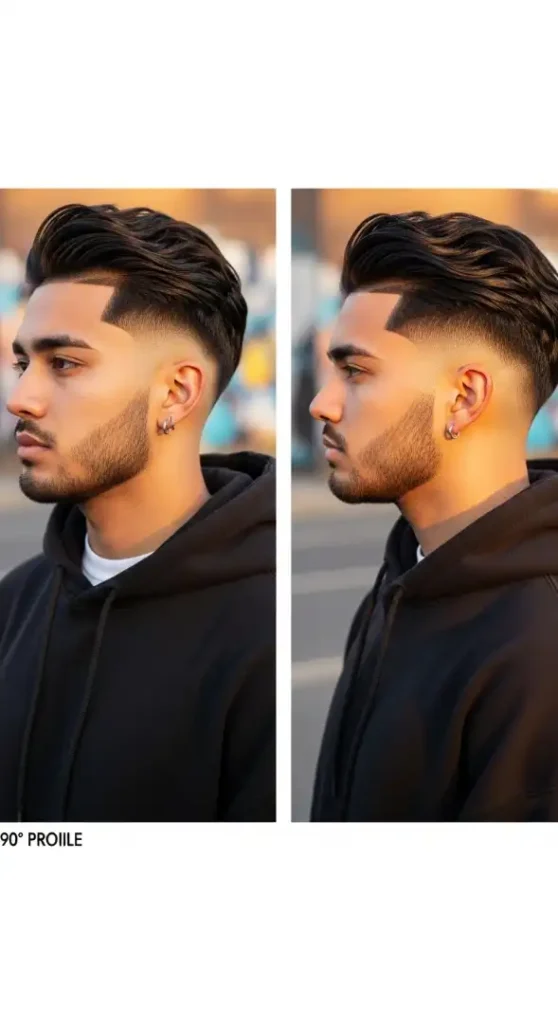
Best Face Shape Match
The Textured Wave Master is engineered specifically for Oval and Diamond face shapes. The natural wave pattern adds horizontal dimension across the top, which balances the narrow chin point characteristic of diamond faces. For oval faces — considered the most versatile shape — this cut enhances natural proportions without distortion. The 2.5-inch length prevents the top-heaviness that longer styles create while maintaining enough texture to avoid the “flat cap” effect. The anatomical advantage lies in how the wave texture creates movement lines that guide the eye across the face rather than straight down, softening angular features. Heart-shaped faces also benefit significantly — the textured top adds width at the temple area where heart faces naturally narrow, creating better upper-to-lower facial balance. Round faces should approach with caution; the horizontal wave emphasis can add unwanted width. If you have a round face and want this style, ask for more vertical texture and slightly longer length (3 inches) to elongate rather than widen.
Essential Grooming Kit
Clippers: Andis Master Adjustable Blade (essential for the precision gradient work on wavy hair) or Oster Classic 76 (powerful motor handles thick Asian hair texture)
Trimmer/Outliner: BaByliss PRO FX787 Gold Trimmer (zero-gap blade for clean hairline on dense hair) or Wahl Detailer (crisp line work around ears and nape)
Styling Tools: Denman D3 Original Styler Brush (7-row configuration perfect for defining waves while blow-drying), wide-tooth acetate comb (detangles wet wavy hair without breaking wave pattern)
Products: Bumble and Bumble Surf Spray (salt-based texture enhancer that defines waves without crunch), American Crew Forming Cream (light hold that lets waves move naturally), Hanz de Fuko Quicksand (matte clay for piece-y texture on second-day hair), Honest Amish Beard Wax (light control for stubble growth direction)
Finishing: Moroccanoil Treatment Light (prevents frizz in wavy hair between washes), dry shampoo powder (extends time between washes which is critical for maintaining wave pattern)
Maintenance Level
Rating: Medium
This cut sits in the maintenance sweet spot. Barber visits every 3 weeks keep the fade fresh — wavy hair disguises grow-out better than straight hair because the texture creates visual movement that masks the blurring fade line. Daily styling takes 6-8 minutes: spray damp hair with sea salt spray, scrunch waves with hands while blow-drying on medium heat with diffuser attachment, finish with a dime-sized amount of forming cream worked through mid-lengths to ends. The wave pattern does most of the work for you — you’re enhancing, not creating. Between washes (every 2-3 days for wavy hair), refresh with dry shampoo at the roots and re-scrunch with damp hands. The stubble beard needs trimming every 5-7 days to maintain the deliberately casual aesthetic. Total weekly time investment: about 45 minutes including one beard trim session. This is the ideal style for guys who want to look put-together without living in front of the mirror.
How To Ask Your Barber
“I want a mid taper fade that works with my natural waves — start at a 0.5 guard right at ear level, blend up to a 2 guard at the temple, and leave 2.5 inches on top. Don’t thin out the top too much; I want to keep the wave density. Use point cutting and texturizing shears to enhance the natural wave pattern, not flatten it. Leave the front slightly longer, about 3 inches, so the waves can flow forward and to the side. Keep my hairline natural — no hard line, just clean up the baby hairs. Blend my stubble into the fade so there’s no disconnect at the sideburns. For the back, taper the neckline naturally; I don’t want a blocky edge. I’m styling this with sea salt spray and cream, so make sure the cut has enough texture to hold shape without product weighing it down.”
The wave texture in this cut proves that natural hair patterns are assets, not obstacles. If you’re curious how a mid taper fade elevates curly hair to a whole different level, the next style showcases exactly that transformation.
FAQ
Q: How do I maintain wavy hair texture between barber visits?
A: Wavy hair thrives on strategic neglect. Wash only every 2-3 days using sulfate-free shampoo to preserve natural oils that define waves. On non-wash days, refresh with dry shampoo at roots and lightly dampen the mid-lengths with water in a spray bottle, then scrunch in a pea-sized amount of forming cream. Sleep on a satin pillowcase to prevent friction frizz. The fade will grow out gradually over 3 weeks, but the wave texture actually helps disguise the blurred transition better than straight hair would.
Q: What’s the difference between the Textured Wave Master and a regular mid fade?
A: The cutting technique and styling approach. The Textured Wave Master uses point cutting and texturizing shears specifically to enhance natural wave patterns, preserving hair density at the top while the regular mid fade often involves uniform clipper work that can flatten waves. The styling also differs — this cut is designed for air-dry or diffused drying with texture products, while a standard mid fade typically requires blow-drying with a brush for a smooth finish.
Q: Can I get this style if my hair is straight?
A: You can get a similar mid taper fade, but you won’t achieve the natural wave texture unless you have at least some natural wave or curl pattern. Straight hair would need to be styled with strong texture products (sea salt spray, matte clay) and potentially heat-styled with a curling technique to mimic the dimensional movement. However, straight hair version would look cleaner and more structured — a different aesthetic entirely, not better or worse, just different.
Q: What products should I avoid with wavy hair in a mid taper fade?
A: Avoid heavy gels, thick pomades, and silicone-heavy serums. These flatten your wave pattern and create that “wet look” that fights against the natural texture this cut celebrates. Also skip products with sulfates and alcohols high in the ingredient list — they strip natural oils and create frizz. Steer clear of fine-tooth combs on dry hair; they break up the wave clumps and create puffiness.
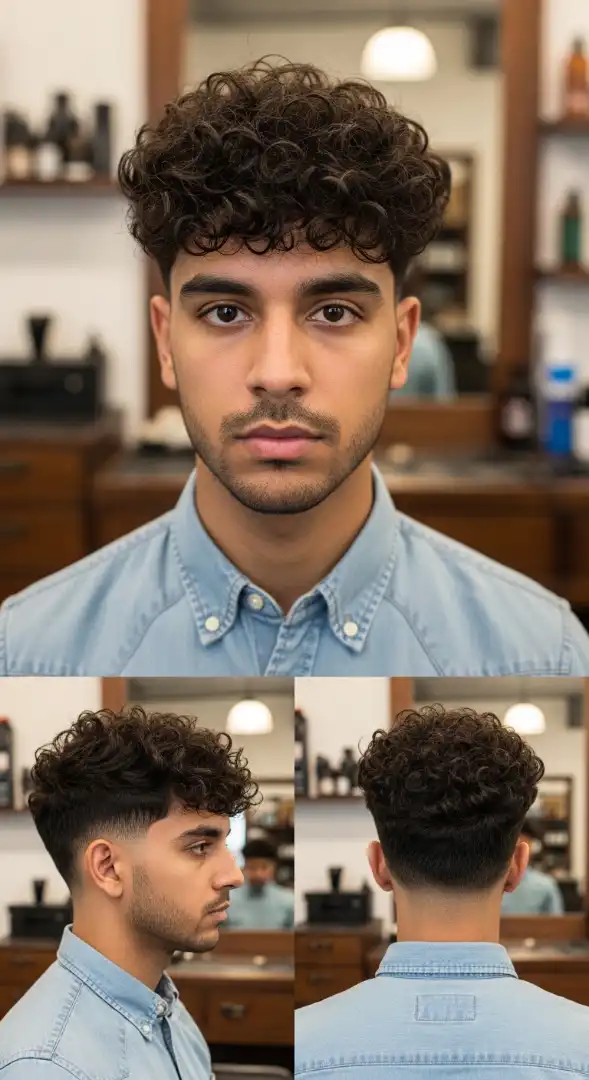
3 of 13 — The Curly Crown Commander
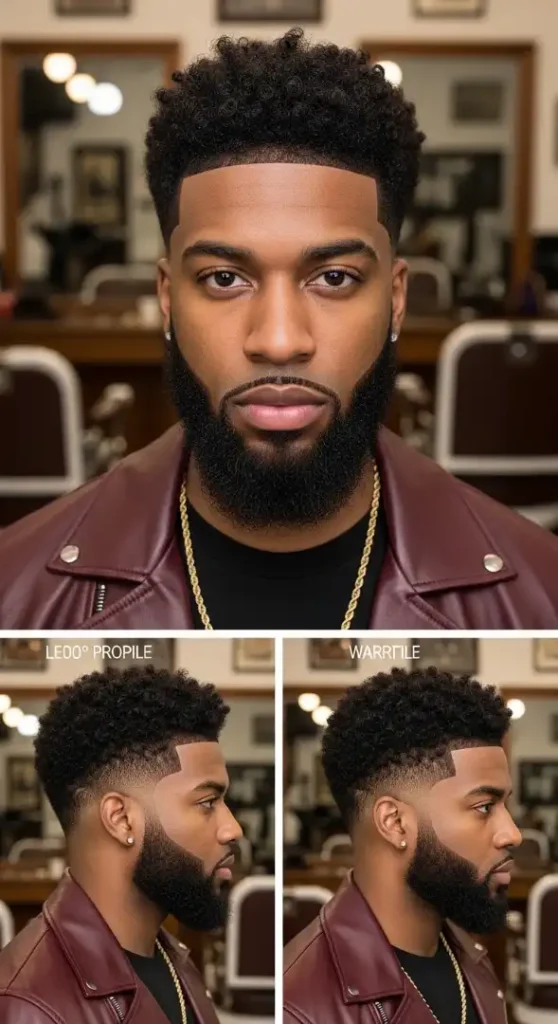
Best Face Shape Match
The Curly Crown Commander is specifically engineered for Square, Diamond, and Oblong face shapes with type 3B-4C hair textures. For square faces, the rounded coil crown softens angular jawlines — the natural spring of coils creates a circular counterpoint to sharp facial geometry. Diamond faces benefit from the width the coil crown adds at the temple level, balancing narrow chins and creating better upper-to-lower facial proportion. Oblong faces find particular advantage here: while the 3.5-inch height might seem counterintuitive for long faces, the rounded horizontal shape of the coil mass creates visual width that breaks up vertical length. The anatomical key is coil density — tight coils create actual physical volume that occupies three-dimensional space, unlike straight hair which lies flat. This volume redistribution balances facial proportions in ways straight-hair cuts cannot replicate. Round faces should approach cautiously; the crown width can over-emphasize circular features. If you have a round face and want this cut, keep the coil crown at 2.5-3 inches and ask for more vertical shaping to create height rather than width.
Essential Grooming Kit
Clippers: Wahl Senior (powerful V5000 motor cuts through dense coily hair without pulling) or Andis Master Cordless (lithium-ion power handles thick textures, critical for fade work on coarse hair)
Trimmer/Outliner: Andis Slimline Pro Li T-Blade (zero-overlap precision for hairline detail on coarse hair) or BaByliss PRO GoldFX Skeleton Trimmer (exposed blade reaches tight areas around coils)
Styling Tools: Wide-tooth seamless acetate comb (detangles coils without breakage), Denman D4 Original Styler Brush (9-row configuration defines coil clumps), edge brush for hairline styling
Products: Cantu Shea Butter Leave-In Conditioning Repair Cream (moisture retention is critical for coil definition), SheaMoisture Coconut & Hibiscus Curl Enhancing Smoothie (defines coils without crunch), Shea Radiance Diamond Edge Hair Gel (holds edges and hairline), Honest Amish Beard Oil (penetrates coarse beard hair, prevents dryness at fade connection), Camryn’s BFF Leave-In Conditioner Spray (daily moisture refresh)
Finishing: Satin bonnet or durag for overnight protection, silk or satin pillowcase (prevents friction breakage)
Maintenance Level
Rating: High
This cut demands dedication, but the results justify the effort. Barber visits every 2 weeks are non-negotiable — coily hair fade transitions blur faster than any other texture because the natural shrinkage makes grow-out instantly visible. Daily routine takes 12-18 minutes: wet hair completely in the shower (coily hair needs water, not just dampness), apply leave-in conditioner while soaking wet, rake through curl-enhancing smoothie with wide-tooth comb, air-dry or diffuse on low heat. Do NOT touch hair while drying — manipulation creates frizz. Nightly routine: apply light leave-in spray, cover with satin bonnet or durag to preserve coil definition. Wash every 5-7 days using sulfate-free co-wash or gentle shampoo — over-washing strips essential oils that coily hair desperately needs. Beard maintenance every 3-4 days: oil application, combing, trimming for shape. Weekly deep conditioning treatment keeps coils healthy. Budget 90-120 minutes per week total for all maintenance. The reward? A crown of perfectly defined coils that commands attention in every room you enter.
How To Ask Your Barber
“I want a mid taper fade that respects my curl pattern — start with a 0.5 guard at ear level, create a smooth transition up to my natural coil texture, and leave 3.5 inches of length on top. Don’t thin out or texturize the crown; I want maximum coil density and definition. Use clipper-over-comb technique for the blend so you’re not cutting individual coils — I want the fade smooth, not choppy. Shape the crown into a rounded silhouette, not a flat-top. Keep my hairline crisp with the trimmer, but don’t push it back — follow my natural hairline. Blend my beard into the sideburns seamlessly; I want the fade and beard to look like one continuous gradient. For the nape, taper it naturally with the grain — no hard edge. I’m using leave-in conditioner and curl cream, so the cut needs to support natural coil shrinkage, not fight it.”
This cut proves that coily hair isn’t a limitation — it’s a sculptural advantage. If you want to see how the mid taper fade translates to straighter textures with maximum volume, the next style shows the high-density approach.
FAQ
Q: How do I prevent my mid taper fade from looking fuzzy between barber visits with coily hair?
A: Moisture is your primary weapon. Daily light misting with leave-in conditioner spray keeps coils defined and tight, which maintains visual sharpness at the fade line. Use a satin bonnet every night to prevent friction frizz that makes the blend look fuzzy. Touch up your hairline weekly with an edge brush and edge control gel — maintaining that crisp perimeter creates the illusion of a fresher fade even as the sides grow. Every 10-12 days, you can do a light self-lineup with a safety razor on the neck and around ears if you’re comfortable, but leave the actual fade gradient to professionals.
Q: What’s the difference between a mid taper fade on coily hair versus straight hair?
A: The cutting technique, maintenance interval, and styling approach are completely different. Coily hair requires clipper-over-comb technique to avoid individual coil cutting that creates patchiness. The fade must be cut slightly higher to account for shrinkage — what looks perfect wet will shrink up once dry. Maintenance is every 2 weeks for coily versus 3 weeks for straight because coil shrinkage makes grow-out dramatically visible. Styling centers on moisture retention, while straight hair focuses on shape and hold. The visual result also differs — coily fades create three-dimensional volume, straight fades create smooth surfaces.
Q: Can I get a mid taper fade if I’m growing out my natural hair?
A: Absolutely, and this is actually an ideal transition style. The Curly Crown Commander keeps length and density at the crown while cleaning up the sides, which allows you to maintain professional appearance while growing natural coils. Just communicate your long-term goal to your barber so they keep maximum length on top and don’t over-thin the crown. Expect the fade portion to require consistent maintenance every 2 weeks, but the crown can grow continuously. In 6-8 months, you’ll have significant length at the crown with options to adjust the fade placement upward as top length increases.
Q: What’s the best way to refresh second or third-day curls on a mid taper fade?
A: Never dry-manipulate coily hair — always add water first. Fill a spray bottle with 3 parts water and 1 part leave-in conditioner. Lightly mist the entire crown section until hair is damp (not soaking). Scrunch sections gently to reactivate coil pattern. Apply a tiny amount of curl cream (pea-sized) to problem areas that have lost definition. Let air-dry or diffuse on low. For overnight preservation, do this refresh routine before bed and sleep with a satin bonnet. The key is rehydration — dry coily hair equals frizz and lost definition.
4 of 13 — The Business Titanium
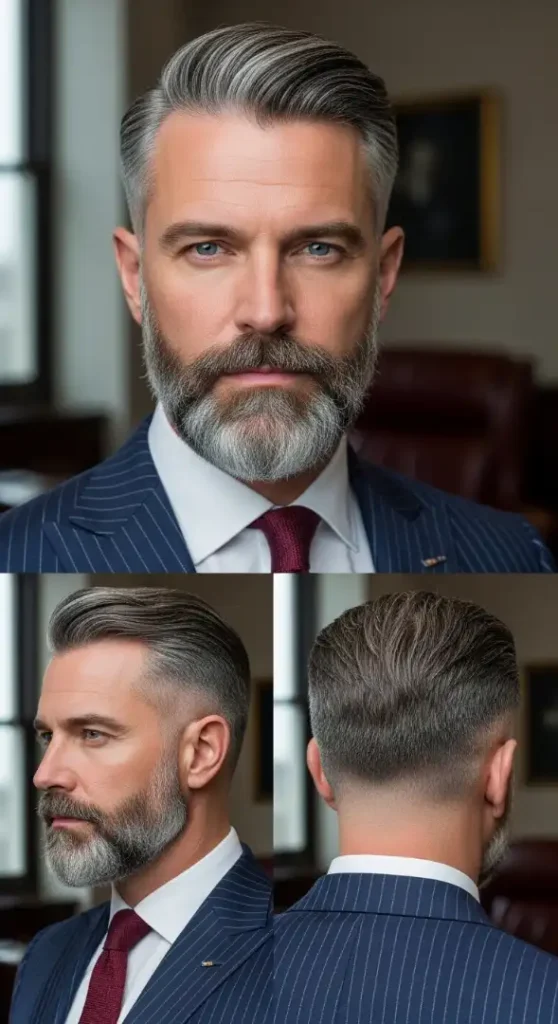
Best Face Shape Match
The Business Titanium works exceptionally well for Oblong, Rectangular, and Strong Angular face shapes, particularly on men over 40 where mature features pair with salt-and-pepper coloring. For oblong faces, the 2.5-inch side-swept top adds essential horizontal volume that breaks up vertical length without creating the “tall cylinder” effect that happens with high volume pompadours. Angular and rectangular faces benefit from the softening effect of the fade’s gradual transition — hard jawlines are balanced by the smooth gradient rather than emphasized by harsh undercut lines. The side-swept styling creates diagonal movement across the face, which softens sharp angles. The salt-and-pepper color distribution acts as natural dimension; darker tones recede while gray tones catch light, creating depth that makes the fade appear more three-dimensional and professionally executed. Square faces also work well here if the beard is maintained at medium density — the combination of fade and beard creates an elongating vertical line. Round faces should avoid this style; the side-swept volume adds horizontal width that over-emphasizes circular features.
Essential Grooming Kit
Clippers: Wahl Senior (classic reliable power for mature hair that may be coarser) or Andis Master (adjustable blade handles mixed gray-and-pigmented hair textures)
Trimmer/Outliner: Andis Slimline Pro Li (precision for mature hairlines that may have receded) or BaByliss PRO FX787 (critical for detailed beard work on gray hair which shows every imperfection)
Styling Tools: Kent 81T Fine-Tooth Comb (hand-sanded cellulose acetate, critical for mature hair), Mason Pearson Pocket Bristle Brush (natural bristle distributes scalp oil which gray hair needs more of)
Products: Layrite Superhold Pomade (gray hair needs stronger hold as it tends to be coarser), Imperial Barber Classic Pomade (traditional water-based, easy to rework throughout the day), Jack Black Beard Oil (nourishes gray beard hair which is naturally drier), Billy Jealousy Beard Control (light hold specifically for gray beards), Claudio St. James Violet Silver Shampoo (neutralizes yellow tones in white/gray hair)
Finishing: Kent FOT Folding Pocket Comb (essential for midday touchups in executive settings), small travel-size pomade tin for briefcase
Maintenance Level
Rating: Medium
This cut occupies professional middle ground. Barber visits every 2.5-3 weeks maintain corporate sharpness — salt-and-pepper hair shows fade blur more prominently than single-tone hair because the gray creates high contrast against skin. Daily styling takes 5-8 minutes: apply pomade to towel-dried hair, comb through with fine-tooth comb to distribute evenly, blow-dry while combing to set side-swept shape, finish with light water-based pomade for malleability throughout the day. Gray hair tends to be coarser and holds style better, which is an advantage. Beard maintenance every 4-5 days: trim for shape consistency, oil daily (gray beard hair is inherently drier than pigmented hair and will look wiry without moisture). Weekly violet shampoo treatment keeps white/gray tones clean and bright rather than yellowed. Budget about 60 minutes per week total. The key maintenance advantage of this style: you can skip haircuts for 4 weeks if needed and it still reads as “intentional executive silver” rather than “forgot to get a haircut.” The salt-and-pepper provides natural forgiveness.
How To Ask Your Barber
“I want a mid taper fade that works with my salt-and-pepper — start at 1mm just above the ears, blend up to a 2 on the sides keeping the gradient smooth, and leave 2.5 inches on top. The salt-and-pepper creates natural texture so don’t over-thin the top; just remove bulk with thinning shears on the interior, not the surface. I’m styling this with a side part and side-sweep to the right, so leave the front at 3 inches for proper grip. My hairline has matured back at the temples — don’t try to line it forward, just clean it up naturally following my actual hairline. Blend my gray beard into the fade; I want the sideburns to show the same color gradient as the hair. Trim the beard to 8-10mm consistent length, clean up the neckline, and shape the cheek line to follow my natural beard growth. For the back, taper the neckline without a harsh line — natural gradient with the grain. I’m using traditional pomade, so the cut needs to be structured enough to hold shape but not so thin that it looks flat.”
This distinguished look proves that maturity is an aesthetic advantage, not a constraint. If you’re curious how the mid taper fade translates to bold color choices for younger guys, the next style explores exactly that territory.
FAQ
Q: How do I prevent my salt-and-pepper hair from looking yellow between barber visits?
A: Use violet or blue-toned shampoo once per week. Gray and white hair oxidizes from minerals in water, styling products, and environmental exposure, creating yellow or brassy tones. Brands like Redken Color Extend Graydiant or Kérastase Blond Absolu neutralize yellow with purple pigments. Apply to wet hair, leave for 3-5 minutes, rinse. Don’t overuse — once weekly is sufficient, more can create purple cast. Between washes, use filtered water if possible, and avoid chlorinated pool water which accelerates yellowing dramatically.
Q: Does the mid taper fade look different on salt-and-pepper hair versus solid-color hair?
A: Yes, significantly. Salt-and-pepper creates natural dimension that makes the fade appear more three-dimensional — darker hairs recede visually while gray hairs catch light and come forward. This means the fade transition has built-in depth that barbers on solid-color hair must create artificially with clipper work. However, gray hair also shows imperfect blend work more obviously because of that same high contrast. The maintenance interval is similar (2.5-3 weeks), but the visual progression between cuts looks different — gray fade blur is more noticeable than same-color blur.
Q: What’s the best product for styling gray hair in a mid taper fade?
A: Water-based pomades with medium-to-firm hold work best for gray hair’s coarser texture. Gray hair tends to be drier and more wiry, so avoid alcohol-heavy products that increase dryness. Layrite Superhold, Imperial Barber Classic, or Suavecito Original Pomade provide all-day hold with easy reworkability. Apply to damp (not soaking) hair for better distribution. Gray hair also responds well to traditional oil-based pomades if you prefer the vintage aesthetic, but these require shampooing to fully remove. For matte finish, American Crew Fiber works but you’ll need more product than you would with pigmented hair.
Q: Should I color my gray hair or embrace it for this style?
A: The Business Titanium is specifically designed to celebrate salt-and-pepper rather than hide it. The distinguished mature aesthetic is the entire point — coloring defeats the style’s core appeal. That said, if patchy gray distribution bothers you, strategically blending with lowlights (not covering completely) can create more even distribution. Full single-color dye will require maintenance every 3-4 weeks and still won’t prevent gray roots from showing at the fade line within days. Embrace the gray — it’s your competitive advantage in corporate environments where distinguished presence matters.
5 of 13 — The Street Edge Warrior
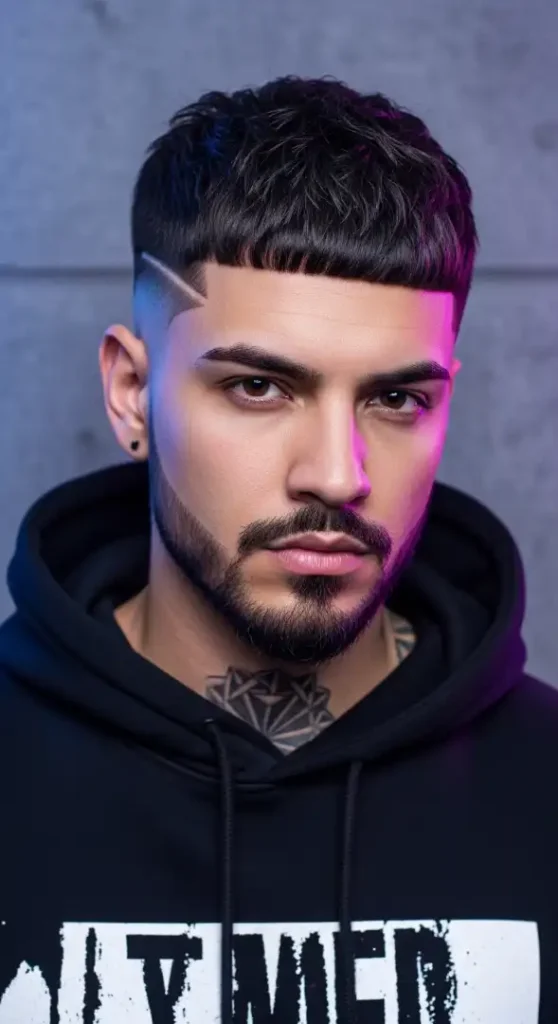
Best Face Shape Match
The Street Edge Warrior is precision-engineered for Diamond and Heart face shapes, with strong secondary suitability for Oval faces. Diamond faces feature narrow foreheads and chins with wider cheekbones — the choppy forward fringe adds essential width at the forehead, balancing the cheekbone prominence. The hard part line creates a horizontal visual break that widens the upper face optically. For heart-shaped faces (wide forehead, narrow chin), the textured crop adds dimension at the crown without over-volumizing the already-wide forehead zone. The mid taper fade removes width at the jaw level where heart faces don’t need it. Oval faces can pull this off with ease due to balanced proportions. The anatomical advantage here is the hard part’s ability to create architectural lines — it’s not just decorative; it literally redirects the eye’s movement across the face, creating perceived width where it’s needed. Round faces should avoid this unless they’re willing to keep the top at 2.5+ inches with vertical texture; otherwise, the forward-styled fringe can emphasize circular features. Square faces with very strong jaws should also reconsider — the aggressive fade can over-emphasize angular features rather than soften them.
Essential Grooming Kit
Clippers: Wahl Magic Clip (cordless convenience for the aggressive skin fade) or Andis Master Cordless (lithium power for dense Latino hair texture)
Trimmer/Outliner: Andis Slimline Pro Li T-Blade (zero-gap critical for the hard part razor line) or BaByliss PRO GoldFX Trimmer (gold standard for sharp line work and goatee definition)
Styling Tools: Fine-tooth cutting comb (for creating choppy texture), Denman D14 Resin Narrow-Row Styling Brush (blow-drying precision), safety razor or straight edge for hard part maintenance
Products: American Crew Fiber (matte finish with strong hold for choppy texture), Uppercut Deluxe Matt Clay (Aussie clay with extreme hold for textured crops), Suavecito Firme Hold Pomade (for days when you want shine instead of matte), Honest Amish Beard Balm (goatee shaping and conditioning)
Finishing: Edge control gel or wax for hard part line maintenance, small mirror for self-checks, travel-size fiber for touch-ups
Maintenance Level
Rating: High
This cut is high-performance with corresponding high maintenance. Barber visits every 1.5-2 weeks are non-negotiable — the skin fade and hard part razor line blur fast and look sloppy when grown out. Daily styling takes 10-15 minutes: towel-dry hair until damp, work fiber through hair focusing on roots and mid-lengths, blow-dry on high heat while using brush to create forward movement and texture, finish with additional fiber on fingertips for piece-y definition and choppy ends. The hard part line requires weekly maintenance at home: use a single-blade safety razor with the grain to keep the line crisp, or book weekly lineups at the barbershop. Goatee trimming every 3-4 days maintains the sharp aesthetic. Hairline touch-ups weekly keep corners sharp. Total weekly time investment: roughly 90-120 minutes including one full barber visit and daily styling. This style doesn’t forgive lazy mornings — unstyled, it looks messy rather than casually cool. The reward? Maximum street credibility and a look that commands respect in any urban setting.
How To Ask Your Barber
“I want an aggressive mid taper skin fade — start with a 0.5 guard or foil shaver right at ear level, fade up tight to the skin at the baseline, and blend up to 2 inches on top. Make the fade sharp, not gradual; I want high contrast. Give me a hard part on the left side with a razor line — clean, straight, one blade width. Don’t curve it; keep it geometric. For the top, I want a textured crop with choppy layers — use point-cutting technique to create separation and uneven ends. Leave the front at 2.5 inches so I can style it forward. Keep my hairline square with sharp corners at the temples; don’t round them off. For my goatee, trim it to 6mm consistent length, sharp line where it meets the cheeks, clean neckline. Don’t blend the goatee into the fade; I want a deliberate separation. For the back, taper the neckline with a skin fade into the neck. I’m styling this with matte fiber, so the cut needs texture and grip, not smooth density.”
This aggressive urban aesthetic proves that mid taper fades can carry serious edge when executed with precision. If you’re ready to see how the same fade translates to a more refined, professional context, the next style demonstrates that versatility.
FAQ
Q: How do I maintain a hard part razor line between barber visits?
A: Weekly home maintenance with a single-blade safety razor keeps it crisp. After a shower when skin is soft, apply light shaving cream or oil to the hard part line. Use the razor WITH the grain (never against) in single gentle strokes. Clean the blade between strokes. Don’t press hard — let the razor’s weight do the work. After, apply alcohol-free aftershave balm to prevent irritation. Alternatively, many barbers offer $10 line-up services between full cuts — 10 minutes to clean the hard part, hairline, and fade edges. That’s often easier and safer than DIY, especially on the back and sides.
Q: What’s the difference between a skin fade and a regular mid taper fade?
A: The baseline gradient. A regular mid taper fade blends from a 1 or 1.5 guard at the bottom to longer length at the top, maintaining some hair at the lowest point. A skin fade (like The Street Edge Warrior) blends down to actual skin using a 0.5 guard or foil shaver, creating maximum contrast. Skin fades require more frequent maintenance (1.5-2 weeks vs. 3 weeks for regular tapers) because the grow-out from skin is dramatically visible. Skin fades also demand higher technical skill from the barber — improper technique creates lines, patches, and irritation.
Q: Can I style this cut with a side part instead of forward?
A: Yes, but it changes the aesthetic significantly. The choppy forward texture is designed to create urban street edge — styling it to the side with a traditional part converts it into a more conservative look. If you want side-parted styling, ask your barber to adjust the layering technique: less point-cutting for choppiness, more blending for smoothness, and keep the top closer to 3 inches for better side-sweep grip. The hard part can remain as an accent line. You’ll also need pomade instead of matte fiber for side-parted styles.
Q: How do I prevent razor bumps on my hard part line?
A: Razor bumps form when shaved hair curls back into skin and causes inflammation. Prevention: always shave with sharp blades (never use dull razors), shave WITH the grain only (never against), use proper lubrication (shaving cream or oil), don’t press hard, and moisturize afterward with alcohol-free balm. If you’re prone to bumps, consider having your barber maintain the hard part with clippers and trimmers instead of razor work — it won’t be quite as crisp, but it eliminates skin irritation. Exfoliate the hard part area once weekly with a gentle scrub to prevent ingrown hairs.
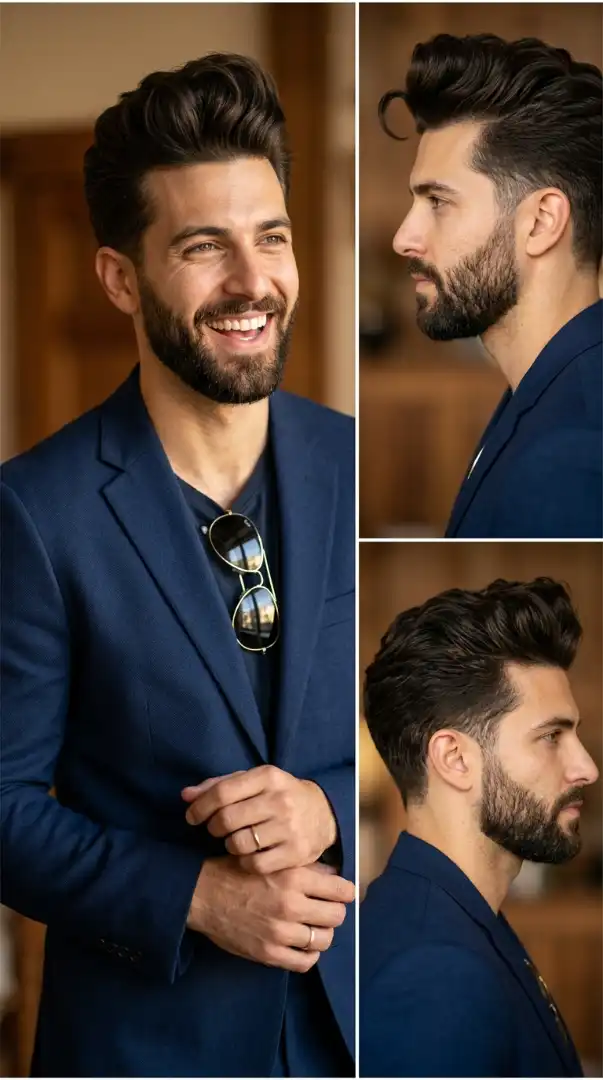
6 of 13 — The Mediterranean Gentleman

Best Face Shape Match
The Mediterranean Gentleman is optimized for Oval, Oblong, and Rectangular face shapes, particularly on men with Mediterranean, Middle Eastern, or naturally wavy hair textures. Oval faces are the universal match — the 3-inch swept volume maintains natural balance without distortion. Oblong faces benefit from the horizontal wave movement and side-swept styling that creates width and breaks up vertical length. The fuller beard (15mm) adds horizontal dimension at the jawline, further shortening perceived face length. Rectangular faces gain from the softening effect of wavy texture — where angular faces can look harsh with slicked styles, the natural wave movement introduces curves that balance straight lines. The anatomical advantage is the wave pattern’s ability to create three-dimensional texture that occupies visual space, making narrow faces appear fuller. Round faces should be cautious — the side-swept volume can add unwanted width. If you have a round face and love this style, ask for more vertical styling and keep beard length shorter (10mm) to create length rather than width. Square faces work well here if the beard is maintained properly; the waves soften the angular jaw while the beard defines structure.
Essential Grooming Kit
Clippers: Oster Classic 76 (powerful motor handles thick Middle Eastern hair texture) or Wahl Senior (reliable workhorse for dense wavy hair)
Trimmer/Outliner: Andis Slimline Pro Li T-Blade (precision for detailed beard sculpting) or Philips Norelco OneBlade Pro (hybrid trimmer-shaver perfect for beard length control and neck cleanup)
Styling Tools: Denman D3 Original Styler Brush (defines waves while blow-drying), wide-tooth acetate comb (detangles without destroying wave pattern), boar bristle beard brush (distributes oils and shapes beard)
Products: Bumble and Bumble Hairdresser’s Invisible Oil (controls frizz in wavy hair without weight), Baxter of California Clay Pomade (flexible hold for wavy textures, matte finish), Beardbrand Utility Beard Oil (nourishes dense sculpted beards), Seven Potions Beard Balm (light hold for beard shaping without stiffness)
Finishing: Cedarwood or sandalwood cologne (complements Mediterranean aesthetic), small beard scissors for detail trimming
Maintenance Level
Rating: Medium
This style hits a maintenance sweet spot for wavy hair. Barber visits every 3 weeks maintain both fade and beard shape — wavy hair disguises fade grow-out better than straight hair because texture creates natural visual movement. Daily styling takes 7-10 minutes: apply invisible oil to damp hair, work through with fingers, blow-dry on medium heat with Denman brush to enhance waves and create side-swept movement, finish with small amount of clay pomade for texture and hold. The key with wavy hair is enhancement, not creation — you’re working with your natural pattern. Beard maintenance requires daily oil application (2-3 drops worked through with fingers), brushing morning and evening, and trimming every 5-6 days. Use clippers with guard attachment for uniform length, scissors for shaping edges. Weekly deep conditioning treatment keeps auburn waves rich and prevents dryness. Budget 60 minutes per week total. The advantage of this cut: it looks intentionally relaxed even when grown out slightly. Missing a barber appointment by a week doesn’t ruin the aesthetic — it just transitions from “freshly cut” to “lived-in gentleman.”
How To Ask Your Barber
“I want a mid taper fade that respects my natural waves — start with a 1mm guard at ear level, create a gradual blend up to a 1.5 or 2 at the temple, and leave 3 inches on top. Don’t over-texturize or thin the waves; I want to keep natural wave density. Use point cutting on the top to enhance wave pattern and remove bulk from the interior, not the surface. I’m styling this swept to the left, so leave the right side slightly shorter for natural fall direction. Keep my hairline natural and soft — no hard corners. For my beard, trim it to 15mm uniform length using guard attachments. Sculpt the cheek line to follow my natural growth pattern — don’t cut it too high. Clean the neckline about one finger-width above my Adam’s apple, faded not lined. Blend the beard into the sideburns and fade seamlessly; I want one continuous gradient from hair to beard. For the nape, natural taper with my hair growth direction, no hard line. I’m using light oil and clay pomade, so the cut should support natural wave movement, not fight it.”
This Mediterranean-inspired aesthetic proves that wavy hair is a styling advantage when the cut works with texture instead of against it. If you’re ready to see how a mid taper fade handles extremely short, military-precision crops, the next style delivers exactly that discipline.
FAQ
Q: How do I prevent my wavy hair from looking frizzy in a mid taper fade?
A: Moisture management is everything for wavy hair. Use sulfate-free shampoo and conditioner — sulfates strip natural oils that wavy hair needs for definition. Apply leave-in treatment or hair oil to damp (not dry) hair after every wash. When blow-drying, use a diffuser attachment on medium heat — high heat creates frizz. Never brush or comb dry wavy hair; if you need to restyle between washes, lightly dampen first with a spray bottle. Sleep on a satin or silk pillowcase to reduce friction. For Mediterranean climates with humidity, use an anti-frizz serum before styling.
Q: What’s the best beard length to pair with the Mediterranean Gentleman cut?
A: 15mm (about 5/8 inch) is the ideal length for this style — long enough to create sculpted definition and masculine presence, short enough to maintain clean lines and professional appearance. Any shorter (10mm or less) and the beard loses the “gentleman” aspect, reading as stubble rather than styled beard. Any longer (20mm+) and you risk overwhelming the balanced proportions this cut creates. The 15mm length also pairs perfectly with the fade because both elements have similar visual weight — neither dominates, creating harmony.
Q: Can I get this cut if my hair is straight instead of wavy?
A: Yes, but the aesthetic changes significantly. Straight hair version would need different styling products (pomade instead of clay, more hold) and different cutting technique (more layering to create artificial texture). The “Mediterranean Gentleman” appeal comes partly from natural wave movement — straight hair version looks more “corporate professional” than “coastal refined.” Not worse, just different. If you have straight hair and want this vibe, add a perm or textured perm to create wave pattern, then get the cut. That’s actually becoming a popular request in high-end barbershops.
Q: How do I maintain auburn hair color richness between cuts?
A: Auburn tones fade faster than dark browns because the red pigments are less stable. Use color-safe shampoo and conditioner (no sulfates). Wash hair in lukewarm water, not hot — heat opens cuticles and releases color. Consider a color-depositing conditioner once per week (copper or auburn tone) to refresh the red undertones. Avoid prolonged sun exposure without protection — UV rays bleach red pigments quickly. If color fades significantly, book a professional toner treatment at a salon rather than attempting box color at home. Natural auburn hair ages into beautiful variations; embrace the dimension rather than fighting it.
7 of 13 — The Undercut Evolution
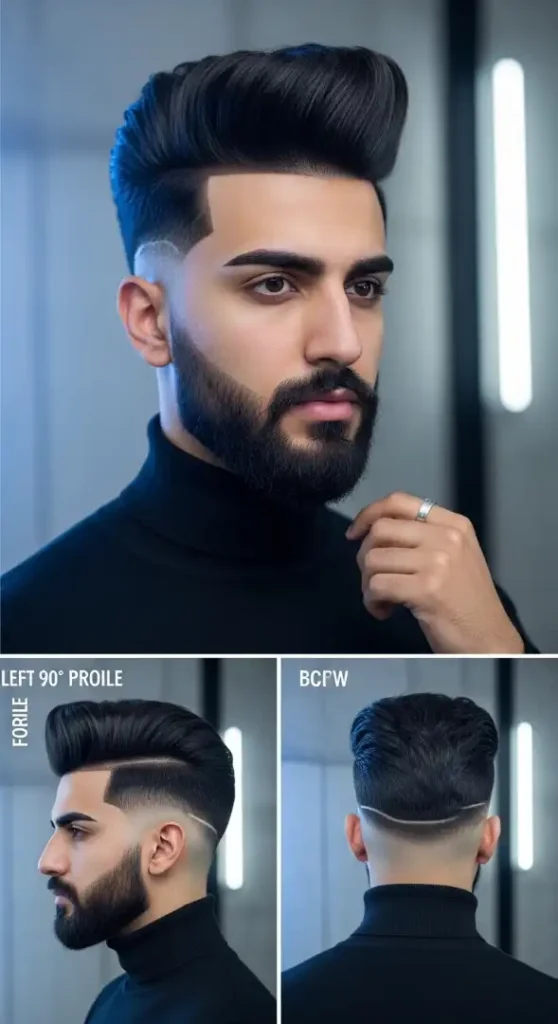
Best Face Shape Match
The Undercut Evolution is specifically architected for Oval, Long, and Heart-shaped faces where vertical height enhancement works as an aesthetic advantage. For long and oblong faces, this might seem counterintuitive — doesn’t added height elongate further? — but the key is the pompadour’s horizontal width at the front creates visual balance. The volume extends forward AND upward, not just up, which breaks the vertical line. Heart-shaped faces benefit dramatically from the disconnected fade’s clean sides reducing temple width where heart faces are already wide, while the pompadour volume creates presence at the crown where heart faces need it. Oval faces can wear this effortlessly because balanced proportions accept bold styling without distortion. The anatomical advantage is structural: the 4-inch top creates actual architectural volume that changes face proportions from multiple viewing angles. From the front, it adds height; from the side, it adds dramatic profile; from behind, it creates presence. Square and round faces should approach cautiously — the added height can make square faces appear top-heavy, and round faces may look wider. If you have these shapes and want this cut, keep the top closer to 3 inches and increase side texture (more gradual fade, less disconnect) for balance.
Essential Grooming Kit
Clippers: Wahl Senior (essential for creating the distinct disconnection line) or Andis Master (adjustable blade perfect for Pakistani hair’s typically dense straight texture)
Trimmer/Outliner: BaByliss PRO FX787 Gold Trimmer (critical for maintaining the sharp disconnect line) or Andis T-Outliner (classic for line work and beard shaping)
Styling Tools: Round thermal brush (small barrel, 1.5-inch diameter for pompadour shaping), blow dryer with concentrator nozzle (essential for directed heat), fine-tooth comb for slicking
Products: Uppercut Deluxe Pomade (strong hold for pompadour structure), American Crew Boost Powder (volume at roots before styling), Layrite Supershine Cream (high-shine finish for slicked-back aesthetic), Jack Black Beard Oil (circle beard maintenance), Got2b Glued Blasting Freeze Spray (locks pompadour in place all day)
Finishing: Edge control gel for hairline maintenance, small mirror for self-checks on pompadour shape
Maintenance Level
Rating: Very High
This is a high-commitment cut requiring professional dedication. Barber visits every 1.5 weeks are mandatory — the disconnect line blurs rapidly and looks sloppy when the separation between top and sides loses definition. Daily styling takes 15-20 minutes and cannot be skipped: towel-dry hair until slightly damp, apply boost powder to roots at crown, apply pomade to entire top section, blow-dry using round brush while pulling hair up and back to create volume, use fine-tooth comb to perfect the slicked-back shape, finish with strong-hold spray to lock everything in place. The pompadour must be restyled from scratch every single morning — this cut has no “second-day hair” option. Circle beard trimming every 4 days maintains shape. Hairline and disconnect line require weekly touch-ups with trimmer or weekly barber line-up appointments. Budget 120-150 minutes per week including barber time and daily styling. The neck and shoulders often show pomade product buildup — shower thoroughly nightly. This style is for men who view grooming as a priority practice, not a casual routine. The payoff? A statement haircut that makes you the most distinctively styled person in any room.
How To Ask Your Barber
“I want a disconnected mid taper fade with strong pompadour volume — start the fade 1.5 inches above my ears, not at ear level. Use a 1mm guard for the sides and create a distinct line where the fade meets the top; don’t blend it gradually. I want that intentional disconnect. Leave 4 inches on top, longest at the front for pompadour height. Layer the top using scissors-over-comb technique so the hair can stand up when styled. The front should be able to reach 2-3 inches of vertical height when blown dry. Style it swept back and slightly to the right. Keep my hairline sharp with geometric corners — clean but not overly squared. For my circle beard, trim it to 8mm, clean the edges to create the circle shape, and don’t blend it into the sideburns — I want an intentional small gap. Sharp cheek line, rounded neckline. For the back, taper the neckline naturally and make sure the top volume continues all the way around the back of my head for 360-degree presence. I’m styling this with pomade and strong-hold spray, so the cut needs maximum length on top for grip and structure.”
This modern evolution of the classic undercut proves that bold height and dramatic disconnection still command attention in contemporary styling. If you’re curious how mid taper fades work with minimal styling for low-maintenance guys, the next style demonstrates exactly that approach.
FAQ
Q: What’s the difference between a disconnected fade and a regular mid taper fade?
A: The blending technique and visual effect. A regular mid taper fade creates a gradual, seamless transition from short sides to longer top — you can’t identify exactly where one length ends and another begins. A disconnected fade (like The Undercut Evolution) intentionally creates a visible line of demarcation between the sides and top, usually 1-2 inches above the ear. This creates high contrast and modern edginess versus the smooth professionalism of a regular taper. Disconnected fades require more frequent maintenance (1.5-2 weeks) because that sharp line blurs quickly with growth.
Q: How do I get pompadour volume if my hair is naturally flat?
A: Blow-drying technique is more important than hair type. Start with damp (not wet) hair. Apply root-lifting powder or mousse to the crown before styling. Use a round brush (small barrel, 1.5-inch) and blow dryer with concentrator nozzle. Pull hair straight up and back while applying heat, holding each section for 3-5 seconds. Work from back to front, creating layers of volume. The round brush creates bend and lift that flat hair naturally lacks. Finish with strong-hold pomade and freeze spray. If your hair is very resistant, ask your barber for slight internal layering — this removes weight and makes volume easier to achieve.
Q: Can I get this style if I have curly or wavy hair?
A: You can get a similar concept, but the execution would be entirely different. The Undercut Evolution depends on straight hair’s ability to be slicked back smoothly with pompadour structure. Curly or wavy hair would create a textured pompadour with natural movement instead of sleek precision — still cool, just a different aesthetic entirely. If you have curly hair and want structured height, ask for a “curly pompadour” or “textured high-volume cut” — your barber will know to create the shape using curl-enhancing products instead of sleek pomades.
Q: Is the disconnected fade professional enough for corporate environments?
A: It depends on your industry and company culture. Traditional conservative industries (law, finance, medicine) may view the disconnect as too edgy for client-facing roles. Tech, creative, marketing, and modern corporate environments generally accept it without issue. The styling approach matters too — slicked back neatly with a moderate pompadour reads more professional than exaggerated height with spiky texture. When in doubt, ask your barber for a “softer disconnect” — a less dramatic line that still has separation but isn’t as bold. You can always make it more dramatic later if your workplace culture allows.
8 of 13 — The Classic Revision
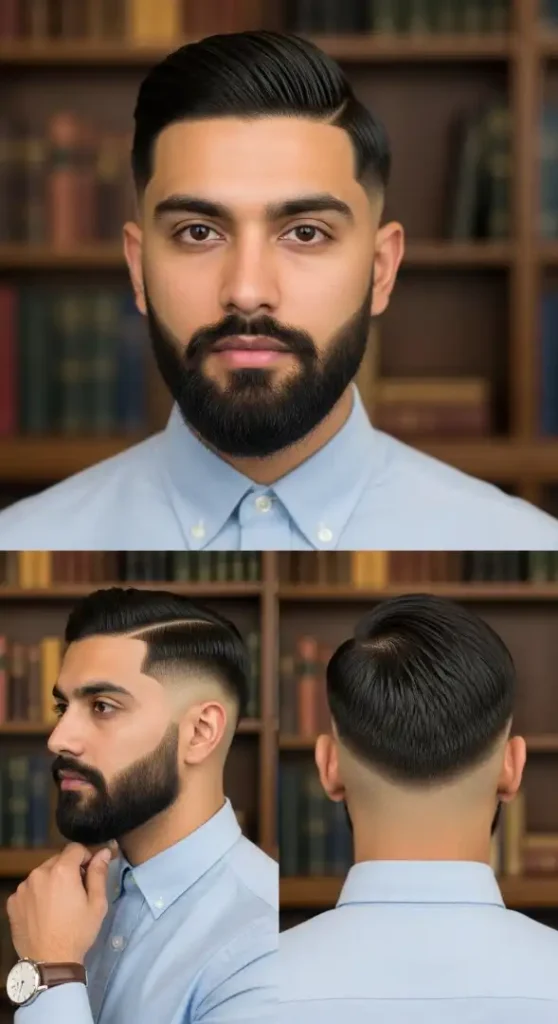
Best Face Shape Match
The Classic Revision is precisely engineered for Oval, Heart, and Diamond face shapes where traditional side-parted styling enhances natural proportions. Oval faces are the textbook match — balanced proportions accept classic styling without requiring corrective elements. Heart-shaped faces benefit from the side-parted volume which adds width at the crown level where heart faces narrow, creating better balance with the wider forehead. The 2.5-inch length prevents over-volumizing the already-wide upper face. Diamond faces find advantage in the side part’s horizontal line which visually widens the narrow forehead while the tapered fade reduces width at the cheekbone level where diamond faces are naturally widest. The anatomical key is the side part’s diagonal line — it creates movement across the face rather than straight vertical or horizontal emphasis, which flatters most facial structures. The Van Dyke beard adds vertical length through the goatee point, which elongates shorter faces. Round and square faces should approach thoughtfully — round faces may want slightly more height (3 inches on top) to create length, and square faces benefit from keeping the fade slightly lower (1.5 inches above ear) to maintain more side mass that balances strong jaws.
Essential Grooming Kit
Clippers: Wahl Magic Clip (precision for clean fade work on straight Indian hair texture) or Andis Master Adjustable (versatile blade adjustment for gradient control)
Trimmer/Outliner: Andis Slimline Pro Li T-Blade (critical for part line definition and Van Dyke precision) or Philips Norelco OneBlade Pro (excellent for maintaining bare cheek areas in Van Dyke)
Styling Tools: Kent 81T Fine-Tooth Comb (creates sharp part line), Mason Pearson Pocket Bristle Brush (distributes pomade and natural oils), small mustache scissors for Van Dyke detail work
Products: Layrite Original Pomade (traditional water-based with natural shine for classic styling), Baxter of California Clay Pomade (alternative for days you want matte finish), Clubman Pinaud Mustache Wax (shapes and controls Van Dyke mustache), Honest Amish Beard Oil (nourishes goatee, conditions facial hair)
Finishing: Fine-tooth pocket comb for midday touch-ups, small mirror for checking part line
Maintenance Level
Rating: Medium
This cut sits comfortably in medium maintenance territory. Barber visits every 3 weeks keep the fade fresh and the part line sharp — classic side-parted styles are more forgiving than avant-garde cuts because “grown out” still reads as “intentional” if the overall shape is maintained. Daily styling takes 6-9 minutes: towel-dry hair until damp, create part line with fine-tooth comb, apply pomade with fingers distributing through entire top section, comb through with part direction (left to right), use brush to smooth and add shine, check part line for clean definition. The Van Dyke beard requires attention every 3-4 days: trim goatee to maintain point shape, trim mustache for clean upper lip line, use trimmer to maintain bare cheek areas, apply mustache wax for hold and shape, condition with beard oil. Part line maintenance weekly keeps it crisp — use the pointed end of a comb to re-establish the line’s depth. Budget about 60 minutes per week total. The advantage: this style looks progressively more “gentleman-distinguished” as it grows out rather than progressively messier like edgier cuts.
How To Ask Your Barber
“I want a classic mid taper fade with a traditional side part — start at 1mm at ear level, blend up to a 2 or 2.5 at the temple, and leave 2.5 inches on top. Create a clean part line on the left side about 1.5 inches from my natural part, use a comb and clippers to define it precisely. I want to comb the top to the right with traditional styling, so cut the layers to allow smooth side combing without pieces sticking up. Keep the front at 2.5-3 inches for proper volume and shaping. My hairline is mature — clean it up naturally, don’t push it forward, just define what’s there. For my Van Dyke beard, trim the goatee to a point at 10-12mm length, keep my mustache trimmed above the upper lip line with a slight downward angle at the corners, and use the trimmer to maintain bare cheeks — I want clean separation between mustache and goatee. Clean neckline on the goatee. For the back of my head, natural tapered neckline with gradient, no hard edge, and make sure the top continues around the back without flat spots. I’m styling this with traditional pomade for a natural shine, so the cut should support smooth combing without needing heavy products.”
This classic approach proves that timeless styling adapts beautifully to modern fade techniques. If you’re ready to see how mid taper fades incorporate bold asymmetry and creative direction, the next style pushes those boundaries.
FAQ
Q: How do I maintain a sharp side part line between barber visits?
A: Weekly home maintenance keeps it crisp. After showering when hair is damp, use the pointed tail end of a fine-tooth comb to trace the part line from front to back, applying gentle pressure to recreate the channel. Style as usual. The part will naturally shallow out as hair grows, but this weekly redefinition extends its sharpness. Alternatively, some men get the part line lightly trimmed with clippers every 10-14 days at the barber (5-minute service, minimal cost) — this maintains crispness without a full haircut. Avoid changing your part side or position; consistency keeps the channel trained.
Q: What’s the difference between a Van Dyke beard and a goatee?
A: Terminology precision matters. A goatee is facial hair only on the chin — no mustache, bare upper lip. A Van Dyke adds a disconnected mustache to the goatee, with intentionally bare cheek areas creating visual separation. The Van Dyke has aristocratic, refined associations; the plain goatee reads more casual-modern. The Van Dyke requires more maintenance because you’re maintaining three separate elements (mustache, goatee, bare cheeks) versus one (chin hair only). But the payoff is significantly more distinctive and sophisticated appearance.
Q: Can I style this cut without pomade for a less formal look?
A: Yes, but expect a different aesthetic. Use matte clay or cream instead of pomade — this creates textured separation rather than smooth shine. Apply to damp hair, work through with fingers, comb the part line, then tousle slightly with fingertips to break up uniformity. The result is “smart casual” rather than “executive formal.” The cut’s structure still shows through, but the finish is contemporary matte instead of classic shine. For ultra-casual days, skip product entirely and just comb after showering — the cut’s shape does the work, you just won’t have hold or control.
Q: How do I know if my face shape suits a side part?
A: Side parts flatter most faces except extremely round faces where they can add unwanted horizontal width. The test: does your face have any angular or elongated features? If yes, side parts work. The diagonal line of the part creates movement that softens angles (good for square faces) and adds dimension to long faces. If you have a perfectly round face, consider a center part or textured top instead — side parts emphasize the circular shape. Your barber can assess your face shape and part placement during consultation; experienced barbers know intuitively which side creates better balance based on your natural hair growth and facial asymmetry.
9 of 13 — The Urban Canvas
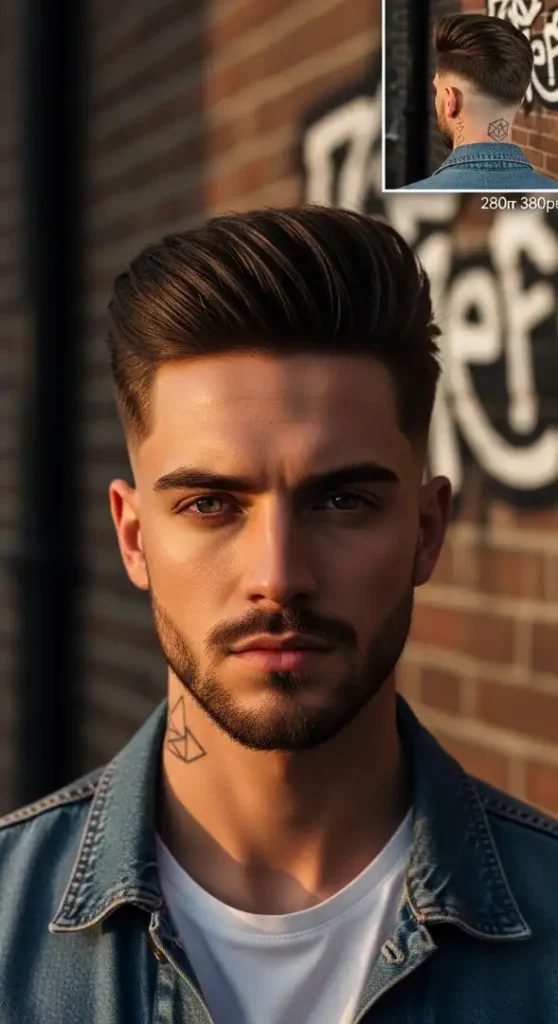
Best Face Shape Match
The Urban Canvas is optimized specifically for Square and Rectangular face shapes where the clean-shaven aesthetic and upward quiff styling create vertical balance against strong horizontal jaw features. Square faces benefit dramatically — the vertical textured quiff draws the eye upward, elongating the face and balancing the wide, angular jawline that square faces naturally possess. The aggressive fade removes width at the sides exactly where square faces don’t need additional mass. Rectangular faces (longer, more vertical squares) also work perfectly because the upward styling adds controlled height without over-elongating. The clean-shaven element is critical here: no beard means the strong jawline is the defining lower facial feature, and the upward quiff creates visual conversation between jaw and crown. Round faces can attempt this but should request additional height (2.5-3 inches on top with more dramatic vertical styling) to create maximum length-to-width ratio. Oval faces work well as always. Heart and diamond faces should be cautious — the upward quiff adds width at the crown where these shapes are already narrow, potentially creating an inverted pyramid effect. If you have heart or diamond face and want this cut, keep the quiff more forward-swept than vertical.
Essential Grooming Kit
Clippers: Wahl Magic Clip (aggressive skin fade capability) or Andis Master Cordless (powerful motor for tight fade work)
Trimmer/Outliner: Andis Slimline Pro Li T-Blade (perfect for clean-shaven neck detail and hairline precision) or BaByliss PRO GoldFX Skeleton Trimmer (exposed blade for maximum closeness)
Styling Tools: Blow dryer with concentrator nozzle (critical for directing hair upward), vent brush or paddle brush (creates volume during blow-drying), fine-tooth comb for final shaping
Products: American Crew Fiber (matte finish with strong hold for piece-y texture), Uppercut Deluxe Matte Pomade (builds volume without shine), Hanz de Fuko Quicksand (texturizing clay for extreme hold and separation), American Crew Boost Powder (root lift before blow-drying)
Finishing: Light hairspray for hold locking (not heavy/visible), travel-size fiber for midday touch-ups
Maintenance Level
Rating: High
This cut demands consistent attention. Barber visits every 2 weeks are essential — the aggressive 0.5mm baseline blurs rapidly, and the clean-shaven aesthetic means there’s zero facial hair to camouflage grown-out fade lines. Daily styling takes 12-18 minutes and is non-negotiable: start with damp hair, apply root boost powder to crown and front, work fiber through mid-lengths avoiding roots, blow-dry on high heat using vent brush to direct hair upward and forward, continuously moving the brush against the grain to create volume, finish with additional fiber on fingertips for piece-y separation and texture definition, light hairspray to lock. The quiff styling must be repeated from scratch daily — there’s no second-day hair option with this structure. Clean-shaven maintenance means daily face shaving or electric trimming to maintain the smooth aesthetic that defines this look. Neck tattoo visibility (if you have one) requires daily assessment — make sure neckline fade doesn’t encroach on ink. Budget 90-120 minutes per week total. This is a lifestyle cut for men who prioritize appearance and are willing to invest the time. The reward? Maximum modern urban edge and a look that photographs exceptionally well.
How To Ask Your Barber
“I want an aggressive mid taper fade with textured quiff — start with a 0.5 guard or foil shaver at ear level creating a skin fade at the baseline, blend up tight with high contrast to 2 inches on top. I want the fade sharp and dramatic, not soft. Leave 2-2.5 inches on top with the front at 3 inches for upward styling. Use point-cutting and texturizing techniques to create piece-y separation and choppy texture — I don’t want smooth density. The styling direction is upward and slightly forward, so cut the layers to support vertical volume. I’m clean-shaven — no beard at all — so the fade needs to blend cleanly into my skin, especially around the sideburn area and neckline. Make my hairline sharp with defined corners. For the neckline, aggressive taper into the neck with skin fade continuing down. I have a small neck tattoo behind my left ear — be careful not to fade into it. I’m styling this with matte fiber and blow-drying for vertical volume, so the cut needs maximum texture for product grip.”
This urban aesthetic proves that clean-shaven paired with aggressive fade creates maximum modern impact. If you’re curious how mid taper fades work with longer, flowing styles, the next style explores that flowing aesthetic.
FAQ
Q: How do I get my quiff to stay upward all day without falling flat?
A: Proper technique and product stacking are essential. Start with root boost powder on damp hair — this creates grit at the roots that helps hair stand. Blow-dry with a vent brush pulling hair AGAINST its natural fall direction while applying high heat. This trains the hair into an unnatural upward position. Use strong-hold matte product (American Crew Fiber or Uppercut Matte) worked into mid-lengths, not roots — product at roots creates weight that causes collapse. Finish with light flexible-hold hairspray (not heavy wet-look spray). If your hair is very straight and resistant, ask your barber for internal layering that removes weight and makes vertical styling easier. Don’t touch your hair throughout the day — oil from hands breaks down product.
Q: Do I need to be completely clean-shaven for The Urban Canvas style?
A: The aesthetic is optimized for clean-shaven, but light stubble (1-2mm) can work if maintained consistently. The key is avoiding any beard length that would blur the hard line between fade and face — no 5mm patchy growth, no neck beard, no sideburns extending below the fade line. If you prefer stubble, trim to 1-2mm with a trimmer (no guard or 0.5mm guard) daily and maintain sharp edges where stubble meets fade. Anything more than 2mm starts competing visually with the fade and reduces the clean modern impact this cut creates.
Q: Can I get this style if my hair is wavy or curly?
A: You can get a similar aggressive fade, but the quiff styling will look completely different. Wavy or curly hair creates textured, loose quiff volume instead of structured piece-y definition. It’s not better or worse, just a different aesthetic — more romantic and soft versus sharp and geometric. You’ll use different products (curl cream and light gel instead of matte fiber) and different technique (diffusing or air-drying instead of aggressive blow-drying). If you have wavy/curly hair and want something closer to the straight-hair Urban Canvas look, ask your barber about texture relaxing or keratin smoothing treatments — these reduce curl enough to make structured styling possible.
Q: How do I prevent my aggressive fade from looking patchy as it grows out?
A: Prevention is difficult because aggressive fades (skin to 2 inches) have such high contrast that any growth creates visible blur. Strategies to extend life: keep hair moisturized with light hair oil so it doesn’t look dry/fuzzy (dry hair shows blur more), maintain your hairline weekly with trimmer self-touch-ups (crisp hairline makes the overall fade look fresher even as sides blur), consider light edge-ups every 10 days between full cuts. Ultimately, aggressive fades require 2-week maintenance — there’s no hack to extend this significantly without compromising the aesthetic.
10 of 13 — The Continental Flow
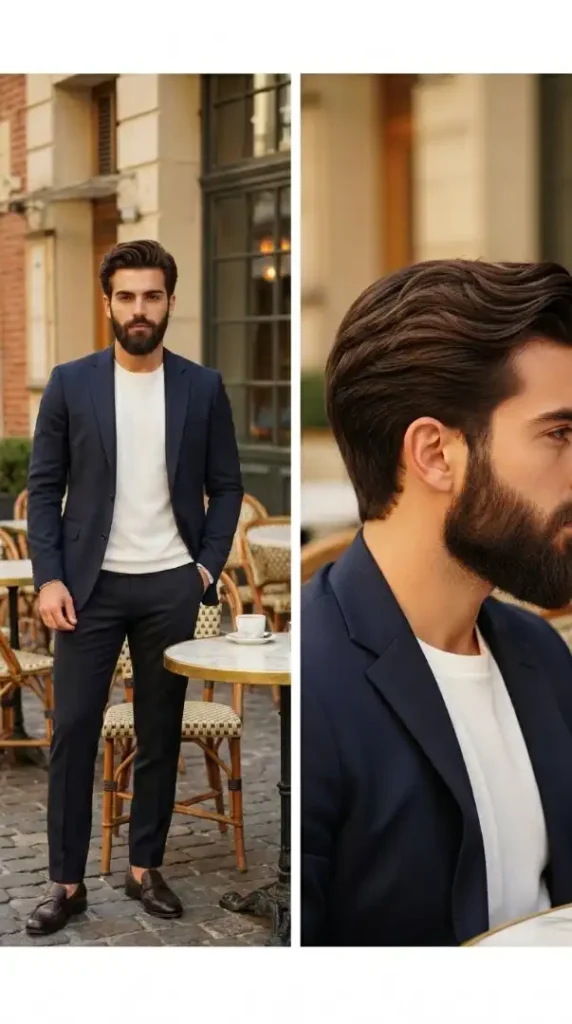
Best Face Shape Match
The Continental Flow is architecturally designed for Rectangular, Oblong, and Strong Angular face shapes, particularly men with Mediterranean, Turkish, or Middle Eastern features where strong masculine structure benefits from softening flow. Rectangular and oblong faces gain essential width from the 4-inch flowing wave volume — the horizontal movement of waves breaks up vertical face length without adding excessive height. The key is flow direction: brushed back and slightly to the side creates diagonal movement that shortens perceived length. Angular faces benefit from the softening organic curves of wave pattern contrasting against straight facial lines — where a slicked-back straight-hair cut would emphasize hardness, the waves introduce natural movement that balances severity. The full-shaped beard adds horizontal width at the jawline, further counteracting vertical length in long faces. Square faces work exceptionally well here for the same softening reason — waves temper angular jaws. Oval faces, as always, adapt easily. Round faces should avoid this style — the horizontal wave flow and side-swept volume add width where round faces don’t need it. If you have a round face and love the flowing aesthetic, request more vertical height (blow-dried upward volume instead of side-brushed flow) and shorter beard length to create length rather than width.
Essential Grooming Kit
Clippers: Wahl Senior (reliable power for thick Turkish/Mediterranean hair) or Oster Classic 76 (high-torque motor handles dense wavy texture)
Trimmer/Outliner: Andis Slimline Pro Li T-Blade (precision for beard sculpting and hairline detail) or BaByliss PRO GoldFX (gold standard for detailed beard work on dense growth)
Styling Tools: Denman D4 Original Styler Brush (9-row for thick wavy hair), wide-tooth acetate comb (detangles waves without breakage), boar bristle beard brush (shapes and distributes beard oil)
Products: Bumble and Bumble Don’t Blow It Fine Hair Styler (air-dry cream that enhances natural waves), Baxter of California Clay Pomade (flexible medium hold for wavy flow), Hanz de Fuko Sponge Wax (natural finish with movement), Beardbrand Utility Beard Oil (nourishes thick Mediterranean beards), Seven Potions Beard Balm (light hold for beard shaping)
Finishing: Sea salt spray for texture refresh between washes, leave-in conditioner for wave definition
Maintenance Level
Rating: Medium
This style occupies comfortable middle territory. Barber visits every 3 weeks maintain fade and beard shape — wavy hair’s natural texture disguises fade grow-out better than straight hair, and 4-inch length provides forgiveness. Daily styling takes 8-12 minutes: after showering, apply air-dry cream or light pomade to soaking-wet hair, use wide-tooth comb to distribute product and establish back-and-left flow direction, scrunch waves with hands to enhance pattern, air-dry completely (or use diffuser on low heat if time-pressed). The waves do the heavy lifting — you’re guiding, not creating. Alternatively, for more structured days, blow-dry with round brush pulling hair back and to the left while adding volume at the crown. Beard requires daily oil application (3-4 drops worked through entire beard), brushing morning and evening with boar bristle brush, and trimming every 5 days to maintain 12-15mm uniform length and jawline sculpting. Weekly deep conditioning treatment on hair keeps waves healthy and frizz-free. Budget 70 minutes per week total. The advantage of this cut: longer length and wave texture mean you can stretch barber appointments to 4 weeks without looking unkempt — the grown-out aesthetic still reads as intentional Continental style rather than neglect.
How To Ask Your Barber
“I want a mid taper fade with flowing length on top — start the fade 1 inch above my ears with a 1mm baseline, blend up gradually to a 2 or 2.5 at the temple, and leave 4 inches on top. Don’t thin out my natural waves; I want to keep the texture and density. Use point cutting to enhance the wave pattern and remove internal bulk, but leave the surface layer intact for flow. I’m styling this brushed back and to the left with natural wave movement, so cut the layers to support that direction. Leave the front and crown the longest at 4-4.5 inches for maximum flow presence. Keep my hairline natural with soft definition — no sharp corners. For my beard, trim it to 12-15mm uniform length and sculpt it to enhance my jawline — take length from under the chin to create definition, keep the cheek line following my natural growth, clean the neckline one finger-width above my Adam’s apple with a fade, not a line. Blend the beard into my sideburns and fade seamlessly. For the back, natural tapered neckline following my hair growth pattern, no hard edge. I’m styling this with air-dry cream or light pomade, so the cut needs to support natural wave flow without requiring heavy products or heat styling.”
This Continental aesthetic proves that longer flowing styles pair beautifully with modern fade techniques. If you’re ready to see how mid taper fades translate to short, ultra-low-maintenance crops, the next style demonstrates that minimalist approach.
FAQ
Q: How do I enhance my natural waves without creating frizz?
A: The golden rule for wavy hair: moisture when wet, never when dry. Apply all products (air-dry cream, sea salt spray, light pomade) to soaking-wet hair immediately after showering. Scrunch with hands to enhance wave clumps, then leave it alone — don’t touch, don’t brush, don’t comb until completely dry. Touching damp wavy hair creates frizz. For drying, air-dry whenever possible; if blow-drying, use a diffuser attachment on low heat and scrunch sections into the diffuser cup rather than blasting with direct heat. Sleep on satin or silk pillowcase. Use sulfate-free shampoo and deep condition weekly. Frizz is usually a symptom of dryness or mechanical friction — solve those and waves stay defined.
Q: What’s the ideal beard length to pair with flowing wavy hair?
A: 12-15mm (roughly 1/2 inch) creates optimal balance — substantial enough to provide masculine structure and definition, short enough to maintain clean lines that don’t compete visually with the flowing hair length. Any shorter (under 10mm) and the beard reads as stubble rather than styled beard, creating imbalance with the longer hair. Any longer (over 18mm) and the beard starts dominating the overall look, making the face appear bottom-heavy. The 12-15mm range also allows proper sculpting — you can shape jawline definition and create clean edges without the bulk that longer beards carry.
Q: Can I get this style if my hair is straight instead of wavy?
A: You can get a similar mid taper fade with 4-inch flowing top, but the aesthetic will be entirely different. Straight hair creates sleek, smooth flow — think “slicked-back Italian businessman” versus “Continental wavy gentleman.” Straight hair requires different products (pomades instead of air-dry creams) and likely more daily styling time (blow-drying with brush for controlled direction). The charm of The Continental Flow is specifically the natural wave texture creating movement and dimension — straight hair version is elegant but lacks that organic flow. If you have straight hair and want wavy texture, discuss texture perms with your barber; modern wavy perms can create natural-looking loose waves.
Q: How do I prevent my beard from looking scraggly as it grows to 12-15mm?
A: Daily maintenance is key during the growth phase. Use beard oil twice daily (morning and evening) to condition hair and prevent dryness that causes wiry scraggly texture. Brush your beard with a boar bristle brush morning and evening to train hair growth direction and distribute oils. Every 3-4 days during growth, trim stray hairs that extend beyond the intended shape — don’t trim overall length, just clean up outliers. Keep your cheek line and neckline cleanly defined during growth; sharp edges make growing beards look intentional rather than neglected. Once you reach target length, maintain it with regular all-over trimming at 12-15mm using guard attachments.
11 of 13 — The Minimalist Edge
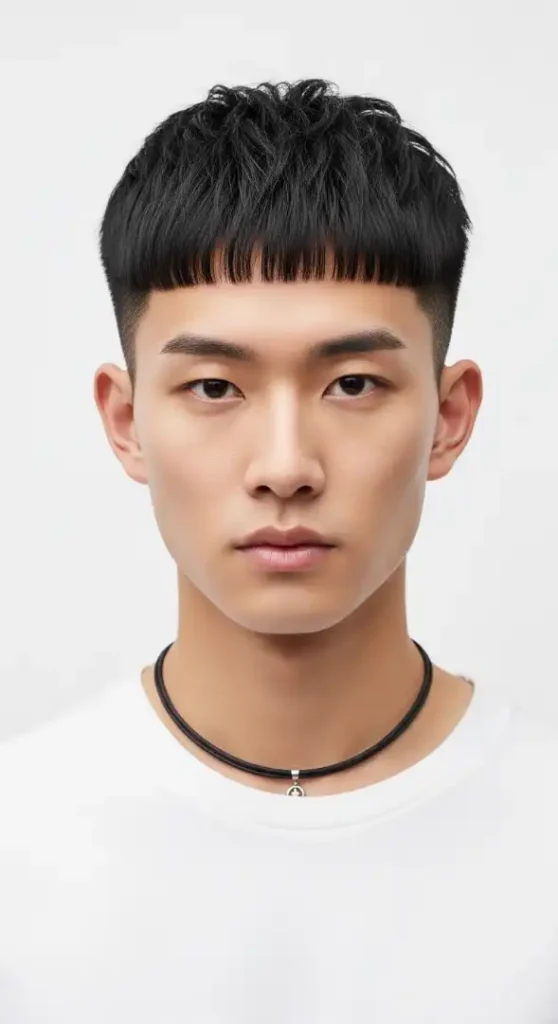
Best Face Shape Match
The Minimalist Edge is universally flattering but particularly optimized for Oval, Round, and Heart-shaped faces. The ultra-short 1.5-inch length with forward-facing fringe creates clean lines without dramatic volume, making it ideal for faces that don’t need structural correction. Oval faces wear this effortlessly due to inherent balance — the minimal length maintains proportions without distortion. Round faces benefit from the forward fringe and short crop creating vertical lines that elongate the face; the minimal side bulk (thanks to the fade) removes width where round faces don’t need it. Heart-shaped faces gain balance from the forward fringe adding visual weight at the forehead level where heart faces narrow. The anatomical advantage is simplicity — by not adding dramatic volume or architectural structure, this cut works with your natural face shape rather than attempting to alter it. Square faces can wear this but should ensure the crop isn’t TOO short (keep it at 1.5-2 inches minimum) to avoid emphasizing jaw angularity. Diamond faces also work well; the minimal styling doesn’t add or subtract emphasis anywhere, letting natural proportions speak. Oblong faces should add slightly more length (2 inches) to prevent over-emphasizing vertical length.
Essential Grooming Kit
Clippers: Wahl Magic Clip (precision for clean fade work on straight Asian hair) or Andis Master (reliable for dense straight textures common in East Asian hair)
Trimmer/Outliner: Andis Slimline Pro Li T-Blade (perfect for clean hairline definition and neck detail) or Philips Norelco OneBlade Pro (excellent for maintaining clean-shaven face and neck)
Styling Tools: Small paddle brush or vent brush (minimal styling aid), fine-tooth comb (for occasional fringe direction)
Products: American Crew Fiber (tiny amount for light texture on minimal-length hair), Uppercut Deluxe Matt Clay (natural finish with light hold), sea salt spray (creates natural texture without product heaviness), Baxter of California Daily Face Wash (clean-shaven maintenance)
Finishing: Light face moisturizer for clean-shaven skin health, travel-size fiber for touch-ups if needed
Maintenance Level
Rating: Low
This is the ultimate low-maintenance aesthetic for modern men. Barber visits every 3-4 weeks maintain the fade and crop length — the ultra-short 1.5-inch top grows slowly and the fade transition is gradual enough that grow-out is forgiving. Daily styling takes 2-5 minutes or can be skipped entirely on casual days: dampen hair lightly with water or leave damp after showering, work a tiny amount (pea-sized) of fiber or clay through hair with fingers creating forward texture, use fingers to direct fringe forward, air-dry. That’s it. No blow-drying, no brushing, no precise styling required. The cut does the work. Many days you can skip product entirely and just towel-dry after showering — the textured cut holds natural shape. Clean-shaven maintenance requires daily face shaving or electric trimming (5 minutes). No beard to groom, no complex styling routine, no temperature-sensitive products. Total weekly time investment: approximately 30-40 minutes including one fade touch-up every 3-4 weeks. This is the style for men who want to look sharp with minimal daily effort — perfect for busy professionals, minimalist lifestyle advocates, or anyone who values efficiency without sacrificing appearance. The psychological advantage: knowing you look good without thinking about it.
How To Ask Your Barber
“I want a minimalist mid taper fade with ultra-short textured crop — start at 1mm at ear level, create a clean gradual fade up to 1.5 inches on top. Keep the fade smooth and professional, not aggressive. Leave 1.5-2 inches on top max, with the front slightly longer at 2 inches for a subtle forward fringe. Use texturizing and point-cutting techniques to create natural piece-y texture that doesn’t require product or styling. I want effortless texture that air-dries well. Style it forward with minimal direction. Keep my hairline clean and natural — no hard edges or sharp corners, just soft definition. I’m clean-shaven with no beard, so make sure the fade blends cleanly into my skin at the sideburns and neckline with no patchiness. For the neckline, natural tapered fade with minimal detail work — clean but simple. I want minimal daily maintenance — ideally I can towel-dry and go, maybe use a tiny bit of fiber on days I want extra texture. Cut it so the natural texture does the work for me.”
This minimalist approach proves that sophistication doesn’t require complexity. If you’re ready to see how mid taper fades handle bold color and contemporary edge, the next style explores exactly that creative territory.
FAQ
Q: Can I really go without product most days with The Minimalist Edge?
A: Yes, if the cut is executed correctly. The key is proper texturizing technique during the haircut — your barber needs to use point-cutting and texturizing shears to create natural piece-y separation that holds shape without product. Straight Asian hair typically has enough natural body at 1.5-2 inches to maintain structure. On product-free days, simply towel-dry after showering and use your fingers to push hair forward into rough fringe shape. It won’t look “styled,” but it will look intentionally casual rather than messy. For meetings or dates, a pea-sized amount of matte clay takes 30 seconds to apply and elevates the look significantly.
Q: What’s the difference between The Minimalist Edge and a basic crew cut?
A: Cutting technique and intentional texture. A basic crew cut is uniform short length all around, typically done entirely with clippers and guards, creating a military-simple aesthetic. The Minimalist Edge uses a mid taper fade (gradual transition from very short sides to longer top), deliberate texturizing with scissors to create piece-y movement, and a forward-facing fringe element that crew cuts lack. The overall effect is modern and stylish rather than utilitarian. Maintenance is similar (both low), but The Minimalist Edge reads as fashion-conscious minimalism while crew cuts read as pure functionality.
Q: How do I maintain smooth clean-shaven skin with the fade?
A: Daily shaving routine is essential for maintaining the clean aesthetic this cut creates. Shave after showering when skin is soft and pores are open. Use quality shaving cream or oil, sharp blade, and shave with the grain (direction of hair growth) to minimize irritation. Rinse with cold water to close pores, pat dry, apply alcohol-free aftershave balm. If you’re prone to razor bumps or ingrown hairs, consider electric trimming with a foil shaver at 0mm instead of blade shaving — you’ll maintain smooth appearance without skin irritation. Exfoliate face twice weekly to prevent ingrown hairs at the fade connection points.
Q: Can I grow this style out gracefully if I want more length later?
A: Yes, this cut grows out better than most. Simply stop cutting the top and let it grow while maintaining the fade every 3 weeks. In 2-3 months you’ll have 3-4 inches on top, which opens up numerous styling options (pompadour, side part, swept back). The fade continues to work as the base regardless of top length. The advantage of growing from The Minimalist Edge is that you’re starting from healthy, well-cut hair with good texture foundation — you’re not growing out a bad cut, you’re evolving a good one into something different.
12 of 13 — The Heritage Craftsman
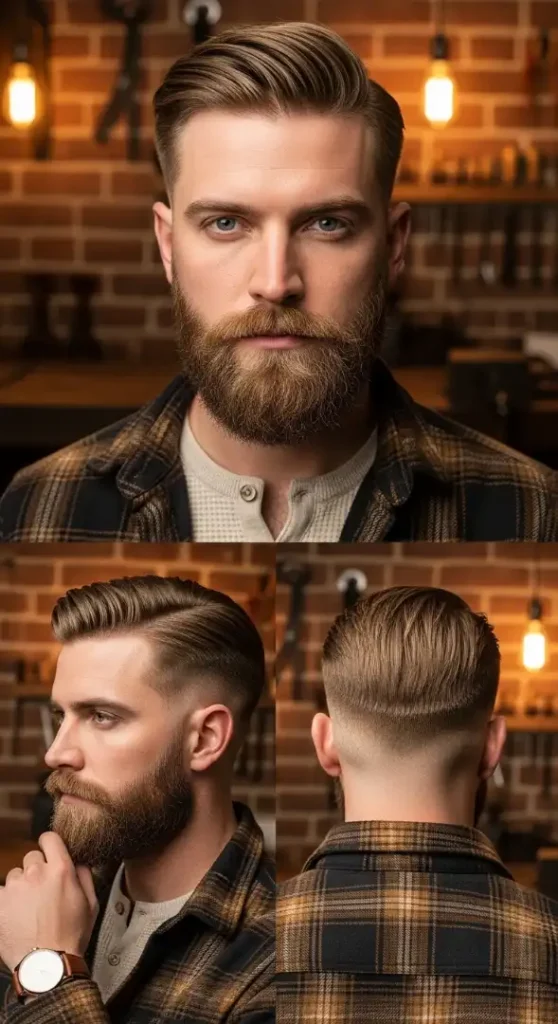
Best Face Shape Match
The Heritage Craftsman is specifically optimized for Square, Rectangular, and Strong Oval face shapes where rugged masculinity and natural fullness create authentic presence. Square faces benefit from the full 18-20mm beard which adds vertical length to balance the wide, angular jaw — the beard extends the face downward, creating better proportions. The 3-inch textured top adds controlled height without overwhelming the strong jaw structure. Rectangular faces gain from the beard’s horizontal width at the jawline, which counteracts the vertical length characteristic of rectangular shapes. The natural side-parted styling creates diagonal movement that breaks up the straight vertical lines. Strong oval faces (oval shapes with more defined, masculine features rather than delicate proportions) wear this effortlessly — the balanced face accepts both the beard fullness and textured top without distortion. The anatomical advantage is the full beard’s three-dimensional presence — it literally occupies physical space that changes face proportions from every viewing angle, providing structure that clean-shaven cuts cannot replicate. Round faces should approach cautiously; the full beard can emphasize circular features unless kept shorter (12mm) and sharply sculpted for jawline definition. Heart and diamond faces may find the full beard creates bottom-heaviness; if these shapes want the Heritage aesthetic, keep beard at 12-15mm and add more top volume (3.5 inches) for better balance.
Essential Grooming Kit
Clippers: Wahl Senior (classic reliability for Caucasian hair texture) or Andis Master (adjustable blade for both hair and beard maintenance)
Trimmer/Outliner: Andis T-Outliner (iconic for line work and beard shaping) or BaByliss PRO FX787 (precision for hairline and beard edge detail)
Styling Tools: Boar bristle brush (essential for natural hair texture and beard grooming), wide-tooth wooden comb (detangles beard without creating static), Kent 81T comb (hair styling)
Products: American Crew Fiber (matte texture for natural finish), Uppercut Deluxe Matt Clay (flexible hold for textured styling), Honest Amish Beard Balm (nourishes and shapes full rustic beards), Beardbrand Utility Beard Oil (conditions coarse beard hair common in light-colored beards), Cremo Beard Cream (detangles thick beards)
Finishing: Beard scissors for detail trimming, small beard comb for pocket carry, natural beard butter for deep conditioning
Maintenance Level
Rating: Medium-High
This cut requires consistent commitment to both hair and beard. Barber visits every 2.5-3 weeks maintain fade sharpness and beard shape — full beards at 18-20mm need professional shaping to avoid looking unkempt. Daily hair styling takes 5-8 minutes: towel-dry until damp, work fiber or clay through hair with fingers focusing on roots and mid-lengths, use hands to create natural side-swept texture following the part line, air-dry or blow-dry briefly for added volume if desired. Daily beard routine takes 7-10 minutes: wash beard with dedicated beard wash (not face soap) every 2-3 days, daily oil application (4-6 drops worked through entire beard from roots to ends), brush beard downward and outward morning and evening with boar bristle brush to train growth and distribute oils, apply light balm or butter for shaping and frizz control. Beard trimming every 5-7 days: uniform length maintenance with guard attachments, shape sculpting with scissors for natural graduated beard outline (not harsh lines), neckline cleanup, mustache trimming for clean upper lip. Weekly deep conditioning treatment on beard keeps coarse hair soft. Budget 90-110 minutes per week total. The reward is an authentic heritage aesthetic that commands respect in both professional and casual settings — looking like you actually know how to use those workshop tools.
How To Ask Your Barber
“I want a heritage-style mid taper fade with natural texture and full beard — start the fade just above my ears at 1mm, create a smooth professional gradient up to a 2 at the temple, and leave 3 inches on top. Texture the top with point-cutting and layering for natural piece-y movement that works with my straight hair. Give me a natural side part on the left, not too defined, just following where my hair naturally wants to part. I’m styling this with matte fiber or clay for a natural finish, not slicked. Keep my hairline natural and soft — no hard edges. For my full beard, trim it to 18-20mm uniform length but shape it naturally — I don’t want hard sculpted lines, I want a rustic organic shape that looks like I’ve been growing it intentionally. Follow my natural beard growth pattern for the cheek line, clean up the neckline about one inch below my jawline with a gradual fade rather than a hard line, and trim my mustache so it’s not covering my upper lip but maintains natural fullness. Blend the beard into my sideburns and fade without harsh separation. For the back, natural tapered neckline following my hair direction, and make sure the side-parted texture continues around the back of my head. I want craftsman rugged, not corporate polished.”
This heritage aesthetic proves that authentic masculinity and modern grooming techniques create timeless style. For the final style in this collection, we’re showcasing how mid taper fades translate to the absolute cutting edge of contemporary trends.
FAQ
Q: How do I maintain a full natural beard without it looking unkempt?
A: The secret is daily oil + brushing + weekly shape maintenance. Every morning: work 4-6 drops beard oil through your entire beard from roots to ends (don’t just apply to surface). Brush downward and outward with a boar bristle brush for 1-2 minutes — this trains growth direction, distributes oils, and removes tangles. Every evening: repeat the brushing routine. Every 5-7 days: trim the overall length to maintain 18-20mm uniformity, use scissors to shape the beard outline naturally (removing longer stragglers), clean up your neckline, and trim your mustache. The difference between “rustic intentional” and “homeless unkempt” is consistent daily grooming — natural shape, yes, but disciplined maintenance.
Q: What’s the difference between The Heritage Craftsman and The Business Titanium beards?
A: Length, density, and aesthetic intention. The Heritage Craftsman uses a full natural beard at 18-20mm with organic shaping for rugged masculine presence. The Business Titanium uses a groomed full beard at 8-10mm with precise sculpting for corporate professionalism. Heritage prioritizes natural authentic texture; Business prioritizes clean executive lines. Heritage reads as outdoor/craftsman/maker; Business reads as boardroom/client-facing. Both are full beards, but length and shaping create entirely different impressions. Choose based on your lifestyle and professional environment.
Q: Can I get this style if my beard grows patchy?
A: It depends on the patch location. If patchiness is primarily on the cheeks (common for many men), you can still achieve The Heritage Craftsman look by keeping the cheek line lower and focusing density on the jawline, chin, and mustache connection. A skilled barber can shape around patches to make them less obvious. If patchiness is on the jawline or chin where beard density is critical for this style’s silhouette, consider a shorter beard style (Van Dyke, goatee, or 12mm fuller beard instead of 18-20mm) that requires less coverage area. Beard growth improves with age — you may not be ready for this style at 22 but could rock it at 28.
Q: What products make light-colored beards look best?
A: Light-colored beards (blonde, light brown, auburn) tend to be coarser and drier than dark beards, so conditioning is critical. Use beard oil with argan or jojoba base (these absorb well into coarse hair). Apply beard balm or butter daily for additional moisture and frizz control — light beards show frizz more obviously than dark beards. Wash with dedicated beard wash only every 2-3 days maximum; over-washing strips essential oils that light-colored facial hair desperately needs. Consider clear beard wax if your light beard has wiry hairs that stick out — it provides invisible hold. Avoid products with dark tints or colors; they’ll be visible in light beards.
13 of 13 — The Avant-Garde Statement
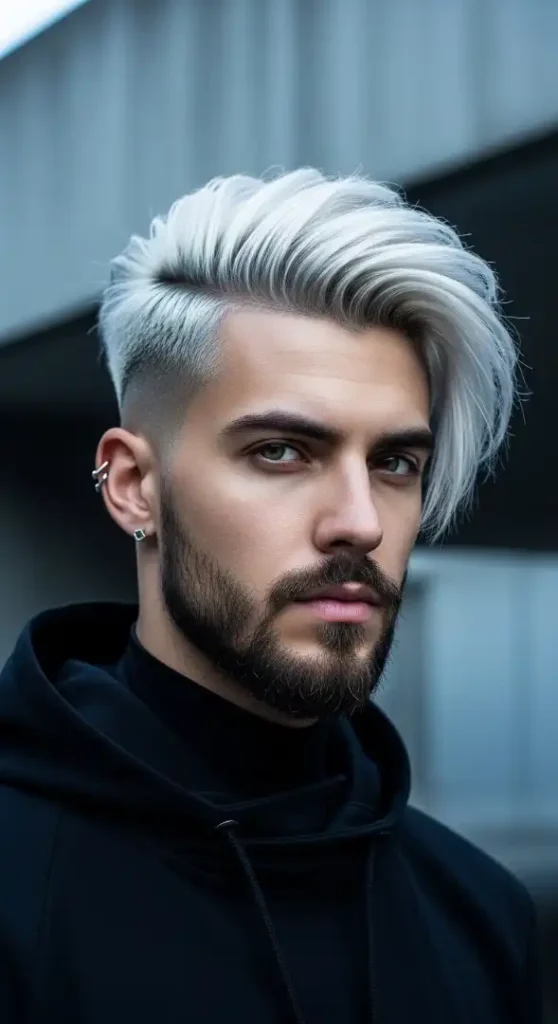
Best Face Shape Match
The Avant-Garde Statement is specifically architected for Angular, Diamond, and Strong Oval face shapes where bold asymmetry and high-contrast elements create artistic impact. Angular faces (sharp cheekbones, defined jawline, narrow chin) benefit from the dramatic asymmetric sweep creating diagonal movement that softens harsh lines while maintaining edge. The platinum color contrast against natural dark roots creates visual interest that draws attention to bone structure. Diamond faces gain from the extreme side volume which adds width at the temple level where diamond faces are naturally narrow, balancing the wider cheekbones. The chin-strap beard adds definition along the narrow chin and jaw, creating structure. Strong oval faces (balanced proportions with masculine definition rather than delicate features) accept the bold asymmetry without overwhelming facial features. The anatomical key is confidence — this cut demands facial features strong enough to compete with the dramatic styling. The platinum contrast, asymmetric sweep, and precise facial hair create such bold visual elements that weak or undefined features get lost. Round and soft oval faces should avoid this style; the high-contrast elements can emphasize softness rather than balance it. Square faces can attempt this but should keep side volume more moderate to avoid creating top-heaviness against the already-strong jaw.
Essential Grooming Kit
Clippers: Andis Master Cordless (precision for skin fade on color-treated hair) or Wahl Senior (reliable for tight fade work regardless of hair color)
Trimmer/Outliner: Andis Slimline Pro Li T-Blade (critical for chin-strap precision along jawline) or BaByliss PRO GoldFX (perfect for maintaining ultra-precise facial hair lines)
Styling Tools: Blow dryer with concentrator nozzle (essential for asymmetric volume), round brush small barrel (creates lift and side sweep), fine-tooth comb for precision shaping
Products: Uppercut Deluxe Pomade (strong hold for dramatic asymmetric styling), American Crew Boost Powder (root volume for platinum hair which can be fine), Got2b Glued Blasting Freeze Spray (locks extreme styling in place), purple shampoo for platinum maintenance, color-safe conditioner
Finishing: Beard precision trimmer for weekly chin-strap maintenance, mirror for self-checking asymmetric shape, travel pomade for touch-ups
Maintenance Level
Rating: Very High
This is the highest-maintenance cut in the entire collection. Barber visits every 1.5-2 weeks are absolutely mandatory — the skin fade and platinum color show every millimeter of growth, and the asymmetric styling requires precise length maintenance. Color maintenance every 4-6 weeks: platinum requires professional toning and root touch-ups to maintain the high-contrast aesthetic. Between color appointments, use purple shampoo 2-3 times weekly to prevent brass/yellow tones. Daily styling takes 15-20 minutes minimum: start with damp platinum hair, apply root boost powder to the side you’re building volume on, work strong-hold pomade through entire top section, blow-dry with round brush while pulling hair up and dramatically to the right, creating extreme asymmetric side volume, use fine-tooth comb for precise shape refinement, lock with strong-hold freeze spray. The styling cannot be approximated or simplified — it’s either fully executed or it looks incomplete. Chin-strap beard requires precise trimming every 3-4 days: maintain 3mm uniform length along the jawline, keep the geometric line sharp where it connects sideburn to chin, shave completely clean cheeks and neck daily with razor or electric trimmer for the high-contrast beard definition. Budget 120-150 minutes per week on hair/beard maintenance, plus monthly color appointments (2-3 hours each). This style is for men who view grooming as an art form and daily routine as creative expression. The reward? You will be the most distinctively styled person in any room, period.
How To Ask Your Barber
“I want an avant-garde mid taper fade with platinum blonde and dramatic asymmetric styling — start the fade 1 inch above my ears with a 0.5 guard creating a skin fade at the baseline, blend up tight with high contrast to 4 inches on top. The top should be cut to support extreme side-swept volume to the right — use layering and texturizing to remove weight so the hair can achieve dramatic height when styled. Leave my natural dark roots showing about a quarter-inch — don’t bleach all the way to the scalp; I want intentional color contrast. My platinum needs regular toning; recommend your colorist. For my facial hair, I want a precision chin-strap beard at 3mm — clean geometric line connecting my sideburns to my chin point along my jawline, with completely shaved cheeks and neck creating maximum definition. Use a straight edge or trimmer for the chin-strap line; I want sharp precision, not natural softness. Keep my hairline clean with defined corners. For the back, aggressive skin fade continuing into the neckline, and make sure the top length continues around the back with proper distribution for the asymmetric sweep. I’m styling this with strong pomade and freeze spray for dramatic side volume, so the cut needs to support extreme styling without fighting it.”
This avant-garde finale proves that mid taper fades are limited only by creativity and commitment. The 13 styles in this collection demonstrate that one foundational technique — the mid taper fade — adapts infinitely across textures, colors, lengths, face shapes, and personal aesthetics.
FAQ
Q: How do I maintain platinum blonde hair between color appointments?
A: Platinum is the highest-maintenance hair color. Weekly purple shampoo 2-3 times prevents yellow/brassy tones — apply to wet hair, leave 3-5 minutes, rinse. Use color-safe sulfate-free shampoo and conditioner exclusively. Wash hair in lukewarm (not hot) water; heat opens cuticles and releases color. Deep condition weekly with protein treatment — bleach damages hair structure and protein rebuilds strength. Avoid chlorinated pools entirely — chlorine turns platinum green. Minimize heat styling temperature; platinum is fragile. Professional toner appointments every 6-8 weeks keep color bright and clean. Root touch-ups every 4-6 weeks maintain the intentional dark-root contrast. Budget $150-300 monthly for color maintenance if you want this to look right.
Q: What’s the difference between a chin-strap beard and a regular beard?
A: Coverage area and aesthetic intention. A regular full beard covers the entire lower face — cheeks, jawline, chin, and neck (with neckline defined). A chin-strap beard is ONLY the jawline itself — a thin precise line of hair connecting sideburns to chin point, with completely clean-shaven cheeks and neck creating high contrast. The chin-strap is geometric and graphic, regular beards are natural and full. The chin-strap requires daily face shaving to maintain the sharp definition; regular beards require overall length maintenance. Chin-strap reads as high-fashion editorial; full beard reads as natural masculine presence.
Q: Can I get dramatic asymmetric styling if my hair is naturally curly or wavy?
A: You can achieve asymmetry, but not the structured geometric drama that straight platinum hair creates. Curly or wavy hair produces organic flowing asymmetry — more volume one side than the other, but with natural movement rather than sculpted precision. It’s beautiful but different — bohemian asymmetry versus architectural asymmetry. If you have curly hair and want The Avant-Garde Statement’s precision, you’d need chemical straightening or keratin smoothing first, then platinum color, then the cut — that’s a significant commitment. Consider embracing your natural texture with a curly-appropriate asymmetric cut instead.
Q: Is platinum blonde professional enough for corporate environments?
A: This depends entirely on your industry and company culture. Traditional conservative industries (law, finance, medicine in client-facing roles) will likely view platinum as too fashion-forward for professional standards. Creative industries (advertising, tech, fashion, media, entertainment) generally embrace bold personal style including platinum. Modern progressive companies evaluate work output over appearance. When in doubt: can you name someone at your company with unconventional style who’s respected and successful? If yes, you have permission. If no, you’re the pioneer — decide if that’s worth potential judgment. Alternatively, achieve The Avant-Garde Statement aesthetic with natural dark brown or subtle highlights instead of platinum — same cut, less color contrast, more professional flexibility.