Long Hairstyles For Men With Thick Hair
1 of 12 — The Cascading Titan
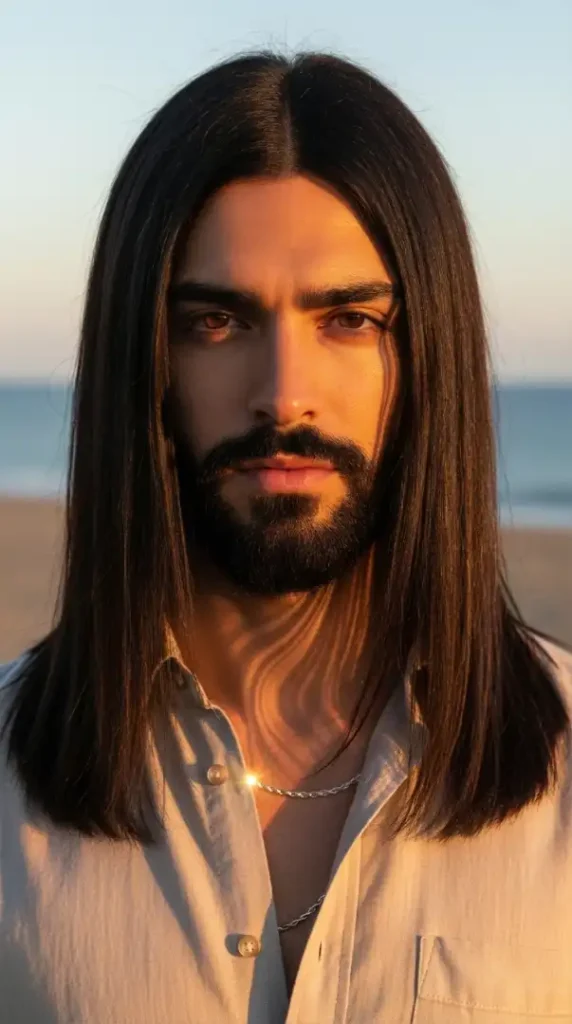
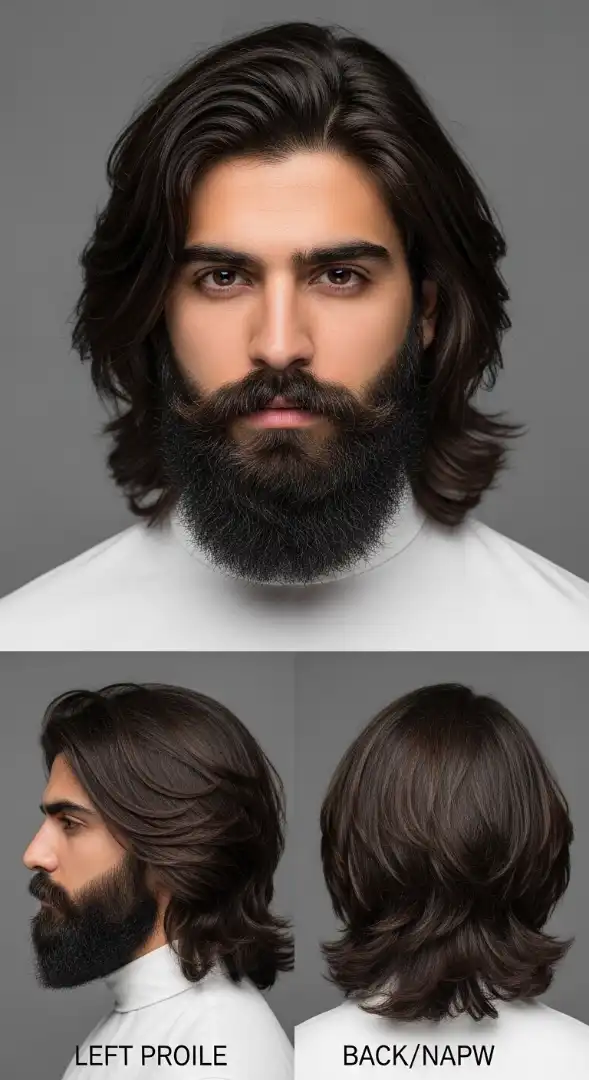
FACE SHAPE MATCH The Cascading Titan is precision-built for the Square face — a face shape defined by equal forehead and jaw width with strongly defined angular corners at the jaw. The central challenge for Square faces with long hair is avoiding styles that add width at the sides, which would exaggerate the jaw’s already-prominent horizontal line. The center-parted curtain style solves this architecturally: by splitting the hair down the middle and draping it vertically along both sides of the face, the curtain panels create strong vertical lines that draw the eye downward and elongate the face, softening the jaw’s angularity without eliminating it. The blunt ends at shoulder length add a horizontal baseline that grounds the look without widening the cheekbones. Men with Heart faces will also find this curtain structure highly flattering — the curtain’s width at the mid-face adds presence to the upper cheek zone while the cascading length softens the narrow chin’s visibility. Avoid this exact configuration on Oblong faces — the vertical fall of the curtains amplifies length in a face that already reads as long.
GROOMING KIT
- Scissors: Kasho KCP-65 Professional Shears — for point-cutting the ends of thick jet-black hair to prevent a blunt, heavy shelf at the ends; the 6.5-inch blade length is ideal for long-hair layering
- Thinning Shears: Cricket Ultra Smooth 30-tooth Thinning Shears — for bulk reduction through the mid-lengths without visibly shortening the hair; essential for managing thick dense hair that tends to balloon at the curtain edges
- Finishing Brush: Mason Pearson Handy Bristle & Nylon (BN3) — the gold standard for distributing styling product through long thick hair and creating the smooth, controlled flow of the curtain panels
- Styling Product: Moroccan Oil Treatment (argan oil, 2–3 pumps applied to damp hair) as a base, followed by a small amount of R+Co Dallas Thickening Spray on the roots to prevent thick hair from going flat at the crown
- Beard Product: Badger Beard Balm (tin, unscented) — 2 fingertips worked through the full beard post-shower to condition and maintain the beard’s weight and shape alongside the long hair
MAINTENANCE LEVEL: Medium
- Salon visit frequency: Every 8–10 weeks — blunt-end long curtain styles grow gracefully; thinning through the mid-lengths is the primary reason to return (thick hair can become heavy and shapeless beyond 10 weeks without bulk removal)
- Daily styling time: 8–12 minutes — towel dry, apply argan oil to damp hair, use a wide-tooth comb to detangle from ends to roots, blow-dry with a paddle brush to set the curtain fall direction; the medium beard requires daily balm
- Product routine: Sulphate-free shampoo twice per week (thick long hair retains sebum longer; over-washing strips the natural oils that give the curtain its weighted, glossy fall); deep conditioner once weekly; argan oil daily
Barber Talk (Exact Script) “I’m growing my hair long — I want to keep the length, just shape it. Take off maybe half an inch from the ends to clean it up — blunt cut, maybe a little point-cutting at the ends to soften the heaviness. I want it center-parted — curtain style. Thin through the mid-lengths with thinning shears to take the bulk out, not the length. Leave the top section as full as possible; just reduce through the underneath layers. Beard: keep the length, tidy the shape — clean the cheek line at a natural arc, neckline razor-clean below the jaw. No major changes — I’m growing this out.”
The Cascading Titan works the center part to perfection — but Style 2 takes the same thick long hair in the exact opposite direction with a sleek, structured undercut that brings discipline to volume.
FAQs
Q: What is the curtain hairstyle for men and how do I grow it out? A: The curtain hairstyle is a center-parted long style where the hair falls symmetrically on both sides of the face like a pair of curtains, typically reaching the jaw or shoulder. To grow it out, trim only the ends every 8–10 weeks to prevent split ends — avoid cutting the sides. Use argan oil daily on damp hair to maintain health during the awkward growth phase. A thinning shear treatment at the 6-month mark removes bulk without losing length.
Q: How do I stop thick hair from going flat at the crown in a long curtain style? A: The primary cause of crown flatness in thick long hair is product weight. Apply a volumizing spray (R+Co Dallas Thickening Spray or Kenra Platinum Silkening Mist) to the roots of damp hair before blow-drying. Direct the blow-dryer upward at the crown with a round brush, lifting the roots. Avoid applying heavy oils or balms to the root zone — reserve conditioning products for the mid-lengths and ends only.
Q: How often should I wash thick long hair? A: Twice per week is the optimal frequency for thick long hair. Thick hair holds natural sebum oils longer than fine hair, which keeps it moisturized and manageable between washes. Daily washing strips these natural oils, causing the hair to over-produce sebum and leaving it dull. On non-wash days, a light dry shampoo at the roots can absorb excess oil without stripping the mid-lengths and ends of their conditioning.
Q: Does the curtain hairstyle work on thick straight hair? A: Thick straight hair is arguably the ideal texture for the curtain style — the weight of thick straight strands creates the signature smooth, weighted fall that makes the curtain look intentional. The challenge is bulk management; ask for thinning shears through the mid-lengths to prevent the curtain panels from looking too heavy or rectangular. A small amount of argan oil adds the subtle shine that makes straight thick curtains look editorial rather than flat.
2 of 12 — The Silk Road Warrior
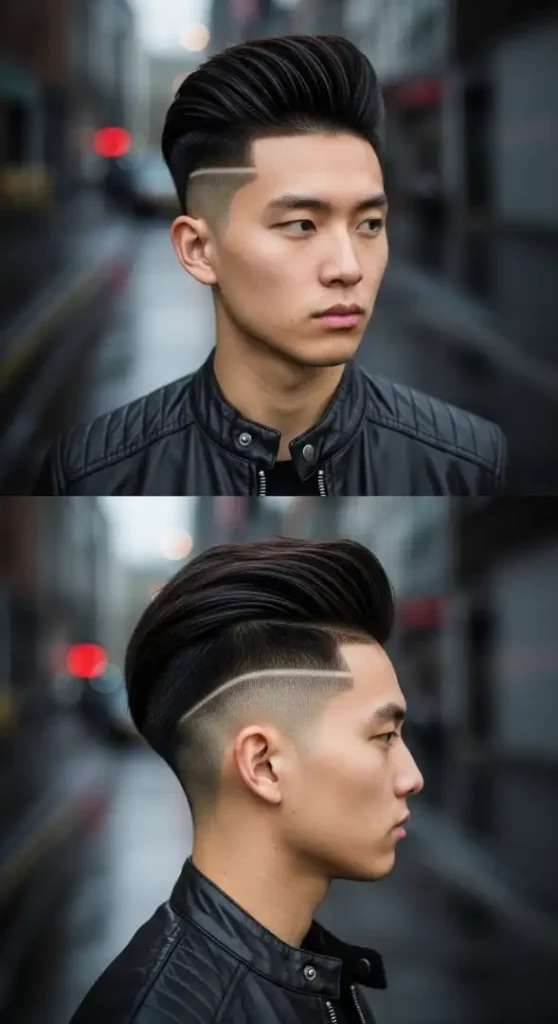
FACE SHAPE MATCH The Silk Road Warrior was designed for the Oval face — and specifically for the Oval face that wants to project authority and boldness without sacrificing proportion. The Oval face is the most accommodating face shape for long hairstyles precisely because its balanced forehead-to-jaw ratio allows the eye to appreciate the style rather than compensate for structural imbalances. The disconnected undercut slick-back creates extreme vertical contrast: shaved sides read as narrow and clean while the swept-back volume reads as bold and elevated. This push-pull creates a face that looks simultaneously disciplined and dramatic. The undercut’s clean horizontal line at the temple acts as a visual equator — above it, volume; below it, precision. For Square faces, this exact cut also works well but the undercut line should be kept lower (just above the ear) to prevent the high volume from making the forehead look disproportionately wide. Men with Round faces should avoid this disconnected undercut — the shaved sides on a round face can make the face look even rounder by contrast.
GROOMING KIT
- Clippers (undercut sides): Andis Master Cordless MLC with a #1 guard for the lowest side section graduating to a #2 at the undercut junction — the magnetic motor handles the dense straight East Asian hair without bogging down
- Scissors (top section): Yasaka M-40 Professional Scissors — Japanese-engineered for precision on dense straight hair; the 6-inch blade cuts cleanly through thick sections without folding or bending the strands
- Finishing Comb: Kent SPC70 Coarse-tooth comb — for initial detangling of the long top section before blow-drying; its wide spacing prevents tension breakage in thick straight long hair
- Styling Product: Gatsby Moving Rubber Extra Hard (yellow tin) — a cult Japanese product specifically engineered for thick dense straight East Asian hair; half a fingertip of product applied to dry hair, blow-dried backward with a round brush; provides extreme hold without the brittle crunch of gel
- Finishing Spray: Kenra Platinum Silkening Mist — 2–3 sprays over the finished slick-back to add billboard-quality shine to jet-black/dark brown straight hair under editorial lighting
MAINTENANCE LEVEL: High
- Salon visit frequency: Every 3–4 weeks — the disconnected undercut is the maintenance driver; the shaved sides grow visibly within 3 weeks, blurring the clean clipper line that defines the entire look; the long top grows more forgivingly
- Daily styling time: 10–15 minutes — the slick-back requires a full blow-dry routine; cannot be air-dried into shape; a round brush and directional blow-drying from front to back are non-negotiable
- Product routine: Sulphate-free shampoo twice weekly; deep conditioning treatment every 10 days on the long top section; Gatsby Moving Rubber daily for the style; the undercut sides need a trimmer clean-up at home every 10–12 days to maintain the line crispness
Barber Talk (Exact Script) “I want a disconnected undercut — clipper the sides to a one at the very bottom, a two at the top of the side, and cut a clean horizontal disconnect line at the temple level. Make it sharp — I want a clear line, not a blend. Leave the top completely long — at least 7 to 8 inches. I’ll style it slicked back. Don’t take length off the top; just clean the ends. The back: leave the length past the collar. Neckline: taper the back neckline — no hard squared edge. No beard work needed — keep me clean-shaven, razor finish on the cheek and neck.”
The Silk Road Warrior commands attention through engineering — but Style 3 throws the rulebook out and lets natural coily long hair do exactly what it wants, and the result is impossible to ignore.
FAQs
Q: What is a disconnected undercut for long hair? A: A disconnected undercut is a long hairstyle where the sides are clipper-cut short (typically a #1 to #3 guard) with a clean, unblended line separating the short sides from a much longer top section. Unlike a fade or taper that gradually blends the transition, the disconnected undercut creates a sharp, visible division — the “disconnect” — for a high-contrast, architectural look. It’s one of the most effective styles for managing volume in thick long hair.
Q: How do I slick back thick straight long hair? A: Apply a maximum-hold water-based pomade or wax (Gatsby Moving Rubber, Uppercut Monster Hold) to 80% dry hair — not wet, not fully dry. Use a wide-tooth comb to direct the hair straight back from the forehead. Follow with a boar-bristle brush to smooth the outer layer. Direct a blow-dryer backward along the hair’s natural growth direction to lock the sweep in place. Finish with a shine spray for editorial-level gloss. Total time: 8–10 minutes.
Q: Does a disconnected undercut work on thick East Asian hair? A: Yes — thick, dense straight East Asian hair is actually ideal for a disconnected undercut slick-back. The density gives the slicked-back top a dramatic, architectural volume that finer hair cannot achieve. The clean clipper sides also cut exceptionally sharply on this hair type due to its straight growth pattern. The main challenge is finding a product strong enough to hold the volume — Gatsby Moving Rubber (Extra Hard) is specifically engineered for this texture.
Q: How do I maintain long thick hair between salon visits? A: Three steps: (1) Wash only twice a week with sulphate-free shampoo — thick hair retains moisture well and over-washing creates static. (2) Use a deep conditioning mask weekly to maintain end health and prevent the dryness that causes thick long hair to frizz and bulk out. (3) Trim your own undercut line at home with a #1 guard every 10–12 days using a cordless clipper — only the sides, never approach the disconnect line or the top. This extends the professional result by 10–14 days.
3 of 12 — The Wild Crown
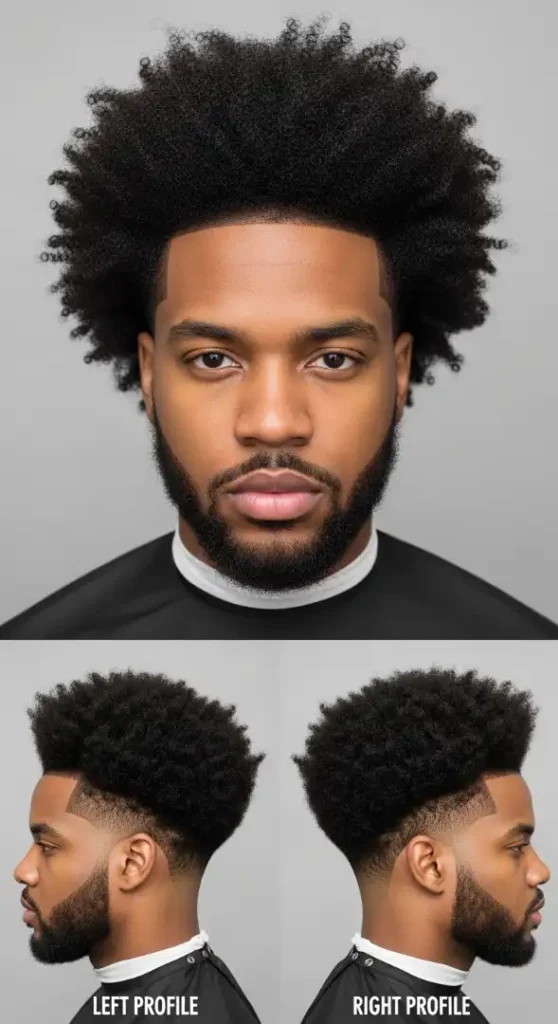
FACE SHAPE MATCH The Wild Crown is the definitive long hairstyle for men with the Round face — and the coily afro is the only natural-hair style that can simultaneously elongate and frame a Round face without compromising the hair’s integrity. Round faces need vertical height above all else — and a 5–6 inch shaped coily afro delivers that vertical height in a way no other style can. The rounded dome silhouette may sound counterintuitive for a round face, but the key is proportion: the crown height visibly exceeds the face’s width, pulling the eye upward and making the face read as taller than wide. The clean, defined hairline at the temples creates a horizontal foundation that visually anchors the face, preventing the afro from making the head look spherical. The 8mm beard adds jaw definition — giving the narrow lower face the structure it needs to balance the dramatic crown volume above. Avoid this exact silhouette on men with Oblong faces — the additional crown height on an already-elongated face creates an extreme vertical proportion that overwhelms the features. For Oblong faces, flatten the afro’s top silhouette into more of an oval shape.
GROOMING KIT
- Pick: Andis Easy Lift Wide-Tine Afro Pick — the tool most responsible for the volume and silhouette shape; use it to lift and expand the afro from the roots upward before the final shaping step
- Shears (shaping): Fromm Comfort Plus 7-inch Curved Shear — the curved blade allows the stylist to trim the afro’s outer dome silhouette without disrupting the coil clusters inside
- Outliner/Trimmer: Andis GTX-EXO Zero Gap — for the razor-sharp hairline definition at the temples and forehead; the precise arc is as important as the afro’s volume in achieving the clean architectural look
- Styling Product: Curl Smith BOUNCE Curl Defining Cream (3 generous pumps to soaking-wet hair, applied section by section using the “praying hands” technique) — defines 3C/4A coils without stiffness or crunchiness; the moisture-rich formula keeps the afro looking luminous rather than dry
- Beard Product: SheaMoisture Beard Wash + Bevel All-In-One Beard Hydrator — the beard wash once weekly; hydrator applied morning and evening to keep the 8mm beard from becoming wiry and patchy
MAINTENANCE LEVEL: High
- Salon visit frequency: Every 2–3 weeks for shape-up and hairline definition — the coily afro’s dome silhouette grows outward in all directions simultaneously and begins to lose its clean rounded shape within 2 weeks; the hairline also needs razor re-definition at this frequency
- Daily styling time: 10–15 minutes — the coily afro requires daily moisture (the LOC method: liquid → oil → cream) and daily pick-out to restore volume; sleeping with a satin bonnet or durag is essential to preserve the dome shape overnight
- Product routine: Co-wash 3–4× per week (sulphate shampoo once weekly); Curl Smith Bounce Curl on wash days; daily water spritz and light oil to re-moisturize; beard hydrator morning and evening
Barber Talk (Exact Script) “I want a shape-up on the afro — pick it all out first, then trim the outer silhouette into a clean rounded dome. Keep as much length as possible — just neaten the shape and make it even on all sides. Hairline: razor-sharp. I want crisp temples, clean forehead arc, natural peak preserved. Don’t go too high on the temples — keep my natural hairline. Beard: 8mm throughout, cheek line at a natural arc, razor-clean the neck below the jaw. I want the hairline and the beard line to feel equally sharp — they’re both architectural.”
The Wild Crown proves that coily volume is its own form of structure — Style 4 moves from controlled volume to the ancient warrior aesthetic, bringing braided long thick hair into the modern era.
FAQs
Q: How do I grow an afro long without it losing shape? A: Growing a long afro requires consistent moisture and monthly shape trims. Use the LOC method daily (liquid water spritz, oil such as jojoba, and cream such as a leave-in conditioner) to maintain moisture — dry coily hair shrinks significantly, making the afro appear shorter than it actually is. Visit the barber every 3–4 weeks for a shape-up only (not a full cut) to keep the dome silhouette clean while the hair gains length.
Q: What is the best product for a defined long coily afro? A: Curl Smith BOUNCE Curl Defining Cream is the top professional recommendation for 3C/4A coily afros requiring both definition and volume. Apply generously to soaking-wet, freshly conditioned hair section by section using the praying-hands technique to coat each curl cluster evenly. Do not disturb the coils while drying — air dry or diffuse on low heat. The result is a defined, moisturized afro that maintains its shape throughout the day.
Q: How do I keep an afro looking fresh overnight? A: Sleep with a satin bonnet, satin-lined durag, or on a satin pillowcase every night. Cotton pillowcases create friction that disrupts the coil definition and causes the afro’s dome to flatten on one side overnight. In the morning, lightly mist the hair with water, add a small amount of leave-in conditioner, and use an afro pick to restore the volume and shape. This 5-minute morning refresh eliminates the need for a full re-styling.
Q: Does the afro hairstyle suit all face shapes? A: A rounded afro suits Round, Oval, and Square faces best. For Round faces, ensure the crown height significantly exceeds the face’s width to create an elongating effect. For Oblong faces, keep the afro’s top flatter and allow more width at the sides to add apparent breadth. For Heart faces, a slightly taller, narrower afro with a more oval silhouette balances the broad forehead. The key variable is silhouette — a skilled barber can shape the same afro differently for different face shapes.
4 of 12 — The Nordic Legend
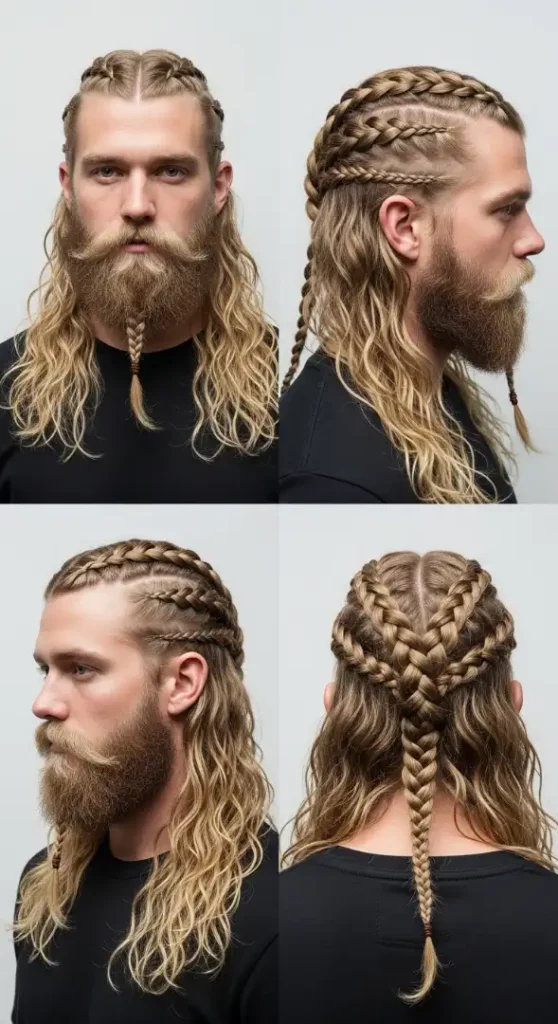
FACE SHAPE MATCH The Nordic Legend is built for the Diamond face — the face shape defined by a narrow forehead, wide cheekbones, and a narrow chin — and the Viking double braid is the most effective structural tool available for this face shape. The Diamond face’s core challenge is managing the prominent cheekbone width while adding visual presence to both the narrow forehead and the narrow chin. The Dutch temple braids solve the forehead problem immediately: by bringing hair forward and downward from the temples in tight braids, they add horizontal width to the forehead zone where the Diamond face is naturally narrow. The full Viking beard at 2 inches provides substantial jaw and chin mass, broadening the face’s bottom third. The loose thick wavy hair falling behind the braids adds volume and width at the lower head and shoulders, framing the narrow chin from below. For Oval and Square faces, this Viking braid style also works exceptionally well. The Square face benefits from the softening movement of the loose waves behind the braids. Avoid on Heart faces — the braid-forward temple styling adds visual width to an already-wide forehead.
GROOMING KIT
- Braiding Tool: Rat-tail comb (Diane #1 Rat Tail Comb) — for parting the Dutch braid sections precisely at the temple; the fine metal tail provides the clean sectioning that makes the braid begin tightly at the scalp
- Brush (pre-braid): Tangle Teezer Men’s Detangler — for smoothing thick wavy hair before braiding; the flexi-tine brush glides through thick wavy lengths without the painful tension breakage of conventional brushes
- Scissors: Kasho KCP-70 (7-inch) — for trimming the ends of the loose wavy section and removing split ends; thick wavy hair develops split ends faster than straight hair due to the curl bend points
- Beard Maintenance: GBS Boar Bristle Beard Brush (medium-firm) + Viking Revolution Beard Oil (cedarwood and pine formula, 12 drops daily) — the brush shapes and trains the Viking beard; the oil conditions the coarser thick beard hair and prevents matting at the braid zones
- Copper Rings: Tribal Hair Rings (hammered copper, 6mm internal diameter) — available from specialist Viking/bohemian jewelry suppliers; slid onto the beard braid ends and crimped gently with pliers for secure hold
MAINTENANCE LEVEL: Medium-High
- Salon/stylist visit frequency: Every 8–10 weeks for a trim of the loose wavy section’s ends; the braids themselves can be redone at home once the technique is learned (approximately 15–20 minutes per braid)
- Daily styling time: 15–20 minutes on braid days; 5–8 minutes on non-braid days (loose waves only require a salt spray and finger-scrunching)
- Product routine: Wash with sulphate-free shampoo twice weekly; deep condition weekly — thick wavy hair needs substantial conditioning to maintain the wave’s integrity and prevent the frizz that makes braiding difficult; beard oil morning and evening
Barber Talk (Exact Script) “I want to keep all the length — just trim the ends by about half an inch, maybe more if there are split ends. Blend the layers through the mid-section so the waves fall more evenly — use a razor comb or thinning shears through the bulk, not scissors. Don’t touch the top or the temple sections — I’ll be braiding those myself. Just neaten the bottom third. For the beard: keep the full length, trim any strays — I want it full and natural. Clean the cheek line subtly at a natural arc. No neckline shave — let the beard grow naturally on the neck. I’ll manage the beard braids at home.
The Nordic Legend channels ancient warrior energy through modern hair — but Style 5 proves that thick South Asian long hair can carry just as much presence with a flowing wave that’s entirely its own.
FAQs
Q: How do I braid thick long hair into Viking braids? A: Viking braids are typically Dutch braids (inverted French braids) that sit raised on top of the hair rather than lying flat. Starting at the temple, separate hair into three sections and begin crossing each outer section under the middle section (not over — that’s a French braid). As you work backward toward the crown, add small new sections from each side to the outer strands before crossing under. Tight, consistent tension is the key to a clean Viking braid on thick hair.
Q: What products help keep thick wavy long hair frizz-free? A: The combination of a sulphate-free shampoo, a weekly deep conditioning mask (Olaplex No. 8 Bond Repair Mask or SheaMoisture Manuka Honey Masque), and a leave-in conditioner (not a rinse-out conditioner) applied to damp hair before styling is the foundational routine. For styling, a salt spray on damp hair diffused on low heat enhances natural wave definition. Avoid towel-rubbing — squeeze-dry with a microfiber towel to prevent frizz-causing friction.
Q: Can I get Viking braids with thick straight hair as well as thick wavy hair? A: Yes — Viking braids work on any hair texture, but the technique varies. For thick straight hair, use a light texturizing paste before braiding to add grip to the slippery strands. For thick wavy hair (as in this style), the natural wave texture provides built-in grip, making the braid easier to maintain tightly throughout the day. Coily thick hair braids the most securely with the least slippage.
Q: How do I grow a Viking beard alongside long hair? A: Grow the beard simultaneously with the hair for proportion harmony. At the 3-month mark, visit a beard specialist to shape the beard’s fundamental structure (cheek line and neckline) — let the barber establish the form, then grow within that structure. Daily beard oil (10–15 drops) prevents the coarser thick beard hair from becoming brittle and breaking, which is the primary obstacle to a full Viking beard. Brush with a boar bristle beard brush morning and evening to train growth direction.
5 of 12 — The Monsoon Wave
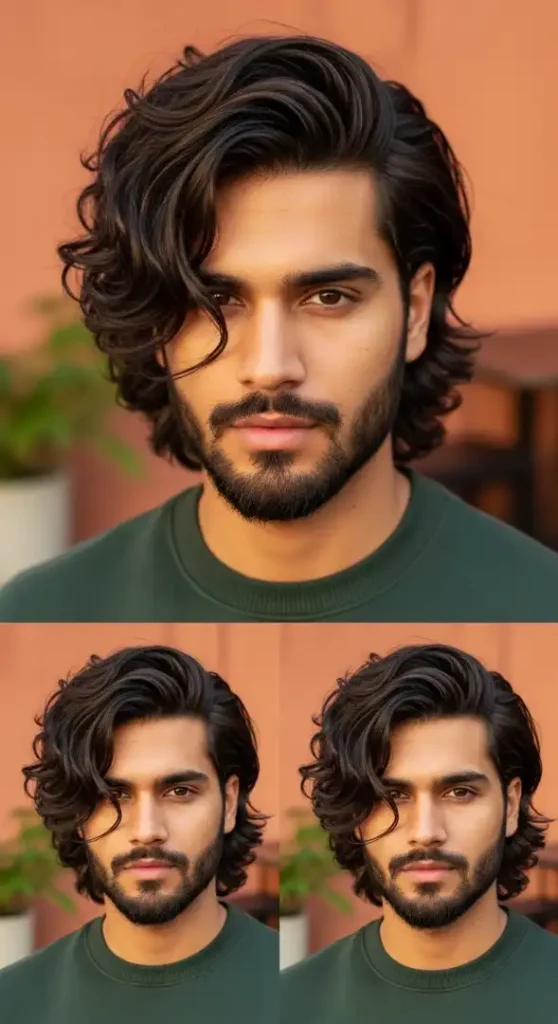
FACE SHAPE MATCH The Monsoon Wave is the essential style for the Oblong face — a face characterized by greater length than width with a narrow forehead and jaw of roughly equal proportions and elongated mid-face. The Oblong face’s fundamental need is horizontal visual width — anything that creates the impression of breadth across the cheekbones and forehead without adding additional vertical height. A swept-to-one-side long wave achieves this by creating strong horizontal movement across the front of the face: the wave sweeping from the right parting across to the left side of the jaw creates an eye-leading horizontal line from forehead level down to the jaw. This horizontal movement is the visual width the Oblong face craves. The side-swept length also partially covers one side of the forehead, visually shortening the face length. The 5mm beard adds jaw definition without beard mass that would elongate the face further. Avoid center-parting this style on an Oblong face — a center part creates two equal vertical panels that elongate rather than broaden.
GROOMING KIT
- Scissors: Cricket Centrix Roc-It Dog Offset Scissors (6.5-inch) — for layering and point-cutting thick South Asian wavy hair; the offset handle reduces wrist fatigue during long layering sessions in dense hair
- Thinning Shears: Fromm Edge 28-tooth Thinning Shears — essential for reducing bulk in the wave’s mid-lengths without destroying the wave pattern; removes approximately 20–30% of the hair’s volume invisibly
- Brush: Tangle Teezer Men’s Paddle Brush — for blow-dry direction setting on the side-sweep; the cushioned paddle distributes heat evenly without creating friction damage on thick wavy lengths
- Styling Product: Living Proof No Frizz Wave Shaping Cream (2 pumps to damp hair) — defines the wave clusters in thick dark brown South Asian hair and controls the frizz that thick wavy hair develops in humidity; the cream formula adds weight that tames the volume without flattening the wave
- Beard Product: Beardoholic Premium Beard Oil (argan and jojoba formula) — 8 drops post-shower into the 5mm beard; the light weight of the oil suits stubble without creating a greasy appearance
MAINTENANCE LEVEL: Medium
- Salon visit frequency: Every 7–9 weeks — the side-swept wave grows gracefully; the key maintenance visit is for thinning-shear bulk reduction as thick South Asian hair accumulates volume rapidly and the wave can become shapeless beyond 10 weeks
- Daily styling time: 8–10 minutes — apply wave cream to damp hair, use a diffuser attachment on a blow-dryer at low-medium heat to enhance the wave definition on the swept side, finish with a light spritz of anti-humidity spray
- Product routine: Sulphate-free shampoo twice weekly; hair mask weekly; wave cream daily on damp hair; beard oil morning; anti-humidity finishing spray before leaving the house
Barber Talk (Exact Script) “I want to keep all the length — side-swept style, deep part on the right side. Take maybe half an inch off the ends to clean them up. I need you to thin through the mid-section and underneath — thinning shears or a razor comb — to reduce the bulk without touching the length. I want the wave to fall more freely, not be compressed by weight. Leave the wave pattern in; don’t blow-dry or flat-iron it. Layers through the mid-section to add movement. Beard: 5mm uniform, clean cheek line at a natural arc, fade the sideburn end into the beard softly. Razor the neck below the jaw.”
The Monsoon Wave brings South Asian thick long hair into its finest expression — Style 6 takes a different approach to long hair, showing how a sleek man bun transforms thick long hair into a study in understated power.
FAQ
Q: How do I tame thick wavy long hair without losing the wave? A: The key is managing bulk without disrupting the wave structure. Ask for thinning shears or a razor comb through the mid-lengths — not the surface layer — to reduce internal bulk while the outer wave pattern remains intact. For daily styling, apply a wave cream or curl-enhancing milk to damp hair and diffuse on low heat rather than blow-drying straight. Never brush dry wavy hair — only comb or finger-detangle when wet.
Q: What is the best way to style a side sweep on thick long wavy hair? A: Wash and conditioner as normal. Apply a wave-defining cream (Living Proof No Frizz Wave Shaping Cream or Kenra Platinum Silkening Mist) to damp hair. Use a wide-tooth comb to create a deep side part and direct the longer side across the face. Use a diffuser on medium heat to set the wave direction without straightening it. Finish with a light anti-humidity spray to lock the side sweep against the frizz-causing factors of daily humidity.
Q: How do I prevent thick South Asian hair from becoming too heavy as it grows long? A: The solution is regular thinning-shear sessions — every 6–8 weeks — that remove internal bulk without reducing length. This keeps thick South Asian long hair moving freely and avoids the “triangle head” effect where the hair expands horizontally at the ends due to density. Also: wash with a volumizing, sulphate-free shampoo (Kérastase Resistance Volumifique) that lifts the roots, preventing the weight of thick hair from flattening the crown.
Q: Does long wavy hair suit South Asian men? A: Absolutely — South Asian men often have naturally thick, high-density wavy or straight hair that carries long styles exceptionally well due to its structural integrity. The challenge is bulk management, not texture. A regular thinning-shear routine and a wave-defining product routine are all that’s needed to take thick South Asian long hair from shapeless to editorial. The dark, rich color of most South Asian hair also photographs and photographs beautifully under warm lighting.
6 of 12 — The Barrio King
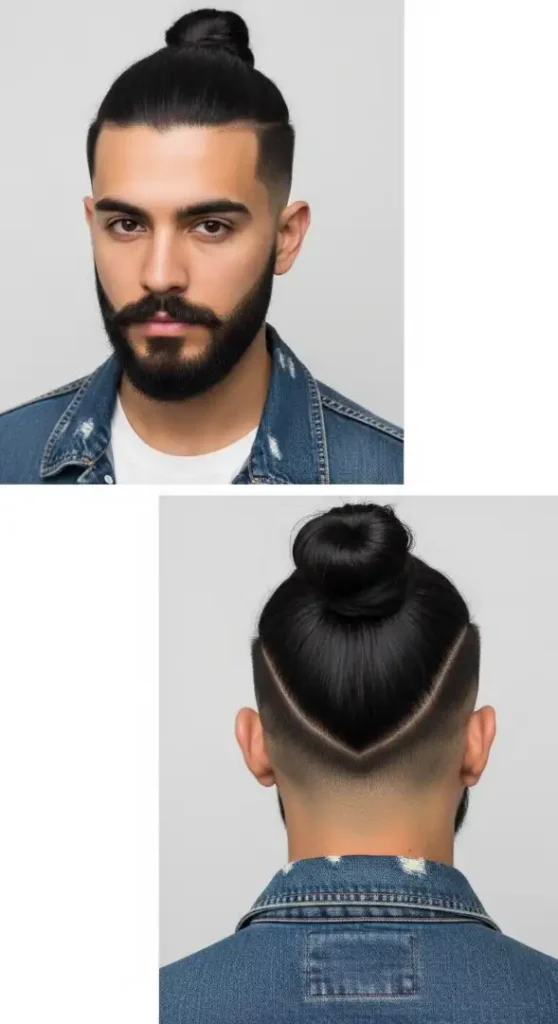
FACE SHAPE MATCH The Barrio King is the definitive man bun style for the Heart face — and the man bun is, architecturally speaking, the perfect tool for this face shape. The Heart face features a broad forehead and prominent cheekbones narrowing to a pointed or narrow chin. The man bun’s primary effect is the exposure of the full face and neck — pulling all the hair backward from the forehead and sides removes any hair framing the face, creating a clean canvas that draws full attention to the face’s features. For the Heart face, this clean exposure is ideal: the strong forehead and cheekbones become the visual statement, while the narrow chin is balanced by the beard at 10mm which adds jaw definition and chin width. The high man bun’s position at the crown also adds modest vertical presence above the forehead without adding width at the temples or cheeks. Men with Round faces should position the man bun lower (mid-crown rather than high crown) to avoid making the face look rounder by contrast. Avoid this fully-exposed style on men with severe skin conditions or a very narrow forehead — the pull-back leaves nowhere to hide.
GROOMING KIT
- Elastic: Slip Silk Hair Ties (large loop, silk-lined) — standard rubber elastics cause breakage in thick long straight hair at the bun point; silk-lined ties hold the bun securely without the friction damage that creates breakage rings in thick hair after 3–6 months of daily bun-wearing
- Brush: Kent 20T Wide-Tooth Comb + Denman D84 Paddle Brush — the comb first to detangle the thick lengths from ends to roots; the paddle brush to smooth the pull-back before gathering into the bun
- Scissors: Only for trim visits — no specific at-home scissors needed for the bun style
- Styling Product: Aveda Men Pure-Formance Pomade (water-based, medium hold) — a small amount (pea-sized) through the sides and temples before gathering into the bun prevents the wispy short hairs along the hairline from escaping the bun and creating a disheveled edge; this is the detail that separates a polished man bun from an unkempt one
- Beard Product: Cremo Beard Oil (bourbon collection) — 10 drops post-shower into the 10mm beard; the bourbon-scented formula provides conditioning for the dense thick beard without heaviness; the subtle scent complements the beard’s authority
MAINTENANCE LEVEL: Low-Medium
- Salon visit frequency: Every 10–12 weeks — the man bun is the lowest-maintenance long style in this collection; the length grows consistently and the bun conceals minor end damage; trim visits are purely for end health and the very occasional thinning-shear session for bulk
- Daily styling time: 4–6 minutes — detangle, smooth the pull-back, gather into a bun, secure with silk tie; apply small amount of pomade to the hairline edges; beard oil in the morning. Done.
- Product routine: Sulphate-free shampoo twice weekly; deep conditioning mask once every two weeks specifically at the bun’s tension point (where the elastic sits) to prevent breakage at the hairline; beard oil daily
Barber Talk (Exact Script) “I just need a trim — maybe half an inch off the ends to clean up any split ends. Run thinning shears through the lower half of the length to reduce some of the bulk — I wear it in a man bun daily, and I want the bun to be less massive. Don’t change the shape — I just want the ends tidied and the bulk reduced underneath. Beard: 10mm throughout, cheek line at a natural arc, mustache trimmed clean. Razor the neck below the jaw. Tight, clean, minimal.”
The Barrio King shows that restraint is its own form of power — but Style 7 lets the hair run free again, with a Middle Eastern long textured layer style that brings desert heat into every strand.
FAQs
Q: How do I tie a man bun with thick long straight hair? A: Brush all hair smooth with a paddle brush from roots to ends. Gather the hair at the upper crown using both hands, pulling the hair back and upward simultaneously — this is the direction that creates a high, tight man bun rather than a low, loose one. Secure with a silk or fabric-lined hair tie (never rubber) to prevent breakage at the tension point. For a cleaner edge, apply a small amount of pomade to the hairline perimeter before gathering. The bun should feel secure but not scalp-straining.
Q: Does a man bun work on extremely thick long hair? A: Yes — thick long hair creates the most dramatic and substantial man buns. The challenge is that the sheer density creates a very large bun that can feel heavy. The solution is regular thinning-shear sessions (every 8–10 weeks) that reduce internal bulk by 20–30% without shortening the hair. This creates a tighter, more refined bun. Use a silk hair tie to prevent the elastic from digging into the thick bundle of hair and creating a crease.
Q: How do I prevent a man bun from causing hair loss or a receding hairline? A: The leading cause of man-bun-related hair loss is chronic tension — wearing the bun too tight, too high, and too consistently. Vary the bun position daily (alternate between high crown and mid-crown). Use silk hair ties that slide rather than grip. Avoid wearing the bun while sleeping — always let the hair down at night and apply a hair oil to the tension zones. Take man bun days off — wear the hair down at least twice per week to rest the hairline.
Q: What beard length pairs best with a man bun for Latin or Mediterranean thick hair? A: 8–15mm of well-shaped beard is the ideal pairing for a man bun on dark thick hair. The beard provides the facial structure that the man bun’s pull-back removes by exposing the full face. Without a beard, a man bun on a Latino or Mediterranean model can read as too severe — the exposed face needs the beard as a softening and structuring frame. Full beards (above 1 inch) can overpower the minimalist quality of the man bun aesthetic.
7 of 12 — The Desert Nomad
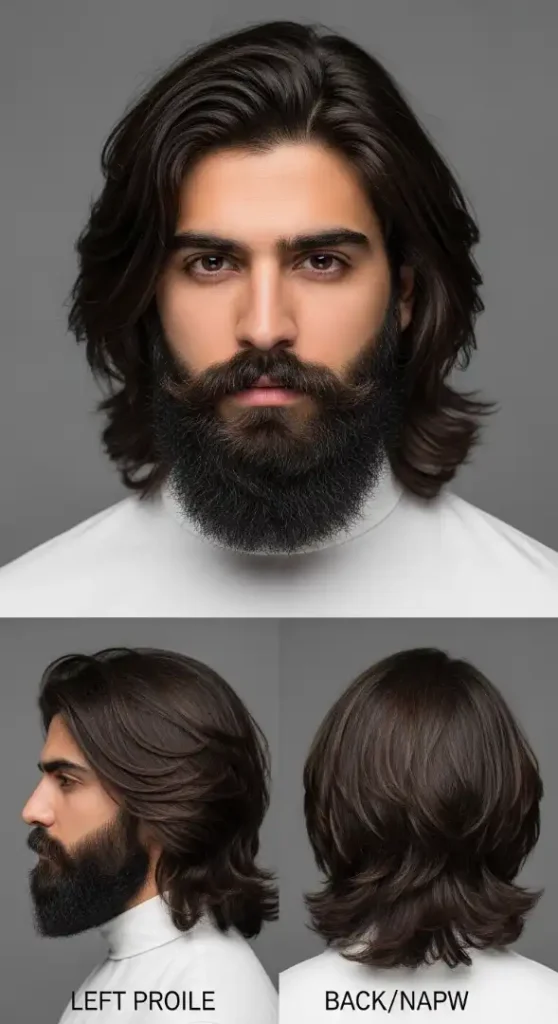
FACE SHAPE MATCH The Desert Nomad is the most flattering long style in this article for the Square face when paired with a substantial beard. Square faces carry strong jaw definition and equal forehead-to-jaw width — and the challenge with long hair on a Square face is preventing the combination from looking overly broad. The razor-layered long wave solves this by creating organic, asymmetric vertical movement that softens the jaw’s geometric angularity. The loose, natural off-center part introduces asymmetry to the face’s otherwise symmetrical geometry, which relaxes the Square face’s intensity. The 2.5-inch full beard, rather than adding more width, actually provides visual closure at the bottom of the face — the beard’s density creates a natural frame that makes the Square face look finished and intentional rather than severe. Oval faces also carry this free-flowing long wave exceptionally well — the Oval face’s inherent balance allows the loose wave to simply look effortlessly handsome. For Heart faces, the full beard is critical — without it, the free-flowing long hair would leave the narrow chin too exposed.
GROOMING KIT
- Razor Comb: Cricket Centrix Razor Comb — the professional’s choice for creating the “invisible” layers in thick long Middle Eastern hair; the razor comb removes bulk while creating feathered, movement-rich ends that a conventional scissors can’t replicate
- Scissors: Kasho KCP-70 7-inch scissors — for the structural length trim; precision at the ends prevents split ends that travel upward in thick dense hair
- Brush: Denman D4 Medium Styling Brush + Mason Pearson Large Bristle Brush (BN1) for the final finish — the Denman for detangling, the Mason Pearson for the smooth-yet-natural finish on the outer layer of waves
- Styling Product: Oribe Curl Gloss Hydration & Hold (2–3 pumps on damp hair) — enhances the natural wave movement in thick Middle Eastern wavy hair without heaviness; the formula doesn’t coat the hair in a film but bonds with the hair’s existing moisture
- Beard Product: Beardbrand Gold Beard Oil (12 drops daily) + Honest Amish Beard Balm (small amount, for shape) — the oil conditions the full 2.5-inch beard; the balm provides light structural hold that prevents a dense beard from matting or losing its shape during the day
MAINTENANCE LEVEL: Medium
- Salon visit frequency: Every 8–10 weeks — the razor-layered long wave grows gracefully; the layers’ feathered ends grow out without creating a hard line; the major reason to visit is a fresh razor-comb pass through the bulk zones and a trim of the ends
- Daily styling time: 10–14 minutes — the full beard requires daily oil, brush, and occasional balm application; the long waves require a wave-defining product and light diffusing or air drying
- Product routine: Sulphate-free shampoo twice weekly; moisturizing conditioner every wash; Oribe Curl Gloss on damp hair daily; beard oil morning and evening; beard balm for structure during special occasions or photography
Barber Talk (Exact Script) “Keep all the length — I want the layers refreshed. Use a razor comb through the mid-lengths and sides to add movement — not just scissors. Feather the ends and take the bulk out from inside the layers, not the surface. I want it to fall naturally, not look styled. Trim about half an inch to three-quarters from the ends. Beard: keep the full length — 2 to 2.5 inches — trim the strays and tidy the shape. Clean the cheek line at a wide natural arc. Neckline: natural arc below the jaw, not a razor scrape — keep it looking like a full beard, not a trimmed corporate beard.”
The Desert Nomad brings natural wave freedom to thick long hair — Style 8 takes a more deliberate approach, showing how salt-and-pepper long hair becomes a masterclass in distinguished masculinity.
FAQs
Q: What is a razor cut for long hair and why is it good for thick hair? A: A razor cut uses a straight razor or razor comb to cut hair at a feathered, angled edge rather than the blunt line created by scissors. For thick long hair, this is the most effective bulk-reduction technique available — the razor removes internal density while creating movement-rich, softened ends that look natural and flow freely. The result on thick wavy hair is a controlled, living movement that blunt scissors can’t replicate.
Q: How do I add movement to thick long hair that falls flat or heavy? A: Three strategies: (1) Request razor-comb layers through the mid-lengths at every trim — this removes weight without removing length. (2) Apply a curl-enhancing or wave-defining product (Oribe Curl Gloss, Living Proof No Frizz Wave Shaping Cream) to damp hair before air drying — this activates the natural wave that thick hair tends to suppress under its own weight. (3) Sleep with the hair in a loose braid — when released in the morning, thick hair that’s been lightly braided overnight has more wave movement and body.
Q: How do I pair a full beard with long hair without looking unkempt? A: Structure is the key distinction between a cultivated full beard + long hair look and an unkempt one. The beard’s cheek line and neckline must be clearly defined and maintained every 1.5–2 weeks even as the length grows freely. The long hair should have clean, layered ends — no split ends or shapeless bottom lengths. Daily beard oil and a boar-bristle beard brush applied morning and evening provide the conditioning and structural discipline that signals intention rather than neglect.
Q: What hairstyle suits Middle Eastern men with thick long hair? A: Thick Middle Eastern hair — which is typically dark, dense, and wavy-to-straight — is particularly well-suited to long layered styles, man buns, and slick-backs. The density creates volume that finer hair can’t achieve naturally, and the natural wave adds movement that makes long styles look dynamic rather than flat. The razor-layered loose wave (as in The Desert Nomad) is the most flattering for most Middle Eastern face shapes, as the layering manages the density while honoring the hair’s natural wave movement.
8 of 12 — The Silver Mane
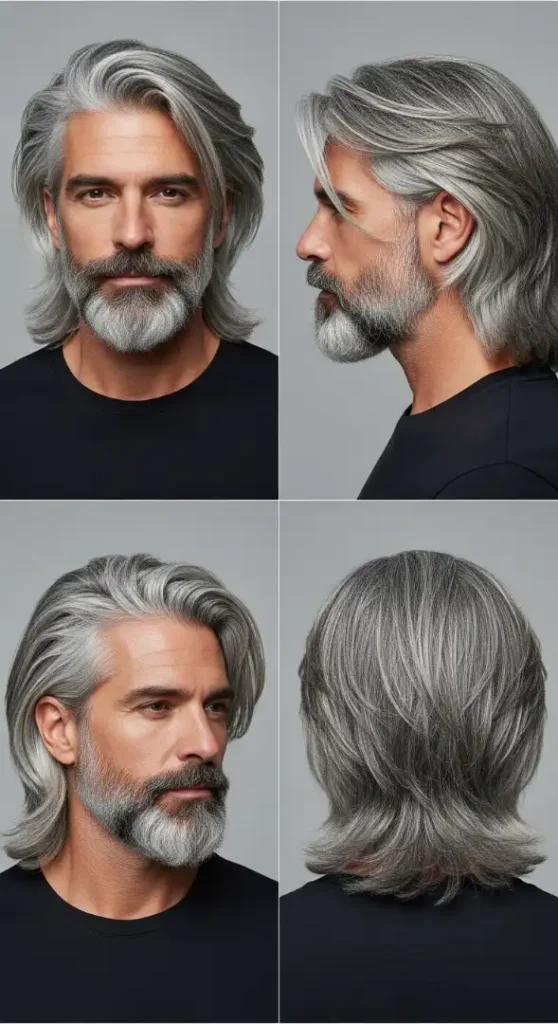
FACE SHAPE MATCH The Silver Mane is engineered for the Oval face in its most distinguished form — the mature Oval face where the hair’s natural greying into salt-and-pepper has begun to redefine the face’s visual field. The Oval face’s balanced proportions mean it can carry the full weight of long salt-and-pepper layered hair without the hairstyle fighting the face’s geometry. The silver-dominant front frames the face with a luminous, light-catching quality that draws the eye directly to the features — the eyes, the beard line, the jaw. The razor layers through the long hair prevent the density of thick salt-and-pepper hair from reading as heavy or aged — instead, the movement makes it read as deliberate and elegant. The 12mm beard at this distinguished length adds substance and completes the face’s narrative. This is not a style suited for very young-looking Oval faces — the silver-and-salt visual language requires the confidence of a man who has earned his grey.
GROOMING KIT
- Scissors: Kasho Green Series KGO-60 offset scissors — for the precision layering cuts in thick salt-and-pepper long hair; the offset handle is essential for the extended cutting sessions required by long dense hair
- Razor Comb: Fromm Comfort Razor Comb — for the feathered interior layer work that creates movement in the thick long silver-dark hair without reducing length
- Purple Toning Shampoo: Shimmer Lights by Clairol (used once weekly) — non-negotiable for maintaining the silver strands’ clarity and preventing the brassiness and yellow tones that affect white and silver long hair; the purple pigment neutralizes yellow without depositing color
- Styling Product: Kevin Murphy EASY RIDER Leave-In Conditioner Creme (2 pumps on damp hair) — specifically engineered for long, thick, color-affected or grey hair; adds moisture and shine without weight, allowing the silver strands to catch light at their maximum luminosity
- Beard Product: Jack Black Beard Oil (Cedarwood + Oakmoss, 10 drops daily) — for the salt-and-pepper short beard; conditions the coarser silver beard strands and prevents the dull, matte appearance that untreated grey beard hair develops; follow with a small amount of Honest Amish Beard Balm for the 12mm structure
MAINTENANCE LEVEL: Medium
- Salon visit frequency: Every 8–10 weeks — the layered long style grows gracefully; the primary maintenance need is a fresh razor-comb pass through the interior layers (which grow out and can lose movement) and a trim of the ends; the purple toning shampoo at home handles color maintenance between visits
- Daily styling time: 10–14 minutes — the silver long hair requires a more attentive routine than pigmented hair (which can mask dullness); a leave-in conditioner is non-negotiable, followed by a gentle air-dry or diffuse-dry to maintain the layer movement
- Product routine: Purple toning shampoo once weekly; sulphate-free moisturizing shampoo otherwise; deep conditioning treatment every 10 days; leave-in daily; beard oil morning and evening
Barber Talk (Exact Script) “Keep the full length — I want to grow this out, not cut it back. Trim the ends by half an inch maximum. I need the layers refreshed — use a razor comb or texture shears through the interior of the mid-lengths to add movement back. The silver hair on top tends to clump together as it grows; open it up with some internal layering. Don’t touch the surface layer — just the underneath. Beard: 12mm throughout, cheek line at a natural arc — wide, not high. Keep the neckline defined but not aggressive. Mustache: trimmed, shaped, no straggling hairs. Hot towel finish if you offer it.”
The Silver Mane shows that ageing with long thick hair is a privilege worn with absolute authority — Style 9 brings a completely different energy with an auburn wave that straddles the line between beach and studio.
FAQs
Q: How do I keep long silver or grey hair looking luminous and not dull? A: Three steps make the difference: (1) Use a purple toning shampoo (Shimmer Lights or Clairol Shimmer Lights) once a week to neutralize the yellow brassiness that grey hair develops from environmental factors; (2) Apply a leave-in conditioner every wash day — grey hair is structurally more porous than pigmented hair and loses moisture faster, leading to the dull, matte appearance; (3) Avoid high-heat styling — grey hair’s porous structure amplifies heat damage, which further dulls the silver’s natural luminosity.
Q: Can long hair look distinguished and professional on older men? A: Absolutely — long hair on distinguished men with thick silver or salt-and-pepper hair is increasingly recognized as a powerful professional aesthetic, particularly in creative, executive, and entrepreneurial contexts. The critical factor is condition: long hair that is dry, split, or shapeless signals neglect. Long hair that is healthy, layered, and well-conditioned signals confidence and discipline. Regular conditioning treatments, purple toning for silver hair, and clean layering from a skilled stylist are the differences between “distinguished” and “unkempt.”
Q: What is the best haircut for mature men with thick long hair? A: Razor-layered long styles are the most flattering for mature men with thick long hair. The razor layering removes the weight that thick hair accumulates as it grows long — preventing the “triangle head” or shapeless cascade that makes long thick hair on older men look unintentional. A layered cut that falls with natural movement, paired with a well-maintained beard, is the combination that reads as consciously chosen and deeply assured.
Q: How do I prevent silver long hair from becoming brittle or breaking? A: Grey hair has a reduced keratin structure compared to pigmented hair, making it more susceptible to breakage under heat, friction, and chemical stress. Use exclusively sulphate-free, moisturizing shampoo. Never brush grey hair dry — only detangle with a wide-tooth comb when the hair is wet and coated with conditioner. Avoid high-heat styling tools; if blow-drying is necessary, use a heat protectant (Kenra Platinum Silkening Mist) and a low-heat setting. Trim ends every 8 weeks to prevent split ends from migrating upward through the silver hair’s more fragile structure.
9 of 12 — The Amber Tide
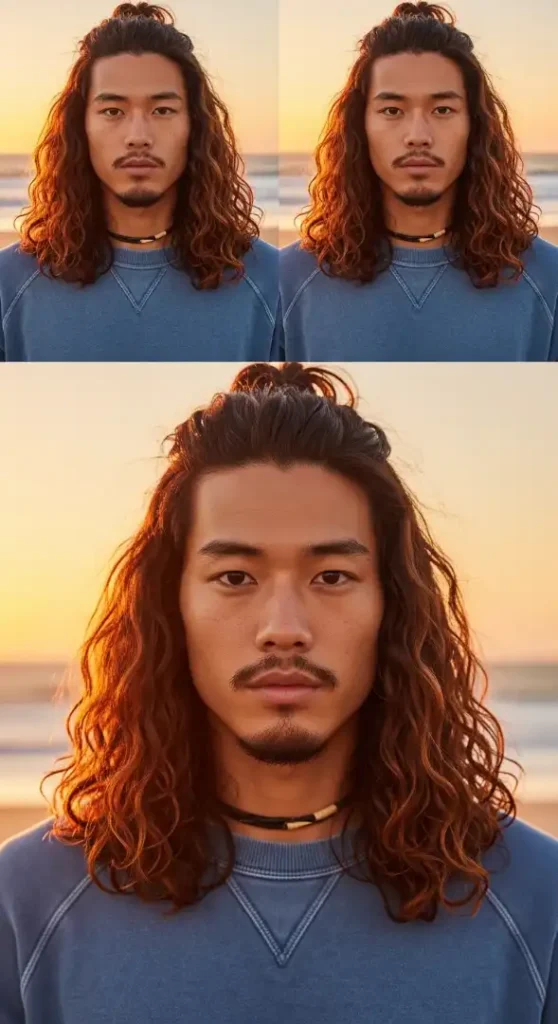
FACE SHAPE MATCH The Amber Tide is built for the Round face — and the half-up style is one of the most effective structural adjustments available for round-faced men with long thick hair. Round faces need vertical emphasis above all else, and the half-up topknot delivers this efficiently: gathering the top section into a loose topknot adds a vertical focal point above the crown, while the remaining loose waves create downward visual movement that elongates the face. The clean-shaven look is critical here — on a Round face, a beard adds chin and jaw width that competes with the style’s elongating vertical goal. The loose waves falling on both sides of the face provide a natural framing that narrows the visual perception of the Round face’s width. The auburn hair color — warm copper tones catching rim light — creates an additional vertical emphasis as the eye follows the light through the wave peaks upward toward the topknot. Men with Oblong faces should skip the half-up topknot and wear the full length down — the topknot adds height that an elongated face doesn’t need.
GROOMING KIT
- Hair Tie: Kitsch Spiral Hair Coils (set of 5) — coil hair ties (phone-cord style) are far superior to conventional elastics for thick long wavy hair; they leave no crease in the hair, grip securely, and don’t cause breakage at the half-up tie point
- Scissors: Fromm International Seamless Curved Shear — for trimming the wavy long ends and refreshing the internal layers that give the auburn waves their movement
- Salt Spray: R+Co Rockaway Salt Spray (one of the most beloved professional texturizing sprays) — 4–5 sprays to damp hair to enhance the natural wave structure in the thick auburn long hair; provides the beach texture that makes the half-up style look effortless rather than styled
- Finishing: Bumble and bumble Hairdresser’s Invisible Oil (5 drops warmed between palms, applied to dry hair ends) — reduces frizz in the loose wave section without adding weight; the invisible oil formula adds luminosity to the auburn tones under golden hour light
- Scalp Care: Briogeo Scalp Revival Charcoal + Coconut Oil Micro-Exfoliating Shampoo (used once weekly) — thick long hair accumulates dead skin cells and product buildup at the scalp that can cause itchiness and dull the hair’s root volume; weekly scalp exfoliation prevents this
MAINTENANCE LEVEL: Low
- Salon visit frequency: Every 10–12 weeks — the half-up casual style is the lowest-formal-maintenance long style; end trims and an interior layer refresh every 10–12 weeks are sufficient
- Daily styling time: 5–7 minutes — salt spray to damp hair, loose wave-scrunch with fingers, half-up tie at the crown; the style takes less time the longer the hair grows because the length adds its own gravity-fed movement
- Product routine: Sulphate-free shampoo twice weekly; salt spray daily; invisible oil on the ends after the salt spray dries; no blow-drying needed — air-dry for the authentic wave texture
Barber Talk (Exact Script) “Keep all the length — I’m growing this out for the surfer wave look. Just trim the ends by about half an inch to prevent split ends. I don’t want layers that are too defined — I want the hair to fall naturally. Maybe just some point-cutting at the ends to soften the bottom line. I wear it half-up sometimes, sometimes down — both need to look natural. No thinning shears today — I want the wave to keep its volume. Clean-shaven face: razor finish, sharp jawline. Nothing else changed.”
The Amber Tide brings surfer-cool ease to thick long hair — Style 10 cranks the intensity up with a coily long natural style that shows exactly how far coily thick hair can go when left to its full expression.
FAQs
Q: How do I style a half-up look with thick long wavy hair? A: Take a top section of hair (from the forehead hairline back to approximately the crown) and separate it from the remaining lower section. Gather just the top section and twist it loosely or leave it loose, securing with a spiral coil hair tie at the mid-crown. The bottom section falls free. Apply a salt spray to the entire length before gathering to enhance the wave texture and prevent the loose bottom section from going flat. The result looks casually intentional — the key is the looseness; a too-tight half-up looks formal, not surfer-cool.
Q: What is the best hair color for thick long hair on East Asian men? A: Auburn, warm brown, and honey blonde tones are the most photographically striking color choices for thick long East Asian hair. The naturally dark base of East Asian hair provides an excellent contrast background for warm copper and auburn tones — the color plays between the lit and shadowed zones of the wave, creating depth and dimension. Professionally done, auburn long hair on East Asian men reads as sophisticated and distinctive. The key is maintaining the color with a moisturizing, color-safe sulphate-free shampoo.
Q: How do I maintain a long thick surfer wave hairstyle without it looking unkempt? A: The visual line between “effortless surfer” and “messy” is hair health. Healthy, conditioned long waves look intentionally tousled; dry, frizzy, split-ended waves look neglected. Maintain end health with trims every 10–12 weeks. Apply a salt spray to damp hair to define the wave structure rather than letting the thick hair dry into random directions. A few drops of a lightweight hair oil on the dry ends prevents the frizz that tips “surfer” into “unwashed.” The half-up tie adds just enough structure to signal intention.
Q: What is the difference between a half-up bun and a man bun? A: A man bun gathers all of the hair (or most of it) into a single bun at the crown, exposing the full nape and sides. A half-up bun (or half-up topknot) only gathers the top section of hair — the hair above the ears and at the crown — leaving the remaining lower length to fall freely. The half-up reads as more casual and relaxed than a full man bun; it’s the halfway-committed style that suits men who want the length down but want the top out of their face. For thick long wavy hair, the half-up is the lower-maintenance, higher-personality choice.
10 of 12 — The Obsidian Flow
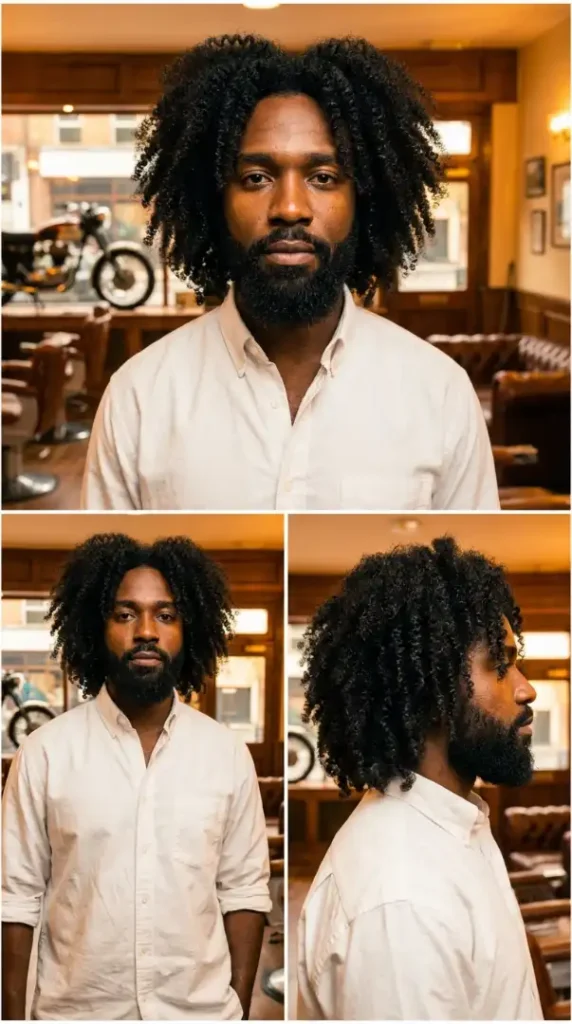
FACE SHAPE MATCH The Obsidian Flow is the definitive long natural hairstyle for the Diamond face — a face defined by narrow forehead and chin flanking wide, prominent cheekbones. Long coily hair is a uniquely powerful tool for the Diamond face because it can be shaped into a silhouette that adds width precisely where the face needs it (the forehead) while the defined coil clusters’ volume adds visual chin mass through length rather than beard bulk alone. The long 3B/3C coil clusters framing the face from the temples downward create visual width at the forehead level — where the Diamond face is narrow — by extending the silhouette outward. The 1.5-inch beard provides jaw and chin width at the face’s other narrow zone. The combined effect is a Diamond face that appears more oval and harmonized. Heart faces also benefit tremendously from long coily styles — the volume at the temples and top of the face balances the heart’s wide upper zone with the hair’s own architectural presence. Avoid this long-free-volume coily style on Round faces — the 360-degree volume exaggerates the round face’s already circular silhouette.
GROOMING KIT
- Detangling Brush: Felicia Leatherwood Detangler Brush — specifically designed for long coily/curly hair; the wide-spaced flexible bristles detangle 3B/3C hair length without disrupting the coil pattern, which is the primary challenge when growing coily hair to 7–8 inches
- Pick: Fromm Afro Pick (chrome, wide-tine) — for gentle volume expansion at the roots before applying styling products on wash day
- Shears (shape trim): Fromm Comfort Plus Curved Shear — for trimming the long coily ends without disrupting the coil clusters; the curved blade follows the natural coil silhouette
- Styling Product: Mielle Organics Pomegranate & Honey Curl Smoothie (generous application to soaking-wet, freshly conditioned hair, section by section) — defines 3B/3C coil spirals at long lengths without weight; the honey formula prevents the frizz and puffing that occurs when long coily hair lacks internal moisture
- Beard Product: Isner Mile Beard Kit (beard wash, beard oil, beard balm, boar bristle brush) — the full kit is appropriate for a 1.5-inch beard; beard wash weekly, oil daily, balm for shape and finishing
MAINTENANCE LEVEL: High
- Salon visit frequency: Every 4–6 weeks for a coil trim (shaping only, not length removal) and a fresh hairline definition — long coily hair needs consistent silhouette shaping as the coils expand outward unevenly
- Daily styling time: 15–20 minutes on wash days (section-by-section curl cream application, diffuse drying); 5–8 minutes on non-wash days (refresh spray and re-definition)
- Product routine: Co-wash 3–4× per week; sulphate shampoo once weekly; curl cream on every wash day; LOC method between wash days; beard oil morning and evening; beard balm for structure when needed
Barber Talk (Exact Script) “I’m growing the coily hair long — I just need a shape trim to keep the silhouette even. Pick it out first, then trim the outer edges to balance the shape. Don’t cut any length off the actual coils — just clean the silhouette. Hairline: razor-sharp arc, keep my natural hairline. Beard: 1.5 inches throughout — trim the strays, clean the cheek line at a wide natural arc. Fade the sideburn area where the hair meets the beard — I want a seamless connection between the long hair and the full beard. Neckline: a clean, defined arc just above the Adam’s apple. Hot towel finish on the beard.”
The Obsidian Flow shows that long coily hair is its own universe of style — Style 11 brings the energy back to straight thick long hair with an undercut-and-flow combination built for the man who refuses to choose between structure and freedom.
FAQs
Q: How do I grow coily hair long without it matting or breaking? A: The key is daily moisture and weekly protein. Use the LOC method daily (liquid water spritz, oil seal, cream moisturizer) to keep the coil clusters hydrated — dry coily hair at long lengths tends to mat where the coils interlock. Use a wide-tooth comb or detangling brush specifically designed for coily hair (Felicia Leatherwood Detangler) when wet and coated with conditioner. Detangle from ends to roots. Never brush dry. Deep condition weekly. Protective styles (loose twists or braids) overnight prevent matting during sleep.
Q: What products define long 3B/3C coily curls? A: The most effective routine for defined long 3B/3C coils is: (1) Apply a moisturizing conditioner to soaking-wet hair in sections and use a Denman brush to define the coil clusters; (2) Apply a curl cream or smoothie (Mielle Organics Curl Smoothie or SheaMoisture Curl Enhancing Smoothie) section by section using the praying hands method; (3) Diffuse on low heat or air dry without disturbing the coils. The result is defined, separated coil spirals throughout the long length.
Q: How do I prevent long coily hair from shrinking and looking shorter than it is? A: Coily hair (especially 4A and above) can shrink to 30–50% of its stretched length when it dries without definition. The solution is a strong moisturizing routine that elongates the coil: apply a leave-in conditioner and a curl cream to soaking-wet hair, then either twist-stretch sections (two-strand twists that, when released dry, have more elongated coils) or use a hair dryer with a diffuser to set the length before the coils fully contract. Stretched coily hair at 7–8 inches is genuinely dramatic and different from the same hair left to shrink unmanaged.
Q: How do I pair a full beard with long coily natural hair? A: The most important technical detail is the “connected beard fade” — where the shorter beard at the sideburn area is blended into the longer hair above it by the barber, creating a seamless transition rather than a visible gap between the long hair and the beard’s cheek line. Ask your barber explicitly for a “beard-to-hairline blend” where the sideburn area is tapered so the long coily hair flows naturally into the full beard’s upper edge. The visual result is a face that appears framed by one unified statement rather than two competing ones.
11 of 12 — The Atlantic Storm
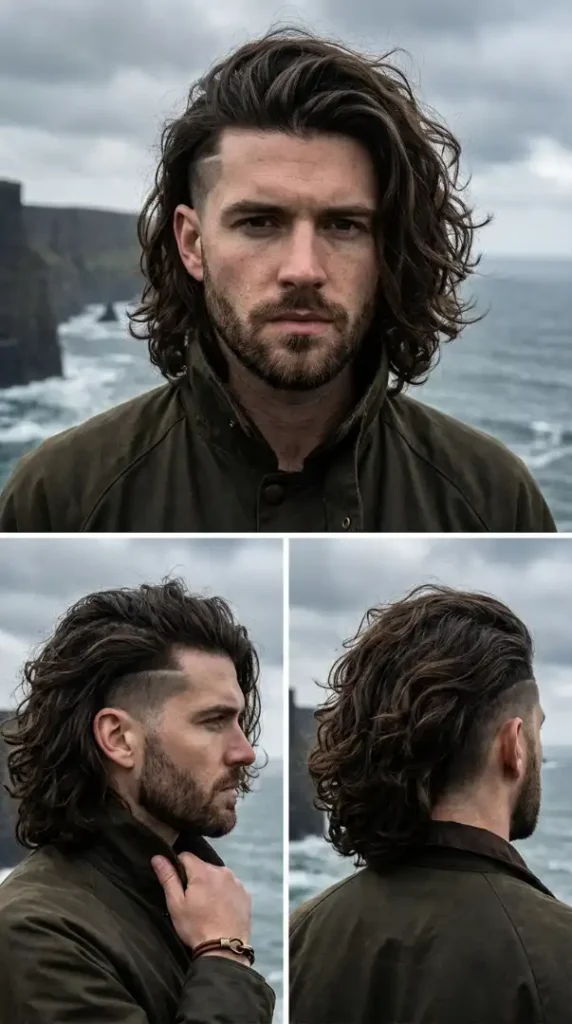
FACE SHAPE MATCH The Atlantic Storm is engineered for the Oblong face — but tackles the challenge from a completely different direction than Style 5. Where The Monsoon Wave used a side-sweep to create horizontal breadth, The Atlantic Storm uses the disconnected undercut to create a distinct visual horizon that breaks the Oblong face’s vertical dominance. The undercut’s clean horizontal clipper line at the temple creates a strong horizontal visual boundary — it’s an architectural line that the eye reads as dividing the face into two more proportionate zones. Above the line: voluminous long wave adding width. Below the line: clean, close sides keeping the face from appearing even taller. The tousled long waves falling forward over the forehead further shorten the face’s apparent length by adding horizontal movement at the forehead. The 7mm beard adds jaw definition without the length that would elongate the face further. This cut does require daily styling — it is not suitable for men who travel without a hair dryer or styling products.
GROOMING KIT
- Clippers (undercut sides): Wahl Magic Clip Cordless — #2 on the undercut sides, clean horizontal disconnect line at the temple using the clipper’s flat edge; the Magic Clip’s adjustable lever provides fine control at the disconnect line without the risk of cutting into the long section above
- Scissors (long top): Kasho Green Series offset scissors (6-inch) — for the long wavy top section’s end trim and the subtle point-cutting that gives the thick dark brown waves their tousled, deliberate texture
- Thinning Shears: Fromm 28-tooth Thinning Shear — for bulk reduction through the interior of the long wavy section; at 10–11 inches, thick wavy hair can become extremely heavy and the undercut sides (being shaved close) emphasize the contrast between the heavy top and light sides — thinning is essential
- Styling Product: Oribe Rough Luxury Molding Wax (1 fingertip applied to 80% dry hair, worked through with fingers using a “tousle and separate” motion) — creates the tousled, high-texture wave definition; matte finish reads dramatically under high contrast editorial lighting
- Beard Product: Bulldog Original Beard Oil (8 drops daily) + Beardbrand Utility Balm for occasional structure in the 7mm beard
MAINTENANCE LEVEL: High
- Salon visit frequency: Every 3–4 weeks — the disconnected undercut requires frequent maintenance; the #2 sides grow visibly and soften the disconnect line within 3 weeks; the long top grows more forgivingly but needs end trims every 8–10 weeks
- Daily styling time: 10–14 minutes — the long tousled wave on thick hair requires a full blow-dry with diffuser attachment on medium heat to set the wave, followed by the molding wax application; air-drying alone produces a shapeless cascade on this hair density
- Product routine: Sulphate-free shampoo twice weekly; deep conditioning mask weekly (the long thick wavy ends need intensive conditioning due to their age and the heat exposure from styling); thinning-shear session every 4–6 months to maintain the top section’s manageable weight
Barber Talk (Exact Script) “Undercut on the sides — clipper to a two, maybe a two-and-a-half on the sides and back. I want a disconnected line — clean, horizontal, sharp. Do not blend it. Leave the top completely long; don’t touch the length. The back: undercut the back as well, same height. Nape: clean clipper line across the nape. The long section on top: point-cut the ends — maybe half an inch off — and run thinning shears through the interior mid-section to remove bulk, not length. I want the waves to move when I toss my head, not sit like a helmet. Beard: 7mm, natural cheek line, razor the neck below the jaw.”
The Atlantic Storm proves that structure and wildness aren’t opposites — they’re partners. Style 12, the final cut in this collection, closes with the most layered and poetic interpretation of thick long hair yet.
FAQs
Q: What is a disconnected undercut with long hair? A: A disconnected undercut with long hair features clipper-cut sides (typically a #1 to #3 guard) separated from the long top section by a clean, unblended clipper line — the “disconnect.” Unlike a fade or taper, there is no blending at the transition; the two lengths are simply adjacent with no gradient between them. The result is a high-contrast, architectural look that works particularly well on thick long wavy or straight hair, where the contrast between the shaved side and the voluminous top is most dramatic.
Q: How do I diffuse-dry thick long wavy hair without frizz? A: Apply a wave-defining product (curl cream, moulding wax, or Oribe Rough Luxury Wax) to 80% dry hair. Attach a large diffuser to your blow-dryer (Dyson Airwrap Diffuser or DevaCurl DevaFuser for large-volume hair). Scoop sections of the long waves into the diffuser bowl without disturbing the wave clusters. Use medium heat, low air flow. Work from the ends upward. Avoid moving the diffuser constantly — hold it in one position for 15–20 seconds, let the wave set, then move to the next section. Total diffuse time: 8–12 minutes for 10–11 inches of thick hair.
Q: Is a disconnected undercut with long wavy hair high maintenance? A: Yes — this is one of the higher-maintenance styles in a long hair collection. The undercut sides need a clipper touch-up every 3–4 weeks to maintain the clean disconnect line. The long wavy top section requires a diffuse-dry styling routine that cannot be skipped — air-drying thick wavy long hair without product or diffusing often produces an uneven, shapeless result. If you travel frequently without access to a hair dryer, this is not the ideal style to maintain.
Q: What face shapes suit a disconnected undercut with long wavy hair? A: Oblong, Oval, and Square faces suit the disconnected undercut with long hair best. For Oblong faces, the horizontal undercut line breaks the face’s vertical dominance. For Oval faces, the dramatic volume contrast reads as effortlessly handsome. For Square faces, the long tousled waves soften the jaw’s angularity while the undercut’s discipline keeps the overall look intentional. Round faces should avoid this style — the shaved sides combined with a voluminous long top can exaggerate the round face’s circular proportions.
12 of 12 — The Jungle Sovereign

FACE SHAPE MATCH The Jungle Sovereign closes this collection with the Heart face — making it the second Heart face style in the article but approaching the challenge through completely different structural tools. Where Style 6 (The Barrio King) used the man bun’s full exposure of the Heart face to let the strong forehead speak, The Jungle Sovereign uses the half-up half-down’s partial coverage to introduce a subtle rebalancing. The Heart face has a wide, prominent forehead and cheekbones tapering to a narrow, sometimes pointed chin. The loose half-bun at the mid-crown adds modest volume above the crown without adding width at the temples — it directs vertical emphasis upward. The loose thick wavy lower half falls on both sides of the face, framing the narrow chin and jaw with cascading warm chestnut wave volume that visually widens the face’s lower third. The 1.5–2 inch full beard is the architectural completion — adding substantial chin and jaw mass to fully counterbalance the Heart face’s broad upper third. This combination is the most comprehensive Face-Shape solution in the article: the half-up, the loose waves, the full beard, and the lateral wave volume all work together as a single coordinated system.
GROOMING KIT
- Scissors: Cricket Ultra Smooth S3 6.5-inch — for the long thick wavy end trim and the layering through the chestnut wave section; the ultra-smooth coating reduces friction drag through thick dense wavy hair
- Thinning Shears: Fromm Comfort Plus 30-tooth Thinning Shear — for removing the internal bulk at the mid-lengths that causes thick chestnut wavy hair to look dense and shapeless rather than defined and flowing
- Brush: Denman D4 Medium Styling Brush + Tangle Teezer Men’s Paddle Brush — the Tangle Teezer for initial wet detangling from ends to roots; the Denman for wave definition on wash-day styling before the half-up is gathered
- Hair Tie: Slip Silk Large Hair Tie (silk-lined) — for the relaxed half-bun at the crown; silk ties leave no crease in the chestnut wave section and hold the relaxed, loose half-bun securely without over-tightening
- Styling Product: Davines More Inside This Is A Medium Hold Hairspray — 4 sprays over the finished loose half-down wave section to lock the wave definition in place in outdoor, wind-affected environments; light hold, not stiff
- Beard Product: Honest Amish Beard Balm (full ingredient list: beeswax, shea butter, argan, jojoba) — 2 fingertips for the 1.5–2 inch full beard; provides conditioning and structural hold in the outdoor jungle/forest environment
MAINTENANCE LEVEL: Medium
- Salon visit frequency: Every 8–10 weeks — the half-up half-down style grows gracefully; the primary maintenance is end trimming and a fresh thinning-shear pass through the mid-lengths to prevent the thick wavy hair from accumulating shapeless bulk as it grows
- Daily styling time: 10–14 minutes — the full beard care (daily oil and brush) accounts for 5–6 minutes; the long wavy half-up requires wave cream application to damp hair, air drying or diffusing, and then gathering the top section into the half-bun
- Product routine: Sulphate-free shampoo twice weekly; deep conditioning mask once weekly; wave cream or mousse on every wash day; beard oil morning and evening; beard balm for special occasions or photography; hairspray for windy outdoor environments
Barber Talk (Exact Script) “Keep all the length — I’m wearing it half-up. Trim the ends by half an inch to three-quarters of an inch to get rid of any split ends. Run thinning shears through the mid-section and underneath — I want the waves to move freely without the bulk weighing everything down. Don’t over-thin the top section — I want density for the half-up bun. Razor-comb through the lower third to add movement to the wave fall. Beard: keep the length at one-and-a-half to two inches. Clean the cheek line — wide natural arc. Trim the mustache so it doesn’t cover the lip. Neckline: leave a natural, wide beard neckline — this is a full beard, not a short corporate trim.”
The Jungle Sovereign closes this 12-style collection with everything it takes — volume, structure, personality, and a beard that frames it all. If you found your style in this article, your next salon visit is the only appointment that matters.
FAQs
Q: What is the half-up half-down hairstyle for men? A: The half-up half-down hairstyle gathers only the top section of the hair (from the crown forward) into a loose bun, topknot, or tied portion at the mid-to-upper crown, leaving the remaining lower length to fall free. It’s a versatile middle-ground between wearing all the hair down (maximum flow, maximum casual) and a full man bun (maximum structure, maximum exposure). For thick long wavy hair specifically, the half-up half-down is one of the most flattering options because it controls the volume at the top while showcasing the wave movement in the free lower section.
Q: How do I style thick long wavy chestnut-brown hair without losing the wave definition? A: Apply a wave cream or curl-defining mousse (Davines More Inside This Is A Curl Cream or Living Proof Curl Defining Styling Cream) to soaking-wet hair immediately after conditioning. Use a Denman brush to define the wave clusters section by section. Air dry or diffuse on medium-low heat without touching the hair while it dries. The most common mistake is touching or combing the hair while it dries — this breaks the wave clusters and creates frizz. Once dry, apply a light hold hairspray to lock the definition, particularly if you’re in an outdoor or humid environment.
Q: Does the half-up half-down look suit a full beard? A: The half-up half-down style with a full beard is one of the most harmonious long hair + beard combinations. The half-bun’s relaxed positioning above the crown adds height without formality, which balances naturally with the full beard’s volume and weight at the lower face. The loose waves falling from the half-bun between the beard and the shoulders create a natural framing zone that makes both the hair and the beard look intentional. This combination reads as adventurous, creative, and artistically confident.
Q: How do I make a half-up bun look relaxed and not too formal? A: The tension is everything. A tight, high half-bun with smooth, pulled-back hair reads as formal. A loose, mid-crown half-bun with slight imperfection reads as relaxed and confident. To achieve the relaxed look: after gathering the top section and securing with a silk hair tie, pull a few loose strands forward at the temples to break the perfection. Loosen the bun slightly by pinching the top and pulling it upward just a touch — creating a slightly puffed, casual form rather than a compact knot. The loose waves of the lower section do the rest of the storytelling.