Curly Hairstyles for Men to Must Try
1 of 12 — The Coil Crown
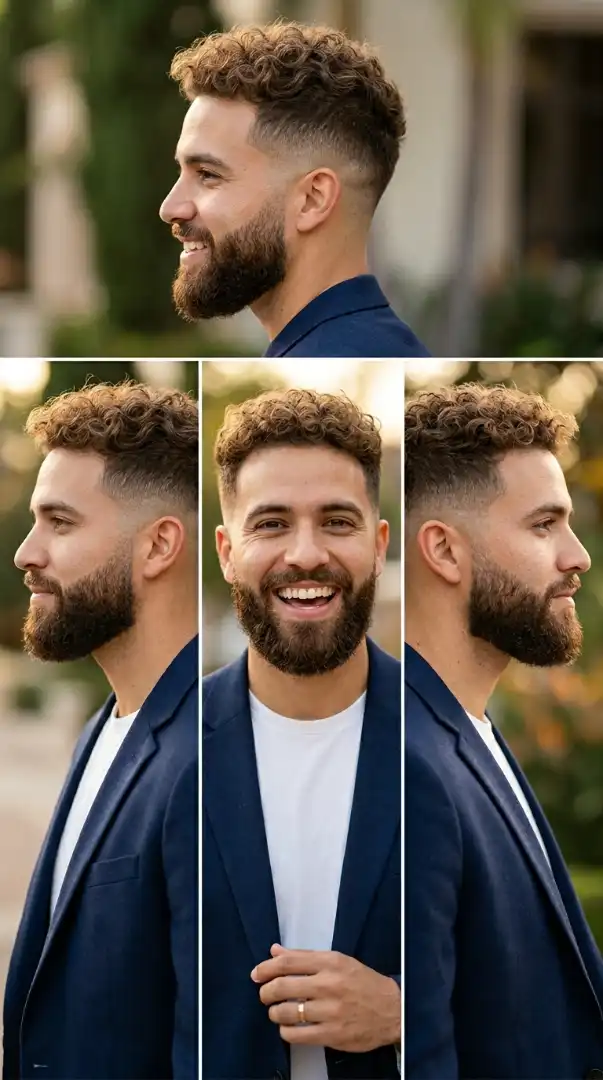
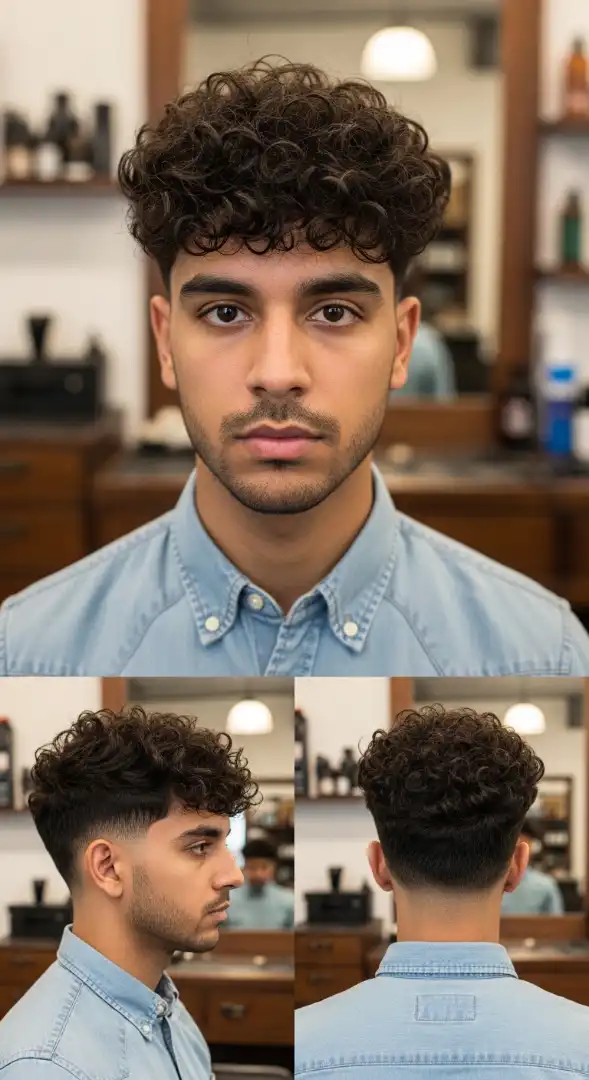
The Coil Crown is the quintessential statement for men with naturally loose spiral curls who want to let their texture lead the look. Medium-length all over — typically 3–4 inches at the crown — this style works by simply optimizing and honoring the natural curl pattern rather than fighting it.
FACE SHAPE MATCH The Coil Crown is engineered for Oval and Oblong face shapes above all others. The natural volume generated at the crown and sides creates a balanced width-to-length ratio on an Oval face, while on Oblong faces, the lateral spread of the curls adds visual width that counterbalances a longer facial structure. It also works respectably on Heart-shaped faces when curl volume is kept slightly more compact at the temples. Men with Round faces should be cautious — the lateral fullness can amplify roundness unless the sides are taken shorter to create contrast.
GROOMING KIT
- Clippers: Wahl Senior Cordless for any light trimming around the ears and neck perimeter
- Diffuser: BaByliss Pro Nano Titanium Dryer with diffuser attachment — essential for enhancing curl definition without frizz
- Detangling: Denman D3 7-Row Styling Brush for wet detangling pre-styling
- Product: Shea Moisture Coconut & Hibiscus Curl Enhancing Smoothie (fingertip application, section by section) + Kinky-Curly Knot Today Leave-In Conditioner as base
- Finishing: Light mist of Cantu Shea Butter Firm Hold Mist to lock without crunchiness
MAINTENANCE LEVEL: Medium
- Salon/barber visit: Every 6–8 weeks for perimeter cleanup and nape shaping only — this style grows gracefully
- Daily styling time: 12–18 minutes including diffuse drying
- Daily routine: Co-wash or rinse 3×/week, apply curl cream on damp hair, scrunch upward, diffuse on low heat medium speed, finish with a light oil seal (argan or jojoba, 2–3 drops)
BARBER TALK Script “I want to keep my length on top — at least 3 to 4 inches of curl. Don’t cut the curls when they’re stretched, measure them compressed. On the sides I want a natural taper — no fade, just a clean taper from about a #3 guard blending down to a #1.5 at the sides, nothing shorter. Keep the nape rounded and natural-looking, not a hard square. Clean up around the ears but leave the sideburn natural, not sharp-lined. I want the perimeter shaped but not obvious — it should look like my hair just grows that way.”
FAQs
Q: How do I style curly hair for men without making it look frizzy? A: Apply a curl-defining cream like Shea Moisture Curl Enhancing Smoothie to soaking-wet hair, scrunch upward section by section, then diffuse on low heat — never rub with a towel. The key is sealing moisture into each curl while it’s still fully saturated. Touching it while drying is the number-one cause of frizz.
Q: Which face shape suits the Coil Crown hairstyle best? A: The Coil Crown suits Oval and Oblong face shapes best. The horizontal volume created by loose spiral curls adds width to longer faces and complements the natural proportions of Oval faces. Men with Round faces should pair this style with slightly shorter sides to avoid added width.
Q: How often do I need to cut curly hair to keep it looking good? A: Curly hair only needs a perimeter trim every 6–8 weeks — significantly less than straight styles. Because curls contract visually, growth is less obvious. Focus on maintaining the nape shape and ear outline rather than cutting length, which preserves the volume and shape of the Coil Crown.
Q: What’s the difference between a curl cream and a pomade for curly hair? A: Curl cream (like Shea Moisture or Cantu) is water-based and designed to hydrate and define natural curl patterns without stiffness. Pomade adds shine and hold but often contains wax that can build up and weigh curls down, causing separation and frizz. For natural curly styles, always reach for curl cream or a gel with flexible hold first.
2 of 12 — The Afro Architect
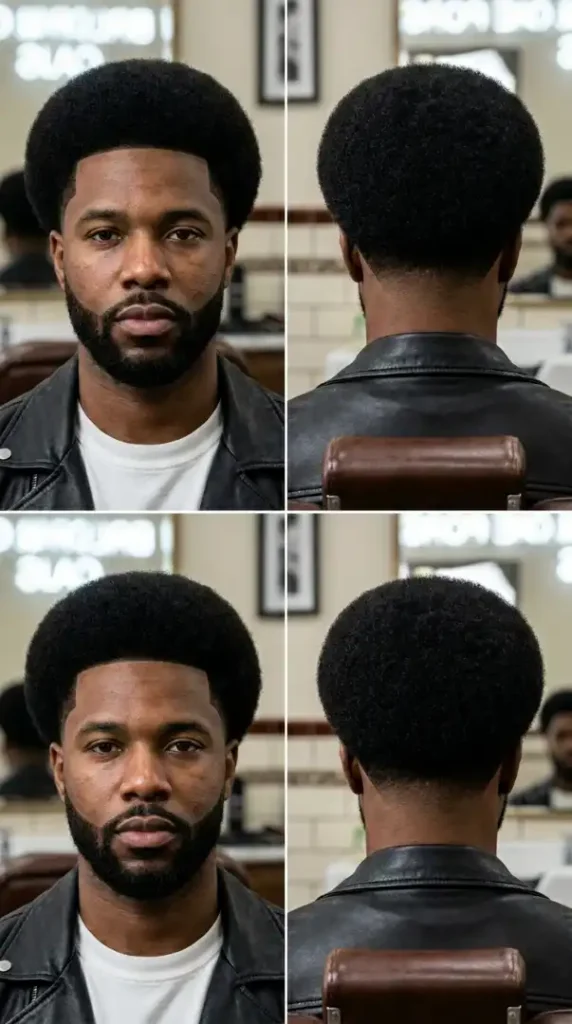
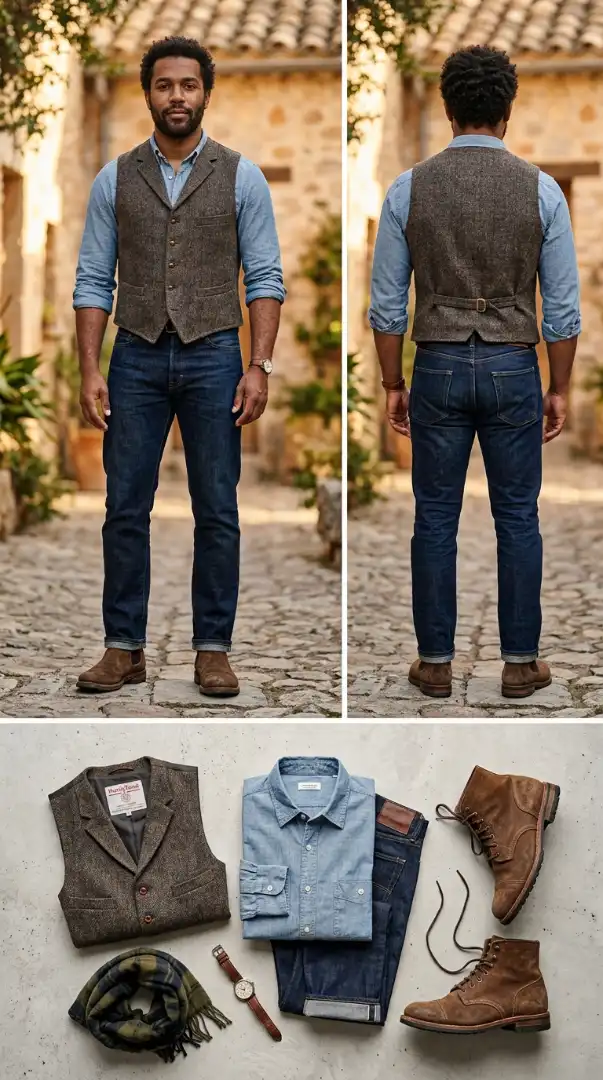
The Afro Architect is a precision-meets-power style — the medium afro sculpted to architectural perfection with a razor-sharp hairline and clean nape. This isn’t just letting coils grow; this is coil geometry. Every edge, every fade graduation, every degree of the dome shape is intentional.
FACE SHAPE MATCH The Afro Architect was built for Diamond and Oval face shapes. Diamond faces — defined by prominent cheekbones and narrower foreheads and jawlines — benefit enormously from the afro’s lateral volume at the crown, which visually widens the forehead area and creates an overall balanced silhouette. The dome structure of the afro echoes and amplifies the strongest feature of the Diamond face: its cheekbones. Oval faces gain commanding height without imbalance. For Square faces, the rounded afro dome softens the jawline beautifully. Men with Round faces should work with a barber to add extra height at the crown while keeping the sides slightly less wide — this elongates rather than widens.
GROOMING KIT
- Clippers: Andis Master Cordless MLC for the tight fade graduation and nape cleanup — the gold standard for coily textures
- Outliner: Andis T-Outliner GTX for the temple and nape lineup — essential for that razor-crisp hairline definition
- Afro Pick: Kent afro pick comb for daily shaping and lifting the crown volume evenly
- Product: SheaMoisture Jamaican Black Castor Oil Leave-In Conditioner (daily moisture) + Cantu Shea Butter Moisturizer for twist-out definition on wash days
- Edge Control: Murray’s Edgewax or Got2B GlossyAntic Frizz Pomade for lineup maintenance between visits
- Beard: Bevel Beard Oil (3–4 drops daily) + Scotch Porter Beard Balm for shaping and edge control
MAINTENANCE Level: High
- Salon/barber visit: Every 2–3 weeks mandatory — the lineup and nape taper grow out quickly and define whether this style looks deliberate or neglected
- Daily styling time: 5–8 minutes — pick out in the morning, moisturize, re-define edges if needed
- Weekly: Deep conditioning mask (30 minutes minimum) to prevent shrinkage-related dryness and maintain coil elasticity
BARBER Talk Script “I want a medium afro — keep the length at about 3 inches, evenly shaped into a clean dome, no flat spots at the crown. I need a razor-crisp hairline lineup from temple to temple — no rounded corners, sharp 90-degree angles at the temples. At the nape, I want a bald fade starting at the nape line and fading up about an inch — clean, squared nape line. The beard should be lined up sharp at the cheekbone and jawline — about a #1 guard for the beard fade into the neck, and a razor edge at the top of the beard. No blending the beard into the afro — I want a clear definition between the two.”
FAQs
Q: How do I keep my afro shaped and even between barber visits? A: Use an afro pick to lift and rotate the hair in even sections every morning — always pick from root to tip, not tip to root. Apply a water-based moisturizer like SheaMoisture Leave-In Conditioner first to add slip. Weekly a gentle steam treatment or hot towel wrap rehydrates the coils and helps the dome retain its shape naturally without product buildup.
Q: What face shape suits a medium afro? A: Diamond and Oval face shapes suit a medium afro best. The lateral crown volume widens a Diamond face’s narrower forehead for perfect proportion. Square and Oval faces also work well — the rounded dome softens angular jaw lines. Round faces should request extra crown height and minimal width to elongate the face shape.
Q: How is a medium afro different from a high-top fade? A: A medium afro maintains volume on all sides — front, sides, and back — creating a dome or rounded shape. A high-top fade removes volume from the sides entirely via a skin or bald fade, leaving a flat or angular platform of hair only at the crown. The afro is rounder and fuller; the high-top is architectural and more dramatic in silhouette.
Q: How often should I get my afro lineup touched up? A: Every 2–3 weeks. The hairline grows approximately 0.5 inches per month, which means your sharp temple and nape lines will visibly grow out within two weeks. The dome shape itself holds longer, but the precision edges — which define the entire look — require regular maintenance to keep the Afro Architect looking intentional rather than unkempt.
SECTION 6 — PINTEREST PIN PACK
📌 PIN TITLE: “12 Curly Men’s Haircuts That Look Better Every Single Day”
📝 PIN DESCRIPTION: The Afro Architect proves that coily hair + razor precision = the sharpest look in any room. This structured medium afro with crisp lineup suits Diamond and Oval faces perfectly. Perfect inspo for your next barbershop session. Click to see all 12 styles.
#️⃣ HASHTAGS: #MensHaircut #AfroHair #MensStyle #Barbershop #AfroHairstylesForMen #MensGrooming #BarberLife #HairstyleIdeas #NaturalCoils #MediumAfro #BarberWork #HairInspo #AfroShaping #CoilyHair #MENXSTYLE #TheAfroArchitect #MenXStyleBlog #BlackMenHair #AfroFade #LineupGoals
⚡ CTA LINE: “Save this now — show your barber these angles and get the perfect cut.”
3 of 12 — The Bouncy Fringe Spiral
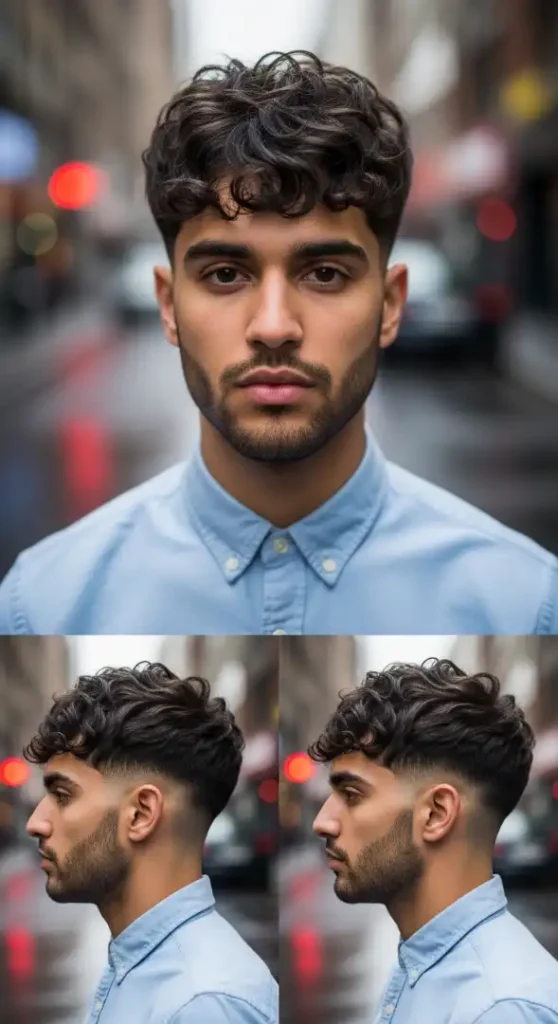
The Bouncy Fringe Spiral solves a problem that haunts curly-haired men for years: what to do with the front. Instead of fighting the forward growth direction of front curls — blow-drying them back, gelding them flat, or hiding them under hats — this style embraces the forward fall. The result is movement, personality, and a look that improves as the day progresses.
FACE SHAPE MATCH This style was designed specifically for Round faces — and it’s one of the most effective optical adjustments available in curly hair. The curtain fringe creates a central vertical axis through the face, breaking the circular silhouette and drawing the eye downward. The low fade on the sides removes horizontal mass, which further prevents the roundness from being emphasized. The overall result is that a Round face reads as Oval when this style is executed correctly. Heart-shaped faces also benefit — the fringe softens the typically prominent forehead by bringing a curtain of texture forward. Less ideal for Oblong faces, as the downward fringe movement can exaggerate facial length.
GROOMING KIT
- Clippers: Wahl Magic Clip for the low fade — ideal for the precise skin-to-full-density graduation on South Asian hair texture
- Outliner: BaByliss Pro FX Skeleton Trimmer for neckline and around-ear cleanup
- Detangling/Styling: Wet Brush Pro for wet detangling, Denman D3 for curl clumping
- Product: Ouidad Advanced Climate Control Defining Gel (medium hold, frizz-blocking formula) applied to wet fringe curls, scrunched upward; John Frieda Frizz Ease Serum, 1–2 drops on dry hair to finish
- Finishing: Wide-tooth comb for initial wet detangle — never brush dry curly hair
MAINTENANCE Level: Medium
- Salon/barber visit: Every 5–6 weeks for low fade refresh and perimeter clean-up
- Daily styling time: 10–15 minutes including product application and air or diffuse drying
- Routine: Wet hair with spray bottle, apply Ouidad gel, scrunch fringe forward, diffuse 8–10 minutes, scrunch out the crunch gently with a microfiber towel
Barber Talk Script “I want the top length kept at around 2.5 to 3 inches — don’t stretch the curls to measure, measure them compressed. The fringe should be long enough to fall forward onto the forehead — I want it to sit between my brows and my hairline, bouncy not flat. On the sides I want a low fade — start the fade about an inch above the ear, skin fade at the bottom, blending up to a #2 or #3 at the top of the sides. Clean up the nape with a rounded natural line — no square cut. Clean up around my ears but don’t take the sideburn too high. I want it to look natural on the sides, styled on top.”
FAQs
Q: How do I keep curly fringe from going flat during the day? A: Flat curly fringe is almost always a moisture problem. In the morning, lightly mist your fringe with a water-and-conditioner mix (50/50 in a spray bottle), scrunch in a light curl gel, and let it air dry or diffuse. Touching it during drying kills the curl. Carrying a small spray bottle for midday refreshes extends bounce throughout the day significantly.
Q: Does a curly fringe work for men with round faces? A: Yes — a curly fringe is one of the best haircuts for men with round faces. The forward fall of the fringe creates a vertical line that visually elongates the face, while a low or mid fade on the sides removes horizontal bulk. The combination makes a round face read as more oval in proportion.
Q: What’s the difference between a curtain fringe and a regular fringe for curly hair? A: A regular fringe falls straight across the forehead in a horizontal line, which is very difficult to maintain with curly hair and often looks stiff. A curtain fringe parts in the center or slightly off-center and falls to each side, working with the natural curl direction rather than against it — making it far more practical and flattering for naturally curly hair.
Q: How often should I get the Bouncy Fringe Spiral touched up? A: Every 5–6 weeks for fade maintenance and perimeter trimming. The top length grows slowly enough that you can stretch to 7–8 weeks if needed, but the low fade will start looking grown-out after 4–5 weeks on most hair types.
4 of 12 — The Curly Undercut Rebel
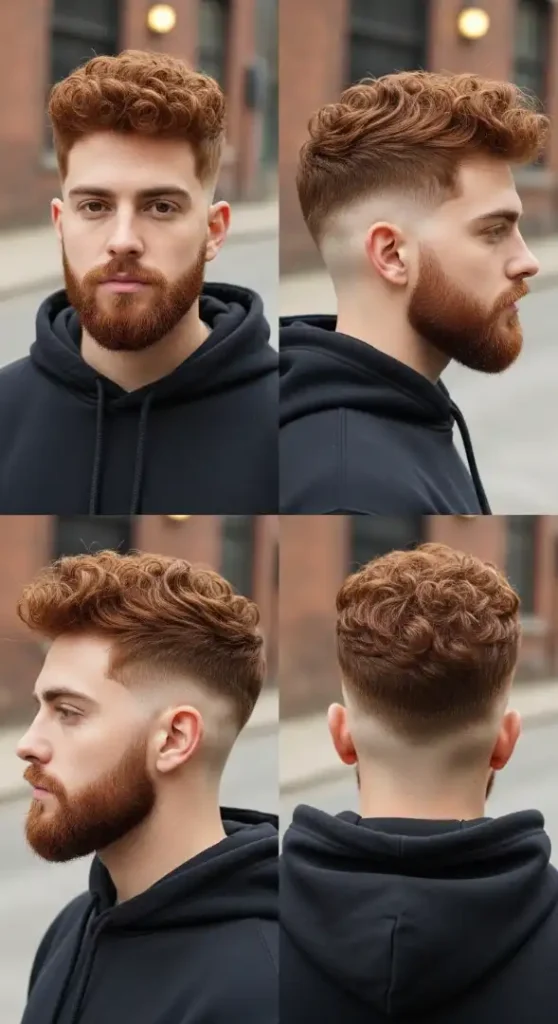
The Curly Undercut Rebel is the curly hair style that refuses to apologize for itself. The disconnected undercut — a hard, shaved side that doesn’t graduate but instead creates a sharp architectural line — amplifies the contrast between the naked sides and the explosive curl volume on top. It’s a high-fashion, high-attitude cut that works best on men who want their hair to make an entrance before they do.
FACE SHAPE MATCH The Curly Undercut Rebel is ideally suited for Square and Diamond faces. The hard undercut disconnect emphasizes the jaw — an asset for Square faces where a strong jaw is the defining feature. The volume is pushed upward and slightly forward, drawing the eye to the eyes and brow rather than widening the face laterally. Diamond faces benefit from the top weight that fills in the narrower forehead area. This style is less ideal for Round faces (the hard side shave creates lateral contrast that can emphasize cheek width) and should be modified with a softer fade transition for Heart-shaped faces to avoid a top-heavy appearance.
GROOMING KIT
- Clippers: Andis Master Cordless for the hard undercut line — the sharp edge requires a precise blade
- Trimmer: Wahl Detailer for the crisp disconnect edge maintenance at home between visits
- Product: Bumble and Bumble Curl Anti-Humidity Gel-Oil for curl definition and frizz control in the humid environment of urban life; Living Proof Curl Defining Styling Cream (quarter-size amount for 3.5-inch curls)
- Beard: Jack Black Beard Oil (3–4 drops on a damp beard) + The Art of Shaving Sandalwood Beard Balm for the medium beard shape
- Finishing: Small amount of Suavecito Matte Pomade applied only at the roots to add lift and volume direction without glossing the curls
MAINTENANCE Level: High
- Salon/barber visit: Every 2–3 weeks — the disconnect line grows out faster than a fade and becomes visually unclear at the 3-week mark
- Daily styling time: 8–12 minutes
- Daily routine: Mist curls with water, apply curl cream, scrunch upward, diffuse or air dry; the sides require zero daily product
Note: This high-maintenance look is NOT ideal if you travel frequently without styling products — the undercut grows out fast, and without a barber, the defining hard edge will disappear within weeks, leaving an undefined in-between shape that is difficult to manage.
Barber Talk Script “I want a disconnected undercut — not a fade, a hard line. Shave the sides with a #0 or zero clip, and I want a clean visible disconnect — I should be able to see where the shaved side ends and my curls begin with no blending between them. Keep the top curls at about 3.5 to 4 inches — don’t over-cut them, I need volume. The nape should be cleaned up at skin level with a squared base. For the beard, I want the cheek line sharp at a natural-but-defined edge, a #1 guard on the body of the beard, faded to skin below the jawline. Keep the mustache connected. Everything should look sharp, not soft.”
FAQs
Q: What is a disconnected undercut and how is it different from a regular undercut? A: A disconnected undercut features a hard, visible line between the shaved or very short sides and the longer hair on top — with no fade or blending between them. A regular undercut graduates the transition slightly. The disconnected version is more dramatic and fashion-forward, creating a stark architectural contrast that amplifies curl volume significantly.
Q: Which face shape is best for a curly undercut? A: Square and Diamond face shapes suit the curly undercut best. Square faces benefit from the strong jaw framing and upward volume direction, while Diamond faces gain crown fullness that complements their naturally prominent cheekbones. Round faces should avoid the hard disconnect and opt for a graduated fade instead.
Q: How do I maintain a disconnected undercut between barber visits? A: Use a Wahl Detailer trimmer to clean up the shaved sides at home — run it gently along the existing hard edge every 5–7 days. For the curls on top, keep them moisturized daily with a light mist and curl cream. The hard line will grow out within 2–3 weeks even with at-home touch-ups, so professional visits remain essential.
Q: Does a curly undercut work for professional settings? A: It depends on the curl length and beard grooming. With curls kept clean and under 4 inches, and a well-shaped beard, the curly undercut reads as creative-professional in industries like design, media, and tech. For more conservative corporate environments — finance, law — a taper fade version with a softer transition reads as more appropriate.
5 of 12 — The Textured Wave Drift

The Textured Wave Drift occupies the space between straight and curly — the styling sweet spot that most men with naturally wavy hair have never fully explored. The goal here is to enhance the wave pattern’s natural S-shape without converting it into something it isn’t. No straightening, no heavy wax, no heat damage. Just directional product application, a light hold, and surrender to the texture.
FACE SHAPE MATCH The Textured Wave Drift is an exceptional match for Heart-shaped faces. The characteristic Heart face — wider forehead narrowing to a pointed chin — benefits from the side-swept wave adding horizontal visual weight at the upper portion of the face, complementing the forehead’s natural width. The medium side length avoids adding jaw-level width, preserving the elegance of the heart silhouette. Oval faces also wear this style with ease — the neutral proportions of an Oval face allow virtually any length and direction without imbalance. It is less suited for Oblong faces, where the sweeping volume can add perceived length to an already vertically oriented face.
GROOMING KIT
- Clippers: Wahl Cordless Senior for natural taper cleanup — East Asian hair texture is typically straight-to-wavy and holds a clean taper beautifully
- Styling: Denman D4 Large Styling Brush for distributing product through wet wavy hair
- Product: American Crew Forming Cream (pea-sized amount) worked through damp hair from root to mid-length; Hanz de Fuko Claymation for added hold and separation on dry hair (rice-grain amount at the roots)
- Finishing: Kent Handmade Fine Tooth Comb for directional shaping post-product
- Optional: A light sea salt spray (R+Co Rockaway Salt Spray) misted on dry hair for added wave definition and natural texture
MAINTENANCE Level: Low to Medium
- Salon/barber visit: Every 7–8 weeks — natural taper grows gracefully and doesn’t require frequent reshaping
- Daily styling time: 5–8 minutes — the simplest routine in this article
- Daily routine: Lightly mist hair with water, work a small amount of forming cream through with fingers, comb directionally, air dry (15–20 minutes) or 5 minutes of diffuse on low
Barber Talk Script “I have naturally wavy hair and I want to work with the wave texture, not cut it out. Keep the top at about 2 to 2.5 inches — don’t scissor-cut the length too much, I need the wave to have room. On the sides, I want a natural taper — a #3 on the sides graduating to a #1.5 at the bottom, nothing shorter. No skin fade — I want it to look natural and not too groomed. Clean up the nape in a slight natural arc, and leave the sideburns natural — just clean up any strays. No razoring on the hairline — I want it soft, not hard-lined.”
FAQs
Q: How do I style wavy hair for men without using heat? A: Apply a small amount of American Crew Forming Cream or a light wave cream to damp hair, comb it in the desired direction, then air dry completely. For more definition, scrunch the hair upward with your palms while it’s drying. Avoid touching it until it’s fully dry — this is the most common mistake that disrupts the wave pattern and creates frizz.
Q: Can East Asian men get naturally wavy or curly hair? A: Yes — while East Asian hair is often described as straight, natural wave patterns ranging from light S-waves to loose curls are common and are increasingly prominent due to generational texture variation. Products designed for wavy hair (not curl creams, not straight pomades) — like forming creams and light sea salt sprays — will enhance the natural texture rather than alter it.
Q: What’s the best hairstyle for men with naturally wavy hair? A: The Textured Wave Drift — or any medium-length style that works with the natural wave pattern — is ideal. Keep the length at 2–3 inches so the wave has room to form, use a light matte cream for hold, and resist the urge to comb it flat. The wave is the style; fighting it is the only mistake you can make.
Q: Does the wave hairstyle look professional? A: Absolutely — with the right product and a clean taper, a textured wave hairstyle is among the most professional-looking natural styles available. The key is a matte finish (avoid shine products in professional settings), a well-maintained taper, and hair kept clean and moisturized. It reads as smart, modern, and intentional.
6 of 12 — The Desert Curl Stack
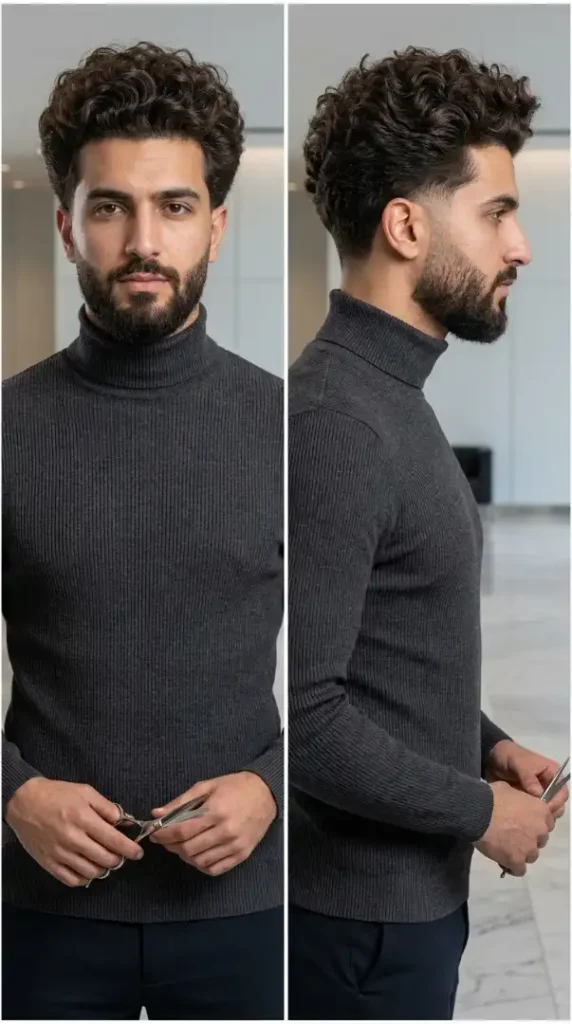
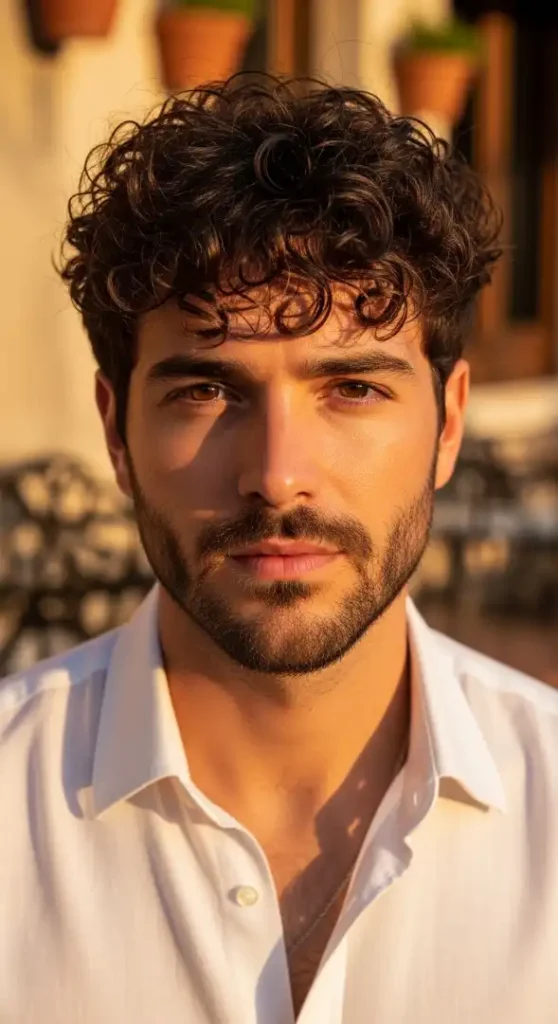
The Desert Curl Stack is the answer for men with naturally voluminous, dark curls who operate in professional environments and have been told — or assumed — that their texture isn’t “office appropriate.” It is. This style channels the natural vertical stack of medium curls with a clean skin fade and a shaped full beard, creating a look that commands a boardroom as confidently as it does a weekend.
FACE SHAPE MATCH The Desert Curl Stack is a precisely engineered solution for Oblong faces. An Oblong face is characterized by a longer-than-wide proportion — and it specifically needs horizontal visual weight added to the sides to create the illusion of greater width. A voluminous curl stack does exactly this: the lateral spread of the curl mass adds perceived width, and the beard adds density at the jawline, further reducing the appearance of excessive length. The key instruction to any barber executing this on an Oblong face is to not over-control the width — let the curls expand naturally to the sides rather than pushing them upward, which would exaggerate the face’s length. Square and Round faces should approach this style with caution — too much lateral curl volume on a Round face adds width where it is least needed.
GROOMING KIT
- Clippers: Andis Master Cordless for the skin fade graduation on the sides
- Outliner: BaByliss Pro FX787 for the beard line definition — the cheek line on a full beard requires a precise detailing blade
- Product: Cantu Men’s Collection 3-in-1 Shampoo/Conditioner/Shaving Cream on wash days; Shea Moisture Manuka Honey & Yogurt Hydrate + Repair Curl Enhancing Smoothie for curl stack definition
- Beard: Honest Amish Original Beard Balm (dime-size daily for length and shape retention); Grave Before Shave Beard Oil for the skin under the full beard
- Finishing: Boar bristle brush for the beard shaping — distributes balm evenly through medium-length beard
MAINTENANCE Level: Medium to High
- Salon/barber visit: Every 3–4 weeks — the skin fade and beard edge work are non-negotiable for the professional setting this style inhabits
- Daily styling time: 10–15 minutes (8 for hair, 5–7 for beard)
- Beard routine: Daily oiling and balm application; weekly beard comb-through; monthly lineup touch-up with outliner at home
Barber Talk Script “I want to keep my curl volume — don’t take too much length off the top, I want the curls to stack and expand naturally to about 3 to 3.5 inches. The volume should spread to the sides, not just upward. On the sides I want a skin fade starting approximately 1.5 inches above the ear, blending clean — I want to see the graduation, not a hard line. Keep the nape skin tight with a rounded nape line. For the beard, I want a natural full shape — cheek line defined but not too sculpted, just following my natural growth. Fade the beard into the neck at skin level, no neck beard. Leave the mustache full and connected to the beard.”
FAQs
Q: Can curly hair look professional for men? A: Absolutely. Curly hair looks entirely professional when paired with a clean fade, a well-shaped beard, and moisturized, defined curls. The Desert Curl Stack specifically — with its controlled volume, skin fade, and groomed full beard — projects authority and confidence in professional settings. The key is regular barber maintenance every 3–4 weeks.
Q: What is the best curly hairstyle for men with Oblong face shapes? A: The Desert Curl Stack — or any style that adds horizontal width through lateral curl volume — is ideal for Oblong faces. The wide, stacked curl mass adds perceived width to the face, reducing the appearance of excessive vertical length. Pair with a beard for additional jaw-level density.
Q: How do I add volume to curly hair for men? A: Volume in curly hair comes from moisture, not product quantity. Hydrated curls naturally lift away from the scalp. Use a hydrating curl cream on soaking wet hair, scrunch upward, and diffuse on low heat. Avoid heavy pomades or waxes — they weigh curls down, which kills volume and creates separation.
Q: How long does the Desert Curl Stack style take to grow in if starting from short hair? A: Starting from a #2 buzz cut, you’ll need approximately 4–6 months to build enough curl length for the stack effect to activate — curly hair typically grows 0.5 inches per month, and you need at least 2.5–3 inches of compressed length for the volume to stack. The fade can be started and maintained from month one.
7 of 12 — The Loose Ringlet Cascade
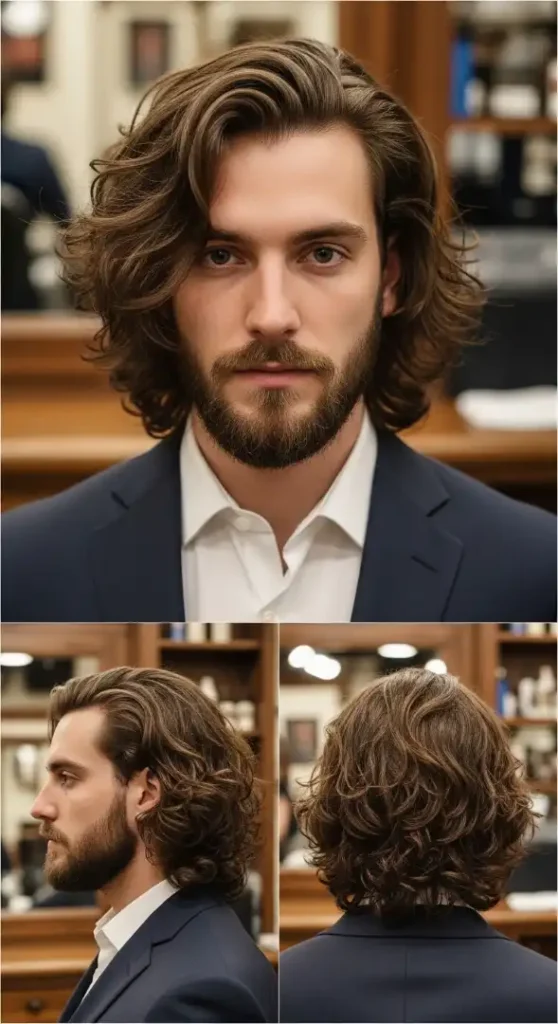
The Loose Ringlet Cascade is for the man who has let his natural curl journey reach its full expression — longer hair, visible ringlet definition, and a confidence that matches the commitment it took to grow it. At 5–6 inches of compressed curl length, this style requires patience (12–18 months from a short cut to reach this length) but delivers a timeless, romantic look that photographs extraordinarily well and ages gracefully.
FACE SHAPE MATCH Long loose ringlets work best on Oval, Oblong, and Diamond face shapes. For Oval faces, the cascade is nearly universally flattering — the balanced proportions allow the ringlets to frame the face without distorting any feature. Oblong faces benefit from the lateral ringlet spread at the cheek level adding visual width, countering the vertical length. Diamond faces — with their wide cheekbones — are framed beautifully by ringlets that fall below the cheekbone level, elongating the lower face. This style is challenging for Round faces: the lateral fullness at cheek level amplifies roundness, and a side part with one-sided draping is generally required to redirect volume away from the widest facial point.
GROOMING KIT
- Scissors: Joewell Black Series 6.0 inch dry-cut shears — long curly hair should be dry-cut by the barber to assess the natural fall
- Detangling: Tangle Teezer Wet Detangling Brush — essential for long curly hair, working in sections from tip to root
- Product: DevaCurl SuperCream Coconut Curl Styler (2 fingertip-sized portions) applied from ears to tips, not at the roots — essential for ringlet cohesion without scalp buildup; OUAI Hair Oil, 3–4 drops as a final seal
- Finishing: Microfiber Turbie Twist for drying — never terry cloth (breaks up ringlets)
- Weekly Deep Conditioning: Briogeo Don’t Despair, Repair! Deep Conditioning Mask (20–30 minutes under a shower cap)
MAINTENANCE Level: Medium
- Salon/barber visit: Every 8–12 weeks for dry trim and shape — long curly hair only needs perimeter shaping, not layering unless specifically desired
- Daily styling time: 20–25 minutes including drying
- Critical routine: Never comb dry ringlets — wet detangle only; apply products to dripping wet hair; diffuse upside down for maximum root volume and ringlet formation; sleep on a satin pillowcase to prevent friction frizz
Barber Talk Script “I want to preserve as much length as possible — please dry-cut my curls so you can see the natural fall. I just want a shape-up: remove any uneven lengths, clean up the perimeter around the ears, and taper the nape to a #1 with a rounded nape line. Don’t thin the ends — I need the weight to help the ringlets form. On the beard, just trim for shape — keep the length at about half an inch, clean the cheek line natural and the neckline faded to skin. I don’t want blunt ends on the beard — point-cut it please.”
FAQs
Q: How do men grow and maintain long curly hair? A: Growing long curly hair requires protecting length through regular trims of only the damaged ends (every 10–12 weeks), deep conditioning weekly, and avoiding heat styling. Use the LOC method daily — Liquid (water mist), Oil (argan or jojoba), Cream (DevaCurl or similar) — applied to damp hair. Sleep on satin, detangle only when wet, and diffuse instead of using direct heat.
Q: How do I get ringlets instead of frizzy curls? A: Ringlet formation depends on three factors: moisture, technique, and product. Apply a curl-defining cream to dripping-wet hair, work it through in sections while scrunching upward, and diffuse on the lowest heat setting while holding the diffuser cup still (don’t move it around). The secret is not breaking the curl clumps while they’re drying — every touch disrupts the ringlet form.
Q: What face shape suits long curly hair for men? A: Oval, Oblong, and Diamond face shapes suit long curly hair best. Oval faces are universally flattered. Oblong faces gain width from lateral curl volume. Diamond faces look elegant with curls falling below the cheekbones. Round faces need careful styling — a side part and asymmetrical draping are recommended to avoid amplifying circular proportions.
Q: Is long curly hair professional for men? A: Yes — when well-moisturized, defined, and groomed. Long curly hair paired with a well-shaped short beard and clean edges reads as creative-professional. In more conservative environments, using a product like OUAI Hair Oil to tame fringe frizz and defining the ringlets with a curl cream keeps the look polished. The Loose Ringlet Cascade with a formal suit (as shown here) is a compelling proof of concept.
8 of 12 — The Defined Coil Fade
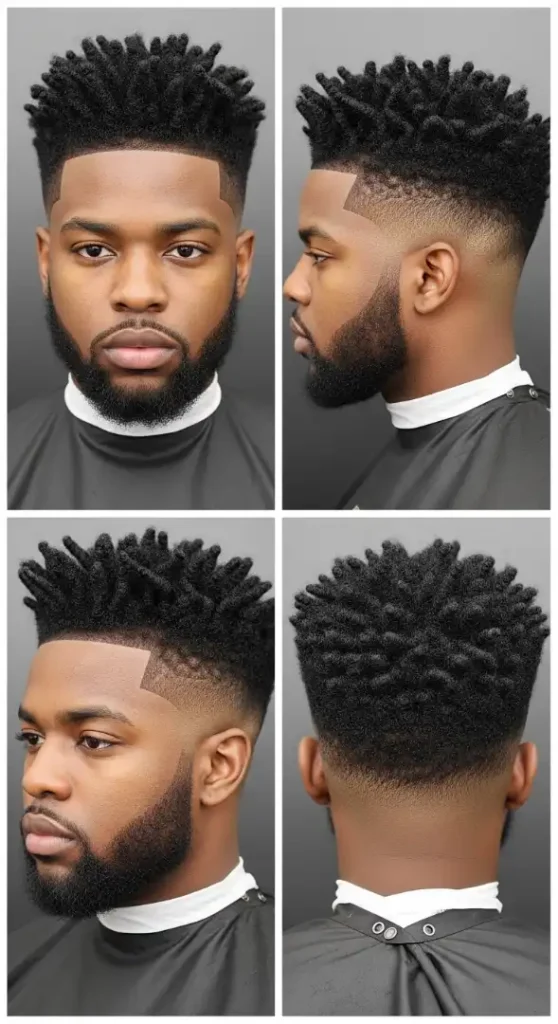
The Defined Coil Fade is precision barbering at its technical apex. A high skin fade — beginning at the temple and dissolving to nothing at the ear — creates the most dramatic contrast available in coily hair styling. The coils on top are not left raw; they are Denman-clumped, product-set, and separated into defined individual units that stand at architectural attention. This is not a hairstyle that simply happens to your hair. This is hair as intention.
FACE SHAPE MATCH The Defined Coil Fade is engineered for Round faces. The high skin fade removes all lateral mass from the sides and concentrates it vertically above, which optically stretches a Round face upward into a more Oval proportion. The taller the coil crown and the tighter the fade, the more elongating the effect. For Diamond faces, the high fade emphasizes the already-prominent cheekbones by creating a dramatic width contrast at the cheekbone level. Square faces should approach this style carefully — the fade’s side-stripping effect works, but the bold curl crown on a Square face can tip from powerful to top-heavy; a mid-height fade (rather than high) is recommended. Avoid this style with Oblong faces as the height it generates will further elongate.
GROOMING KIT
- Clippers: Andis Master Cordless MLC — non-negotiable for the high skin fade on coily texture; the precision blade is essential for the #0 bald base
- Outliner: Wahl Detailer Li for the hairline lineup and beard edge work
- Coil Definition: Denman D3 7-Row Brush — the tool that creates defined coil clumps from loose coils; use in sections on soaking wet hair
- Product: Eco Styler Olive Oil Gel (medium hold) applied section by section on wet hair, then Denman-brushed to define each coil unit; ORS Curls Unleashed Curl Defining Cream as an under-layer
- Beard: Bevel All-in-One Razor for lineup maintenance; SheaMoisture Beard Conditioning Oil for the lined beard
MAINTENANCE Level: Very High
- Salon/barber visit: Every 1.5–2 weeks — the high skin fade grows the fastest of any fade type and loses its drama rapidly after two weeks
- Daily styling time: 15–20 minutes on wash days; 5 minutes on dry days
- Wash day routine (2–3×/week): Sulfate-free co-wash → leave-in conditioner → Eco Styler gel → Denman coil definition → diffuse; maintain in between with a water mist and light curl cream refresh
Barber Talk Script “I want a high skin fade — start the fade at my temple, right at the top of my ear level, and go bald from there down. The fade should graduate through #0.5 and #1 over about 1.5 inches upward, then blend into my natural hair. The transition should be clean — not blotchy. I want the nape skin-tight with a clean squared base. For the lineup, I want a crisp temple-to-temple hairline — 90-degree corners. Keep my top coils at about 1.5 to 2 inches compressed. Beard lineup sharp — cheek line at natural growth, neck line faded clean to skin. No blending the hairline — everything sharp and defined.”
FAQs
Q: What is a high skin fade and how is it different from a low fade? A: A high skin fade begins at the temple level — the top of the ear — and fades to skin-level (zero guard) at that height, creating a dramatic contrast that removes mass from most of the side of the head. A low fade begins just above the ear or at the nape and creates a subtler transition. High fades maximize the height-to-width contrast and are most dramatic on coily hair; low fades are more conservative and versatile.
Q: How do I get defined coils instead of a frizzy afro? A: Defined coils require the Denman Brush technique. On dripping wet hair, apply a strong-hold curl gel (Eco Styler Olive Oil), then run a Denman D3 brush through each section in a downward motion — the brush’s teeth clump individual curls into defined coil units. Work section by section from nape to crown. Let fully air dry or diffuse on low — do not touch until completely dry.
Q: How often should I get a high fade touch-up? A: Every 1.5 to 2 weeks. A high skin fade grows out faster than any other fade type because the zero-guard base is more visually obvious as it fills in. At 2.5 to 3 weeks, a high fade has typically grown into what looks like a mid-fade — the dramatic contrast that defines the style has already diminished significantly.
Q: What products give coily hair the most definition? A: Eco Styler Olive Oil Gel combined with a Denman brush delivers the strongest coil definition available in over-the-counter products. The gel provides hold while the brush physically shapes the curl clumps. For softer definition with less crunch, substitute the gel for a curl custard (like Camille Rose Naturals) and use fingers instead of a brush for a looser defined look.
9 of 12 — The Curly Quiff Authority
SEO AUTHORITY CONTENT
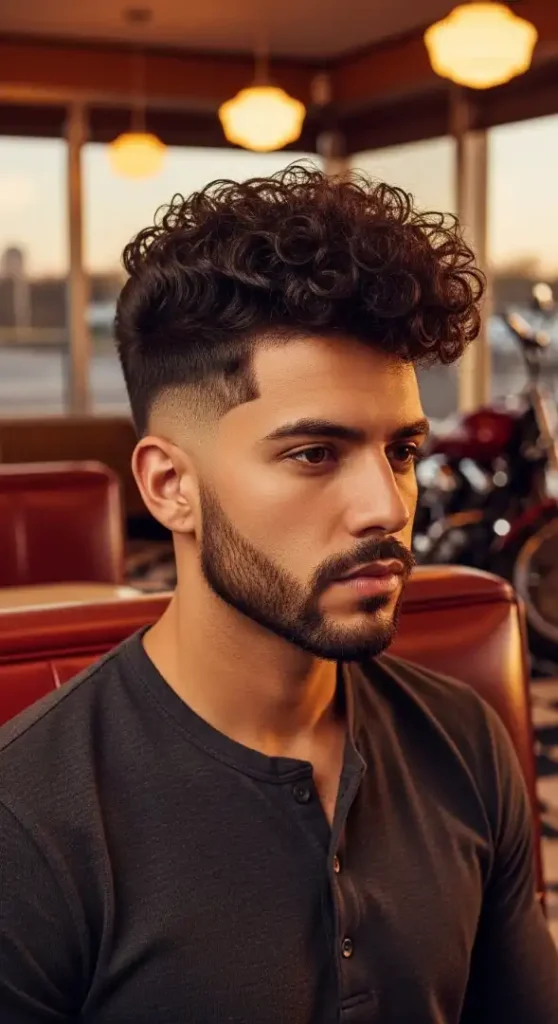
The Curly Quiff Authority is the evolution of the quiff format for naturally curly hair — not the slicked-back version, not the blow-dried pompadour, but a true upward volumization of natural spiral curls using the right product combination and technique. It’s a style that occupies the enviable intersection of effort and authenticity: it looks deliberate without looking stiff.
FACE SHAPE MATCH The Curly Quiff Authority is a powerful shape for Diamond and Oval face shapes. The forward-upward volume of the quiff fills in the forehead region of a Diamond face — one of its defining characteristics is a narrower forehead — and adds commanding height. Paired with a mid fade that sculpts the sides, the Diamond face gains both width at the top and definition at the jaw. Oval faces are naturally accommodating of upward volume and wear the curly quiff with understated authority. Square faces can work with this style but should keep the quiff direction more upward than forward to avoid adding visual width at the forehead. Avoid for Oblong faces — the height of the quiff will exaggerate facial length.
GROOMING KIT
- Clippers: Wahl Magic Clip for the mid fade graduation — the taper lever adjustment makes clean graduation exceptionally controllable
- Blow Dryer: BaByliss Pro Nano Titanium Dryer with a concentrator nozzle — used to direct the front curls upward on low heat while fingers lift from the root
- Product: Bumble and Bumble Curl Anti-Humidity Gel-Oil as the base curl layer; Byrd Hairdo Products Texturizing Surf Spray (light mist) on semi-dry hair to add lift and body; American Crew Forming Cream (dime-size) at the roots of the quiff for initial lift before diffusing
- Beard: Wahl Detailer Li for lineup maintenance; Scotch Porter Beard Serum for the faded beard grooming
MAINTENANCE Level: Medium to High
- Salon/barber visit: Every 3–4 weeks — the mid fade needs refreshing and the quiff section needs perimeter shaping
- Daily styling time: 12–18 minutes (including the directional blow-dry lift of the quiff)
- Daily routine: Apply curl product to damp hair, concentrate blow-dry with concentrator at roots of quiff section while lifting forward, diffuse remaining hair, finish with light cream
Barber Talk Script “I want a curly quiff — the front 2 inches of hair need to stay at 4 inches of length at minimum so I can get height. Don’t scissor cut the curls while stretched — measure compressed. I want a mid fade on the sides: start at the ear level, skin to #0.5 at the base, graduating to a #3 at the top of the sides. The transition should be clean and gradual over about 2 inches. Keep the back medium-length with a rounded nape taper to #1. Shape the beard with a mid fade on the cheeks — #1 on the body, skin fade on the neck. Sharp cheek line — follow my natural growth. Mustache connected and full.”
FAQs
Q: How do I style a quiff with naturally curly hair? A: Apply a volume-adding curl cream to damp hair, then use a blow dryer with a concentrator nozzle on low heat while lifting the front section upward with your fingers — this trains the curls to stand rather than fall. Once 80% dry, diffuse remaining sections, then finish the quiff with a light mist of sea salt spray and a final finger-lift at the roots. The natural curl texture is what makes it look alive.
Q: What is the difference between a curly quiff and a curly pompadour? A: A curly quiff pushes volume upward and forward at the front, with the back sitting lower — the front is the star. A pompadour traditionally sweeps backward from the face, creating a wave-like arch. In curly hair, the quiff is more natural-looking (the curls express themselves upward) while a pompadour on curly hair requires more heat styling and smoothing product to achieve the backward sweep.
Q: Does a curly quiff work with a fade? A: A mid or low fade is the ideal pairing for a curly quiff — the faded sides create the contrast that makes the top volume readable and architectural. Without the fade, the quiff blends into surrounding hair and loses its definition. A mid fade (starting at ear level) is the most versatile — dramatic enough to define the quiff, restrained enough for professional settings.
Q: How long does hair need to be for a curly quiff? A: At minimum 3 inches of compressed curl length at the front section — which means approximately 5–6 inches of stretched hair length for tighter curl patterns. With less than 3 compressed inches, the quiff won’t hold its lift throughout the day. For the best quiff structure, aim for 3.5 to 4 inches of compressed length at the crown and front.
10 of 12 — The Salt & Pepper Spiral
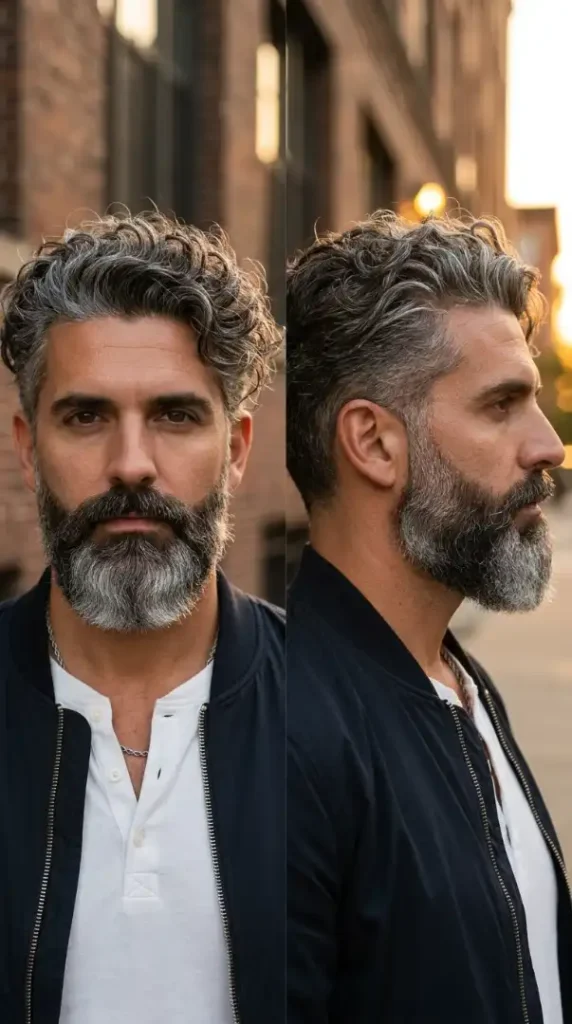
The Salt & Pepper Spiral is a style that celebrates what most men are tempted to dye away. Natural silver threading through dark curls is genuinely rare and photographically spectacular — the high-contrast color interplay between white and brown creates a natural visual depth that no colorist can fully replicate. This is the style for the man who has decided his age is not something to correct but to own.
FACE SHAPE MATCH The Salt & Pepper Spiral is ideally matched for Square and Oval face shapes. A Square face — all about the jaw — is maximized by this style: the full salt-and-pepper beard draws attention directly to the strong jawline while the soft curl volume at the top softens the squared corners of the forehead and crown. The medium curl length doesn’t add aggressive width, maintaining the masculine angularity of the Square face without overwhelming it. Oval faces benefit from the neutral proportions allowing the distinguished salt-and-pepper color story to take center stage without any structural correction needed. This style is broadly flattering across most face shapes because its power comes from color and character rather than volume or architectural extremes.
GROOMING KIT
- Clippers: Wahl Senior Cordless for the natural taper — minimal fade, just cleanup
- Trimmer: Remington PG6025 for beard shaping and length maintenance at home between visits
- Scalp Care: Neutrogena T/Gel Therapeutic Shampoo (used once weekly) — salt-and-pepper hair with changing texture is prone to scalp sensitivity as the silver strands have less natural oil coating; follow with Briogeo Scalp Revival Charcoal + Coconut Oil Micro-Exfoliating Shampoo
- Product: Moroccanoil Treatment Light (3–4 drops through wet curl perimeter) for the oil that salt-and-pepper/silver hair lacks; Pattern Beauty Styling Cream for curl definition without weighing down the finer silver strands
- Beard: Every Man Jack Beard Oil for the full beard daily; Beardbrand Tree Ranger Utility Balm for shape retention
MAINTENANCE Level: Low to Medium
- Salon/barber visit: Every 6–8 weeks — the natural taper and full beard grow at an acceptable rate; this is a graceful-growing style
- Daily styling time: 8–12 minutes
- Key consideration: Silver hair strands are more porous and prone to dryness and frizz — daily moisture with a curl cream or oil is more important for salt-and-pepper curls than for fully pigmented hair
Barber Talk Script “I want to keep the curls — don’t take length, just shape the perimeter. I have salt-and-pepper hair and I want it to look intentional and groomed, not neglected. On the sides, a very natural taper — a #2 blending down to a #1.5 at the bottom, no skin fade. I want the sides to look natural and lived-in. Keep the nape in a rounded arc, same natural taper to a #1.5. For the beard, I want a full shape — trimmed to about 0.5 to 1 inch in length, using scissors please, not clippers, for a more natural finish. Cheek line at natural growth, neckline cleaned up to skin. Don’t square the neckline — round it.”
FAQs
Q: How should men style salt-and-pepper curly hair? A: Salt-and-pepper curly hair needs extra moisture — silver strands are more porous and dry than fully pigmented hair. Use an argan oil treatment (3–4 drops) through wet hair before applying a lightweight curl cream. The goal is hydration and definition without heaviness. Avoid gel with high alcohol content, which dries silver hair dramatically. Moroccanoil Treatment Light and Pattern Beauty Styling Cream are excellent choices.
Q: Should I dye my grey curly hair or embrace it? A: Embracing grey is a valid and increasingly celebrated choice — salt-and-pepper curls have a natural depth and visual interest that dyed hair can’t replicate. Culturally, grey hair on men is associated with authority, experience, and confidence. If the concern is uniformity, a skilled colorist can blend the grey transition more smoothly without fully dyeing it. But for many men, the natural distribution of silver through dark curls is the most striking version of their hair.
Q: How do I keep grey curly hair from looking frizzy and coarse? A: Grey and silver hair has a rougher cuticle structure than pigmented hair, which causes it to feel coarser and frizz more easily. Counteract this with: a sulfate-free moisturizing shampoo (2× weekly max), a rich conditioner every wash, a weekly deep conditioning mask (Briogeo Don’t Despair Repair), and a daily oil application (argan, jojoba, or Moroccanoil). Hydrated grey curls look soft and luminous; dehydrated grey curls look wiry and aged.
Q: Does salt-and-pepper hair need special styling products? A: Yes — standard curl gels contain alcohol levels that can dehydrate silver hair. Opt for alcohol-free, oil-enriched curl products: Moroccanoil Curl Defining Cream, Pattern Beauty Styling Cream, or SheaMoisture Manuka Honey Leave-In Conditioner. Silver hair also benefits from purple-toning conditioners (1×/month) to counteract any yellowing of the white strands.
11 of 12 — The Wild Curl Taper
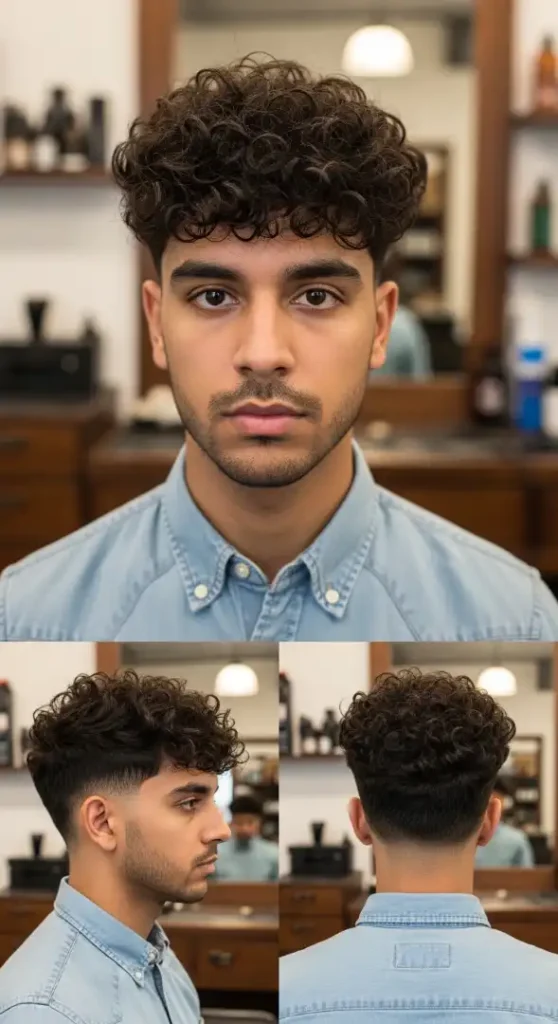
The Wild Curl Taper is the style for the man who has spent years trying to tame his curls into submission and has finally chosen freedom. The operative principle here is selective control: the taper at the base of the sides creates a clean frame without suppressing the volume above, and the result reads as intentional rather than unkempt. It’s the hairstyle equivalent of a tailored jacket worn over a band t-shirt.
FACE SHAPE MATCH The Wild Curl Taper is ideally suited for Oblong and Heart face shapes. An Oblong face — longer than it is wide — needs horizontal visual mass, and a wild, wide curl crown delivers exactly that. The taper keeps the bottom of the style clean, so the width expansion happens exclusively at the top and mid-section of the head — right where Oblong faces need it most. Heart-shaped faces with prominent foreheads are complemented by the abundant top volume that matches the natural width of the forehead, and the taper creates a slimmer neck-and-nape frame that suits the Heart face’s narrowing lower structure. Less suited for Round faces — the lateral explosion of the wild curl adds width to the widest point of the face.
GROOMING KIT
- Clippers: Andis Pro AllIn One for the taper foundation
- Scissors: Joewell Kamisori 5.5″ for dry perimeter shaping — wild curls should be shaped dry by the barber to see their natural fall
- Product: Miss Jessie’s Pillow Soft Curls (for South Asian mixed-wavy/curly textures) for defined-but-not-stiff curl clumps; Garnier Fructis Curl Treat Leave-In Jelly as a second application layer for extra hold at the roots
- Scalp: Nizoral Dandruff Shampoo 1× weekly — high-density, thick curly hair is more prone to scalp buildup and dandruff from product accumulation
- Finishing: Devacurl Light Defining Gel misted onto dry hair for afternoon frizz control without re-wetting
Maintenance Level: Low to Medium
- Salon/barber visit: Every 6–8 weeks — the taper needs refreshing but the wild top grows beautifully and doesn’t require precise shaping between visits
- Daily styling time: 10–15 minutes on wash days; 3–5 minutes on non-wash days (mist and go)
- Critical rule: Resist the urge to brush or comb the wild top when dry — it will frizz. Use fingers only for dry adjustment.
Barber Talk Script “I want to keep my curl volume — this style is supposed to look wild and natural on top, so don’t cut too much off the top. Just shape the perimeter of the curls so it doesn’t look ragged — dry cut please, so you can see where the curls naturally fall. I want a low taper at the base of the sides — not a fade, just a taper. #2 at the bottom graduating naturally to #3 and then into my full curls. Nape rounded, natural arc. Sideburns natural, just clean up any strays. Medium stubble just needs a shape — cheek line natural, no hard cut, just tidy. I want everything to look intentional but natural.”
FAQs
Q: How do I style thick curly hair without making it look unkempt? A: The difference between wild-and-intentional versus wild-and-unkempt is the perimeter. Have a barber dry-cut the perimeter of your curls every 6–8 weeks — this shapes the outer boundary of the volume without reducing the curl mass. Apply a curl product to wet or damp hair consistently, and the inner definition of the curls will do the rest. Clean edges and moisturized curls are the only two requirements.
Q: What is a taper vs a fade for curly hair? A: A taper gradually reduces hair length from the full curl density above to shorter lengths at the sides and nape — but stops before reaching skin level. A fade goes all the way to skin (or near skin level with a #0.5 guard) for a sharper, more dramatic contrast. A taper is subtler and more natural-looking; a fade is more precise and requires more frequent maintenance. For wild, natural curl styles, a taper usually reads more authentically than a skin fade.
Q: Does curly hair look good with a taper? A: Yes — a taper is arguably the most natural-looking base for curly hair because it follows the hair’s natural growth pattern and provides a clean frame without the hard contrast of a skin fade. It works especially well for wild, high-volume curl styles because it prevents the look from appearing completely unstyled while preserving the full curl expression at the top.
Q: How do I prevent frizz with thick wild curly hair? A: Frizz in thick curly hair is caused by two things: lack of moisture and mechanical disruption. Keep the hair well-hydrated with daily curl cream or leave-in conditioner. Never brush or comb dry curly hair — use fingers only. When drying, either air dry without touching or diffuse on low heat. Sleeping on a satin pillowcase prevents significant nighttime friction frizz.
12 of 12 — The Coily Volume Surge
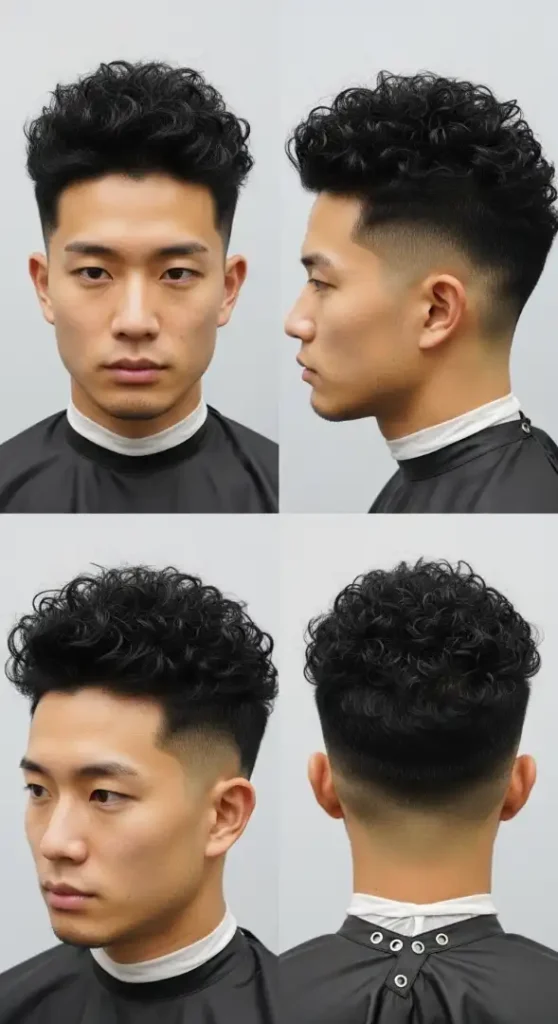
The Coily Volume Surge is the article’s definitive closing statement. It is the most volume-maximized, texture-forward, unapologetically bold style in this guide — a full coily crown on a clean-shaven face, the minimalist body and face providing complete deference to the extraordinary natural texture above. It is also a reminder that coily hair is not a hair type with limitations — it is a hair type with infinite potential that most men never fully explore.
FACE SHAPE MATCH The Coily Volume Surge is uniquely well-suited for Heart and Diamond face shapes. A Heart face’s wider forehead and pointed chin create an inherent imbalance — but a broad coily volume crown sits directly at and above the widest part of the face, extending that width skyward and creating a commanding top-heavy silhouette that reads as powerful rather than disproportionate. A Diamond face gains coil volume at the crown that fills in the narrower forehead, and the clean skin base accentuates the prominent cheekbones. For Oval faces, the volume is universally manageable. For Round faces, this style requires careful consideration — the lateral coil spread adds significant horizontal mass and should be modified with a high fade to redirect perceived width upward rather than outward.
GROOMING KIT
- Clippers: Andis Master Cordless MLC — the skin fade requires the tightest blade available
- Outliner: BaByliss Pro FX787 for the nape squared base and hairline precision
- Coil Care: Mielle Organics Rosemary Mint Strengthening Leave-In Conditioner (applied in sections on wet hair) — exceptional for coil definition and scalp health; Eco Styler Krystal Styling Gel for maximum coil hold
- Detangling: Denman D3 on soaking wet conditioned hair — essential for defining individual coil units
- Deep Conditioning: Olaplex No.8 Bond Intense Moisture Mask 1× weekly — even healthy coily hair benefits from Olaplex’s bond-building moisture
- Scalp: Tea tree scalp oil (1–2 drops at the nape and hairline) to prevent buildup-related irritation from the skin fade area
Maintenance Level: High
- Salon/barber visit: Every 2–3 weeks — the skin fade base and nape hairline are the critical maintenance zones
- Daily styling time: 15–20 minutes on wash days; 5 minutes on dry days
- Wash day routine (3× weekly): Co-wash → Mielle Leave-In → Eco Styler Gel → Denman definition → diffuse; daily refresh: water mist + small amount of leave-in, scrunch, air dry
Barber Talk Script “I want maximum coil volume on top — don’t cut the length unless the ends are noticeably damaged. Measure compressed, not stretched. At the base of the sides I want a skin fade — bald at the very bottom, fading upward through #0.5, #1, and blending into my full coil volume above over about 2 inches. Clean squared nape line, skin tight at the very base. Temple-to-temple hairline clean and crisp — I want the hairline defined but natural in shape, not artificially straight. Clean-shaven face — no beard, no stubble. Everything below the coils should be minimal so the hair is the full statement.”
FAQs
Q: How do I maximize volume in coily hair for men? A: Volume in coily hair comes from three sources: hydration, definition, and diffusing technique. Always start on soaking wet hair — dry application kills volume. Apply leave-in conditioner section by section, then add a gel or curl cream. Use a Denman brush to define coil clumps, then diffuse upside down on low heat, holding the diffuser cup still beneath sections. The upside-down position uses gravity to lift the roots, which is where volume originates.
Q: Can East Asian men have coily or curly hair naturally? A: Yes, though it’s less common. Naturally coily or tightly textured hair in East Asian heritage occurs through genetic variation and is not an indicator of mixed heritage. East Asian curl patterns, when they occur, range from loose waves to tight coils. Men with this texture should use products formulated for coily hair types (leave-in conditioners, curl gels, co-wash cleansers) rather than products designed for straight East Asian hair, which typically contain heavy silicones incompatible with coily textures.
Q: What is the best haircut for men with very coily hair? A: A skin fade paired with a natural coil crown — as in The Coily Volume Surge — is the most architecturally effective haircut for very coily hair. The skin fade base creates a defined frame, removes the visual clutter at the sides, and allows the full coil density at the top to be the complete statement. Alternative options include the Defined Coil Fade (Style 8) or the Afro Architect (Style 2) depending on desired shape.
Q: How do I keep a skin fade looking clean in coily hair? A: Book your barber every 1.5–2 weeks for a lineup and base touch-up. Between visits, use a precision trimmer (like the BaByliss Pro FX787) along the existing skin fade base to slow the visual grow-out. Keeping the nape hairline clean with the trimmer at home — following the existing squared or rounded line exactly — extends the fresh-cut appearance by several days.