11 Asian Men Hair Styles to Try This Summer
1 of 11 — The Seoul Shadow Textured Crop
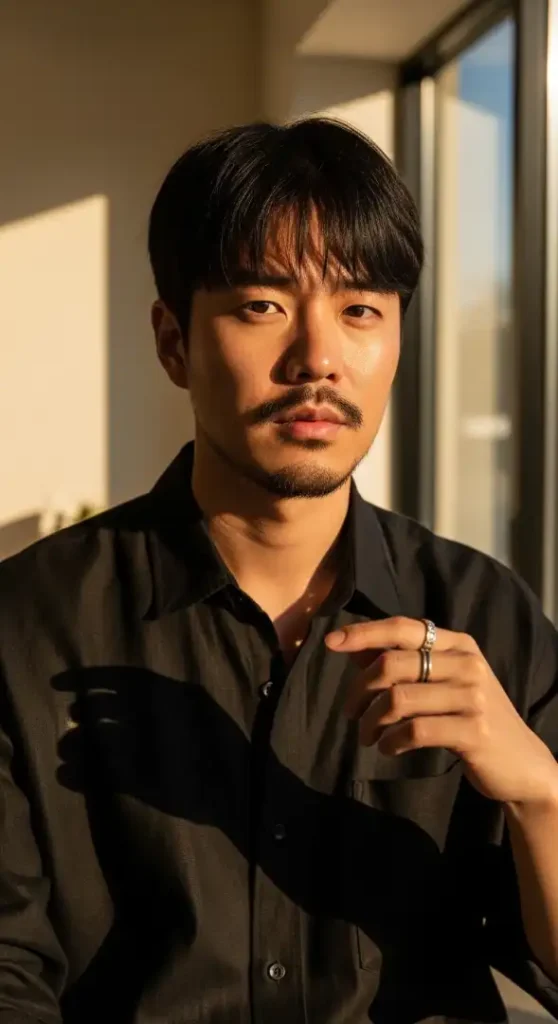
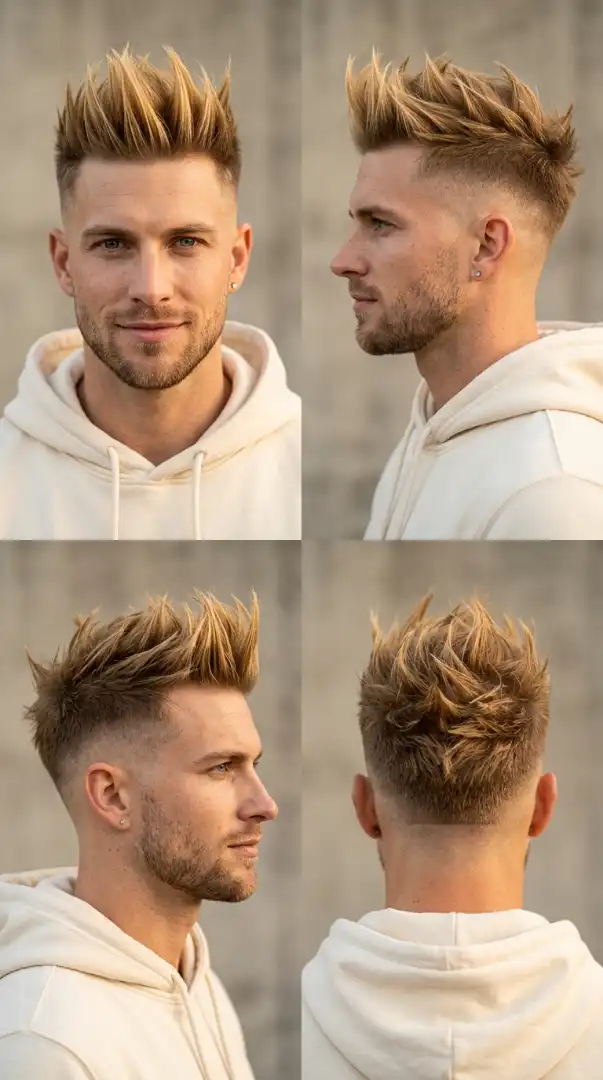
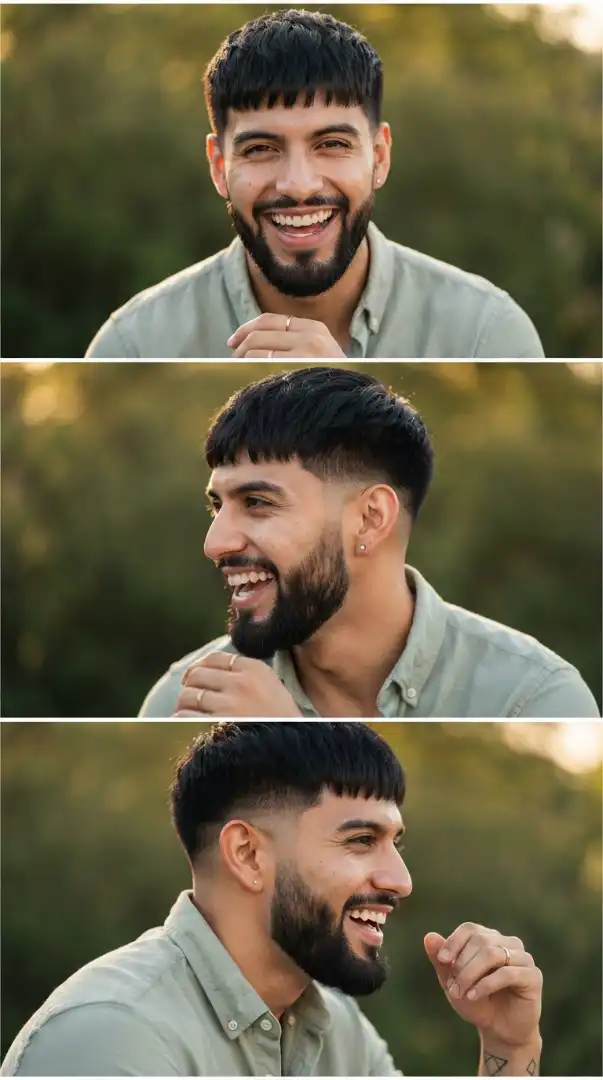
The Seoul Shadow Textured Crop is the ultimate low-maintenance cut for Asian men seeking a refined yet effortless summer style. This cut works exceptional magic on oval and diamond face shapes because the choppy textured fringe adds horizontal width across the forehead, balancing the natural angularity of these face types. The side taper removes bulk without creating harsh lines, drawing attention upward to the textured crown where the real personality lives.
GROOMING KIT — THE EXACT ARSENAL:
- Clippers: Wahl Magic Clip with #2 guard (6mm) for the sides
- Trimmer: Andis T-Outliner for clean temple lines and sideburn detailing
- Finishing Tools: Kent 81T fine-tooth comb for precision parting, Denman D3 brush for texture distribution
- Styling Product: Layrite Natural Matte Cream (dime-sized amount), American Crew Fiber for piecey definition on humid days
- Maintenance: Uppercut Deluxe Sea Salt Spray for added volume and texture
MAINTENANCE LEVEL: Medium. Expect salon visits every 3-4 weeks to maintain the textured layers and keep the side taper crisp. Daily styling takes approximately 4-6 minutes: towel-dry hair to 80%, work product through from roots to tips using fingers (never a brush at this stage), then use the fine-tooth comb to create separation in the fringe. The beauty of this cut is that it actually looks better with a little natural movement — overthinking it kills the vibe.
BARBER TALK — YOUR EXACT SCRIPT: “I want a textured crop with choppy layers on top, about 2-3 inches in length at the crown. Taper the sides with a #2 guard, blending up to the top with scissors. Keep the fringe falling naturally across my forehead — no heavy bangs, just textured pieces. Clean up the temples and neckline, but keep it soft, not blocky. For the beard, just clean up the edges and keep it at a light stubble length with a #1 guard.”
This style pairs perfectly with the modern Asian aesthetic that balances heritage with contemporary edge — if you’re looking for something bolder, the next cut takes the fade to another level entirely.
FAQs
Q: How do I maintain the Seoul Shadow Textured Crop at home between salon visits?
A: Use a fine-tooth comb daily to redistribute the texture and prevent the fringe from clumping together, apply a dime-sized amount of matte cream to damp (not wet) hair, and get a quality trimmer to clean up your neckline every 10-14 days. The key is keeping the sides tight while letting the top grow naturally — don’t over-trim the textured layers yourself or you’ll lose the choppy effect that makes this cut work.
Q: Which face shape suits the Seoul Shadow Textured Crop best?
A: Oval and diamond face shapes benefit most because the horizontal fringe adds width across the forehead, creating balance with naturally angular features. Round faces can wear this cut too, but ask your barber to keep more height at the crown and less density in the fringe to avoid adding unwanted width.
Q: What’s the difference between a textured crop and a regular short cut?
A: A textured crop uses point-cutting and razor techniques to create deliberate choppy, uneven layers that move independently, while a regular short cut typically features uniform length with blunt edges. The textured crop requires significantly more skill to execute properly — it’s a precision cut disguised as casual styling, which is why it costs more at high-end barbershops.
Q: What products do I need for the Seoul Shadow Textured Crop?
A: Start with Layrite Natural Matte Cream as your foundation (works in humid climates without getting greasy), add American Crew Fiber for extra definition on days you need more hold, and keep Uppercut Sea Salt Spray on hand for volume when your hair feels flat. Avoid heavy pomades or gels — they’ll kill the natural texture and make the cut look dated.
2 of 11 — The Tokyo Skin Fade Executive
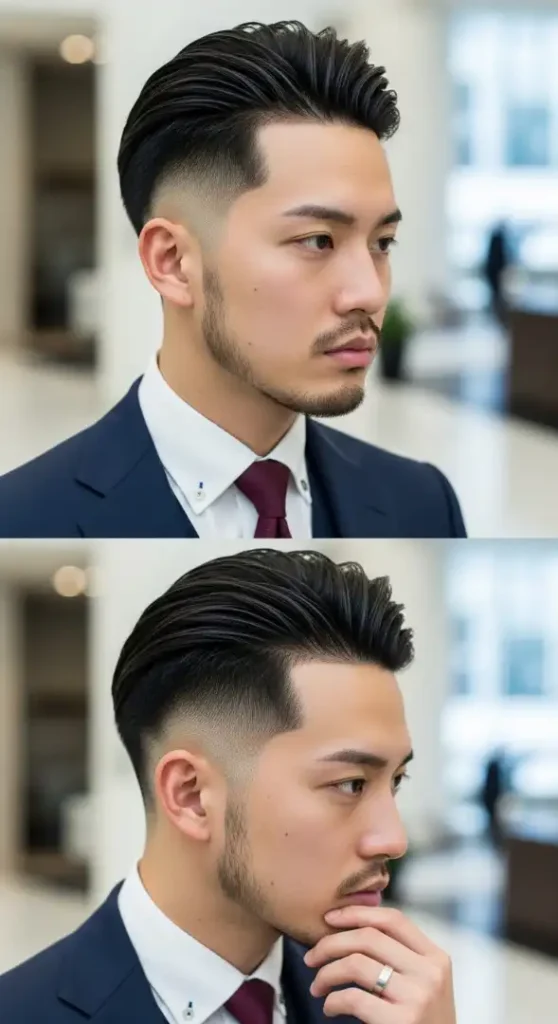
The Tokyo Skin Fade Executive is the power move for Asian professionals who need to project authority without sacrificing modern edge. This cut is specifically engineered for square and oblong face shapes because the high skin fade removes visual weight from the sides, creating vertical emphasis that elongates the face while the slicked-back top adds controlled volume without bulk. The sharp angular hairline and precise side part create geometric definition that photographs exceptionally well in professional settings — think LinkedIn profile photos, conference presentations, and client meetings where first impressions convert to closed deals.
GROOMING KIT — THE EXACT ARSENAL:
- Clippers: Andis Master Cordless with adjustable blade (essential for skin fade precision)
- Trimmer: BaByliss Pro FX787 FoilFX for final skin-level detail work at the fade line
- Detailing: Wahl Detailer for surgical-precision temple lines and hairline edging
- Styling Products: Baxter of California Clay Pomade (high shine, firm hold), Uppercut Deluxe Featherweight (for pre-styling volume), O’Douds Traditional Pomade for all-day hold in humid climates
- Maintenance Tools: Boar bristle brush (Kent BRD4) for distribution and shine, wide-tooth acetate comb for initial slick-back
MAINTENANCE LEVEL: High. This is not a wash-and-go situation. Salon visits required every 2 weeks maximum — skin fades grow out noticeably fast, and the sharp lines that make this cut executive-ready turn sloppy quickly. Daily styling routine: 8-12 minutes including shower. Apply pomade to damp hair, use boar bristle brush to slick back while blow-drying on medium heat, finish with a light mist of holding spray. Budget 90-120 minutes monthly for professional maintenance and $45-75 per cut at a quality barbershop that understands Asian hair texture.
BARBER TALK — YOUR EXACT SCRIPT: “High skin fade on the sides and back, starting the fade at temple level. Blend from skin to a #0.5, then to #1, creating three visible gradient levels — I want to see the transition, not a blocky wall. Top should be 3.5 to 4 inches, scissor-cut with slight layering for movement. Create a hard part on my left side about 2 inches from center. Keep the hairline sharp and angular at the temples — boxy, not rounded. Clean-shave the back of my neck, and edge up the sideburn area with the foil trimmer for maximum crispness.”
This cut demands confidence and commitment — if you’re searching for something equally sharp but more forgiving on the maintenance schedule, the next style delivers boardroom credibility with half the upkeep.
FAQs
Q: How do I maintain a high skin fade at home between barber visits?
A: Invest in a quality foil shaver like the BaByliss FoilFX and touch up the lowest part of your fade (the actual skin section) every 4-5 days — just the bottom inch where stubble shows first. Use a handheld mirror to check the back of your neck and keep those lines crisp. However, the gradient blending zones require professional clippers and an experienced hand, so don’t attempt to re-create the full fade yourself or you’ll end up with patches.
Q: Which face shape suits The Tokyo Skin Fade Executive best?
A: Square and oblong face shapes gain the most benefit because the high fade removes side bulk, creating vertical lines that elongate and slim the face while the slicked top adds controlled height without making the face appear longer. Round faces should avoid this cut — the lack of side volume will emphasize facial roundness rather than balance it.
Q: What’s the difference between a skin fade and a bald fade?
A: They’re the same cut with different regional terminology — “skin fade” is more common in Asia and Europe, while “bald fade” is American barber shop language. Both refer to a fade that goes down to bare skin (no guard, 0mm) at the lowest point, creating maximum contrast with the longer hair on top.
Q: How often should I get The Tokyo Skin Fade Executive touched up?
A: Every 2 weeks without exception if you’re maintaining the sharp executive aesthetic this cut is designed for. You can stretch to 3 weeks if you have slower hair growth and are willing to accept slightly softer lines, but beyond that, the fade loses its gradient definition and the hard part grows out, destroying the precision that makes this cut boardroom-worthy.
3 of 11 — The Shanghai Flow Undercut
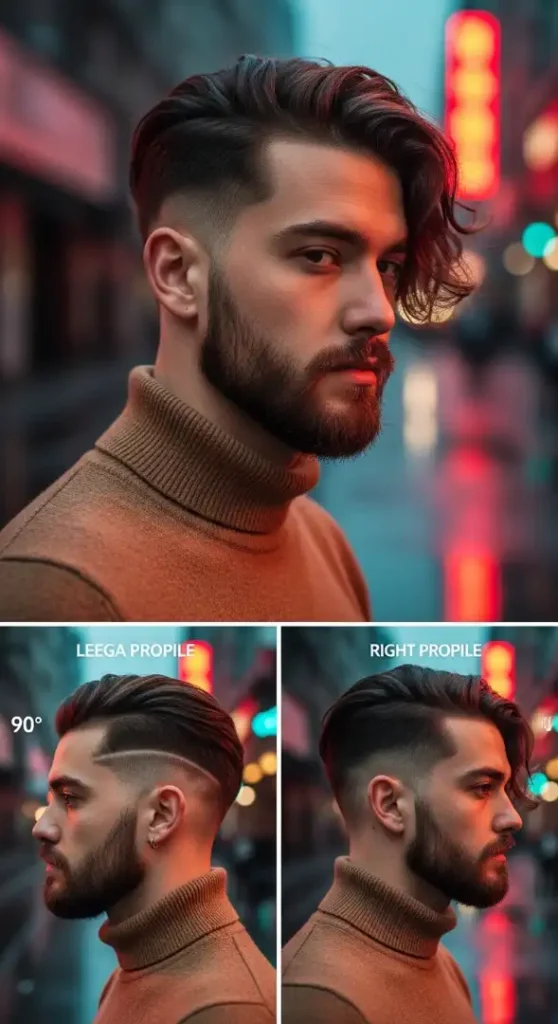
The Shanghai Flow Undercut is the rebellious answer for Asian men tired of conservative corporate cuts. This style works brilliantly on heart and oval face shapes because the voluminous flowing top adds width at the crown and temples, balancing a narrower chin (heart shape) or complementing the natural symmetry of an oval face. The disconnected undercut creates dramatic contrast — there’s no gradient, no blending, just a hard line between the #1 guard sides and the 5-6 inch flowing top. This isn’t a style that whispers; it makes a statement in creative industries, tech startups, and anywhere individuality trumps conformity.
GROOMING KIT — THE EXACT ARSENAL:
- Clippers: Oster Fast Feed with #1 guard (3mm) for uniform side length
- Trimmer: Wahl Detailer for the hard disconnect line — precision is everything here
- Styling Tools: Dyson Airwrap or quality blow dryer with concentrator nozzle for directing flow, wide-tooth comb for wet detangling without breaking wave pattern
- Products: Hanz de Fuko Claymation (for textured matte flow), Kevin Murphy Anti-Gravity spray (pre-styling volume booster for fine Asian hair), Bumble and bumble Surf Spray (enhances natural wave without crunch)
- Beard: Honest Amish Beard Oil (keeps the medium-length beard soft and defined), Kent beard comb for daily grooming
MAINTENANCE LEVEL: Medium-High. Salon visits every 3 weeks to maintain the sharp disconnect line and prevent the undercut from growing out into an awkward mid-length phase. Daily styling: 10-15 minutes. The flow requires blow-drying with intention — you’re sculpting volume and direction, not just drying hair. Apply Anti-Gravity spray to damp hair, blow dry while lifting at the roots and directing flow to your preferred side, then work in a small amount of Claymation for texture and hold. The beard adds another 3-5 minutes daily for oil application and combing to prevent the dreaded “neck beard” look.
BARBER TALK — YOUR EXACT SCRIPT: “I want a disconnected undercut — hard line, no fade, no blending. Buzz the sides and back with a #1 guard, keep it uniform all the way up to where the top starts. Leave the top long, about 5 to 6 inches, and layer it slightly so I get natural movement and flow — I’m going to sweep it to the side, so cut it with that direction in mind. The disconnect line should be sharp and visible; I want people to see the contrast. For the beard, trim it to about 10mm length using a #3 guard, shape the cheek line, and create a defined jaw border. Keep the mustache slightly shorter than the beard so it doesn’t overtake my upper lip.”
This cut requires confidence and a willingness to stand out — if that sounds like your energy but you want something that works in more traditional settings, the next style bridges creative and corporate seamlessly.
FAQs
Q: How do I maintain The Shanghai Flow Undercut at home between barber visits?
A: Buy quality clippers like the Oster Fast Feed and touch up your sides every 10-12 days using the #1 guard — buzz straight up the sides, stopping at the disconnect line (don’t touch the top). The hard line will soften slightly as it grows out, but keeping the sides tight prevents the awkward “growing out” phase. Never attempt to trim the top yourself unless you’re experienced with scissors — flow cuts require understanding hair’s natural fall pattern.
Q: Which face shape suits The Shanghai Flow Undercut best?
A: Heart and oval face shapes benefit most — the voluminous top balances a narrower chin (heart) or complements natural symmetry (oval). Square faces can wear this cut but should ask for extra length on top (6+ inches) to soften the jawline. Round faces should generally avoid this style as the side volume removal emphasizes facial width.
Q: What’s the difference between a disconnected undercut and a regular undercut fade?
A: A disconnected undercut has a visible hard line where the short sides meet the long top — zero blending, creating stark contrast. A regular undercut fade gradually transitions from skin or short length up to the longer top hair, creating a smooth gradient. Disconnected cuts are bolder and more fashion-forward; fades are more versatile and traditional.
Q: What products do I need for The Shanghai Flow Undercut?
A: Start with Kevin Murphy Anti-Gravity spray on damp hair for volume, blow dry while directing the flow, then apply Hanz de Fuko Claymation (dime-sized amount) for textured hold that lasts all day. On days you want more natural wave definition, add Bumble and bumble Surf Spray before the clay. For the beard, use Honest Amish Beard Oil daily to keep it soft and prevent the wiry texture that makes Asian facial hair look unkempt.
4 of 11 — The Manila Classic Pompadour
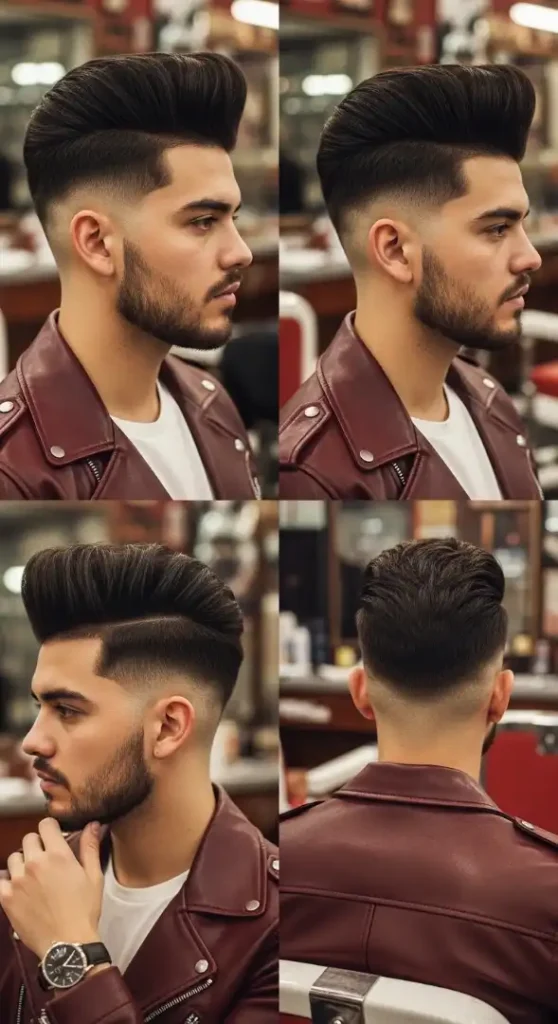
The Manila Classic Pompadour is proof that some styles transcend trends and become timeless. This cut is masterfully designed for oval and oblong face shapes because the dramatic vertical height at the front adds visual length to the face, while the mid-fade sides remove bulk without creating harsh angles — the result is a balanced, masculine silhouette that photographs like a vintage Hollywood headshot. The pompadour requires Asian hair’s natural thickness and straightness to achieve that signature wall of height without collapse, making it uniquely suited to East Asian and Filipino hair textures that Western barbers often struggle to work with properly.
GROOMING KIT — THE EXACT ARSENAL:
- Clippers: Wahl Senior with #1, #2, and #3 guards for the mid-fade gradient
- Trimmer: Andis GTX for temple detail work and clean neckline definition
- Styling Tools: Round boar bristle brush (Mason Pearson B3) for creating lift and tension during blow-drying, fine-tooth comb (Kent 20T) for final shaping
- Products: Lockhart’s Heavy Hold Pomade (original water-based formula — the gold standard for pompadours), Murray’s Superior (petroleum-based for all-day hold in tropical humidity), Layrite Supershine for pre-styling, Got2b Glued Freeze Spray for locking the pomp in place
- Blow Dryer: Required — T3 Cura or equivalent with concentrator nozzle, you cannot achieve this height with air-drying
MAINTENANCE LEVEL: Very High. Salon appointments every 2 weeks without fail — the mid-fade grows out quickly and the pompadour proportions get distorted if the sides aren’t kept tight. Daily styling: 15-20 minutes, non-negotiable. This is not a roll-out-of-bed look. Morning routine: Apply Layrite Supershine to damp hair, blow dry while pulling hair up and back with the round brush creating tension and lift, apply Lockhart’s Heavy Hold while hair is still slightly warm from the dryer, use the fine-tooth comb to shape the front wall and create the signature swoop, finish with a light mist of Got2b Freeze Spray. Budget $60-90 per cut at barbershops that specialize in classic cuts — this style requires genuine skill and shouldn’t be trusted to chain salons.
BARBER TALK — YOUR EXACT SCRIPT: “Classic pompadour with a mid-fade on the sides. Start the fade just above my ears with a #1 guard, blend up through #2 and #3, creating a smooth gradient — I want three visible levels but soft transitions between them. The top needs to be 4 to 5 inches long at the front, tapering slightly shorter as it goes back toward the crown. Cut the top with scissors, adding very slight layering so it has some internal structure for hold. Taper the back to create a triangle shape that points down toward the nape. Clean up the neckline with a straight razor for a sharp horizontal line. I’m styling this straight back with high lift, so cut it with that intention — I need length at the front to create the height.”
This is the cut for men who appreciate classic masculinity and aren’t afraid of high-maintenance routines — if you want similar vintage vibes with modern ease, the next style updates the pompadour blueprint for 2026.
FAQs
Q: How do I maintain The Manila Classic Pompadour at home between barber visits?
A: Keep a quality trimmer (Andis GTX recommended) and clean up your neckline every 5-7 days using a handheld mirror — just the bottom horizontal line, don’t touch the fade gradient. Use the #1 guard to touch up the very lowest section of your fade if stubble starts showing through, but stop there — attempting the full fade blend at home will create patches and lines that require professional correction.
Q: Which face shape suits The Manila Classic Pompadour best?
A: Oval and oblong face shapes are ideal because the vertical height elongates the face without making it appear too long, creating balanced proportions. Heart-shaped faces can work if you keep the pompadour height moderate (3-3.5 inches instead of 4+). Round and square faces should generally avoid tall pompadours — the added height emphasizes facial width rather than balancing it.
Q: What’s the difference between a pompadour and a quiff?
A: A pompadour is styled straight back from the forehead with all hair moving in one direction, creating a uniform wall of height. A quiff sweeps the front hair up and forward or to the side, creating more casual movement and texture. Pompadours are more formal and structured; quiffs are more relaxed and versatile. Both require similar length and blow-drying techniques.
Q: What products do I need for The Manila Classic Pompadour?
A: Start with Layrite Supershine cream on damp hair, blow dry with a round boar bristle brush to create lift and shape, then apply Lockhart’s Heavy Hold pomade while hair is still slightly warm (it distributes better). For high-humidity climates or all-day events, layer Murray’s Superior on top for petroleum-based lock-down hold. Finish with Got2b Glued Freeze Spray. This is a 3-4 product minimum stack — shortcuts produce disappointing results.
5 of 11 — The Bangkok Street Buzzcut
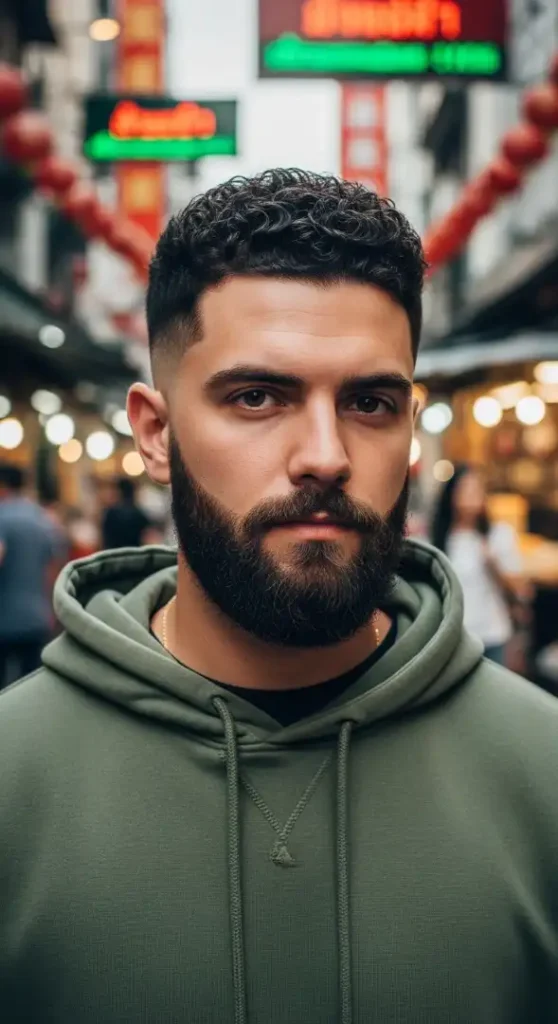
The Bangkok Street Buzzcut is the ultimate freedom cut for Asian men who value zero-maintenance functionality over elaborate styling. This cut works universally across all face shapes because the uniform #2 guard length (6mm) creates balanced proportions without adding or removing visual weight from any specific zone — it’s the rare cut that’s truly face-shape agnostic. The full beard becomes the primary focal point and shape-modifier: grown thicker along the jawline, it adds angular definition to round faces; kept shorter and closer, it softens square faces. This is the move for men in hot, humid climates (Southeast Asia, South Asia, tropical regions) where elaborate hairstyles collapse within an hour of stepping outside.
GROOMING KIT — THE EXACT ARSENAL:
- Clippers: Wahl Elite Pro with #2 (6mm) guard — this is a one-guard operation, incredibly simple
- Trimmer: Philips OneBlade for beard shaping and neckline cleanup (best for daily maintenance without irritation)
- Beard Tools: Wooden beard comb for detangling, beard scissors for mustache trim
- Products: Honestly Amish Beard Balm for shaping and softness, Jojoba oil or Argan oil for daily moisture (prevents the wiry Asian beard texture), Nivea Men Post-Shave Balm for neck cleanup irritation
- Optional: Electric rotary shaver (Philips Norelco 9000) for maintaining clean cheek lines without daily razor burn
MAINTENANCE LEVEL: Extremely Low. This is the lowest-maintenance cut in this entire article. Salon/barber visits: every 4-6 weeks if you want a professional to handle it, or never if you own clippers and are willing to spend 8 minutes buzzing your own head once a month. Daily styling time: zero minutes for hair, 3-5 minutes for beard oil application and combing. No products, no blow dryer, no brushes, no pomade. Shower, towel dry, apply beard oil, done. Budget $15-25 per cut if you outsource it, $0 if you DIY with the Wahl Elite Pro.
BARBER TALK — YOUR EXACT SCRIPT: “Buzzcut with a #2 guard all over — uniform length everywhere, no fade, no taper, no variations. Keep the hairline natural and rounded; I don’t want sharp temple corners or boxy edges. For the beard, shape the cheek line to follow my natural cheekbone (or slightly lower if my cheeks grow patchy), create a defined jaw border that follows my jawline angle, and trim the length to about 12-15mm using a #4 or #5 guard. Keep the mustache slightly shorter than the rest of the beard — I don’t want it hanging over my lip. Clean up the neck area below the jaw border with a trimmer or razor.”
This cut is perfect for active lifestyles, gym-focused routines, or anyone who travels frequently without access to styling products — if simplicity is your goal but you still want visual interest, the next style adds texture without complexity.
FAQs
Q: How do I maintain The Bangkok Street Buzzcut at home?
A: Buy the Wahl Elite Pro clippers with a #2 guard, stand in front of a mirror in your bathroom, and buzz your entire head once every 3-4 weeks. Start at the front hairline and move the clippers straight back over your head, then do side passes, then the back (use a handheld mirror for the back or ask a partner to help the first few times). It takes 8-10 minutes total. For the beard, use the Philips OneBlade every 3-5 days to maintain your cheek line and jaw border.
Q: Which face shape suits The Bangkok Street Buzzcut best?
A: All face shapes can wear this cut because the uniform short length is neutral — it doesn’t emphasize or de-emphasize any facial features. Your beard shape becomes the primary tool for face-shaping: grow it thicker along the jawline to add definition to round or oval faces, keep it closer and more groomed to soften square or angular faces. The buzzcut itself is just a clean canvas.
Q: What’s the difference between a #1, #2, and #3 buzzcut?
A: Guard numbers correspond to length in millimeters: #1 = 3mm (very close, scalp slightly visible, especially on darker hair), #2 = 6mm (short but not military-close, natural hair color fully visible), #3 = 9mm (noticeably more length, less “buzzcut” aesthetic). #2 is the sweet spot for most Asian men — short enough to be low-maintenance but long enough to show your natural hair texture and color.
Q: What products do I need for The Bangkok Street Buzzcut?
A: For the haircut itself: zero products. Your hair is 6mm long — it doesn’t need styling, hold, or shine. For the beard: Honestly Amish Beard Balm daily to keep it soft and shaped, plus jojoba oil or argan oil if you have dry skin or live in a low-humidity climate. That’s the entire kit — two products max, and both are for the beard.
6 of 11 — The Singapore Business Taper
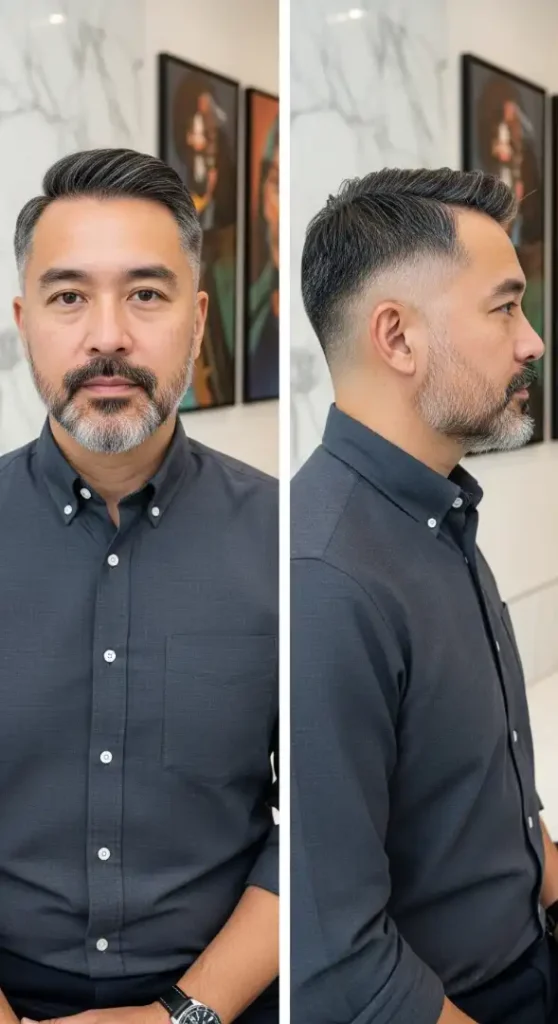
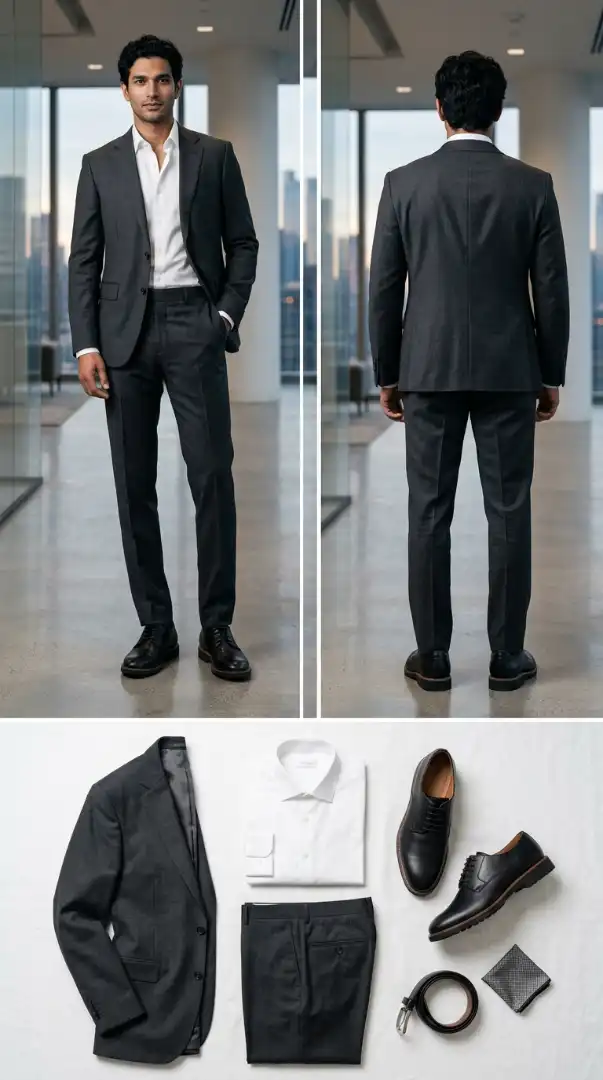
The Singapore Business Taper is the intelligent choice for Asian professionals in conservative industries — finance, law, consulting, corporate executive roles — where personal branding matters but visible experimentation is career-limiting. This cut is precision-engineered for oval, oblong, and square face shapes because the low taper and conservative side part create clean vertical lines that elongate the face (oval/oblong) or add structure without excessive width removal (square). The salt-and-pepper coloring isn’t a flaw to hide — it’s a power move that signals experience, wisdom, and seasoned authority. Younger professionals can request this cut in solid dark tones, but men 35+ should embrace the gray rather than dyeing it out.
GROOMING KIT — THE EXACT ARSENAL:
- Clippers: Oster Model 10 with #2, #3, and #4 guards for the subtle taper gradient
- Trimmer: Wahl Peanut for temple cleanup and beard edge-work
- Styling Tools: Kent 20T fine-tooth comb (tortoiseshell, professional appearance), boar bristle brush for volume and distribution
- Products: Baxter of California Hard Cream Pomade (matte finish, firm hold for all-day board meetings), American Crew Grooming Cream (lighter alternative for casual Fridays), Kiehl’s Nourishing Beard Grooming Oil for the boxed beard
- Finishing: Alterna Caviar Anti-Aging Professional Styling Sea Salt Spray for thinning hair (adds texture and body without looking overdone)
MAINTENANCE LEVEL: Medium. Barber visits every 3 weeks to maintain the taper gradient and keep the part line crisp — this cut looks sloppy if the taper grows out unevenly or the part loses definition. Daily styling: 5-7 minutes. Apply pomade to damp hair, use the boar bristle brush to create the side part and comb hair in the intended direction while blow-drying on low heat, finish with the fine-tooth comb for precision. The beard adds 2-3 minutes for oil application and shaping with the beard comb. Total morning routine: under 10 minutes, perfectly aligned with a busy professional schedule.
BARBER TALK — YOUR EXACT SCRIPT: “Conservative business taper — I need this to look appropriate in a boardroom. Low taper on the sides starting below the temple, use #2, #3, and #4 guards to create a subtle graduated blend — nothing dramatic, very smooth transitions. The top should be 2.5 to 3 inches, scissor-cut with slight layering for natural movement. Create a side part on my left about 2 inches from center — I’ll be combing it to the right. Keep the hairline natural and clean; no hard angles or boxy edges. For the beard, maintain the boxed shape following my natural jaw border, trim to about 6-8mm using a #2 or #3 guard, keep the cheek line medium-high and symmetrical, mustache slightly shorter than the beard. Clean edges, conservative finish.”
This cut is the corporate uniform for ambitious Asian professionals — if you’ve climbed high enough that image consulting firms are in your budget, this is what they’ll recommend.
FAQs
Q: How do I maintain The Singapore Business Taper at home between barber visits?
A: Use a quality beard trimmer like the Wahl Peanut to maintain your beard edges every 4-5 days — just the cheek line and neck border, don’t touch the length. For the haircut, the biggest at-home win is keeping the part line visible: use your fine-tooth comb every morning to re-establish the part exactly where your barber created it. Don’t attempt to touch up the taper yourself — uneven fades on a conservative business cut are immediately noticeable and unprofessional.
Q: Which face shape suits The Singapore Business Taper best?
A: Oval, oblong, and square face shapes are ideal. The low taper and side part create vertical structure that elongates (beneficial for oval/oblong) without removing too much side volume (important for square faces that need some width to balance a strong jawline). Round faces should ask for a slightly higher taper to remove more side bulk and create elongating vertical lines.
Q: Should I embrace or hide gray hair in a professional setting?
A: Embrace it completely if you’re 35+ and in a senior or leadership role — gray hair signals experience, maturity, and authority that can actually enhance your professional credibility. Dyeing it out often looks unnatural (flat, uniform color that doesn’t exist in nature) and can backfire, making colleagues question your authenticity. If you’re under 35 and going gray prematurely, it’s a personal choice, but many young executives report that early gray actually helped them be taken more seriously in client meetings.
Q: What’s the difference between a taper and a fade?
A: A taper gradually reduces hair length as it goes down the sides and back, typically using longer guards (#2-#4) and creating a subtle, conservative gradient. A fade uses shorter guards (often starting at skin or #0.5) and creates more dramatic contrast between the top and sides. Tapers are professional and boardroom-appropriate; fades are more casual and fashion-forward. This cut is a taper, not a fade.
7 of 11 — The Hong Kong Ivy League
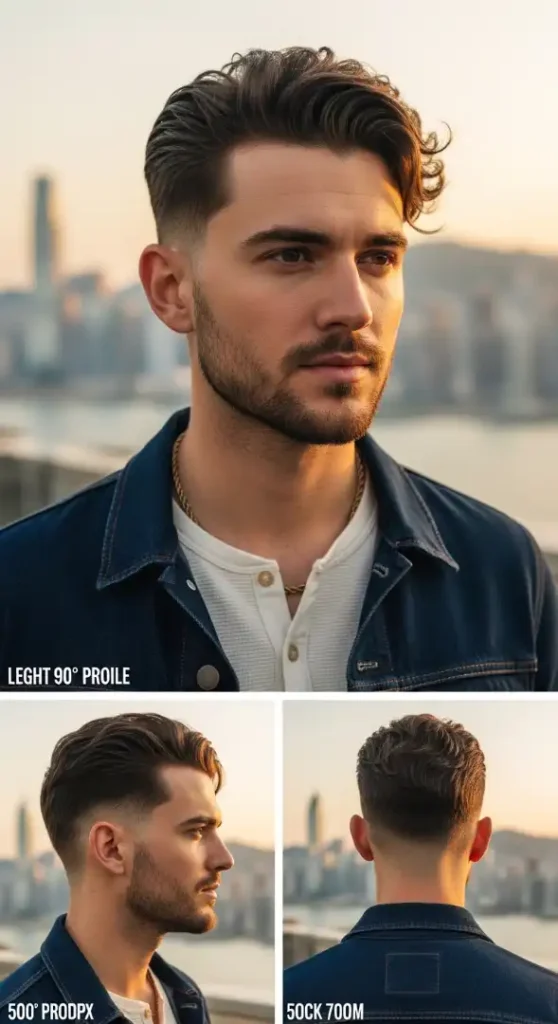
The Hong Kong Ivy League is the Swiss Army knife of Asian men’s haircuts — versatile enough for Monday morning client presentations and Friday night rooftop bars without a single styling adjustment between the two. This cut is brilliant for oval, heart, and round face shapes because the textured top adds horizontal width across the forehead (balancing heart-shaped faces with narrower chins), the short tapered sides remove bulk (slimming round faces), and the natural swept styling creates balanced proportions that flatter oval faces universally. The key differentiator from a standard crew cut is the length — 1.5 to 2 inches on top versus the crew cut’s ultra-short 0.5-1 inch, which gives you actual styling options instead of “it is what it is” acceptance.
GROOMING KIT — THE EXACT ARSENAL:
- Clippers: Wahl Magic Clip with #3 and #4 guards for the subtle taper
- Trimmer: Andis T-Outliner for beard detailing and temple cleanup
- Styling Tools: Vented brush for quick blow-drying with volume, fingers for final texture (no comb needed with this cut)
- Products: Hanz de Fuko Quicksand (dry texture paste — works on dry hair, no pre-styling needed), Kevin Murphy Easy Rider (anti-frizz defining cream for wavy Asian hair), Moroccan Oil Treatment (small amount on damp hair prevents frizz in humid Hong Kong summers)
- Beard: Honest Amish Beard Oil for keeping designer stubble soft and non-patchy
MAINTENANCE LEVEL: Low-Medium. Barber visits every 4-5 weeks — this cut’s beauty is that it actually looks better with 2-3 weeks of growth rather than fresh-cut sharp, giving it that lived-in versatility. Daily styling: 3-5 minutes maximum. Towel dry to about 70% moisture, apply a dime-sized amount of Hanz de Fuko Quicksand, run fingers through hair pushing it to your preferred side, done. No blow dryer required unless you want extra volume for a formal event. The designer stubble beard requires trimming every 4-5 days with a #1 or #2 guard to maintain the intentional scruff look without crossing into “forgot to shave” territory.
BARBER TALK — YOUR EXACT SCRIPT: “Ivy League cut with a short taper. Top should be about 1.5 to 2 inches, scissor-cut with point-cutting to add texture — I want natural movement, not a blunt uniform length. Taper the sides with #3 and #4 guards, creating a soft gradient from bottom to top — nothing dramatic, very smooth. Keep the front fringe just touching my forehead when it falls naturally. Blend the back in a gradual taper down to the nape; don’t block it or create a hard line. Temple area should be clean but not sharp-cornered — keep it natural. For the stubble, use a #1 or #2 guard all over my beard zone, shape the cheek line to follow my cheekbones, and define the neck border just above my Adam’s apple. Keep it looking intentional, not lazy.”
This is the thinking man’s haircut — low effort, high versatility, ages gracefully, and works whether you’re 22 or 42.
FAQs
Q: How do I maintain The Hong Kong Ivy League at home between barber visits?
A: The beauty of this cut is minimal home maintenance. For the beard, use your trimmer with a #1 or #2 guard every 4-5 days to keep the stubble at consistent designer length. For the haircut itself, the only home maintenance is optional: if your neckline starts looking shaggy after 3 weeks, use your trimmer (no guard) to clean up the bottom neck hairline — just the very bottom edge, don’t touch the taper gradient.
Q: Which face shape suits The Hong Kong Ivy League best?
A: Oval, heart, and round face shapes all benefit. The textured top adds width to balance heart-shaped faces, the short sides remove bulk to slim round faces, and the natural proportions flatter oval faces universally. Square and oblong faces can wear this cut too but should keep slightly more length on the sides (#4 guard minimum) to avoid over-emphasizing facial angles or length.
Q: What’s the difference between an Ivy League and a crew cut?
A: Length and versatility. An Ivy League has 1.5-2 inches on top with enough length to create a side part, swept style, or textured look — it’s finger-styleable and has personality. A crew cut is 0.5-1 inch on top, stands straight up, and offers zero styling options — it’s ultra-short, military-adjacent, and looks the same every day. Ivy League bridges short convenience with just enough length for individuality.
Q: What products do I need for The Hong Kong Ivy League?
A: Hanz de Fuko Quicksand is your one-product solution for daily styling — works on dry hair, creates texture without shine or weight, holds all day in humid climates. Add Kevin Murphy Easy Rider if you have wavy hair that tends to frizz, or Moroccan Oil Treatment (tiny amount on damp hair) if you live in high humidity. For the beard, Honest Amish Beard Oil keeps stubble soft. That’s it — 2-3 products maximum.
8 of 11 — The Seoul Side Part Gentleman
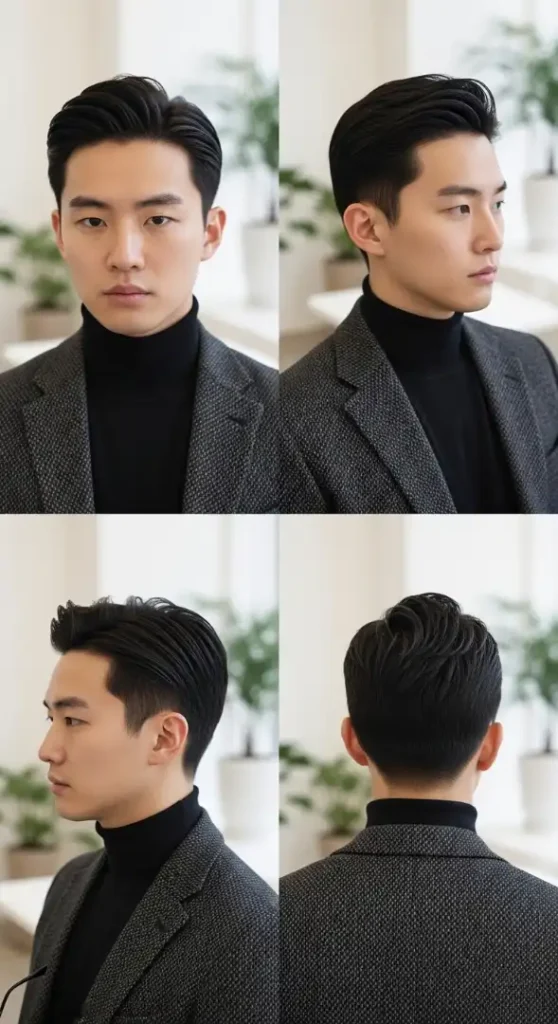
The Seoul Side Part Gentleman is refined masculinity distilled into a haircut — the choice for Asian men who value timeless elegance over trendy experimentation. This cut is architecturally designed for oval and diamond face shapes because the deep side part and swept volume create horizontal width across the forehead, balancing the natural narrow points at forehead and chin (diamond) or maintaining beautiful proportions (oval). The hard part line shaved into the scalp isn’t just aesthetic — it’s functional, creating a permanent guide that makes daily styling foolproof. This is the cut you see on successful Asian entrepreneurs, creative directors, and men who understand that personal branding is an investment, not an expense.
GROOMING KIT — THE EXACT ARSENAL:
- Clippers: Andis Master with #1.5, #2.5, and #3.5 guards for the precise fade gradient
- Trimmer: Wahl Detailer for the shaved hard part line (requires steady hand and skill)
- Styling Tools: Mason Pearson Pocket Comb (tortoiseshell), Kent boar bristle brush for shine distribution, blow dryer with concentrator nozzle
- Products: Uppercut Deluxe Pomade (water-based, high shine, re-styleable throughout the day), Suavecito Firme Hold (stronger hold for humid climates or all-day events), Layrite Supershine as a pre-styler for maximum gloss
- Finishing: L’Oréal Professionnel Tecni.Art Fix Design spray for locking the style without making hair crunchy
MAINTENANCE LEVEL: High. Barber visits every 2-3 weeks maximum — the medium fade grows out fast, and the hard part line requires professional re-shaving (don’t attempt this at home with clippers unless you want a crooked part that destroys the entire aesthetic). Daily styling: 10-15 minutes. Apply Layrite Supershine to damp hair, blow dry while using the boar bristle brush to sweep hair in the intended direction, apply Uppercut Pomade once hair is 90% dry, use the pocket comb to refine the part and create the swept shape, finish with a light mist of Fix Design spray. Budget $50-80 per cut at high-end barbershops — this level of precision doesn’t come from discount chains.
BARBER TALK — YOUR EXACT SCRIPT: “Classic side part with a hard part line and medium fade. Create a shaved hard part on my left side, about 3 inches from center — use the trimmer to shave a clean line about 2-3mm wide. The top should be 3 to 4 inches long, scissor-cut with slight layering for natural volume. Medium fade on the sides starting mid-temple: #1.5 at the bottom, blend through #2.5, finish at #3.5 where it meets the top — I want to see three distinct levels but smooth transitions between them. Taper the back in a rounded shape down to the nape, fading to skin at the neck hairline. Keep the hairline sharp and geometric at the temples. I’m styling this with high-shine pomade swept to the right from the hard part, so cut it with that direction and volume in mind.”
This cut requires commitment to the routine and budget for professional maintenance — but the payoff is walking into any room knowing your grooming game is unquestionably dialed in.
FAQs
Q: How do I maintain The Seoul Side Part Gentleman at home between barber visits?
A: Keep a beard trimmer (Wahl Detailer recommended) and touch up your neckline every 5-7 days — just the very bottom horizontal line where hair meets bare neck. For the hard part line, do NOT attempt to re-shave it yourself — the line needs to be perfectly straight and positioned, which requires professional tools and an outside perspective. Touch up the lowest section of your fade (the #1.5 zone) with clippers every 10 days if stubble starts showing through.
Q: Which face shape suits The Seoul Side Part Gentleman best?
A: Oval and diamond face shapes are ideal because the swept side part adds horizontal width at the forehead, creating balance. Heart-shaped faces can wear this cut if they keep moderate (not excessive) volume on top. Round and square faces should generally avoid this style — the side volume and hard part can emphasize facial width rather than creating elongating lines.
Q: What’s a hard part and why would I want one?
A: A hard part is a thin line (2-3mm wide) shaved into your scalp with a trimmer, creating a permanent visible guide for your side part. Benefits: makes daily styling foolproof (the part is always in the exact same place), creates sharp visual definition, and adds a refined detail that separates this cut from standard side parts. Downside: requires professional maintenance every 2-3 weeks as it grows out.
Q: What products do I need for The Seoul Side Part Gentleman?
A: Start with Layrite Supershine on damp hair for pre-styling slip and initial shine, blow dry while brushing into place, then apply Uppercut Deluxe Pomade (about a nickel-sized amount) for final hold and high-gloss finish. In humid climates or for 12+ hour hold, use Suavecito Firme Hold instead of Uppercut. Finish with L’Oréal Fix Design spray to lock everything in place. This is a 3-product minimum routine — shortcuts produce mediocre results.
9 of 11 — The Tokyo Street Fade Mullet
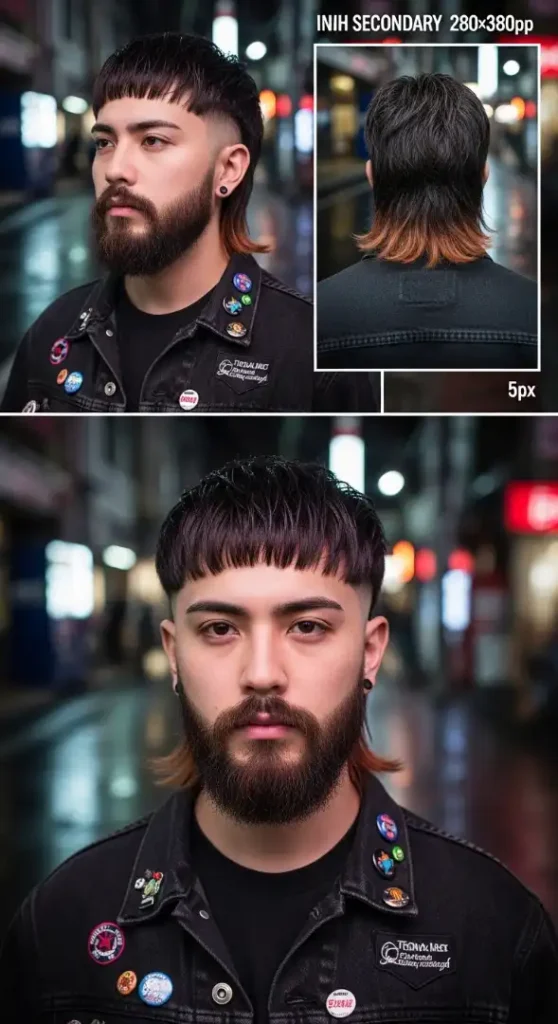
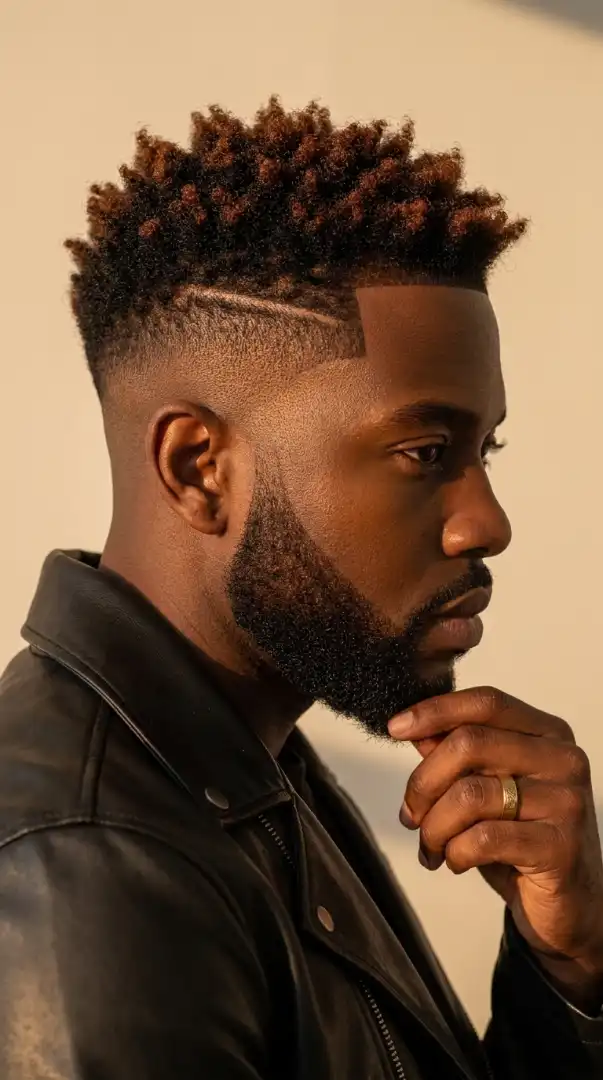
The Tokyo Street Fade Mullet is the comeback nobody expected and everybody’s talking about — the modern mullet has shed its 1980s trailer-park stigma and emerged as the haircut of choice for Asian creatives, streetwear enthusiasts, and men who refuse to blend into the background. This cut works exceptionally well on oval, heart, and oblong face shapes because the short textured front adds width at the forehead (balancing heart faces with narrower chins), the high skin fade removes side bulk (creating vertical lines that elongate oblong faces), and the flowing back section adds visual interest without disrupting facial proportions (perfect for neutral oval faces). The key is contrast — short front, shaved sides, long back — half measures produce a confused look that reads as “growing out a bad haircut” rather than intentional style.
GROOMING KIT — THE EXACT ARSENAL:
- Clippers: Andis Master Cordless for the high skin fade precision
- Trimmer: BaByliss Pro FoilFX for final skin-level detail at the fade line
- Styling Tools: Wide-tooth comb for detangling the longer back without breakage, texture scissors for maintaining the choppy fringe layers
- Products: Hanz de Fuko Claymation for the textured front (matte finish, strong hold), Uppercut Deluxe Sea Salt Spray for the flowing back section (adds movement and texture), Kevin Murphy Session Spray for all-day hold without stiffness
- Beard: Beardbrand Tree Ranger Beard Oil (keeps the fuller beard soft and conditioned)
- Color: If adding highlights like the model, use Wella Koleston Perfect in a warm auburn tone applied only to the tips — DIY not recommended, go to a colorist
MAINTENANCE LEVEL: Medium-High. Barber visits every 2-3 weeks for the skin fade (it grows out noticeably fast) and to maintain the mullet proportions — if the back gets too long or the front grows too much, the ratio breaks and it stops reading as a modern mullet. Daily styling: 8-12 minutes. Apply Sea Salt Spray to the back section while damp, scrunch and let air dry for natural texture. Apply Claymation to the front fringe using fingers to create piecey separation and texture. Use Session Spray to lock everything in place. The beard adds another 3-5 minutes for oil application and shaping.
BARBER TALK — YOUR EXACT SCRIPT: “Modern mullet with high skin fade. Shave the sides down to skin starting at temple level, creating a dramatic fade — I want maximum contrast between the shaved sides and the longer hair. Front fringe should be short and choppy, about 1.5 inches, point-cut for texture and movement. The top gradually gets longer as it moves back, ending at 4 to 5 inches at the nape — this creates the mullet flow. Don’t block the back or create a harsh line; let it fall naturally and taper the very ends slightly. The transition from short front to long back should be gradual, not a sudden shelf. For the beard, trim to about 12-15mm using a #4 guard, shape the cheek line, define the jaw border. Keep it full and intentional. If I’m adding color highlights, just the back tips in a warm auburn tone — nothing on the sides or front.”
This cut is a statement — wear it with confidence or don’t wear it at all.
FAQs
Q: How do I maintain The Tokyo Street Fade Mullet at home between barber visits?
A: Use a quality foil shaver like the BaByliss FoilFX to touch up the skin fade zones every 4-5 days — just the actual skin sections where stubble shows first. For the mullet length, trim your own fringe every 2-3 weeks using texture scissors (cut vertically into the hair, never horizontally) if you’re confident with scissors; otherwise leave it to your barber. The fade gradient requires professional tools and technique.
Q: Which face shape suits The Tokyo Street Fade Mullet best?
A: Oval, heart, and oblong face shapes benefit most. The short textured front adds forehead width (great for heart shapes), the high fade creates vertical elongation (perfect for oblong), and the overall proportions balance naturally with oval faces. Square and round faces should approach this cut cautiously — the lack of side volume can emphasize facial width.
Q: Is the modern mullet actually different from the 1980s version?
A: Completely different. 1980s mullets featured permed, feathered hair with soft, blended sides and an exaggerated length difference — they read as dated and often unintentional. Modern mullets have sharp contrast (skin fades, disconnected sides), textured rather than feathered styling, and more moderate length ratios (4-5 inches at back vs. 1.5 at front, not 10 inches vs. 2). Modern mullets are architectural and intentional; retro mullets were soft and accidental-looking.
Q: What products do I need for The Tokyo Street Fade Mullet?
A: Hanz de Fuko Claymation for the front fringe (matte texture, strong hold), Uppercut Sea Salt Spray for the back section (natural movement and wave), Kevin Murphy Session Spray for all-day hold without crunch. For the beard, Beardbrand Tree Ranger Beard Oil daily. If you have the auburn highlights, add a purple shampoo (Fanola No Yellow) once a week to prevent warm tones from turning brassy orange.
10 of 11 — The Shanghai Slick Fade
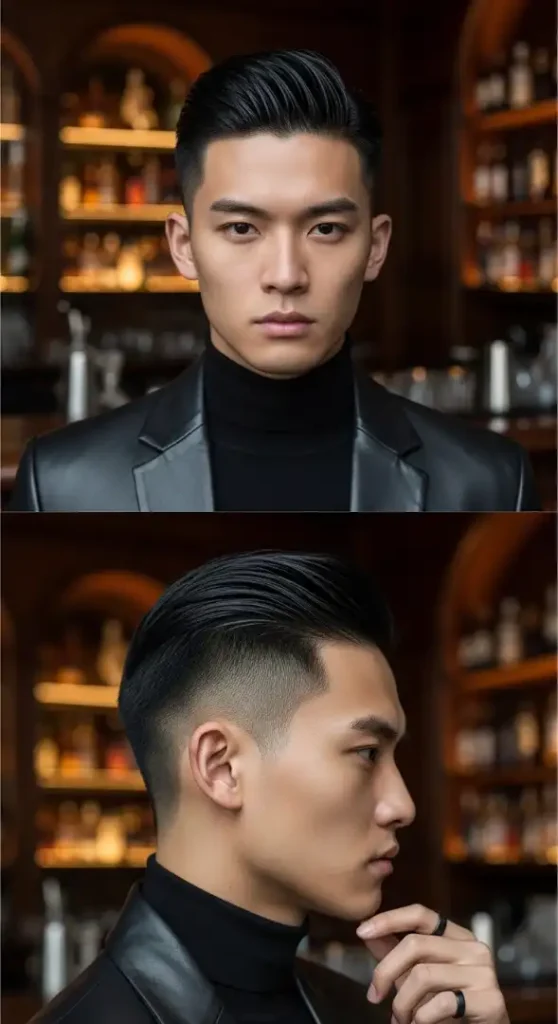
The Shanghai Slick Fade is power dressing for your hair — the cut that communicates wealth, taste, and absolute control in a single glance. This style is precision-engineered for square and oval face shapes because the slicked-back zero-volume profile creates clean vertical lines that enhance a strong square jawline while maintaining balanced proportions on naturally symmetrical oval faces. The wet-look high-shine finish isn’t just aesthetic — it’s functional armor for high-stakes environments where every detail communicates competence: investor meetings, luxury hospitality, high-end sales, entertainment industry, anywhere image is currency. This is not a haircut for men who apologize; it’s for men who close deals.
GROOMING KIT — THE EXACT ARSENAL:
- Clippers: Oster Fast Feed with #0.5, #1.5, and #2.5 guards for the precise low fade gradient
- Trimmer: Andis T-Outliner for surgical-precision temple lines and fade detail
- Styling Tools: Fine-tooth metal comb (not plastic — metal glides better through product-heavy hair), boar bristle brush for initial distribution
- Products: Murray’s Superior Hair Dressing Pomade (petroleum-based, maximum shine, industrial-strength hold), Suavecito Firme Hold (water-based alternative if you need to restyle during the day), Layrite Supershine as a base layer for extra gloss
- Finishing: Got2b Glued Freeze Spray for absolute lock-down that survives 12+ hour days
MAINTENANCE LEVEL: Very High. Barber appointments every 1.5 to 2 weeks without negotiation — the low fade shows growth immediately, and the sharp temple lines blur quickly, destroying the surgical precision that makes this cut work. Daily styling: 12-18 minutes. This is not a quick routine. Shower, towel dry to about 80%, apply Layrite Supershine evenly through damp hair, blow dry while brushing straight back to set the direction, apply Murray’s Superior while hair is still slightly warm (petroleum pomades apply better on warm hair), use metal comb to slick everything perfectly back with zero gaps or lifted sections, finish with Got2b Freeze Spray. Budget $70-120 per cut at premium barbershops — this level of fade precision and edge-work doesn’t exist at $25 chain salons.
BARBER TALK — YOUR EXACT SCRIPT: “Slicked-back style with a low-to-mid fade. Fade starts just above my ear: #0.5 at the bottom, blend through #1.5, finish at #2.5 where it meets the top — I want to see three distinct levels with smooth transitions. Top should be 3 to 4 inches, all one length, scissor-cut with zero layering — I need it to lie flat when slicked back, so don’t add texture or point-cutting. The hairline at temples needs to be sharp and angular, not rounded. Taper the back in a low fade down to the nape. I’m styling this straight back with heavy product and maximum shine, so cut it knowing there will be zero volume or lift — everything goes back flat.”
This cut costs money, demands time, and requires unwavering commitment to the routine — but the payoff is walking into any room knowing you look like you own it.
FAQs
Q: How do I maintain The Shanghai Slick Fade at home between barber visits?
A: Use a quality trimmer (Andis T-Outliner) to maintain your temple lines every 5-6 days — just the sharp geometric edges at your temples, not the fade itself. For the fade, touch up the #0.5 zone (the absolute lowest section) every 7-10 days if stubble becomes visible. Never attempt to re-create the fade gradient at home — the three-level precision requires professional tools and outside perspective.
Q: Which face shape suits The Shanghai Slick Fade best?
A: Square and oval face shapes are ideal. The flat slicked profile emphasizes a strong square jawline, creating masculine angularity. Oval faces maintain balanced proportions with this zero-volume style. Round, heart, and oblong faces should generally avoid this cut — the lack of volume and flat profile emphasizes facial roundness (round) or makes faces appear longer (oblong/heart).
Q: How do I get that wet-look shine without my hair looking greasy?
A: The wet-look IS heavy product — there’s no way around it. Use petroleum-based pomades like Murray’s Superior for maximum shine, but apply to damp (not soaking wet) hair and distribute evenly before blow-drying. The blow-dry step is critical — it sets the pomade and prevents the “just got out of the shower” dripping look. If you want shine without the weight, layer Layrite Supershine (water-based) first, then a smaller amount of Murray’s on top.
Q: What’s the difference between a low fade and a mid fade?
A: The starting point. A low fade begins just above the ear (at or slightly above ear-top level), creating a conservative gradient with more hair visible on the sides. A mid fade starts at temple level (about 1-2 inches above the ear), removing more side volume and creating more dramatic contrast. This cut uses a low-to-mid fade — starting slightly above the ear but not quite at temple height.
11 of 11 — The Manila Beach Wave Taper
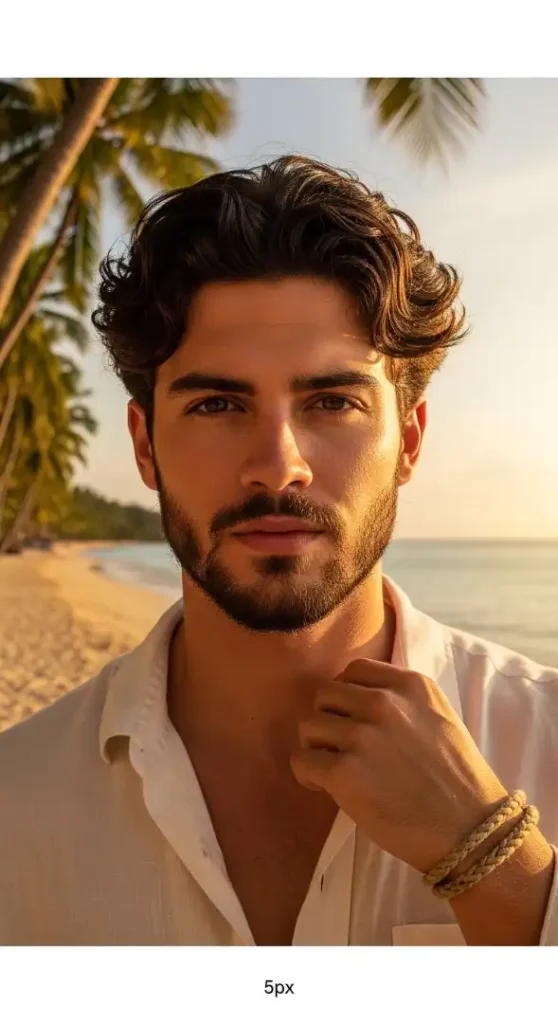
The Manila Beach Wave Taper is summer freedom in haircut form — the effortless style for Asian men who value natural texture over forced perfection. This cut works beautifully on all face shapes because the natural wavy volume and tousled movement create balanced, approachable proportions without emphasizing or minimizing any specific facial features. The sun-lightened highlights aren’t artificial — they develop naturally if you spend time outdoors (beach, pool, hiking), or you can request subtle balayage highlights from a colorist to achieve the look intentionally. This is the anti-corporate cut: zero slickness, zero sharp lines, maximum authenticity.
GROOMING KIT — THE EXACT ARSENAL:
- Clippers: Wahl Magic Clip with #3 and #4 guards for the soft taper
- Trimmer: Philips OneBlade for beard maintenance and gentle neckline cleanup
- Styling Tools: Wide-tooth comb for detangling without destroying wave pattern, fingers for styling (no brushes — they straighten out natural waves)
- Products: Bumble and bumble Surf Spray (the gold standard for beach texture), Kevin Murphy Killer.Waves (twist cream for defining wave pattern), Ouai Wave Spray (lightweight alternative for fine Asian hair)
- Beard: Bulldog Original Beard Oil (keeps light stubble soft without heaviness)
- Sun Protection: If you’re achieving natural sun highlights, use a leave-in conditioner with SPF to prevent hair from becoming dry and brittle
MAINTENANCE LEVEL: Very Low. Barber visits every 4-6 weeks — this cut actually looks better with 2-4 weeks of growth, so you’re not chasing fresh-cut precision. Daily styling: 2-4 minutes. Apply Surf Spray to damp hair, scrunch with hands to enhance natural wave, let air dry while you do literally anything else. That’s it. No blow dryer, no brushing, no precision combing. The beard requires trimming every 5-7 days with a #1 or #2 guard to maintain the light groomed stubble length without crossing into full beard territory.
BARBER TALK — YOUR EXACT SCRIPT: “Beach wave taper — I want this to look natural and effortless, not sharp or corporate. Taper the sides with #3 and #4 guards, creating a very soft gradient — no skin showing, no dramatic contrast, just a gentle fade from top to sides. The top should be 3 to 4 inches, scissor-cut with point-cutting to enhance my natural wave texture — I want movement and separation, not uniform length. Don’t create a defined part; let the hair fall naturally. The front can touch my forehead when it’s dry. Taper the back softly down to the nape with no hard lines. For the beard, trim to light stubble length using a #1 or #2 guard, shape the cheek line naturally (following where my beard actually grows), and clean up the neck border. Keep everything soft and beach-ready, not office-sharp.”
This is the haircut for men who measure success in experiences, not conference room victories — perfect for creatives, remote workers, coastal living, or anyone who refuses to sacrifice personal authenticity for corporate conformity.
FAQs
Q: How do I maintain The Manila Beach Wave Taper at home?
A: The beauty of this cut is minimal maintenance. For the beard, use your trimmer with a #1 or #2 guard every 5-7 days to keep stubble at consistent length. For the haircut, the only home maintenance is optional neckline cleanup every 3-4 weeks with your trimmer (no guard) — just the very bottom edge where hair meets bare neck. Don’t touch the taper gradient or the top layers yourself.
Q: Which face shape suits The Manila Beach Wave Taper best?
A: All face shapes can wear this cut successfully because the natural wavy volume and tousled texture create balanced, neutral proportions. Round faces benefit from the vertical volume on top, square faces are softened by the wave movement, oval faces maintain their natural symmetry, and heart/diamond faces gain width at the forehead from the textured top.
Q: How do I get natural sun-lightened highlights without damaging my hair?
A: Spend time outdoors in natural sunlight (beach, pool, hiking) and UV rays will naturally lighten the outer layers of Asian hair, especially if you have dark brown rather than jet black hair. To protect against damage, use a leave-in conditioner with SPF (Sun Bum Beach Formula or Ouai Leave-In Conditioner). For intentional highlights without sun exposure, ask a colorist for subtle balayage using a tone 2-3 shades lighter than your natural color, focused only on the ends and surface layers.
Q: What products do I need for The Manila Beach Wave Taper?
A: Bumble and bumble Surf Spray is your one essential product — apply to damp hair, scrunch with hands, air dry. That’s the entire routine. If you want extra wave definition, add Kevin Murphy Killer.Waves before the Surf Spray. For the beard, Bulldog Original Beard Oil keeps stubble soft. You can skip all other products — this cut is designed for minimal product dependency.