
20 Fringe Hairstyles for Men: Messy, Textured & Forward-Falling Cuts
The fringe is back — and this time it is not the neat, ruler-straight fringe of school photographs. The autumn/winter 2026-27 runways brought back soft, parted, irregular bangs that fall forward onto the forehead, trend reports from Milan to London list the forward fringe among the season’s defining looks, and barbers are calling the fade with a forward fringe one of the fastest-growing requests in the chair, especially from younger clients. The reason is practical as much as fashionable: a fringe shortens a long face, hides a high or uneven hairline, and gives a haircut its character from the front — the angle every photograph actually sees.
This guide covers 20 fringe hairstyles for men — the messy and textured fringes that lead the trend, the blunt French and Caesar versions, the angular and asymmetrical cuts, and the fringes for curly, wavy, straight, fine and thick hair. Every style comes with the face shapes it flatters, the grooming kit it needs, its upkeep rhythm, and the exact words to say to your barber. Winter notes run throughout, because a fringe lives where the hat sits: it is the first thing a beanie bends and, styled right, the fastest thing to rebuild.
If your top wants to sweep up instead of falling forward, our textured crop guide is the closest cousin; and if the front wants a hard blunt line with a sharper fade, the Edgar cut guide covers that end of the family.
1 of 20 — The Messy Fringe
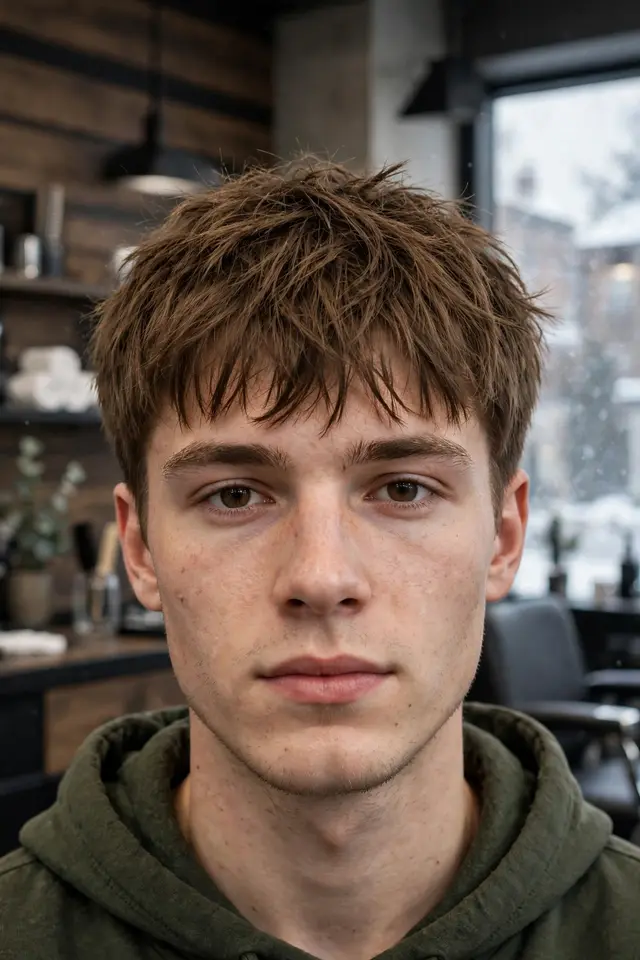
What is a messy fringe?
The face of the comeback. The Messy Fringe keeps the top at two to three inches and lets it fall forward in tousled, uneven pieces — no straight line, no visible effort, the ends broken up by point-cutting so the fringe looks grown rather than placed. The sides are usually tapered or softly faded so the front’s disorder has a tidy frame to sit in. It is the fringe for men who want the trend without the styling ritual: fingers, thirty seconds, out the door. In winter it is the most forgiving fringe here — a beanie flattens everything equally, and a messy front rebuilds by simply being messed up again.
Face Shape: Kind to long faces and high foreheads — the forward fall shortens both. Round faces should keep the sides tighter.
Grooming Kit: Matte paste or clay, pea-sized. A comb is optional; fingers are the tool this fringe was designed for.
Maintenance: Every 3–4 weeks — messiness forgives growth better than any other fringe, but the ends need re-breaking eventually.
Barber Script: “Messy fringe — top forward, point-cut the ends so it falls broken and natural, taper the sides.”
Order optional — the fringe that looks best uncombed.
Q: How messy is too messy for a fringe?
A: When the pieces separate into visible strings and the hairline disappears under overgrown ends, it has crossed from styled to overdue. The test: if you cannot see the fringe’s general shape in the mirror, it is time for the chair, not more product.
Q: Does a messy fringe work for the office?
A: Yes, worn on the shorter, tighter end — keep the pieces at brow length or above and the sides clean. The mess reads as texture at that length, not neglect. Save the longer, wilder version for creative workplaces.
2 of 20 — The Textured Fringe
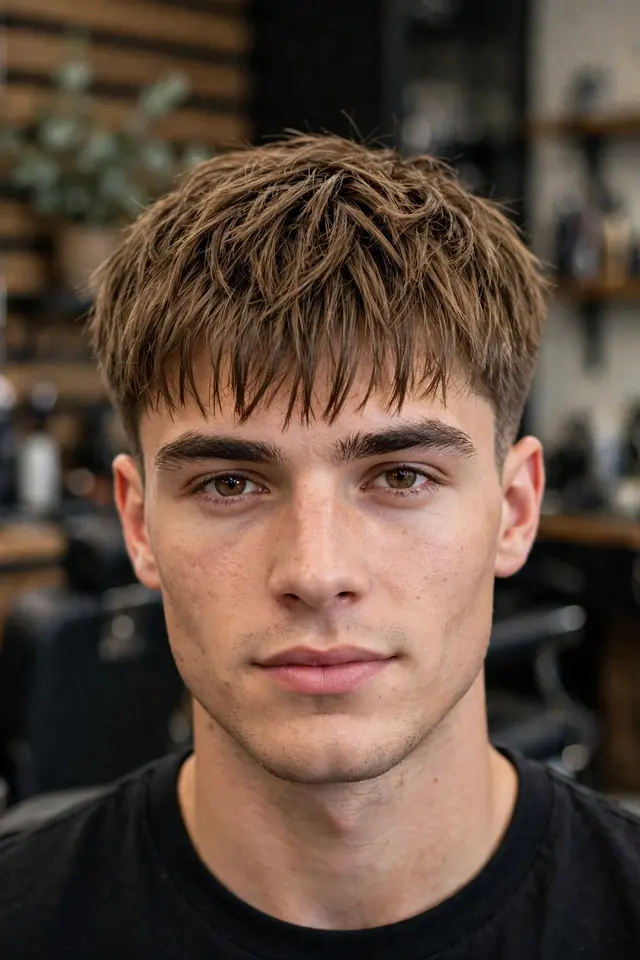
How does a textured fringe differ from a messy fringe?
Control. The Textured Fringe is the messy fringe’s engineered sibling: the top is layered and heavily point-cut so the forward-falling front separates into deliberate, defined pieces with visible depth — the fringe you see in barbershop photographs, where every strand seems placed but nothing looks stiff. It sits on most tops of most articles in this guide because it is the modern default: texture is what separates a 2026 fringe from a 2006 one. In winter, that layered construction pays off — the pieces interlock, so wind moves the fringe less than a flat front, and the shape survives a coat collar.
Face Shape: Nearly universal — the broken front softens strong features and the layered top adds structure to soft ones.
Grooming Kit: Matte clay for separation, worked in dry. On wash days, a light sea salt spray before drying builds the piecey base.
Maintenance: Every 3 weeks — texture is a haircut feature, and it grows out on schedule.
Barber Script: “Textured fringe — heavy point-cutting on top, front falling forward in pieces, matte finish.”
Placed, not combed — texture does the talking.
Q: Textured fringe or textured crop — what is the difference?
A: How much front you keep. The crop’s fringe is short and sits close; the textured fringe keeps more length and presence at the front, worn as the style’s main feature. If you like the crop but want the front to matter more, this is the step.
Q: Can I get a textured fringe with straight hair?
A: Yes — straight hair is where point-cutting earns its fee. Without natural wave, the texture has to be cut in, and a good barber will layer the front so the pieces separate on their own. Your styling is one minute with clay, no more.
3 of 20 — The French Crop Fringe
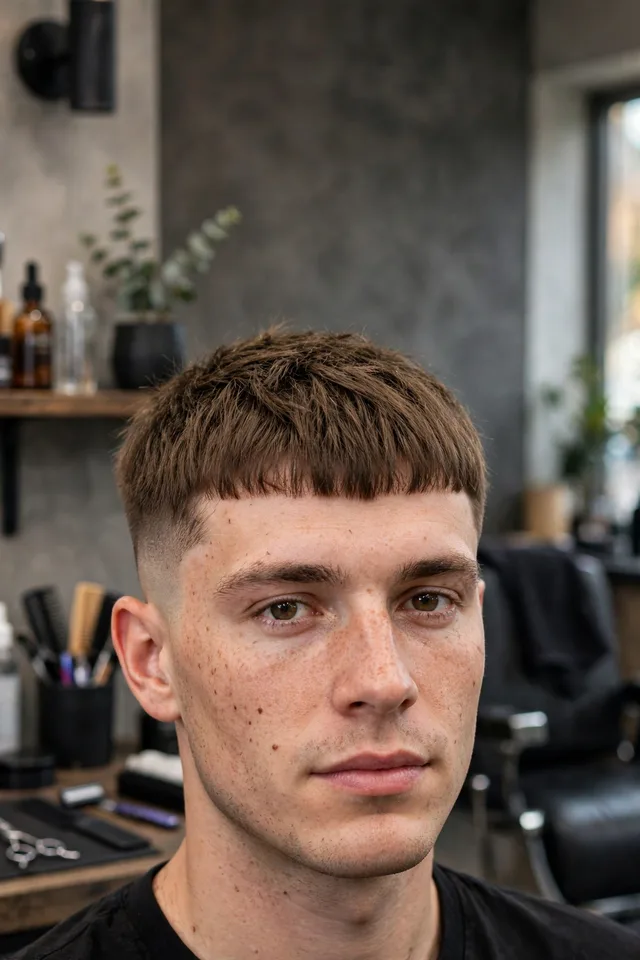
What defines a French crop fringe?
The blunt line — softened for 2026. The French Crop Fringe wears its front cut in a short, mostly straight edge across the forehead, heavier and more deliberate than the broken fringes around it, with the top kept short and the sides faded or tapered. It is the focal-point fringe: the line draws the eye and gives the whole cut its architecture. This year’s version keeps the line but roughs it slightly, so it reads modern rather than severe. Winter suits it — a short, heavier fringe is the least hat-affected front in this guide, and its line reasserts itself with one forward brush.
Face Shape: Excellent on oval and square faces; it covers high foreheads and evens out uneven hairlines honestly.
Grooming Kit: A brush or wide comb and the lightest matte product — this fringe is built by the cut, not the styling.
Maintenance: Every 2–3 weeks — a line is a line, and it blurs on schedule.
Barber Script: “French crop fringe — short blunt fringe in front, slightly roughened edge, short textured top, tapered sides.”
The line is the look — architecture at the forehead.
Q: French crop fringe or Caesar fringe — which is which?
A: Length and weight. The French fringe is a touch longer and heavier, worn as the cut’s main feature; the Caesar’s fringe is shorter, smaller and part of an all-over short cut. Style 9 covers the Caesar — compare the two photographs and the difference is obvious.
Q: Will a blunt fringe suit a receding hairline?
A: Often, yes — a straight fringe line can sit at the hairline’s strongest point and give the front a deliberate edge instead of a retreating one. Your barber may soften the corners. What it cannot do is cover deep temple recession; be honest in the consultation.
4 of 20 — The Angular Fringe
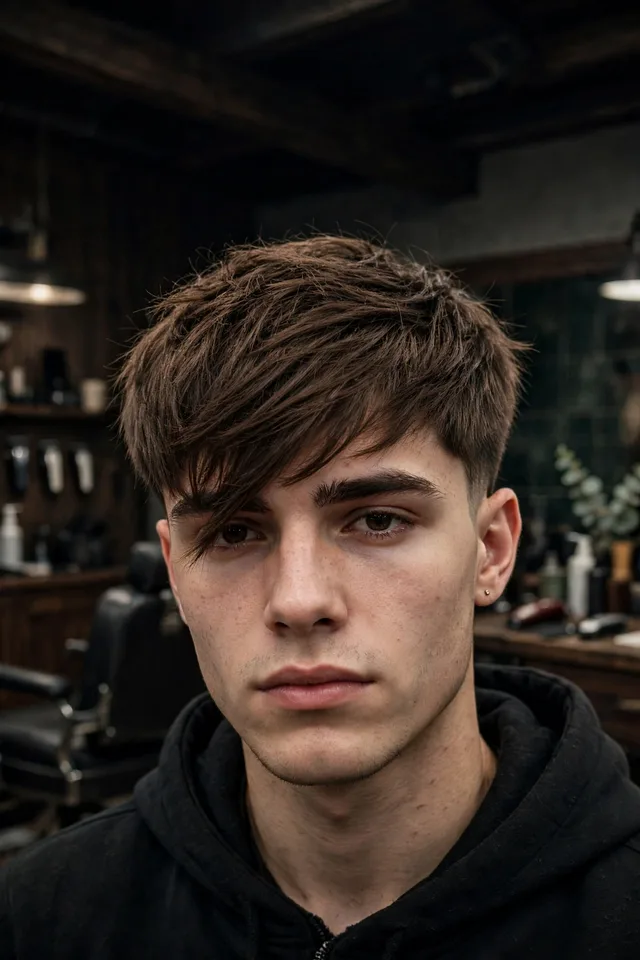
What is an angular fringe?
Geometry. The Angular Fringe is cut on a deliberate diagonal — longer on one side, sweeping down across the forehead at an angle — or shaped with a sharp asymmetric point that gives the front a designed edge. It was the fringe of the 2010s indie era, and it has returned with the rest of the decade’s soft geometry, now worn looser and less lacquered. It is the fringe with the most personality here: it changes the face’s apparent proportions, pulling the eye sideways. Winter’s caution: an angle is a drawing, and hat hair redraws it — expect a mirror and thirty seconds each morning.
Face Shape: A diagonal shortens long faces dramatically and adds interest to symmetrical oval ones; very round faces find it widening.
Grooming Kit: Matte paste and a comb for setting the angle while damp. This fringe is placed, not shaken into place.
Maintenance: Every 2–3 weeks — angles expire faster than straight lines.
Barber Script: “Angular fringe — cut the front on a diagonal, longer on my stronger side, keep the top textured.”
A diagonal across the forehead — the fringe with a point of view.
Q: Which side should the angular fringe be longer on?
A: Your stronger side — the side where your hairline and growth sit best, which your barber can judge in seconds. The longer corner usually starts above the stronger temple so the sweep falls with the growth, not against it.
Q: Is the angular fringe dated now?
A: The lacquered 2012 version is; the soft 2026 version is not. The difference is finish — matte, broken ends, worn loose. Keep the geometry, lose the gel, and it reads as a deliberate retro reference rather than an old photograph.
5 of 20 — Fringe with a Mid Fade
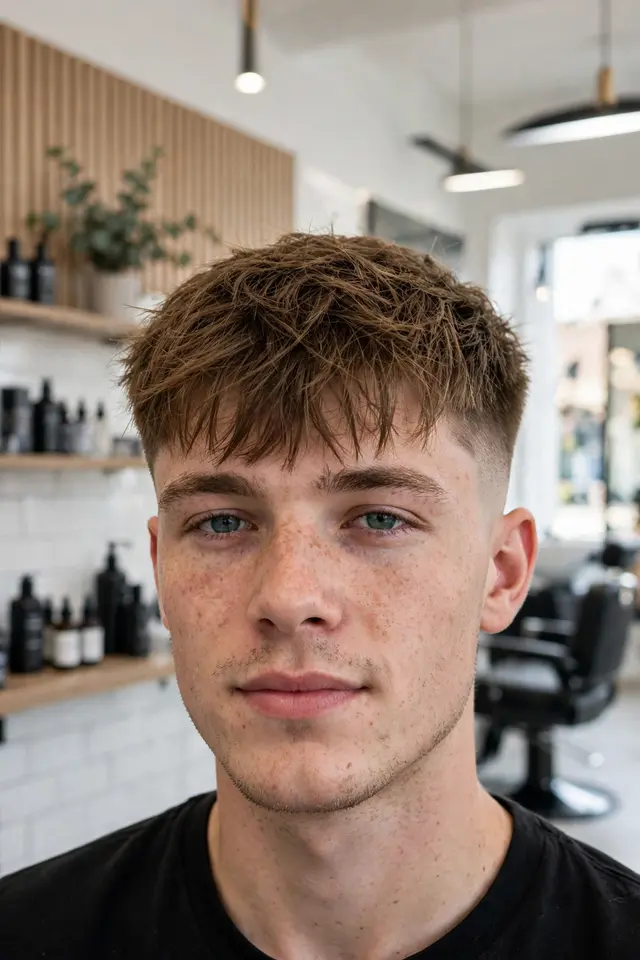
Why pair a fringe with a mid fade?
Contrast, in the combination barbers are booking most. Fringe with a Mid Fade keeps the front’s forward fall as the feature while the sides graduate cleanly from the temples down — sharp enough to frame the fringe, soft enough to grow out gracefully. It is the version younger clients ask for by photograph: the fringe supplies the style, the fade supplies the freshness. It is also the most adaptable seat in this guide — the same front works with the fade raised or lowered next visit. In winter, the mid fade sits below most hat lines, so the fringe takes the hat’s damage alone and rebuilds alone, quickly.
Face Shape: The balanced default — the fade slims the sides while the fringe shortens the front, flattering oval and round faces alike.
Grooming Kit: Matte paste for the front; nothing for the fade but a moisturiser in winter if the skin shows dry.
Maintenance: Every 2–3 weeks, driven by the fade; the fringe can stretch to the same rhythm at brow length.
Barber Script: “Fringe with a mid fade — fringe forward and textured, mid fade on the sides, keep the front’s length.”
The photograph version — fringe for style, fade for freshness.
Q: Mid fade or low taper with a fringe — how do I choose?
A: By how sharp you want the frame. The mid fade reads fresher and younger and needs a 2–3 week rhythm; the low taper (style 10) reads softer and more classic and forgives a month. The fringe itself does not change between them.
Q: Can the fringe and fade disagree about my hairline?
A: They solve different problems. The fade handles the sides and temples; the fringe handles the front. A fringe is actually the standard prescription for a front hairline you dislike — it comes forward and covers the evidence, while the fade keeps the rest honest.
6 of 20 — The Curly Fringe
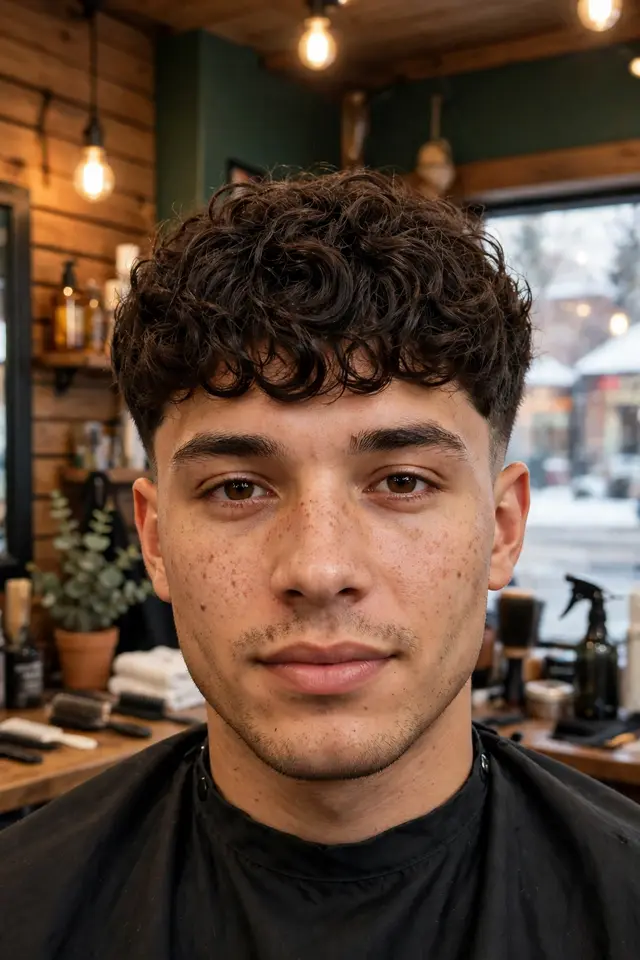
How does a curly fringe work?
By surrender, not force. The Curly Fringe lets the front keep its natural curl pattern, cut long enough that the curls form a soft, rounded front over the forehead instead of being straightened into a line. The weight of the curl keeps it forward on its own — no daily styling argument — and the sides are tapered so the silhouette stays intentional. Cut it dry: curls shrink as they dry, and a wet-cut curly fringe ends an inch above where it was planned. Winter is curly hair’s driest season, so the fringe’s definition is a moisture question — cream on damp hair, hands off while it dries.
Face Shape: The soft front flatters angular faces; very round faces should keep the fringe shorter so the fullness does not widen them.
Grooming Kit: Curl cream, a wide-tooth comb for wet hair only, and a diffuser if you dry with heat. Straighteners are not invited.
Maintenance: Every 4 weeks comfortably — curls forgive growth; get the sides tapered between fringe appointments if they fuzz.
Barber Script: “Curly fringe — cut it dry, keep the front’s curl long enough to form, taper the sides clean.”
The curl does the falling — you just keep it fed.
Q: How long should a curly fringe be cut?
A: Longer than it looks in the chair — dry curls spring up one to two inches depending on tightness. A barber fluent in curl cuts it in its dry, natural state and checks the fall before finishing. If your barber reaches for the spray bottle first, ask questions.
Q: Why does my curly fringe frizz by midday?
A: It dried thirsty or it was touched too much. Cream goes on soaking-wet hair, curls are left strictly alone while drying, and the day is survived. In winter, a satin-lined beanie instead of wool removes the other frizz source — friction.
7 of 20 — The Straight Fringe
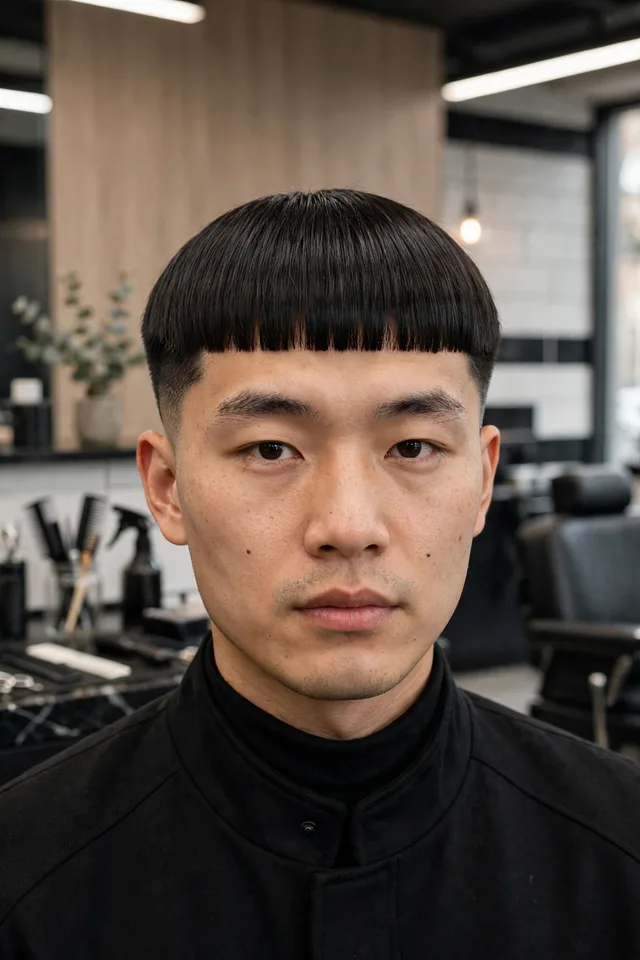
Who suits a straight fringe?
Men with straight hair and the patience for precision. The Straight Fringe is cut in a clean, even line straight across the forehead — the boldest, most graphic fringe here, a direct descendant of mod and bowl-line geometry worn with modern tapered sides so it reads fashion rather than costume. On straight hair it lies where it is cut with almost no styling; on any other hair type it is a daily negotiation. Winter is its friend: no curl to frizz, no wave to wander — the line simply needs a forward brush after a hat.
Face Shape: Made for oval and longer faces with strong features. It is unforgiving on very round faces — the horizontal line widens them.
Grooming Kit: A fine comb and almost nothing else. A whisper of matte paste at the corners if they lift.
Maintenance: Every 2 weeks, honestly — a straight line announces its growth first. Trims are quick and cheap.
Barber Script: “Straight fringe — clean even line across the front, top kept neat, sides tapered.”
A ruler line with modern sides — graphic and deliberate.
Q: Straight fringe or French crop fringe?
A: How finished you want the line. The French fringe is rougher, shorter-feeling and broken at the edge; the straight fringe is one clean horizontal statement. Photographs make the choice easy — the straight fringe is the bolder object.
Q: Can a straight fringe work with a cowlick at the front?
A: It is the hardest pairing in this guide. A front cowlick lifts one section of the line and the gap shows daily. A good barber will either cut the fringe longer to weight it down or talk you into the textured version — believe him.
8 of 20 — The Long Fringe
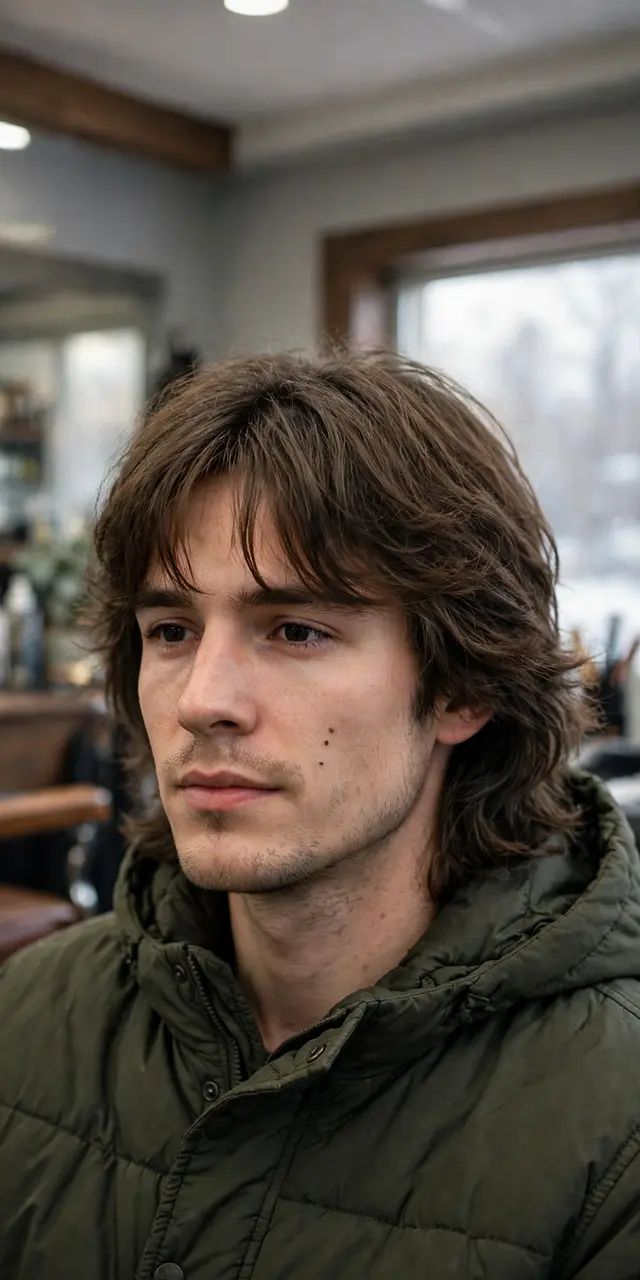
What is a long fringe?
The grown-out end of the family: the front kept at three to four inches, falling forward over the forehead and often brushing or passing the brows, with the top’s length flowing back into longer, looser hair. The Long Fringe is the romantic of the set — it moves, it can be swept aside, pushed back or left to fall, and it carries the 90s soft-bangs energy the runways revived. It is also a commitment: the fringe is in your eyes’ neighbourhood and your morning routine’s. Winter flatters it (scarves, coats, indoor light all love movement) and tests it — static makes long fronts cling and separate.
Face Shape: Long faces should be careful — a long fringe plus a long face reads very long. It shines on oval and square faces.
Grooming Kit: A light cream for separation and static, a brush, and tolerance. Heavy product makes long fringes stringy.
Maintenance: Every 4–5 weeks — length is the style, so appointments are shapings, not resets.
Barber Script: “Long fringe — keep the front at three to four inches falling forward, textured ends, length through the top.”
The romantic front — length that falls, moves and sweeps.
Q: How do I keep a long fringe out of my eyes at work?
A: Sweep it, do not cut it in frustration. A long fringe parts naturally at its weakest point with a touch of cream — wear it swept on workdays, fallen on weekends. That versatility is the entire point of keeping the length.
Q: Long fringe or curtain — what is the difference?
A: Direction of the part. The long fringe falls forward as one piece; a curtain is parted in the middle and falls to both sides. The curtain frames, the fringe covers. Men growing toward a curtain usually pass through this style first.
9 of 20 — The Caesar Fringe
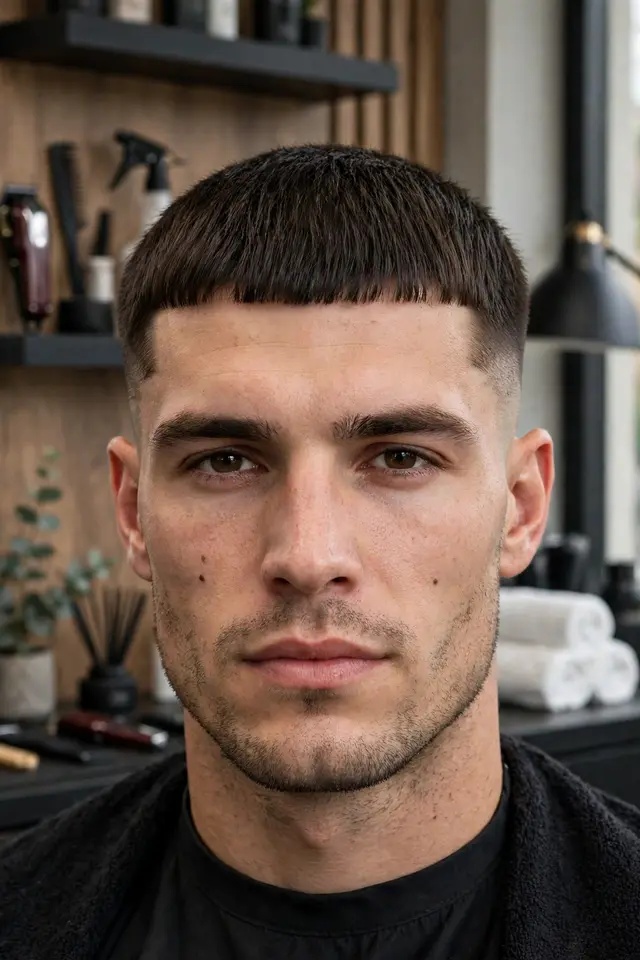
What is a Caesar fringe?
The smallest fringe with the longest pedigree: a short, straight-across micro-fringe of half an inch to an inch, on an all-over short Caesar cut with the top lying forward. The Caesar Fringe never really left — it is the fringe of athletes and soldiers because it asks for nothing — and its 2026 return comes with updated proportions: a taper or low fade at the sides instead of the classic clippered uniformity. It is the answer for men who like the idea of a fringe but not the upkeep of one. Winter barely touches it; there is almost nothing for a hat to ruin.
Face Shape: Superb on square and strong-jawed faces; it also camouflages a high hairline at the front better than any short cut.
Grooming Kit: Almost none — a pea of matte paste if the front lifts. This is the wash-and-wear fringe.
Maintenance: Every 2–3 weeks to keep the micro-line crisp; the cut itself is five minutes in the chair.
Barber Script: “Caesar fringe — short straight fringe in front, top lying forward, taper or low fade at the sides.”
Half an inch of fringe, two thousand years of pedigree.
Q: Caesar fringe or French crop fringe — the real difference?
A: Proportion. The Caesar is short all over — the fringe is small because everything is. The French crop keeps more top and a heavier fringe as its main feature. Choose the Caesar for zero effort, the French for a front that performs.
Q: Does a Caesar fringe suit thinning hair?
A: It is one of the best short answers for it. The forward-lying top covers the front hairline, the short length keeps thin areas from separating visibly, and the micro-fringe gives the front a deliberate edge. Keep the sides tapered low rather than skin-faded.
10 of 20 — Fringe with a Low Taper
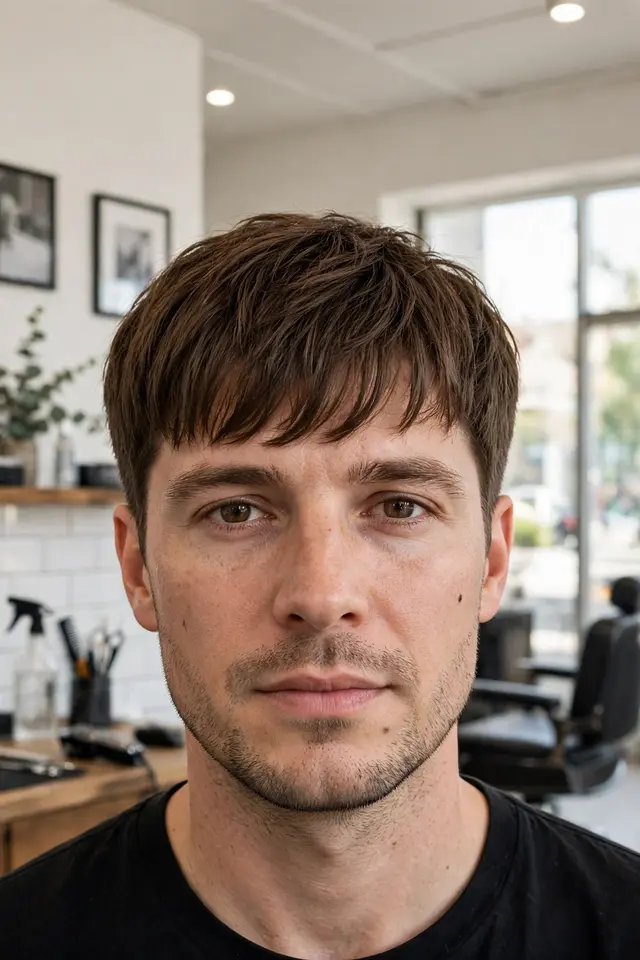
Why choose a fringe with a low taper?
For the classic end of the trend. Fringe with a Low Taper pairs the forward front with the softest, lowest blend — just around the ears and neckline — so the whole portrait reads natural and grown rather than barbershop-sharp. It is the fringe for conservative workplaces, older men joining the trend, and anyone whose hair grows fast enough to make fades a subscription. The taper also keeps maximum side hair, which balances the fringe’s front weight. Winter is gentle with it: no skin line to dry out, no sharp edge for a hat band to dent.
Face Shape: Kind across the board; the soft sides keep width where narrow faces want it.
Grooming Kit: Matte paste for the fringe, nothing else required. The taper’s softness is the cut’s own work.
Maintenance: Every 3–4 weeks — the most forgiving rhythm in this guide, fringe included.
Barber Script: “Fringe with a low taper — fringe forward and textured, low taper only around the ears and neckline.”
The trend at its most grown-up — fringe in front, softness at the sides.
Q: Is a low taper with a fringe too soft to read as a style?
A: No — the fringe carries the statement and the taper carries the grooming. Photographs read front-first; a deliberate fringe over soft sides looks intentional, while the same fringe over grown-out messy sides just looks overdue.
Q: Who should pick this over the mid fade version?
A: Men over thirty-five, men in conservative jobs, and fast growers. The mid fade is the younger, sharper frame; the low taper is the same fringe with manners and a longer fuse between appointments.
11 of 20 — The Wavy Fringe
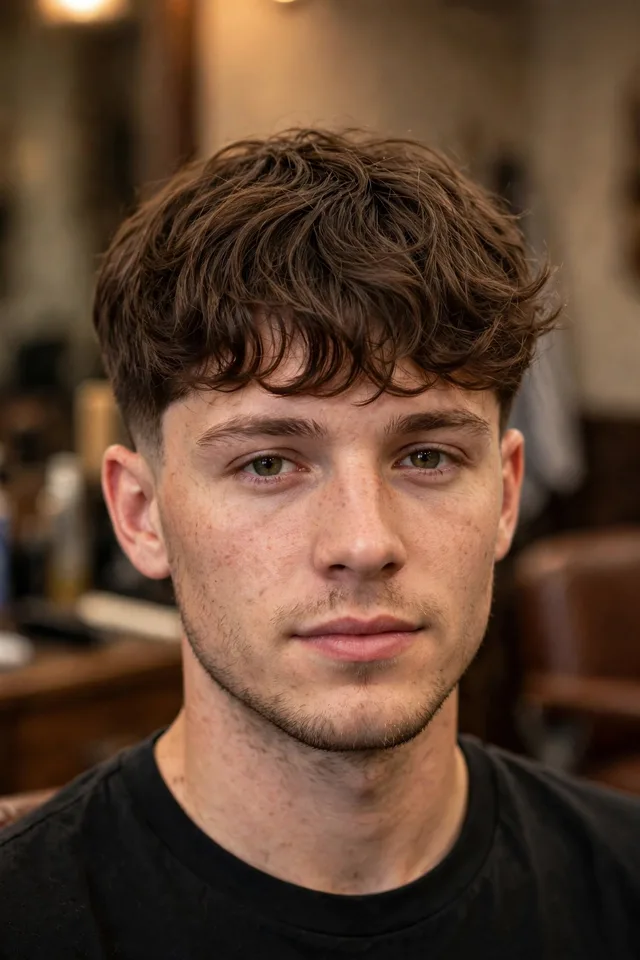
How should wavy hair wear a fringe?
Loosely, and a touch longer than planned. The Wavy Fringe works with the hair’s natural S-bend — the front is cut so the waves fall forward in a soft, broken curtain of movement rather than being pressed into a line they will escape by noon. It is the fringe the A/W runways actually showed: parted sometimes, fallen sometimes, never lacquered. The barber cuts it dry or barely damp, because a wave’s length lies when wet. In winter, wavy fringes drink moisture and misbehave in dry heated air — a light leave-in is the difference between romantic and ragged.
Face Shape: The soft movement flatters almost everyone; square faces gain softness, long faces gain width at the front.
Grooming Kit: Leave-in conditioner, a light cream, and a wide-tooth comb. Drying is scrunch-and-leave, not brush-and-force.
Maintenance: Every 3–4 weeks; the wave hides growth kindly, but the ends need re-shaping before they separate.
Barber Script: “Wavy fringe — cut it dry, keep the front long enough for the wave to fall forward naturally.”
Let the wave fall where it wants — forward.
Q: My wavy fringe keeps parting in the middle — is that wrong?
A: No, that is the wave voting, and the runways voted with it this year. A softly parted wavy fringe is a legitimate finish — lean in, keep the sides tapered, and it reads as the relaxed middle of this guide rather than a failed straight front.
Q: Should I blow-dry a wavy fringe straight on formal days?
A: You can, with a brush and forward heat, but budget the minutes and expect the wave to return with humidity. Most wavy-fringe owners find the swept version (style 17) is the better formal answer — it works with the bend instead of ironing it.
12 of 20 — The Fringe and Beard
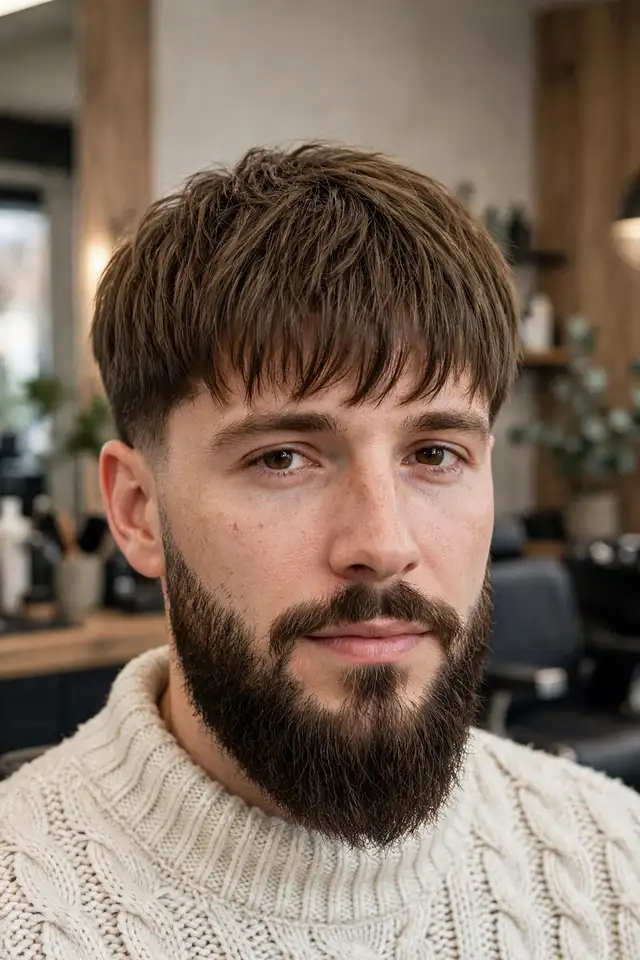
Why does a fringe pair so well with a beard?
Proportion. The Fringe and Beard frames the face at both ends — hair forward at the top, beard shaped below — and the face in the middle reads shorter, stronger and more deliberate. It is the combination that turns a fringe from youthful to masculine: the front that can read boyish on a clean-shaven face gains instant gravity above a kept beard. The connection matters: a low or classic beard fade where the sideburn meets the fringe’s frame keeps the two elements in one conversation. Winter is beard season anyway — this is the pairing the whole season conspires toward.
Face Shape: Built for longer faces — the fringe shortens from above, the beard anchors below. Round faces should keep the beard’s sides tight.
Grooming Kit: Matte paste for the fringe; beard oil and a brush below. Two small rituals, one face.
Maintenance: Fringe every 3 weeks; beard shaped at the same visit so the two frames stay in proportion.
Barber Script: “Fringe and beard — fringe forward and textured, shape the beard to balance it, fade the sideburns into both.”
Framed at both ends — the fringe grows up.
Q: How full should the beard be with a fringe?
A: Proportionate, not maximal. A medium, shaped beard balances most fringes; a very long beard plus a long fringe crowds the face. The rule: the longer the fringe, the tighter the beard’s outline should be.
Q: Does the fringe and beard suit a patchy beard?
A: A short, boxed beard works — keep it at stubble-to-short length with clean lines, and it still supplies the lower frame. The pairing fails only when the beard is grown long hoping patches disappear; they do not, and the fringe deserves better company.
13 of 20 — The Choppy Fringe
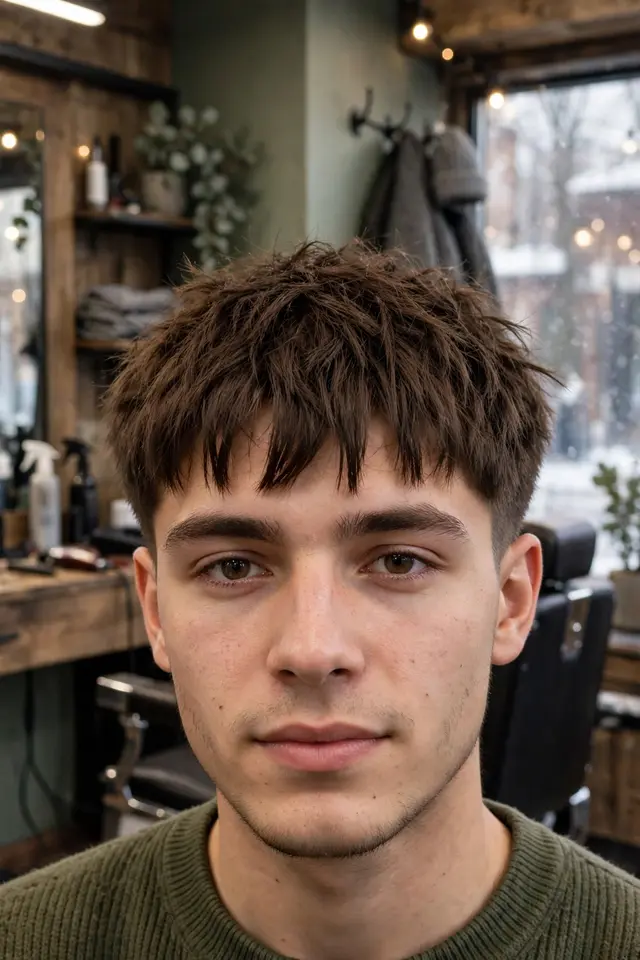
What makes a fringe choppy?
Aggressive texture, worn forward. The Choppy Fringe is cut with deep point-cutting and razor work so the front falls in separated, jagged pieces with gaps between them — the most broken fringe in this guide, a deliberate rough edge rather than a smooth one. It belongs to the spiky, tousled winter crops everywhere this December: uneven on purpose, like you ran your hands through it and stopped caring. It hides a multitude — uneven hairlines, cowlicks, a rushed morning — because disorder is the design. Winter’s static actually helps it; separation is the look.
Face Shape: The broken front softens strong features and disguises asymmetry; very fine hair should see style 15 instead.
Grooming Kit: Clay, applied dry and sparingly — choppiness dies under heavy product, which glues the pieces back together.
Maintenance: Every 3 weeks — the chop is a cut feature; grown out, it collapses into a merely messy fringe.
Barber Script: “Choppy fringe — deep point-cutting, front falling in separated jagged pieces, tapered sides.”
Rough edge by design — gaps are the point.
Q: Choppy fringe or messy fringe — how do they differ?
A: Intention’s visibility. The messy fringe looks casually undone; the choppy fringe looks deliberately cut that way — the pieces are bigger, the gaps wider, the silhouette more graphic. If strangers can tell a barber did it, it is choppy.
Q: Can a choppy fringe look professional?
A: At shorter lengths, yes — the chop reads as texture in an office the way it reads as edge in a studio. Keep it above the brows, keep the sides clean, and the jaggedness stays a detail rather than the headline.
14 of 20 — The Soft Korean Fringe
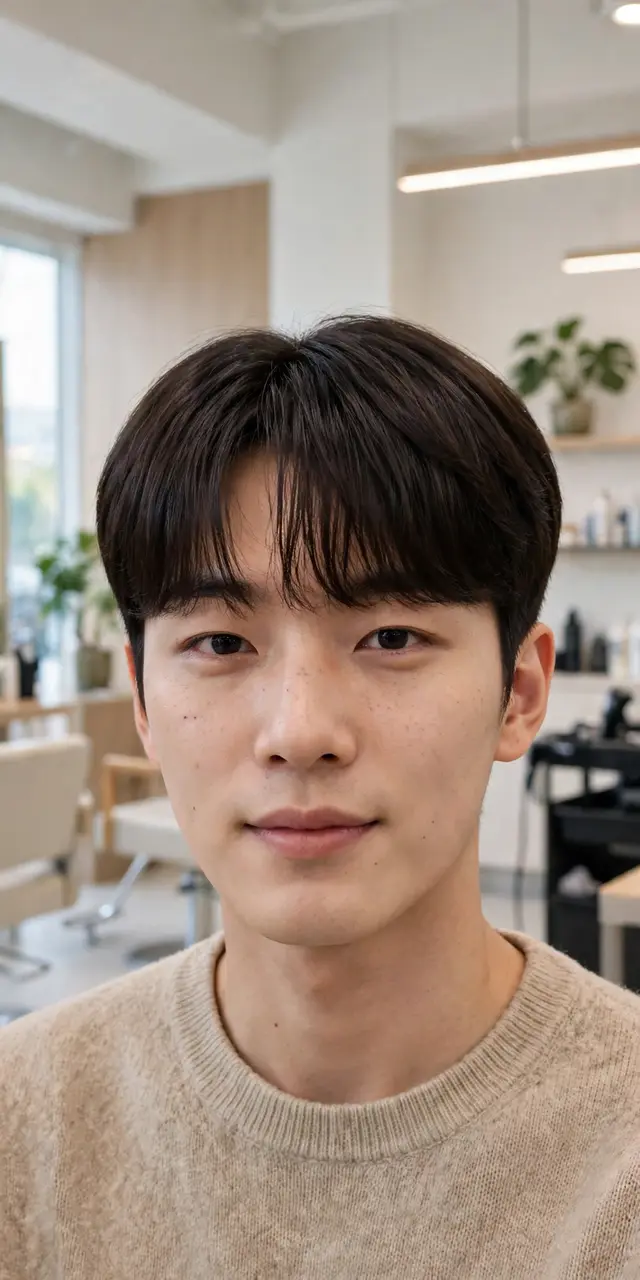
What is a soft Korean fringe?
The gentle engineering of the two block family, worn forward. The Soft Korean Fringe keeps the front falling in a soft, rounded curtain — often with the slightest centre weight — over the two block’s disconnected sides, giving that clean, youthful K-drama front: neat, even and deliberately smooth without being blunt. It is the most polished fringe here and the one that photographs most kindly, softening the whole face. In winter it asks for the most care of the soft fringes — its smoothness shows flyaways, so a light anti-static cream earns its place.
Face Shape: Lovely on oval, heart and longer faces; its rounded front softens a strong brow and jaw.
Grooming Kit: A round brush for the gentle forward roll, light cream, and anti-static spray in winter. Heavy wax ruins the softness.
Maintenance: Every 3 weeks — the two block’s disconnect shows its growth at the sides first.
Barber Script: “Soft Korean fringe — two block sides, front falling forward soft and rounded, keep it smooth, not blunt.”
Smooth, rounded, youthful — the polished fringe.
Q: Soft Korean fringe or straight fringe — what changes?
A: The edge’s mood. The straight fringe is one hard horizontal line; the Korean fringe is rounded at the corners and softer through the front, worn slightly longer. Same family of neatness, different temperature — the Korean version is the warmer one.
Q: Does the soft Korean fringe suit wavy hair?
A: Loose waves, yes — the roll of the brush can set the front smooth each morning. Tight curl will fight the smoothness daily; the curly fringe (style 6) is the honest version of the same forward idea.
15 of 20 — The Fringe for Fine Hair
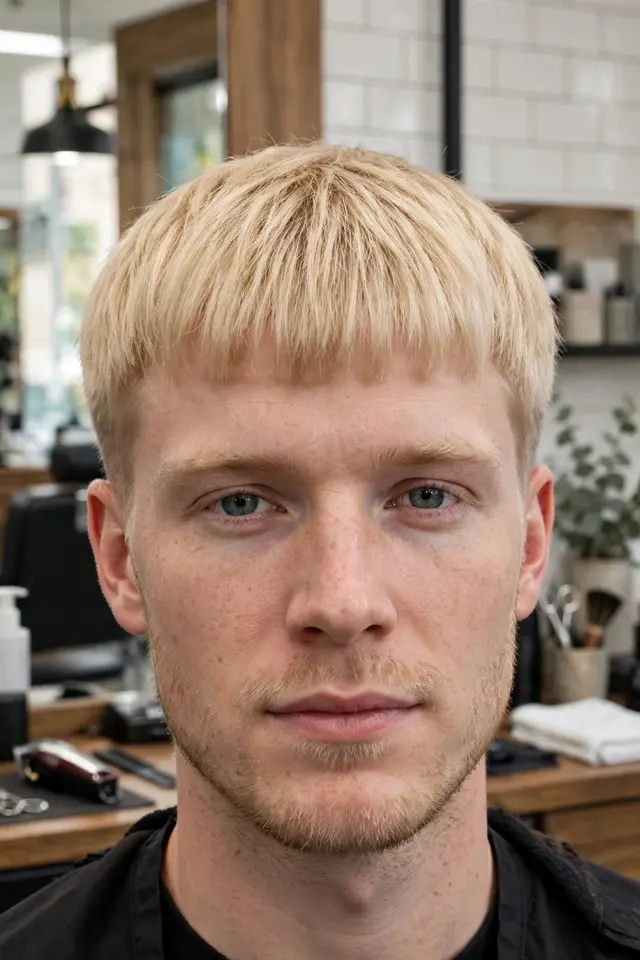
Can fine hair wear a fringe?
Yes — cut shorter and kept blunt-ish. Fine hair’s fear is separation: a long fine fringe splits into strings and shows the forehead through itself. The Fringe for Fine Hair answers with physics: a shorter front (above the brows), cut with a slightly heavier, less broken edge so the strands support each other, on a top that stays modest in length. The result reads as a deliberate fringe with presence, not a rumour of one. Winter static is the fine fringe’s daily tax — anti-static cream, not oil, is the finish; oil collapses fine hair on contact.
Face Shape: The forward fall shortens long faces without the weight fine hair cannot supply; round faces keep the sides tapered tight.
Grooming Kit: A light volumising mousse on damp hair, a dry matte paste, and anti-static cream. Every product here must be weightless.
Maintenance: Every 3 weeks — fine hair shows a fringe’s growth quickly because there is less of it to hide behind.
Barber Script: “Fringe for fine hair — shorter front, slightly blunt edge for weight, nothing too broken or long.”
Shorter and a little blunter — fine hair’s fringe physics.
Q: Why does my fine fringe separate into strings by midday?
A: Length and oil, usually. Past the brows, fine strands part under their own movement; add the forehead’s natural oils and they clump into strings. The fixes stack: shorter cut, dry shampoo at the fringe’s roots in the morning, hands off it afterwards.
Q: Is a fringe a mistake on a thinning hairline?
A: Often the opposite — a forward fringe is the classic cover for a front hairline in retreat, worn at the hairline’s strongest point. The fine-hair rules apply double: short, supported, honest. Your barber will tell you if the recession is too deep for it to read as style.
16 of 20 — The Fringe for Thick Hair
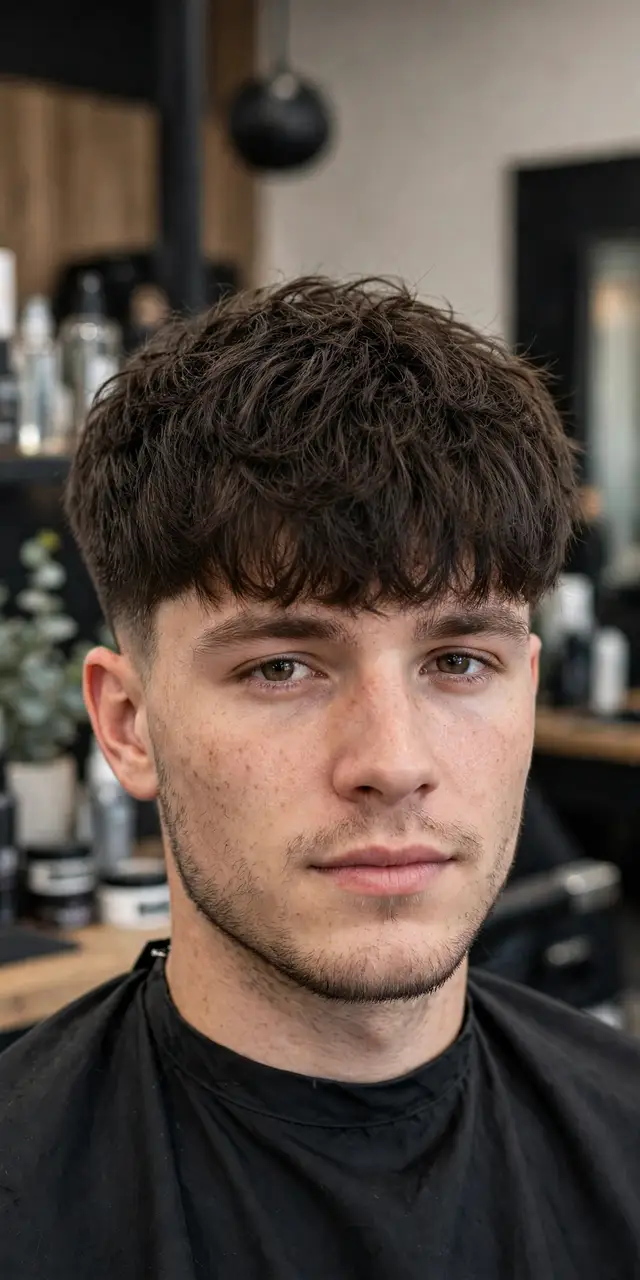
Why does thick hair love a fringe?
Because the fringe spends thick hair’s surplus exactly where it shows. Thick hair worn up or back fights gravity and bulk all day; worn forward as a fringe, its weight works for the style — the front falls into place and stays, with a density no product can fake. The Fringe for Thick Hair keeps the front substantial, takes weight out of the top’s interior so the mass reads as texture rather than helmet, and tapers the sides down so the head keeps a shape. Winter’s dry air expands thick hair further — the interior weight removal matters more, not less, in December.
Face Shape: The front’s weight shortens long faces beautifully; square faces should keep the fringe’s edge broken to soften it.
Grooming Kit: Matte cream only — thick hair needs control, not volume products. A strong dryer for wash days; air-drying thick fringes takes hours.
Maintenance: Every 3 weeks — thick hair’s regrowth changes a fringe’s fall faster than any other type.
Barber Script: “Fringe for thick hair — keep the front full, take the weight out of the top’s middle, taper the sides down.”
Density spent at the front — thick hair’s best bargain.
Q: Should a thick fringe be thinned out?
A: Through the interior, yes; at the edge, carefully. Thinning the middle removes the bulk that makes the fringe sit like a shelf, while the front edge keeps enough weight to fall as one piece. Ask for weight removal, not a wispy edge — wispy is the one thing thick hair should not imitate.
Q: How do I stop a thick fringe looking like a bowl cut?
A: Texture and sides. A bowl reads when the fringe is one unbroken weight at one length over clippered-equal sides. Point-cut the edge, layer the interior, and taper the sides — the silhouette changes from bowl to barbered in the same length.
17 of 20 — The Side-Swept Fringe

What is a side-swept fringe?
The fringe’s formal exit. The Side-Swept Fringe is cut to fall forward, then styled across to one side in a soft diagonal sweep — forward hair wearing a side part’s manners. It is the version for men who like the fringe family but need a front that can dress up: the sweep uncovers one side of the forehead, reads instantly more polished, and pairs with coats and collars the way the fallen fringe pairs with knitwear. It is also the receding hairline’s friend — swept toward the stronger side, it covers ground as style, not strategy. Winter formality is its season.
Face Shape: The diagonal flatters oval and rectangular faces and softens a square jaw; it is the kindest fringe for uneven hairlines.
Grooming Kit: A brush, a light-to-medium cream, and two minutes. The sweep is set while damp and left alone.
Maintenance: Every 3 weeks; the sweep’s length balance matters — past a point it stops sweeping and starts flopping.
Barber Script: “Side-swept fringe — cut forward, styled across to my stronger side, soft diagonal, tapered sides.”
Forward hair, formal manners — the fringe dresses up.
Q: Side-swept fringe or side part — which is more modern?
A: The swept fringe. A side part is a fixed line in hair worn back or flat; the swept fringe keeps the fringe’s forward length and texture, just directed. It reads younger and softer — and on the days you skip styling, it simply becomes a fringe again.
Q: Which side should I sweep toward?
A: The side your growth supports — usually where the hairline is stronger and the natural fall agrees. Sweeping against a cowlick is a daily war you will lose by afternoon; your barber can find the cooperative side in one consultation.
18 of 20 — The Asymmetrical Fringe
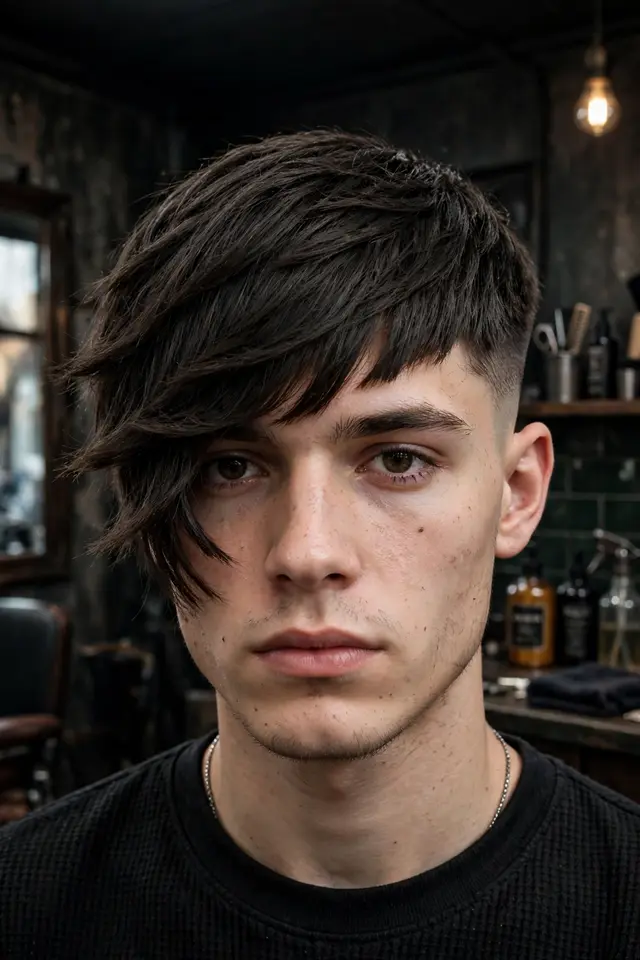
What is an asymmetrical fringe?
Deliberate imbalance: one side of the front cut noticeably longer or heavier than the other — not the angular fringe’s smooth diagonal, but a stepped, off-balance front where the asymmetry itself is the design. It is the most editorial fringe here, a cousin of the mod and indie cuts that treats the forehead as a composition. Worn well, it makes an ordinary face look art-directed; worn accidentally, it looks like a mistake — which is why it belongs to confident men with good barbers. Winter’s hats are its enemy and its reset button: the shape needs its mirror moment each morning.
Face Shape: Best on oval and symmetrical faces that can lend the balance the hair withholds; it adds interest to plain features.
Grooming Kit: Matte paste and a mirror you trust. This fringe is placed piece by piece, at least at first.
Maintenance: Every 2–3 weeks — asymmetry has a shorter grace period than any other shape; growth evens it into confusion.
Barber Script: “Asymmetrical fringe — front longer and heavier on one side, stepped, keep it deliberate, tapered sides.”
Imbalance on purpose — the editorial fringe.
Q: Angular or asymmetrical fringe — what is the difference?
A: Continuity. The angular fringe is one smooth diagonal line; the asymmetrical fringe breaks the line — a step, a weight change, a corner. The angular reads sleek; the asymmetrical reads designed. Choose by how much attention the front should demand.
Q: Can I grow out an asymmetrical fringe without an awkward phase?
A: The phase is shorter than feared: the longer side becomes a side sweep (style 17) within one trim, and the shorter side catches up in two. Ask your barber to convert, not just trim — the exit is a known route, not a wilderness.
19 of 20 — The Winter Fringe
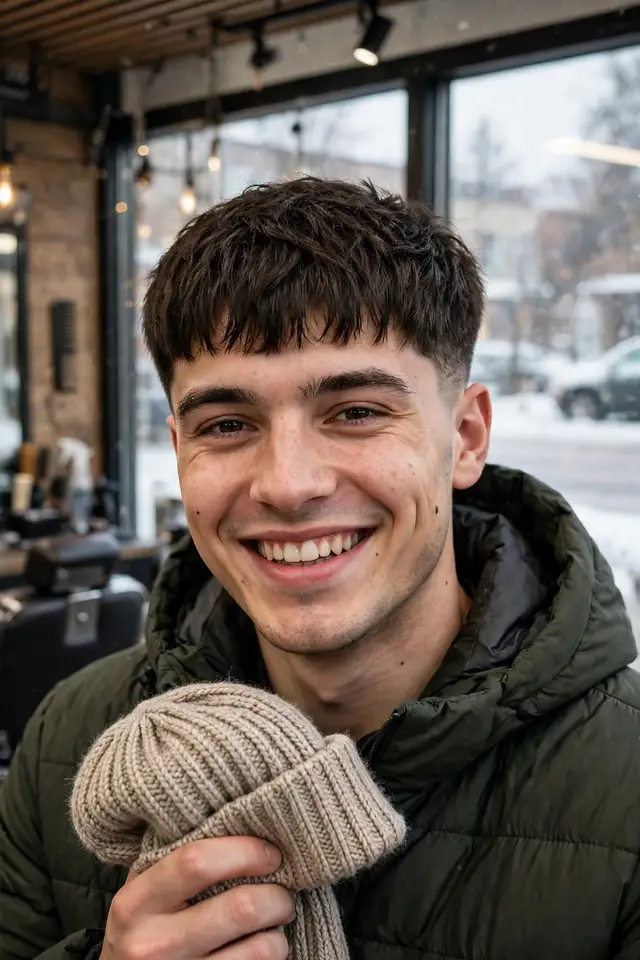
How should a fringe change for winter?
Shorter at the front, softer at the edges, and chosen for the rebuild. The Winter Fringe is the seasonal build of the family: a textured fringe kept just above the brows — so a beanie’s band sits above it rather than crushing it flat — on tapered sides that survive scarves and collars, with a matte flexible finish that re-forms with fingers alone. The routine changes too: dry the fringe forward before the hat goes on (a damp fringe under wool sets in whatever shape the hat chooses), and rebuild at the other end with thirty seconds and a fingertip of water at the roots. Worn this way, winter stops being the fringe’s enemy.
Face Shape: Suits every face the textured fringe does; the above-brow length is especially kind to shorter faces.
Grooming Kit: Matte paste, a travel brush if you commute, and a satin-lined beanie — the fringe’s best winter friend.
Maintenance: Every 3 weeks through the season; ask for the above-brow length each time so the hat geometry keeps working.
Barber Script: “Winter fringe — textured fringe kept just above the brows, tapered sides, flexible matte finish.”
Built for beanie weather — short enough to survive the hat.
Q: How do I fix a beanie-flattened fringe fast?
A: Water at the roots, warmth, fingers — in that order. A fingertip of water resets the worst dents, thirty seconds of warm air or warm hands reactivates the roots, and you re-break the pieces with your fingers. Never add product to a flat fringe; it seals the flatness in.
Q: Should I just cut the fringe off for winter?
A: No — adjust it, per this style. The men who abandon fringes in November are reacting to the long, fragile version. The winter build bends under a hat and stands back up in half a minute, which is the whole design.
20 of 20 — The Fringe King
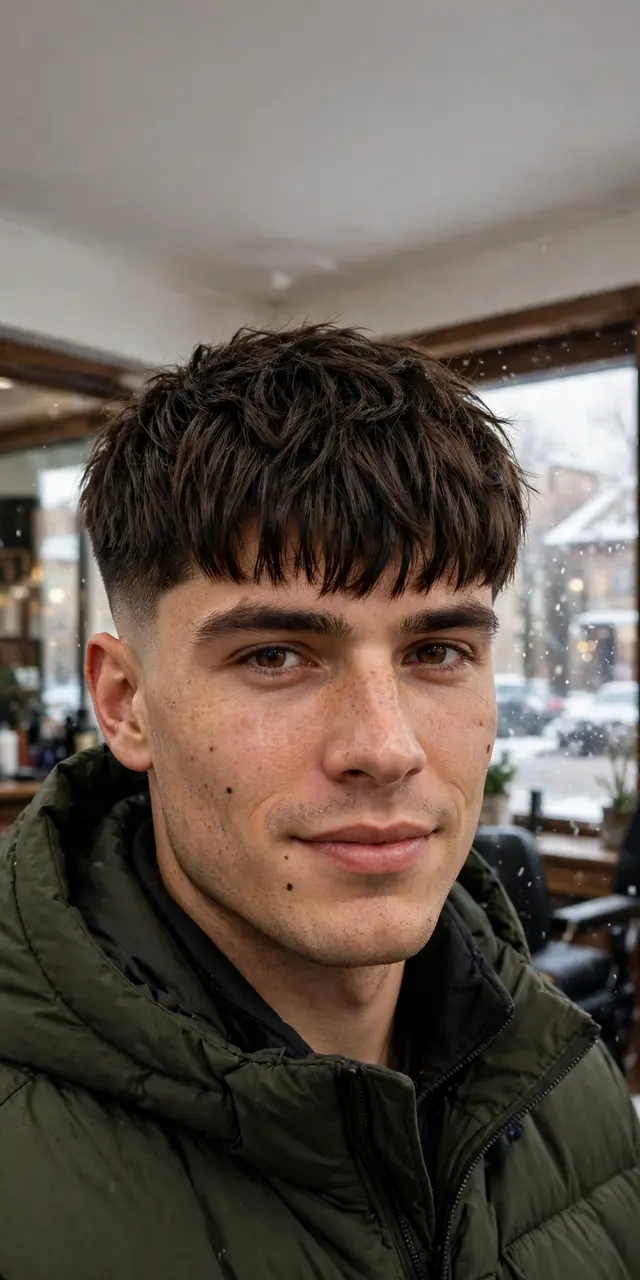
What is the single best fringe hairstyle for men?
The one that combines this guide’s lessons at their most wearable: a textured fringe with real point-cut depth, worn at brow length so it survives hats and offices alike, over a mid fade that frames it fresh for two weeks, with the option — built into the length — to sweep it sideways on formal days. The Fringe King is not the bluntest here (that is the straight fringe), the longest (the long fringe) or the wildest (the asymmetrical) — it is the balanced one: the trend’s face, executed at the length and texture that flatter the most men and forgive the most mornings. If you book one fringe this winter, book this one.
Face Shape: The most forgiving front here — brow length and broken texture adjust to long, oval, round and square faces alike.
Grooming Kit: Matte clay, a brush for sweep days, and fingers for the rest. Three tools, every version of the week.
Maintenance: Every 3 weeks at the barber; under a minute each morning is the honest daily price.
Barber Script: “The full works — textured fringe at brow length, deep point-cutting, mid fade, long enough to sweep.”
Texture, balance and a front that survives winter — the complete fringe.
Q: Why does this beat a plain French crop?
A: Range. The French crop’s blunt line is one look, worn one way; the king’s texture and brow length give you the fallen fringe, the swept version and the pushed-up front from a single cut. Versatility is what a king is for.
Q: What is the one habit that makes any fringe look better?
A: Drying it forward from wet, every time. A fringe styled on slept-in hair never reaches its shape — the roots have already set backward or sideways overnight. Wet it down, dry it forward: that sequence is most of the style.
The Bottom Line
Fringe hairstyles for men run on three truths: the front is the style — choose its length by your face (shorter for round and fine, longer for square and thick) and its edge by your temperament (blunt for architecture, broken for ease); the sides are the frame — a fade for freshness, a taper for manners; and winter is the fringe’s real test, passed by above-brow length, a forward dry before the hat, and a thirty-second rebuild after it. Pick your fringe by your hair type — curl keeps its moisture, waves keep their length, fine hair keeps it short and supported — and keep the three-week rhythm. For the fringe’s closest cousin worn flatter, see the textured crop guide, and for the front line at its sharpest, the Edgar cut guide.





One Comment