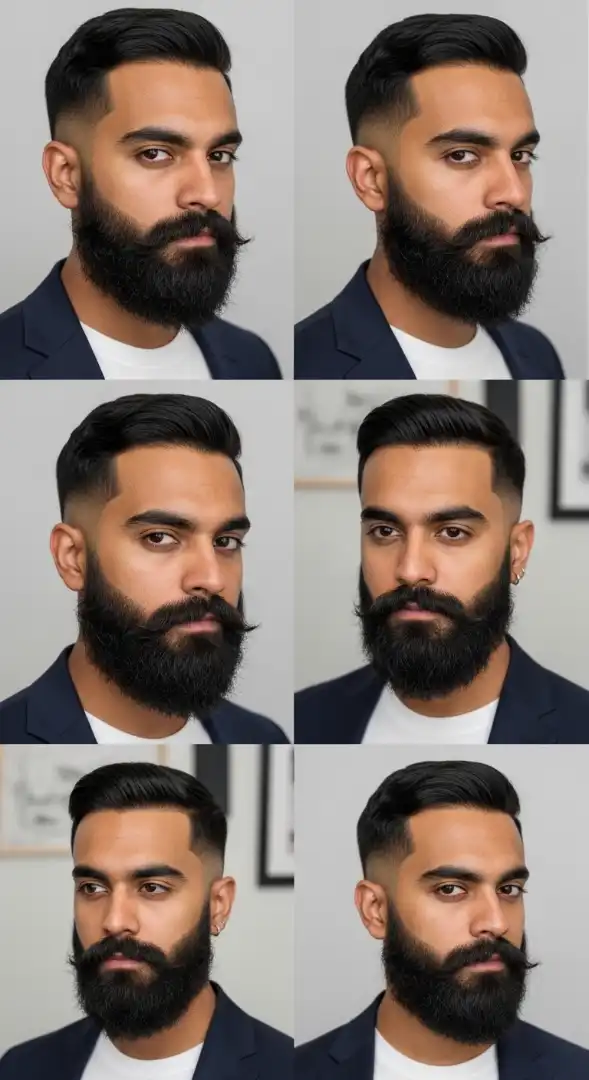
20 Caesar Cut Hairstyles for Men: Classic, Textured & Modern Versions
The oldest haircut in this entire series is suddenly the one to watch. The Caesar cut — two thousand years old, named for a Roman emperor — is climbing again on every dataset that matters: booking platform Fresha puts Caesar searches up 83 percent year over year, trend trackers describe it as “returning with updated proportions”, and hairline-matching tools now recommend it by name for receding and thinning hair. The reason is the era: men’s hair in 2027 is about quiet upkeep — short, honest, low-drama cuts that look deliberate without a daily routine — and no cut was ever more quietly deliberate than this one.
Understand the architecture and every version in this guide makes sense. A Caesar cut runs the top at one short, even length — one to two inches — brushed forward, and finishes it with the signature: a short fringe cut straight across the forehead. The sides stay short, by scissor, taper or fade. That forward fringe is the whole genius of the design: it covers the forehead, softens the temple corners, and makes a maturing hairline a non-issue, which is why barbers reach for it when a client says “short, but kind”. Two neighbours need fencing off before we start: the French crop wears a longer, choppier fringe (two to three inches, point-cut), and the crew cut tapers its top and wears the front up. The Caesar is shorter, straighter and more forward than both.
Inside: the classic blueprint, the textured and cropped versions, taper, skin fade, high fade, undercut and line-up pairings, versions for curly, wavy, straight, thick and fine hair, the buzz-length extreme, the longer fringe, the messy take, the receding-hairline case, the winter version, and the complete look that obeys every rule. Each comes with the face shapes it flatters, the kit it needs, the upkeep it honestly demands, and the exact words to say in the chair. For the Caesar’s longer-fringed cousin in depth, see our textured crop hairstyles for men guide; for the tapered-top classic, our crew cut hairstyles for men guide is its home.
1 of 20 — The Classic Caesar Cut
What exactly is a Caesar cut?
The original. The classic Caesar cut runs the top at one even length — an inch to an inch and a half — brushed forward into a short fringe cut straight across, with the sides scissor-cut short and neat. No fade, no texture tricks, no styling theatre: the same silhouette carved on Roman statues, and still the cleanest short answer in barbering. If a client asks for “short and tidy, but not a buzz”, this is where the conversation starts.
Face Shape: Oval and square faces wear it best — the straight fringe shortens a long forehead and the even top keeps proportions honest.
Grooming Kit: Almost nothing. A fingertip of matte cream on the days you want separation; the cut is designed to work without product.
Maintenance: Every three to four weeks — the fringe line is the feature, and it is the first thing regrowth blurs.
Barber Script: “Classic Caesar — top at one even length, about an inch and a half, brushed forward, short straight fringe, sides scissor-cut short.”
Q: What is the difference between a Caesar cut and a French crop?
A: Length and fringe character. The Caesar is one to two inches with a short, straight fringe; the French crop runs two to three inches with a longer, choppier, point-cut fringe. The Caesar is the tidier ancestor.
Q: Is the classic Caesar too plain for 2027?
A: The data says the opposite — the quiet, even version is exactly what the low-upkeep era is booking. Plain, cut perfectly, reads as confidence.
Two thousand years old — and the tidiest inch in barbering.
2 of 20 — The Textured Caesar Cut
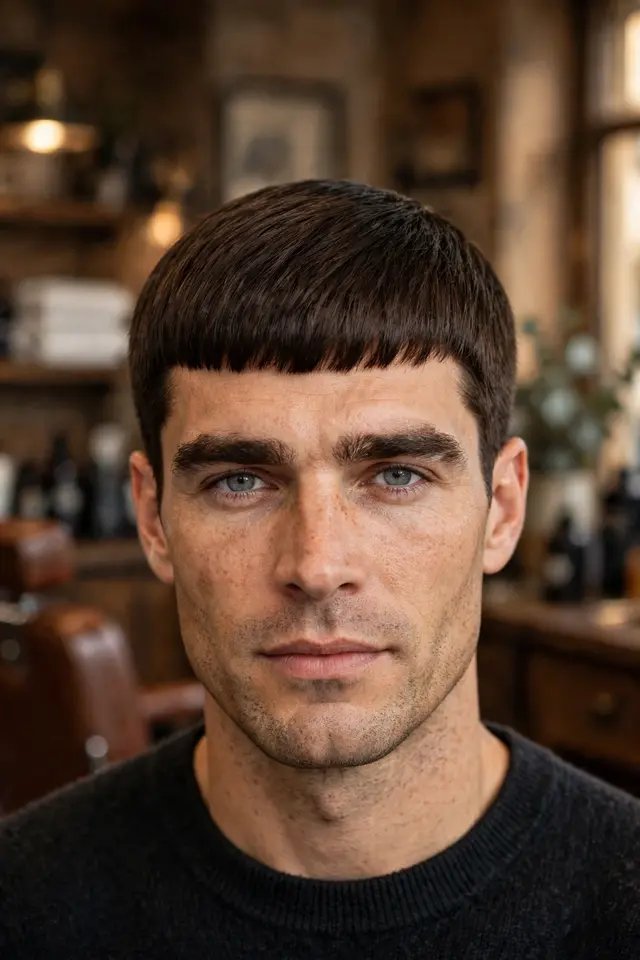
What changes when you add texture?
Everything except the silhouette. The textured Caesar cut keeps the even short top and straight fringe, then point-cuts the top so the hair separates into visible pieces instead of lying as one sheet. It is the version trend lists mean by “updated proportions”: the Roman outline, with a modern, broken-up surface that photographs better, styles in seconds and forgives a cowlick the classic cannot hide.
Face Shape: All faces — the texture adds width on narrow faces and breaks up the blockiness on square ones.
Grooming Kit: A matte clay or paste, pea-sized, worked through dry hair with fingertips — texture is placed by fingers, never by comb.
Maintenance: Three to four weeks; the point-cutting holds its separation longer than a blunt top does.
Barber Script: “Textured Caesar — inch and a half on top, point-cut for separation, brushed forward, straight fringe, sides short.”
Q: Textured or classic Caesar for thick hair?
A: Textured, almost always — point-cutting removes the helmet effect thick hair gets from an even blunt top, while keeping the same clean fringe.
Q: How do I stop the texture looking messy by evening?
A: Less product, applied to fully dry hair. Clay on damp hair separates by noon; on dry hair it holds the pieces where your fingers put them.
The Roman outline, broken up for the camera age.
3 of 20 — Caesar Cut with a Low Taper

Why pair the Caesar with a low taper?
Because it is the 2026 update the trackers keep naming. Caesar cut with a low taper keeps the short forward top and straight fringe, then tapers only the sideburns and neckline — no fade line up the side, no skin, nothing to shout. The result is the softest modern Caesar: the fringe does the talking, the edges simply vanish, and the grow-out is the kindest of any pairing in this guide.
Face Shape: All faces, and especially good for men whose workplaces reward polish over statement.
Grooming Kit: A light matte cream and a comb for the fringe line; the taper asks for nothing.
Maintenance: Four weeks comfortably — the taper’s edges blur gracefully instead of expiring.
Barber Script: “Caesar with a low taper — top even at an inch and a half, forward, straight fringe. Taper the sideburns and neckline only.”
Q: Low taper or scissor sides on a Caesar?
A: Scissor sides are the classic; the low taper is the modern refresh — cleaner at the edges, softer grow-out, same top. Choose by how sharp you want the outline.
Q: Does the low taper work with a beard?
A: Beautifully — the taper’s gentle edge meets the beard’s top line without a hard junction. It is the most grown-up pairing in this guide.
The modern Caesar — fringe in front, whisper at the edges.
4 of 20 — Caesar Cut with a Skin Fade

How sharp can a Caesar get?
This sharp. Caesar cut with a skin fade takes the sides to the skin and blends up into the short forward top, maximising contrast: bare sides, dense top, and the straight fringe drawn like a ruler across the forehead. It is the loudest Caesar in the guide and the one barbers photograph — the Roman silhouette rebuilt with modern clipper aggression.
Face Shape: Strong, even features — the exposure is total, so the head shape and jaw do the talking.
Grooming Kit: None for the sides; a matte product for the top only. Sunscreen for newly exposed skin in the first week.
Maintenance: Every two to three weeks — skin fades expire fastest, and this one’s contrast shows regrowth honestly.
Barber Script: “Caesar with a skin fade — top at an inch and a half brushed forward, straight fringe, skin fade on the sides, keep the fringe line crisp.”
Q: Is a skin fade Caesar office-safe?
A: In creative and casual workplaces, yes; in conservative ones, choose Style 3. The top is identical — only the sides change volume.
Q: How do I keep the fringe line straight between visits?
A: You don’t cut it yourself — a home trim ruins the geometry. A barber edge-up at the two-week mark keeps it ruler-straight cheaply.
Maximum contrast — the fringe drawn with a ruler.
5 of 20 — The Caesar Crop
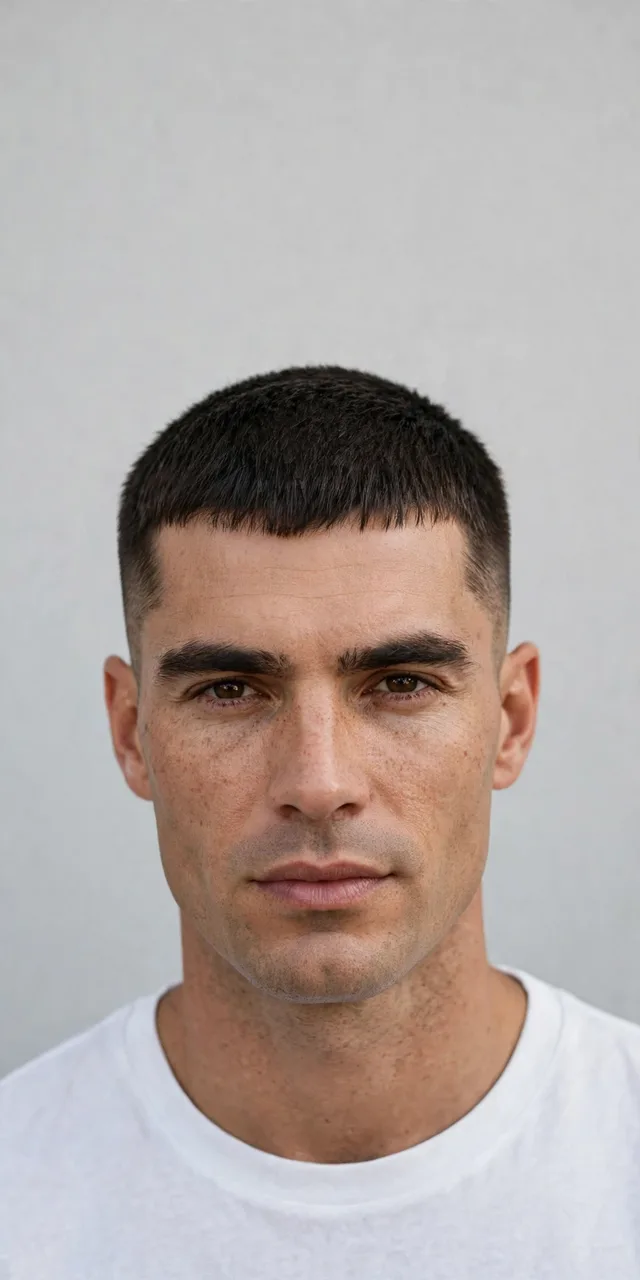
What is the difference between a Caesar and a Caesar crop?
Length, again — the Caesar crop is the shortest full version: the top cropped closer (around an inch or under), the fringe shorter and tighter to the forehead, the whole cut reading almost like a textured buzz with a fringe line. It is the minimalist’s Caesar — the least hair that still carries the signature — and the easiest version in this guide to live with.
Face Shape: Oval and angular faces; the tight proportions reward bone structure and punish nothing.
Grooming Kit: Optional entirely. A matte fibre for the days you want the fringe defined; nothing on the others.
Maintenance: Three weeks, and every visit is quick — there is very little hair to argue about.
Barber Script: “Caesar crop — top cropped to about an inch, forward, short straight fringe kept tight, sides short and clean.”
Q: Caesar crop or French crop — which is shorter?
A: The Caesar crop, clearly. The French crop keeps two to three inches of choppy top; the Caesar crop sits near an inch with a straighter fringe.
Q: Is the Caesar crop good for thinning hair?
A: Very — short, even and forward is the density formula. Keep it matte and avoid wet-look products, which separate fine hair and show scalp.
The least hair that still signs its name.
6 of 20 — Caesar Cut with a High Fade
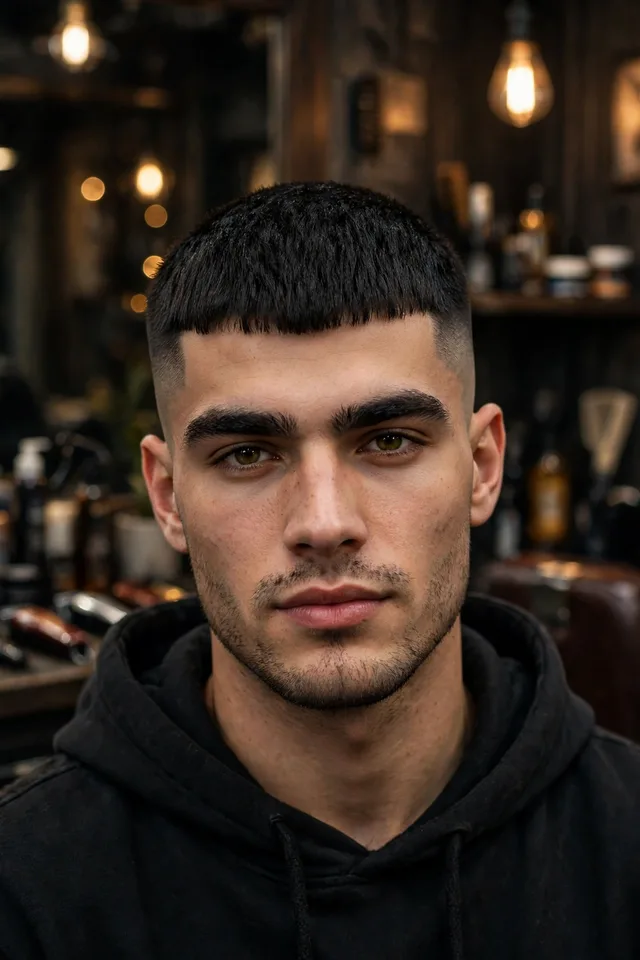
Does a high fade break the Caesar rules?
It bends them deliberately. Caesar cut with a high fade takes the fade up to the temples, leaving the short forward top as an island — the fringe becomes the entire front of the haircut, framed by bare sides. It suits men who want the Caesar’s hairline kindness with a fade’s aggression, and it is the version most often requested by younger clients in barbershop trend reports.
Face Shape: Round faces gain the most — the high fade slims the sides and the fringe shortens the face’s height.
Grooming Kit: A matte paste for the top island; the fringe must sit forward and flat, not lifted.
Maintenance: Two to three weeks — high fades show their regrowth line early and honestly.
Barber Script: “Caesar with a high fade — top inch and a half forward with a straight fringe, fade taken high to the temples.”
Q: High fade or skin fade Caesar — what is the difference?
A: Height versus depth. A skin fade describes how short the fade goes (to skin); a high fade describes where it starts (at the temples). This one usually does both.
Q: Does a high fade suit a receding hairline?
A: Less well than Style 17 — bare temples next to a thinning front create contrast. The low taper version hides recession; the high fade advertises bone structure.
The fringe as an island — bold water all around.
7 of 20 — Caesar Cut with an Undercut

Can a Caesar sit on an undercut?
It can — and the disconnection suits the fringe. Caesar cut with an undercut clips the sides to one short length with no blend, so the forward top ends at a visible shelf and the straight fringe becomes a hard graphic line. It is the most fashion-forward Caesar in the guide: Roman geometry with a deliberately modern break in it.
Face Shape: Angular and oval faces — the shelf adds width at the temples, which narrow faces welcome.
Grooming Kit: A matte clay to keep the top lying forward over the shelf; a comb to keep the fringe line intentional.
Maintenance: Three weeks — the shelf stays graphic only while the sides stay short.
Barber Script: “Caesar with an undercut — top forward at an inch and a half, straight fringe, sides clipped to one short length, no blending.”
Q: Will the top hang over the sides oddly?
A: At Caesar lengths, no — the top is too short to flop. The shelf reads as a clean step, which is exactly the graphic effect this version wants.
Q: Undercut or faded sides for a first Caesar?
A: Faded (Styles 3 or 4) for a first — the blend forgives more and grows out kinder. The undercut is the commitment version.
Roman geometry, with a deliberate break in it.
8 of 20 — Caesar Cut with a Line Up
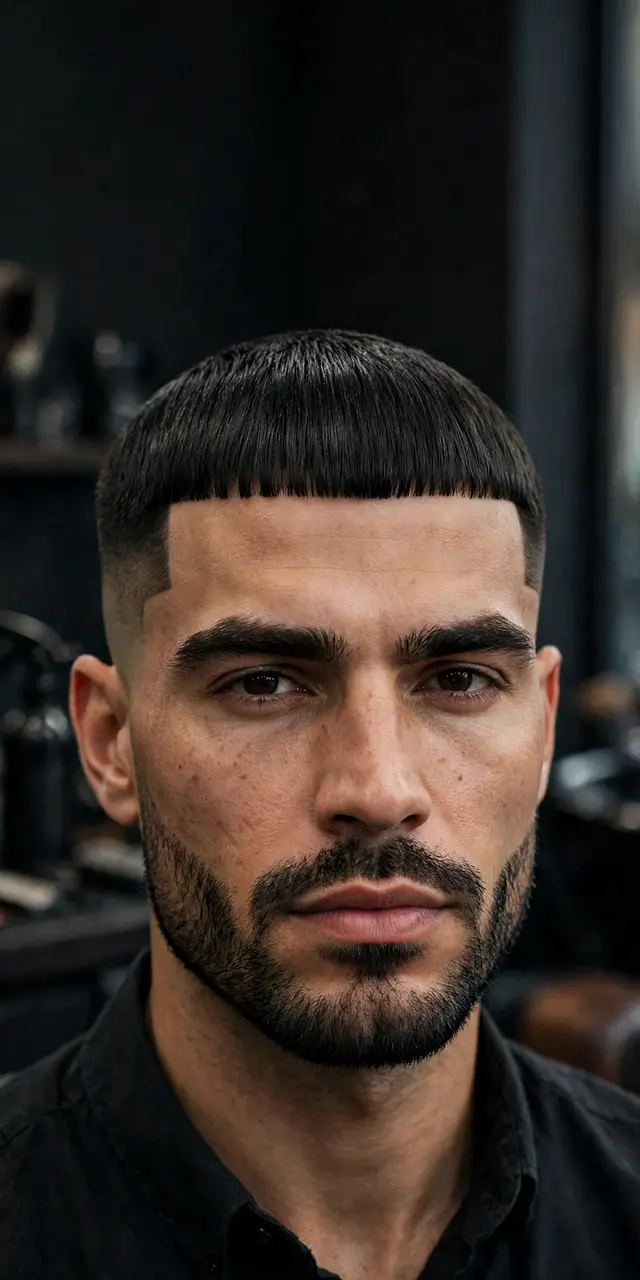
Why do the Caesar and the line-up belong together?
Because both are geometry. Caesar cut with a line up sharpens every edge the cut owns — the fringe line, the temples, the hairline corners — into crisp, ruler-drawn borders. On a cut this short and straight, the line-up is not decoration; it is the difference between tidy and architectural. It is also the version whose photos travel furthest on barbershop feeds.
Face Shape: All faces with a reasonably straight natural hairline — the line-up enhances a line rather than inventing one.
Grooming Kit: Nothing new for the top; the investment here is barber time, not product.
Maintenance: The cut holds three to four weeks, but the line-up itself wants a refresh every ten days to stay architectural.
Barber Script: “Caesar with a line up — even top forward, straight fringe, and sharpen the fringe line, temples and corners.”
Q: Does a line-up look natural?
A: Cut conservatively, yes — it cleans the existing line. Cut aggressively into a new hairline, it looks drawn-on and grows out badly. Ask for enhancement, not invention.
Q: Can I maintain the line-up at home?
A: The temples, carefully, with a trimmer and a steady hand. The fringe line, no — one slip rewrites the whole haircut. Leave the front to the barber.
Tidy is a choice; architectural is a line-up.
9 of 20 — The Curly Caesar Cut

How does the Caesar handle curls?
By shortening them into obedience. The curly Caesar cut keeps an inch or two of curl on top, brushed and trained forward so the fringe lands as a soft, textured line instead of a straight one — the curl’s natural piece-iness does the texturing for free. It is one of the most requested curly short cuts in barbershops because it ends the daily negotiation with longer curls.
Face Shape: All faces — the fringe softens long foreheads and the short sides keep curly volume from widening the head.
Grooming Kit: A curl cream or leave-in for moisture, applied to damp hair; matte paste only if a piece needs persuading.
Maintenance: Three to four weeks; curls forgive regrowth at the sides but the fringe length sets the appointment.
Barber Script: “Curly Caesar — top at an inch and a half to two inches, cut dry, forward, fringe following the curl. Sides short.”
Q: Should curly hair be cut wet or dry for a Caesar?
A: Dry, by a barber who knows curls — wet curls stretch and spring back shorter than expected, which is how fringes end up an inch too short.
Q: How do I stop the fringe frizzing?
A: Moisture, not product weight: leave-in on damp hair, hands off while it dries, and a silk pillowcase does more than any serum.
The curl, shortened into obedience — and it suits it.
10 of 20 — The Wavy Caesar Cut

What does the wave add to a Caesar?
Movement the straight version has to fake. The wavy Caesar cut combs the top forward so the natural wave bends across the forehead, turning the straight fringe into a soft, sweeping line. It reads relaxed where the classic reads formal — the Caesar for men whose hair already has a opinion and no intention of lying flat.
Face Shape: Oval and rectangular faces; the wave’s sweep adds width that narrow faces welcome and square faces should keep shorter.
Grooming Kit: A light cream or sea-salt spray for definition; heavy clay flattens the wave you are trying to keep.
Maintenance: Three to four weeks — waves grow out softly, so this version forgives a late appointment.
Barber Script: “Wavy Caesar — top around two inches, forward with the wave, fringe cut to sit where the wave bends. Sides short and clean.”
Q: Should the fringe follow the wave or fight it?
A: Follow it — always. A fringe cut against the wave’s bend springs up and splits. Cut where the wave lands and it lies there by itself.
Q: Wavy Caesar or wavy fringe — what is the difference?
A: Length. The Caesar’s fringe is short and even; the fringe family wears it longer and looser. Same direction, different commitment.
The formal cut, relaxed by its own weather.
11 of 20 — Caesar Cut for Straight Hair

Why is straight hair the Caesar’s home turf?
Because the cut was designed on it. Caesar cut for straight hair runs the even top forward and the fringe falls in one clean, straight line — no training, no persuasion, no product diplomacy. Straight hair also shows the cut’s geometry most honestly: every millimetre of the fringe line is visible, which is why barbers judge a Caesar by how it sits on straight hair.
Face Shape: All faces; long faces gain the most, since the horizontal fringe line visually shortens the forehead.
Grooming Kit: A matte paste for separation — straight hair’s only Caesar problem is lying too flat and looking like a helmet.
Maintenance: Three to four weeks; straight hair shows the fringe line blurring first, so keep the rhythm.
Barber Script: “Caesar for straight hair — top even at an inch and a half, forward, fringe cut straight and clean. Point-cut the ends lightly so it doesn’t sit flat.”
Q: How do I stop a straight Caesar looking like a bowl cut?
A: Two defences: keep the fringe short (above the eyebrows, never touching them) and ask for light point-cutting so the line is clean but not stamped. Length is what makes bowls.
Q: Should straight hair get the textured or classic version?
A: A light texture (Style 2) — the classic’s blunt sheet is the one version that can read flat on pin-straight hair. A little separation fixes it.
The geometry, shown honestly — straight hair hides nothing.
12 of 20 — Caesar Cut for Thick Hair
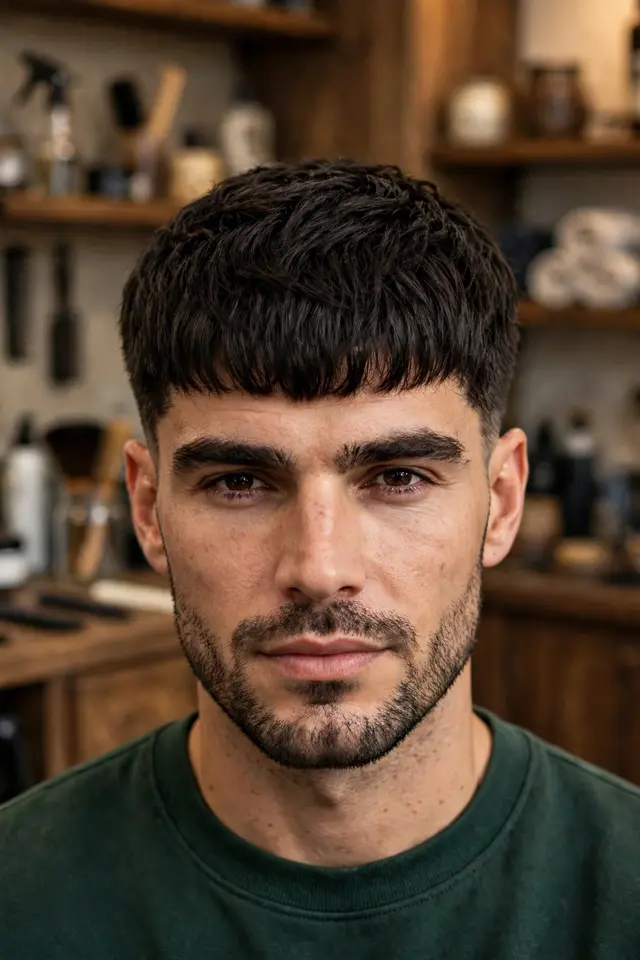
How do you stop thick hair looking like a helmet?
Thin it from inside and texture the ends. Caesar cut for thick hair is the version stylists keep calling underrated: the short even top removes the bulk that makes thick hair unmanageable, internal thinning stops the helmet effect, and the forward fringe gives all that density a direction. Thick hair holds the Caesar’s shape better than any other hair type — it just needs a barber who removes weight, not length.
Face Shape: All faces — thick hair’s natural volume suits the short proportions, and round faces should keep the sides tighter.
Grooming Kit: A heavy-hold matte clay, small amount, worked to the roots — thick hair ignores light products entirely.
Maintenance: Three to four weeks; thick hair regains its bulk fast, and the internal thinning is refreshed each visit.
Barber Script: “Caesar for thick hair — top at an inch and a half, forward, straight fringe. Thin the bulk from inside and texture the ends; I don’t want a helmet.”
Q: Why does my thick Caesar puff up after a week?
A: Bulk regrowth — thick hair grows outward as much as downward. The fix is the barber’s internal thinning at every visit, not more product at home.
Q: Thick hair — Caesar or textured crop?
A: Both work; the Caesar is shorter and tidier, the crop longer and looser. If your thick hair defeats styling by noon, the Caesar’s brevity wins.
Density, given a direction — thick hair’s tidiest answer.
13 of 20 — Caesar Cut for Fine Hair

Can fine hair carry a Caesar?
Yes — short is fine hair’s friend. Caesar cut for fine hair keeps the top short and even so the strands overlap and read denser, brushes everything forward to cover the hairline, and avoids the two fine-hair traps: length, which separates and shows scalp, and wet-look product, which does the same in minutes. Cut right, a fine Caesar looks thicker than the hair it is made from.
Face Shape: All faces — the forward fringe and even top flatter fine hair on any bone structure.
Grooming Kit: A matte volumising paste or a light clay, used sparingly on dry hair; a dryer for thirty seconds of forward lift.
Maintenance: Every three weeks — fine hair shows regrowth separation sooner, and the fringe placement is the strategy.
Barber Script: “Caesar for fine hair — top short and even, forward, fringe covering the corners. Keep every bit of density; no thinning shears.”
Q: Why must fine hair avoid thinning shears?
A: Fine hair has no bulk to spare — thinning removes the overlap that creates the illusion of density. Texture for fine hair comes from the cut’s shortness, not from shears.
Q: Which products make fine hair look thinner?
A: Gels, oils and anything with shine. Wet separation is the enemy; matte and dry is the whole strategy for this version.
Shorter, matter, denser — fine hair’s honest illusion.
14 of 20 — The Short Caesar Cut
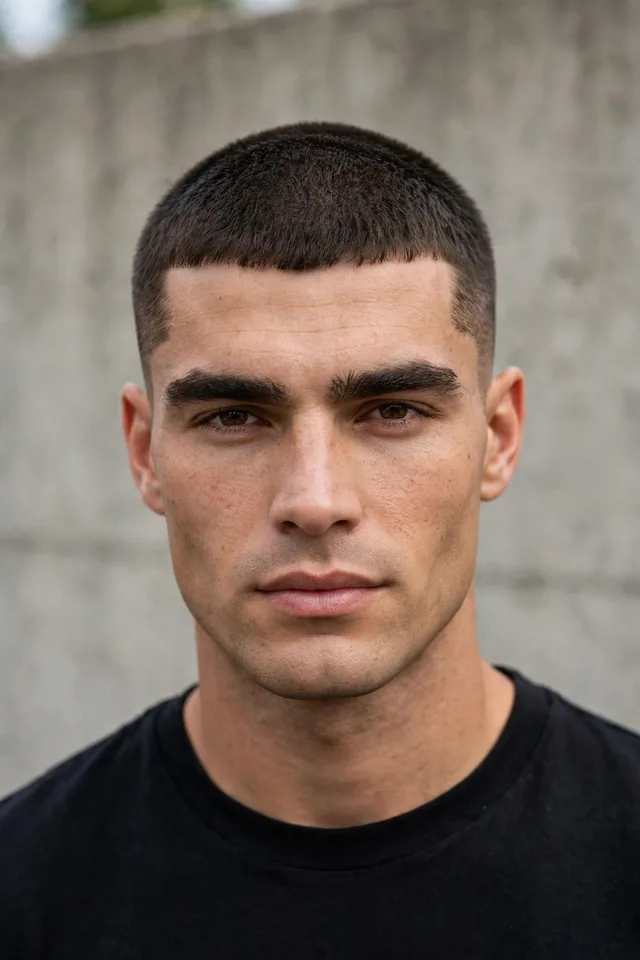
How short can a Caesar go?
To buzz length — with one line left standing. The short Caesar cut runs the top at a #4 or #5 guard, nearly a buzz, but keeps the fringe cut as a deliberate straight line across the forehead. That single line is the entire difference between this and a buzz cut: minimalism with a signature. It is the lowest-upkeep Caesar in the guide and the bravest-looking.
Face Shape: Strong, even features and a good head shape — at this length there is nowhere for anything to hide.
Grooming Kit: None. Moisturiser and sunscreen for a scalp at this exposure; styling does not exist here.
Maintenance: Two to three weeks — buzz lengths show regrowth quickly, though each visit takes minutes.
Barber Script: “Short Caesar — #5 on top, forward, but cut the fringe as a clean straight line. Sides to match, edges tidy.”
Q: Short Caesar or buzz cut — what actually differs?
A: The fringe line. A buzz is one length with a natural hairline; the short Caesar keeps a cut, straight fringe. It is a small difference that reads as a completely different intention.
Q: Can I do the short Caesar at home?
A: The length, yes — clippers are honest. The fringe line, risky: it is the only skilled part. Most men clipper the top and let the barber draw the line monthly.
Buzz length, one line standing — minimalism with a signature.
15 of 20 — Caesar Cut with a Longer Fringe

How long can the fringe go before it stops being a Caesar?
About two inches — and this version lives on that border deliberately. Caesar cut with a longer fringe keeps the even top but lets the fringe reach the eyebrows, brushed forward in a fuller curtain of hair. It borrows the crop family’s drama while keeping the Caesar’s straight, even discipline — the choice for men who want the forehead coverage maximised and the look a little less military.
Face Shape: Long and oval faces gain the most — the fuller fringe shortens the forehead most dramatically of any version here.
Grooming Kit: A light matte cream and a comb; the longer fringe needs a morning direction, unlike its shorter brothers.
Maintenance: Three weeks — fringe length is the feature and drifts past the eyebrows quickly.
Barber Script: “Caesar with a longer fringe — top even at two inches, fringe left to the eyebrows, kept straight and full. Sides short.”
Q: At what point does this become a French crop?
A: When the fringe gets choppy. Keep it straight and even and it is a Caesar at any length; point-cut it into pieces and you have crossed into crop territory (Style 5’s family).
Q: Does a longer fringe suit a professional job?
A: Yes, kept neat — it reads as a deliberate fringe, not a statement. Let it pass the eyebrows and it starts reading as a different, younger haircut.
The border version — maximum coverage, Caesar discipline.
16 of 20 — The Messy Caesar Cut

What makes a Caesar messy on purpose?
Broken pieces, kept short. The messy Caesar cut point-cuts the top into separated, uneven pieces and breaks the fringe line into a soft zigzag instead of a ruler edge — the silhouette stays Caesar, the surface goes deliberately undone. It is the version for men who find the classic too tidy: same brevity, same forward direction, none of the parade-ground finish.
Face Shape: All faces — the broken fringe softens strong foreheads and the texture flatters narrow faces.
Grooming Kit: A matte paste, fingertip amount, pinched into the ends piece by piece — messy is placed, not shaken into being.
Maintenance: Three to four weeks; the mess forgives regrowth better than the ruler-straight versions do.
Barber Script: “Messy Caesar — top inch and a half, point-cut into pieces, fringe broken and uneven, forward. Sides short and clean so the mess stays on top.”
Q: Messy Caesar or textured Caesar — what is the difference?
A: The fringe. The textured version keeps the fringe line straight while texturing the top; the messy version breaks the fringe itself. One notch further from the parade ground.
Q: Can messy still look deliberate and not uncut?
A: Yes — the sides are the tell. Clean short sides under a broken top reads as a style; grown-out sides under it reads as neglect.
Parade-ground length, weekend surface.
17 of 20 — Caesar Cut for a Receding Hairline

Why is the Caesar the hairline’s best friend?
Because the fringe does the covering. Caesar cut for a receding hairline brushes the top forward so the fringe covers the temple corners where recession starts, keeps the sides’ length moderate (no bare contrast beside a thinning front), and never asks the hairline to perform. Hairline-matching tools recommend this cut by name for receding and thinning hair — of every short cut in barbering, this is the one designed, almost by accident, to be kind at the front.
Face Shape: All faces with early-to-moderate recession; advanced recession is better served by Style 14 or a buzz — your barber should say so honestly.
Grooming Kit: A matte volumising product and thirty seconds of dryer time forward; shine at the front is the enemy.
Maintenance: Every three weeks — the fringe’s placement over the corners is the strategy and must stay where the barber put it.
Barber Script: “Caesar for a receding hairline — top forward to cover the corners, fringe straight, keep the sides’ length moderate, no skin fade.”
Q: Why do high fades look so bad with recession?
A: Contrast. Bare temples beside a thinning front make the thin area the most noticeable thing on the head. The Caesar removes the contrast and covers the evidence.
Q: How much recession can a Caesar honestly cover?
A: Early to moderate — corners and early temple retreat. Once the front is deeply receded, the fringe has nothing to stand on, and short-all-over (Style 14) is the stronger answer.
Kindness by geometry — the fringe stands where the hairline retreats.
18 of 20 — Caesar Cut for Black Men

Why does the Caesar anchor Black barbering?
Because the dark Caesar is a foundation cut. Caesar cut for Black men runs the top short and even — often at wave length — brushed forward into a clean fringe, with tapered edges and a sharp line-up finishing the outline. It is the base under 360 waves, the tidy answer for coarse and coily hair, and one of the most-worn short cuts in Black barbershops for decades: the Caesar’s evenness is what waves are trained on.
Face Shape: All faces; the top’s even length and the line-up’s geometry flatter every bone structure.
Grooming Kit: A moisturising pomade or wave butter, a medium brush for training, and a durag for the night routine.
Maintenance: Edges and line-up every one to two weeks — the outline is the detail everyone sees; the top holds longer.
Barber Script: “Caesar — top even and short, forward, fringe clean, taper the edges and finish with a line-up. I’m training waves on top.”
Q: Caesar or waves — do I have to choose?
A: No — the Caesar is the cut, waves are the training. A short even Caesar top is exactly what 360 waves are brushed into; most wave journeys start with this haircut.
Q: How do I keep coily hair moisturised at Caesar length?
A: A leave-in or light butter daily — short hair dries faster than it looks. The durag at night holds both the moisture and the forward direction.
The foundation cut — evenness that waves are built on.
19 of 20 — Winter Caesar Cut

Why is the Caesar the perfect winter short cut?
Because winter cannot hurt it. The winter Caesar cut keeps its one-to-two-inch top and short fringe — there is nothing for a beanie to crush, no fade line to expose a cold scalp, no length to go static and strange under a hood. It survives the holiday-season gap between appointments better than any styled cut, and it comes out from under a hat needing one comb-through, not a rebuild.
Face Shape: All faces — winter changes the routine around the cut, not the cut itself; choose your underlying version by face as normal.
Grooming Kit: A richer conditioner than summer for the top, moisturiser against dry heated air, and a comb for the post-beanie reset.
Maintenance: The three-to-four-week rhythm holds through winter — one appointment covers the whole holiday stretch.
Barber Script: “Winter Caesar — my usual Caesar, maybe a touch longer on top for the season. I wear a beanie over it daily.”
Q: Do beanies ruin a Caesar?
A: Less than any other cut in this series — there is no height to flatten and no part to lose. Comb it forward again and it is restored in seconds.
Q: Should I grow my hair out for winter warmth instead?
A: The Caesar will not warm your ears — no short cut will; that is the beanie’s job. What it gives you is a cut that looks identical in December and January.
The hat-proof classic — identical in December and January.
20 of 20 — The Caesar King
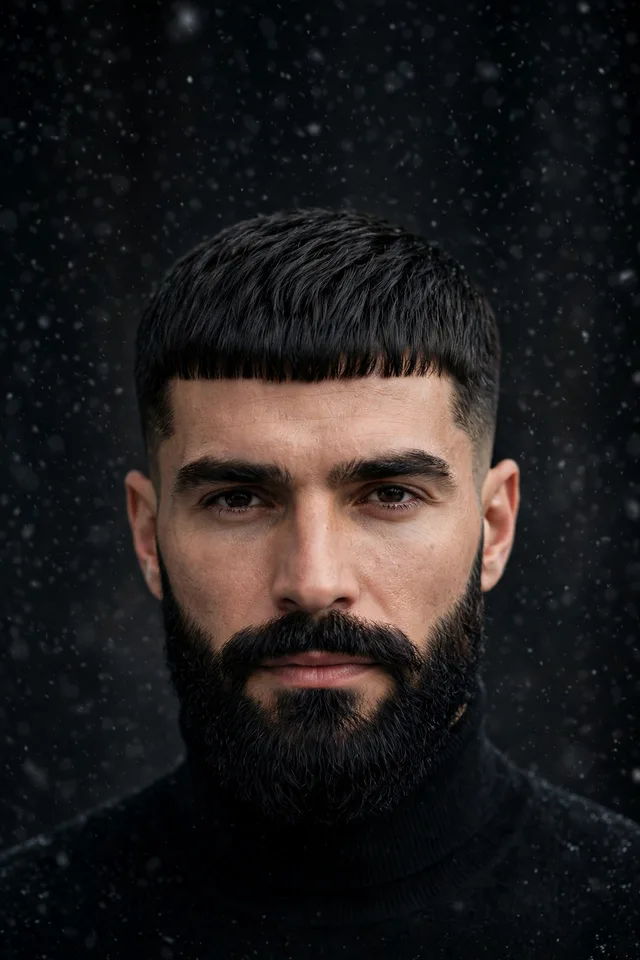
What does the complete Caesar obey?
Every rule in this guide at once. The Caesar King runs the full formula: the top textured at its full deliberate short length, the fringe cut ruler-straight and sitting exactly where it should, edges tapered clean, and a shaped beard returning weight below — with falling snow behind, because winter is when this cut’s indifference to weather shows best. Nothing is left to chance: the fringe is geometry, the texture is placed, the beard is balanced, and the whole thing still takes one minute a morning.
Face Shape: Any face that can grow the beard — the fringe and beard adjust to the face wearing them, and the combination is engineered balance.
Grooming Kit: The full bench: matte clay, a real comb, beard oil, and a barber who understands that the fringe line is the crown.
Maintenance: Fringe and edges every three weeks without exception, beard shaped at every visit — the king runs on rhythm, not hope.
Barber Script: “The full Caesar — textured top at an inch and a half, fringe ruler-straight, edges tapered clean, beard shaped to balance.”
Q: What makes this the king and not just Style 2 with a beard?
A: The completeness. Style 2 is the modern surface; the king adds the beard’s balance, the perfect fringe placement and every edge finished — the formula, completed.
Q: How do I keep the king looking royal all winter?
A: Condition against dry air, reset the fringe after every beanie, keep the three-week appointments sacred, and never let a trim soften the fringe line — the straight edge is the crown.
Every rule obeyed — two thousand years, perfected.
The Bottom Line
The Caesar won its comeback by being exactly what the era ordered: short, straight and honest. Its discipline fits in one breath — the top at one even short length, brushed forward, the fringe cut straight across, the sides kept short by whatever method suits your life. Choose your version by your hair and your honesty: the classic for purity, texture for the camera age, the taper for softness, the fades for contrast, the crop and short versions for minimalism, and the forward fringe above all if your hairline is retreating — no short cut covers it more kindly. Respect the rhythm (three to four weeks, and guard the fringe line with your life) and never let a barber chop the fringe into pieces unless you meant to order a crop. Want the longer-fringed cousin? Our textured crop hairstyles for men guide takes the fringe longer; want the absolute minimum? Our buzz cut hairstyles for men guide removes everything but the attitude. Pick the Roman — it has had two thousand years of practice.