
20 Warrior Cut Hairstyles for Men: The Textured Brad Pitt Cut & Its Modern Versions
Some haircuts are trends; the warrior cut is a reference men carry into barbershops in a screenshot. Born as Brad Pitt’s Fight Club hair — choppy, textured, deliberately wrecked — it has come back as one of the defining men’s cuts of 2026: searches for the warrior cut are up 86% year over year at roughly 150,000 a month, “Brad Pitt hair” searches are climbing again, and stylists from Alan Howard to the Daimon Barber call it one of the most requested styles in the chair, with Austin Butler’s softer red-carpet version giving it a second, more wearable reference. The appeal is the shift it represents: away from severe skin fades and sculpted styling, toward texture, movement and a cut that grows out instead of falling apart.
This guide covers 20 warrior cut hairstyles for men — the classic Fight Club original and the modern Butler version, the tapered and faded frames, the spiky, long, wavy and curly builds, and the versions tuned for thick hair, fine hair and a receding hairline. Every style comes with the face shapes it flatters, the grooming kit it needs, its upkeep rhythm, and the exact words to say to your barber. The rules that define the family run throughout: heavy point-cut texture on top, a piecey fringe pushed forward, and rugged low-to-mid tapered sides — never a skin fade, because the softness is the point.
The warrior cut borrows its forward front from the fringe family and its choppy discipline from the textured crop — both guides are worth reading alongside this one.
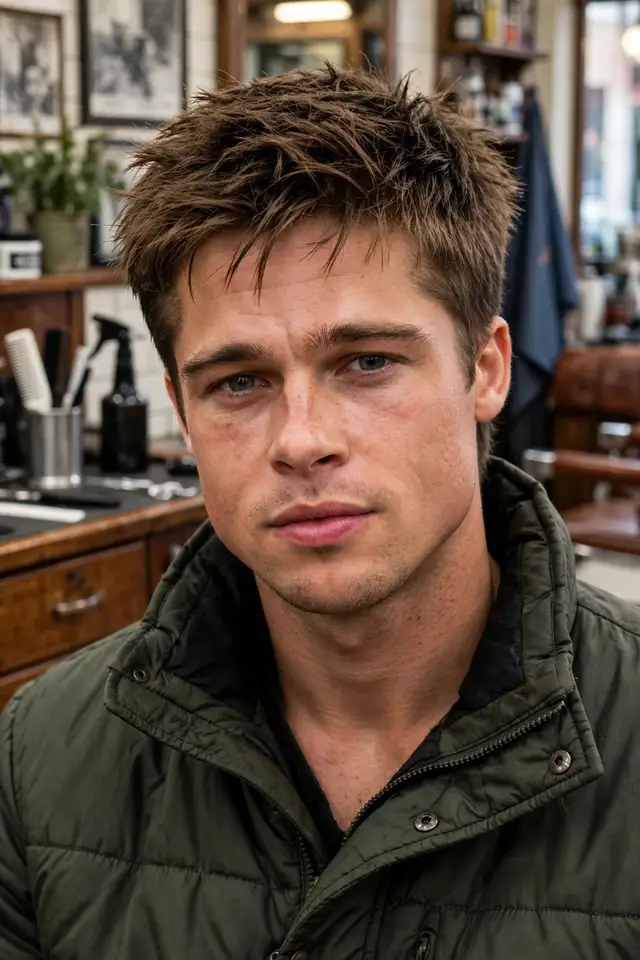
1 of 20 — The Classic Warrior Cut
What is the classic warrior cut?
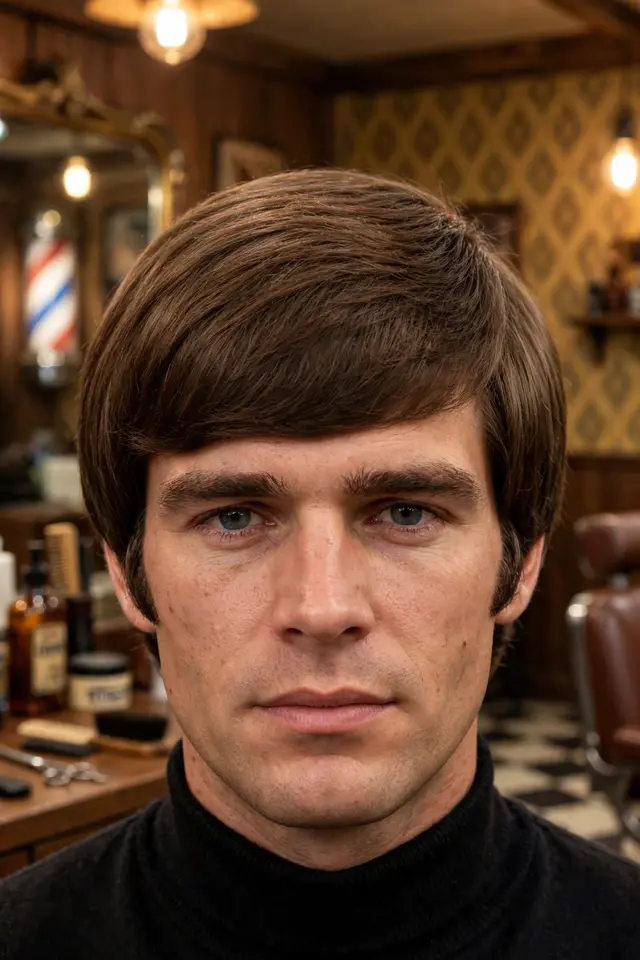
The original: Brad Pitt’s Fight Club hair, rebuilt. The Classic Warrior Cut keeps two to three inches on top — longest at the crown — point-cut and slide-cut into choppy, uneven pieces, with a piecey fringe pushed forward and broken up, never a blunt line. The sides are a low-to-mid taper on a #2 to #3 guard: short, but deliberately not skin-tight, because the rugged softness around the edges is what separates a warrior cut from a crop with a fade. Styled rough — sea salt spray, a rough blow-dry, matte clay through fingers. In winter it is in its element: it is a coat-and-scarf haircut, built to look lived-in.
Face Shape: Best on oval and square faces; the height and texture also slim round faces when the sides stay tight.
Grooming Kit: Sea salt spray, matte clay, and your fingers. A dryer for the rough-dry; a brush is not part of this religion.
Maintenance: Every 3–4 weeks — it grows out gracefully, which is half its fame.
Barber Script: “Classic warrior cut — two to three inches on top, point-cut choppy, piecey fringe forward, low taper on a #2 to #3, no skin fade.”
Fight Club’s hair, rebuilt — controlled chaos, no skin fade.
Q: What exactly makes a cut a “warrior cut” and not a textured crop?
A: Three things: the length (two to three inches, longer than a crop), the fringe (piecey and pushed forward, never blunt), and the sides (a rugged #2–#3 taper instead of a fade). A crop is the neat cousin; the warrior cut is the same family after a fight.
Q: Do I need Brad Pitt’s hair for the classic warrior cut?
A: You need thickness or wave more than you need his face. The cut was designed on thick, slightly wavy hair and shows best there. Fine, straight hair can wear it — style 8 covers the adjustments — but expect product to do more of the work.
2 of 20 — The Modern Warrior Cut
How does the modern warrior cut differ?
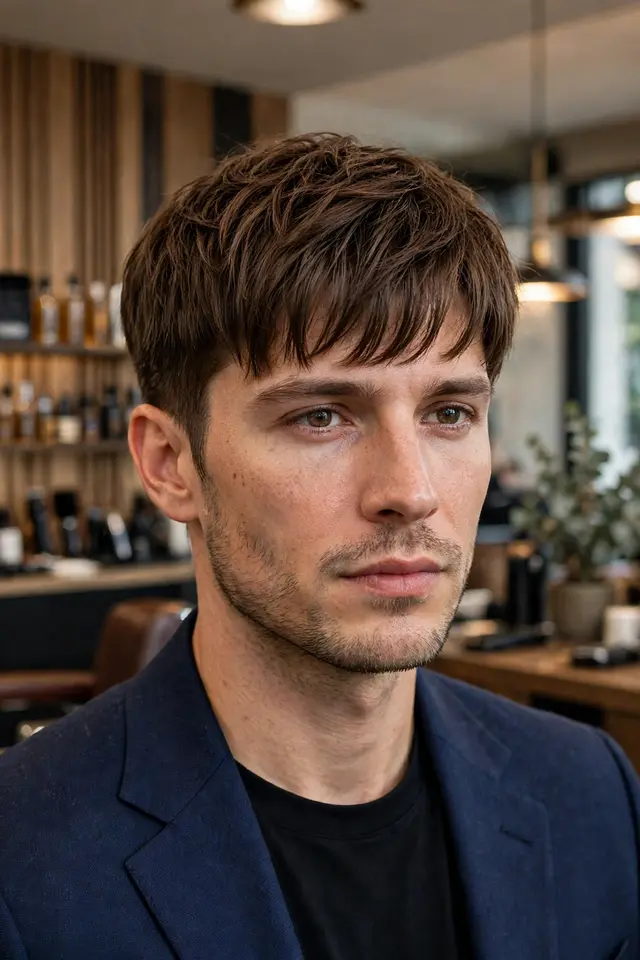
Polish, by about twenty percent. The Modern Warrior Cut — the version Austin Butler’s red-carpet appearances popularised — keeps the classic’s architecture (choppy textured top, forward piecey fringe, tapered sides) and softens the execution: the pieces are separated rather than spiked, the mess is arranged, and the finish reads deliberate in photographs and at dinners. It is the warrior cut for men who want the reference without the grunge — the version that survives a blazer. Winter is its showcase season: it is the rare “messy” cut that pairs with tailoring instead of fighting it.
Face Shape: The balanced default of the family — oval faces especially, and it softens a strong square jaw.
Grooming Kit: A light styling cream or soft clay, sea salt spray on damp hair, and two minutes with a dryer for the arranged finish.
Maintenance: Every 3–4 weeks; the softness forgives the fourth week better than the classic does.
Barber Script: “Modern warrior cut — textured top and piecey fringe like the classic, but softer and cleaner in the finish, low taper sides.”
The same bones, twenty percent more polish — the red-carpet warrior.
Q: Classic or modern warrior cut — how do I choose?
A: By wardrobe, honestly. If your week is knitwear and boots, the classic’s rawer finish is the match. If your week includes shirts, jackets and photographs, the modern version carries the same silhouette without explaining itself. The barber’s base cut is nearly identical.
Q: Is the modern warrior cut just a styled classic?
A: Almost — the cut is a touch cleaner through the sides and the top’s pieces are cut for separation rather than spikes, but yes: most of the difference lives in the styling. Many men get the classic cut and style it modern on formal days, which is the smartest seat in this guide.
3 of 20 — Warrior Cut with a Low Taper
Why pair the warrior cut with a low taper?
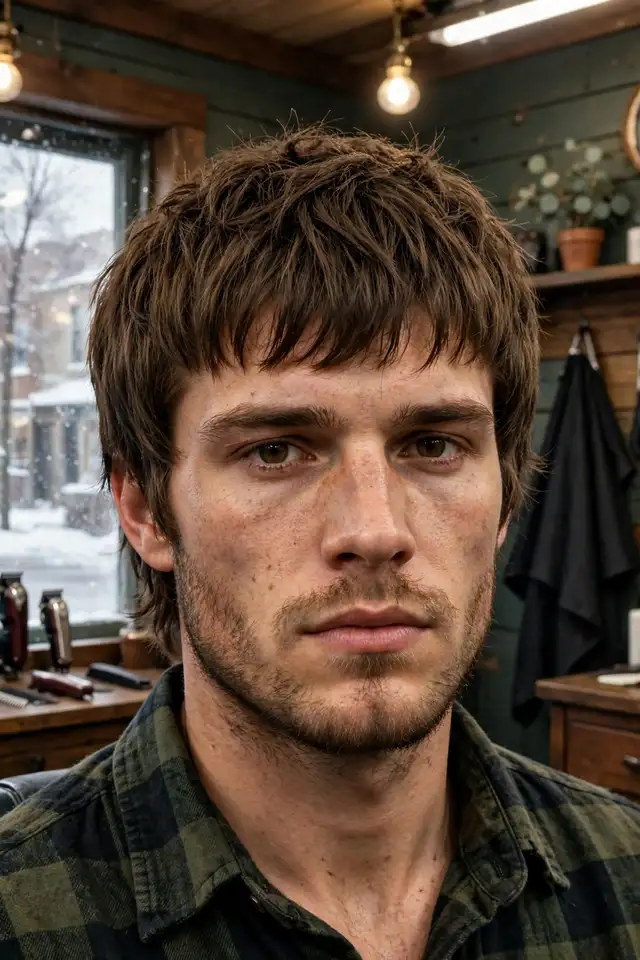
Because it is the family’s home key. Warrior Cut with a Low Taper keeps maximum ruggedness: the sides graduate only around the ears and neckline on a #2–#3, leaving the silhouette soft and grown all the way around — the closest the 2026 version gets to how the original actually sat. It is the lowest-maintenance frame here: no fade line to expire, no sharp edge for a hat band to dent, and a grow-out so gentle that the five-week version still looks intentional. Winter is gentle with it in return — nothing exposed, nothing to dry out.
Face Shape: Kind across the board; the side hair kept in place adds width where narrow faces want it.
Grooming Kit: Sea salt spray and matte clay; the taper asks for nothing.
Maintenance: Every 4 weeks, and it will forgive five — the most relaxed rhythm in this guide.
Barber Script: “Warrior cut with a low taper — choppy textured top, piecey fringe, low taper only, keep the sides rugged.”
Maximum ruggedness — the original’s own frame.
Q: Low taper or mid fade for a warrior cut?
A: The taper is the authentic frame; the mid fade (style 4) is the fresher, younger remix. Purists and low-maintenance men take the taper. If your barber suggests a fade “to clean it up,” know that you are trading the cut’s character for sharpness — sometimes worth it, never free.
Q: Will a low taper make the top look too heavy?
A: Only if the top is left unlayered. The warrior cut’s point-cutting removes the interior weight, so the top reads as texture above the soft sides, not as a block. If your hair is very thick, ask for extra slide-cutting through the crown.
4 of 20 — Warrior Cut with a Mid Fade
Is a mid fade allowed on a warrior cut?
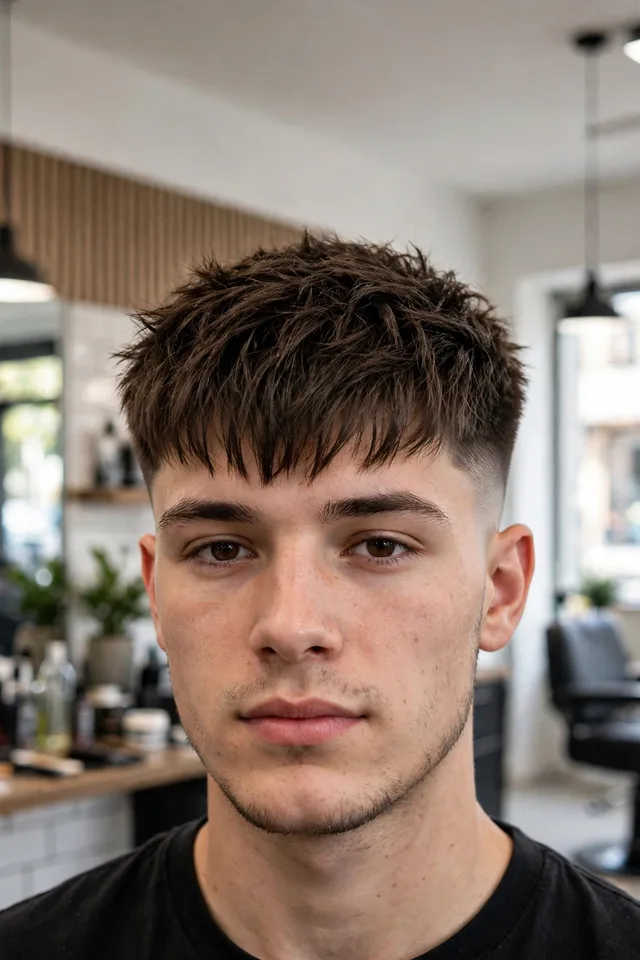
Allowed, and increasingly booked — with one warning attached. Warrior Cut with a Mid Fade keeps the choppy top and piecey fringe untouched and sharpens the frame: the sides graduate from the temples, giving the portrait a freshness the taper version trades away. Younger clients ask for it because it photographs crisper; purists object because the original’s ruggedness is the point. Both are right — this is the remix, not the record. Winter’s note: the fade sits low enough that a beanie band mostly misses it, so the top takes the hat alone.
Face Shape: The fade slims the sides, making it the round face’s best seat in the family while the top’s height does the rest.
Grooming Kit: Sea salt spray and clay for the top; a moisturiser for the faded skin in winter if it shows dry.
Maintenance: Every 2–3 weeks, set by the fade; the top could go four — the sides set the calendar.
Barber Script: “Warrior cut with a mid fade — keep the top and fringe exactly warrior, mid fade on the sides.”
The remix — warrior top, fresher frame.
Q: Does the mid fade version still count as a warrior cut?
A: By the top, yes — the choppy texture, the length and the forward piecey fringe are all present, and those are the cut’s identity. The sides are where it borrows from the fade family. Call it a warrior cut with a fade and no one at the barbershop will argue.
Q: Mid fade or skin fade with a warrior top?
A: Mid, if you must fade. A skin fade’s hard contrast fights the top’s softness and turns the portrait into a different haircut entirely — a crop with spikes. The mid fade keeps enough shadow on the sides to stay in the warrior’s world.
5 of 20 — The Spiky Warrior Cut
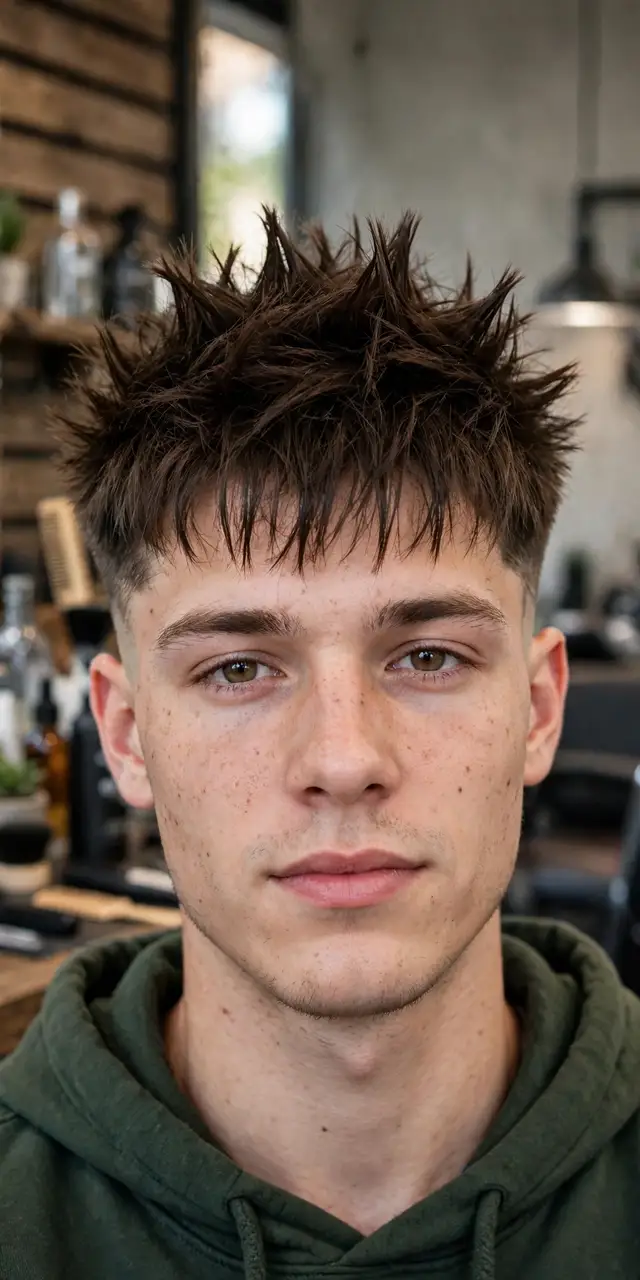
What is a spiky warrior cut?
The top at its most aggressive. The Spiky Warrior Cut takes the classic’s choppy pieces and styles them upward into separated, deliberate spikes — the Fight Club poster energy, where the top looks like it survived something. The cut supports it: pieces point-cut at varied lengths so they stand in clumps rather than as one gelled crest. It is the youngest, loudest seat in the family and the one most dependent on product discipline — spikes are clay and fingers, rebuilt each morning in a minute. Winter wind is its sparring partner; the matte finish means a flattened spike rebuilds by re-roughing, no wash needed.
Face Shape: Height-hungry faces win — round faces slim noticeably under a spiky top; very long faces should keep the spikes shorter.
Grooming Kit: Matte clay or fibre, a styling powder at the roots for separation, and dry hands. Wet-look gel belongs to another decade.
Maintenance: Every 3 weeks — spike pieces lose their points as they grow, and the points are the style.
Barber Script: “Spiky warrior cut — point-cut the top into pieces that stand, piecey fringe, low taper, matte finish.”
The poster version — spikes with a past.
Q: How do I stop spiky pieces collapsing by midday?
A: Product on dry hair, less of it than you think, and powder at the roots. Collapsing spikes are usually over-loaded spikes — heavy product pulls pieces down by noon. Build in two light passes instead of one heavy one, and rough the top back up with dry fingers at midday.
Q: Are spikes too young for a man over thirty?
A: The separated, matte, shorter spikes in this style are not the frosted crests of 2001. Worn at this length with a taper and a beard, they read as texture with intent. The tell is shine and height — keep both low and the age question disappears.
6 of 20 — The Long Warrior Cut
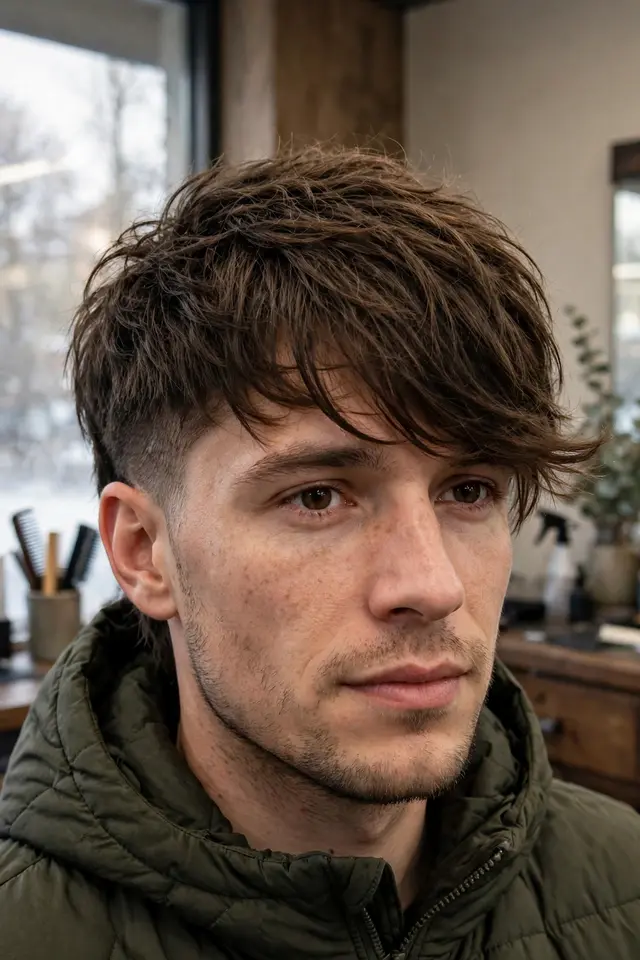
What is a long warrior cut?
The family’s upper register: the top kept at three to four inches — Pitt’s Troy-adjacent length pulled back toward the warrior’s texture — with the layers longer, the fringe piecey and long enough to sweep, and the sides still a rugged low taper. The Long Warrior Cut moves; it is the version for men growing their hair out who refuse to pass through an awkward no-style winter to get there, because the warrior’s structure carries length with intent. It asks more daily: a minute of arrangement instead of thirty seconds. In return it is the most versatile seat here — forward, swept or pushed back from one cut.
Face Shape: Long faces should be careful (length on a long face reads very long); it shines on oval and square faces.
Grooming Kit: Sea salt spray, a light cream for the longer pieces, and a dryer. Heavy clay at this length makes strings.
Maintenance: Every 4–5 weeks — appointments are shapings, keeping the piecey ends from becoming mere length.
Barber Script: “Long warrior cut — three to four inches on top, long choppy layers, piecey fringe, low taper sides.”
Length with intent — the grow-out that skips the awkward phase.
Q: Can I grow a classic warrior cut into the long version?
A: That is exactly its origin story. Skip two appointments, let the top gain an inch, and ask your barber to re-shape the ends into longer pieces rather than trim back to the classic. The fringe is the last part to arrive — it needs the length to sweep.
Q: Long warrior cut or wolf cut — what is the difference?
A: The back and the silhouette. A wolf cut keeps a shaggy, layered back and a mullet-adjacent outline; the long warrior keeps the back tapered and tidy like the rest of this family — the length lives on top. If you want the drama in front only, stay warrior.
7 of 20 — Warrior Cut for Thick Hair
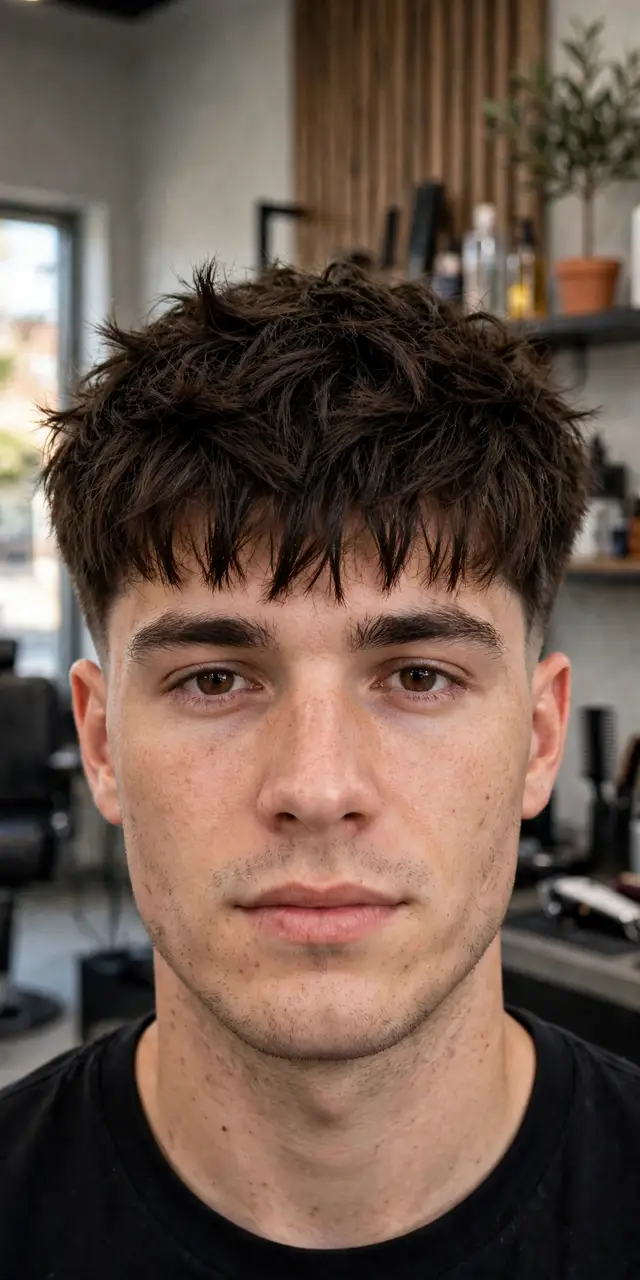
Why is thick hair the warrior cut’s home turf?
Because the cut spends thickness exactly where it shows. The Warrior Cut for Thick Hair keeps the classic architecture and adds the interior work thick hair demands: slide-cutting through the crown and mid-lengths so the choppy pieces separate instead of forming one helmet of hair, with the fringe’s pieces thinned at their ends so they fall individually. Done right, thick hair does half the styling itself — the pieces have the body to hold the mess. Winter’s dry air expands thick hair further, which makes the interior weight removal more important now, not less.
Face Shape: The top’s movement suits every face; square faces gain texture, round faces gain height without width.
Grooming Kit: Sea salt spray and matte clay only — thick hair needs no volume products, ever. A strong dryer for wash days.
Maintenance: Every 3–4 weeks — thick regrowth changes the top’s behaviour faster than any other type.
Barber Script: “Warrior cut for thick hair — classic warrior shape, slide-cut the interior so the pieces separate, low taper.”
Density spent as texture — thick hair’s best argument.
Q: Should a warrior cut be thinned with thinning shears?
A: Slide-cutting, yes; blanket thinning, no. Thinning shears used carelessly leave thick hair fuzzy at the ends and wreck the piecey silhouette. A barber who reaches for the razor or slide-cutting technique understands this cut; one who only thins may not.
Q: My warrior cut looks like a mushroom by week three — why?
A: The sides grew, not the top. Thick hair’s taper puffs outward as it grows and the silhouette rounds. The fix is a sides-only tidy at week two or three — a five-minute appointment most barbers will do cheaply — while the top keeps its length.
8 of 20 — Warrior Cut for Fine Hair
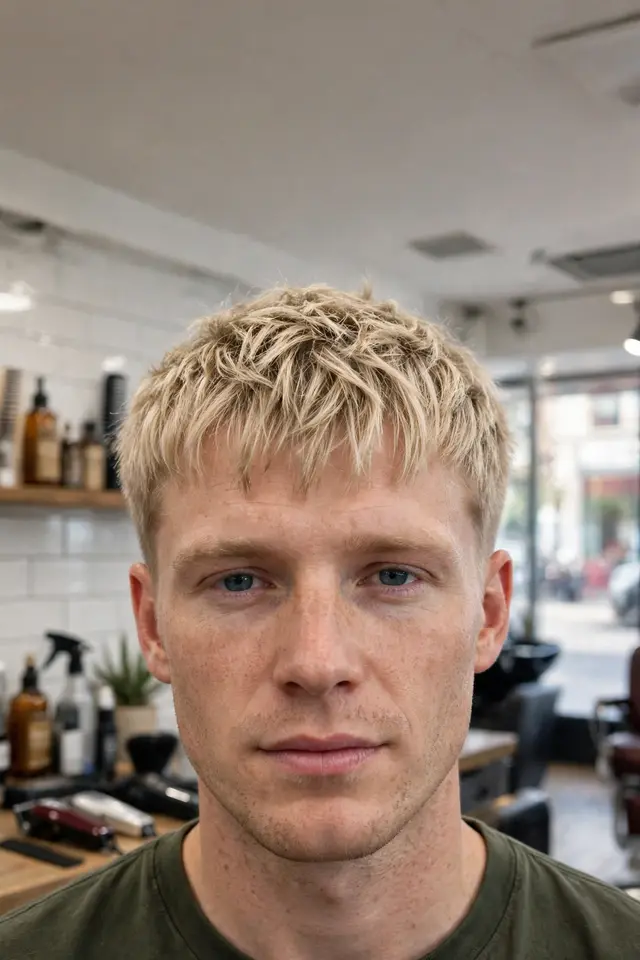
Can fine hair wear a warrior cut?
Yes — with the physics adjusted. Fine hair’s enemies are separation and collapse: long fine pieces split into strings and the mess reads as thinness. The Warrior Cut for Fine Hair answers with a shorter top (around two inches), pieces cut slightly blunter so strands support each other, and styling built on powder and spray rather than clay, which weighs fine hair flat. The result keeps the silhouette — choppy, forward, rugged sides — at a scale fine hair can carry. Winter static is the daily tax; anti-static cream at the ends, never oil.
Face Shape: The forward fringe shortens long faces without demanding weight fine hair cannot supply; keep the taper tight on round faces.
Grooming Kit: Volumising mousse or sea salt spray on damp hair, styling powder at the roots, and the lightest matte paste. All weightless, all of it.
Maintenance: Every 3 weeks — fine hair shows a textured cut’s growth quickly because there is less to hide behind.
Barber Script: “Warrior cut for fine hair — shorter top around two inches, blunter pieces, piecey fringe, low taper.”
Same silhouette, finer physics — the warrior at two inches.
Q: Why does my fine warrior cut go flat by noon?
A: Product weight and length, usually. Past two and a half inches, fine pieces part under their own movement; clay then glues them down. Shorter top, powder instead of paste, and a midday rough-up with dry fingers is the stacked fix.
Q: Will the warrior cut make fine hair look thinner?
A: The opposite, worn right — the piecey forward fringe covers the front hairline, the choppy texture creates shadow and apparent density, and the shorter length stops thin areas separating. It fails only when grown long and worn wet-look; keep it short, dry and matte.
9 of 20 — The Wavy Warrior Cut

How does wavy hair wear the warrior cut?
Like it was designed for it — because effectively it was. Pitt’s original sat on wavy hair, and the Wavy Warrior Cut simply lets the natural S-bend supply the movement the point-cutting creates on straight hair: the top is cut a touch longer so the waves form the choppy pieces themselves, and the fringe falls piecey by nature. The barber cuts it dry or barely damp, because a wave’s true length hides when wet. Winter is wavy hair’s thirsty season — a light leave-in under the salt spray keeps the pieces defined instead of frizzy.
Face Shape: The soft movement flatters almost everyone; angular faces gain ease, long faces gain width at the front.
Grooming Kit: Leave-in conditioner, sea salt spray, matte cream. Drying is scrunch-and-leave; brushing a wavy warrior cut straight is a daily war.
Maintenance: Every 3–4 weeks; waves forgive growth, but the ends need re-shaping before they separate into frizz.
Barber Script: “Wavy warrior cut — cut it dry, keep the top long enough for the wave to form the pieces, low taper.”
The original’s own hair type — the wave does the chopping.
Q: Should I use sea salt spray on wavy hair or is it enough?
A: Wavy hair often needs less spray and more moisture. Salt spray adds grit and separation, but in winter it can dry an already thirsty wave. Layer it over leave-in, use half the amount a straight-haired man would, and judge by the mirror, not the recipe.
Q: My wavy warrior cut keeps looking like a shag — what is wrong?
A: Length at the back, usually. The shag keeps layered length all around; the warrior keeps the back tapered short. Ask for the back and sides brought back to the taper while the top keeps its wave — the silhouette snaps back into the family.
10 of 20 — The Curly Warrior Cut
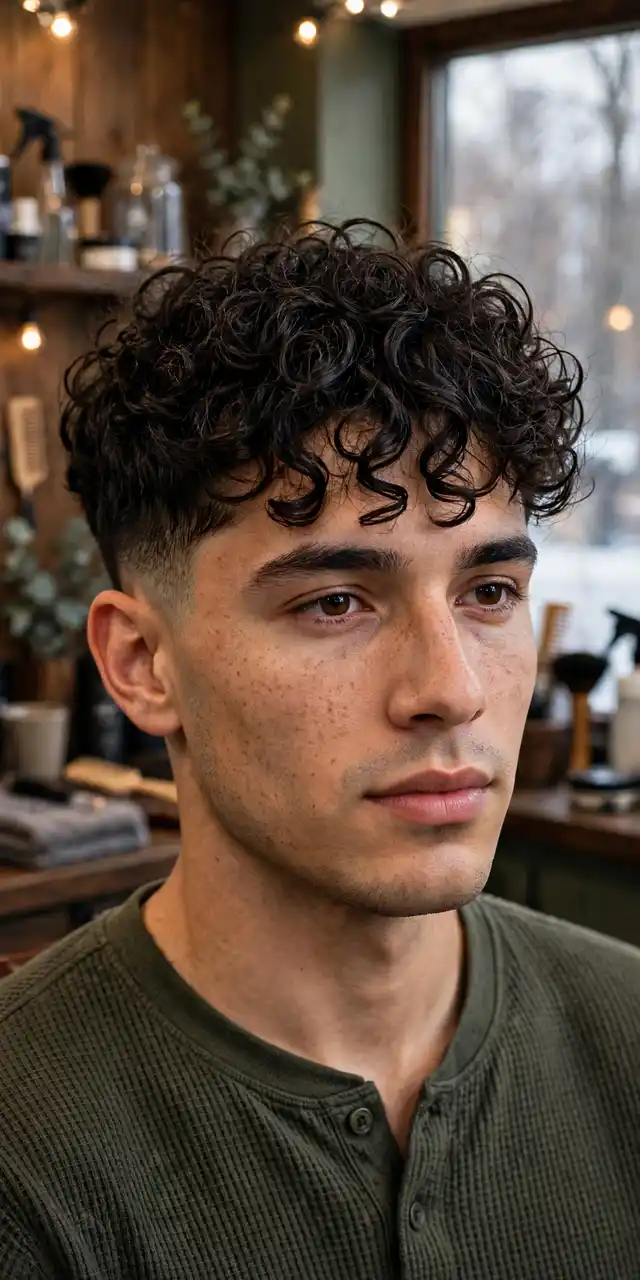
Can curly hair wear a warrior cut?
Yes, and it brings its own texture for free. The Curly Warrior Cut keeps the top long enough for the curls to form their choppy pieces — the curl pattern does the point-cutting’s work — with a fringe of curls falling piecey over the forehead and the sides tapered so the silhouette stays deliberate rather than round. It must be cut dry: curls shrink as they dry, and a wet-cut curly warrior lands an inch shorter than the plan. Winter is curly hair’s driest season, so definition is a moisture question first and a product question second.
Face Shape: The textured top flatters angular faces; round faces should keep the sides tighter and the top’s height controlled.
Grooming Kit: Curl cream, a light gel or mousse for hold, a diffuser if you dry with heat. Combs touch it wet only.
Maintenance: Every 4 weeks comfortably — curls forgive growth; tidy the taper between appointments if it fuzzes.
Barber Script: “Curly warrior cut — cut it dry, top long enough for the curls to form pieces, fringe of curls forward, tapered sides.”
The curl brings the texture — you bring the moisture.
Q: How long should the top be for a curly warrior cut?
A: Longer than it looks in the chair — dry curls spring up one to two inches. Most curly warriors sit at three inches or more measured stretched. A curl-fluent barber cuts dry, checks the fall, and only then refines. If the spray bottle comes out first, ask questions.
Q: Why does my curly warrior cut frizz by evening?
A: It dried thirsty or it was touched. Cream on soaking-wet hair, curls left strictly alone while drying, and the day survives. In winter, a satin-lined beanie instead of raw wool removes the other frizz engine — friction.
11 of 20 — Warrior Cut with a Beard
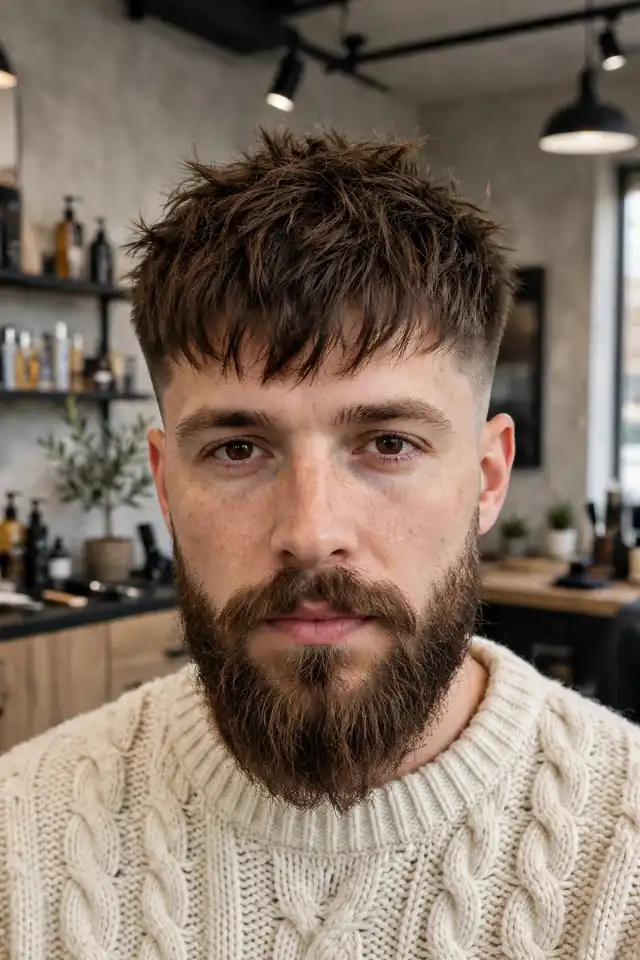
Why does a beard complete the warrior cut?
Because the cut’s whole argument is rugged, and a beard is the argument’s second half. Warrior Cut with a Beard pairs the choppy top with a shaped, medium beard — the combination that made the reference photographs immortal: texture above, structure below, and a face in the middle reading stronger from both directions. The connection point is the sideburn, where a low or classic beard fade lets the taper and the beard share one gradient instead of colliding. Winter conspires toward this pairing anyway — it is beard season, and this is the beard’s best haircut.
Face Shape: Built for longer faces — the top’s mess disrupts, the beard anchors. Round faces keep the beard’s sides tight and the top’s height up.
Grooming Kit: Matte clay above; beard oil and a brush below. Two small rituals, one silhouette.
Maintenance: Hair every 3–4 weeks; the beard shaped at the same visit so the proportions stay married.
Barber Script: “Warrior cut with a beard — choppy top and piecey fringe, shape the beard to medium, fade the sideburns into both.”
Texture above, structure below — the complete portrait.
Q: How full should the beard be with a warrior cut?
A: Medium and shaped is the sweet spot. A very long beard pulls the portrait’s weight down and fights the top’s energy; a tight stubble under-reads the ruggedness. Keep the beard’s outline clean — the mess belongs to the hair, not the jaw.
Q: Does the pairing suit a patchy beard?
A: At short, boxed length, yes — the lower frame still forms and the warrior top carries the statement. Grow it long hoping the patches vanish and they will not; keep it short and deliberate and the combination holds.
12 of 20 — The Textured Warrior Crop
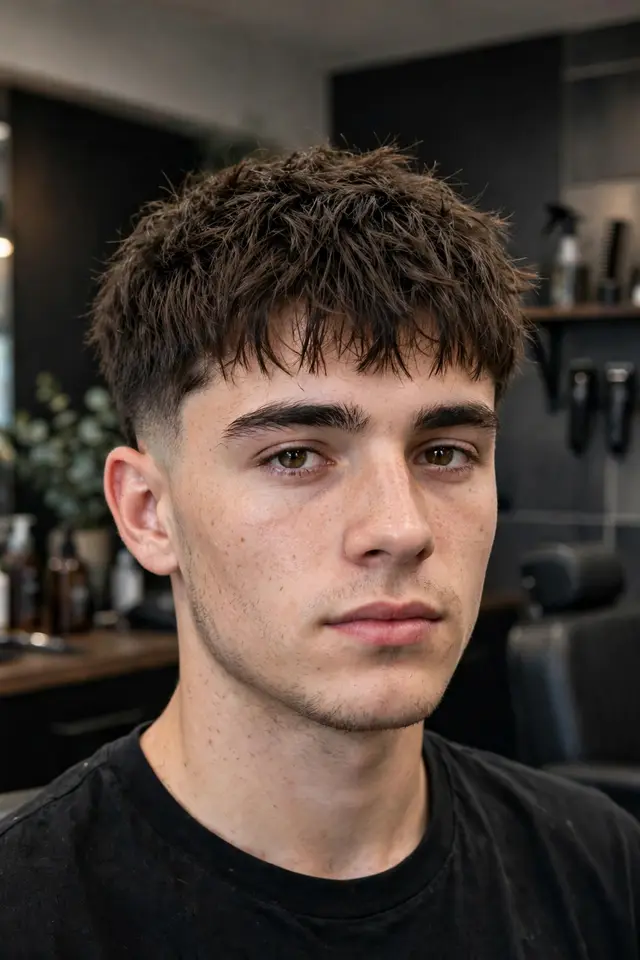
What is the textured warrior crop?
The gateway version: the warrior’s texture and fringe discipline at crop length. The Textured Warrior Crop keeps the top at one and a half to two inches — shorter than the classic — but point-cuts it into the same choppy pieces, pushes the short fringe forward piecey rather than blunt, and keeps the low taper. Barbers report the messy-crop-with-fringe family among their most requested chair variations right now, and this is its warrior-flavoured seat: for men who want the trend’s texture without the classic’s length or styling minute. Winter suits it — almost nothing for a hat to ruin, rebuilt with fingers.
Face Shape: The short top with height in the pieces slims round faces; very long faces keep the fringe a touch longer.
Grooming Kit: A pea of matte clay and, on wash days, salt spray. The shortest shopping list in the family.
Maintenance: Every 2–3 weeks — at crop length, growth shows faster; the appointments are quick.
Barber Script: “Textured warrior crop — crop length, choppy point-cut pieces, short piecey fringe forward, low taper.”
Warrior texture at crop length — the gateway cut.
Q: Textured warrior crop or textured crop — what is the difference?
A: The fringe and the sides. A standard textured crop usually takes a blunt or broken-short fringe and a fade; the warrior crop keeps the fringe piecey and separated and the sides a rugged taper. Same length, different accent — the warrior crop sounds rougher because it is.
Q: Is the warrior crop a good first step toward the classic?
A: It is the designed on-ramp. Grow the top for two appointments and the crop becomes the classic without a single awkward month, because the texture pattern is already cut in. Many men stop here permanently — it is a destination, not just a door.
13 of 20 — The Messy Warrior Fringe
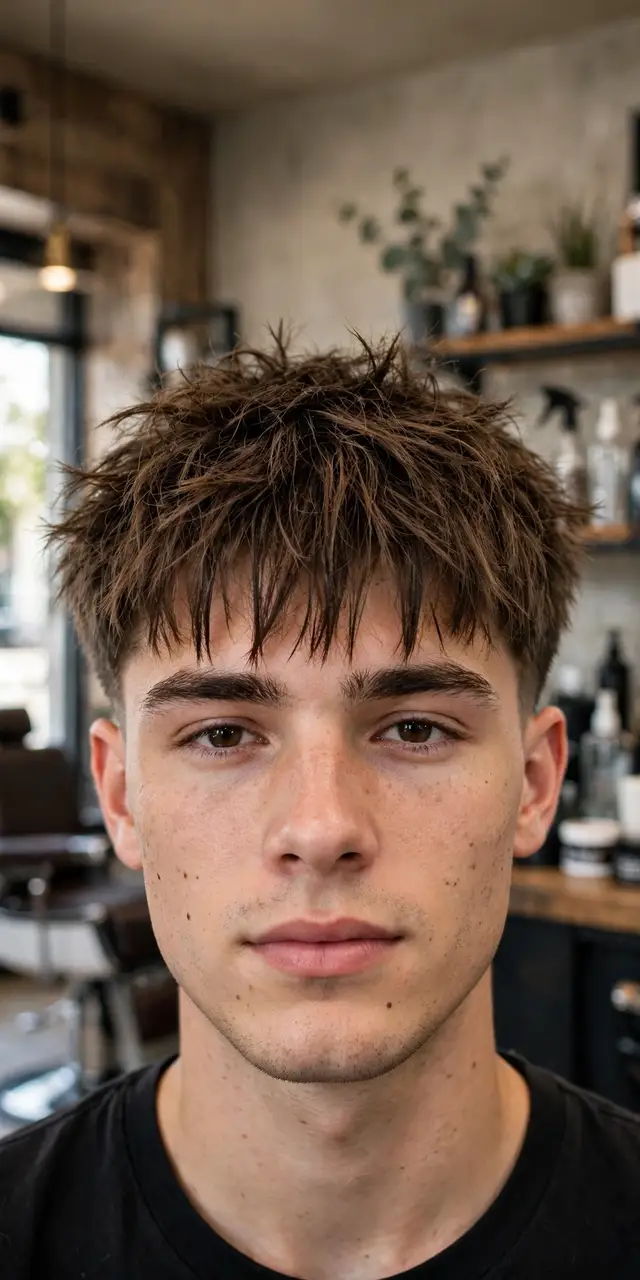
What is the messy warrior fringe?
The fringe-forward build of the family: the top’s length concentrated at the front, where a genuinely messy, broken fringe falls over the forehead in separated pieces, while the crown sits a touch shorter than the classic’s. If the classic warrior is a crop that grew, this is a fringe that enlisted — it borrows the warrior’s choppy sides and rugged taper and puts the whole budget into the front. It is the youngest-looking version here and the natural next step for men coming from the fringe article’s messy fringe who want more edge. Winter flatters it; beanie hair rebuilds by being messed up again.
Face Shape: The forward fall shortens long faces and covers high foreheads; round faces keep the taper tight and the fringe above the brows.
Grooming Kit: Sea salt spray and a fingertip of clay, worked in dry. Fingers are the styling tool; a comb undoes the point.
Maintenance: Every 3 weeks — the front’s pieces need re-breaking before they merge into a curtain.
Barber Script: “Messy warrior fringe — length concentrated at the front, fringe falling messy and broken, choppy crown, low taper.”
The fringe that enlisted — the family’s front at full volume.
Q: Messy warrior fringe or the messy fringe from the fringe guide?
A: Company it keeps. The fringe guide’s messy fringe sits on softer, more classic tops and tapers; the warrior version pairs the front with a choppier crown and the family’s rugged #2–#3 sides. Same front door, rougher house.
Q: How messy can the fringe get before it reads unkempt?
A: When the pieces string together and the fringe’s shape disappears, it is overdue, not styled. The shape should still read in the mirror at arm’s length — disorder with a silhouette. If you cannot find the silhouette, book the chair, not more product.
14 of 20 — Warrior Cut for a Receding Hairline
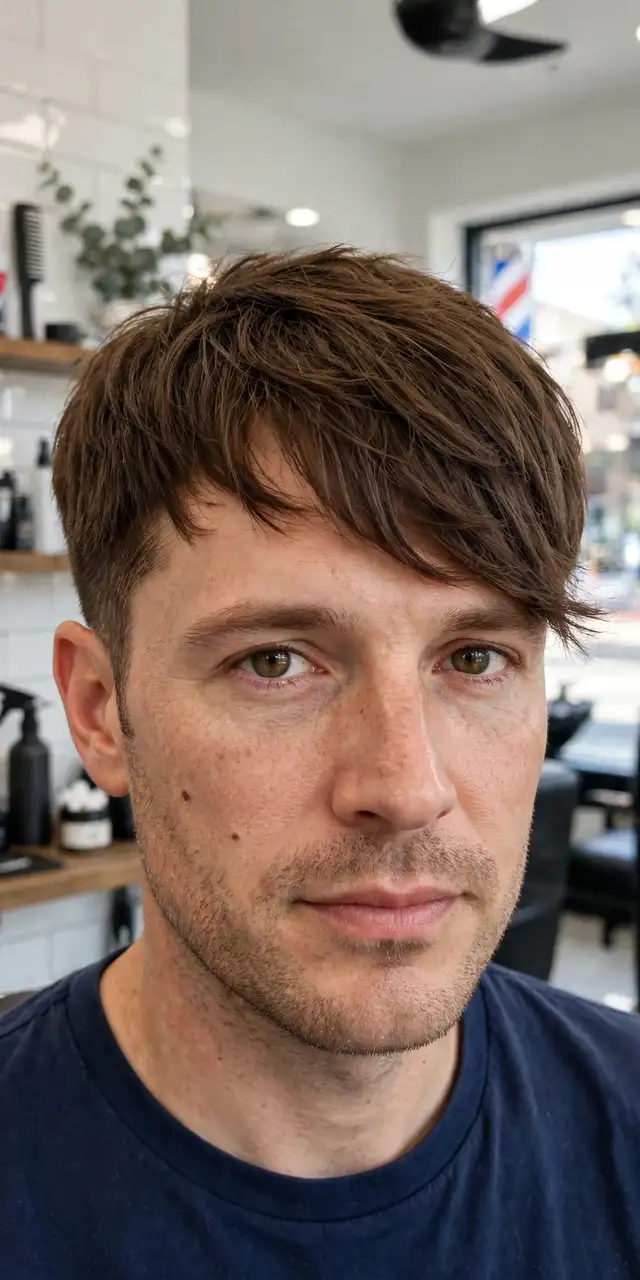
Can a warrior cut suit a receding hairline?
It is one of the family’s quiet strengths — the piecey forward fringe is the standard camouflage for a front hairline in retreat, because it comes forward over the temples’ weakest ground while the choppy texture breaks up the hairline’s edge so no clean line advertises it. The Warrior Cut for a Receding Hairline tunes the recipe: the fringe kept at its fullest, the top’s pieces cut to fall diagonally toward the stronger side, and the sides a low taper rather than a fade — skin-tight sides would spotlight the contrast at the temples. Honesty applies: deep recession belongs to shorter answers, and your barber should say so.
Face Shape: Suits the faces the classic suits; the diagonal fall also softens a high forehead’s corners.
Grooming Kit: Matte clay and salt spray; keep everything dry-finish — shine on a receding hairline draws the eye to exactly the wrong map.
Maintenance: Every 3 weeks — the camouflage is length-dependent; let it grow shaggy and the coverage thins.
Barber Script: “Warrior cut for my hairline — keep the fringe full and forward, pieces falling to my stronger side, low taper, no fade.”
Forward pieces over the weak ground — camouflage with style.
Q: Won’t a fringe just look like I am hiding something?
A: Only if it is worn like a curtain — long, flat and obviously arranged. The warrior’s version is short, choppy and broken, which reads as a style first and coverage second. Men have worn forward fringes for two thousand years; the Caesar’s men did not look like they were hiding.
Q: At what point should I stop fighting recession with a fringe?
A: When the hairline’s retreat passes the fringe’s honest reach — roughly, when the temple points sit behind the fringe’s natural fall line. Your barber can show you in the mirror in seconds. From there, the buzz family is the stronger answer, worn short and owned.
15 of 20 — The Grown-Out Warrior Cut

What is a grown-out warrior cut?
The fourth-week version, designed rather than endured. The Grown-Out Warrior Cut is cut from the start to peak at weeks three to six: the top a fraction longer than the classic, the taper left softer so its growth line never appears, the pieces cut to separate more — not less — as they lengthen. It is the warrior for men whose calendars defeat monthly barbering: travellers, new fathers, the simply busy. The trick is the first cut’s generosity — a barber cuts for where the hair is going, not where it is. Winter is its natural habitat; hats, travel and holidays all stop being scheduling threats.
Face Shape: Unchanged from the classic as it grows — the silhouette softens evenly rather than collapsing in one place.
Grooming Kit: Salt spray, clay, and tolerance. At week five the finish is cream, not clay — softer product for longer hair.
Maintenance: Every 5–6 weeks by design; a neckline tidy at week three is optional, not required.
Barber Script: “Grown-out warrior cut — cut it to peak at week four: slightly long top, soft taper, pieces that separate as they grow.”
Cut for week four — the warrior that forgives your calendar.
Q: Is the grown-out version just skipping appointments?
A: No — skipping appointments on a classic cut gives you a good three weeks and two scruffy ones. The grown-out version is engineered differently from the first snip: extra length where growth helps, softness where growth shows. The endpoint looks deliberate because it was planned.
Q: How do I style week-five warrior hair differently?
A: Softer and less. Switch from clay to cream, use half the amount, and let the pieces fall where the extra length wants them — fighting week-five hair into week-one shape is a losing, greasy battle. The style’s whole promise is that it stops needing you.
16 of 20 — Warrior Cut for Round Faces
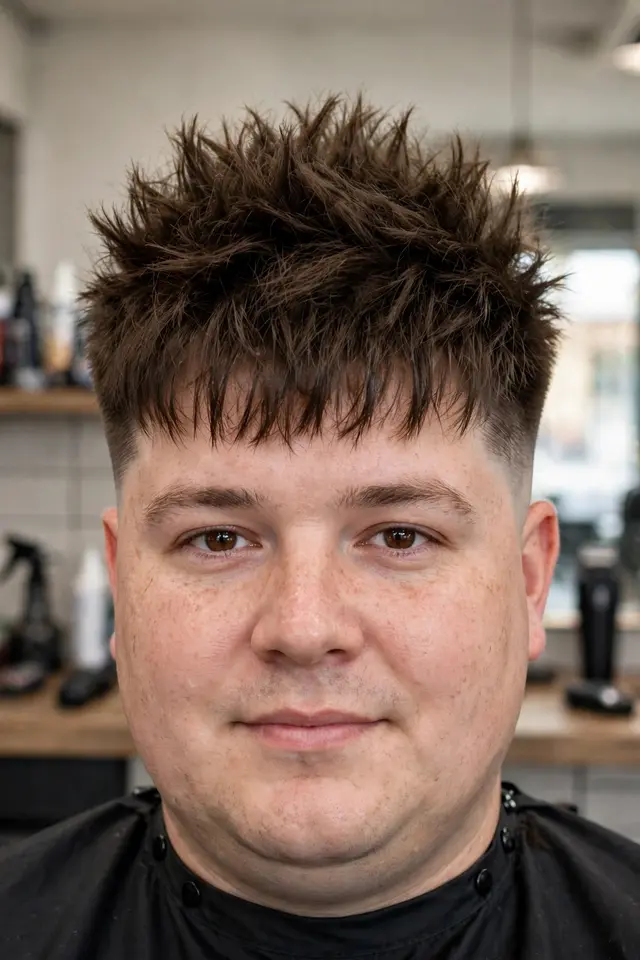
How does the warrior cut slim a round face?
With height and tightness in the right places. Barbers name the warrior cut among the most requested variations for round faces right now, and the engineering is legible: maximum choppy height on top to lengthen the portrait, the piecey fringe kept above the brows so it does not widen the forehead, and the sides taken to the family’s tightest honest taper — a low taper on a #2, or the mid fade of style 4 for maximum slimming. What it avoids is width: no bulk at the temples, no long fringe sweeping sideways. The result keeps the warrior’s texture while quietly redrawing the face longer.
Face Shape: Built for round faces; heart faces can borrow it with a slightly longer fringe.
Grooming Kit: Styling powder at the roots for lift, matte clay for the pieces. Height is built at the roots, not the ends.
Maintenance: Every 3 weeks — the slimming is proportion-dependent, and growth spends proportion fast.
Barber Script: “Warrior cut for a round face — maximum height on top, fringe above the brows, tightest low taper.”
Height up, width out — the warrior as a slimming device.
Q: Should round faces really avoid the longer fringe versions?
A: The brow line is the rule: a fringe that ends at or above the brows keeps the forehead’s width honest; one that falls long and full adds a horizontal band exactly where a round face least wants one. Piecey and broken is fine — long and solid is the widening version.
Q: Does a beard help or hurt with the round-face warrior?
A: Helps, if it is shaped long rather than wide: a beard with length at the chin and tight sides extends the portrait’s vertical. A wide, bushy beard under a warrior top makes two round shapes. Ask for the beard’s length at the bottom, not the cheeks.
17 of 20 — The Short Warrior Cut
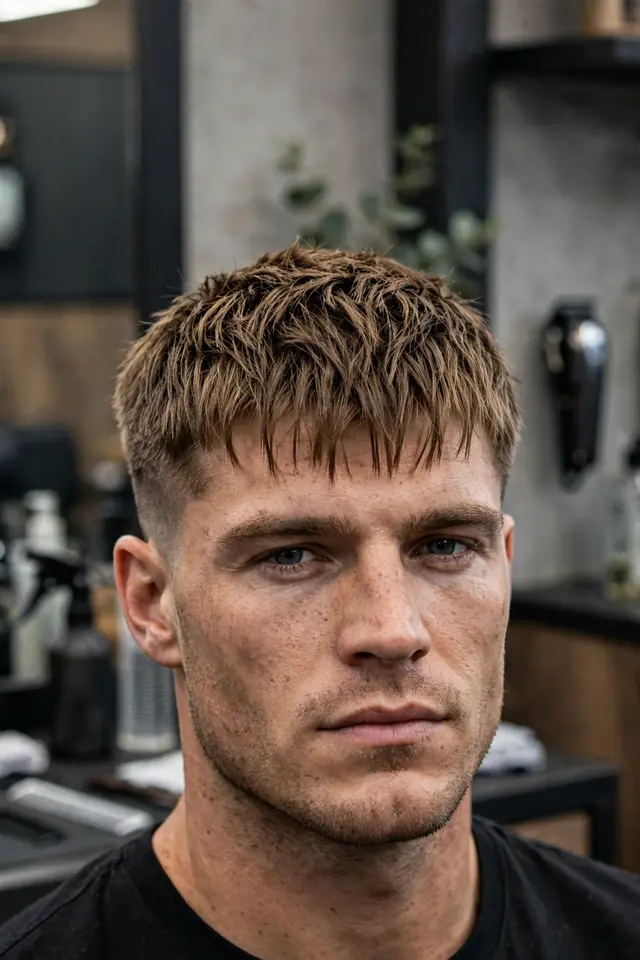
What is a short warrior cut?
The family’s floor: the top at one to one and a half inches — closer to the induction end of the spectrum — but still point-cut into pieces, still fringed forward in broken pieces, still on the rugged taper. The Short Warrior Cut is for men who want the warrior’s texture signature at near-military convenience: almost no styling, nothing to flatten under a hat, and a grow-out that simply becomes the warrior crop (style 12) by week three. It is also the heat-and-helmets answer — gym-heavy lives, hard hats, and men who shower twice a day and style never.
Face Shape: Strong features win — square and angular faces carry the shortness best; the fringe still softens a high hairline.
Grooming Kit: Next to none. A pea of clay on the days you want the pieces visible; the cut does the rest.
Maintenance: Every 2–3 weeks to hold the shortness; or let it ride to the crop and re-cut monthly.
Barber Script: “Short warrior cut — one to one and a half inches on top, point-cut pieces, short broken fringe, low taper.”
Near-military convenience, warrior signature intact.
Q: Short warrior cut or buzz cut — where is the line?
A: Texture and the fringe. A buzz is one length everywhere with no forward front; the short warrior keeps varied, point-cut lengths and a deliberate piecey fringe. From across the room they are cousins; from across the table the warrior has visibly more going on.
Q: Will it look too severe without styling?
A: The taper protects it — severe comes from skin fades and hard lines, and this cut has neither. Unstyled, it reads as a short textured cut with good manners. Add the pea of clay and the pieces announce themselves; the choice is daily, which is the point.
18 of 20 — The Warrior Side Sweep
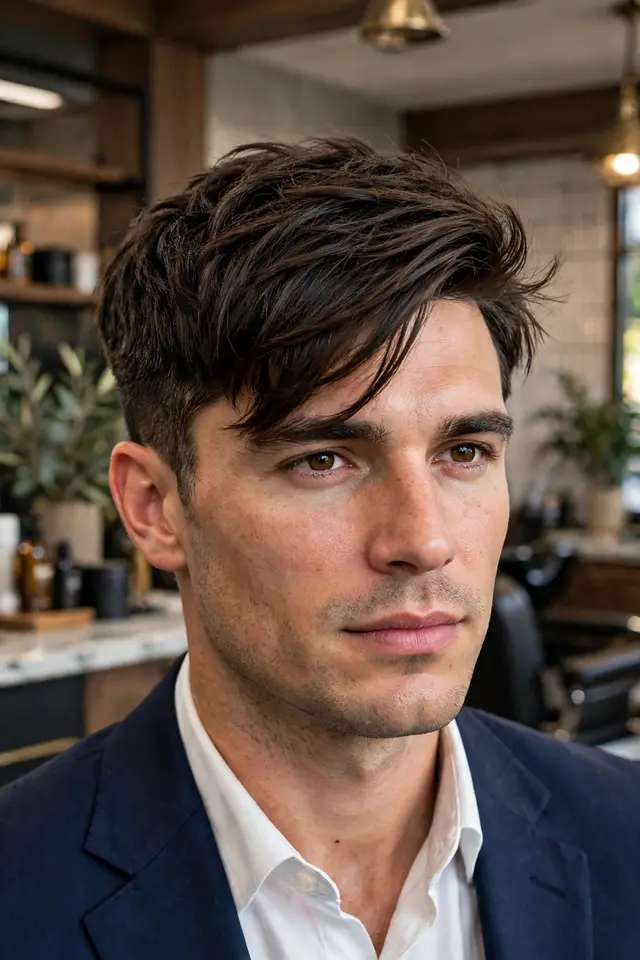
What is a warrior side sweep?
The formal exit of the family: the warrior’s length and texture, styled across to one side instead of forward. The Warrior Side Sweep keeps the choppy top and rugged taper untouched and simply changes the top’s direction — the pieces sweep diagonally, uncovering one side of the forehead and instantly reading more polished, while the texture stops it from becoming a side part. It is the version for weddings, photographs and the office party: one cut, two temperatures. Winter formality is its season, and it is also the receding hairline’s second friend — swept toward the stronger side, it covers as it combs.
Face Shape: The diagonal flatters oval and rectangular faces and softens a square jaw; kind to uneven hairlines.
Grooming Kit: A brush, a light cream, and two minutes while damp. The sweep is set early and left alone.
Maintenance: Every 3–4 weeks, as the classic; the sweep needs the length balanced — too long and it flops instead of sweeping.
Barber Script: “Warrior side sweep — classic warrior cut, styled across to my stronger side, keep the texture visible.”
Same cut, formal direction — the warrior dresses up.
Q: Is the side sweep a different haircut or a styling choice?
A: A styling choice on the same cut, with one cut-time note: tell your barber you sweep, and the pieces at the front will be left a fraction longer to make the turn. Everything else is identical. That is the family’s quiet luxury — range without re-cutting.
Q: Which side should the sweep go?
A: The side your growth supports — where the hairline is stronger and the natural fall agrees. Sweeping against a cowlick is a war lost by afternoon. Your barber finds the cooperative side in one look, and it is worth building the habit from day one.
19 of 20 — The Winter Warrior Cut

How should a warrior cut change for winter?
Almost nothing — which is precisely its winter credential — but the details sharpen. The Winter Warrior Cut is the classic built with the season in mind: the taper left at #3 rather than #2 so no near-skin strip faces the wind, the fringe’s pieces kept just above hat-band height, and the styling switched to a flexible matte clay that re-roughs with fingers after a beanie instead of setting hard and snapping. The routine adds one step: dry the top forward-ish before the hat goes on, because a damp warrior under wool dries in the hat’s shape, not the cut’s. Rebuild at the door: ten seconds, dry fingers, done.
Face Shape: The classic’s own range — oval and square lead; the #3 taper keeps a touch more side width for narrow faces.
Grooming Kit: Flexible matte clay, sea salt spray for wash days, and a satin-lined beanie — the warrior’s winter ally.
Maintenance: Every 3–4 weeks through the season; ask for the #3 taper each time so the winter geometry holds.
Barber Script: “Winter warrior cut — classic warrior, taper at a #3 not a #2, pieces kept above hat-band height.”
Built for coat weather — the classic, winterised at the edges.
Q: How do I fix beanie-flattened warrior hair fast?
A: Dry fingers, worked upward through the pieces — the warrior’s texture is its own repair kit. If it is truly flat, a fingertip of water at the roots plus thirty seconds of warm air resets it. Never add clay to a flattened top; it seals the flatness in a matte cast.
Q: Does the warrior cut work with a heavy winter beard?
A: It is the season’s natural pairing (style 11) — just keep the beard’s outline disciplined, because between a choppy top and a wild beard the face disappears. One element messy at a time is the winter rule; the warrior volunteers.
20 of 20 — The Warrior King
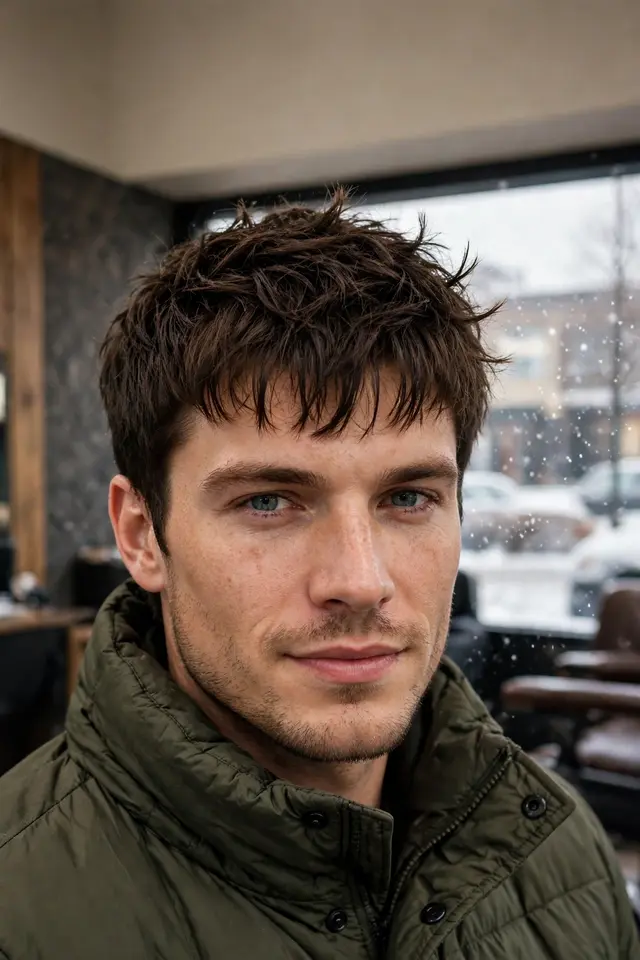
What is the single best warrior cut for men?
The one that keeps every rule the family runs on and breaks none for fashion: a two-to-three-inch top point-cut into real, separating pieces — longest at the crown — a piecey fringe pushed forward and worn broken, sides in the rugged low-to-mid #2–#3 taper with no skin in sight, finished rough with salt spray and clay. The Warrior King is not the loudest here (that is the spiky), not the longest (the long warrior), not the most polished (the modern) — it is the reference itself, executed at the lengths that flatter the most faces and forgive the most mornings. If you book one warrior cut this winter, book the original, done properly.
Face Shape: The family’s most forgiving seat — oval and square lead, round faces slim under its height, long faces shorten under its fringe.
Grooming Kit: Sea salt spray, matte clay, a dryer for the rough-dry, and fingers. Four tools, every version of the week.
Maintenance: Every 3–4 weeks at the barber; one minute each morning is the honest daily price.
Barber Script: “The full warrior — two to three inches on top, point-cut choppy, piecey fringe forward, taper on a #2 to #3, no skin fade.”
The reference itself — texture, fringe and rugged sides, nothing wasted.
Q: Why does this beat a plain textured crop?
A: Length and intent. The crop is shorter, neater and usually faded — a tidy haircut. The king keeps an inch more top, a forward fringe and rugged sides, which adds up to a silhouette with a story: it reads as a character, not a default. Men screenshot this one.
Q: What is the one habit that makes any warrior cut look right?
A: Rough-drying it. The warrior’s texture is set while the hair dries — towel or blow-dry it in the direction it will live, pieces forward and separated, then clay. Style it wet-flat and comb it later and no product will resurrect the mess that makes the cut.
The Bottom Line
Warrior cut hairstyles for men run on three rules: texture is cut in, not styled on — the point-cut pieces on a two-to-three-inch top are the haircut, and product only wakes them up; the fringe goes forward, piecey and broken, never blunt; and the sides stay rugged — a #2–#3 low-to-mid taper, because the moment a skin fade arrives the warrior becomes a crop in costume. Pick your build by your hair (thick hair is home turf, fine hair goes shorter and blunter, curls are cut dry) and your calendar (the grown-out build peaks at week four by design). For the front worn as its own style, see the fringe guide, and for the family’s neater cousin, the textured crop guide.

One Comment