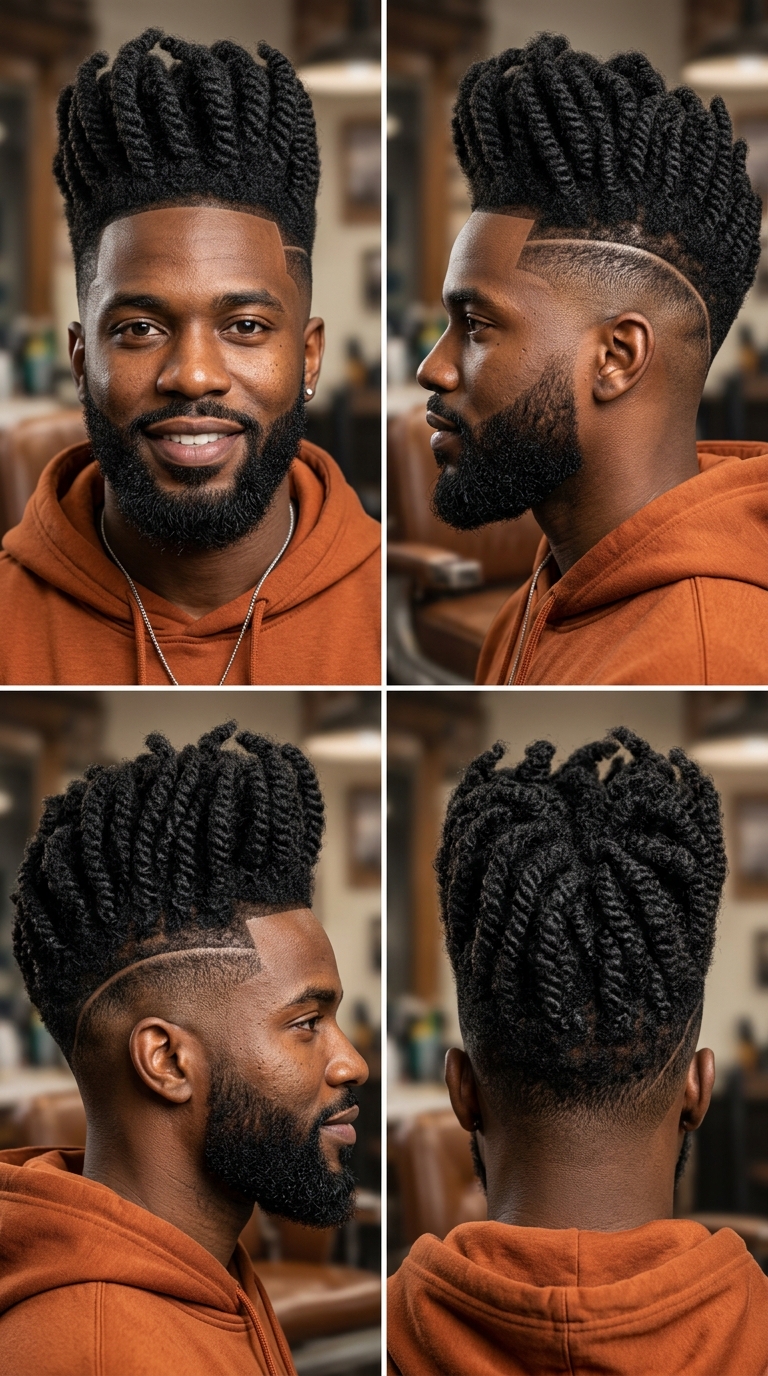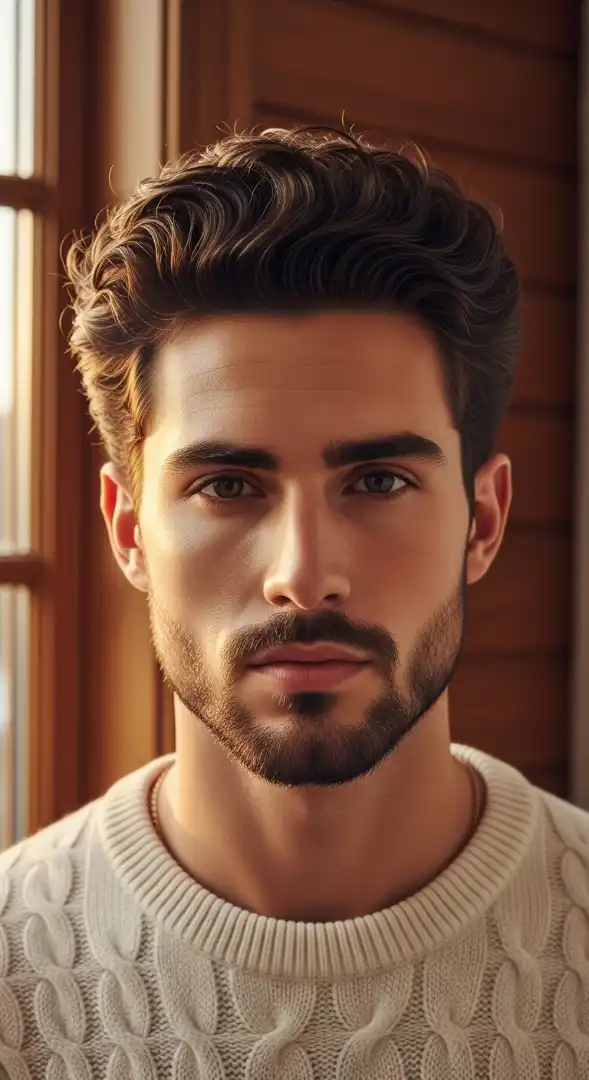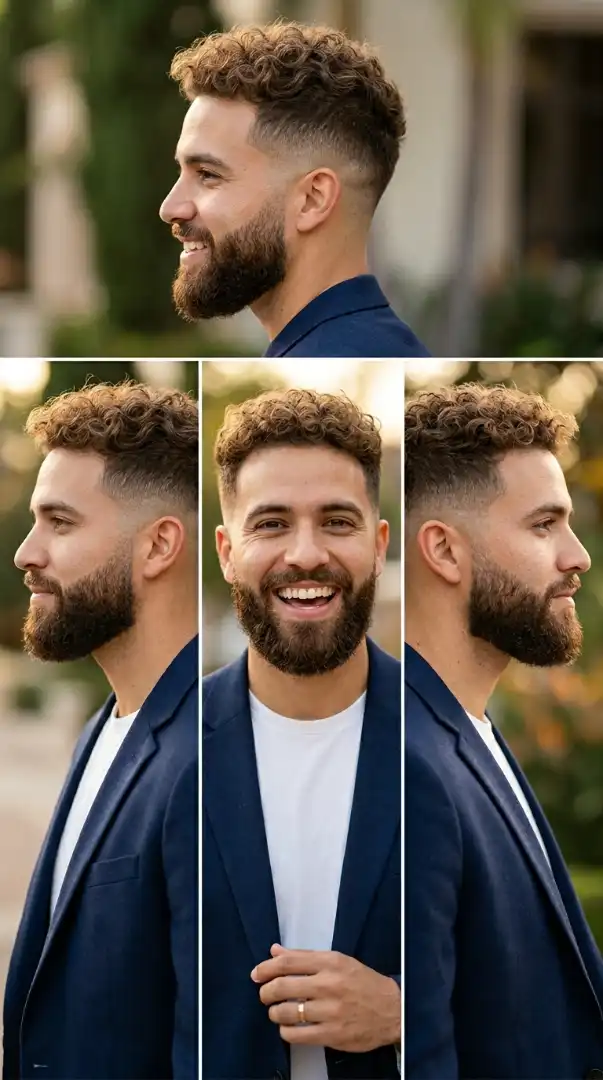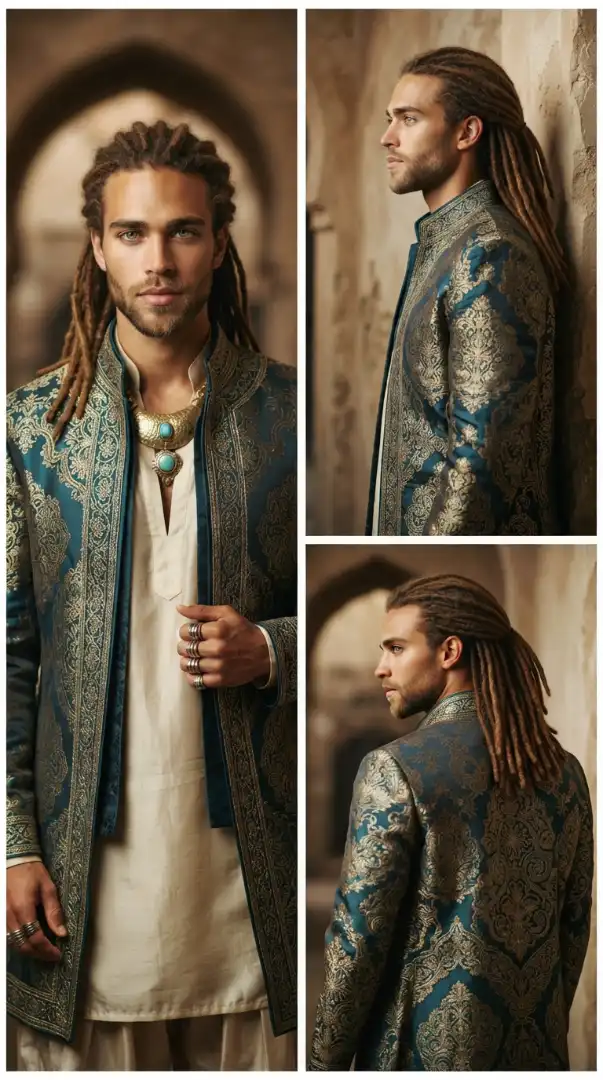
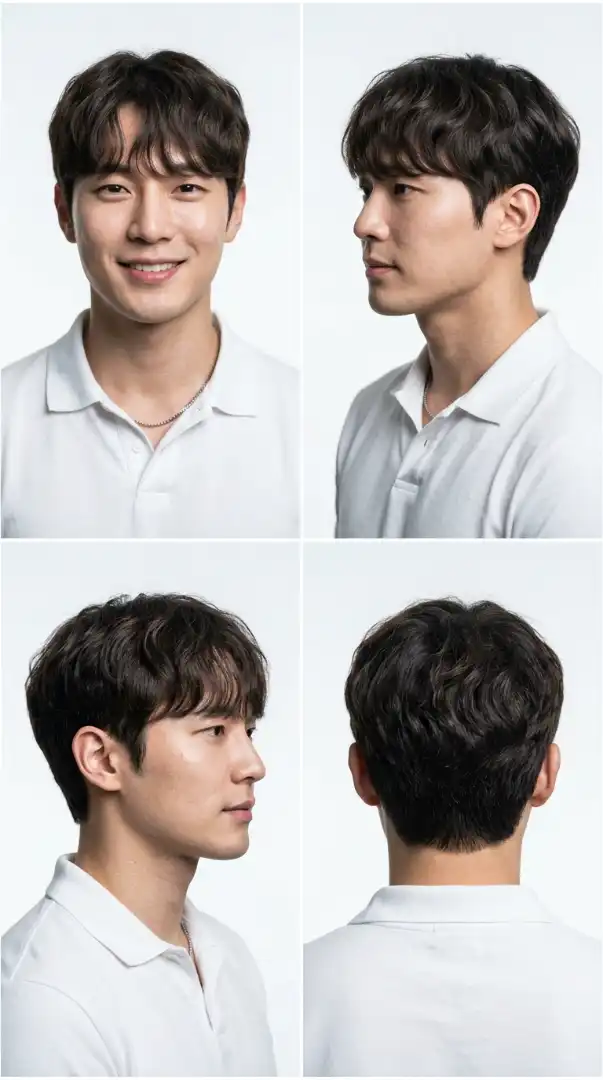
13 Fringe Haircuts for Men stylish and Modern Styles That Turn Heads
1 of 13 — The Effortless Fringe Icon
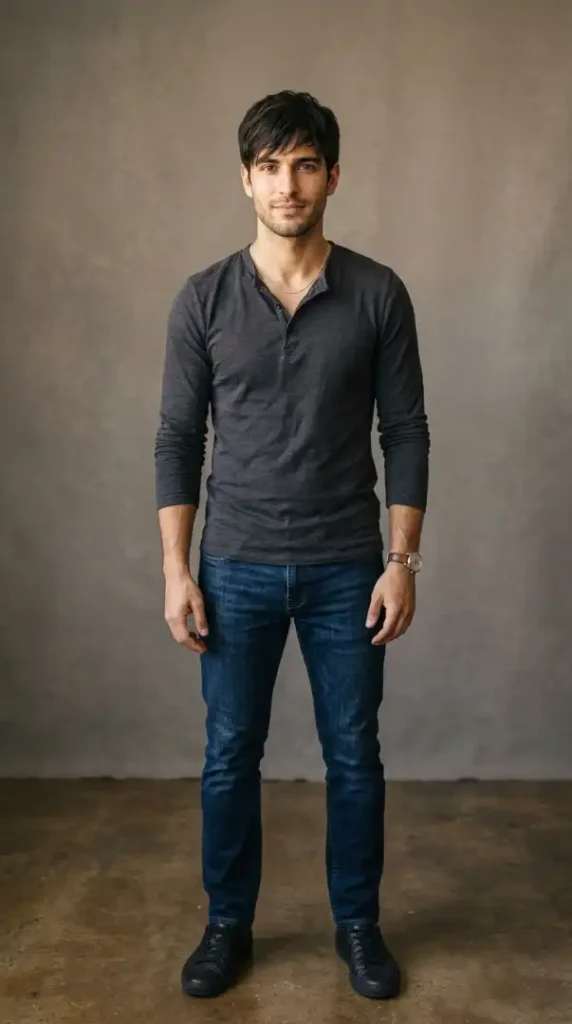
The Effortless Fringe Icon: Why This Cut Works
The Effortless Fringe Icon has become one of the most requested fringe haircuts for men because it delivers a polished, styled look without demanding a complicated routine. This soft, forward-swept fringe sits naturally on the forehead, catching light and framing the face with a relaxed, lived-in texture rather than a stiff, over-groomed finish. It reads as effortless precisely because of deliberate cutting technique — feathered ends, controlled density, and a hairline that’s been softened rather than blunt-cut. For men searching for a fringe haircut that photographs well and styles fast, this is the benchmark cut barbers keep coming back to.
Best Face Shape for The Effortless Fringe Icon
Oval and square face shapes benefit the most from The Effortless Fringe Icon. On an oval face, the soft diagonal fringe adds texture and visual interest without altering already-balanced proportions, while on a square face, the feathered ends soften strong jaw angles and take some of the visual weight off the sides. Round faces should approach this style carefully — a heavy, low fringe can add width to the mid-face and make the face appear shorter, so a slightly higher fringe with more lift at the crown is recommended to maintain vertical balance. Long or oblong faces generally do well too, since the horizontal line of the fringe interrupts excess length and shortens the visual proportion of the face.
Grooming Kit You’ll Need
- Clippers: Wahl Magic Clip (Model 5049-400) or Andis Master (Model 01557) for guard work around the sides
- Trimmer/Outliner: Andis T-Outliner (Model 04710) for clean edge work and hairline definition
- Finishing Tools: Kent 81T fine-tooth comb for parting precision, Denman boar bristle brush for polish and texture blending
- Styling Product: Layrite Original Pomade (medium hold) for a natural, matte-finish fringe, or American Crew Fiber for extra hold with texture
- Maintenance: Honest Amish beard oil for facial hair conditioning, applied in a dime-sized amount
Apply a pea-sized amount of pomade to damp hair, work it through the fringe with fingertips (not a comb) to preserve texture, then use a blow dryer on low heat to set the forward direction while the pomade sets.
How Often You Need a Touch-Up
This is a LOW-to-MEDIUM maintenance style. Barbershop visits are needed every 4-5 weeks to keep the fringe length in check and the sides tidy, since this cut relies on the fringe staying at a specific length to hold its forward direction. Daily styling takes just 5-7 minutes in the morning — apply product to damp hair, finger-comb the fringe forward and slightly to the side, and let it air-dry or use a diffuser on low heat. The product routine is a single step: one pomade application. As the cut grows out, the fringe will start falling into the eyes around week 5-6, at which point it either needs a trim or can be styled into a slightly longer, swept-back look as a transitional style. Monthly maintenance cost typically runs $25-40 depending on region and barbershop pricing. Difficulty rating for home upkeep: Beginner-friendly.
What to Say to Your Barber
Say this to your barber: “I want an Effortless Fringe Icon with a mid skin fade starting at the temple line. Take the top to guard #4, leaving enough length up front for a 2-3 inch forward fringe. Keep the fringe with point cutting for soft, feathered ends — no blunt line across the forehead. For the fade, blend from guard #1 at the hairline up to guard #4 at the parietal ridge. Keep my stubble length at 3mm and taper it cleanly into the sideburn. Finish with a soft, undone texture on top — don’t slick it down, and keep the fringe edges textured, not sharp.”
If this low-maintenance approach appeals to you, the next style takes the fringe in a completely different direction with heavier texture and a curtain-style part that adds serious visual drama.
2 of 13 — The Textured Curtain Crop
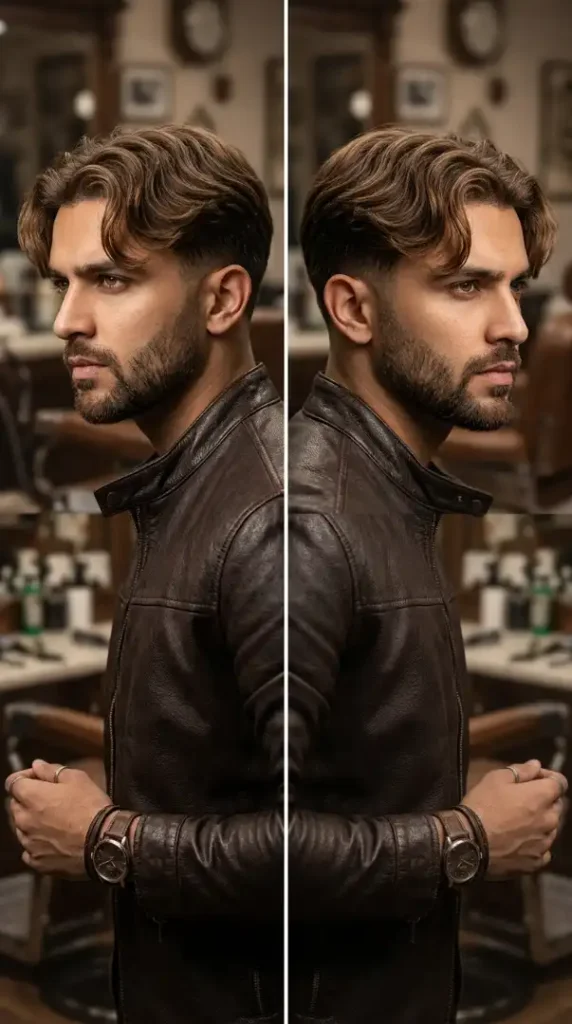
The Textured Curtain Crop: A Modern Classic
The Textured Curtain Crop takes the 90s-revival curtain fringe and gives it a contemporary edge through heavy texturizing and a tighter fade on the sides. Unlike the flat, symmetrical curtains of decades past, this version relies on wavy or naturally textured hair to create movement and volume through the center part. It’s one of the most searched fringe haircuts for men because it strikes a balance between nostalgic and current — familiar enough to feel classic, textured enough to feel new.
Best Face Shape for The Textured Curtain Crop
Square and diamond face shapes see the strongest results from The Textured Curtain Crop, since the center part draws a vertical line down the face that complements angular bone structure without adding extra width. Heart-shaped faces also do well, as the curtain fringe softens a wider forehead and balances a narrower chin. Round faces should avoid a heavy, low-hanging curtain, since the horizontal fringe line combined with the center part can visually widen the mid-face — if a round-faced client wants this cut, request more lift at the roots and a slightly higher parting point to maintain vertical balance.
Grooming Kit You’ll Need
- Clippers: Andis Master (Model 01557) for the low fade on the sides
- Trimmer/Outliner: Andis T-Outliner (Model 04710) for beard-to-fade blending and sideburn precision
- Finishing Tools: Kent 81T fine-tooth comb for the center part, Denman boar bristle brush for texture distribution
- Styling Product: American Crew Fiber (matte finish, high hold) for hold without shine, or a light sea-salt spray for natural wave enhancement
- Maintenance: Viking Revolution beard oil, applied in a dime-sized amount for the full beard
Apply a dime-sized amount of fiber paste to towel-dried hair, use fingers to create the center part, then scrunch the sides gently to enhance natural wave texture rather than flattening it.
How Often You Need a Touch-Up
This is a MEDIUM maintenance style. Barbershop visits every 3-4 weeks keep the low fade sharp, though the curtain fringe on top can be left slightly longer between full cuts, roughly every 6-8 weeks. Daily styling takes about 8-10 minutes, since the center part and texture need active shaping rather than just air-drying. The product routine involves two steps: sea-salt spray on damp hair followed by a matte fiber paste once mostly dry. As the cut grows out, the curtain effect actually improves for the first few weeks as there’s more length to work with, but the fade will need attention by week 4. Monthly maintenance cost is typically $30-50. Difficulty rating for home upkeep: Intermediate, since achieving a natural, non-flat part takes some practice.
What to Say to Your Barber
Say this to your barber: “I want a Textured Curtain Crop with a low bald fade starting just above the ear. Take the top to guard #5, keeping enough length at the crown for a natural center part and curtain fall on both sides. Point cut the fringe ends so they’re feathered, not blunt. For the fade, blend from skin at the hairline up to guard #5 at the parietal ridge. Taper my beard into the fade at the jawline, keeping length at 6mm. Finish with texture throughout the top — no comb-over slick, keep it natural and wavy.”
If the curtain look feels like it needs too much daily part maintenance, the next style delivers a sharper, more architectural silhouette that holds its shape with almost no styling at all.
3 of 13 — The Modern French Fringe
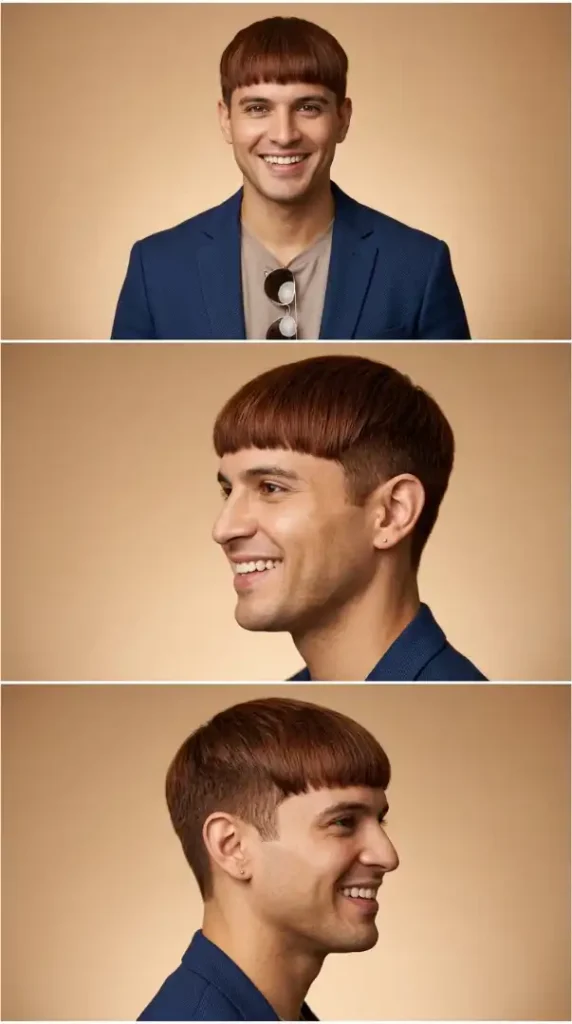
The Modern French Fringe: Structured and Sharp
The Modern French Fringe brings a blunt, precisely cut hairline into contemporary men’s grooming, delivering a structured, intentional look that reads as polished rather than casual. Unlike softer, feathered fringe styles, this cut relies on density and a clean horizontal line to make an impact, which is why it’s become a favorite search term among men wanting a fringe haircut with more visual weight and definition.
Best Face Shape for The Modern French Fringe
Round and oblong face shapes benefit most from The Modern French Fringe, since the straight horizontal line across the forehead interrupts vertical length and adds width at the top, creating better overall proportion. Oval faces can wear this cut easily as well, given their already-balanced structure. Square and diamond faces should be more cautious — the hard horizontal line of the fringe can emphasize an already-strong jaw or wide cheekbones, making the face look boxier; if chosen, the sides should be kept slightly longer to soften the transition.
Grooming Kit You’ll Need
- Clippers: Wahl Magic Clip (Model 5049-400) for side and back maintenance
- Trimmer/Outliner: Andis T-Outliner (Model 04710) for the precise blunt fringe line and clean hairline edge
- Finishing Tools: Kent 81T fine-tooth comb for parting precision, Denman boar bristle brush for smoothing
- Styling Product: Layrite Original Pomade (medium hold) for a smooth, controlled finish without excessive shine
- Maintenance: Honest Amish beard oil for the jawline and neck skin if clean-shaven, applied sparingly
Apply a dime-sized amount of pomade evenly through the fringe using a comb to maintain the blunt, structured line, then press gently downward with a flat palm to set the shape.
How Often You Need a Touch-Up
This is a MEDIUM-to-HIGH maintenance style. The blunt fringe line needs barbershop touch-ups every 3 weeks to stay crisp, since even small amounts of growth soften the sharp horizontal edge. Daily styling takes about 6-8 minutes, combing the fringe into place with product to maintain the structured line. The product routine is a single pomade application, combed rather than finger-styled for precision. As the cut grows out, the fringe loses its blunt edge within about 3 weeks and starts to look more like a soft, natural fringe rather than the deliberate French style. Monthly maintenance cost runs approximately $35-55 given the more frequent touch-ups required. Difficulty rating for home upkeep: Intermediate, since maintaining the sharp line without a barber requires steady hands and a good trimmer.
What to Say to Your Barber
Say this to your barber: “I want a Modern French Fringe with a blunt, straight-across fringe sitting just above the eyebrows. Take the top to guard #5, keeping the front section long enough for a full 2-inch blunt fringe. Cut the fringe line with scissors for a clean, precise edge — no point cutting or texturizing on the fringe itself. Keep the sides at guard #3 with a subtle taper, not a hard fade. Finish with a lineup at the temples and a clean, defined hairline across the forehead.”
If the sharp, structured look feels like a bigger commitment than you want, the next style softens things considerably with a wolf-cut fringe that thrives on natural texture and requires almost no precision styling.
4 of 13 — The Sharp Fringe Fade
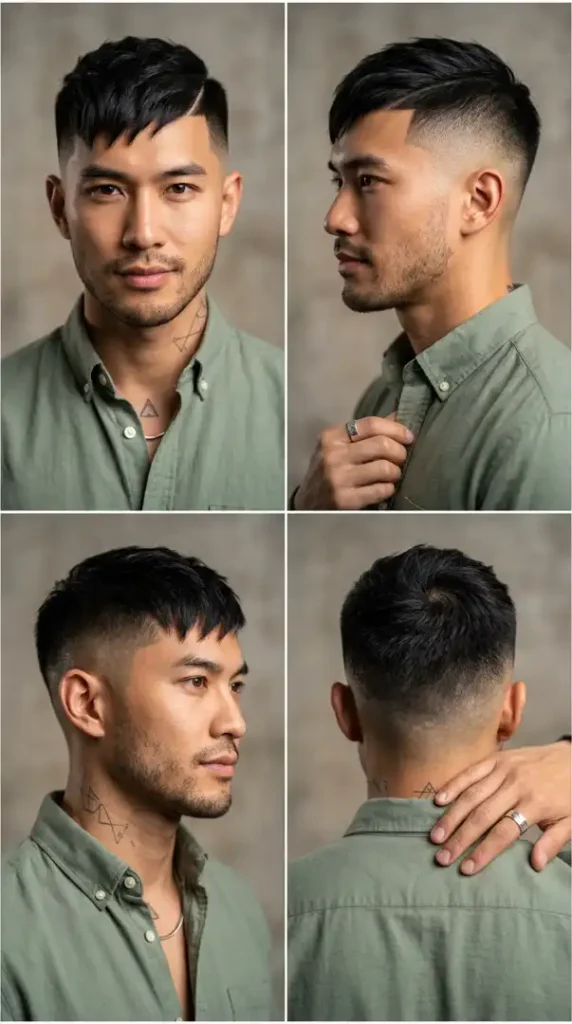
The Sharp Fringe Fade: Bold and Precise
The Sharp Fringe Fade combines a high-contrast skin fade with a swept, textured fringe for one of the most striking silhouettes in modern men’s grooming. This is a style built for impact — the dramatic gradient from skin to hair draws the eye immediately, while the textured fringe on top adds movement and keeps the cut from feeling too severe. It’s a frequent search term for men wanting a fringe haircut that reads as bold, current, and editorial.
Best Face Shape for The Sharp Fringe Fade
Square and oval face shapes handle The Sharp Fringe Fade exceptionally well, since the high fade removes visual width from the sides, creating a vertical line that elongates the face and draws the eye upward toward the textured top. The sharp temple fade acts as a contour line, complementing angular bone structure. Round faces also gain real benefit, as the fade mimics the angular structure a round face naturally lacks, effectively reshaping perceived proportions. Faces to approach with more caution: very oblong or long faces, where the added height from the fade and textured crown can exaggerate vertical length — a lower fade start point is recommended in that case.
Grooming Kit You’ll Need
- Clippers: Andis Master (Model 01557) for the high skin fade
- Trimmer/Outliner: Andis T-Outliner (Model 04710) for the sharp temple line and sideburn point
- Finishing Tools: Kent 81T fine-tooth comb for parting, Denman boar bristle brush for texture separation
- Styling Product: American Crew Fiber (matte finish, high hold) for defined texture and separation
- Maintenance: Viking Revolution beard oil for stubble conditioning, applied in a dime-sized amount
Apply a pea-sized amount of fiber to dry hair, work through with fingertips to create separated texture, then use a comb to define the hard part line at the front.
How Often You Need a Touch-Up
This is a HIGH maintenance style. The high skin fade requires barbershop touch-ups every 2 weeks to maintain the crisp gradient, since fade lines grow out and lose definition faster than any other element of this cut. Daily styling takes 7-10 minutes to rebuild texture and re-define the part line. The product routine is a two-step process: fiber for hold, followed by a light comb-through for the part. As the fade grows out, it starts to look shaggy and undefined within about 10-14 days, well before the top length becomes an issue. Monthly maintenance cost is on the higher end at $50-70 given the frequent fade touch-ups. Difficulty rating for home upkeep: Advanced, since maintaining a sharp skin fade at home is genuinely difficult without professional clippers and experience.
What to Say to Your Barber
Say this to your barber: “I want a Sharp Fringe Fade with a high skin fade starting at the temple line. Take the top to guard #4, keeping enough length at the front for a swept, textured fringe with a hard part. Blend the fade from skin at the hairline up to guard #4 at the parietal ridge. Keep my stubble at 2mm, tapered cleanly into the sideburn point. Finish with texture through the top using a razor or thinning shears, and a sharp lineup at the temples and hairline.”
If a high skin fade feels like more upkeep than your schedule allows, the next style takes a completely different approach with a wolf-cut fringe that’s built to look intentionally undone.
5 of 13 — The Wolf Cut Fringe

The Wolf Cut Fringe: Shaggy, Layered, Low-Effort
The Wolf Cut Fringe brings heavy layering and intentional shagginess into men’s fringe styling, creating volume and texture that looks great whether it’s freshly cut or two months grown out. This style has surged in popularity because it embraces imperfection — the choppy, uneven fringe is meant to look a little wild, which makes it one of the most forgiving fringe haircuts for men who don’t want to style precisely every single day.
Best Face Shape for The Wolf Cut Fringe
Oval and heart-shaped faces suit The Wolf Cut Fringe particularly well, since the layered volume at the crown balances a narrower chin while the choppy fringe softens the forehead. Long or oblong faces also benefit, as the horizontal volume added by the layering interrupts vertical length. Square and round faces should be more selective — too much volume on the sides can add unwanted width, so requesting shorter layers around the ears while keeping length and volume concentrated at the crown and fringe helps maintain better proportion.
Grooming Kit You’ll Need
- Clippers: Wahl Magic Clip (Model 5049-400) for light shaping around the neckline only
- Trimmer/Outliner: Andis T-Outliner (Model 04710) for neckline cleanup
- Finishing Tools: Denman boar bristle brush for texture, wide-tooth comb for detangling wavy hair
- Styling Product: Sea-salt texturizing spray for natural volume, or a light matte clay for definition without heaviness
- Maintenance: Honest Amish beard oil for the full beard, applied generously given the fuller beard length
Apply sea-salt spray to damp hair and scrunch upward from the roots to build volume, then let it air-dry or diffuse on low heat — avoid brushing it smooth, since texture is the point of this cut.
How Often You Need a Touch-Up
This is a LOW maintenance style, one of the most forgiving fringe cuts available. Barbershop visits are only needed every 8-10 weeks, since the whole point of the wolf cut is embracing shagginess as it grows. Daily styling takes just 3-5 minutes — a quick spritz of texturizing spray and a scrunch is often all that’s needed. The product routine is a single step. As the cut grows out, it genuinely improves in appearance for the first several weeks, gaining more of the layered, wolf-like silhouette the style is named for. Monthly maintenance cost is low, around $15-25 on average given the infrequent cuts. Difficulty rating for home upkeep: Beginner-friendly, since imperfection is part of the intended look.
What to Say to Your Barber
Say this to your barber: “I want a Wolf Cut Fringe with heavy layering throughout and a choppy, textured fringe that falls just above my eyebrows. Take the top to guard #6, but use point cutting and razor texturizing throughout to break up the ends — I don’t want a blunt or uniform cut anywhere. Keep the sides longer, blending naturally rather than fading, guard #5 tapering into guard #6 at the crown. Taper my beard length to 8mm, keeping it full and natural. Finish with texturizing throughout for maximum shag and movement — the messier, the better.”
If shaggy volume isn’t your thing, the next style pulls things back into a clean, office-appropriate silhouette that still keeps the fringe as the statement piece.
6 of 13 — The Executive Fringe Sweep
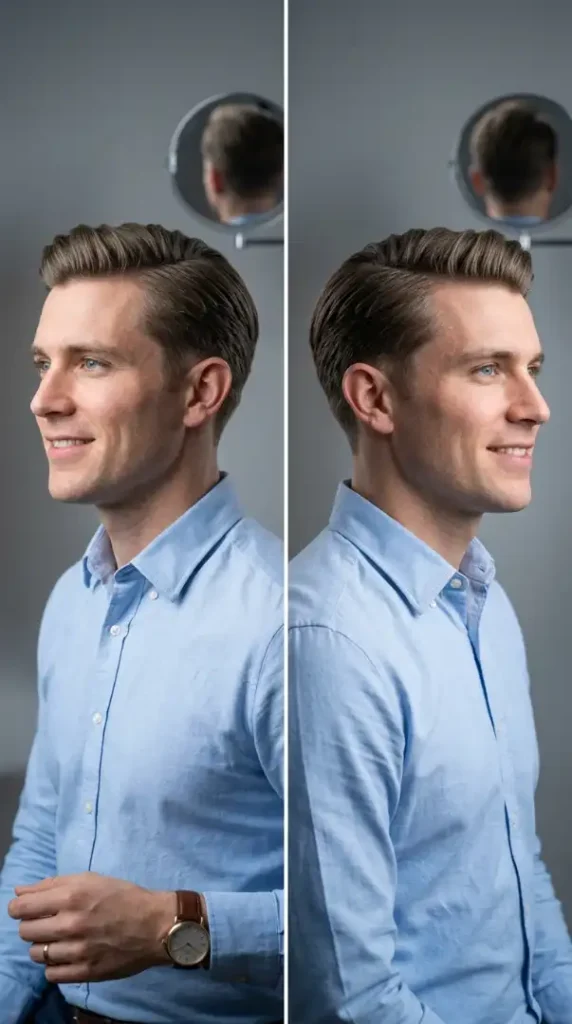
The Executive Fringe Sweep: Polished for the Office
The Executive Fringe Sweep takes the fringe trend and makes it appropriate for corporate and formal environments by structuring it into a controlled side sweep instead of letting it hang loose. It’s the go-to fringe haircut for men who want the texture and movement of a modern fringe without sacrificing a professional, put-together appearance in the boardroom.
Best Face Shape for The Executive Fringe Sweep
Oval and square face shapes gain the most from The Executive Fringe Sweep, since the structured side sweep adds height and direction while the tight sides keep clean vertical lines. Round faces gain real definition from the swept angle, which counters the natural roundness with a diagonal line. Oblong faces should request slightly more volume through the crown to avoid over-elongating the face further. Diamond and heart-shaped faces can wear this cut well but should keep the sweep moderate in height to maintain proportion with a narrower chin.
Grooming Kit You’ll Need
- Clippers: Wahl Magic Clip (Model 5049-400) for the sides
- Trimmer/Outliner: Andis T-Outliner (Model 04710) for a crisp hairline and temple detail
- Finishing Tools: Kent 81T fine-tooth comb for the sweep direction, Denman boar bristle brush for polish
- Styling Product: Layrite Original Pomade (medium hold) for a smooth, controlled finish with natural shine
- Maintenance: Honest Amish beard oil for skin conditioning post-shave, applied sparingly
Apply a dime-sized amount of pomade to damp hair, comb the fringe up and back into a controlled sweep, then blow-dry on medium heat while directing the fringe with a round brush to lock in the shape.
How Often You Need a Touch-Up
This is a MEDIUM maintenance style. Barbershop visits every 3-4 weeks maintain the taper and keep the fringe length appropriate for a controlled sweep. Daily styling takes 6-8 minutes, since the sweep needs to be actively directed with a comb and product rather than left to fall naturally. The product routine is a single pomade step, though achieving the sweep does take a blow dryer for the best hold. As the cut grows out, the fringe becomes harder to control and starts falling forward instead of sweeping back around week 4. Monthly maintenance cost runs approximately $30-45. Difficulty rating for home upkeep: Intermediate, since the swept shape requires consistent technique.
What to Say to Your Barber
Say this to your barber: “I want an Executive Fringe Sweep with a low taper fade starting above the ear. Take the top to guard #6, keeping the front fringe long enough to sweep back and to the side, around 2.5 to 3 inches. Keep the fringe blunt underneath but textured on top for movement. Blend the taper from guard #2 at the hairline up to guard #6 at the crown. Finish with a crisp lineup at the temples and a defined, professional hairline.”
If a structured, office-ready look isn’t quite your style, the next fringe cut brings back a rougher, choppier edge that’s built for rebellion, not boardrooms.
7 of 13 — The Choppy Fringe Rebel
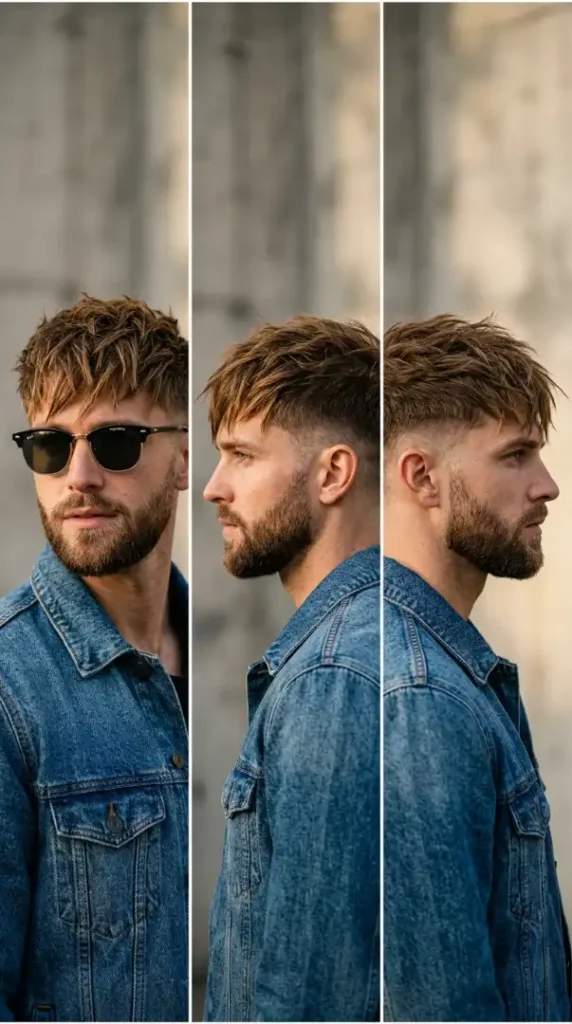
The Choppy Fringe Rebel: Textured and Unapologetic
The Choppy Fringe Rebel is built for men who want their fringe haircut to make a statement rather than blend in. Heavy razor texturizing creates jagged, broken-up ends that contrast sharply against a disconnected undercut, resulting in a bold, editorial silhouette. This is one of the most distinctive fringe haircuts for men searching for something with visible attitude and street-style credibility.
Best Face Shape for The Choppy Fringe Rebel
Oval and oblong face shapes work exceptionally well with The Choppy Fringe Rebel, since the horizontal volume of the choppy fringe interrupts vertical length without adding unwanted width elsewhere. Heart-shaped faces also benefit, as the textured fringe softens a wider forehead. Round and square faces should be more cautious with this style — the dramatic volume and horizontal emphasis at the front can add visual bulk to an already-full mid-face, so keeping the fringe tighter and less voluminous helps maintain balance.
Grooming Kit You’ll Need
- Clippers: Andis Master (Model 01557) for the disconnected undercut
- Trimmer/Outliner: Andis T-Outliner (Model 04710) for the hard sideburn edge and undercut line
- Finishing Tools: Wide-tooth comb for detangling texture, Denman boar bristle brush for separating layers
- Styling Product: American Crew Fiber (matte finish, high hold) worked in with fingers for maximum texture
- Maintenance: Viking Revolution beard oil for the full beard, applied generously
Apply a generous pea-sized amount of fiber to dry hair, scrunch and pull sections apart with fingers to emphasize the choppy, disconnected texture, then finish by tousling for an intentionally undone finish.
How Often You Need a Touch-Up
This is a MEDIUM maintenance style. Barbershop visits every 4-5 weeks maintain the undercut definition, while the choppy top can actually benefit from a little extra growth between cuts. Daily styling takes 5-7 minutes, mostly spent scrunching product through for texture rather than precise combing. The product routine is a single fiber application. As the cut grows out, the choppy texture holds its character well for several weeks, though the undercut will need attention by week 4-5 as it starts to grow together with the top. Monthly maintenance cost runs approximately $30-40. Difficulty rating for home upkeep: Beginner-to-Intermediate, since texture forgives small imperfections.
What to Say to Your Barber
Say this to your barber: “I want a Choppy Fringe Rebel with a disconnected undercut, guard #1 on the sides transitioning sharply into a longer top at guard #6. Keep the fringe heavily texturized with a razor or thinning shears for jagged, broken ends — no smooth or blunt cutting anywhere on top. Taper my beard into the undercut line at 5mm. Finish with a hard sideburn edge and a sharp lineup at the front hairline only.”
If disconnected and edgy isn’t quite your energy, the next fringe style brings a completely different vibe inspired by clean, minimalist Korean grooming trends.
8 of 13 — The Korean Wave Fringe
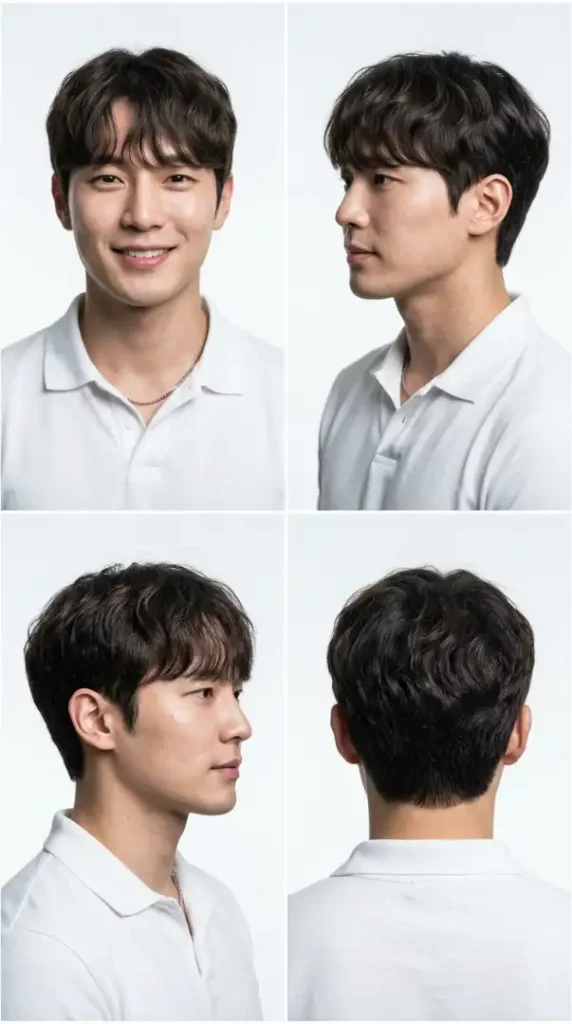
The Korean Wave Fringe: Soft, Romantic, Refined
The Korean Wave Fringe brings the soft, center-forward fringe popularized by Korean fashion and entertainment into mainstream men’s grooming. Unlike sharper, structured fringe cuts, this style relies on rounded, gentle movement and a naturally soft hairline, giving it a youthful, approachable quality that photographs beautifully. It’s a consistently trending search term for men wanting a fringe haircut with a softer, more romantic edge.
Best Face Shape for The Korean Wave Fringe
Oval and heart-shaped faces suit The Korean Wave Fringe especially well, since the soft, centered fringe frames the face gently without adding harsh lines. Square faces also benefit, as the rounded fringe softens strong jaw angles. Round faces should be more careful — a heavy, low fringe combined with rounded volume can emphasize roundness, so requesting slightly more length and a higher fringe placement helps maintain better face proportion for round-faced clients.
Grooming Kit You’ll Need
- Clippers: Wahl Magic Clip (Model 5049-400) for light side maintenance only
- Trimmer/Outliner: Andis T-Outliner (Model 04710) for a soft, natural hairline edge
- Finishing Tools: Wide-tooth comb for gentle detangling, Denman boar bristle brush for soft shine
- Styling Product: A light, non-greasy hair cream for natural hold without stiffness, applied sparingly
- Maintenance: A lightweight facial moisturizer for clean-shaven skin conditioning
Apply a small amount of light hair cream to damp hair, use fingers (not a comb) to shape the fringe gently downward and center, then air-dry naturally to preserve the soft wave pattern.
How Often You Need a Touch-Up
This is a LOW-to-MEDIUM maintenance style. Barbershop visits every 5-6 weeks are usually enough, since this cut doesn’t rely on a sharp fade or precise line that grows out quickly. Daily styling takes just 4-6 minutes given the minimal, natural-hold approach. The product routine is a single light cream application. As the cut grows out, the soft waves become even more pronounced and the style often looks better with a little extra length. Monthly maintenance cost is moderate at $25-35. Difficulty rating for home upkeep: Beginner-friendly.
What to Say to Your Barber
Say this to your barber: “I want a Korean Wave Fringe with soft, rounded layers and a center-forward fringe that falls just above my eyebrows. Take the top to guard #6, keeping the front section long enough for natural, soft movement. Point cut the fringe for a rounded, soft edge — no hard or blunt lines anywhere. Keep the sides at guard #4 with a subtle, natural taper rather than a sharp fade. Finish with a soft, natural hairline and minimal texturizing to keep the rounded shape.”
If soft and romantic isn’t the direction you’re going, the next style takes things in a bolder, more expressive direction with a fringe cut built around raw, undone charm.
9 of 13 — The Messy Fringe Heartthrob

The Messy Fringe Heartthrob: Tousled and Magnetic
The Messy Fringe Heartthrob leans fully into deliberate imperfection, using natural texture and coil pattern to create a fringe that looks effortlessly tousled rather than precisely styled. This cut works with the hair’s natural movement instead of fighting it, making it one of the most low-effort, high-impact fringe haircuts for men with textured or coily hair types.
Best Face Shape for The Messy Fringe Heartthrob
Oval and square face shapes handle The Messy Fringe Heartthrob particularly well, since the natural volume at the crown adds height while the tousled fringe softens strong features without overwhelming them. Diamond faces also benefit, as the textured fringe balances wider cheekbones. Long or oblong faces should keep the volume more contained at the front rather than piled high at the crown, since excess vertical volume can exaggerate an already-long face shape.
Grooming Kit You’ll Need
- Clippers: Andis Master (Model 01557) for the sides and back
- Trimmer/Outliner: Andis T-Outliner (Model 04710) for a clean, natural hairline
- Finishing Tools: Wide-tooth comb for detangling coily texture, a diffuser attachment for the blow dryer to preserve natural pattern
- Styling Product: A lightweight curl cream or texturizing paste that defines without weighing hair down
- Maintenance: Viking Revolution beard oil for the full beard, applied generously to maintain shape and softness
Apply curl cream to damp hair, scrunch upward gently from the ends to the roots to encourage natural volume, then diffuse on low heat, tousling occasionally by hand rather than combing through.
How Often You Need a Touch-Up
This is a LOW maintenance style. Barbershop visits every 5-6 weeks are typically sufficient, since natural texture holds its shape well as it grows. Daily styling takes just 4-5 minutes with a simple scrunch-and-diffuse routine. The product routine is a single curl cream application. As the cut grows out, the natural texture and volume actually become more pronounced and the tousled look holds up well over time. Monthly maintenance cost is moderate at $25-35. Difficulty rating for home upkeep: Beginner-friendly, since natural texture does most of the styling work.
What to Say to Your Barber
Say this to your barber: “I want a Messy Fringe Heartthrob with natural volume and texture kept intact — please don’t over-thin the top. Take the top to guard #6, keeping enough length for the natural coil pattern to show through in the fringe. Keep the sides at guard #4 with a soft taper, not a sharp fade. Taper my beard to 6mm, keeping it full. Finish with minimal cutting on top — I want the natural texture to do the work, just clean up the shape and edges.”
If natural texture and tousled volume isn’t the direction you want, the next style brings back a taller, more structured silhouette with the fringe integrated into a classic pompadour shape.
10 of 13 — The Fringe Pompadour Fusion
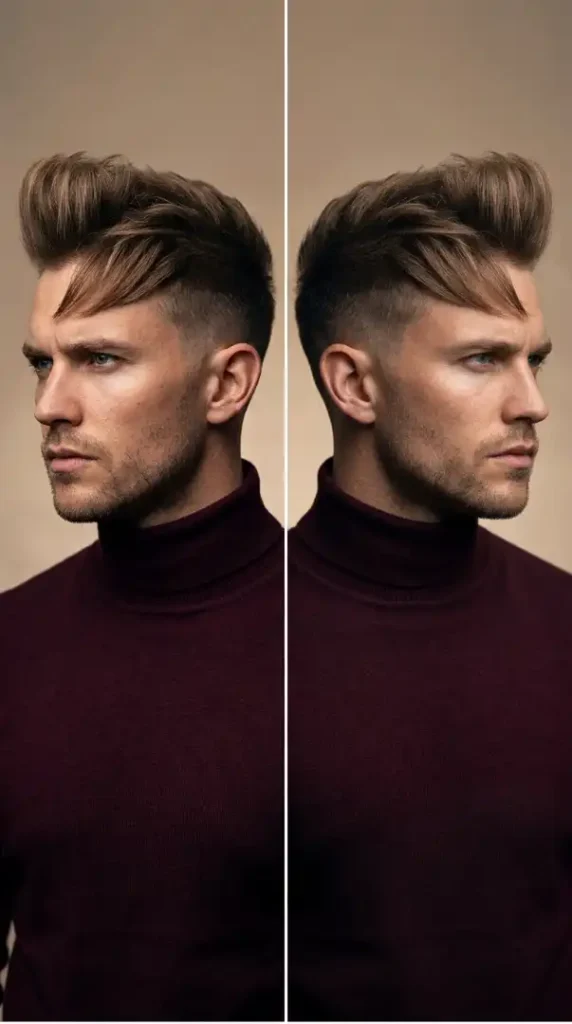
The Fringe Pompadour Fusion: Height Meets Texture
The Fringe Pompadour Fusion merges the classic volume of a pompadour with the forward-falling texture of a modern fringe, creating a hybrid style that adds height at the crown while still keeping visual softness at the front. It’s a strong choice for men who want a fringe haircut with more dramatic silhouette and presence than a flat, close-to-the-head style.
Best Face Shape for The Fringe Pompadour Fusion
Round and square face shapes benefit most from The Fringe Pompadour Fusion, since the added height at the crown elongates the face and draws the eye upward, counteracting width at the jaw or cheeks. Oval faces also wear this style comfortably given their balanced proportions. Faces to approach carefully: already-long or oblong faces, where extra height can push proportions too far vertically — a lower, more moderate pompadour height is recommended in that case to avoid an overly elongated appearance.
Grooming Kit You’ll Need
- Clippers: Wahl Magic Clip (Model 5049-400) for the tight side taper
- Trimmer/Outliner: Andis T-Outliner (Model 04710) for the sharp temple fade and sideburn point
- Finishing Tools: Kent 81T fine-tooth comb for building height, Denman boar bristle brush for smoothing the pompadour base
- Styling Product: A strong-hold pomade for the structured height, such as a heavy-hold water-based pomade
- Maintenance: Honest Amish beard oil for stubble conditioning, applied sparingly
Apply a generous dime-sized amount of strong-hold pomade to damp hair, blow-dry while lifting the front section upward and back with a round brush, then comb the fringe portion forward slightly at the very front for the fusion effect.
How Often You Need a Touch-Up
This is a MEDIUM-to-HIGH maintenance style. Barbershop visits every 3 weeks maintain the tight taper needed to support the pompadour’s height contrast. Daily styling takes 8-10 minutes given the blow-drying and lifting required to build volume. The product routine is a single strong-hold pomade step, though achieving consistent height requires practice with a round brush. As the cut grows out, the pompadour loses structural height and starts to flop forward within about 3 weeks. Monthly maintenance cost runs approximately $35-50. Difficulty rating for home upkeep: Advanced, since building consistent height takes real technique.
What to Say to Your Barber
Say this to your barber: “I want a Fringe Pompadour Fusion with a tight taper fade starting above the ear. Take the top to guard #7 at the front for maximum pompadour height, tapering the length down slightly toward the crown. Keep the very front section long enough to fall forward slightly into a soft fringe over the pompadour base. Blend the taper from guard #2 at the hairline up to guard #7 at the top. Finish with a sharp lineup at the temples and hairline for a clean, structured contrast.”
If that much daily volume-building isn’t practical for your routine, the next style takes fringe styling in a much lower-maintenance, low-fade direction.
11 of 13 — The Low Taper Fringe
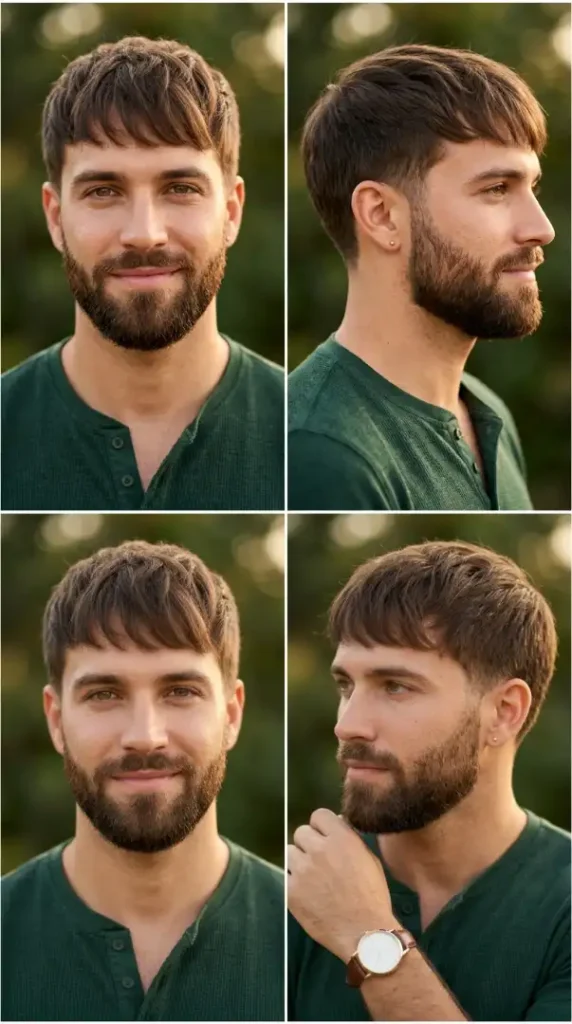
The Low Taper Fringe: Understated and Everyday
The Low Taper Fringe strips away the drama of high fades and sharp lines in favor of a subtle, barely-there taper that lets the fringe do all the visual work. This is one of the most wearable, everyday fringe haircuts for men who want a natural, unforced appearance that doesn’t scream “fresh haircut” and instead just looks like great hair.
Best Face Shape for The Low Taper Fringe
Nearly every face shape can wear The Low Taper Fringe comfortably, which is part of its appeal, though oval and heart-shaped faces see the most natural-looking results since the soft fringe complements already-balanced proportions without needing to correct anything dramatic. Square faces benefit from the way the soft fringe edge takes hardness off strong jaw angles. The one face shape that should adjust slightly is round — a very low, heavy fringe can add width at the mid-face, so keeping the fringe a touch shorter and less dense helps maintain proportion.
Grooming Kit You’ll Need
- Clippers: Wahl Magic Clip (Model 5049-400) for the subtle low taper
- Trimmer/Outliner: Andis T-Outliner (Model 04710) for light, natural edge work
- Finishing Tools: Wide-tooth comb for gentle styling, Denman boar bristle brush for a natural finish
- Styling Product: A light, matte styling cream for natural hold without heaviness, applied sparingly
- Maintenance: Honest Amish beard oil for the full beard, applied generously
Apply a small amount of styling cream to damp hair, finger-comb the fringe forward naturally, and let it air-dry without heavy manipulation to preserve the relaxed, natural finish.
How Often You Need a Touch-Up
This is a LOW maintenance style, one of the easiest fringe cuts to maintain. Barbershop visits every 6-8 weeks are typically enough, since the low taper is subtle and grows out gracefully without losing its shape dramatically. Daily styling takes just 3-5 minutes with minimal product. The product routine is a single light cream step. As the cut grows out, it maintains a natural, intentional look for much longer than higher-contrast fade styles, often still looking great at the 6-week mark. Monthly maintenance cost is low, around $20-30. Difficulty rating for home upkeep: Beginner-friendly.
What to Say to Your Barber
Say this to your barber: “I want a Low Taper Fringe with a subtle taper starting low, just above the ear, guard #3 blending gradually up to guard #6 at the crown — nothing dramatic or high-contrast. Take the top to guard #6, keeping the fringe at a natural length that falls forward. Taper my beard to 5mm, keeping it full and natural. Finish with a soft, natural hairline — no sharp lineup, just clean and understated edges.”
If understated isn’t dramatic enough for you, the next style embraces natural curl pattern for a completely different, higher-texture take on the fringe trend.
12 of 13 — The Bold Blunt Fringe
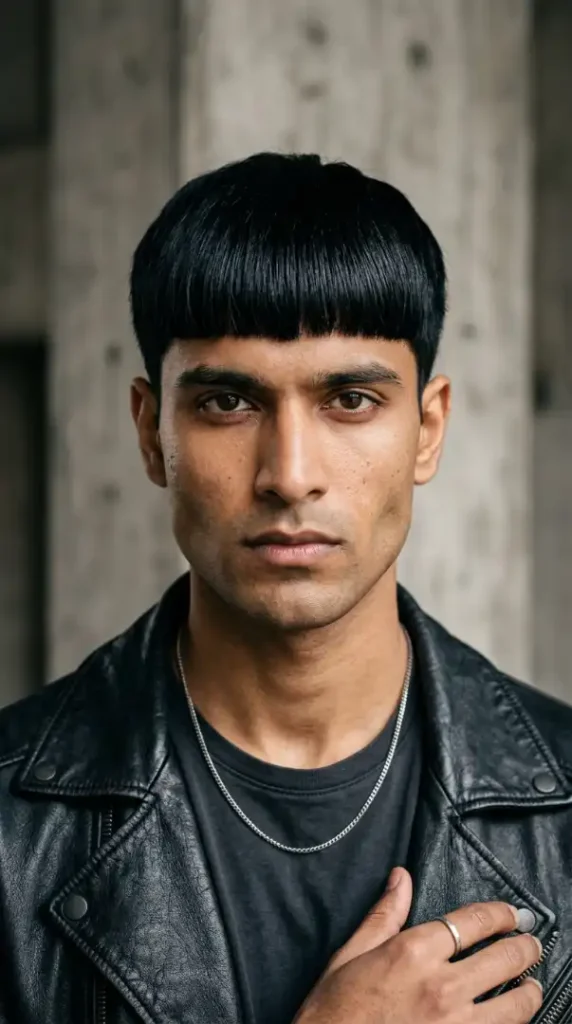
The Bold Blunt Fringe: Maximum Statement, Maximum Impact
The Bold Blunt Fringe closes out this collection with the most dramatic, high-density fringe style of the set. Thick, weighty, and cut with absolute precision, this style prioritizes impact over subtlety, making it the fringe haircut of choice for men who want their hair to be the first thing people notice. It’s a strong search term among men researching bold, editorial-style haircuts that stand apart from softer, everyday fringe cuts.
Best Face Shape for The Bold Blunt Fringe
Oval and long/oblong face shapes benefit most from The Bold Blunt Fringe, since the heavy horizontal line dramatically interrupts vertical length and adds visual weight to the upper face, creating better overall balance. Round and square faces should approach this style with real caution — the thick, heavy horizontal line can add significant width to the mid-face and make already-full features appear fuller, so a slightly shorter, less dense fringe with visible sides is recommended for these face shapes to avoid an overwhelming effect.
Grooming Kit You’ll Need
- Clippers: Wahl Magic Clip (Model 5049-400) for side maintenance
- Trimmer/Outliner: Andis T-Outliner (Model 04710) for the precise, heavy blunt line
- Finishing Tools: Kent 81T fine-tooth comb for exact parting and line precision, Denman boar bristle brush for smoothing density
- Styling Product: Layrite Original Pomade (medium hold) for a controlled, weighty finish without excess shine
- Maintenance: A lightweight facial moisturizer for clean-shaven skin conditioning
Apply a dime-sized amount of pomade evenly through the fringe with a comb, pressing the line flat and straight with a fine-tooth comb to maintain the bold, geometric edge.
How Often You Need a Touch-Up
This is a HIGH maintenance style. Barbershop visits every 2-3 weeks are needed to maintain the sharp, heavy blunt line that defines this cut, since even minor growth softens its geometric precision. Daily styling takes 7-9 minutes combing the dense fringe into its exact line. The product routine is a single pomade application, combed rather than finger-styled to preserve the precise edge. As the cut grows out, the blunt line softens within about 2-3 weeks and starts to look more like a heavy, natural fringe rather than the deliberate bold style. Monthly maintenance cost runs approximately $40-60 given the frequent touch-ups required. Difficulty rating for home upkeep: Advanced, since maintaining a perfectly straight, dense line without a barber is genuinely difficult.
What to Say to Your Barber
Say this to your barber: “I want a Bold Blunt Fringe with a thick, straight-across fringe sitting right at my eyebrows, cut with scissors for maximum precision — no texturizing or point cutting on the fringe line itself. Take the top to guard #6, keeping maximum density throughout for weight and impact. Keep the sides at guard #4 with a subtle taper. Finish with a crisp lineup at the temples and a perfectly straight, geometric hairline across the front.”
That completes the full 13-style fringe haircut collection — from the softest, most natural everyday looks to the boldest, most editorial statement cuts.
13 of 13— The Relaxed Wash-and-Go Fringe

The Relaxed Wash-and-Go Fringe: Natural Texture, Zero Effort
The Relaxed Wash-and-Go Fringe is built entirely around natural texture, requiring almost no active styling beyond washing and letting hair fall into place. This is the ultimate low-effort fringe haircut for men with naturally coily or textured hair who want great everyday hair without a morning routine.
Best Face Shape for The Relaxed Wash-and-Go Fringe
Oval and square face shapes work particularly well with this style, since natural volume at the crown adds height while the soft fringe frames the face gently. Diamond faces also benefit from the way the natural texture balances wider cheekbones. Long or oblong faces should keep volume more contained at the front rather than allowing it to build high at the crown, to avoid exaggerating length.
Grooming Kit You’ll Need
- Clippers: Andis Master (Model 01557) for the sides and back
- Trimmer/Outliner: Andis T-Outliner (Model 04710) for a clean, natural hairline
- Finishing Tools: Wide-tooth comb for gentle detangling only
- Styling Product: A lightweight leave-in conditioner for natural moisture and definition, no heavy hold products
- Maintenance: Viking Revolution beard oil for the full beard, applied generously
Apply a small amount of leave-in conditioner to damp hair after washing, finger-comb gently to detangle, and let it air-dry completely without further manipulation.
How Often You Need a Touch-Up
This is the LOWEST maintenance style in this collection. Barbershop visits every 6-8 weeks are typically enough, since natural texture holds its shape well as it grows. Daily styling takes 2-3 minutes at most — often just a quick finger comb after washing. The product routine is a single lightweight leave-in step. As the cut grows out, the natural texture and volume become more pronounced and the look often improves with extra length. Monthly maintenance cost is low, around $20-30. Difficulty rating for home upkeep: Beginner-friendly.
What to Say to Your Barber
Say this to your barber: “I want a Relaxed Wash-and-Go Fringe with natural texture kept intact — please don’t over-thin the top. Take the top to guard #6, keeping enough length for the natural coil pattern to show in the fringe. Keep the sides at guard #4 with a soft taper. Taper my beard to 6mm, keeping it full. Finish with minimal cutting on top — I want the natural texture to do the styling.”
That wraps up this collection of 14 fringe haircuts — from the sharpest editorial statement pieces to the lowest-effort, most natural everyday looks.