
13 Edgy Punk-Inspired Cuts That Redefine Bold Men’s Style
1 of 13 — The Shockwave Mohawk

Face Shape Match
The Shockwave Mohawk is engineered for Square face shapes, where the strong jawline is already the face’s dominant feature. The vertical strip of height down the center draws the eye upward and elongates the face, while the shaved sides remove bulk and let the jaw read even sharper. Oval faces also handle this style well because there’s no natural width to correct — the mohawk simply adds drama on top of already-balanced proportions.
Round and Oblong faces should approach this style with caution. On a Round face, the height can look disconnected from the width of the cheeks unless the sides are kept extremely tight to compensate. On an Oblong face, adding more vertical height on top of an already long face can push proportions too far — a lower, less dramatic strip is the safer call.
Grooming Kit
Clippers: Wahl Magic Clip (Model 5049-400) for the bulk shave and skin fade blending. Trimmer/Outliner: Andis T-Outliner (Model 04710) for the squared-off hairline and temple edge work. Finishing Tools: Kent 81T fine-tooth comb to separate and lift the mohawk strip, Denman boar bristle brush for the flanks. Styling Product: American Crew Fiber (matte finish, high hold) — a dime-sized amount worked into damp hair, then a second pea-sized amount for touch-ups through the day. Maintenance: Honest Amish beard oil for the stubble, a few drops massaged in after the morning shower.
Maintenance Level
Rating: HIGH.
Barber visit frequency: every 2 weeks for the fade and hairline touch-up, since the shaved sides grow out visibly fast. Daily styling time: 6-8 minutes each morning — wetting, applying fiber, combing the strip upward, and locking the shape with a blast of cool air from a hairdryer. Product routine: two-step — fiber for hold, then a light-hold spray to set for the day. Growth pattern: the sides fill in within 10-12 days and start to soften the fade line, while the top strip keeps its texture longer but loses crispness at the edges. Cost consideration: roughly $60-90 per month for barber visits plus product. Difficulty rating: Advanced for home maintenance — the skin fade blending is best left to a professional.
Barber Talk
Say this to your barber:
“I want a Shockwave Mohawk with a skin fade starting right at the temple line. Take the sides down to skin with clippers, no guard, blending up to guard #2 at the parietal ridge. Keep a strip about 2-3 inches wide down the center at full length — don’t blend it into the sides, I want a hard, deliberate line. Square off the hairline across the front rather than rounding it. Finish with a crisp lineup at the temples and a sharp edge around the strip so it holds its shape when styled upward.”
If this high-maintenance shaved-side statement feels like too much daily upkeep, the next style trades the razor-sharp sides for a softer, wash-and-go texture that still keeps the rebellious edge.
2 of 13 — The Ink Vein Undercut

Face Shape Match
The Ink Vein Undercut’s heavy top volume is a natural complement to Oval faces, which already have balanced proportions and can carry extra height and weight on top without it overwhelming the rest of the face. The hard disconnection line also flatters Diamond faces by drawing attention away from the narrower forehead and toward the cheekbones, where the swept-back volume naturally frames the widest part of the face.
Round faces should be more careful with this style — the heavy, rounded volume on top can add width exactly where a Round face needs less. If a Round-faced client wants this cut, request a flatter, more directional sweep rather than a full rounded pile of volume.
Grooming Kit
Clippers: Andis Master (Model 01557) for the shaved undercut sides. Trimmer/Outliner: Andis T-Outliner (Model 04710) for the sharp disconnection line. Finishing Tools: Denman boar bristle brush to smooth and direct the swept-back top, wide-tooth comb for detangling before styling. Styling Product: Layrite Original Pomade (medium hold) — a dime-sized amount worked through damp hair for a natural sheen and flexible hold. Maintenance: Viking Revolution beard oil, a few drops for jawline skin conditioning even when clean-shaven.
Maintenance Level
Rating: MEDIUM.
Barber visit frequency: every 3-4 weeks to keep the disconnection line crisp, since the shaved sides grow more slowly than a full fade. Daily styling time: 5 minutes — comb through pomade while damp and sweep back with fingers or a brush. Product routine: single-step, one pomade application. Growth pattern: the top grows into a fuller, heavier sweep over several weeks which many wearers prefer, while the sides need trimming every 2-3 weeks to preserve the hard line. Cost consideration: roughly $50-70 per month for barber visits plus product. Difficulty rating: Intermediate for home maintenance — the disconnection line requires a steady hand.
Barber Talk
Say this to your barber:
“I want an Ink Vein Undercut — take the sides and back down with clippers, no guard, straight to skin, with a hard disconnected line about an inch above the ear, no blend into the top. Leave the top at full length, at least 4-5 inches, so I have enough to sweep back. Don’t texturize it too much, I want weight and volume to hold the sweep. Keep the sideburns thin and tapered into the shaved side. Finish with a clean, straight lineup along the disconnection line and around the ears.”
If the hard disconnection feels too dramatic for your daily routine, the next style softens that same silhouette into a gradual blend that’s easier to maintain between cuts.
3 of 13 — The Riot Line Pompadour

Face Shape Match
The Riot Line Pompadour is built for Diamond faces — the height at the front adds length to a face that’s naturally widest at the cheekbones, balancing the narrower forehead and chin. Heart-shaped faces benefit too, since the volume up top draws attention away from a broader forehead and toward the more even lower half of the face.
Round faces should avoid a very tall, rounded pompadour, as it can make the face look shorter and wider by contrast. A more angular, forward-swept version with sharper tapering on the sides works better if a Round-faced client wants this style.
Grooming Kit
Clippers: Wahl Magic Clip (Model 5049-400) for the tapered sides. Trimmer/Outliner: Andis T-Outliner (Model 04710) for the beard-to-taper connection and hairline. Finishing Tools: Kent 81T fine-tooth comb for parting and lift, round boar bristle brush for the front volume. Styling Product: Layrite Original Pomade (high hold) — a dime-sized amount, plus a small amount of blow-dry lotion for lift before styling. Maintenance: Honest Amish beard oil, several drops worked into the full beard daily.
Maintenance Level
Rating: HIGH.
Barber visit frequency: every 3 weeks for the taper touch-up, every 4-5 weeks for the beard shaping. Daily styling time: 8-10 minutes — blow-drying the front section upward with a round brush before applying pomade. Product routine: two-step, blow-dry lotion followed by high-hold pomade. Growth pattern: the front volume gets easier to style as it grows, but the tapered sides lose their sharpness within 2-3 weeks. Cost consideration: roughly $70-100 per month including beard trims. Difficulty rating: Advanced for home maintenance — the blow-dry lift technique takes practice.
Barber Talk
Say this to your barber:
“I want a Riot Line Pompadour with a mid taper starting above the ear, blending from skin up to guard #3 at the parietal ridge. Leave the top at 5-6 inches at the front for height, tapering down to 3 inches toward the crown. Point cut the front section for texture rather than a blunt cut, so it has natural movement when I style it up. Taper my beard into the fade at the jawline, keeping the length at about 8mm. Finish with a crisp lineup at the temples and a clean edge around the beard.”
If this much daily blow-drying isn’t for you, the next style keeps the same rebellious energy but styles dry in under three minutes.
4 of 13 — The Static Shock Crop

Face Shape Match
The Static Shock Crop’s short, textured top and tight sides suit Oblong faces particularly well, since it avoids adding extra height that would stretch the face further, instead keeping visual weight balanced and horizontal. Square faces also do well here, as the tight taper draws attention to the strong jawline without competing volume on top.
Round faces should be cautious with a crop that’s too short and even all over, since it can make the face look wider without a strong vertical element. Requesting slightly more length and texture in the fringe helps a Round-faced client add balance.
Grooming Kit
Clippers: Andis Master (Model 01557) for the tight taper on the sides and back. Trimmer/Outliner: Andis T-Outliner (Model 04710) for the temple fade and nape edge work. Finishing Tools: Kent 81T fine-tooth comb for parting, Denman boar bristle brush for texture blending. Styling Product: Layrite Original Pomade (medium hold) — a pea-sized amount worked through damp hair with fingers for a natural, textured finish. Maintenance: Viking Revolution beard oil, a few drops for stubble conditioning.
Maintenance Level
Rating: LOW.
Barber visit frequency: every 3-4 weeks for the fade and nape touch-up. Daily styling time: 3-5 minutes — a pea-sized amount of pomade worked through damp hair and finger-styled into place. Product routine: single-step. Growth pattern: the crop grows out gracefully into a slightly longer, still-wearable texture over 4-5 weeks before it needs a full trim. Cost consideration: roughly $40-60 per month. Difficulty rating: Beginner-friendly for home maintenance.
Barber Talk
Say this to your barber:
“I want a Static Shock Crop with a low fade starting just above the ear, blending from skin at guard #1 up to guard #3 at the parietal ridge. Take the top to about 2 inches with texture point cutting so it has natural movement, not a blunt cut. For the fade, blend gradually from the starting guard up to the ending guard with no visible lines. Taper the nape with a rounded shape rather than a hard square edge. Finish with a natural, textured fringe and a soft edge at the hairline rather than a razor-crisp lineup.”
If this low-maintenance crop is exactly your speed, the next style pushes the same easy routine into an even bolder shape for those who want more visual impact without more effort.
5 of 13 — The Bone Yard Buzz

Face Shape Match
The Bone Yard Buzz’s ultra-short, uniform length is a strong match for Oval faces, since the cut doesn’t compete with or exaggerate any single feature — it simply lets the natural face shape lead. Heart-shaped faces also benefit, as the short sides keep the visual weight low and balanced rather than adding bulk near the forehead.
Long or Oblong faces should be cautious, since an all-over buzz with no length on top provides no way to visually shorten the face. If a client with an Oblong face wants this look, suggest leaving marginally more length on top (a “textured buzz” rather than a true skin-tight buzz) to soften the effect.
Grooming Kit
Clippers: Wahl Magic Clip (Model 5049-400) for the all-over buzz length. Trimmer/Outliner: Andis T-Outliner (Model 04710) for the sharp temple fade and hairline. Finishing Tools: Kent 81T fine-tooth comb for beard shaping, Denman boar bristle brush not required for this ultra-short length. Styling Product: A light matte cream (small dime-sized amount) is optional for a subtle finish; many wearers skip product entirely. Maintenance: Honest Amish beard oil, a few drops worked into the beard daily.
Maintenance Level
Rating: LOW.
Barber visit frequency: every 2-3 weeks to keep the fade sharp, since a buzz shows regrowth quickly. Daily styling time: under 2 minutes — this is a true wash-and-go cut. Product routine: optional, zero to one step. Growth pattern: the buzz softens into a slightly longer, still-neat texture over 2 weeks before the fade line starts to blur. Cost consideration: roughly $40-50 per month. Difficulty rating: Beginner-friendly — many wearers buzz their own hair at home with the right clipper guard.
Barber Talk
Say this to your barber:
“I want a Bone Yard Buzz with a guard #2 on top, blending into a skin fade at the temples starting right above the ear. Blend from skin up to the guard #2 length gradually with no harsh line. Keep the crown density even all over — no longer patches. Line up the front hairline naturally rather than square, and clean up around the ears. Keep my beard at a consistent 5mm with the trimmer, tapering slightly at the neckline.”
If a buzz feels too minimal for your taste, the next style keeps things low-maintenance but adds a bold, textured statement on top.
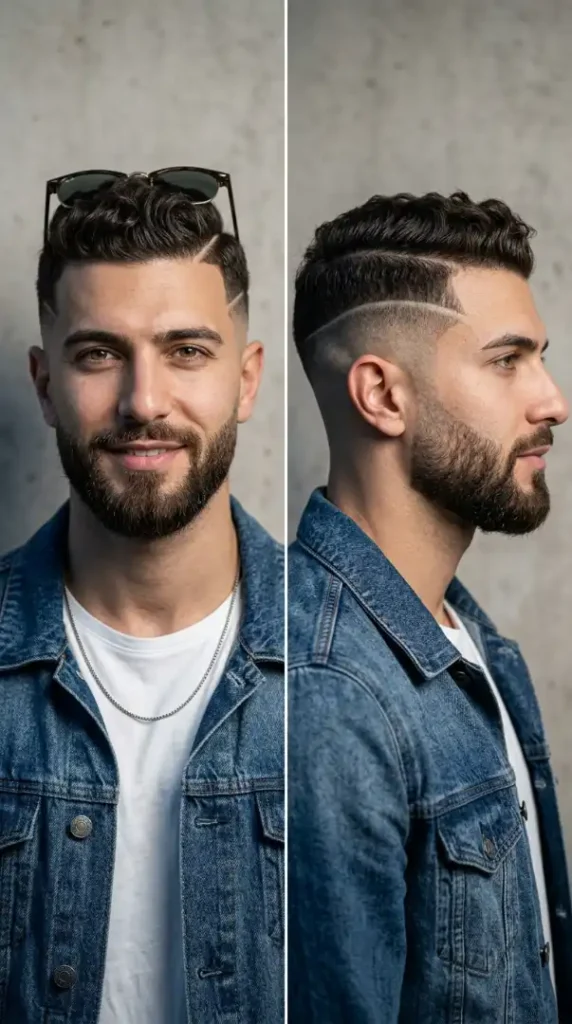
6 of 13 — The Vandal Fade
Face Shape Match
The Vandal Fade’s shaved design line creates a strong diagonal that works especially well on Round faces, breaking up the natural curve of the cheeks and jaw with an angular accent that reads as more structured. Oval and Square faces also carry the style well, since the line adds a graphic detail without needing to correct any proportion issue.
Heart-shaped faces should be mindful of where the design line starts — placing it too close to the temple can emphasize a wider forehead. Starting the line slightly further back, closer to the crown, balances this out.
Grooming Kit
Clippers: Andis Master (Model 01557) for the fade beneath the design line. Trimmer/Outliner: Andis T-Outliner (Model 04710) for the precise shaved design line — this is the most technical part of the cut. Finishing Tools: Kent 81T fine-tooth comb for the hard part, Denman boar bristle brush for the top texture. Styling Product: American Crew Fiber (matte finish, high hold) — a dime-sized amount for texture and hold without shine. Maintenance: Viking Revolution beard oil for the full beard, applied daily.
Maintenance Level
Rating: HIGH.
Barber visit frequency: every 2 weeks, since the shaved design line grows out and loses definition faster than the surrounding fade. Daily styling time: 5-6 minutes for the textured top with the hard part. Product routine: single-step fiber application. Growth pattern: the design line is the first element to fade — most wearers notice it softening within 10 days. Cost consideration: roughly $60-80 per month. Difficulty rating: Advanced for home maintenance — the design line should be left to a barber.
Barber Talk
Say this to your barber:
“I want a Vandal Fade with a mid skin fade starting above the ear, blending from skin up to guard #3 at the parietal ridge. Keep the top at about 3 inches with a hard side part. Shave a single clean design line from the part down toward the temple, about a quarter-inch wide. Taper my beard into the fade at the jawline, keeping the length at 6mm. Finish with a crisp lineup at the temples and sharp edges around the design line.”
If a shaved design line feels like too much upkeep for your schedule, the next style delivers the same edgy attitude with a cut that only needs attention once a month.
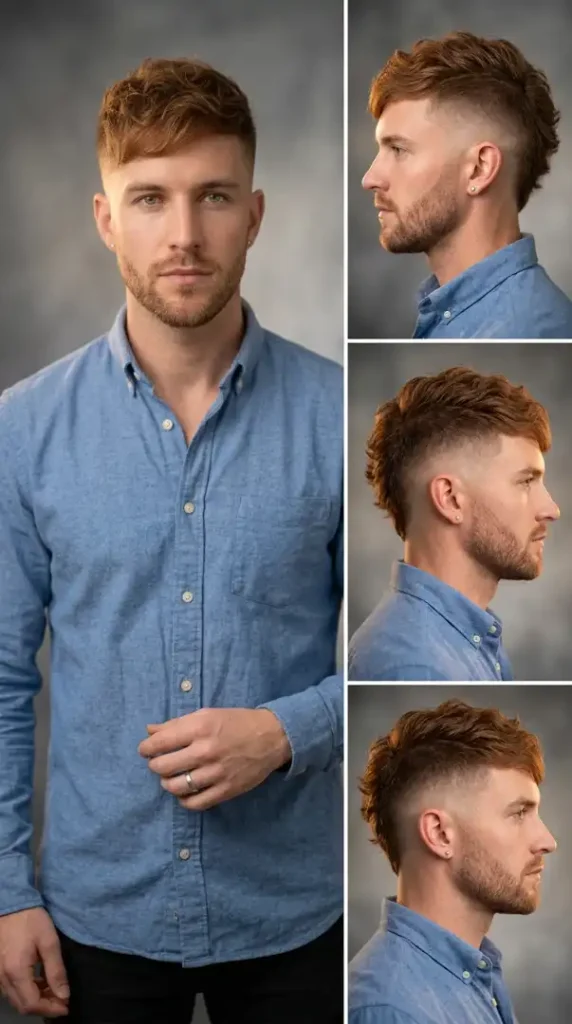
7 of 13 — The Molten Mohawk
Face Shape Match
The Molten Mohawk’s softer, textured strip works well on Heart-shaped faces, where the vertical line balances a wider forehead by drawing the eye down through the center rather than out to the sides. Oval faces also handle the height easily, since there’s no width issue to correct.
Round faces should request a lower-profile version, as a tall textured strip on an already-round face can look disconnected from the jawline. Keeping the height moderate and the sides tighter helps maintain balance.
Grooming Kit
Clippers: Wahl Magic Clip (Model 5049-400) for the sides and mid fade. Trimmer/Outliner: Andis T-Outliner (Model 04710) for the temple and hairline edge work. Finishing Tools: Kent 81T fine-tooth comb to lift and separate the strip, Denman boar bristle brush for texture. Styling Product: Layrite Original Pomade (medium hold) — a dime-sized amount for a naturally textured, less rigid finish than a classic mohawk. Maintenance: Honest Amish beard oil for the stubble.
Maintenance Level
Rating: MEDIUM.
Barber visit frequency: every 3 weeks for the fade touch-up. Daily styling time: 5-6 minutes — texturizing the strip with fingers and pomade rather than sculpting it rigidly. Product routine: single-step. Growth pattern: the softer texture of this mohawk variant grows out more gracefully than a sharp shockwave version, staying wearable for up to 4 weeks. Cost consideration: roughly $55-75 per month. Difficulty rating: Intermediate for home maintenance.
Barber Talk
Say this to your barber:
“I want a Molten Mohawk with a mid fade starting above the ear, blending from skin up to guard #3 at the parietal ridge. Leave a soft strip about 3 inches wide down the center, textured with point cutting rather than a hard blunt edge, so it looks more organic than a classic mohawk. Let the front fall into a slight fringe rather than standing perfectly upright. Finish with a soft, natural edge at the hairline rather than a razor-crisp lineup.”
If you like this softer take on a bold shape, the next style channels that same rebellious spirit into a completely shaved statement look.
8 of 13 — The Split Skull Fade
Face Shape Match
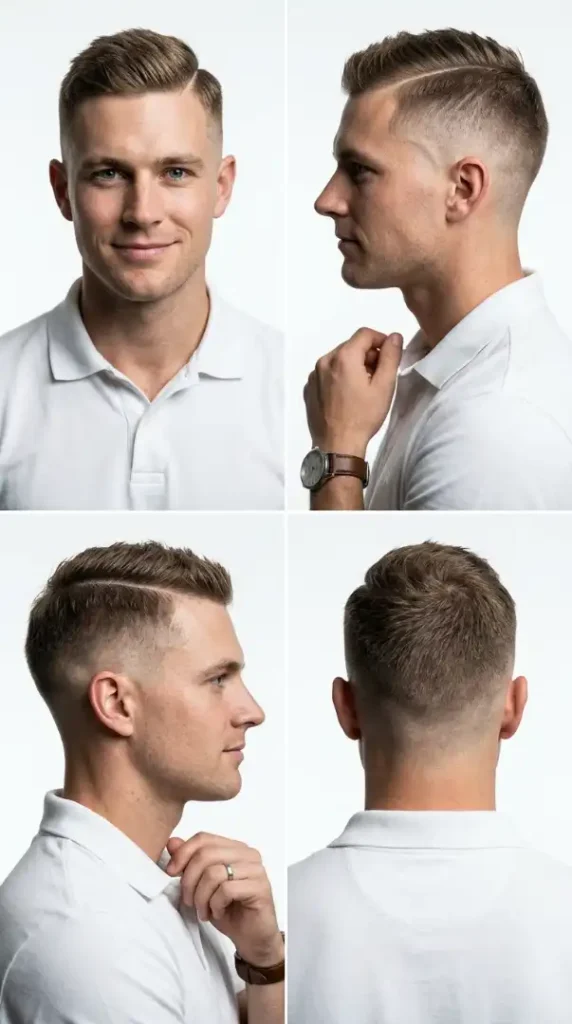
The Split Skull Fade’s sharp shaved part line adds structure that flatters Square faces the most, echoing the jaw’s own angularity with a clean straight accent up top. Oval faces also carry it easily, since there’s no proportion to correct — the part simply adds a graphic detail.
Round faces should request the part line be cut steeper and more diagonal rather than straight across, since a straight horizontal line can visually widen the head. A diagonal treatment reads as more slimming.
Grooming Kit
Clippers: Andis Master (Model 01557) for the tight fade. Trimmer/Outliner: Andis T-Outliner (Model 04710) for the precise shaved part line — this is the technical centerpiece of the cut. Finishing Tools: Kent 81T fine-tooth comb for the part, Denman boar bristle brush for the top texture. Styling Product: American Crew Fiber (matte finish, high hold) — a dime-sized amount for hold with a natural matte finish. Maintenance: A light aftershave balm for the clean-shaven skin, applied post-shave to prevent irritation.
Maintenance Level
Rating: HIGH.
Barber visit frequency: every 2 weeks, since the shaved part line loses definition quickly. Daily styling time: 5 minutes — combing the part and setting texture with fiber. Product routine: single-step. Growth pattern: the part line is the first detail to blur, typically within 8-10 days. Cost consideration: roughly $60-80 per month. Difficulty rating: Advanced for home maintenance — the shaved line requires precision.
Barber Talk
Say this to your barber:
“I want a Split Skull Fade with a mid skin fade starting above the ear, blending from skin up to guard #3 at the parietal ridge. Keep the top at about 2.5 inches with texture point cutting. Shave one clean, straight part line from the front hairline back toward the crown, about a quarter-inch wide. Taper the nape with a rounded shape. Finish with a crisp lineup at the temples and a sharp edge along the part line.”
If keeping a shaved line fresh every two weeks sounds like a lot, the next style delivers a similarly graphic look that only needs a full trim once a month.
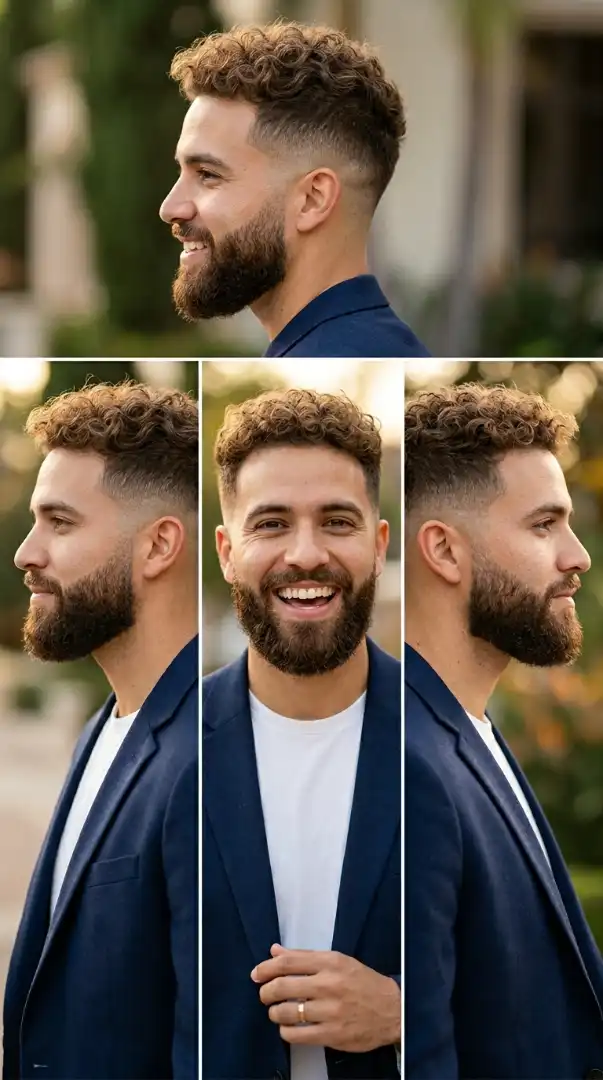
9 of 13 — The Neon Nomad Fade

Face Shape Match
The Neon Nomad Fade’s loose, voluminous curls on top suit Oval faces beautifully, since the added volume doesn’t need to correct any width issue and simply enhances the naturally balanced proportions. Diamond faces benefit too, as the fullness on top softens the angularity of the cheekbones.
Round faces should ask for the top kept slightly more directional and less rounded in shape, since an overly full, round silhouette on top of an already-round face can remove definition rather than add it.
Grooming Kit
Clippers: Wahl Magic Clip (Model 5049-400) for the fade beneath the curls. Trimmer/Outliner: Andis T-Outliner (Model 04710) for the temple blend and beard edges. Finishing Tools: Wide-tooth comb for detangling curls, fingers for scrunching and defining texture. Styling Product: A lightweight curl cream (dime-sized amount) to define texture without weighing curls down, plus a small amount of Layrite pomade at the roots for hold. Maintenance: Honest Amish beard oil, several drops for the full beard daily.
Maintenance Level
Rating: MEDIUM.
Barber visit frequency: every 3-4 weeks for the fade touch-up, since curls disguise regrowth on top better than straight hair. Daily styling time: 6-8 minutes — scrunching curl cream through damp hair and letting it air-dry or diffuse. Product routine: two-step, curl cream plus light root pomade. Growth pattern: curls generally look better as they grow longer, extending the time between full cuts to 6-8 weeks. Cost consideration: roughly $55-75 per month. Difficulty rating: Intermediate — learning to work with natural curl pattern takes some practice.
Barber Talk
Say this to your barber:
“I want a Neon Nomad Fade with a low fade starting just above the ear, blending from skin up to guard #2 at the parietal ridge. Leave the top long, at least 4 inches, and don’t thin it out too much — I want the curls to keep their natural volume. Taper my beard into the fade at the jawline, keeping the length at 8mm. Finish with a soft, natural edge at the hairline rather than a hard lineup, so the curls can fall naturally.”
If curly volume isn’t your natural texture, the next style delivers the same warm, rugged energy in a straight-hair-friendly version.
10 of 13 — The Chrome Spike Crop

Face Shape Match
The Chrome Spike Crop’s short, defined texture on top gives Round faces the vertical lift they need, with individual spiked pieces creating visual height without adding bulk. Square faces also do well, since the tight fade keeps the focus on the jawline while the spiked top adds a playful contrast.
Oblong faces should keep the spikes lower and more textured rather than tall and pointed, since additional height can stretch an already long face further than ideal.
Grooming Kit
Clippers: Andis Master (Model 01557) for the tight fade. Trimmer/Outliner: Andis T-Outliner (Model 04710) for the temple blend and hairline. Finishing Tools: Kent 81T fine-tooth comb for sectioning, fingers for texturizing and spiking. Styling Product: A strong-hold wax or clay (pea-sized amount) worked into dry hair and pinched upward to create defined spikes. Maintenance: Viking Revolution beard oil for the stubble.
Maintenance Level
Rating: LOW.
Barber visit frequency: every 3-4 weeks for the fade touch-up. Daily styling time: 3-4 minutes — working wax through dry hair and pinching spikes into place. Product routine: single-step. Growth pattern: the spiked texture actually becomes easier to style as it grows slightly longer, up to about 4 weeks. Cost consideration: roughly $40-60 per month. Difficulty rating: Beginner-friendly for home maintenance.
Barber Talk
Say this to your barber:
“I want a Chrome Spike Crop with a low fade starting above the ear, blending from skin up to guard #2 at the parietal ridge. Keep the top short, around 1.5-2 inches, with heavy texturizing so it spikes easily with product. Point cut the ends rather than blunt cutting for a more piece-y texture. Finish with a natural, soft edge at the hairline.”
If you’d rather skip the daily spiking routine altogether, the next style keeps things textured but settles naturally without any product-dependent shaping.
11 of 13 — The Rebel Skull Taper

Face Shape Match
The Rebel Skull Taper’s short, natural-texture top and sharp side taper flatter Oval faces effortlessly, since the balanced proportions need no correction — the cut simply highlights healthy, well-maintained texture. Square faces also benefit, as the tapered sides keep attention on the jawline.
Round faces should ask for slightly more length and shape retained on top rather than an all-over short taper, to avoid flattening the natural height the face needs.
Grooming Kit
Clippers: Wahl Magic Clip (Model 5049-400) for the sharp side taper. Trimmer/Outliner: Andis T-Outliner (Model 04710) for the precise natural hairline and beard edges. Finishing Tools: Wide-tooth comb and fingers for defining natural coil texture — a boar bristle brush is not recommended for this hair type. Styling Product: A curl-defining cream or twist cream (dime-sized amount) worked through damp hair to enhance natural texture and add shine. Maintenance: Honest Amish beard oil, several drops worked into the full beard daily.
Maintenance Level
Rating: LOW.
Barber visit frequency: every 2-3 weeks for the taper touch-up. Daily styling time: 4-5 minutes — applying cream to damp hair and letting the natural texture set. Product routine: single-step. Growth pattern: the tightly coiled texture holds its shape well as it grows, extending time between full cuts to 5-6 weeks. Cost consideration: roughly $45-65 per month. Difficulty rating: Beginner-friendly for home maintenance.
Barber Talk
Say this to your barber:
“I want a Rebel Skull Taper with a tight taper on the sides, blending from a guard #1 at the bottom up to a guard #3 near the crown. Leave the top at a natural length of about 1-1.5 inches to preserve the coil texture — no chemical straightening. Taper my beard into the sides at the jawline, keeping the length at 10mm. Finish with a clean, natural edge at the hairline and around the beard, not an overly sharp lineup.”
If you love this natural, low-effort texture, the next style keeps that same easy routine but leans into a more angular, punk-inspired silhouette.
12 of 13 — The Blackout Buzz
Face Shape Match
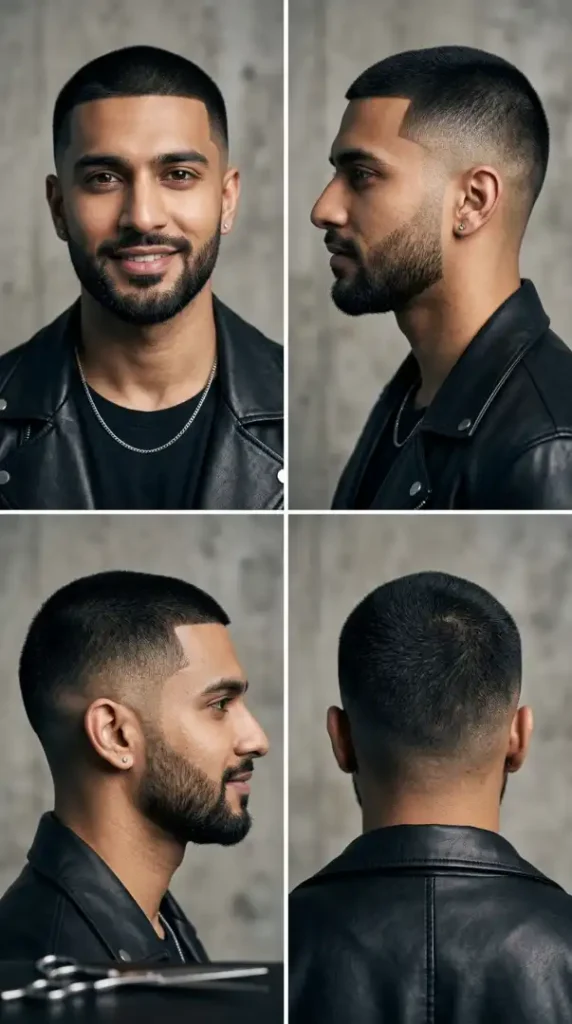
The Blackout Buzz’s uniform, all-over shortness works best on Square and Oval faces, letting the jawline and natural bone structure take full focus without competing volume. The sharp fade adds just enough structure to frame the face without changing its shape.
Oblong faces should be cautious, since a true buzz with no length anywhere removes the option to visually balance a longer face. A slightly longer guard on top (guard #3-4 instead of #1-2) helps soften the effect for an Oblong-faced client.
Grooming Kit
Clippers: Andis Master (Model 01557) for the all-over buzz. Trimmer/Outliner: Andis T-Outliner (Model 04710) for the sharp temple fade and squared hairline. Finishing Tools: Not typically required for this ultra-short length — a soft-bristle brush can be used to clear loose clippings. Styling Product: Optional light matte cream, a dime-sized amount, for a subtle finish. Maintenance: Viking Revolution beard oil for the short beard, applied daily.
Maintenance Level
Rating: LOW.
Barber visit frequency: every 2 weeks to maintain the sharp fade. Daily styling time: under 2 minutes. Product routine: optional, zero to one step. Growth pattern: softens into a slightly fuzzy texture within 10-14 days. Cost consideration: roughly $40-50 per month. Difficulty rating: Beginner-friendly for home maintenance.
Barber Talk
Say this to your barber:
“I want a Blackout Buzz with a guard #1 on top, blending into a skin fade at the temples starting right above the ear. Blend gradually from skin up to the guard #1 length with no visible line. Square off the hairline at the front rather than rounding it, and keep the nape squared too. Keep my beard at a consistent 4mm with the trimmer.”
If a full buzz is more minimal than you’d like, the next style closes out this collection with a longer, statement-making finish.
13 of 13 — The Wasteland Quiff

Face Shape Match
The Wasteland Quiff’s upward-swept volume flatters Oval and Diamond faces particularly well — the added height elongates subtly while the tapered sides keep the silhouette clean rather than bulky. Heart-shaped faces also do well, since the volume is concentrated at the front rather than spread wide, keeping the forehead from looking wider than it is.
Round faces should ask for the quiff kept more forward and directional, avoiding a fully rounded puff of volume, to prevent adding unwanted width to an already round silhouette.
Grooming Kit
Clippers: Wahl Magic Clip (Model 5049-400) for the tapered sides. Trimmer/Outliner: Andis T-Outliner (Model 04710) for the hairline and beard edges. Finishing Tools: Kent 81T fine-tooth comb for lift, round boar bristle brush for the front volume during blow-drying. Styling Product: Layrite Original Pomade (medium hold) with a small amount of blow-dry lotion for lift before styling. Maintenance: Honest Amish beard oil for the stubble.
Maintenance Level
Rating: MEDIUM.
Barber visit frequency: every 3-4 weeks for the taper touch-up. Daily styling time: 6-7 minutes — blow-drying the front upward with a round brush, then setting with pomade. Product routine: two-step. Growth pattern: the quiff becomes easier to style with slightly more length, staying wearable for up to 5-6 weeks. Cost consideration: roughly $55-75 per month. Difficulty rating: Intermediate for home maintenance.
Barber Talk
Say this to your barber:
“I want a Wasteland Quiff with a mid taper starting above the ear, blending from guard #1 up to guard #3 at the parietal ridge. Leave the top at 4-5 inches at the front for height, point cutting for natural texture rather than a blunt cut. Keep the fringe with movement, not a stiff structured shape. Finish with a soft, natural edge at the hairline rather than a hard lineup.”
That wraps the full 13-style collection — from razor-sharp shaved lines to natural, low-maintenance texture, there’s a punk-inspired cut here for every face shape and every level of daily styling commitment.