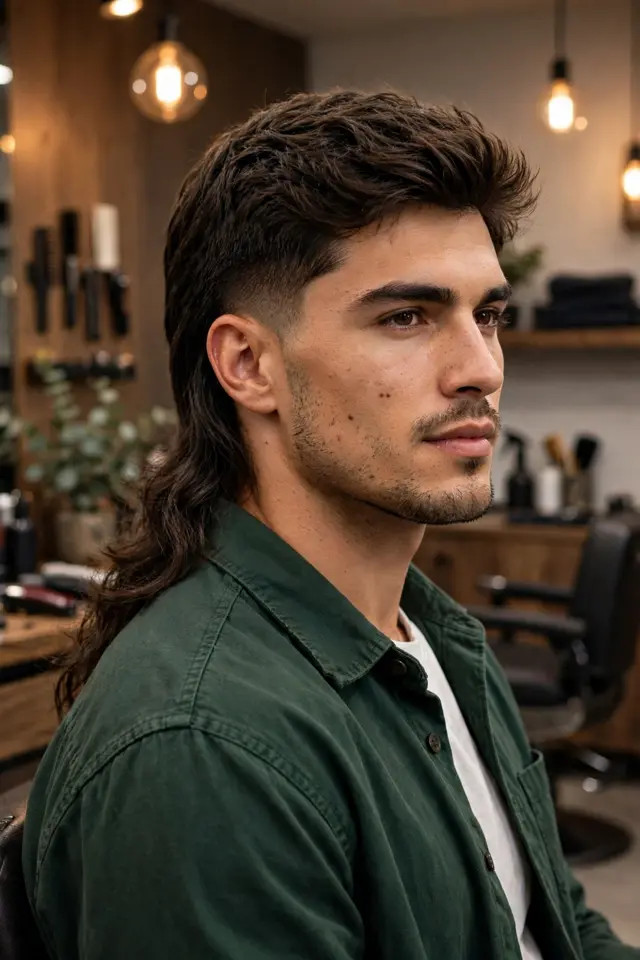
20 Modern Mullet Haircuts for Men: Burst Fades, Tapers & Soft Mullets
The mullet did not come back as a joke — it came back as the most searched haircut in men’s grooming. The modern mullet haircut pulls in over 450,000 searches a month, Pinterest boards are filling with burst fade mullet pins by the thousands (one burst fade pin alone has been saved more than 4,500 times), and barbers from London to Seoul name it among their most-requested cuts of the season. The reason is simple: the modern mullet haircut is not the 80s costume. It is a deliberate silhouette — textured on top, clean at the sides, flowing at the back — rebuilt with tapers, fades and layers that make it wearable in an office on Monday and a gig on Friday.
Winter is its natural season, too. That long back is built-in insulation for your neck, the shape survives under a beanie better than any sculpted style, and the grow-out months the back needs are exactly the months nobody sees your hair at its worst. Below are the 20 modern mullet haircut variations worth your time — from the soft, first-timer mullet to the full winter finale — each with the faces it flatters, the kit it needs, the upkeep it honestly takes and the exact words for your barber. New to the silhouette? Start with the baby mullet and the soft mullet. Growing in from our long hairstyles for men guide, or softening out of the wolf cut hairstyles for men article, you are already halfway here.
One rule before the list: a mullet is a ratio, not an accident. The back must be deliberately longer than the top, the sides deliberately cleaner than the back. Let any one of the three drift and you do not have a mullet — you have a haircut you missed. Now, the 20.
1 of 20 — The Classic Modern Mullet
What is the classic modern mullet haircut, the reference for all the rest?
The blueprint: a textured medium top, clean tapered sides, and a back that flows past the collar to the upper back. This is the modern mullet haircut in its purest form — everything the 80s original promised, executed with modern blending instead of a hard shelf. If you show your barber one photograph from this entire list, show this one: it is the ratio every other variation bends.
Face Shape: Best on oval and square faces; the back lengthens the profile and the texture breaks up strong angles.
Grooming Kit: Sea salt spray, a light matte cream and a wide comb — the classic mullet is styled with fingers, not tools.
Maintenance: Sides and top trimmed every 4–6 weeks while the back grows; dust the back’s ends every 8 weeks to keep them healthy.
Barber Script: “Classic modern mullet — textured top, tapered sides, back long and layered past the collar, blended transitions.”
Q: How long does the back of a modern mullet need to be?
A: Past the collar is the entry point — roughly four to six inches at the back while the top sits at three to four. The ratio matters more than the raw length: the back should read clearly longer from every angle.
Q: Is the modern mullet professional enough for work?
A: The classic version, yes. Tapered sides and a layered — not straggly — back read as a deliberate style, and plenty of men wear exactly this cut in offices. Save the extreme versions for creative workplaces.
The blueprint — texture up top, flow at the back, clean in between.
2 of 20 — The Burst Fade Mullet
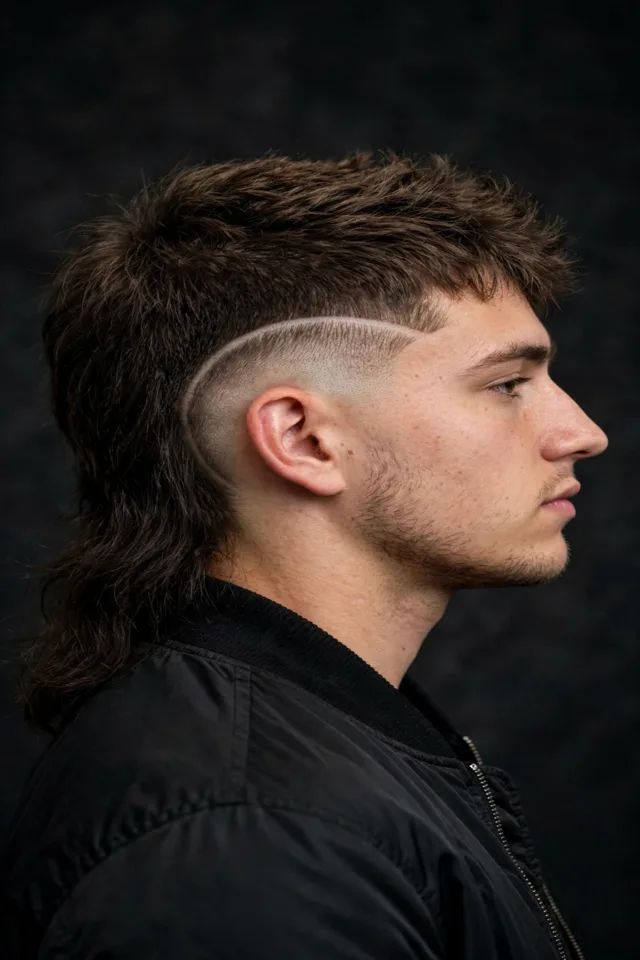
Why is the burst fade mullet the most saved mullet on Pinterest?
Because the fade itself is the artwork. The burst fade mullet curves its fade in a semicircle around the ear — bursting outward like a sunburst — while the top stays textured and the back flows long. On Pinterest this is the mullet: burst fade pins collect saves in the thousands because the shape photographs like a logo. It is the sharpest mullet variant here, and the one that turns heads at barbershop distance.
Face Shape: Best on oval, square and heart faces; the curved fade slims wide cheeks and shows off a strong jaw.
Grooming Kit: A matte paste for the top, plus your barber on a two-week cycle — burst lines blur fast.
Maintenance: The burst fade needs re-cutting every 10–14 days to keep the arc crisp; the back just needs conditioning and dusting.
Barber Script: “Burst fade mullet — burst fade around the ears, textured top, leave the back long and layered.”
Q: What is the difference between a burst fade and a drop fade mullet?
A: The burst fade arcs in a tight semicircle purely around the ear and leaves the neckline hair in place; the drop fade follows the head’s curve down behind the ear toward the neck. The burst is bolder and more graphic.
Q: Does a burst fade mullet suit curly hair?
A: Beautifully — it is one of the most pinned combinations for a reason. The burst carves clean architecture around the ear while the curls keep their volume on top and at the back.
An arc around the ear and a river behind it — Pinterest’s favourite mullet.
3 of 20 — The Soft Mullet
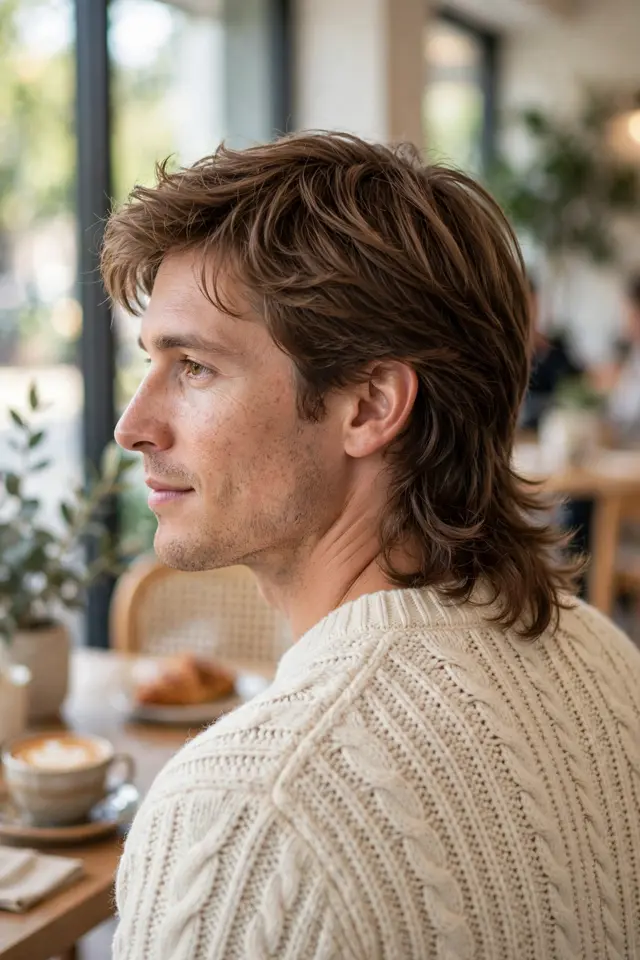
What makes the soft mullet the most wearable modern mullet haircut?
Restraint. The soft mullet trades every harsh line for gentle ones: scissor-cut sides, a soft taper instead of a skin fade, textured layers and a back that flows just past the collar with feathered ends. It is the modern mullet haircut for men who want the silhouette without the statement — it reads as simply great hair until someone sees it from behind. Barbers call it the gateway mullet, and for good reason.
Face Shape: Suits almost every face; the softness flatters mature faces and strong features without fighting them.
Grooming Kit: A light cream and sea salt spray — heavy product destroys the soft finish this cut exists for.
Maintenance: The kindest upkeep here: reshape every 6–8 weeks, and the grow-out between cuts still looks intentional.
Barber Script: “Soft mullet — scissor-cut sides, gentle taper, textured layers, back just past the collar with feathered ends.”
Q: Soft mullet or classic mullet — which first?
A: The soft mullet, if you are even slightly unsure. It is easier to sharpen a soft mullet into a classic later than to soften a bold one — and most first-timers never want to sharpen it.
Q: Does the soft mullet work on straight hair?
A: Yes — the layers and feathered ends give straight hair the movement it needs. Wavy hair wears it effortlessly; very straight hair just needs the layering cut a touch shorter and stronger.
All the silhouette, none of the shout — the gateway mullet.
4 of 20 — The Taper Fade Mullet
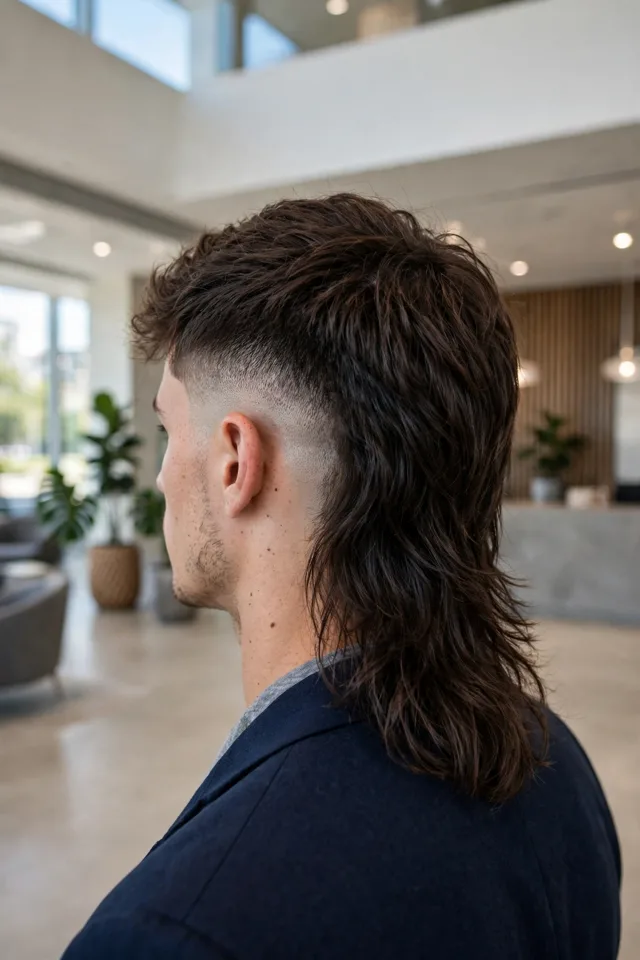
Why is the taper fade the professional’s mullet haircut men choose?
Because it hides in plain sight. The taper fade mullet tightens the sides gradually — a taper on the upper sides that cleans up at the neckline — while the top stays textured and the back flows long. From the front it reads as a clean, conservative cut; the mullet only reveals itself in profile. Among mullet haircut men wear to offices, boardrooms and weddings, this is the number one choice.
Face Shape: Best on oval, square and round faces; the tidy sides slim the silhouette while the back adds profile.
Grooming Kit: A light pomade or cream for the top, and a neckline trimmer for between-visit tidy-ups.
Maintenance: Taper refreshed every 3–4 weeks; the back and top reshape every 6–8. Moderate, predictable, office-safe.
Barber Script: “Taper fade mullet — taper the sides, clean the neckline, textured top, back long and layered.”
Q: Taper fade or burst fade — which is more office-friendly?
A: The taper, by a distance. The burst fade is a graphic statement; the taper fade is a whisper. Choose the taper when your workplace has opinions about hair.
Q: Can a taper fade mullet grow out gracefully?
A: Better than any faded variant. The taper’s gradual lengths soften as they grow, so weeks five and six still look deliberate — one more reason it is the professional’s pick.
Conservative from the front, mullet from the side — the office camouflage.
5 of 20 — The Curly Mullet
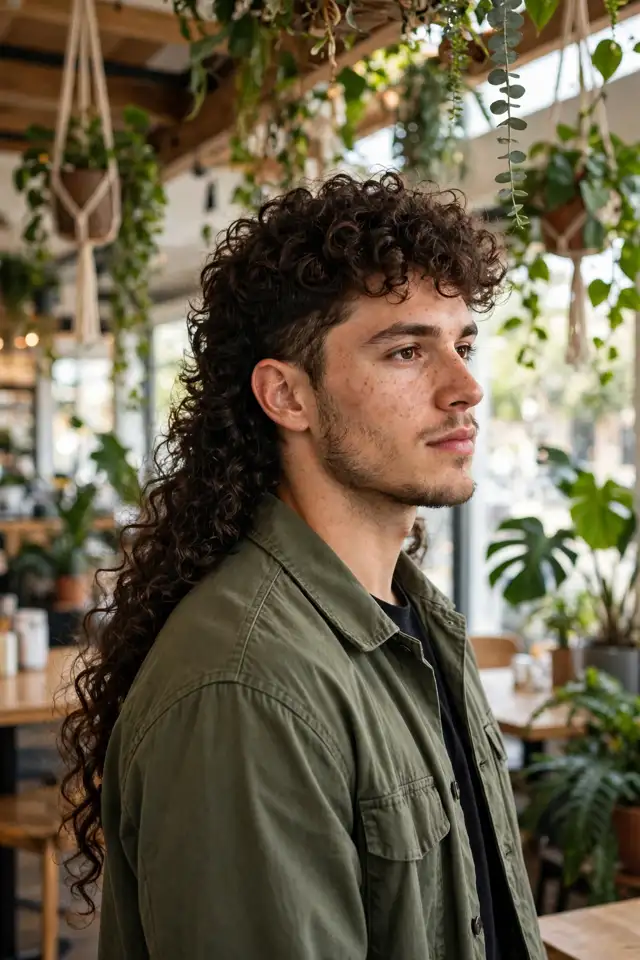
Why is the curly mullet the fullest modern mullet haircut of all?
Because curls give the silhouette free volume. A curly mullet keeps the top full of natural ringlets, tapers the sides to control the width, and lets the back fall in long curls past the collar — the most characterful modern mullet haircut on this list, and one of the most requested in barbershops right now. Our curly hairstyles for men guide covers the shorter curly cuts this one grows from.
Face Shape: Best on oval, heart and long faces; curly volume at the back balances a strong chin and lengthens the profile.
Grooming Kit: Curl cream, leave-in conditioner and a diffuser — the same shelf as every good curly routine.
Maintenance: Dry cuts every 6–8 weeks to shape the curls, refresh with water and cream between washes, never brush it dry.
Barber Script: “Curly mullet — cut it dry, keep the top full, taper the sides, long curly back shaped, not thinned.”
Q: How do I stop a curly mullet turning into a triangle?
A: Layers and the taper. The sides must be tapered or layered close so the width stays at the top and back, never at the ears. One-length curly mullets are where triangles come from.
Q: Should a curly mullet be cut wet or dry?
A: Dry, curl by curl. Curls shrink as they dry, so a wet cut is a guess — and the back length of a mullet is the last place you want a guessing barber.
Curls on top, curls behind — the mullet with the most character.
6 of 20 — The Wavy Mullet
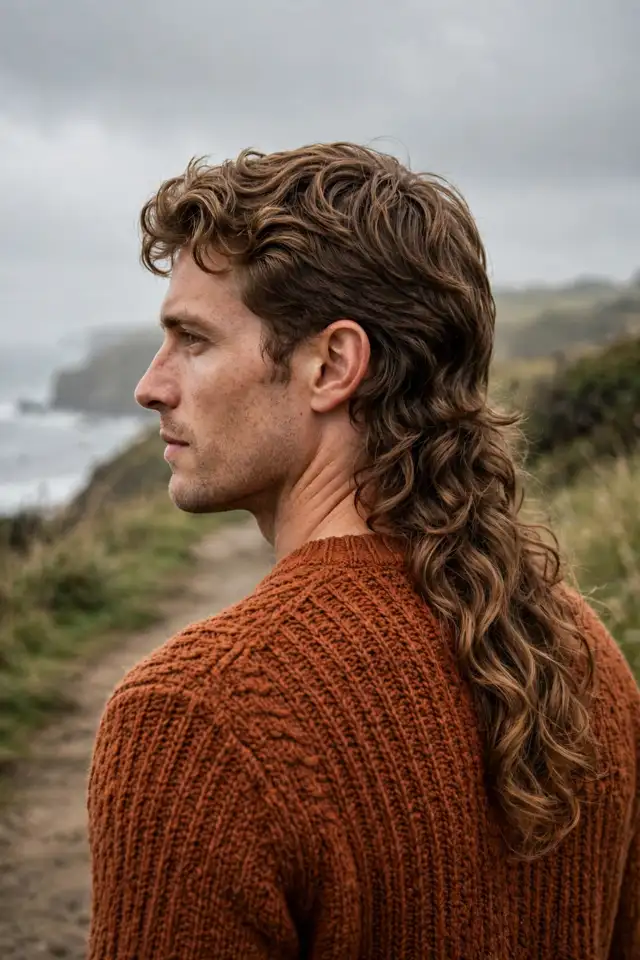
What makes the wavy mullet the easiest modern mullet haircut to live with?
Waves do the styling for you. The wavy mullet runs natural S-waves through a medium top and a long back, with soft tapered sides — the waves supply the texture and movement that straight hair needs product and effort to fake. It is the modern mullet haircut at its most relaxed: salt spray, scrunch, and the winter wind finishes the job on your way out of the door.
Face Shape: Best on oval and square faces; the wave softens strong features and the back adds easy length to the profile.
Grooming Kit: Sea salt spray and a moisturising cream for dry winter days — a two-product cut.
Maintenance: Low: reshape every 6–8 weeks, condition the long back weekly, and let day-two hair be the best hair.
Barber Script: “Wavy mullet — keep the wave, long layers, soft taper sides, back long to the upper back.”
Q: My waves disappear when my hair gets long — will a mullet still work?
A: Yes, if the layers are right. Long layers cut at the right points release the wave pattern instead of weighing it down; a good barber cuts wavy mullets with the wave’s fall in mind.
Q: Wavy mullet or curly mullet — where is the line?
A: The curl pattern itself. Loose S-waves that straighten when pulled are a wavy mullet; coils and ringlets that spring back are a curly mullet. The care differs more than the cut.
The waves style it, the wind finishes it — the relaxed mullet.
7 of 20 — The Baby Mullet
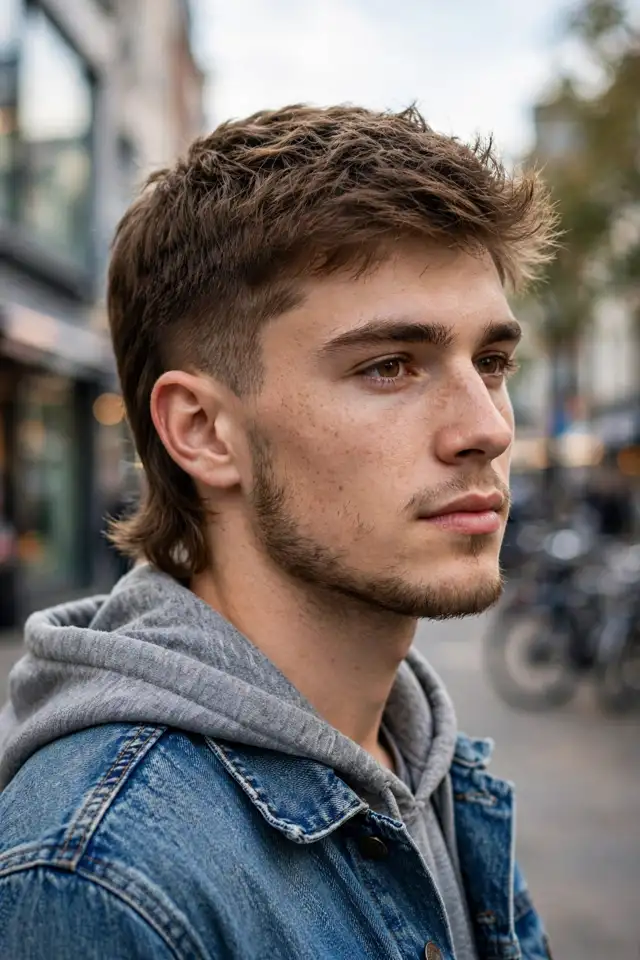
What is the baby mullet, the starter modern mullet haircut?
The mullet with training wheels: a short textured top, short tapered sides and just a short soft tail at the back reaching the collar. The baby mullet lets you test the silhouette at minimum commitment — if you love it, you simply stop trimming the back; if you do not, one ordinary haircut erases it. Barbers recommend it constantly to the mullet-curious, and it is where half the full mullets in this list began.
Face Shape: Suits nearly everyone — the short proportions keep it safe on round, square and long faces alike.
Grooming Kit: A pea of matte paste. That is the whole kit; short hair needs almost nothing.
Maintenance: Trim the top and sides every 3–4 weeks, and decide honestly each visit whether the back keeps growing.
Barber Script: “Baby mullet — short textured top, tapered sides, just a short tail at the back to the collar.”
Q: How long until a baby mullet becomes a real mullet?
A: About three to four months of leaving the back alone while the top and sides stay trimmed. The tail passes the collar, the ratio clicks, and the baby is a mullet.
Q: Is a baby mullet just a bad grow-out?
A: Only if it is accidental. Cut deliberately — clean taper, shaped tail — it reads as a style from day one. The difference between a baby mullet and a missed haircut is the barber’s intent.
Test the silhouette at collar length — one haircut erases it if you hate it.
8 of 20 — The Long Mullet
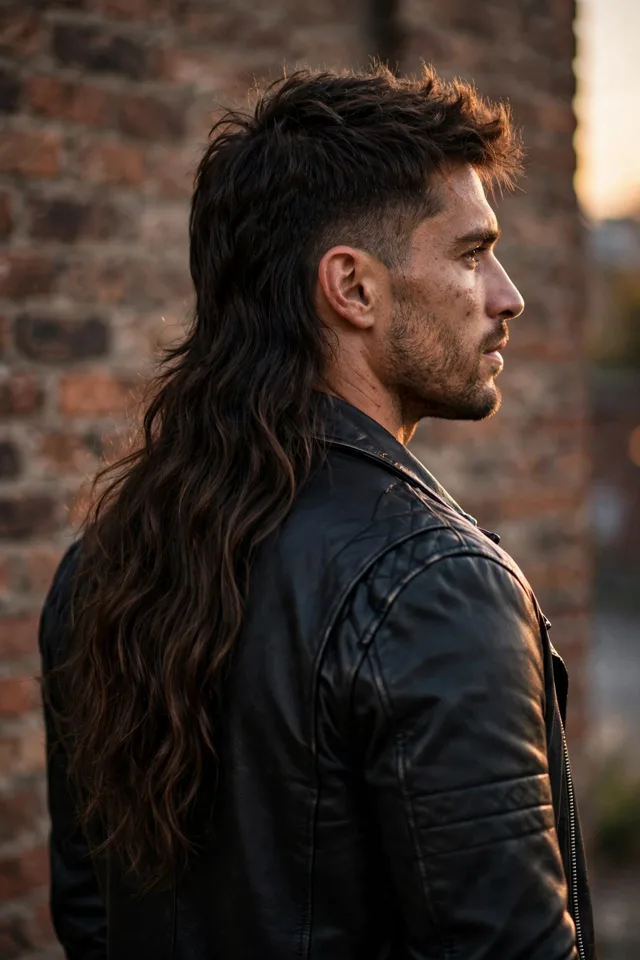
Why is the long mullet the statement end of mullet haircut men wear?
Scale. The long mullet keeps a medium textured top and tapered sides, then lets the back run all the way to the middle of the back — the silhouette at maximum drama. It is the mullet haircut men choose when subtlety has left the conversation: rock photographs, festival fields and winter streets are its natural habitat, and it pairs with the beard from our beard styles for men list like they were designed together.
Face Shape: Best on oval and long faces with the features to carry it; the sheer length can overwhelm small or very round faces.
Grooming Kit: The long-hair shelf: conditioner, leave-in, a wide comb and good ties for tying the back up.
Maintenance: The back needs long-hair care — condition every wash, dust the ends every 8 weeks — while the top and sides trim monthly.
Barber Script: “Long mullet — protect the back length, textured top, tapered sides, layers through the back only.”
Q: How long does a long mullet take to grow?
A: From a classic mullet, six to nine more months of back growth. From short hair, plan on a year to eighteen months — the baby and classic stages along the way are styles in themselves.
Q: Can I tie a long mullet back?
A: Yes — a low ponytail or half-up tie is its second hairstyle, and the taper keeps the sides clean while it is tied. It is the most versatile of the dramatic mullets for exactly this reason.
Maximum back, zero apology — the mullet as a statement.
9 of 20 — The Wolf Mullet
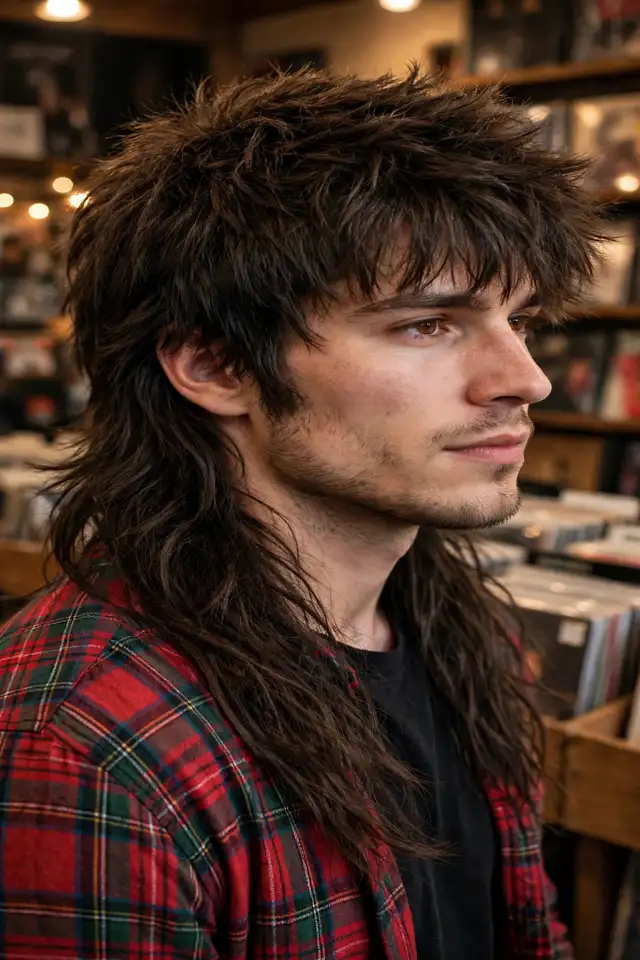
What happens when a wolf cut meets a modern mullet haircut?
The two biggest cuts of the decade merge — and the result is better than either. The wolf mullet takes the wolf cut’s heavy choppy layers, shaggy fringe and top volume, then extends the back into full mullet territory. It is the most layered, textured modern mullet haircut here; if the classic mullet is a silhouette, the wolf mullet is a texture with a silhouette attached. Our wolf cut hairstyles for men article is its parent — this is the child that moved out.
Face Shape: Best on oval, heart and long faces; the fringe shortens tall foreheads and the layers widen narrow faces.
Grooming Kit: Sea salt spray and a matte cream; the wolf mullet is scrunched and finger-styled, never brushed flat.
Maintenance: Layers need reshaping every 6 weeks to keep the chop deliberate; the back dusts every 8.
Barber Script: “Wolf mullet — heavy wolf layers and fringe on top, textured sides, long layered mullet back.”
Q: Wolf cut or wolf mullet — which should I grow?
A: Grow the wolf cut if you want texture with a moderate back; grow the wolf mullet if you want the full silhouette too. Many men start with the wolf cut and simply stop trimming the back.
Q: Does the wolf mullet suit fine hair?
A: It is one of the better mullets for fine hair — the heavy layering manufactures volume that fine hair lacks. Keep the back a touch shorter so the ends do not string.
The decade’s two biggest cuts, merged — texture with a tail.
10 of 20 — The Curtain Mullet
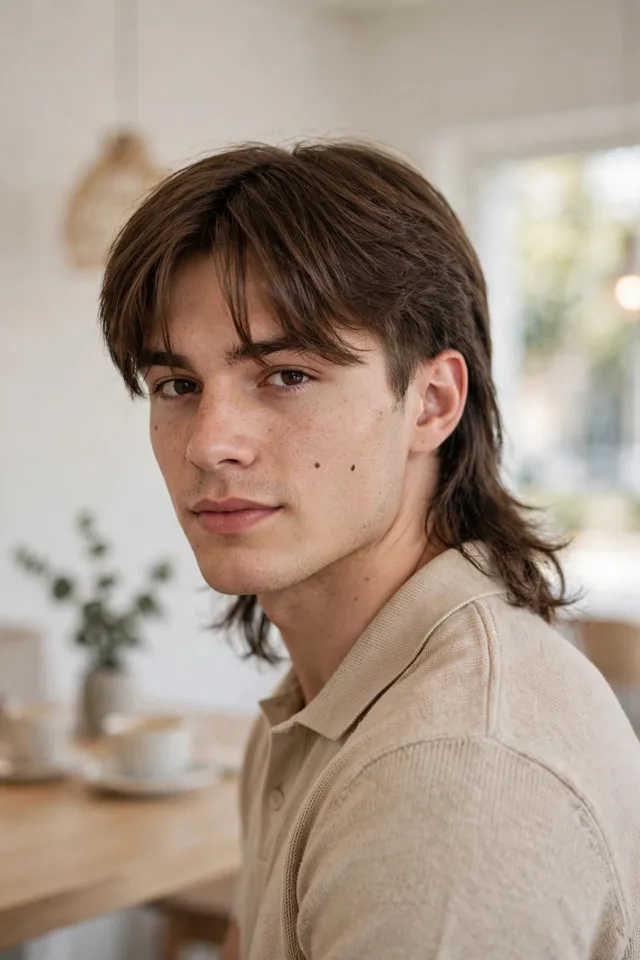
Why is the curtain mullet the softest way into mullet haircut men trends?
Because the front is pure romance and only the back is rebellion. The curtain mullet pairs a clean middle part with face-framing curtain panels — the front half of our curtain hairstyles for men guide — then runs the back long past the collar. From the front it reads K-drama; from behind, pure mullet. For younger men especially, it is the mullet that needs no courage at all.
Face Shape: Best on oval and heart faces; the centre part and panels flatter balanced features and soften square jaws.
Grooming Kit: A tail comb for the part, a light cream, and a dryer to set the curtain sweep on formal days.
Maintenance: The part needs daily training, panels trimmed every 5–6 weeks, the back dusted every 8.
Barber Script: “Curtain mullet — centre part with curtain panels, tapered sides, long layered back.”
Q: My hair will not hold a middle part — can I still wear it?
A: Train it wet after every wash and pin the panels while they dry; most hair learns within a few weeks. A fractionally off-centre part also works and flatters asymmetric faces.
Q: Curtain mullet or curtain haircut — what is the difference?
A: Only the back. Curtain hair keeps the back at ordinary length; the curtain mullet lets it flow. If your curtains are already grown, you are one missed back-trim from this style.
K-drama at the front, mullet at the back — the no-courage mullet.
11 of 20 — The Permed Mullet
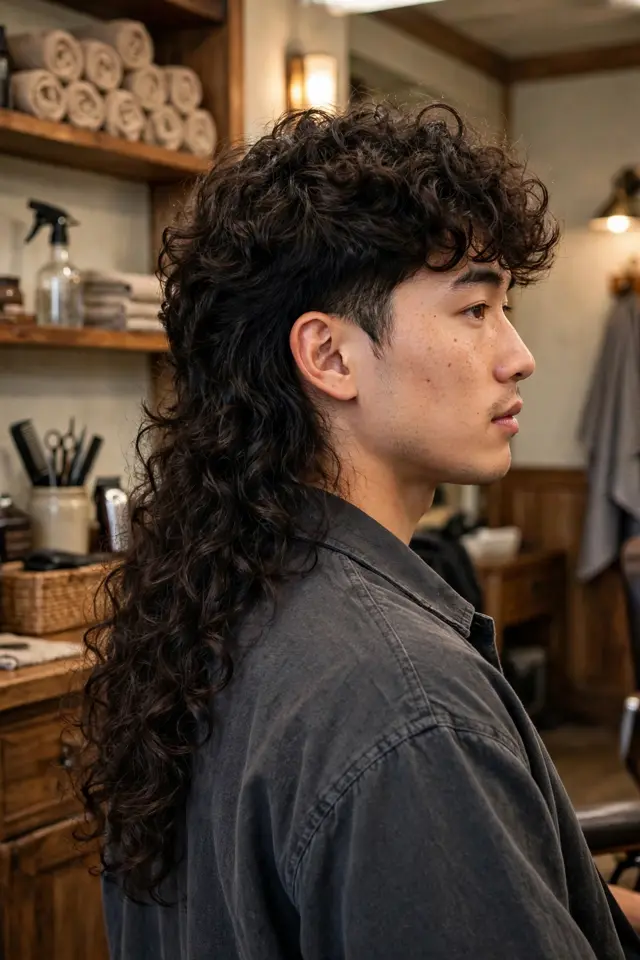
Why are men perming the modern mullet haircut?
Because texture is the whole trend, and a perm manufactures it. The permed mullet adds soft chemical waves or curls through the top and back of naturally straight hair — hugely popular in East Asian barbershops, where the perm-plus-mullet is a standard order. For straight-haired men it is the shortcut to the volume that wavy and curly men get free, and the perm grows out softly over three to five months.
Face Shape: Best on oval and square faces; permed volume widens narrow faces and softens hard angles.
Grooming Kit: A moisturising cream, curl-friendly shampoo, and no heat styling for the first weeks after the perm.
Maintenance: The perm refreshes every 3–5 months; the mullet shape trims every 5–6 weeks as usual.
Barber Script: “Permed mullet — loose perm through the top and back, tapered sides, keep the back long.”
Q: Will a perm damage my hair?
A: A modern loose perm done by a competent barber, on healthy hair, with proper aftercare, is a low-risk service. The damage stories come from tight perms on already-compromised hair — get an honest consult first.
Q: How long does a permed mullet take at the barbershop?
A: The perm itself runs 90 minutes to two hours, plus the cut. Book it as one long appointment, and do not wash the hair for 48 hours afterwards so the curl sets.
Straight hair, borrowed waves — texture on demand.
12 of 20 — The Mullet with a Full Beard
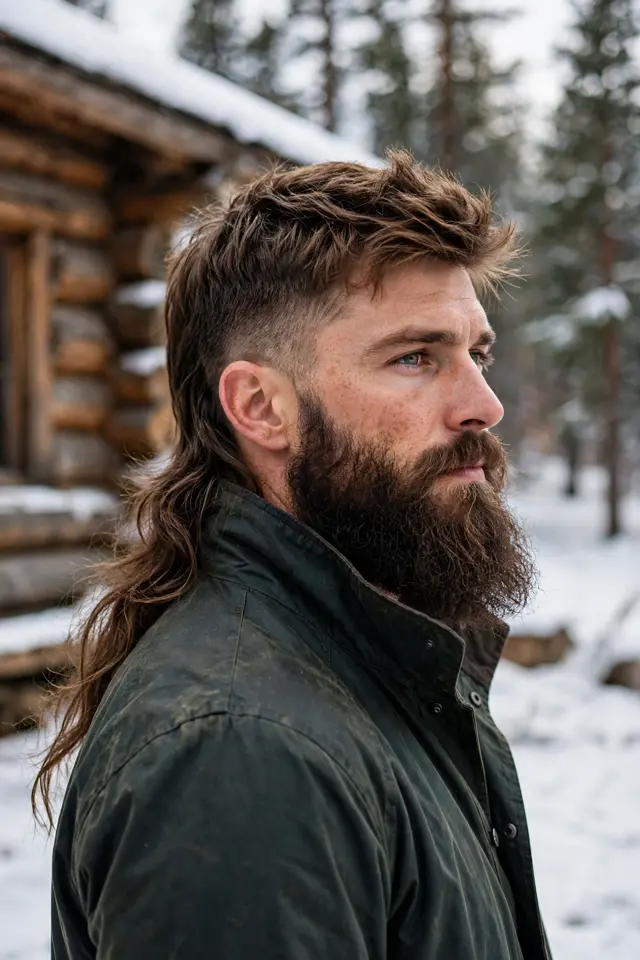
Why is a full beard the natural partner of the mullet haircut men grow?
Balance. A mullet puts the drama at the back of the head; a full beard puts weight at the front of the jaw — together the head reads complete from every angle. It is the rugged winter version of the mullet haircut men wear with waxed jackets and cabin weekends, and the beard’s warmth argument matches the mullet’s built-in scarf. Beard shapes and care live in our beard styles for men guide.
Face Shape: Best on oval and long faces; the beard anchors softer jaws, and the long back lengthens the whole silhouette.
Grooming Kit: Beard oil and a boar brush join the mullet’s salt spray — two routines, one shelf, five minutes.
Maintenance: Line the beard weekly, oil it daily in winter, and keep beard and mullet trims on the same visit rhythm.
Barber Script: “Modern mullet with a full beard — shape both in one sitting so the lengths balance.”
Q: Which grows first — the mullet or the beard?
A: Start them together. The beard establishes in about two months and carries the look while the mullet’s back is in its awkward phase; by winter, both have arrived.
Q: Can a beard make a mullet look too much?
A: Only an unkempt one. A lined, oiled, shaped beard reads deliberate; a wild beard plus a wild mullet reads wilderness. Keep one of the two tidy and the combo always works.
Drama at the back, weight at the jaw — the rugged winter pairing.
13 of 20 — The Drop Fade Mullet
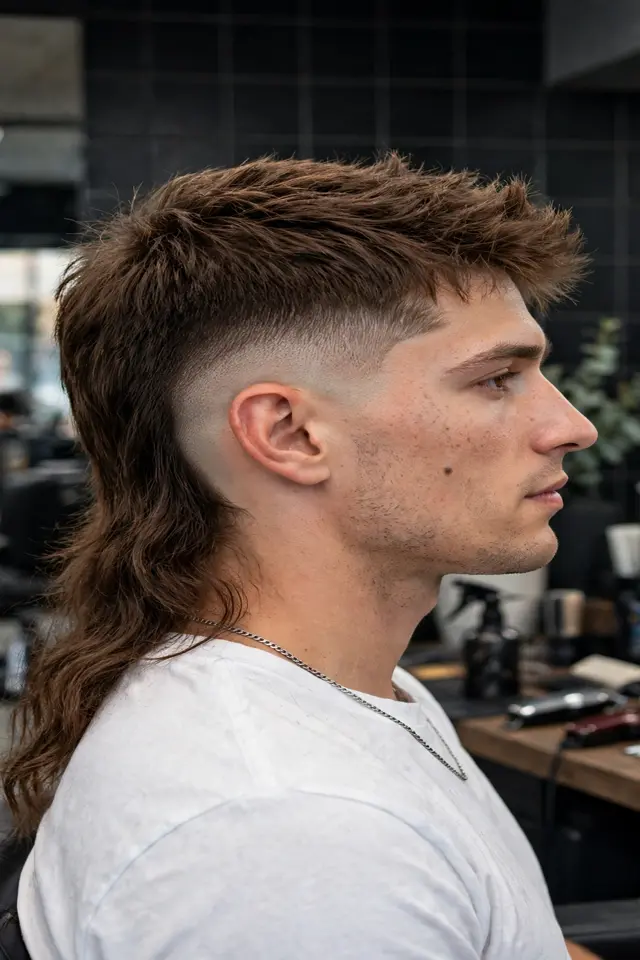
What separates the drop fade mullet from the burst fade mullet?
The line’s journey. The drop fade mullet curves its fade down behind the ear, dropping toward the neckline as it follows the head’s natural arc — a lower, sleeker sweep than the burst fade’s tight semicircle. Paired with a textured top and a long back, it is the smoothest of the faded mullets: less graphic than the burst, more sculpted than the taper.
Face Shape: Best on oval, round and square faces; the dropped line lengthens the side profile and slims the cheeks.
Grooming Kit: Matte paste for the top; the fade itself needs only a barber who understands the drop.
Maintenance: Fades blur — re-cut every 2 weeks to hold the dropped arc; the back trims on the normal 6–8 week rhythm.
Barber Script: “Drop fade mullet — fade dropping behind the ears, textured top, back long and layered.”
Q: Drop fade or burst fade — how do I choose?
A: Look at your head shape and your nerve. The drop fade is sleeker and suits rounder heads; the burst fade is bolder and more graphic. When in doubt, the drop fade grows out kinder.
Q: Does the drop fade mullet work with a beard?
A: Yes — the fade’s drop line flows naturally into a faded beard if your barber blends the two. Ask for the beard fade to meet the hair fade at the sideburn.
The fade that follows your head’s own curve — the sleek faded mullet.
14 of 20 — The Textured Fringe Mullet
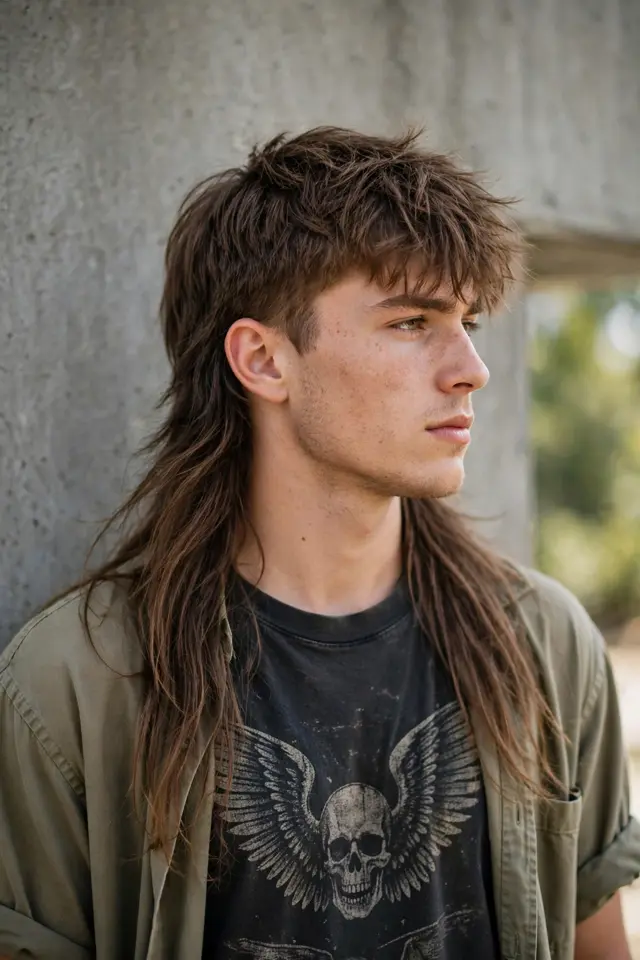
Why does a fringe change the mullet haircut men recognise?
Because it moves the personality to the front. The textured fringe mullet drops a choppy, forward fringe over the forehead — crop DNA from our winter haircuts for men list — while the back flows long behind. The fringe shortens the face, covers tall foreheads, and gives the mullet a younger, more indie energy than any swept-back version.
Face Shape: Best on long, oval and heart faces; the fringe is the single best trick for shortening a tall forehead.
Grooming Kit: Matte clay and fingers — the fringe is pushed forward and piece-separated, never combed neat.
Maintenance: Fringe trims every 3–4 weeks (it grows into your eyes fast), full reshape every 6.
Barber Script: “Fringe mullet — choppy forward fringe, textured sides, long layered back, point-cut everything.”
Q: Fringe mullet or crop — which is actually different?
A: The back, entirely. A crop keeps the back short and tidy; the fringe mullet lets it flow. Same face-framing front, completely different silhouette from behind.
Q: Does a fringe mullet suit a receding hairline?
A: It can help — a forward fringe covers the temples and hairline corners that swept styles expose. Keep the fringe textured and uneven rather than a straight shelf, which draws the eye.
Crop energy in front, mullet behind — the indie mullet.
15 of 20 — The Two-Block Mullet
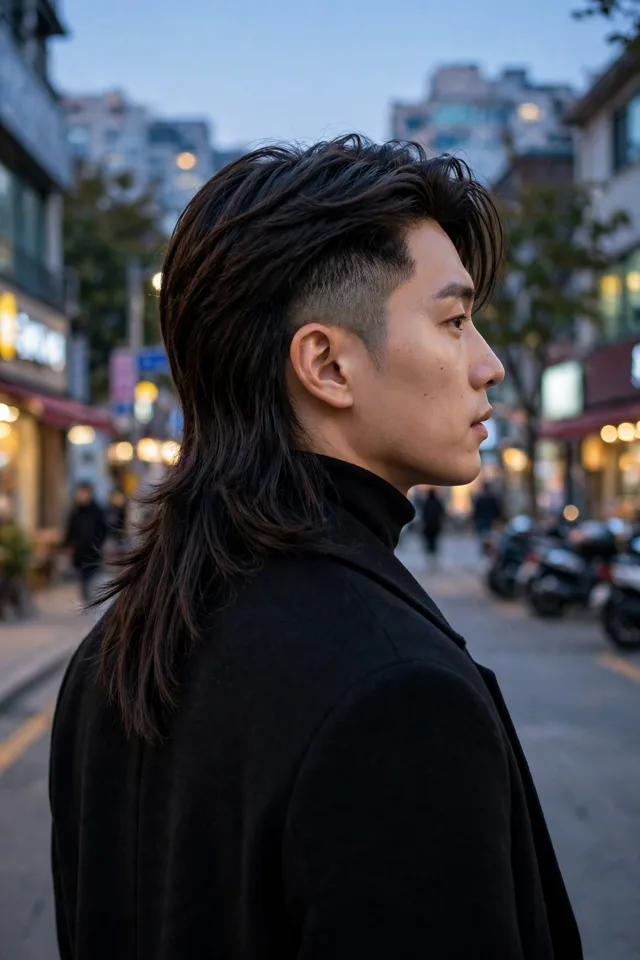
What is the two-block mullet, the K-pop modern mullet haircut?
Seoul’s precision version. The two-block mullet takes the Korean two-block structure — neat short sides, a heavy layered top with a clean disconnection — and extends the back into a long layered tail. It is the sharpest, most deliberate modern mullet haircut here: every line placed, nothing accidental. Our Korean hairstyles for men guide covers the two-block family it descends from.
Face Shape: Best on oval, heart and diamond faces; the heavy top and clean sides frame sharp features beautifully.
Grooming Kit: A light wax for the top’s separation, and a dryer — two-block shapes are set with heat, not hope.
Maintenance: The structure needs a barber every 3–4 weeks; precision cuts announce their own grow-out.
Barber Script: “Two-block mullet — clean two-block sides, heavy layered top, long layered back, keep the disconnection.”
Q: Does the two-block mullet need thick hair?
A: It wears best on medium-to-thick straight or wavy hair — the heavy top is the design. Fine hair can do it with a shorter top and a perm for body, as in the permed mullet above.
Q: Two-block mullet or curtain mullet — which is more K-pop?
A: Both live in Seoul. The two-block is the sharper, idol-stage version; the curtain mullet is the softer, drama-lead version. Choose by how much edge your face and wardrobe want.
Every line placed — the mullet, engineered in Seoul.
16 of 20 — The Choppy Mullet
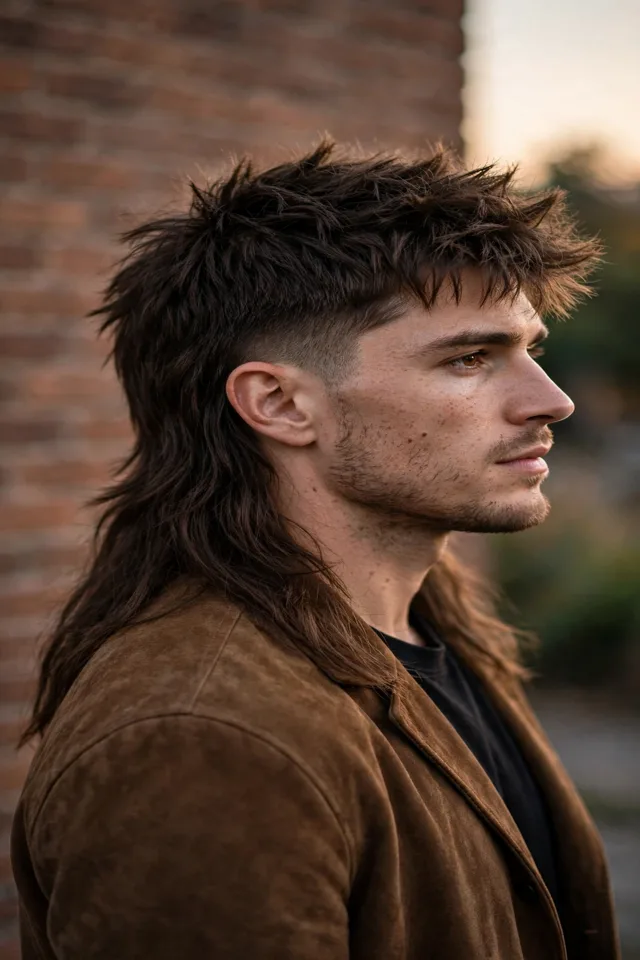
What makes the choppy mullet the roughest modern mullet haircut?
Point-cutting, everywhere. The choppy mullet is carved with aggressive point-cut layers — uneven, piecey, deliberately rough through the top and back — then set against a clean taper fade at the sides so the roughness reads as design rather than neglect. It is the modern mullet haircut for men who find the classic too neat: maximum texture, zero polish, all intent.
Face Shape: Best on oval and square faces; the choppy top breaks up angles and adds width to narrow faces.
Grooming Kit: A gritty matte paste or powder for separation — choppy hair is styled piece by piece.
Maintenance: The chop needs re-cutting every 4–5 weeks; grown-out choppiness turns to shapelessness faster than smooth layers do.
Barber Script: “Choppy mullet — point-cut choppy layers everywhere, taper fade sides, long choppy back.”
Q: Choppy or wolf mullet — what is the real difference?
A: Emphasis. The wolf mullet is about layered volume and the fringe; the choppy mullet is about severed, piecey ends top and back with cleaner sides. Wolf is fuller; choppy is sharper.
Q: Can a choppy mullet look smart for formal events?
A: Smoothed with cream and combed down, it passes — the layers lie flatter than they photograph. It will never be the slickest man in the room, and that is rather the point of it.
Rough on purpose — texture you can see from across the street.
17 of 20 — The Shaggy Mullet
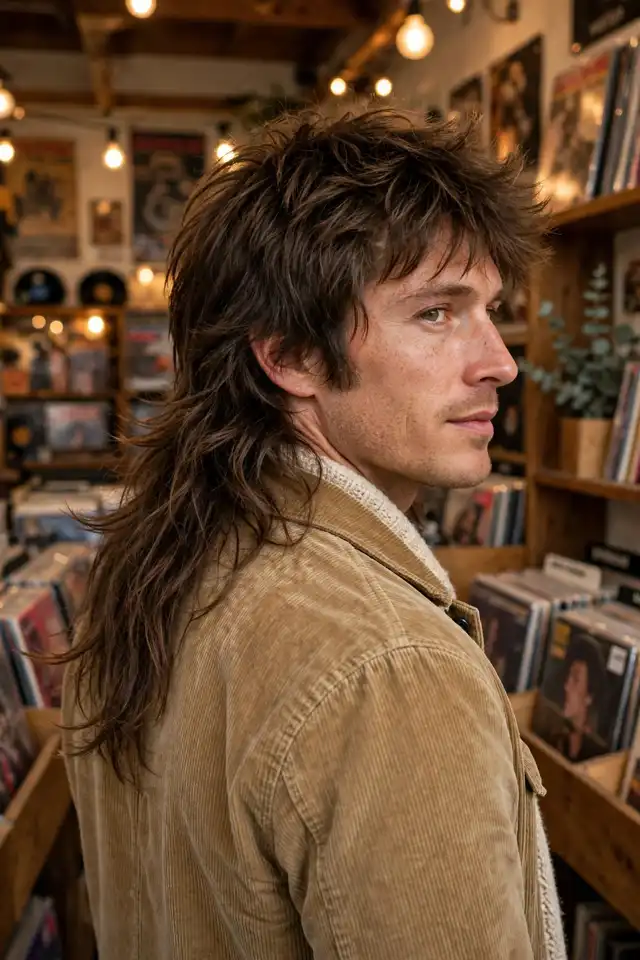
Why is the shaggy mullet the vintage soul of mullet haircut men trends?
Because it keeps what the 70s got right. The shaggy mullet runs a full shaggy layered top with a messy fringe, keeps the sides full and scissor-cut with no fade at all, and lets the back fall in flipped-out layers. It is the least barbered mullet here — deliberately undone, warm under winter hats, and the closest living relative of the rock-photograph originals. Men growing out our long hairstyles for men shags often land here by accident, then stay on purpose.
Face Shape: Best on oval, heart and long faces; the full sides add width that narrow faces welcome.
Grooming Kit: Sea salt spray and a light cream. A shaggy mullet that meets a brush has been betrayed.
Maintenance: Forgiving: reshape every 7–8 weeks, and the in-between weeks are the best-looking ones.
Barber Script: “Shaggy mullet — shag layers all over, messy fringe, no fade, long shaggy back with flipped ends.”
Q: Shaggy mullet or soft mullet — which is softer?
A: The soft mullet — it uses a gentle taper and cleaner ends. The shaggy mullet is fuller, messier and more vintage; soft is the neat cousin, shaggy is the rock one.
Q: Does the shaggy mullet suit thick hair?
A: It is made for it. Thick, wavy hair supplies the body this cut runs on; the layers simply remove the weight that would otherwise turn it into a helmet.
No fade, no polish, all 70s soul — the undone mullet.
18 of 20 — The Grown-Out Mullet
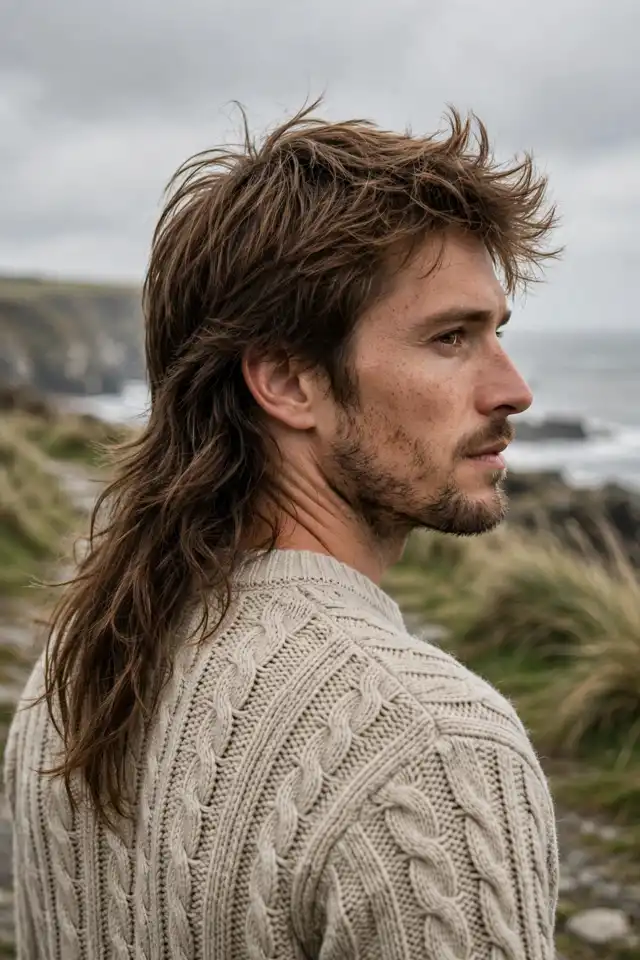
What is the grown-out mullet, the modern mullet haircut at month six?
The same mullet, lived in. Tops lengthen and blend, faded sides grow into soft layers over the ears, and the back reaches its full natural length — the grown-out mullet is what every mullet on this list becomes between barber visits, and styled deliberately it is a destination rather than a decay. It is the lowest-maintenance modern mullet haircut here, and winter’s beanie season is its natural home.
Face Shape: Suits most faces once grown; the softness flatters mature faces and strong features equally.
Grooming Kit: A leave-in conditioner and a light cream — grown-out hair is managed, not styled.
Maintenance: A tidy-up every 8–10 weeks — neckline, ends, nothing structural. The cheapest mullet to own.
Barber Script: “Grown-out mullet — just tidy the neckline and ends, keep every bit of the grown length.”
Q: How do I grow out a mullet without the awkward phase?
A: Grow it in the right order: back first, sides last. Keep the neckline clean throughout — a tidy neckline is what separates a deliberate grow-out from a missed haircut.
Q: When is a mullet officially grown out versus just overgrown?
A: When the ends are healthy and the neckline is clean, it is grown out. Split ends and a fuzzy neck mean overgrown — one tidy-up appointment converts it back.
Month six, styled on purpose — the mullet at its most relaxed.
19 of 20 — The Faux Hawk Mullet
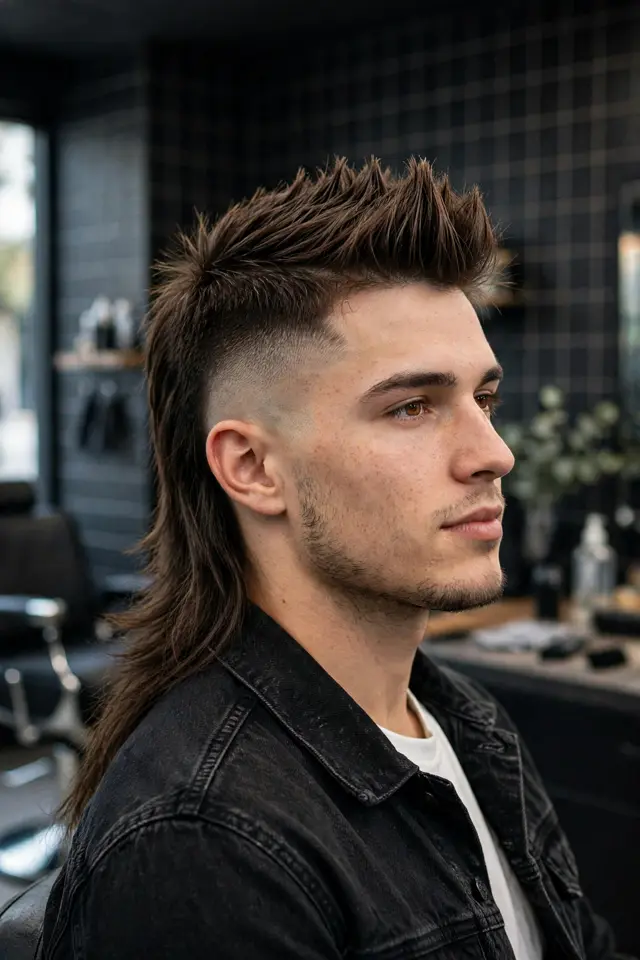
What is the faux hawk mullet, the loudest mullet haircut men ask for?
Two statements in one head: the top styled up into a central faux-hawk ridge, the sides taken down to a skin fade — and then the back flowing long, because of course it does. The faux hawk mullet is the mullet haircut men choose for maximum contrast: aggressive from the front, party from behind, and impossible to mistake for anything else in the barbershop.
Face Shape: Best on oval and round faces; the central height lengthens the face, and the tight sides slim it.
Grooming Kit: Strong-hold matte product and a dryer — a faux hawk is built upward every morning, without exception.
Maintenance: The highest here: the fade re-cuts every 10–14 days, and the ridge is a daily styling commitment.
Barber Script: “Faux hawk mullet — skin fade sides, long textured centre strip styled up, back long.”
Q: Faux hawk mullet or mohawk mullet — what is the difference?
A: The faux hawk keeps a wider, wearable centre strip blended into the fade — no shaved mohawk line. It reads bold in the street and acceptable in most rooms a true mohawk is not.
Q: Can the faux hawk mullet be worn down?
A: Yes — combed forward or to the side, the centre strip becomes an ordinary textured top. That two-in-one nature is exactly why busy men pick it over a true mohawk.
Spikes up front, river behind — the loudest mullet in the shop.
20 of 20 — The Finale: The Winter Mullet King
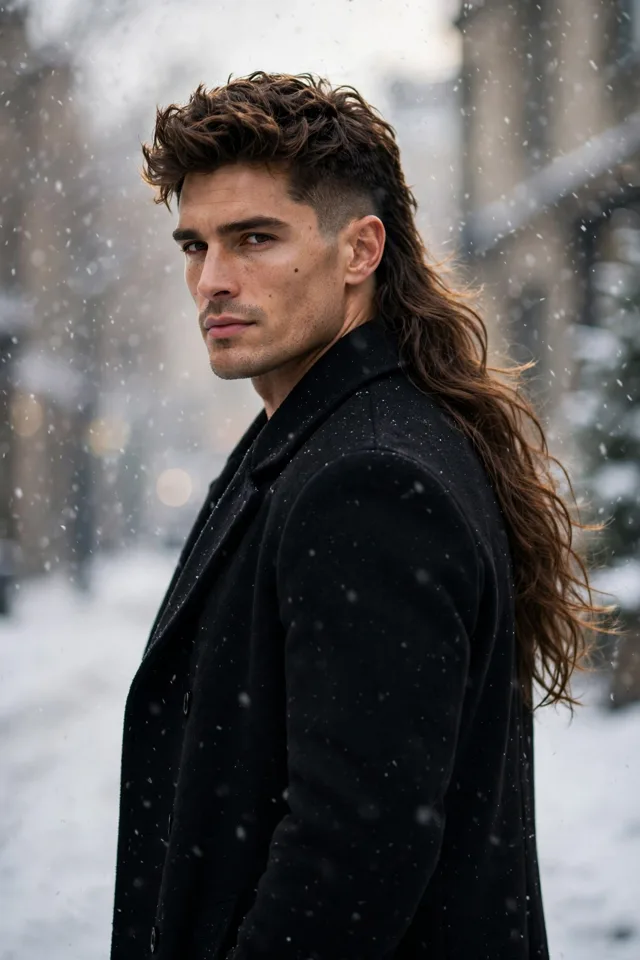
What is the winter mullet king, the finale of the modern mullet haircut?
Everything this list taught, at full size. The winter mullet king runs a full textured top with real presence, clean tapered sides, and a magnificent back flowing well past the shoulders — thick, healthy, deliberate from every angle. It is the modern mullet haircut as winter’s own style: the back is a scarf, the shape shrugs off beanies, and the silhouette owns every room built of coats and cold light. Men do not drift into this one. They decide.
Face Shape: A king’s mullet frames every face by presence; balanced features and strong jaws wear the crown most naturally.
Grooming Kit: The full shelf — salt spray, cream, conditioner, leave-in — a king’s back is conditioned like long hair, because it is.
Maintenance: Monthly shape visits, ends dusted every 8 weeks, conditioning non-negotiable. Royalty is a routine.
Barber Script: “The winter mullet king — full textured top, tapered sides, protect the long back, shape everything.”
Q: How long does the winter mullet king take to grow?
A: From a classic mullet, about six months of protected back growth. From short hair, a year or more — the baby, classic and long mullets on this list are the road, and every stage is wearable.
Q: What separates the king from the long mullet?
A: Finish. The long mullet is length; the king is length with the top built up, the sides perfected and the whole shape maintained like it matters. It is the difference between having a mullet and reigning in one.
Full top, clean sides, a back like a banner — winter’s own mullet.
The Bottom Line
The modern mullet haircut earned its 450,000 monthly searches honestly: no other cut offers this much range inside one silhouette. Start soft or baby if you are testing the water, take the burst or drop fade if you want the graphic version Pinterest cannot stop saving, go wolf, choppy or shaggy for texture, and grow toward the long mullet and the winter king when you are ready to commit. Whatever the variant, hold the ratio sacred — textured top, clean sides, deliberate back — and the mullet will never read as an accident.
Ready to keep growing? The long hairstyles for men guide picks up where the mullet’s back leaves off. Prefer the layers without the tail? The wolf cut hairstyles for men and curtain hairstyles for men lists are your exits, the curly hairstyles for men guide covers the coiled versions, and if you ever cut it all back, the winter haircuts for men list will be waiting. Grow the back. Trust the ratio.